Showing posts with label Indochina. Show all posts

Monday, November 20, 2023

Booneshares offers rare US railroad and South American certificates in December scripophily auction

Mario Boone is a major player in the field of antique share certificates and financial documents. The auctioneer scheduled his 71st scripophily auction on 2 December 2023. This auction will take place live on the internet via the Invaluable platform. On the agenda are more than 1000 lots of bonds and shares.


The auction features stunning shares from all parts of the world. This founders share from the Banque de Cochinchine was issued in 1907 and printed by the well-known security printer Crabbé. The share is signed by Noël Pardon, who previously was acting governor of Cochinchina and New Caledonia, and then governor of Guadeloupe and Martinique. L(ot) 46 starts at €400.


For this occasion, auctioneer Mario Boone has compiled a strong section of US railroad certificates. To give an example: L777, starting at €300, comprises a 1877 bond from The Cheraw and Chester Railroad Company, South Carolina. Only two examples known and coxrail.com reports no sales recorded within the last ten years. 

The US railroad section counts over 200 lots. A few more examples:
  • 5% First Mortgage Gold Bond $1000 from The Canon City and Cripple Creek Electric Railway Company, mountain vignette, 1897, L762
  • L949, The Western Virginia and Kentucky Rail Road and Coal Company, $1000 bond, 1857, several vignettes, amazing scrollwork and very rare
  • L769, The Central Union Depot and Railway Company, $100 shares, 1885, vignette of Cincinnati building and street scene 
  • A rare print from the American Bank Note Company is L876, Nevada Southern Railway Company, First Mortgage 5% 30 Year Gold Bond of $1000, 1893 


The auction catalog includes stock certificates from companies involved in all types of activities. Such as this CELTA share. This cooperative was founded in 1931 to compete with Sudam, a private company providing electricity to the city of Tres Arroyos in Argentina. The still existing cooperative expanded its activities over the years also including telephone, funeral, health and dental services. This share, issued in 1939, presents a bold Art Deco scene conceived by the artist T. Menna. 

Often these old securities have been designed by the artists of the day. The auction catalog lists a special index of the artists and engravers featured in the offerings. The certificate illustrated below depicts a Congolese woman with basket, an elephant tusk, a village, a map of the Basankusu region and the Star of Congo in the underprint. 


The early 20th century share shown here is from the notorious ABIR. The company harvested rubber in the Congo Free State, then private property of King Leopold II of Belgium. ABIR forced the local population to pay taxes and to harvest rubber under inhumane conditions. Those who failed where beated, mutilated, killed or their relatives were kidnapped or raped. This share from 1904 is a testament to Belgium's awful low point in history. 

It was Frans Hens who made the design of the certificate. He was the first Belgian artist to travel in the 1880s through the Congo and paint its nature, villages and people. He became known as a painter of the Belgian coast and the Schelde river. L82 is listed with a start price of €50. 


Another major topic in the sale is South America. The auction includes several single-item lots but also group lots from most South American countries. Collectors have the opportunity to acquire several certificates in these lots at reduced average item prices. However, in case no group bids are received most of these groups will be split into single-item lots during the auction.  

Illustrated above is L1002 a 1909 Banco de Guatemala share. Printed by Waterlow & Sons it shows several vignettes and many guilloches. Very lovely printed is the Resplendent Quetzal - featured in the coat of arms of Guatemala: the country's national bird representing freedom and independence.  L1002 is part of the Guatemala group lot, L992.


There is lots more to discover in the auction. Here are the auction details :

F.L.


PS : Did you like this post ? Thank you for sharing it on you favorite social media channel !

Saturday, April 29, 2023

Auctioneer Boone celebrates 40th anniversary in Antwerp: oldest stock exchange building houses international scripophily auction and bourse

Mario Boone's 70th scripophily event spans 4 days! On Saturday May 6, a live auction with nearly 800 lots of historic and splendid antique shares and bonds takes place at the "Handelsbeurs" in Antwerp, the oldest stock exchange building in the world.

An international scripophily bourse with free entrance for any visitor is organized at the same location on Sunday May 7. A great opportunity to see antique securities in the center of Antwerp.

On Monday 8 and Tuesday 9 May, roughly 1500 more interesting lots will be sold through the Invaluable platform (live internet auctioning) or via the usual absentee bidding options.


This 1884 share in the Fabrica de Faianças das Caldas da Rainha, a porcelain factory from Portugal, is superbly designed and printed. Against a background of tiles the drawing combines a still life with more than 10 animals. Can you find them? L(ot) 463 starts at €1000. 


Saturday morning kicks off with a section of some 200 lots from Belgium Congo, Ruanda-Urundi and Belgium, including a 1899 Banque Coloniale de Belgique share certificate showing African scenes, L(ot) 6, and L34, a brewery share in the Brasserie de Stanleyville from 1949, both starting at €50. 

Noteworthy in the Belgian chapter are:  L82, Exposition Internationale Coloniale et d'Art Flamand Anvers 1930, a share subscription for the colonial exhibition in 1930, start price €50, and L84, a $500 gold bond from the City of Antwerp. Not to be missed is L97, Compagnie Internationale des Telephones, the oldest Belgian telephone share, 1881, with a large underprint of an early telephone. 


The Société de Zoologie in Antwerp, one of the oldest zoos in Europe, was founded in 1843. Its shareholders could enter the zoo for free on showing their share, hence the folds. Printed in 1843 by Joseph-Ernest Buschmann and designed by his brother and painter Gustave Buschmann. L299, €300 


More Belgian's, and this applies to other countries too, can be found in a mammoth World Highlights section, lot range 193-775. Some examples :
  • The Société Anonyme d'Horticulture et de Botanique de Gand was founded by botanists who started holding botanic exhibitions known as "Gentse Floraliën". Its share from 1835, decorated with flowers, is extremely rare, L294.
  • A top object in any art collection is the 1897 share from the Compagnie Fermière des Eaux Minerales de Genval. It is designed by Art Nouveau architect, painter and designer Paul Cauchie, known for his sgraffito technique. Only three certificates were found in the 1990s, and this is the last one available. L310 starts at €10,000 and can be seen in detail on the auctioneer's brand new website here.
  • The world famous Lotus Bakeries is listed on Euronext Brussels and run by Jan Boone, the grandson of founder Jan Boone sr. This specimen founder share of the Banket- en Peperkoekbakkerij "LOTUS" voorheen "Boone Gebroeders" dates from 1934 and is the only one known to the auctioneer, L318.


Then part of of the French colonies, the Mekong delta with its shallow waters was the perfect place to use "de Lambert hydroglisseurs", aka airboats. This 1920 share from the Société Anonyme des Hydroglisseurs "de Lambert", L228, starts at €200. 


In the Australasia, Asia and Africa sections I spotted these items:
  • Bank of Australia, Sydney, 1833, early share printed on vellum, L193
  • L205 is a nominative share from the Société Provinciale Privilégiee du Fokien - Hoa-Hu, China, 1902, company set up by diplomat Paul Claudel, Chinese landscape.
  • Opium shares are rarely seen. L226 is a nominative share from the Société Fermière de l'Opium au Tonkin, issued in Hanoi, 1887.
Lot range 271 through 279 comes from a diamond collection and includes scarce items such as a 1889 share from The Borneo Diamond Exploration Syndicate. 


This 100 soles share in the Compañia Explotadora de Perlas de Sechura, Lima, 1902, is part of a collection of 214 bonds and shares from Peru, L676. 


The European chapter is the largest one with over 300 lots, L280-L595. This blog format doesn't lend itself for enumerating all lots. Here are some of many astonishing historic securities:
  • L375 and L376 are two Eiffel companies: Société de Constructions de Levallois-Perret and the Société de la Tour Eiffel both showing the Eiffel tower.
  • Christiana Bye og dens Oplands Korn-Selskab, freely translated as Christiania Town and its Upland Grain Company: extremely early Norwegian share, dated 1810, from the time when Denmark ruled Christiania, today Oslo, L451
  • A Swiss watch collection, L563 through L574, includes names like LeCoultre, Tissot and Longines.


L338, Compagnie Générale Maritime, 1856, signed by politician and financier Emile Pereire, gorgious design by painter and engraver Melchior Péronard, €3000 


Over 50 lots of securities and related documents are featured in the 16th-18th century section, including:
  • A 1679! bond from the city of Enghien, Haunaut province, in need for financial resources under French occupation, 4 wax seals, L596
  • On Aug 27, 1701, Philip V, King of Spain and Louis XIV signed a treaty granting France the exclusive privilege to supply the Spanish colonies in the Americas with African slaves. This right was called the "Asiento". Issued in 1703 for 3000 Livres this share in the Compagnie Royale de l'Assiente, is an important evidence of imperialistic slave-trading practises in the 18th century and extremely rare, L607.


Rio de Janeiro Tramway Light and Power Company Limited, 1 share, text in English, French and German, 1909, facsimile signature of electrical engineer and entrepreneur Frederik Stark Pearson, L664, €200


The Latin America chapter, lots 657 through 677, include several remarkable collection lots. Each of these will be offered as a single group, and only when no bids are made, each collection will split and offered into single item lots in the online sessions on the following Monday & Tuesday:
  • L658 collection of Brasilian government bonds
  • L659 collection of Brasilian state bonds
  • L660 collection of Brasilian railroad certificates
  • L661 collection of Brasilian port/shipping certificates
  • L662 collection of Brasilian Industrial securities
  • L670 collection of Mexican scripophily
  • L676 collection of bonds and shares from Peru 
More Latin Americ scripophily, as is the case for other themes, will be auctioned on the two online sessions on 8 & 9 May 2023.


L682, New Jersey Southern Rail Road Company, $1000 bond, 1873 signed by railway tycoon Jay Gould, extremely rare, €12000


The American section of the Saturday highlights is divided in three chapters : Jay Gould , railroads, and various themes. To name a few:
  • The 50 cents bond, 1841, from the Ocmulgee and Flint River Rail Road Company is not only small in size and value, but rare as well. L689
  • L763 is stock certificate from The Kansas City Distilling Company, a whisky maker, view of the distillery, 1889
  • The World's Columbian Exposition was held in Chicago in 1893. It's share shows a lovely vignette of an allegorical woman and an underprint of the exposition site. L765
A tip for American railway collectors, you should check out Coxrail on this auction, see here


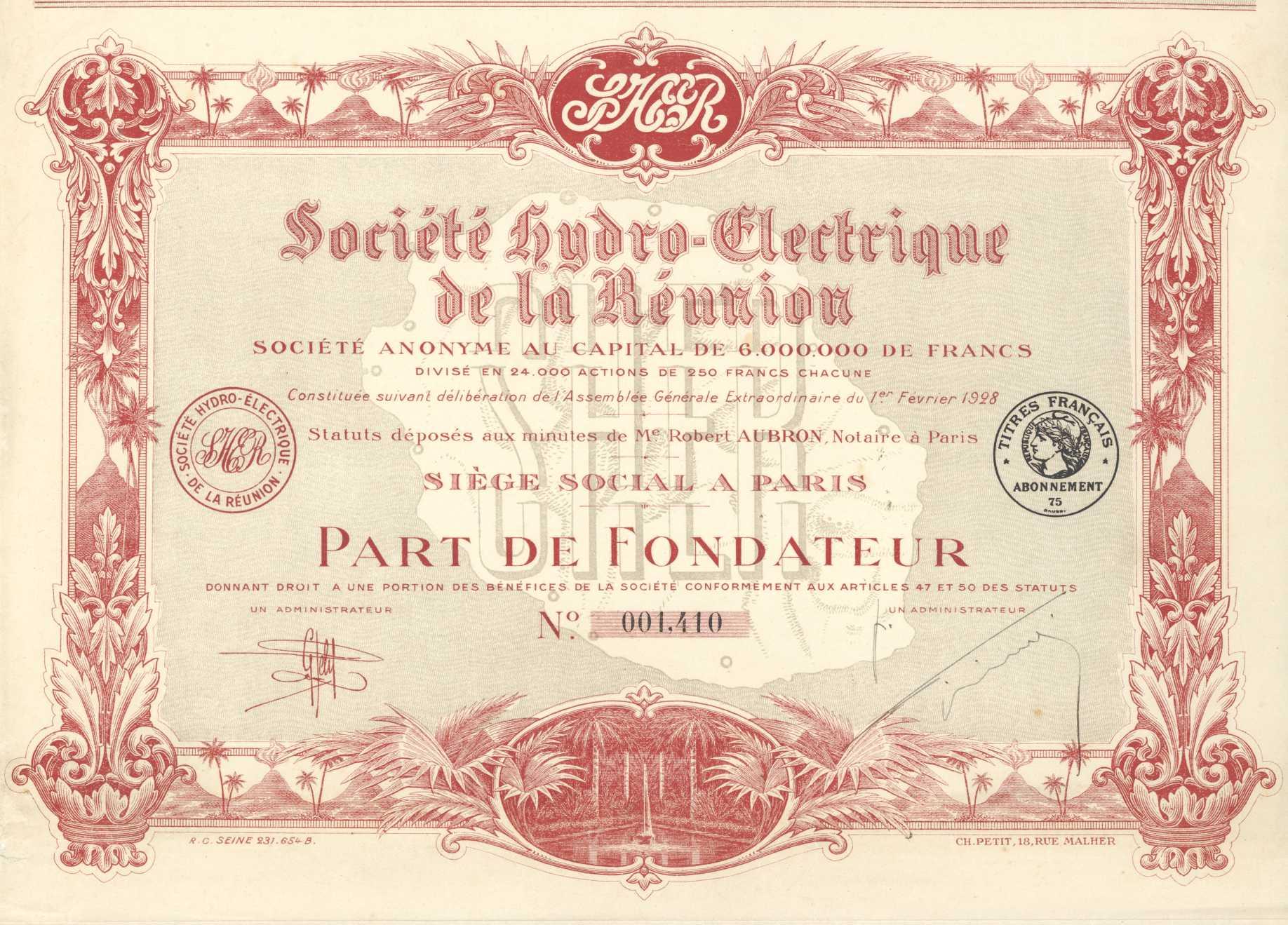
Société Hydro-Electrique de la Réunion, founder's share, 1928, map of Réunion in underprint and border with a pattern of volcanos, likely the Piton de la Fournaise, L927, €50 


The online sessions of this event are scheduled the days after the bourse on Sunday. These offer another 1500 lots of scripophily (or a bit less when the Latin American collections are hammered on the preceding Saturday - see above). Use the catalog's indexes or the search functions on the auctioneer's new website to find what you need.

The weekend of 6 & 7 May is a chance to see some great antique securities. The venue is the Handelsbeurs Antwerpen. 

Here are the auction details :
F.L.


PS : Did you like this post ? Thank you for sharing it on you favorite social media channel !


Wednesday, September 19, 2018

Saved at the last minute

Do you think that shares certificates have a life of their own ?  Yes, I think so. Shares are born, find a companion and even get a career. And they retire, and some of them face a horrible end.

Share certificates are born in a split second the moment they are printed. Some of them can be quite large, others are small. Many shares look rather plain, and believe me, there are some real uglies out there. But there also a lot of beauties you can't keep your eyes off. Pretty soon they get their serial number and the signatures of the company officers they represent.


share in the Tôt-Lam tea company from Indochina, dated 1912

A real knockout, this Tôt-Lam tea share from 1912 sold for €800 in Mario Boone's Apr 2018 auction. 
courtesy Mario Boone 


Already from birth, share certificates speak their mother tongue. Some can speak two languages, and a few of them are real polyglots. In fact, they need to talk, some can be really mouthy, in order to attract a companion, a human companion. People are fond of shares, because of their looks and their gossip, and especially because shares support the ambitions of people. You can find out more about that in this short introduction later.


Share from the Société Financière d'Égypte with text in four languages

This share from the Société Financière d'Égypte was issued in 1863. The construction of the Suez Canal, which was still in progress, made Egypt, then part of the Ottoman Empire, commercially and strategically important to foreign powers. The share is a true "polyglot" and speaks French, English, Arabic and Italian. 


A share starts its career as soon as it is issued. Then it has been purchased by its companion, the owner of the share. The latter's name is often written on the front. The share keeps talking on and on. 
"Please keep me, I'm still in a top shape"
"Hey, can't you give me a nice coupon cut ?"
"Sorry, I'm not feeling well this quarter"
"Did you see that? That bully stamped me on the forehead !"
The certificate is whining all the time, but as lang as things go well, share and owner stay together.

Some share certificates are born under a lucky star. They are issued to or signed by a pioneering entrepreneur, a Nobel Prize winner, a President of a nation, or even a rockstar. In that case, these shares can see the world, experience adventures or witness important events. Of course, they brag about it. Can you imagine the jealousy that is between them ?


Scindia Steam Navigation share certificate with signature of Sumati Moraree

Sumati S. Morarjee signed this share in the Scindia Steam Navigation Company (SSNC). Sumati Morarjee was married to Shanti Kumar, son of Narottam Morarjee, the founder of the SSNC. A close friend of Mahatma Gandhi, she took care of Gandhi at her home while he was recovering from appendicitis (1924) and after his release from prison in Poona (1944). Sumati became in full charge of the SSNC by 1946. She was the first female ship magnate and the first woman in the world to head an organisation of ship owners - the Indian National Steamship Owners Association. 


During their career shares incur creases, tear and receive ink stamps. They can look weary, but all that is an illusion. These physical characteristics point to hardened veterans that have been on a mission all the time. Make no mistake. The ink stamps received are service ribbons awarded for heroic action in stressful financial operations such as capital increases, currency conversions and par value reductions.

When share certificates retire they are appointed Commander in the Order of the Grand Cancellation and proudly wear the ultimate medal : a String of Cancellation Holes, a Cancelling Pen Stroke, a Cancellation Stamp or any of those combinations.


share in the London and North Eastern Railway Company (LNER)

The London and North Eastern Railway Company (LNER) was one of the "Big Four" in the Interwar Period. The company also operated several ships. Many of these were lost in World War II. The SS Archangel was bomded and sunk off the East coast of Scotland (1941). The SS Malines was torpedoed off Port Said (1942), and the SS Amsterdam struck a mine off Normandy, France (1944). This LNER share started its career in 1927 and wears now with great satisfaction its medal, the String of Cancellation Holes.


And they lived happily ever after! Well, only a few do. The other day I saw this McLeod and Company share. McLeod built and owned several railways in and around Calcutta. 


ordinary shares certificate from McLeod and Company, Limited

McLeod's railways, managed by McLeod Light Railways, were organized as separate companies, e.g. Kalighat Falta Railway, Ahmedpur-Katwa Light Railway, Burdwan-Katwa Light Railway and Bankura Damodar Railway. McLeod also operated textile mills in India. 


Born with serial number 3829, the McLeod share started its career in 1948. McLeod-3829 was decorated with tax stamps and pen stroke cancellations. All of a sudden I felt disturbed because of a conspicuous ink stamp that was put upside down on the document. I turned the paper for a better look.


ink stamp with text  Surrendered for dematerialisation


My goodness ! SURRENDERED FOR DEMATERIALISATION. Just like banknotes, at the end of their life cycle, share certificates are shredded and sent to the incinerator. I knew that, but still, I was shocked. 

Then I saw the smile on McLeod-3829 that told me that a kind person had saved it from the worst. Phew. I winked at it, "You are safe with me now", and I gave the poor share a big hug. Oops !  


F.L.


NB: Thank you for signing the Guest book

Sunday, April 8, 2018

Antwerp puts treasures from Egypt on the block

The 60th auction of Mario Boone takes place on 14 April with an exceptional large range of high quality collectibles from all over the world. The sale offers about 8,900 antique stocks and bonds spread over 1,939 various sized lots. The items to be sold represent nearly 100 countries and span 800 years of financial history (13th -21th century). 


Before getting into more details on the numerous rarities and remarkable certificates, I have to talk first about the unprecedented, top-notch scripophily from Egypt that is at stake in this auction. Boone's sale includes 1,171 bond and shares certificate from Egyptian companies and governments. Collectors and investors interested in such an unparalleled variety of Egyptian scripophily have several auction sections to look into.

Chemin de Fer Keneh-Assouan 3.5% bond of £20 Cairo, 1925 part of the "Pharaonic Collection" lot 1877


Chemin de Fer Keneh-Assouan 
3.5% bond of £20, Cairo, 1925 
part of the "Pharaonic Collection" lot 1877
click image to enlarge

The regular Egypt section, lots 248 through 261, contains a Canal Maritime de Suez, starting at a modest €200, and a Ciments d'Egypte Massarah (Caire) share, €500, equally rare and stunning. 

Another series of Egyptian rarities can be found in the Simar Empain collection which also comes under the hammer. For many decades the late Jacques Simar built up a scripophily collection related to Baron Edouard Empain. Simar published a book on the subject, see here. Edouard Empain, Belgian captain of industry, is known for building the Paris Métro and the district of Heliopolis in Cairo. You can find the Empain Egypt items in lot range 549-576 which includes several sought-after certificates like specimen bonds from the Tramways du Caire, from €200, and the Heliopolis Palace Hotel du Caire, starting at €100.

The sale of Egyptian scripophily peaks with the most complete collection ever brought together. The "Pharaonic" collection includes 1,096 bonds and shares representing Egypt's financial history from the 19th and 20th century. Included are numerous interesting, decorative and historic securities, to name a few : Soufrière d'Égypte, Egyptian Guaranteed 3% Loan, Canal Maritime de Suez, City of Alexandria, Bank of Abyssinia, Banque Egyptienne de Commerce, Marconi Radio Telegraph Co of Egypt, Kodak (Egypt), Investment Bank of Egypt, Nationalization-Loan of the United Arabic Republic and many more. The collection is offered as one lot (1877) and may be acquired from €79,000.


Another, much smaller collection, to be sold in a single lot consists of 134 classic Egyptian certificates. Bids for this lot (1892) are invited from €1,400.

Apart from all those pyramids, sphinxes, scarabs, cobras and hieroglyphs, the sale offers more than 7,500 bonds and shares from other countries as well. And as is the case with Egypt, countries are presented either by their own regular section, as a part of the Simar Empain collection, or may be found as a collection or group lot. Let me discuss some of the highlights.

Banque Hypothécaire Franco-Egyptienne, 1910, share certifcate


Banque Hypothécaire Franco-Egyptienne 
F500 shares, Paris, 1910 
 part of the "Pharaonic Collection" lot 1877

As you can expect from a Boone auction, the Belgian section is substantial (lot range 328-456) and opens with a medieval loan on vellum from 1469. Written in Latin, the document, lot 328, is one of the oldest financial documents related to the region of Kortrijk and is expected to fetch at least €2,000. A rare and decorative highlight will certainly interest collectors of zoo scripophily. The share in Société d'Histoire Naturelle à Gand, dated 1852, illustrated with vignettes of a lion, tiger, ostrich, peacocks, crocodiles and many more animals, can be obtained from €2,000.

More remarkable Belgium scripophily can be found in the Empain collection, lot range 457-511. Here, Banque Industrielle Belge (Ancienne Banque E.-L.-J. Empain) is historical to Belgium's financial history. The bank was Edouard Empain's major investment vehicle. The number 1 certificate offered in the sale, represents 76% of all shares, is issued to Empain and starts at €500.


In the Austro-Hungarian Empire section, an extremely rare Thiergarten-Gesellschaft in Wien from 1862 can be fetched from €800. The Grandhotel Pupp, a location for movies Last Holiday (Queen Latifah) and Casino Royale (James Bond Daniel Craig), can be acquired from €50. Hey, movie locations, wouldn't that be an interesting theme to collect.

Denmark scripophily is not often seen. The sale includes 11 certificates (lots 692-702) including a Kjobenhavns Sommer-Tivoli share from 1918. The Tivoli amusement park opened its doors in 1843. Start price €500.

Thé Tôt-Lam, F100 share, 1912, Indochina lot 134 in the auction, start price €600

Thé Tôt-Lam 
F100 share, 1912, Indochina
lot 134 in the auction, start price €600

The Compagnie Royale de l'Assiente, one of the earliest French companies, was active in slave trading. Only one other share is known, bids are welcome from €10,000 (lot 709) for its 3000 Livres share, issued 1704. France has left us so many decorative bond and share certificates and this occasion is not an exception to that. Great work of art can be admired on a share from the L'Union des Mines, start price €60. Further, you should check out how Bacchus is having the time of his life on Cave des Affaires, €200.

Probably the most fascinating, lot 1433, is a Spanish financial loan document from the year 1279! Latin script on parchment, this notary act of a bank deposit of 500 solds to a Catalonian banker is the earliest known privately owned banking document.  €15,000 start price.


Viet Nam Ngan Hang - Banque du Vietnam
first bank in Vietnam founded and managed by Vietnamese 
share of 15.000$, Saigon, 1973
lot 177 in the auction, start price €1,400

Some highlights from the big scripophily countries China, Russia, USA and Germany :

  • A $1000 Republic of China 6% Secured Gold Loan Treasure Note from 1919, with pagoda vignette, should have been redeemed by a 1937 bond issue. A rarity like this starts at €1,000.  
  • The Bukharan People's Soviet Republic was a short-lived city state from 1920 to 1925 located in today's Uzbekistan. The sale includes a rare, Bukharan bond from 1923 and can be obtained from  €200.
  • In the US section, you can't miss a Proprietors of the New Theatre share. Issued 1791, with a huge vignette of the Philadelphia theatre to be constructed, this is the oldest theatre scripophily seen yet. Bids are invited from €5,000. You can find out more about the American railway section here on the Coxrail blog.
  • The German section starts with two bonds, dated 1808, from Napoleon's Kingdom of Westphalia. Bids can start at €400 and €300.


There is lots more to discover from other countries and all kinds of collecting themes in this sale. Dig through the auction catalogue, 263 pages, and/or use the indexes on countries, themes, Belgian provinces, autographs, artists & engravers and printer companies to find your treasures.

The day after the sale, Mario Boone organizes his regular scripophily bourse internationally attended by dealers and visitors.

Auction details
  • Location : Antwerpen, Belgium
  • Date : auction 14 April 2018, bourse 15 April 2018
  • Further info : online catalogue  here, and PDF version there 
  • The "Pharaonic Collection" can be viewed in detail here 

F.L.

Friday, November 21, 2014

What is scripophily ?

Take a little test
What is the oldest and the youngest word in the following list ?
  1. scripophily
  2. computer
  3. android.
I bet you are wrong ! I was too. I'll give you the answer right away.

The word scripophily is a contraction of 
  • the English word “scrip”, a certificate entitling ownership right, 
  • and the Greek word "φίλος" (philos), meaning "friend".

Scripophily is about collecting old securities and related items
Securities can roughly be divided in :
  • debt securities, such as a bond, which represents a debt of a company, a society, a federal, statal or municipal authority, or a non-governmental organization
  • equity securities, such as a stock certificate (also known as a share certificate), which represents part ownership of a company, society or association.


More than just collecting
Scripophily involves also the study of stock and bond certificates and their related history. One can be a scripophilist without owning a single stock or bond. 

Did you know that antique stocks and bonds are easy to find ?
Many certificates are common and can be easily and cheaply acquired on bourses and online platforms like eBay. More interesting material is found at dedicated auctions. Some certificates, like this one, are very rare and have a great historical importance and reside only in museums

Why collect ?
There are tens of reasons why scripophily items are appealing : security engraving, artistic design, particular vignettes, a pioneering activity, the name of a company, historical background, the name of the holder, a signature of a famous person, and many more reasons.


Indochina share of the Société Agricole et Industrielle du Thap-Muoi, Vietnam
Société Agricole et Industrielle du Thap-Muoi
Share of 20 French Indochinese piasters, Saigon, 1928, printed in Paris by Chaix
The piaster was the currency of French Indochina between 1885 and 1952.
Tháp Mười is a rural district in the Mekong Delta region of Vietnam.
double-click image to enlarge


Is it really important to make a distinction between true and untrue scripophily? 
Absolutely not. Scripophilists may also collect other related papers, often not regarded as true scripophily, for instance : insurance policies, membership certificates, invoices. The issuers used these papers in their daily business processes. This contrasts with securities that were issued only occasionally during the lifespan of the issuer. Hence, ordinary lottery tickets, drawn on a weekly basis, belong to the former group, and lottery loans to the latter. Combining both types of documents in a collection only contributes to the fun and learning possibilities.


The Ericsson Shipping Company, Ltd, 1915
Printed by Andrew Reid & Co., Newcastle, UK.
The company owned the S.S. Willingtonia, a steel hulled steam cargo ship, built in 1918. 
In the very same year the ship was torpedoed and sunk by the German submarine UC27. 
A weird coincidence, the company's shipping flag depicts a swastika, 
in many cultures seen as a sign of good fortune.


Do you know the word in your language ?
In other languages, scripophily is often translated in a similar sounding word
  • Escripofilia (Spanish)
  • Scriptophilie  (French)
  • Scripophilie (French, German)
  • Scriptofilie (Dutch)
  • Scripofilie (Dutch, Romanian)
  • Scripofili (Norwegian)
  • Scripofilia (Italian)
  • Skripofilija (Lithuanian)
  • Skrypofilistyka (Polish)
  • Скрипофилия (Russian)
Is the word for scripophily in your language not listed here? Please let me know, I’ll make sure it deserves its place in the list.


How old is the word scripophily ?
The word scripophily is actually a relatively modern word, as you can see here in Google’s Ngram chart. This tool lets you trace the usage of a word or phrase during the past five centuries (!) by seeing how often it's appeared in books over that time span.


Google Ngram Viewer chart of the word scripophily
The word Scripophily started appearing in books halfway the 1970s.
Source : Google Ngram  Viewer

As  you see, the word Scripophily started appearing in the 1970s, which is pretty modern when compared to words like android (17th century) and computer (16th century). 


F.L.

Tip : The more (online) scripophily friends you have, the more you will share knowledge and have fun. You should join a club or participate in a social media group !

PS : Scripophily is also the name of the magazine issued by the International Bond & Share Society (IBSS), see more here .

Related links 


Can you help me to reach more people by sharing this post ? 

Saturday, June 30, 2012

How Claude Lorrain influenced scripophily !

Claude Lorrain 1605-1682: French artist of the Baroque era
I start off this article with a little task for you. Below, two old shares are listed. I want you to double-click the images and take a good look at their enlarged versions. For the moment don't spent any time checking out the other images from this post which are discussed later. So, take a deep breath, forget what is happening around you and focus on these first two certificates. Try to identify what these two shares have in common. I am not talking about any similarities in geographical, historical or economical terms, but in terms of visual experience. 

share of the Sugar Company of Annam (French Indochina)
Société Sucrière d'Annam, in English : Sugar Company of Annam
 Share of 100 Francs, Saigon, French  Indochina, 1929
Printed by the French printer Imp. B. Arnaud
double-click to enlarge

a 10 share certificate of the Helouan (Egypt) Development Company
Helouan (Egypt) Development Company
10 Ordinary Shares of 1 Pound Sterling, 1907
Note the art deco elements in the border design : early for the date.
double-click to enlarge

What do these shares have in common ?
When looking at the Sucrière d'Annam share, my eyes immediately perceive the printed borders, the company's name and  the 100 Francs denomination. But then, something else happens, unknowingly. After that first glance, my eyes are guided right into the underprint design. I'm not focusing anymore on the flat surface of the share. No, I'm peering .. deeper into the design. It sounds silly, but my eyes come at rest on a point a few meters further into the open space between the sugar canes. The same happens when looking at the share of the Heloun (Egypt) Development Company. When you see it, you'll first notice the title, its denomination and the border. But also here, the next blink of your eyes sets your focus on a spot maybe a 100 meters further into the design, behind the palm trees but before the sphinx. Magic ?

Tuesday, January 11, 2011

Reference catalogue : La France d'Outre-Mer


  • Title : La France d'Outre-Mer
  • Authors : Guy Cifré
  • ID: ISBN 2-9501106-2-2, published by Numistoria, 1993
  • Languages : French
  • Number of pages : 151
  • Images : black and white, almost on every page and often more than 1 per page; 5 color images on the book covers
  • Indexes : region index, certificates in the catalogue ordered by region and then by name

This work catalogues French colonial shares and bonds. Regions included are :
Algeria, Morocco, Tunisia, Ivory Coast, Dahomey, French Guinea, Senegal, Sudan, Niger, French Congo, Gabon, Ubangi-Shari, Cameroon, Somalia, Ethiopia, Madagascar, Syria, Lebanon, Indochina, New Caledonia, New Hebrides, French Guiana and many other smaller states.

F.L.

I will occasionally describe briefly a reference book or catalogue in my postings.