Showing posts with label Sweden. Show all posts

Saturday, August 14, 2021

Watermarks in Scripophily - part 2 Paper manufacturers

In Watermarks in Scripophily – part 1 I introduced you into the world of watermarks specifically on bonds and shares. This time we’ll talk about watermarks created by the paper makers themselves, perhaps the most obvious category of watermarks in scripophily. 

The first watermarks appeared in Italy during the 13th century. They were used to identify the papermaker or the trade guild that manufactured the paper. An interesting question is whether watermarks were invented, or just a side effect in the production process?


images 1a and 1b: When viewed against a light source, this Nira Valley Sugar Co share reveals a watermark pattern of bold vertical and faint horizontal lines. This is an example of laid paper. A detail of the pattern is shown here below. Click images to enlarge. The actual company and its share was described and illustrated in part 1 of this series, see here


European paper was initially made by dipping a wooden-framed screen, a lattice of metal wires, into a tub of warm water and cellulose fibers, scooping up this pulp, and then letting the water drain out. The cellulose came from cotton linters or recycled cloth (rag), and only much later wood fibers were used too. 

The cellulose fibers subsequently matted into a thin layer against the screen. For hundreds of years these screens had a rectangular design with widely-spaced vertical “chain” wires and closely-spaced horizontal “laid” wires tied on top of the chain wires.

In the process the wires in the screen compress the pulp fibres and reduce their thickness. The resulting patterned portion of the paper is thinner and lets more light through than the surrounding paper. 

The laid wires yield faint lines in the watermark. Chain wires have a greater impact and are responsible for the bolder lines. This type of paper is known as laid paper. A nice example can be seen above in images 1a and 1b.


images 2a and 2b: The Swedish immigrant Willgodt T. Odhner invented the Arithmometer, a pinwheel calculator. Following the Russian revolution, his company moved from St. Petersburg to Göteborg, Sweden. This 1918 share’s watermark reveals a coat of arms of the paper manufacturer Lessebo, a crowned beehive with the date 1719. The words ‘Handgjord Post’ translate as ‘handmade post’. Image courtesy Wilhelm Leiter 


Paper makers found out that they could add special designs to the watermark by sewing wire designs to the screen frame. A paper maker could now incorporate its coat of arms, a logo, or its name into the watermark. The product could now be identified and became difficult to counterfeit. An interesting example is the Original-Odhner share, see images 2a and 2b.

Often paper makers have a remarkable history. The Original-Odhner’s share’s paper manufacturer is Lessebo Paper. The paper mill was originally an iron mill established in the 17th century. In the 1690s the mill started making heavy paper for paper cartridges used for containing a bullet and gunpowder. In 1719 the mill gained permission to manufacture paper, a date that you see in the company’s coat of arms (image 2a). Lessebo Paper still manufactures hand-made paper today.

Over time, the production of watermarks became mechanized. During manufacture paper pulp is passed through rolls with a raised design. The designs applied on the rolls cause density variations in the produced paper. In turn, these density variations make an image or a pattern appear in the paper in the form of various shades of lightness and darkness. We speak of multi-tonal watermarks.

A relevant example can be seen in part 1, see there, namely the Indian Post Office 5-Year Cash Certificate. That paper shows light, dark and even multi-tonal watermarks giving the viewer an impression of depth. Another fine example can be seen on a Olivetti bond, see images 3a and 3b.


Images 3a and 3b: Ing. C. Olivetti & C. was founded in 1908 as a typewriter manufacturer and evolved into computers and smartphones. This certificate, issued 1948, has a watermark pattern, a repeating design that is applied all over the surface of the paper. Watermark patterns can be seen on many Russian railway bonds. In most cases it is not possible to detect whether patterns like these were designed by the paper manufacturer, or by commission of the certificate’s printer or issuer. The pattern on this Olivetti bond consists of diagonally placed geometrical figures. The multi-tonal shade gives you an impression of depth and the pattern appears as a structure of ‘buttons’, looking like bubble wrap plastic, something I usually cannot resist popping! 


In the 1700s James Whatman started a paper making business in Maidstone, Kent. He experimented with the wire screen used in the process. Whatman replaced the lattice of laid and chain wires with a screen of a much finer woven mesh of wires. As a result, the paper was formed on a much more uniform surface and showed no watermark pattern of lines, unless a wire design had been sewn to the screen. This type of handmade paper is called wove paper, and its invention led to what we know as modern paper today.

Whatman was probably the first paper company that added a year to its watermark, see image 4b. You may discover on your certificates watermarks by other paper makers incorporating a year as well. The shares in the United Commercial Bank, Calcutta, issued in the 1960s, show the T H Saunders (or parts of it) name with the year 1946. That company was founded by Thomas Harry Saunders. Famous for its diversity in watermark designs used on stamps, bills of exchange, securities, and the like, Saunders won medals at international exhibitions for his light and shade watermarks that were used to prevent frauds.


Images. 4a and 4b: Established in the 1840s as the Auckland Hotel, Kolkata’s Great Eastern Hotel, today known as the LaLiT Great Eastern, hosted many notable persons like Nikita Khrushchev, Elizabeth II, Dave Brubeck and M K Gandhi. This 1937 share was printed on wove paper. Its watermark shows the WHATMAN name, ‘HAND MADE’ and the year ‘1916’. 


You cannot interpret a year in a watermark as the year of paper production or as a print date. It should be seen as “paper produced not earlier than” because mills did not always update their watermarks.

Besides their name and coat of arms, paper mills sometimes added to the watermark an indication of the paper brand and the paper quality. That made it easy for stationery businesses and printers to look up the right type of paper in their inventory. As an example, I show here an American paper, see images 5a and 5b.


Images 5a and 5b: The Q1 Corporation was a pioneering microcomputer company. In 1972 they delivered the world’s first personal computer based on an 8-bit general purpose microprocessor, the Intel 8008. The share bears the watermark of the Strathmore Paper Co, founded in 1892, West Springfield, Massachusetts. The watermark shows the brand ‘Strathmore Script’ and its quality ‘100% Cotton Fibre’. Cotton fibres are strong yet soft and create a uniform paper surface that is strong and flexible. 100% cotton paper is often used for banknotes. 


In some cases, paper makers add to their watermark the location where the paper was made. Some examples from Indian shares: The Rajnagar Spg. Wvg. & Manufacturing Co Ltd, preference share, 1945, was ‘MADE IN ENGLAND’ and a 100 Rupees share in The Birla Mills Ltd, 1920, reveals ‘MADE IN CANADA’.

More of a surprise is a 100 Rs share from The Gold Mohur Mills Ltd, 1926, Bombay, telling us ‘MADE IN AUSTRIA’. Another example that illustrates the export of quality paper products is shown in images 6a and 6b.
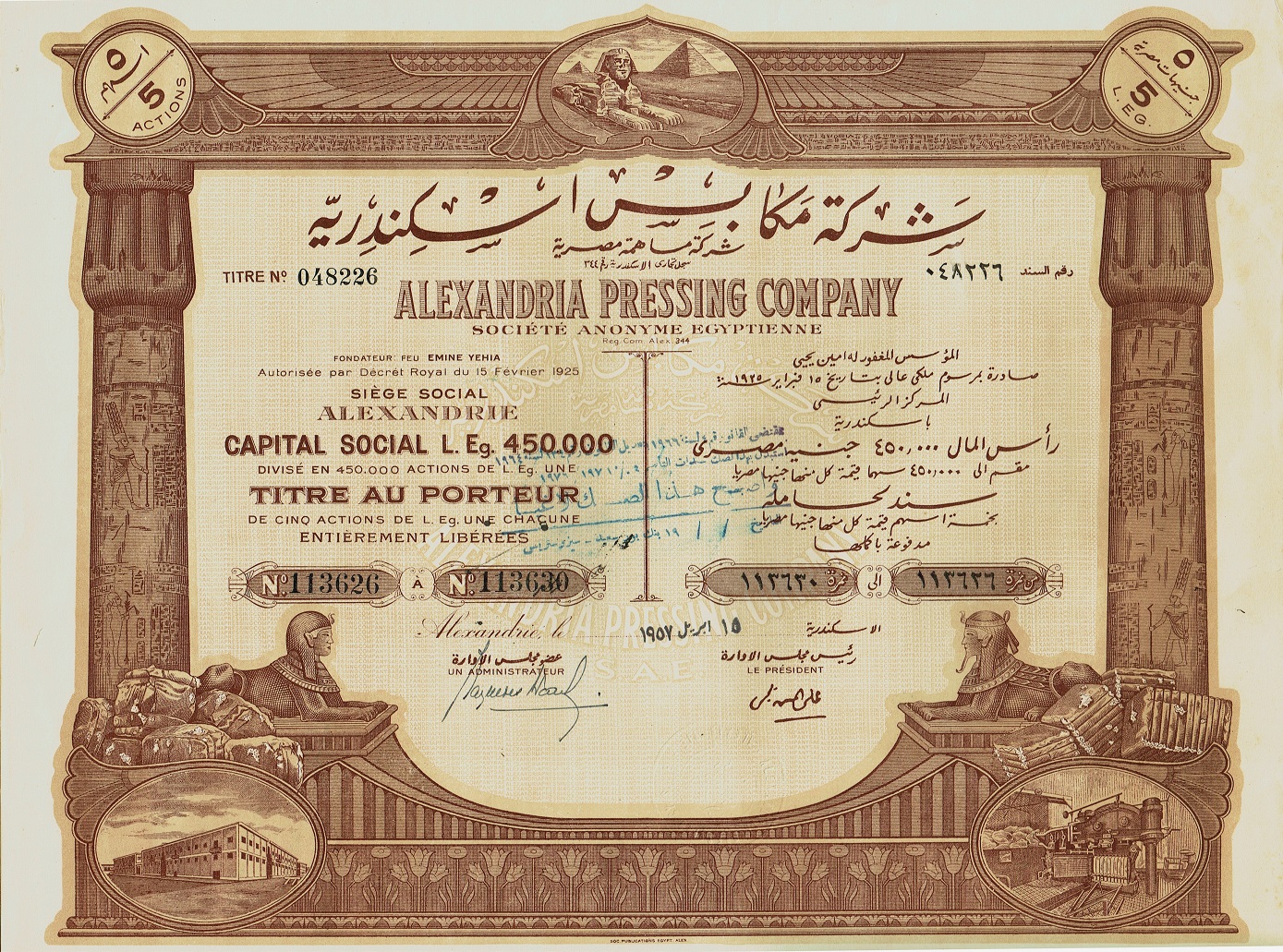


Images 6a and 6b: From Egypt, the shares from the Alexandria Pressing Company that were issued in the 1950s have a watermark showing the name of the Norwegian company ‘BORREGAARD’, the paper type ‘TUB SIZED LEDGER’ and the location of the paper mill ‘MADE IN NORWAY’.


I conclude this part in the series with one of my favorites: a share in The Dahramsi Morarji Chemical Co Ltd, Bombay (DMCC). Its watermark shows the line LUCKY PARCHMENT, a design of a jockey racing a horse, and the words RAG CONTAINING underneath. See images 7a and 7b below.

Parchment paper is not to be confused with “parchment”. The latter is a writing material made from animal skin. The former is a type of cellulose-based paper (made from wood pulp and cotton fibers) which has been treated chemically to make the paper stronger, more heat resistant and above all non-sticky.

You’ll find the words PARCHMENT also in the watermarks of shares from McLeod and Co, Ltd (1940s) and many other scripophily examples. In my example, LUCKY PARCHMENT is a parchment paper brand from the Indian paper company Ballarpur Paper and Straw Board Mills, Ltd.

RAG CONTAINING is another line of text in the DMCC watermark. Rag paper or cotton paper is primarily made of cotton linters or from used cloth (rags). Cotton paper may last many decades without any sign of deterioration, see also images 5a and 5b before.


Images 7a and 7b: This share in The Dahramsi Morarji Chemical Co Ltd was issued in 1968. The company's headquarters were located at Dr Dababhoy Naoroji Road in Mumbai. The certificate shows the coat of arms of the company, including a tiny map of India, and has a watermark of a racing jockey. 


The DMCC’s remarkable jockey watermark seems unrelated but it is not. I learned from scripophily expert Sayeed Cassim (see also here) that the Ballarpur paper company was founded by Karam Chand Thapar, who headed the Thapar Group of companies. The Thapar family was involved in race horse ownership, hence the jockey.

Time for a quick review. The first watermarks were formed, likely unexpectedly, in the production process of what we now call laid paper. Paper makers then added a logo, their coat of arms, or their name to the watermark design. Some of them further added a year, a paper type or brand, and also a location where the paper was made. If you haven’t done so already, you might start viewing your certificates against a window.

In part 3, I’ll show that paper manufacturers start adding watermark elements on behalf of one of their important customer segments: security printers.


F.L. 

This article was initially published in Scripophily magazine No. 114, December 2020. 
You might be interested to read : Watermarks in Scripophily - part 1 Introduction 


Wednesday, February 10, 2021

F.H.W. auctions 1900 lots of historic securities in online event. Scripophily from Germany and Austro-Hungarian Empire substantial.

Freunde Historischer Wertpapiere (FHW) has scheduled its 119th sale for February 20, 2021. This time auctioneer Jörg Benecke and his team selected nearly 1900 lots of historic bonds and share certificates. Major sections have been reserved for scripophily from the USA, the Austro-Hungarian Empire, and of course Germany.

The auction starts with the American scripophily section, over 240 lots, the bigger part being railway securities. 


L(ot) 41 is an uncancelled! stock certificate from The Cincinnati, Portsmouth & Virginia Railroad Company. Henry Fink signed in 1903 this share as President. He was born in Germany and was called the "Dean of Railroad Men", a title he earned for his continuous service in the railroad field. Fink started his career in 1851 as a rodman on the Western Maryland Railroad. Within several railroad companies he climbed up from construction engineer and master of transportation all the way to vice president, general manager, and receiver. Henry Fink wrote several works on transportation subjects.


Here are some other interesting US railway lots : 
  • L44, The Cincinnati, Washington & Baltimore Railroad, 5% First Income Mortgage Bond, $1000, 1883, rare 
  • The Tyrone and Clearfield Railway Company share from 1867, L221, displays a lovely railway vignette and is signed by John Edgar Thomson best know for his leadership of the Pennsylvania Railroad. Thomson, an entrepreneur but also a reknown civil engineer co-designed what became known as "Horseshoe Curve".
  • L29, The Central Pacific Railway Company, $500 4% First Refunding Mortgage Gold Bond, 1899, color print by ABN with portrait of Collis Potter Huntington, rare 

One of the main roles in FHW's event is played by k.u.k. and its successor states (Nachfolgestaaten). The Austro-Hungarian Empire (1867-1918) comprised Austria, Hungary and parts of todays Italy, Serbia, Croatia, Romania, Slovakia, Czech Republic, Poland and Ukrain. It was the second-largest country in Europe after the Russian Empire at over 620,000 km2. The "kaiserlich und königlich" refers to "imperial (Austria)" and "royal (Hungary)".  The sale features over 300 k.u.k. lots including this lovely fire engine share.


L507 is a 100 Forint share from the Tarnóczy Tűzoltószer- És Gépgyár Részvenytársasag, in English: Tarnóczy Fire engine and Machine Company. Issued in Budapest, 1891, it shows the company's factory, hand-operated fire engines, lathes, a blacksmith and a firefighter with firehose. 


The lion's share of new offerings can be found in two major sections of the auction: Germany before, and, after 1945. The former counts 272 lots, the latter - the "DM" part - features 495 lots. As good as all regions and economic themes are represented. I checked out the catalog reference index on 'breweries and malthouses' and found tens of entries ! 


The economy of West Germany developed rapidly after World War II. This "Wirtschaftswunder" created a heavy demand for steel. German post-WWII securities are often artistically designed. Modern German steel scripophily counts perhaps the most stunning examples. Check FHW's catalog for L1816 Stahlwerke Peine-Salzgitter, L1542 Dortmund-Hörder Hüttenunion and L1641 Hüttenwerke Phoenix. This 1000 DM specimen share in the Rheinisch-Westfälische Eisen- und Stahlwerke AG dates from 1953, L1764 in the sale. Click image to enlarge


Top German item in the sale is L1223, a founders share from 1838 in the Gesellschaft für Spinnerei & Weberei in Ettlingen, the first public limited company in the German cotton industry. The share shows the detailed floor plan of the factory and its usage of hydropower from the Alb, a tributary of the Upper Rhine. The company is known today as ETTLIN AG and still manufactures fabric and technical textiles. 

You want to inspect the "50%" lot range 688-1126. Here, unsold lots from previous sales are offered again at 50% of the original start price. Included are also bonds and shares from the Dr. Werner P. Schmidt Automobile and China Collection.  


From the Dr. Werner P. Schmidt Automobile Collection, L881 consists of two Volvo shares from the 1930s. Volvo was founded in 1927 as a subsidiary of the ball bearing manufacturer SKF. The share shown here bears the facsimile signature of SKF founder Sven Wingqvist. 


There is a lot to discover in the sale, so here are the details :


F.L.


PS : Did you like this post ? Thank you for sharing it on you favorite social media channel !


Wednesday, November 4, 2020

Book : Osakekirjat Kertovat

Pekka Kantanen and Kari J. Sillanpää introduce the readers into the world of scripophily. They compiled about 100 share certificates, mainly from Finland, in a charming A4-sized hard cover work. 


  • Title : Osakekirjat Kertovat - Aktiebreven Berättar - Share Certificates, Past and Present
  • Authors : Pekka Kantanen, Kari J. Sillanpää
  • ID : ISBN 951-9417-06-0, published by Kustannusosakeyhtiö, 1988
  • Languages : Finnish, Swedish, English
  • Number of pages : 184
  • Images : about 100 page wide images, one third in color
  • Indexes : no index


The book is trilingual. Every share discussed has a paragraph in Finnish, Swedish and English which is very interesting to learn the Finnish scripophily jargon. Besides a company background, the authors address various topics such as evolutions in Finnish corporate law, signatures of noteable persons, designs and printing aspects. 

Most of the shares featured are from Finland, or were issued under the Grand Duchy of Finland. The publication can interest also already advanced collectors because the book includes several remarkable shares that are rarely seen at auction, e.g. a Nokia share from 1886, a Suomen Kultaseppä Osakeyhtiö share printed with gold and silver, etc. The book can be found on e-commerce platforms.


F.L.


Previous post

Wednesday, September 16, 2020

Referenskatalog Svenska Aktiebrev

On the occasion of their 40th Anniversary the Swedish scripophily society, SFHV, published its third edition of the Referenskatalog Svenska Aktiebrev. This reference work in the Swedish language lists over 8000 Swedish stocks and bonds.


front cover of the Referenskatalog Svenska Aktiebrev


Members of the Svenska Föreningen för Historiska Värdepapper (SFHV) produced a third up-to-date catalog. In 1998 SFHV published a first reference catalogue on Swedish shares (5651 entries). A second, updated catalogue from 2010 added 2000 “new” shares. In this new book editors Marita Strandberg, Bo Niklasson and John Örtengren included 8500 certificates.

Several small chapters enclose the main catalog section: 

  • Förord/Preface
  • Att samla på gamla aktiebrev är också att göra utflykter i ekonomisk historia (Collecting old share certificates is also making excursions into economic history) 
  • När började aktiebrev anvaändas i Sverige ? (When were share certificates used in Sweden?) 
  • Starten på SFHV (The start of SFHV) 
  • Det internationella aktiebrevsamlandet började för hundra år sedan (International stockbroking [in Sweden] - began a hundred years ago) 
  • Internationale föreningar (International [scripophily] associations) 
  • Värdering av gamla aktiebrev är en sammanvägning av olika faktorer (Valuation of old share certificates is the result of various factors) 
  • Hur man hittar i katalogen (How to use the catalog) 
  • Förkortningar i textkatalogen (Abbreviations in the text catalog) 
  • Main catalog section 
  • Stadgar Svenska Föreningen för Historiska Värdepapper (Statutes SFHV) 
  • Litteraturförteckning ([interesting] Bibliography [on Swedish scripophily]) 


share certificate from the Rosenbad AB from Stockholm

This AB Rosenbad share illustrates the Rosenbad building that was designed by Art Nouveau architect Gustaf Ferdinand Boberg. The share is adorned all around with roses. Completed in 1902 on the site where there used to be a rose spa, the building features several rose ornaments on its facades. When you walk all the way through Stockholm’s Drottninggatan shopping street towards Gamla stan, the old town district, you’ll find the Rosenbad building on the right corner before you cross the bridge that leads to the Parliament House. It now houses the Swedish government chancellery. Catalog entry 5578, 5 shares of 1000 Kronor, 1900 


The catalog section counts over 8000 entries of Swedish stocks and bonds which are classified by company name. Each entry is characterized by

  • name of the company or organization
  • type of activity
  • county
  • municipality
  • denomination
  • year
  • remarks

NOTE : Apart from the basic twenty-six letters, A–Z, the Swedish alphabet includes Å, Ä, and Ö. These are distinct letters, and are sorted after Z. So you'll find the entry for a share in the Östra Centralbanans Jernvägs AB, see image here, at the end of the catalog.


share in Telefonaktiebolaget L. M. Ericsson

Lars Magnus Ericsson started in 1876 his telegraph repair shop which became Telefonaktiebolaget L. M. Ericsson in 1925. After WWII the company specialized in computerized telephone exchanges. In the late 1960s Ericsson developed a military computer and got involved in personal computers in the 1980s. Bluetooth technology was invented at the company's Lund office in 1989. Catalog entry 7149 : 1 "A" share of 35 Kronor, 1951 


More information about the book
  • Title: Referenskatalog Svenska Aktiebrev
  • Editors : Marita Strandberg, Bo Niklasson, John Örtengren
  • ID : 978-91-89330-69-6, published 2019 by Svenska Föreningen För Historiska Värdepapper
  • Languages : Swedish
  • Number of pages : 215
  • Images : more than 750 small color images (ca 3cm x 3.5cm)
  • Index : no index, certificates are classified by company name in the main catalog section

Are you into Swedish scripophily ? Then, no doubt, this would be a nice Christmas present. You can order the catalog from the Swedish Association for Historical Securities, or you can check your favorite scripophily dealer.


F.L.

Related link


Previous posts

Thursday, January 2, 2020

Puzzling scripophily - No. 2 - solution

In order to resolve Scripophily Puzzle No. 2 you could use three visual cues that pointed to a particular company. This puzzle was a bit tougher than no. 1, yet, one reader provided a correct answer. 


The visual cues were details from the design of a share in the company that we are looking for. The first two images feature signatures. The third image shows a text fragment in some language, printed on top of a drawing.

In general, antique securities from companies were signed by directors of the company. This is no exception. Signatures of some famous persons like Thomas A. Edison are easy to derive. Here, we have less readable examples. 


Sven Wingqvist signature on stock certificate


If you've read this recent blogpost, then you could have recognized the signature of the Swedish industrialist Sven Wingqvist, founder of SKF.  This is the first clue.

There is one image with a fragment of the lettering on the certificate. It mentions 'ETT HUNDRA Kronor'. Ett Hundra is Swedish for one hundred, and refers in this case to 100 Swedish Krona, the denomination of the certificate.


fragment of a share with underprint cut-through section of a plane


So Sweden is a keyword in this puzzle. You may guess that the other signature comes from another Swedish person. Correct. It belongs to Swedish banker and Olympic tennis player Marcus Wallenberg Jr


signature of Marcus Wallenberg Jr


You didn't resolved the last signature ? Well, that's no showstopper. The 'ETT HUNDRA Kronor' image shows a front profile of a propeller plane in the underprint. Googling the three words aviation, Sweden and Wingqvist will lead you to the solution : Svenska Aeroplan Aktiebolaget (Swedish Airplane Company), aka SAAB.


SAAB was founded in 1937 by Sven Wingqvist, Marcus Wallenberg Jr and Axel Wenner-Gren. The latter established Electrolux. 


1944 share in the Svenska Aeroplan Aktiebolaget, aka SAAB

Svenska Aeroplan Aktiebolaget
1 share of 100 Kronor, 1944


SAAB, an aircraft and defence business, was the parent company of automobile manufacturer Saab Automobile. The profile in the underprint of its share shows a twin-engine military plane built during WW II, the SAAB 18. The company pioneered in 1971 with a self-developed computer for its Viggen combat aircraft. 

Reader "detective" DB provided the correct answer for puzzle no. 1 and also for this puzzle. Outstanding DB! You are now entitled a second portion of "eternal fame". 


Happy New Year !

F.L. 


Monday, November 4, 2019

Swedish Society of Historical Securities celebrates in Stockholm !

The members of the Svenska Föreningen för Historiska Värdepapper proudly announced the 40th Anniversary of their favorite society. A pioneer when it comes to scripophily, SFHV, founded in 1979, celebrates with an exciting weekend in Stockholm at the end of this month.


Östra Centralbanans Jernvägsaktiebolag
This 100 kronor share from the Eastern Central Line Railway Co., Linköping was issued in 1900. The design includes a map showing the line from Linköping to Vimmerby.


The two-day festivities are inaugurated on Friday evening, November 29, 2019, with an exhibition of Swedish certificates. Guest speakers will talk on the subject of collecting old bonds and shares. On Saturday, 20 November, the society will organize an anniversary auction, concluded with a dinner. Place to be : Jernkontoret, Kungsträdgårdsgatan 10, Stockholm. 


Aktiebolaget Svenska Kullagerfabriken was founded in 1907 by Sven Gustaf Wingqvist, a Swedish engineer and inventor of the famous SKF ball bearing and roller bearing. This 5 shares SKF certificate from 1918 has Wingqvist's facsimile signature in its lower right corner.


For this occasion, SFHV will publish a catalog of Swedish shares (about 8,000 of them) and, around the end of the year, also a 400-page Anniversary book with all articles published in its quarterly magazine during these 40 years, totalling some 125 articles.

More information available on : http://www.historiskavardepapper.com/
Jubilee Auction catalog, see here .

F.L. 

Monday, July 11, 2016

Guadeloupe on the map

Guadeloupe is a small group of islands forming one French overseas department in the Caribbean. Very few Guadeloupean bond and share certificates are known. G Cifré's La France d'Outre-Mer only lists seven certificates. From a statistical point, the chance of finding scripophily with a map of Guadeloupe would be one in a million.

Société Anonyme des Usines de Beauport
5000 Francs share, undated

In 1908 the sugar factory Société Anonyme des Sucreries de Port-Louis (SASPL) was taken over by three Bordeaux families, who operated it as the Société Anonyme des Usines de Beauport (SAUB). The company was founded in 1863 and made use of its own railway system to transport sugar cane from the surrounding estates. After World War I more and more bananas were grown on the islands. Sugar, once a highly profitable trade, lost gradually its importance and suffered from several poor harvests. SAUB went bankrupt in 1981.


The map on the certificate shows Guadeloupe's two main islands.
It is not visible on the rather roughly drawn map, but both islands,
Basse-Terre and Grande-Terre, are separated by a narrow sea channel
called Rivière Salée (Salt River).
Double-click image to enlarge.

Guadeloupe was colonized from 1635 onward by the Compagnie des Îles de l'Amérique, a French chartered company. Over the next two centuries the British seized the island group several times from the French. Just before French control of Guadeloupe was internationally accepted after the 1815 Treaty of Vienna, Sweden owned Guadeloupe for about 15 months as a result of the Anglo-Swedish Alliance in 1813. Have you seen any early Swedish Guadeloupe scripophily ? Me neither, but scripophily often reveals big surprises, sooner or later.

F.L.

Reference links

Sunday, April 27, 2014

Artemon - Mail bid auction May 2014


Numismatics and Financial History - Artemon auction
This German mail bid auction is described from lot 501 and 
features banknotes, coins, documents 
and about a hundred scripophily lots.


Aktiebolaget Stockholms Rederi & Skeppsvarv
in English: Stockholm Shipping & Shipyard Company
Share of 500 Kronor, 1918
double-click image to enlarge


  • Date : May 7, 2014
  • Place : not applicable, this part of the auction, starting from lot 501, is a mail bid auction only
  • Practical info, see here
  • Auction catalogue can be downloaded here 


F.L.

Friday, November 1, 2013

The Copper Handbook - a manual of the copper mining industry of the world


The Copper Handbook, by Horace Stevens
image by Boone Shares
Following is a list of the elements with which copper is found chemically united in nature. This list includes 29 of the 77 elements known to science at this writing. Following the name of each element is its chemical symbol and atomic weight, as now figured by the best authorities : 


Aluminium Al 27.1
Antimony Sb 120
Arsenic As 75
Bismuth Bi 208.3
Calcium Ca 40.1
Carbon C 12
Chlorine Cl 35.45
Cobalt Co 59
Copper Cu 63.6
Hydrogen H 1.01
Iron Fe 56
Lead Pl 206.9
Manganese Mn 55
Nickel Ni 58.7
Niobium Nb 93.7
Nitrogen N 14.04
Oxigen O 16
Phosphorus P 31
Platinum Pt 195
Selenium Se 79.2
Silicon Si 28.4
Silver Ag 107.93
Sulphur S 32.06
Tellurium Te 127.5
Tin Sn 119
Tungsten W 184
Uranium U 240
Vanadium V 51.4
Zinc Zn 65.4


Excerpt from The Copper Handbook 1903, Vol. III for the year 1902, page 27


More than 2000 copper mines in all parts of the world
Scripophily auctioneers and a few blessed collectors use the book for researching companies. The 1903 issue contains 2207 company profiles. Most of the mines included are located in the USA, others are active in the following countries: Argentina, Austria, Australia, Algeria, Bolivia, Canada, Chili, Cuba, France, India, Italy, Ireland, Japan, Mexico, Norway, Peru, Portugal, Rhodesia, Russia, South Africa, Spain, Sweden, Turkey, UK and much more, even Sudan and New Caledonia. Many company descriptions span tens of lines, sometimes several pages. As an example, I included the profile of the Parrot Silver and Copper Company:


share certificate of the Parrot Silver and Copper Company
Parrot Silver and Copper Company
shares of 10 Dollars, issued in 1904, Butte, Montana
printed by Western Banknote Company, Chicago
In the Copper Handbook Vol. III the company
was ranked 25th in the list of largest copper producers.
double-click image to enlarge

PARROT SILVER & COPPER CO. - MONTANA
Mine office: Butte, Silver Bow Co., Montana. Harry A. Galway, superintendent. Has a stock issue of 230,000 shares, bulk of which is held by the Amalgamated Copper Co. This company is mixed up to some extent in the litigation that is so unpleasant a feature of mining operations in Butte. Principal mines are the Little Minah and Parrot, opened circa 1884. Company holds 19 claims in all, mostly well located. A barren zone occurs at a depth of about 1,000' , but good ore bodies are found below. Production is at the rate of about 12,000,000 pounds yearly. The ores carry fair values in silver and gold, as well as copper. Mine employs 300 to 400 men, when working full force. The Little Minah mine has a 1,000' two-compartment shaft connected underground with the Nipper. The Parrot mine is about 1,700' deep, main shaft having 3 compartments to 400' level and 4 compartments below, connected underground with Colusa-Parrot, Never Sweat, Nipper and Original mines.

detail from share certificate depicting parrot and ingot
detail from the Parrot Silver and Copper Company's stock certificate
vignette of a brainy parrot claiming his ingot (I want a parrot like that)


This book is encyclopedic
Do you know the meaning of following terms or expressions? Watch out! I can not pronounce some of these words I. Don't hurt yourself in the act.
  • pertenencia: one mineral claim in Mexico; area, one hectare or 2,471 acres
  • cutting down: when a shaft is enlarged, work begins at the top, and the work of enlargement is called cutting down
  • dognacskaite: a sulphide of bismuth and copper; carrying about 12% copper; from Hungary
  • pinching out: the narrowing of a vein to extinction

When was the first copper shipment from the Australian continent ? Answer: 1843
What was the world's largest mine in the early 1900s ? Answer: The Anaconda Copper Mining Company, Butte, Montana, producing more than 100,000,000 Pounds in 1901.

Thursday, July 14, 2011

Reference catalogue : Swedish Share Certificates Before 1850

  • Title : Svenska Aktiebrev Före 1850 - Swedish Share Certificates Before 1850 - Schwedische Aktien Vor 1850
  • Authors : Birger Strandberg, Björn Franzén
  • ID: ISBN 91-630-0421-6, published by AB Aktiesamlaren BJB, 1991
  • Languages : Swedish, English, German
  • Number of pages : 220
  • Images : mostly in black and white, a few in color, almost on every 2 pages
  • Indexes : index by date of issue on page 14
This catalogue gives an overview of Swedish share certificates issued before 1850 :
  • 16 shares dated between 1728 and 1799
  • 80 shares dated between 1800 and 1850
Many companies listed were active in the field of mining, canals, bridges, banking, shipping, shipyards, early trading companies, health resorts, sports and recreation and many more. Less usual themes included : a billiard club, swimming and horse riding schools, and even a 'share in a stallion' is present.  Many rarities.
F.L.

Monday, July 26, 2010

60 % at 10 o'clock, or how can you name your scanned detail images ?

This detail map (click to enlarge) shows the railway line of the Kristianstad-Hessleholms railway company. It is a vignette on a 1906 share of the Kristianstad-Hessleholms Järnvägsaktiebolag. The railway company was founded in 1863 and nationalized in 1944.

I often scan details of certificates, but how do I name these images ? The scanned image of a whole certificate gets the same filename as the ID - identification number - of the certificate in my database. In this case, the certificate has an ID of 1405.  So, the image has 1405.jpg as its filename being the name of the certificates ID and the file type "jpg" in this case.  

Scanned image files of details on certificates also need a filename. This is how I do it. Just take a look at the example of the Swedish railway certificate.

  1. First, we need to position the vignette from a reference point.  I use the center of the certificate, which is at the crossing of the bisector lines. Now, imagine a clock in the center of the certificate.

  2. We position the vignette as a combination of a direction (an hour on the clock) and a distance of the center of the vignette from the center of the clock (0%) to the border (100%).
So, our detail image can be "positioned" at 10 o'clock - 60% . The filename of the resulting scan will be 1405_10_60.jpg, which is the outcome of the certificate ID, the hour position and the distance % and the file extension jpg.

Purists, can question this example and argue that 1405_1030_55.jpg is more accurate. However, it is an approach that has worked well for many years now, and, when ordering the files by filename in your file folder list, detail images get sorted along with the images of the whole certificate.

So, that's how I do it. I'd happy to learn from other approaches. In case you'd wonder, here is the whole certificate's image.