Showing posts with label inventions. Show all posts

Friday, April 15, 2022

International auction & bourse weekend in Antwerp shows amazing historic securities and scripophily collections

A major player in the field of antique stock certificates, auctioneer Mario Boone scheduled his 68th scripophily auction and bourse on 30 April and 1 May 2022. On the agenda are about 1400 scripophily lots ready to go on the block. Boone managed to assemble exceptional rare and beautiful stocks and bonds from all continents. 

Part of the offerings are several thematic collections containing exceptional items. One of them is the Portuguese Railways collection consisting of 126 lots of Portuguese and Portuguese colonial railway certificates. The collection formed the basis of the 1990 published Boone-Shakespeare catalog on Spanish and Portuguese railway scripophily and it was further enlarged with new discoveries. Bidders will first have the opportunity to bid on the entire collection as a whole. Start price is set at €18,000. In case no bid is achieved, the auctioneer presents the lots one by one.


Founded in 1908 the Companhia Carris de Ferro do Porto operated the Porto tramways. This 5 shares of Rs10$00 certificate from 1909, only one known, shows a perspective of the Dom Luís I Bridge taken from Vila Nova de Gaia. Part of the Portuguese railway collection, Lot 617 (L618-L744). 


The Boone sale includes many highlights from the turbulent 18th century! That century saw the great powers waging several wars and expanding slave trading across the Atlantic but also the founding of Los Angeles, the discovery of the Rosetta Stone, the premiere of Mozart's Don Giovanni, and the invention of the steamboat and the power loom. Some of the historical items from this period are : 
  • L409 is a 2500 livres share from the Compagnie des Indes from 1770
  • From 1797, L285, a share from the Natur-Torfgräber Unternehmung zu Moosbrunn, a peat digging company in Lower Austria, is probably the oldest Austro-Hungarian share known.
  • The most mind-blowing lot in the sale, L516, is a 1777 founder share from the Iron Bridge company. Boone expects it to hammer at €18,000. 


This share in the Company for Building a Bridge across the River Severn, Ironbridge, Shropshire, England, dates from 1777. Opened in 1781, it was the first major bridge in the world to be made of cast iron. The share is signed by Abraham Darby III and John Wilkinson

Darby took over the iron-making business of his family. He became manager of the Coalbrookdale ironworks. The Darbys and other ironmasters like John Wilkinson perfected the technique of smelting iron with coke, instead of coal. This allowed them to produce cheaper and more cast iron. They started casting iron rails and wheels for railway wagons. 

John "Iron-Mad" Wilkinson invented a precision boring machine that could bore cast iron cylinders such as cannon barrels and piston cylinders used in steam engines. In 1787 he launched on the Severn an iron ship. In 1775 Wilkinson and local businessmen commissioned Abraham Darby III to build the Iron Bridge. 

Thanks to the bridge, its builders and their achievements, the area around Ironbridge is described by UNESCO as the "Birthplace of the Industrial Revolution". The monument gave its name to the town that grew around it. The Ironbridge Gorge Museum Trust runs 10 museums throughout the IronBridge Gorge World Heritage Site; they tell the story of the Industrial Revolution. 


Signatures of Abraham Darby III and John Wilkinson. 
Few people have had such a lasting impact on modern society. L516 


Another remarkable collection offered in the auction are 78 Panorama certificates. Before the advent of cinema audiences could visit a panorama or diorama attraction. Often implemented as large winding 360-degree paintings, and sometimes constructed as mobile attractions or in specialized theatres, these immersed the viewer in large topographic landscape views and historical events. The collection as a whole can be purchased, L9, starting at €8,000. In case no bid is achieved, the auctioneer presents the lots one by one, L10-87.


The Panorama collection includes attractions from Belgium, the Netherlands, Austria, France, the USA and more. This share in the French Royal London Panorama company dates from 1881. The company built its panorama in the former Saville House, Leicester Square, London, where it showed the battle of Waterloo. L65 


The printed catalog contains several indexes to help you find what you are looking for. The online versions can be searched by keywords. The largest country represented this time is the USA and, including a Confederate Bonds collection, counts over 300 lots. Many non-typical scripophily countries are represented as well such as Fiji, Pakistan, Kenya, San Marino and Uruguay.
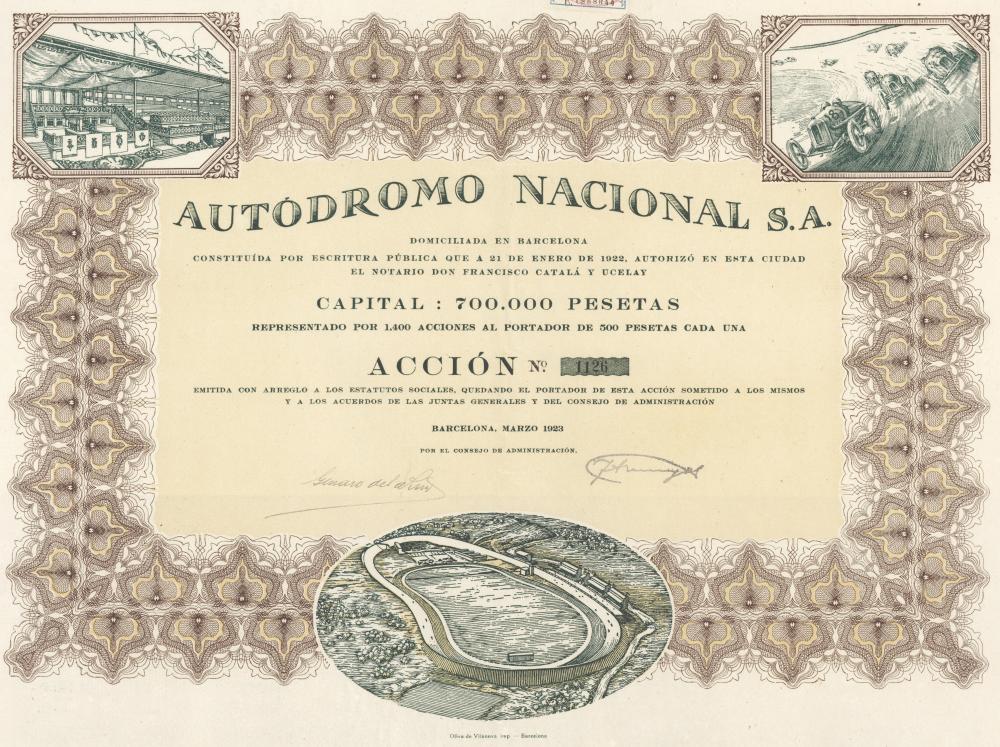


One of the lots mentioned under the "Sports" index, L927, is a 1923 share in the Autodrómo Nacional SA. Founded in 1922 the company built and operated the Terramar Autodrome, a racing circuit in Sant Pere de Ribes, Catalonia, Spain. In 1923 Alberto Divo won the first race with his Sunbeam at an average of 142 kilometers per hour. 


Even if you are not a collector the weekend of 30 April & 1 May is an opportunity to see some great antique securities. The venue is the Antwerp Crown Plaza. An airport shuttle from Brussels Airport to Antwerp (about 30 minutes) stops in front of the hotel. The public bus stops right outside the place and takes you in 10 minutes to Antwerp Central Station. 

Here are the auction details :
  • Location : Antwerp, Belgium
  • Dates
    • 30 April 2022, Boone's 68th live and internet auction
    • 1 May 2022, bourse of historic bonds and shares
  • Further info : 
    • online catalog & bidding, see here 
    • or via the Invaluable platform (large images), see there 
    • and the PDF version of the catalog can be found here 
F.L.


PS : Did you like this post ? Thank you for sharing it on you favorite social media channel !

Tuesday, November 9, 2021

Shall we take the car, the plane, or the boat ?

Recently I was surprised by a vintage stock certificate. Its design was rather plain featuring an eagle vignette, frequently seen on American scripophily. But the name of the issuing company was SPACETRONICS, INC., and that was enough to get my attention.

My first guess was that the company developed radar equipment, missile guidance systems or something like that. But that turned out not to be the case. 


This story is about Walter A. Crowley (1917-2008). As an engineer he worked at General Motors, and later at Chrysler on guidance systems for missiles. Crowley also designed and built a Benson Gyrocopter but after two crashes he aimed his research at 'flight without height'. 

Crowley observed that blowing air into the center of a conical lampshade would cause it to rise and hover steadily above any surface, including water. In 1957 he developed an air cushion vehicle that could traverse land or sea without physical contact. 

A first test flight, or you could say test ride, occured in an in-house experiment with Crowley's ten year old son as the test pilot. Other prototype vehicles and outdoor tests followed. In the mean time he formed his Hydro-Air Transportation Company and filed a patent in 1958.

In this period Carl W. Bollum Sr. worked at the Washington office of the Army Ballistic Missiles Agency. Bollum was sent out to learn about Crowley's ideas. But, unlike himself, his office did not show further interest. 


Soon after Bollum left the army he founded Spacetronics. The company incorporated on October 8, 1958, under the laws of the District of Columbia. Spacetronics was located at Bethesda, Maryland, less than 10 miles away from Washington, D.C. Bollum was chairman of the board and president. 

Spacetronics acquired Crowley's company and its related patents and rights. In return Bollum promised to provide capital to develop Crowley's ideas. He hired Crowley as chief engineer and appointed him vice president. 

In that period the US Navy got interested in the so-called "ground-cushion phenomenon". Hearings sessions took place before the Committee on Science and Astronautics at the House of Representatives on 13, 14 and 15 April, 1959. Several projects on air cushion vehicles were discussed. The key people from Spacetronics were invited to present their developments. Other projects screened involved those from the Ford Motor Company and the Curtiss-Wright Corporation, among others.

At the start of the hearings, Admiral R. Bennett, Chief of Naval Research, USN, explained why the Navy and the Marine Corps was interested :  
"... such a ground proximity machine, used as an amphibious transport or an assault boat, with a low silhouette and moderate load-lifting capability would be extremely valuable in accelerating the ship-to-shore movement. Traveling 4 or 5 feet over the wave tops at speeds up top 50 mph and capable of negotiating beaches up to 15 percent slope, the vehicle would present a far less vulnerable target than our present craft ..."

Bollum, president of Spacetronics, knew how lucrative military contracts could be. His company built a heavy-duty prototype vehicle for the US Marine Corps. The machine could achieve a ground clearance of nearly 12 inches and was stable even as a dozen men moved around its deck. 


This Hydro-Air vehicle, aka a ground effect machine, built by Spacetronics, Inc.,  is designed for traversing swampy ground, snow or ice. A flexible skirt enables it to cross many obstructions. The horizontal propeller behind the driver maintains pressure in the hollow body. 
source: Aviation Week 1959-01-12, via the Internet Archive  


The company gets national coverage after The New York Times, on Sunday, October 11, 1959, publishes a special news article "Flying Platform Planned in U.S." :
A Washington concern announced last week that it was building a flying platform as a prototype for a cargo-carrying craft that would skim over water on an air cushion. The "Hydro-Air" vehicle, being built by Spacetronics, Inc., is similar to the Saunders-Roe Hovercraft that is under test in Britain. The American craft is scheduled to be unveiled next month.
When completed, the prototype will be tear-drop shaped, thirty-two feet long, twenty-four feet wide and two feet high. A horizontal propeller at the forward section will pump air downward to lift the craft just off the water. With aft-mounted fans, for forward propulsion, the vehicle will attain speeds up to fifty miles an hour, it was said.
Officials reported that there were essentially two designs for providing lift for such a vehicle. One is a "pelum chamber" [sic; should be 'plenum chamber' ], used on the Spacetronics craft, to provide a billowing volume of air, and the other "annular jets which gain lift by directing a curtain of air at the water surface", he said. The latter is the method used on the Saunders-Roe craft.


Around the same time the British worked on a much larger commercial vehicle, the "hovercraft, based on the earlier work by Christopher Cockerell and produced by the Sanders-Roe company. 

Both Cockerell's and Crowley's prototypes could not spark more military interest. Two main problems of these early crafts were inaccurate steering control and the stirring up of dust on land.

In 1960 the Spacetronics owners moved to Daytona Beach, Florida, with the intention to produce a commercial-type model for fishermen. 

They had some big ideas. In The International Teamster (a union magazine), issue Oct 1960, you can read that the company was designing a big cargo air truck. Allegedly Southern Airways, Inc., had ordered two of these from Spacetronics, envisioning trucking cargo over water on regular scheduled runs between Miami and the Bahama Islands.


Another far reaching idea from Spacetronics shows a train riding air cushions on a concrete rail
source: Popular Mechanics 1960-06: Volume 113, Issue 6, via the Internet Archive 


It is not clear what happened next, but the company was suddenly dissolved. Yet, Bollum still believed in the potential of Crowley's ideas. You can see here that in 1963 Bollum filed a patent for an "earth-skimming air vehicle" mentioning his name as the inventor.  

Walter A. Crowley went to develop new air cushion concepts at American Machine and Foundry in Stamford, Connecticut. In 1961 the Boeing Company hired him. There he developed an air-bearing system for moving heavy objects with compressed air, up to and including an entire 747 Jumbo Jet. In fact, in 1967, Boeing spun off a succesful subsidiary, Aero-Go, to commercialize all kinds of products based on Crowley's concepts : aero-planks, aero-pallets, air-cushion vehicles, scissor lift tables and much more. 

Crowley's original scale model and prototype hovercraft is on display in the Smithsonian Air Museum in Washington, D.C. 


Walter A. Crowley, research & development manager of Aero-Go, demonstrates the Terra Skipper while skimming over sand and sea at 30 miles an hour. 
Excerpt from The Seattle Times, Pictorial, November 24, 1968 as seen on aerogoeurope.de 8 Nov 2021  


F.L.


Something extra :
  • The Spacetronics, Inc., share illustrated here was issued to James Harold Scribner. Likely, this is Dr. James Harold Scribner, the first US Navy dentist to visit the South Pole and Antarctica. He participated in the first Operation Deep Freeze in 1955-56 with Admiral Byrd. Spacetronics was involved as a Navy contractor, and in the hearings sessions of 1959 (see main article)  the company envisioned its air cushion vehicles operating also in polar regions. The company's location was Bethesda, MD, where there was a dental clinic at the Bethesda Naval Hospital. From a good source I learned that Dr. Scribner was married to Dorothy Louise Scribner nee Meadows who worked as a navy nurse stationed at Bethesda!

Reference links :

Previous posts

Tuesday, May 12, 2015

IBSS Mail Bid Auction - May 2015


The International Bond and Share Society, sets its next (members only) auction date to 25 May 2015. This auctions counts more than 200 lots, representing more than 40 countries and an equal number of themes. Also on offer is a collection of insurance policies (19th century).


share certificate from the Société Française du Vacuum Cleaner

Société Française du Vacuum Cleaner
Share of 100 Francs, Paris, 1903
printed by Crabbé
lot 46 in the auction

In 1901, Hubert Cecil Booth of England invents the motorized vacuum cleaner. 
This French Vacuum Cleaner Company from Paris obtained the monopoly patent 
and offered vacuum cleaning services to private homes, businesses and shops. 
More, including nice old photographs, on this French blog.


  • Date : May 25, 2015
  • Place : not applicable, this is a mail bid auction only
  • Auction catalogue can be downloaded here, where also the images of the lots can be viewed.


F.L.


Monday, February 7, 2011

Take a parachute and jump

One of the days in my life that I will never forget, is the day when, at the age of 20, I jumped with a parachute at a height of 800 meters above the ground. During a one day training I had learned in theory how to open the main parachute, which was a round type, when to open the reserve and most important how to land on the ground in a rolling mouvement. Quite exciting .. until I had to enter that little airplane for the real thing which was ... even more exciting.


detail from share showing the balloon with safety parachute invented by Louis Capazza
Capazza's balloon with safety parachute
image colors and contrast edited
in order to emphasize the underprint