Showing posts with label casino. Show all posts

Saturday, September 30, 2023

FHW auction features more than 1500 historic bonds and shares including several German collections

Freunde Historischer Wertpapiere (FHW) has scheduled its 124th sale for October 7, 2023. This time the auctioneer selected more than 1500 lots of historic bonds and share certificates. Major sections have been reserved for scripophily from the USA, Germany, the German DM era, and a series of more than 300 lots from other countries.


One of the auction's highlights is this gorgeous share from the Société des Fermes Réunies du Kurhaus et de la Banque de Nauheim Hesse Électorale. It was the Frenchman Jacques Roland Viali who founded the casino and the accompanying health resort. In addition to the roulette hall, there was also a reading room, a concert hall and a dance hall. Spa guests strolled in the adjoining parc around the large pond and boats were purchased to provided more entertainment. Within a year after its opening, 1 Jan 1854,  Nauheim received city rights, and soon new avenues were constructed. Few companies would change a town's history so quickly. This 1854 share, with Viali signature, is part of the Deutschland Top 20 chapter and starts at €2,600. L(ot) 626 in the auction


Traditionally FHW is know for its strong emphasis on German scripophily. On top of that, several collections are now going under the hammer. The Hans-Werner Schmidt collection of Oberfranken (Upper Franconia) features 338 certificates in 146 lots from all themes, including brewery shares, such as L162, a rare share from the Erste Bamberger Export-Bierbrauerei Frankenbrau


Collectors of DM securities will be pleased to find a large section in the catalog counting almost 400 lots of securities from the Deutsche Mark era. However, this SchmidtBank KGaA 1000 shares certificate, is part of the Hans-Werner Schmidt Oberfranken collection, L225. Bidding starts at €500. 

The USA forms the largest non-German chapter in the sale with about 200 lots such as:
  • L1350, Barkley-Grow Aircraft Corp, stock certificate, 1936, airplane vignette, €240 
  • L1419, Massachusetts Fish Co, specimen share, 1907, crowded harbour scene, €100 
  • L1461, Petaluma and Sebastopol Railroad, stock certificate, 1889, rare, €600 


The Sebago and Long-Pond Steam-Navigation Company built its Fawn steamboat in 1847. It had a shallow hull to navigate Maine's winding Songo River, with passengers asked to shift sides as ballast to keep both paddlewheels in the water around sharp curves. This 1848 share features three vignettes, two paddlewheel steamers and a church, and a green company seal. L1483, €400 


There is a lot more to discover in the sale, so here are the details :


F.L.

Wednesday, December 29, 2021

The most valuable scripophily item hammered in 2020

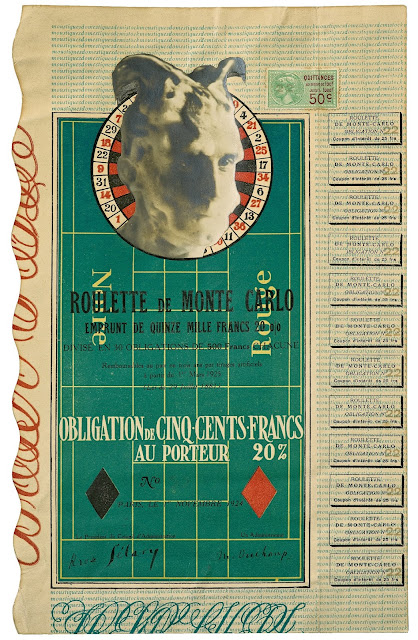
One of the highest auction sales in 2020 was a subscription for shares in the South Sea Company. Issued in 1720 the document was signed by one of the most influential scientists of all time Isaac Newton. It sold in the University Archives May 2020 auction for US$85,000 without premium. This in itself is a fantastic result, but it was eclipsed by an even more spectacular sale: Marcel Duchamp's Monte Carlo bond.


Sotheby's 4 February 2020 London sale featured this Roulette de Monte Carlo 500 Francs bond, number 22, dated 1924. The bond was issued and designed by Marcel Duchamp. It features a picture of himself made by American artist and close friend Man Ray.  Duchamp's head is covered with shaving lather. His hair is peaked into two devilish horns.
Photograph courtesy of Private collection c/o Sotheby’s


Marcel Duchamp (1887-1968) is one of the most revolutionary and influential artists of the 20th century. He was born in Blainville-Crevon, a farming village in Normandy, France. His brother Gaston aka Jacques Villon became a famous painter. His sister Suzanne was also a painter, and his brother Raymond a sculptor.

Duchamp pioneered in the field of plastic arts, conceptual art and kinetic art. He introduced readymades, ordinary manufactured objects that he modified to combine creativity with criticism. 

Fountain, one of his most discussed and controversial works, was a readymade of a porcelain urinal presented with an altered orientation. His Belle Haleine - Eau De Voilette, a readymade of a perfume bottle, created in 1921 with the help of Man Ray, sold at Christie's New York in Feb 2009 for  $11,406,900.


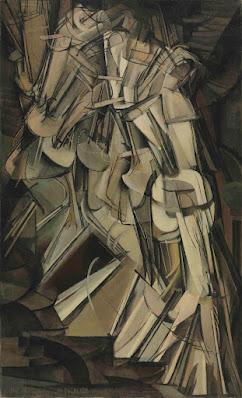
Marcel Duchamp finished his Nude Descending a Staircase, No. 2 in 1912. 
The painting is located at the Philadelphia Museum of Art.


Since childhood Duchamp's family introduced him to the game of chess. He became a good player and even wrote about chess. His fascination with the game distressed his first wife so much that at some point she glued his pieces to the chessboard. 

Possibly the logic and mathematical concepts behind the chess game sparked his interest for the roulette game. Duchamp worked out a system which he could apply to the roulette tables of Monte Carlo. To finance increased wagers, Duchamp created bonds of 500 francs, repayable over a three-year period at 20% interest rate. 

The artist planned to produce thirty of these bonds. Only eight, possibly less, bearing a legal stamp, were "issued" to some of his close friends as personal loans or as an early form of crowdlending certificates. 


Upon further investigation you'll find out that there is something special going on with these certificates. 

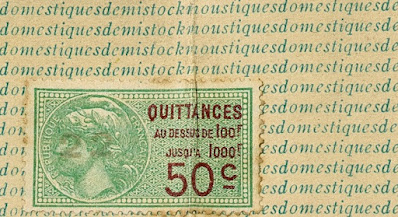
First of all, repeated in green ink in a continuous pattern in the underprint, you'll find a pun “moustiques domestiques demi-stock” (domestic mosquitoes half-stock).

Then, there is the interest rate of 20%. During the mid twenties, long term bond interest rates in France were about 6 to 8%. The one mentioned on the certificate must have been shocking.


Let's have a look at the signatures on the Monte Carlo bond. In its lower corners you'll find two signatures of company administrators, which is usually a legal requirement. The signature on the right is M[arcel] Duchamp's. The one on the left reads as Rrose Sélavy. Here we are dealing with the same person. 

Rrose Sélavy was a Duchamp pseudonym. The name sounds like the French phrase Eros, c'est la vie. Sélavy emerged in 1921 in a series of photographs by Man Ray showing Duchamp dressed as a woman.


Here is one last oddity. Normally, on French securities we see a standard formalution like "Statuts déposés chez ..., notaire a", which means 'Articles of association filed with [name of person], notary at [name of location]'.  Instead, we see the mentioning of a French law : Loi du 29 Juillet 1881.

The French Law of 29 July 1881, also known as the Law on the Freedom of the Press of 29 July 1881, defines the freedoms and responsibilities of the media and publishers in France. One of the most important reforms installed by the law was a major reduction in the extensive range of activities deemed slanderous.


As is the case with his other works, also here Duchamp challenges us and questions society, traditional art values and even his own productions.

In her 2004 essay Marcel Duchamp (1887–1968) Nan Rosenthal, art historian and back then curator at The Metropolitan Museum of Art, wrote : 
By World War I, he had rejected the work of many of his fellow artists as “retinal” art, intended only to please the eye. Instead, Duchamp wanted, he said, “to put art back in the service of the mind.” 

The Duchamp bond realized £495,000 including 20% buyer's premium.

F.L.


Reference 

Friday, April 19, 2019

Spink London launched its E-auction of world bonds & share certificates

Exactly 443 lots of scripophily will go on Spink's E-block. This online sale already started Apr 12 15:00. The bidding window closes on April 30 11:00. At stake are antique stocks and bonds from many countries. Larger sections include China, Japan, Australia & New Zealand, UK, Confederate States of America and the USA. 


5% Japanese Imperial Loan, Meiji 42 (1909), bond for 500 yen 
Historically, Japanese dates were expressed as years of a named era. Emperor Meiji, who ascended the throne in 1868 tied the era name to the reign of the current emperor. Meiji 42 indicates the 42th year of Meiji's reign. As the first year of the reign is year 1 and not year 0, one has the subtract 1. So Meiji 42 stands for 1868+42-1 = 1909. 
L(ot)89 in the auction, scarce 


Dun Mountain Copper Mining Company, Limited, 10 shares of £1, London, 1857 
Dun Mountain, named for its brown (dun) colour, is located near the city of Nelson. In the 1850s and 1860s, chromite and copper were mined on the mountain leading to the building of New Zealand's first railway. Marvellous embossed seal of a miner at work, click image to enlarge.  L136 is estimated at £80 


The oldest certificate in the sale, L237, is a handwritten warrant authorising a payment from 1655 and handsigned by Oliver Cromwell, see here. Estimated between £5000-£6000, it is expected to realize also the highest result.

The most rare certificates in the sale are indicated with R12. Rarity 12 stands for 'only one known'. The auction includes a handful of these. You can use 'R12' in the online search function to find them, e.g. L240, a specimen $5000 bond from The Government of the United Kingdom of Great Britain and Ireland, dated 1916.

The largest group lot is L158 and counts 2200 bonds from several loans issued by the Österreichische Staats-Eisenbahn-Gesellschaft  between 1855 and 1885.


£50 may buy you this stunning Casino Municipal de la Ville de Nice bond from 1881. 
L168 in the auction  


The Modern Comedies Company, Limited was a British company producing theatrical comedies. Founded with a £10,000 capital, very few certificates have been issued. The then famous actors Frank Curzon and Gertrude Silver aka Gertrude Kingston signed this share in 1902. L321 


More auction details :

  • Location : this is an Internet only sale
  • Date : April 12 15:00 - April 30 11:00. 
  • Further info : see here 

F.L.

Tuesday, December 26, 2017

Scripophily magazine reveals early Fiji scripophily

The International Bond & Share Society (IBSS) recently launched its 105th issue of Scripophily magazine. IBSS started 40 years ago and since then has been encouraging collecting of antique securities. The society publishes its flagship, Scripophily magazine,  three times a year and also offers a free newsletter.

This time the magazine counts over 50 pages illustrated with more than 100 images of bonds and shares.  An overview of the stories :
  • Digging scripophily at the Carrera Marble Quarries 
  • "Numismatics, meet Scripophily" exhibit at the American Numismatic Association Convention 
  • The Newport Casino 
  • Rogues Gallery, extract from Hollender's Financing the World
  • Scripophily of the Gold Coast and Ghana 
  • Animal vignettes 
  • U.S. Presidents on Scripophily 
  • Profile and history of the Warner Company 
  • Southern Revenue-stamped stock certificates of the Civil War Era, part II 
  • "Selling the Stock", about the use of securities as advertising and promotion material 
  • The New York Produce Exchange 
  • Cox's Corner, the periodical column on our hobby 
Other recurring topics are : society matters, news, bourse reviews, auction reviews, events calendar, member classifieds, book reviews, interviews, letters to the editor and the like. 

The auction section includes tens of reports from sales in Australia, Belgium, China, Germany, Italy, Switzerland, UK and USA. Noted top sellers were shares from the Compagnie des Indes, Bank of China and a BMW founder's specimen share. The magazine provides more details on these and hundreds of other lots auctioned over the past months worldwide. One eyecatcher was a Fiji share sold by Downies, Australia, illustrated below.

Downies 324th sale ran from 18th to 20th July 2017. The auction took place in Box Hill, Victoria, Australia, and included a remarkable, early Fijian share certificate from The Polynesia Company, Limited. 

Polynesia Company share certificate

The Polynesia Company, Limited 
certificate for £2 shares, 1869 
An alert collector purchased this early Fiji scripophily 
for (only) A$120, buyer's premium not included. 
image : Downies

Before Fiji became a British colony in 1874, its government was dominated by European settlers. The Polynesia Company incorporated 7th Dec 1868 after purchasing around 200,000 acres of land around Suva in Fiji. The land was bought from local chiefs including warlord Cakobau, a former cannibal before he was christened in 1854. Because of the rising price of cotton following the American Civil War (1861-1865), the company had become interested in acquiring land in Fiji for planting cotton. However, several legal issues arose when it turned out that the land Cakobau had sold was not completely his to give. 

Not a member of IBSS yet ?
Then these links should help you out :


F.L.

Saturday, August 20, 2016

What is a share certificate, what is a stock certificate ?


Share certificates are no testimonies of charity, nor are stock certificates a special kind of inventory lists. But what are they? If you are not really into finance, you might not know what these objects stand for. 

Millar Loom share certificate issued to Lieutenant-Colonel Enrnest Richard Hope Torin
The Millar Loom Company Limited
Share certificate for 100 shares of £1, printed by Howard and Jones, London
double-click image to enlarge
-
The Millar Loom Co Ltd was formed to buy patents for a new type of loom.
This particular share issued in 1898 mentions that Lieutenant-Colonel Ernest Richard Hope Torin
is the Registered Proprietor of the certificate. From 1874 to 1884 he served 
with the 13th Hussars cavalry (Baden-Powell) in India and Afghanistan . 
You can see Torin's picture here


Synonyms
Both terms, share certificate and stock certificate, mean the same. They are synonyms. The former is more widely used in Commonwealth of Nations countries (e.g. UK, Canada, Australia, India), the latter is preferred in the US. The word stock refers to the capital stock of a company.

Here are the terms in some other languages :
aandeel , action, actie, Aktie, részvény, azione, acción, ação, osake, acțiune, hlutabréf, hisse senedi, aktiebrev, АКЦИЯ, АКЦIA, μετοχή, תעודת מניה, शेयर, 股權證書, 株券, 주권 , شهادة الأسهم
Just like in English, probably every language has its own synonyms. In Germany we speak of Aktie and Anteilschein, in France of action, part or titre, in Swedish aktie and aktiebref, in Spain acción, parte and cédula.

Art Nouveau design in the acción al portador from the Minas de Carmenes company
Minas de Cármenes Sociedad Anonima
Share of 500 Pesetas, série A, Gijon, 1903
-
A bearer share certificate, in Spanish:acción al portador, 
is issued without mentioning the shareholder's name. 
The lower half of the certificate shows 32 dividend coupons.

Ownership in a company
In order to explain what these certificates are, I must tell you first about companies. Suppose you want to start a business. Then you will need an amount of money to get your business up and running. You likely will have to lease or invest in business assets, pay for work or services, buy consumer goods, and lots of other things.
But your financial resources may not be sufficient; or, you might want to share the investment risk with others. These are the main reasons why you form a joint-stock company. In that case, you allow others to participate when they co-invest in your company. In return they receive share certificates in your company in proportion to the amount invested. So, a share certificate represents ownership in a company.

Stichtersaandeel in  Ypersche Weverij - Le Textile Yprois uit Ieper
Ypersche Weverij Naamloze Vennootschap
Le Textile Yprois Société Anonyme
English : Ypres Textile Company
Registered founder's share, 1924
-
Registered shares mention the name of the shareholder,  
which is also recorded in the company's shareholders register.
It is an effective method for the company to stay informed 
about its shareholders.

Physical papers
A share certificate is a piece of paper that mentions the name of the company, the number of shares owned, the date of issue and an identification number. To avoid forgery, their designs contain a number of security features such as legal signatures of company officers, corporate seals, water marks, engine turned designs, etc.
Share certificates were created decades and even centuries ago. The lucky ones that have survived such a long, often remarkable journey through time are now residing comfortable with other companions in a collection or even a museum. Now, share certificates have mostly been replaced by electronic accounts in today's financial networks.

Tagalsch Prauwenveer stock certificate mentions ownership transfers on rear
NV Tagalsch  Prauwenveer
Registered share of 600 Gulden, Batavia (Jakarta), 1902
The company operated a proa ferry and ship unloading service
 at Tegal at the north coast of Central Java. 
The rear side (right image) tells us that the share 
was transferred to a new owner in 1920 and later in 1938. 
double-click image to enlarge

Being a shareholder
Shareholders are only liable for the company's debts to the value of their shares. This concept of limited liability is one of the success factors of this type of business organization. Shareholders have voting rights at the company's shareholder meetings. And they can expect to receive a proportional share in the company's profits. When the company dissolves, they receive a proportional share of the liquidation proceeds.

Bearer share (Inhaber) from the Walther Electronic Aktiengesellschaft, Germany
Walther Electronic Aktiengesellschaft
1 Share of 50 DM, issued Gerstetten 1979, with corresponding dividend coupon sheet
This company originates from 1886 when it started manufacturing tools and guns. 
In the 1970s Walther produced electronic calculators and text processors.
-
Many German shares are bearer shares stating that Der Inhaber dieser Aktie 
ist bei der Aktiengesellschaft nach Massgabe der Satzung als Aktionär beteiligt,
which means that the owner (Inhaber) of this share is a shareholder 
of the company in accordance with the company's rules. 

Registered versus Bearer 
When the name of the shareholder is registered in the company's share register, the issued certificate will state his/her name and therefore is called a registered certificate. When it is sold, the name of its owner will be replaced in the company's share register. Either a new share will be issued for the new owner and the old certificate will be cancelled, or the name of the previous owner will be overwritten on the certificate, and a statement of ownership transfer is written on the rear.
Bearer shares, on the other hand, do not mention the owner's name. These are owned by an anonymous "bearer". Such shares can be sold to another party without the knowledge of the company. Bearer certificates have been popular because they were easy to sell (without transfer taxes).

registered stock certificate from the Chicago, Burlington and Quincy Railroad Company, dated 1903
Chicago, Burlington and Quincy Railroad Company
Stock certificate for 100 shares issued in 1903 to Henry Clews & Co.
Almost all American stock certificates are "registered" and state that 
shares are transferable only on the books of the company in person or by attorney...

Dividends
A company usually distributes a fraction of its profits among its shareholders. A certain amount for each share will then be allocated. The income received from the ownership of shares is called a dividend.

  • In case of a registered share certificate, only the officially registered shareholder receives dividend payments. Dividend payments were often written on the rear side of the certificate. 
  • Bearer certificates have a sheet of dividend coupons. In return for a clipped coupon, a shareholder receives a dividend payment. By counting the number of missing coupons, one can tell how many dividends have been paid out.

Vereenigde Oost-Indische Compagnie (VOC)
In 2010 Ruben Schalk, history student at the Universiteit Utrecht, 
discovered the so far oldest share in the world in the Westfries Archief in Hoorn. 
The certificate dates from September 9th, 1606. 
The second page records the payments of dividend.
Source: Wikipedia.

Amazing, exotic and even weird species
The world of share certificates would certainly have interested Alexander von Humboldt whose work on botanical geography laid the foundation for the field of biogeography. As centuries passed, share certificates adapted to new political, economical and regional conditions and evolved into several types (founding shares, preference shares, et cetera) and local varieties. 
Do they teach scripogeography at Oxford ?

25 shares of 4 Egyptian pounds in the Stationery Industries company from Alexandria

Stationery Industries (Société Anonyme Egyptienne)
Titre Nominatif de 25 Actions de L.E.4
English: Registered certificate for 25 shares of 4 Egyptian Pounds
Alexandria, 1956
-
This "hybrid" share certificate has some bizarre characteristics. 
a) It is a registered certificate, yet there is a dividend coupon sheet attached 
(partly visible in the upper image). 
b) Although it is a registered certificate, the name of the registered shareholder is not mentioned.
Was this an error in the print design?
c) Even though the first owner is unmentioned,  we see on the rear side 
dates (date de la cession) and names of new owners for two share transfers (lower image).


F.L.

Related links


PS 😉 : Who is in 2016 the most known person in the world ? Tip: it is a shareholder.

Trump Hotels & Casino Resorts, Inc.
This certificate looks like and is produced in the same way as a share certificate, but it isn't one. 
It is a specimen certificate. More about specimens in Euratom specimen or proof ?
Image courtesy : Scripophily.com