Showing posts with label tobacco. Show all posts

Friday, February 9, 2024

FHW's 125th auction is online with exceptional antique stocks and bonds

Jörg Benecke has scheduled FHW's 125th sale for 2 March 2024. With his team he brought together 2000 lots of scripophily and related documents. The event, a live auction held at FHW's home base Wolfenbüttel, offers historic and beautiful antique stocks and bonds from all continents. 


A highlight in FHW's auction is L(ot)962, a 1858 share in the Eisenhütten-AG Blücher, an early steel company from Dortmund. Germany's Ruhr area counted almost 300 coal mines by the 1850s. Coal was exported or processed in coking ovens into coke, used in blast furnaces, producing iron and steel. This 200 Thaler share depicts Generalfeldmarschall Gebhard Leberecht von Blücher who won several battles against Napoleon’s troops. He joined Wellington at the Battle of Waterloo, his army playing a decisive role in the final victory. The vignette shows von Blücher wearing the Star of the Grand Cross of the Iron Cross awarded only twice in history. This rare and spectacular lithoprint by H. Kaufmann from Münster starts at €2,800. 


The Eisenhütten-AG Blücher certificate is part of the Deutschland bis 1945 chapter that includes about 650 lots. Some of the other historic items here are:
  • Deutsche Bank, Berlin, 200 Thaler share, 1881, extremely rare and a top object in any international finance collection 
  • Junkers Flugzeug- und Motorenwerke AG, 1000 shares certificate, from the Reichsbank archives
  • LLoyd-Werft Aktiengesellschaft, builder of boats, 10000 Mark share 1923, underprint of a sailboat and a hand emerging from the water rescuing a canoe.
  • Münchener Trambahn-Actien-Gesellschaft, 400 Mark share, 1882, rare founder's share 


Part of the 200 lots in the Deutschland ab 1945 chapter, is this BASF specimen 1000 shares certificate. BASF as we know it today was reorganized in 1952 and became the largest producer of chemicals in the world. In the 1960s and 1970s BASF succesfully sold computer tape and other storage devices. At the end of the 1970s the company marketed Hitachi's mainframe computers and soon thereafter launched their own line of business microcomputers like the BASF 7120 model. The certificate dates from 1967 and shows the Ludwigshafen production site.  L1457 starts at €500. 


A surprise is the sale of a complete collection of stocks and bonds related to Israel. About 130 certificates, spanning two centuries, are initially offered as one lot at €20,000, L24. In case of no bids, buyers have the opportunity to bid on the individual lots. 


This certificate from The Arab Cigarettes and Tombac Company Ltd is part of the Israel collection. The company was founded in Nazareth, which is the largest Arab city in Israel today. The company traded in cigarettes and tombac, a unwashed natural tobacco leaf used with the waterpipe. This unissued share of 1 Palestine pound with text in English and Arabic might be available from €240. 


Over 350 lots are comprised in the USA chapter. Among the many interesting items are: 
  • L1743 Florida Land Rock Phosphate Company, Western Bank Note engraving, 1894, unique vignette of phosphate miners in forest 
  • L1835 New Orleans, Opelousas and Great Westeren Rail Road Company, stock certificate, 1855, large train vignette, signed by Benjamin Franklin Flanders, Governor of Louisiana and mayor of New Orleans, who formed the 'Friends of Universal Suffrage' 
  • L1680 Central New England Railway Company, preferred stock, 1906, large Poughkeepsie Bridge vignette 
  • L1652 Apperson Bros. Automobile Company 


Steel engraving is the trademark of the American Bank Note Company. With no sales recorded during the past ten years in the coxrail.com database, this stock from the Tennesee based Morristown and Cumberland Gap Railroad can find a new home from €500 onwards. L1824 


The auction catalog counts over 200 pages. You'll find several more chapters in it, including two with items offered at half of their previous start price. So, lots to discover there. Here are the details :
  • Location : The event takes place at the company headquarters in Wolfenbüttel.
  • Date : 2 March, 2024
  • Further info, see here; PDF catalog see there; live bidding is possible through https://connect.invaluable.com/dwa/  


L277: Sociedad del Teatro Chapi de Villena, 25 pesetas share from 1915, vignette of the Spanish composer Ruperto Chapi, lovely Art Nouveau design, €150 


F.L.

PS : Did you like this post ? Thank you for sharing it on you favorite social media channel !

Tuesday, September 20, 2016

Stocks are hip and shares are old school


Earlier, I explained that "share certificate" and "stock certificate" mean the same. I also believe different kinds of securities have evolved because of changing environments. Well, here is an example of adaptive evolution in scripophily. 

Check out the following two certificates :

  • double-click their images to enlarge them, 
  • and look for similarities and differences.

certificate No 1
Image courtesy : Geert Leemeijer 

certificate No 2
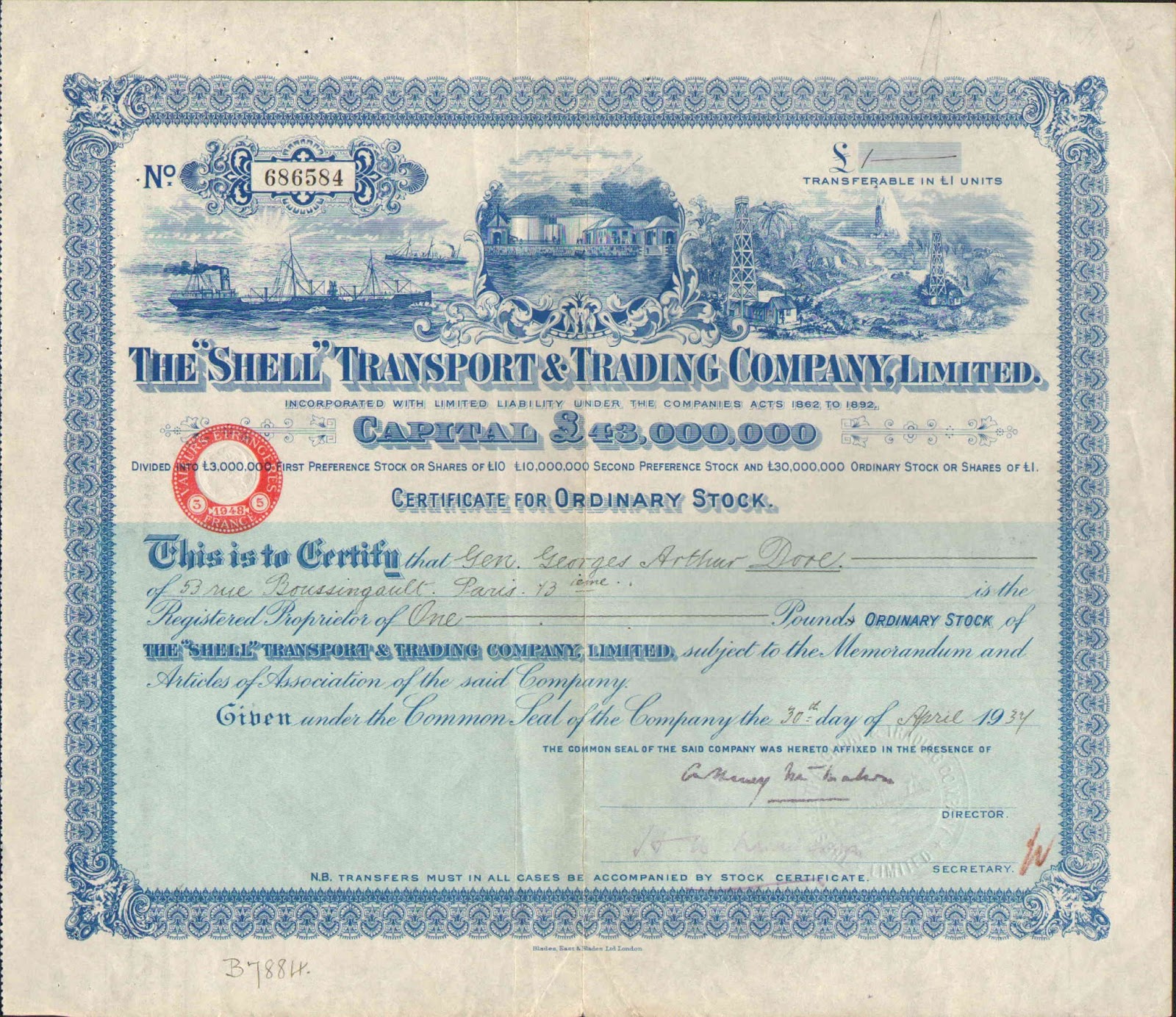
The "Shell" Transport and Trading Company Limited stock certificate
Image courtesy : Geert Leemeijer


This is an odd couple
Both look like standard certificates. They also resemble each other :
  • Both are issued by The "Shell" Transport & Trading Company, Ltd
  • Both are printed by Blades, East & Blades Ltd.  
  • And both state a capital of £43,000,000.
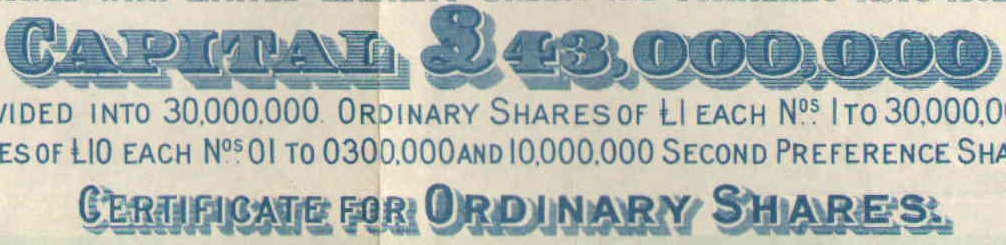
Yet, there is something strange about this pair. Did you notice that the first one is issued as a £1 ordinary share, and the second one as a £1 ordinary stock certificate ? You can verify this in these details.

detail from certificate No 1

detail from certificate No 2


Certificate No 1 was issued almost ten years earlier than certificate No 2. That raises the question why change the lettering from "share" to "stock" ? Why would a company want this : there is no change in the capital structure, and after all stock and share mean the same thing.

A matter of modern language ?
Geert Leemeijer aka Stockold Scripophily brought these two examples under attention in the Collectible Stocks & Bonds Facebook group. Geert suggested that over time the term stock certificate became more popular than share certificate. The different lettering on these securities was ".. a matter of modern language".

Here is an overview of the Shell examples provided by Geert with the date of issue and the stated capital :
  • shares
    • 1920 - £23,000,000 - 20 ordinary £1 bearer shares , blue
    • 1925 - £43,000,000 - 5 ordinary £1 bearer shares, brown
    • 1929 - £43,000,000 - ordinary £1 registered shares, blue
  • stocks
    • 1937 - £43,000,000 - ordinary £1 registered shares, blue
    • 1937 - £43,000,000 - 1 ordinary £1 bearer share, red
    • 1954 - £88,000,000 - ordinary £1 registered shares, blue
    • 1957 - £113,000,000 - ordinary £1 registered shares, blue

Two of these are displayed above, the others are grouped in the paste-up image below. The set illustrates the transition from share to stock for the Shell company.

share and stock certificates from the "Shell" Transport and Trading company
"Shares" in the upper row, "stocks" below.
The brothers Marcus and Sam Samuel founded The "Shell" Transport and Trading Company in 1897.
Their father imported and sold sea-shells and that's how the "Shell" company got its name. 
Image courtesy : Geert Leemeijer


Shell is not the only one
Other British companies also favoured stocks above shares. The UK section of Tabak-Peter shows the following examples :
  • British-American Tobacco Ltd
  • The Imperial Tobacco Company (of Great Britain and Ireland) Ltd. 
Earlier certificates from these companies are printed as shares and later ones as stocks.

Another example is the J. Lyons & Company Ltd.  J. Lyons started as a spin off from the Salmon & Gluckstein tobacco company at the end of the 19th century. The company expanded into a chain of teashops, ran high class restaurants and started to manufacture biscuits and later ice cream.

J. Lyons and Company Limited preference shares certificate overstamped as stock certificate

J. Lyons & Company, Limited
7% Preference "shares" of £1, 1923
The red stamp on the certificate, see below, tells us that 
The Shares referred to herein were converted into stock on the 24th June, 1940


J. Lyons developed original ideas about what the future of business could be like. After World War II they supported the EDSAC computing project at the University of Cambridge Mathematical Laboratory. In 1959 J. Lyons built their own computer, called Lyons Electronic Office I. Based on the EDSAC design, LEO I handled the company's accounts and logistics.

J. Lyons and  Company Limited stock certificate. A computer pioneer.
J. Lyons & Company Limited
7% Cumulative Preference "stocks" of £1, 1958
PS : Former British Prime Minister Margaret Thatcher worked 
as a food research chemist for the company around the 1950s.

UK stocks and shares in the Turbulent Thirties
Google's Ngram viewer displays charts that show how often terms, or phrases, occur in a corpus of books over a preselected number of years. The Y-axis shows the percentages of references to each term from all terms Google has indexed for a year (X-axis) in the entire corpus.


Google Ngram viewer chart shows a decline for the word share certificate in the British English corpus
Google Ngram viewer shows a decline for the term
share certificate from the 1930s till the early 1940s.
double-click image to enlarge

The corpus used in the chart is British English. It consists of books in the English language published in Great Britain. The chart illustrates a decline for the term share certificate over a period from the 1930s till the early 1940s (blue line). Meanwhile stock certificate saw an increase at the end of the 1930s. You can also check the same with the American English corpus, but the share certificate pattern is not repeated in that graph. According to Google Ngram's data, the term share certificate became more popular again from the 1960s.

Apparently during the 1930s it was trendy to speak of stock certificates in the UK. In this period a number of British companies preferred to market their securities as stock certificates instead of share certificates. Possibly this can be explained by the increase of intercontinental (American) aviation, radio, and film. A matter of adapting modern language.

F.L.

Related links


Sunday, February 13, 2011

The archipelago of the Philippines

7107 is the number of islands in the archipelago of the Philippines. The 11 largest islands make up 95% of the total land area. Their often whimsical coastlines amount up to 36289 kilometers, which is almost as long as Russia's 37653 km.
A typical Philippine island has mountains that are surrounded by coastal lowlands. The islands are volcanic in nature as these are part of the Pacific ring of fire (see here). As a result the islands have rich mineral deposits. The Philippines have the largest gold deposits after South Africa.

Consolidated Mines, Inc.
Certificate for 19000 shares, 1946