Showing posts with label hotels. Show all posts

Sunday, April 24, 2022

Scripophily Puzzle No. 6 - solution

I'm sure you recognized the Disney vignette as one of the three visual cues from Puzzle No. 6 . Even with the other vignettes provided, solving the puzzle was not straightforward. Yet I did receive one correct answer.

The three visual cues were clippings from three different stock and bond certificates. The common link between the cues was a particular object.

The correct answer for the puzzle was ... (drumm roll in the background) ... the Liberty Bell.


Shares from the American Union Fire Insurance Company from Philadelphia, PA, show the Liberty Bell in front of the city's Independence Hall. Printed by the Security Bank Note Company, this share certificate was issued in 1910. Things were not going well for the insurance company. It liquidated in 1913. 


The Liberty Bell was made in Great Britain by a foundry that became known as Whitechapel Bell Foundry, a producer of many famous bells such as the Big Ben in London.

Pennsylvania commissioned the Liberty Bell in 1751 to celebrate the 50th anniversary of William Penn's Charter of Privileges, Pennsylvania's original constitution. After a rough passage across the Atlantic, the bell cracked when it was first rung.

Two Philadelphia workmen, John Pass and John Stow, recasted the bell. Its large distinctive crack, also visible in the vignette above, originated somewhere in the first part of the 19th century. The bell was placed in the tower of the Pennsylvania State House, aka Independence Hall. This leads us to the first cue.


These bonds, issued by the City of Philadelphia in 1866 (upper right image) and 1861, feature the same vignettes, including the city's Independence Hall that housed the Liberty Bell for about two centuries. It is now located in the Liberty Bell Center. This pair of bonds was sold at Holabird Americana's Dec 2020 auction at $50 without buyer's premium. 


The bell became a symbol of freedom. In the 1830s several anti-slavery journals featured the bell in their publications. In 1853 President Franklin Pierce visited Philadelphia. He spoke of the bell as the symbol of the American Revolution and Liberty.

George Lippard writes his "Fourth of July, 1776" in 1847. In that story a young boy instructed an aged bellman to ring the bell on America's Independence Day. But that was not correct. Historians assume that the Liberty Bell rang on July 8th to summon the people to hear the Declaration of Independence read out aloud for the first time. Anyway, Lippard's story was widely reprinted and retold as 'historical fact' for many decades to come.

On the occasion of Philadelphia's 1876 Centennial International Exhibition a replica of the Liberty Bell was cast. It weighed 13,000 pounds (5900 kg), more than six times the weight of the original bell.

The Liberty Bell was not displayed at Philadelphia's Centennial Exhibition. But it made several trips to various other expositions and celebrations in the years thereafter. This brings us to the second cue of puzzle No. 6.


The World's Columbian Exposition, aka Chicago's World Fair, took place in 1893 to mark the 400th anniversary of Christopher Columbus' arrival in the New World in 1492. With 46 countries participating, it attracted over 27 million visitors. This $10 shares certificate from 1893 was printed by the Western Bank Note Company. It sold for $400 excluding buyer's premium in Holabird Americana's 2018 October auction. 


In 1893 the Liberty Bell was sent to Chicago's World Columbian Exposition as a highlight of the festivities. It was not the only big bell on display there.

For the World's Columbia exhibition a much larger Columbian Liberty Bell was casted. Two days before the end of the exhibition, Chicago's Mayor Carter Harrison sounded his "new" bell at his final speech on 28 Oct 1893. A few hours later Harrison was assassinated.

The original Liberty Bell returned from Chicago bearing a new crack. Wherever it went, the bell attracted millions of people, more cracking occurred, and souvenir hunters chipped pieces away from it. After 1915 Philadelphia refused any further requests for having the bell featured in events like that.

There was also a third "bell" present at the Chicago event. It was a full-sized model of the Liberty Bell made out of oranges by the State of California. This brings us to our last cue for this puzzle which showed Walt Disney and several Disney figures.


In Holabird Americana's May 2021 auction this Walt Disney stock certificate went $120 excluding buyer's premium. The company displays a full-sized replica of the Liberty Bell in Walt Disney World, Florida. 


As part of the US Liberty Bell Savings Bond Drive, the US government ordered 55 full-sized replicas of the Liberty Bell in 1950. These were casted by Fonderie Paccard in France. Shipped as gifts to US states and territories the bells were to be displayed and rung on patriotic occasions. 

In 1989 Walt Disney ordered another bell casted by the same foundry from the same mold. It stands now on Liberty Square in the Magic Kingdom, Bay Lake, Florida.

The Liberty Bell sometimes appears on coins, stamps, bonds and stock certificates. I'm interested to see other examples from the latter category. Several American corporations have used the bell's name and image, but none so daringly as the restaurant chain Taco Bell.

On April 1, 1996, Taco Bell launched an ad in the newspapers posting that it had purchased the Liberty Bell and renamed it the "Taco Liberty Bell". Thousands of outraged people had called Taco Bell headquarters and the bell's caretaker, the National Park Service. By noon it was told that the story was a joke. The company's publicity stunt allegedly led to nearly a $1,000,000 rise in sales that week.

I received one joint correct answer on this puzzle from Randy & Scott. Well done! You are now entitled a portion of "eternal fame".


F.L.

Reference links


Saturday, August 14, 2021

Watermarks in Scripophily - part 2 Paper manufacturers

In Watermarks in Scripophily – part 1 I introduced you into the world of watermarks specifically on bonds and shares. This time we’ll talk about watermarks created by the paper makers themselves, perhaps the most obvious category of watermarks in scripophily. 

The first watermarks appeared in Italy during the 13th century. They were used to identify the papermaker or the trade guild that manufactured the paper. An interesting question is whether watermarks were invented, or just a side effect in the production process?


images 1a and 1b: When viewed against a light source, this Nira Valley Sugar Co share reveals a watermark pattern of bold vertical and faint horizontal lines. This is an example of laid paper. A detail of the pattern is shown here below. Click images to enlarge. The actual company and its share was described and illustrated in part 1 of this series, see here


European paper was initially made by dipping a wooden-framed screen, a lattice of metal wires, into a tub of warm water and cellulose fibers, scooping up this pulp, and then letting the water drain out. The cellulose came from cotton linters or recycled cloth (rag), and only much later wood fibers were used too. 

The cellulose fibers subsequently matted into a thin layer against the screen. For hundreds of years these screens had a rectangular design with widely-spaced vertical “chain” wires and closely-spaced horizontal “laid” wires tied on top of the chain wires.

In the process the wires in the screen compress the pulp fibres and reduce their thickness. The resulting patterned portion of the paper is thinner and lets more light through than the surrounding paper. 

The laid wires yield faint lines in the watermark. Chain wires have a greater impact and are responsible for the bolder lines. This type of paper is known as laid paper. A nice example can be seen above in images 1a and 1b.


images 2a and 2b: The Swedish immigrant Willgodt T. Odhner invented the Arithmometer, a pinwheel calculator. Following the Russian revolution, his company moved from St. Petersburg to Göteborg, Sweden. This 1918 share’s watermark reveals a coat of arms of the paper manufacturer Lessebo, a crowned beehive with the date 1719. The words ‘Handgjord Post’ translate as ‘handmade post’. Image courtesy Wilhelm Leiter 


Paper makers found out that they could add special designs to the watermark by sewing wire designs to the screen frame. A paper maker could now incorporate its coat of arms, a logo, or its name into the watermark. The product could now be identified and became difficult to counterfeit. An interesting example is the Original-Odhner share, see images 2a and 2b.

Often paper makers have a remarkable history. The Original-Odhner’s share’s paper manufacturer is Lessebo Paper. The paper mill was originally an iron mill established in the 17th century. In the 1690s the mill started making heavy paper for paper cartridges used for containing a bullet and gunpowder. In 1719 the mill gained permission to manufacture paper, a date that you see in the company’s coat of arms (image 2a). Lessebo Paper still manufactures hand-made paper today.

Over time, the production of watermarks became mechanized. During manufacture paper pulp is passed through rolls with a raised design. The designs applied on the rolls cause density variations in the produced paper. In turn, these density variations make an image or a pattern appear in the paper in the form of various shades of lightness and darkness. We speak of multi-tonal watermarks.

A relevant example can be seen in part 1, see there, namely the Indian Post Office 5-Year Cash Certificate. That paper shows light, dark and even multi-tonal watermarks giving the viewer an impression of depth. Another fine example can be seen on a Olivetti bond, see images 3a and 3b.


Images 3a and 3b: Ing. C. Olivetti & C. was founded in 1908 as a typewriter manufacturer and evolved into computers and smartphones. This certificate, issued 1948, has a watermark pattern, a repeating design that is applied all over the surface of the paper. Watermark patterns can be seen on many Russian railway bonds. In most cases it is not possible to detect whether patterns like these were designed by the paper manufacturer, or by commission of the certificate’s printer or issuer. The pattern on this Olivetti bond consists of diagonally placed geometrical figures. The multi-tonal shade gives you an impression of depth and the pattern appears as a structure of ‘buttons’, looking like bubble wrap plastic, something I usually cannot resist popping! 


In the 1700s James Whatman started a paper making business in Maidstone, Kent. He experimented with the wire screen used in the process. Whatman replaced the lattice of laid and chain wires with a screen of a much finer woven mesh of wires. As a result, the paper was formed on a much more uniform surface and showed no watermark pattern of lines, unless a wire design had been sewn to the screen. This type of handmade paper is called wove paper, and its invention led to what we know as modern paper today.

Whatman was probably the first paper company that added a year to its watermark, see image 4b. You may discover on your certificates watermarks by other paper makers incorporating a year as well. The shares in the United Commercial Bank, Calcutta, issued in the 1960s, show the T H Saunders (or parts of it) name with the year 1946. That company was founded by Thomas Harry Saunders. Famous for its diversity in watermark designs used on stamps, bills of exchange, securities, and the like, Saunders won medals at international exhibitions for his light and shade watermarks that were used to prevent frauds.


Images. 4a and 4b: Established in the 1840s as the Auckland Hotel, Kolkata’s Great Eastern Hotel, today known as the LaLiT Great Eastern, hosted many notable persons like Nikita Khrushchev, Elizabeth II, Dave Brubeck and M K Gandhi. This 1937 share was printed on wove paper. Its watermark shows the WHATMAN name, ‘HAND MADE’ and the year ‘1916’. 


You cannot interpret a year in a watermark as the year of paper production or as a print date. It should be seen as “paper produced not earlier than” because mills did not always update their watermarks.

Besides their name and coat of arms, paper mills sometimes added to the watermark an indication of the paper brand and the paper quality. That made it easy for stationery businesses and printers to look up the right type of paper in their inventory. As an example, I show here an American paper, see images 5a and 5b.


Images 5a and 5b: The Q1 Corporation was a pioneering microcomputer company. In 1972 they delivered the world’s first personal computer based on an 8-bit general purpose microprocessor, the Intel 8008. The share bears the watermark of the Strathmore Paper Co, founded in 1892, West Springfield, Massachusetts. The watermark shows the brand ‘Strathmore Script’ and its quality ‘100% Cotton Fibre’. Cotton fibres are strong yet soft and create a uniform paper surface that is strong and flexible. 100% cotton paper is often used for banknotes. 


In some cases, paper makers add to their watermark the location where the paper was made. Some examples from Indian shares: The Rajnagar Spg. Wvg. & Manufacturing Co Ltd, preference share, 1945, was ‘MADE IN ENGLAND’ and a 100 Rupees share in The Birla Mills Ltd, 1920, reveals ‘MADE IN CANADA’.

More of a surprise is a 100 Rs share from The Gold Mohur Mills Ltd, 1926, Bombay, telling us ‘MADE IN AUSTRIA’. Another example that illustrates the export of quality paper products is shown in images 6a and 6b.


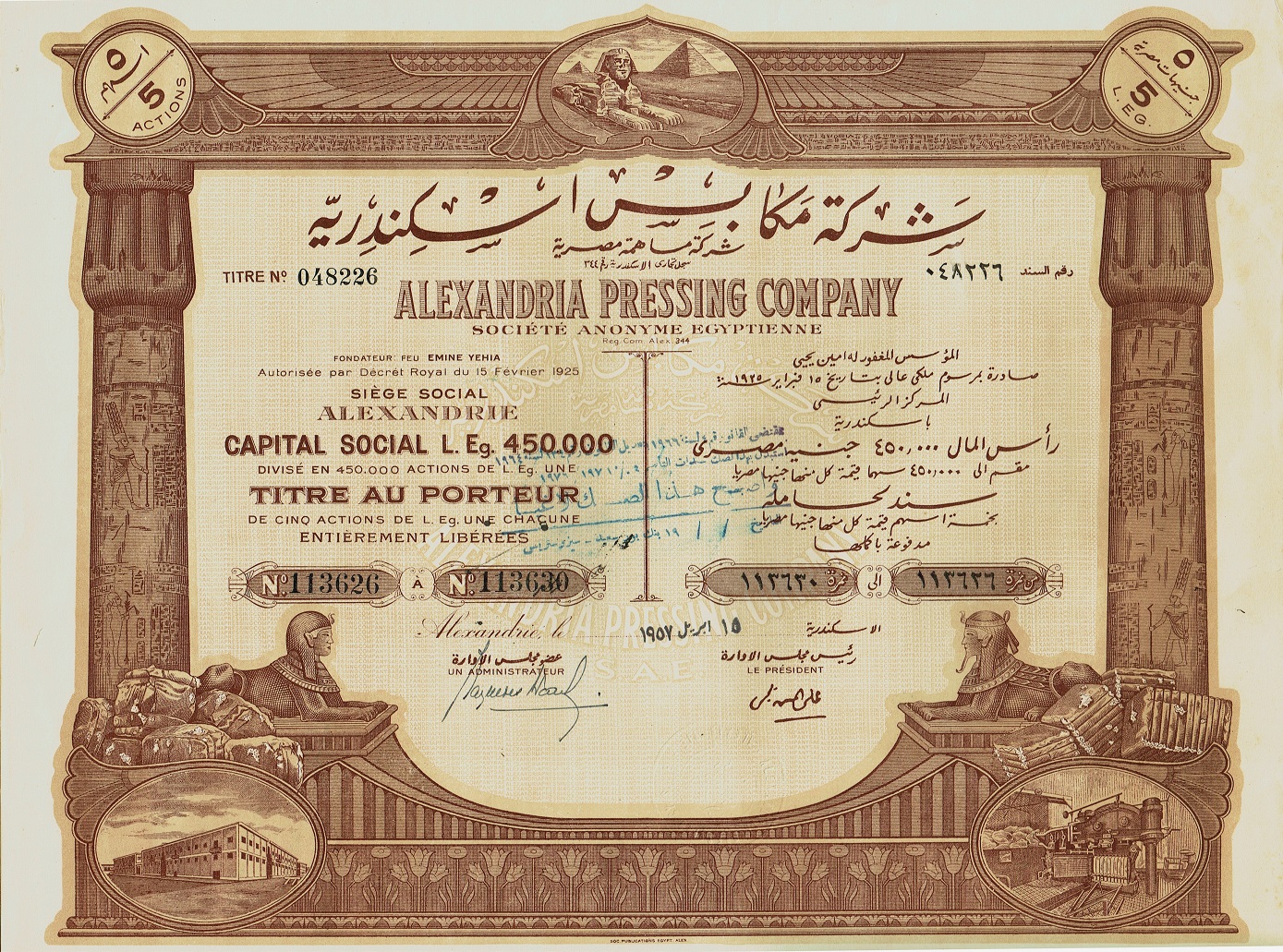
Images 6a and 6b: From Egypt, the shares from the Alexandria Pressing Company that were issued in the 1950s have a watermark showing the name of the Norwegian company ‘BORREGAARD’, the paper type ‘TUB SIZED LEDGER’ and the location of the paper mill ‘MADE IN NORWAY’.


I conclude this part in the series with one of my favorites: a share in The Dahramsi Morarji Chemical Co Ltd, Bombay (DMCC). Its watermark shows the line LUCKY PARCHMENT, a design of a jockey racing a horse, and the words RAG CONTAINING underneath. See images 7a and 7b below.

Parchment paper is not to be confused with “parchment”. The latter is a writing material made from animal skin. The former is a type of cellulose-based paper (made from wood pulp and cotton fibers) which has been treated chemically to make the paper stronger, more heat resistant and above all non-sticky.

You’ll find the words PARCHMENT also in the watermarks of shares from McLeod and Co, Ltd (1940s) and many other scripophily examples. In my example, LUCKY PARCHMENT is a parchment paper brand from the Indian paper company Ballarpur Paper and Straw Board Mills, Ltd.

RAG CONTAINING is another line of text in the DMCC watermark. Rag paper or cotton paper is primarily made of cotton linters or from used cloth (rags). Cotton paper may last many decades without any sign of deterioration, see also images 5a and 5b before.


Images 7a and 7b: This share in The Dahramsi Morarji Chemical Co Ltd was issued in 1968. The company's headquarters were located at Dr Dababhoy Naoroji Road in Mumbai. The certificate shows the coat of arms of the company, including a tiny map of India, and has a watermark of a racing jockey. 


The DMCC’s remarkable jockey watermark seems unrelated but it is not. I learned from scripophily expert Sayeed Cassim (see also here) that the Ballarpur paper company was founded by Karam Chand Thapar, who headed the Thapar Group of companies. The Thapar family was involved in race horse ownership, hence the jockey.

Time for a quick review. The first watermarks were formed, likely unexpectedly, in the production process of what we now call laid paper. Paper makers then added a logo, their coat of arms, or their name to the watermark design. Some of them further added a year, a paper type or brand, and also a location where the paper was made. If you haven’t done so already, you might start viewing your certificates against a window.

In part 3, I’ll show that paper manufacturers start adding watermark elements on behalf of one of their important customer segments: security printers.


F.L. 

This article was initially published in Scripophily magazine No. 114, December 2020. 
You might be interested to read : Watermarks in Scripophily - part 1 Introduction 


Saturday, January 23, 2021

Scripophily Puzzle No. 4 - solution

In Puzzle No. 4 we were looking for a novel. This time, three scripophily detectives gave the correct answer. "A bit too easy" I was told. 

In order to solve the puzzle, I provided you two visual cues : details from the designs of a bond and a share certificate. Let's have a look at them.


The first image shows a logo consisting of the interlaced letters W and L flanked by two lions and a banner underneath. The banner shows some words. Click the image to enlarge it. You can't distinguish all the words but Compagnie, des, Lits and Européens must be clear.

Googling these words brings up links to the Compagnie Internationale des Wagons-Lits. In the Google Images results pane you'll find a similar logo, and likely, an image of one of the company's bond certificates like the one shown here.


The Compagnie Internationale des Wagons-Lits et des Grands Express Européens, in short CIWL, was founded by the Belgian Georges Nagelmackers in 1872. His business pioneered in luxurious on-train catering and sleeping car services. CIWL operated the famous long-distance Orient Express that originally ran from Paris to Constantinople (Istanbul).


The second image shows a fragment from a share certificate. We can read [H]ôtel de Constantinople, and you can also detect a stamp that mentions Société Française des Grands Hotels Internationaux. All-knowing Google tells us that we are talking about the Pera Palace Hotel in Istanbul. 

The Pera Palace was built in 1892 for the CIWL. The company needed a suitable hotel at the final destination of its Orient Express. Among its famous guests were : Mustafa Kemal Atatürk, Ernest Hemingway, Queen Elizabeth II, Alfred Hitchcock and Jacqueline Kennedy.


Using the words Wagons-Lits and book, or even novel, in your next Google search yields many results to multiple publications. So does Pera Palace combined with the words book or novel. Obviously, both are popular subjects.

A better idea was to search for the combination of all these words : Wagons-Lits, Pera Palace and novel, or, even better, Orient Express and novel. The outcome leads you to the solution : Murder on the Orient Express, a novel written by the English writer Agatha Christie.


Christie's famous book appeared in 1934. It brings the story of Hercule Poirot, a Belgian detective, who returns from the Middle East on the Orient Express. The train is stopped by heavy snowfall and a murder is discovered. Poirot's trip home to London is interrupted to solve the murder.

Agatha Christie stayed on several occasions at the Pera Palace from 1926 through 1932. It is said that she wrote there Murder on the Orient Express in her favored room, 411. Did you know you can still book her room for your stay in Istanbul ? 

Did Agatha Christie ever travel on the Orient Express ? As a matter of fact, yes, she did, more than once. Her first journey on the Orient Express was in late 1928, only a few months before a blizzard, near Cherkeskoy, Turkey, stranded another Orient Express for six days. And in December 1931, when Christie returned from her husband's archaeological dig at Nineveh, aboard an Orient Express, sections of railway track were washed away by heavy rainfall flooding. 


In scripophily, we have seen bonds and shares that were issued to or signed by famous authors like Ernest Hemingway and Mark Twain. Wouldn't it be a baffling mystery if a share issued to Agatha Christie would turn up in suspicious circumstances ?

To conclude, scripophily detectives DB and RS provided a correct answer, but is was SC who was the first to solve puzzle no 4.  Great job everyone. You are now entitled a portion of "eternal fame".


F.L.


PS 


Saturday, August 20, 2016

What is a share certificate, what is a stock certificate ?


Share certificates are no testimonies of charity, nor are stock certificates a special kind of inventory lists. But what are they? If you are not really into finance, you might not know what these objects stand for. 

Millar Loom share certificate issued to Lieutenant-Colonel Enrnest Richard Hope Torin
The Millar Loom Company Limited
Share certificate for 100 shares of £1, printed by Howard and Jones, London
double-click image to enlarge
-
The Millar Loom Co Ltd was formed to buy patents for a new type of loom.
This particular share issued in 1898 mentions that Lieutenant-Colonel Ernest Richard Hope Torin
is the Registered Proprietor of the certificate. From 1874 to 1884 he served 
with the 13th Hussars cavalry (Baden-Powell) in India and Afghanistan . 
You can see Torin's picture here


Synonyms
Both terms, share certificate and stock certificate, mean the same. They are synonyms. The former is more widely used in Commonwealth of Nations countries (e.g. UK, Canada, Australia, India), the latter is preferred in the US. The word stock refers to the capital stock of a company.

Here are the terms in some other languages :
aandeel , action, actie, Aktie, részvény, azione, acción, ação, osake, acțiune, hlutabréf, hisse senedi, aktiebrev, АКЦИЯ, АКЦIA, μετοχή, תעודת מניה, शेयर, 股權證書, 株券, 주권 , شهادة الأسهم
Just like in English, probably every language has its own synonyms. In Germany we speak of Aktie and Anteilschein, in France of action, part or titre, in Swedish aktie and aktiebref, in Spain acción, parte and cédula.

Art Nouveau design in the acción al portador from the Minas de Carmenes company
Minas de Cármenes Sociedad Anonima
Share of 500 Pesetas, série A, Gijon, 1903
-
A bearer share certificate, in Spanish:acción al portador, 
is issued without mentioning the shareholder's name. 
The lower half of the certificate shows 32 dividend coupons.

Ownership in a company
In order to explain what these certificates are, I must tell you first about companies. Suppose you want to start a business. Then you will need an amount of money to get your business up and running. You likely will have to lease or invest in business assets, pay for work or services, buy consumer goods, and lots of other things.
But your financial resources may not be sufficient; or, you might want to share the investment risk with others. These are the main reasons why you form a joint-stock company. In that case, you allow others to participate when they co-invest in your company. In return they receive share certificates in your company in proportion to the amount invested. So, a share certificate represents ownership in a company.

Stichtersaandeel in  Ypersche Weverij - Le Textile Yprois uit Ieper
Ypersche Weverij Naamloze Vennootschap
Le Textile Yprois Société Anonyme
English : Ypres Textile Company
Registered founder's share, 1924
-
Registered shares mention the name of the shareholder,  
which is also recorded in the company's shareholders register.
It is an effective method for the company to stay informed 
about its shareholders.

Physical papers
A share certificate is a piece of paper that mentions the name of the company, the number of shares owned, the date of issue and an identification number. To avoid forgery, their designs contain a number of security features such as legal signatures of company officers, corporate seals, water marks, engine turned designs, etc.
Share certificates were created decades and even centuries ago. The lucky ones that have survived such a long, often remarkable journey through time are now residing comfortable with other companions in a collection or even a museum. Now, share certificates have mostly been replaced by electronic accounts in today's financial networks.

Tagalsch Prauwenveer stock certificate mentions ownership transfers on rear
NV Tagalsch  Prauwenveer
Registered share of 600 Gulden, Batavia (Jakarta), 1902
The company operated a proa ferry and ship unloading service
 at Tegal at the north coast of Central Java. 
The rear side (right image) tells us that the share 
was transferred to a new owner in 1920 and later in 1938. 
double-click image to enlarge

Being a shareholder
Shareholders are only liable for the company's debts to the value of their shares. This concept of limited liability is one of the success factors of this type of business organization. Shareholders have voting rights at the company's shareholder meetings. And they can expect to receive a proportional share in the company's profits. When the company dissolves, they receive a proportional share of the liquidation proceeds.

Bearer share (Inhaber) from the Walther Electronic Aktiengesellschaft, Germany
Walther Electronic Aktiengesellschaft
1 Share of 50 DM, issued Gerstetten 1979, with corresponding dividend coupon sheet
This company originates from 1886 when it started manufacturing tools and guns. 
In the 1970s Walther produced electronic calculators and text processors.
-
Many German shares are bearer shares stating that Der Inhaber dieser Aktie 
ist bei der Aktiengesellschaft nach Massgabe der Satzung als Aktionär beteiligt,
which means that the owner (Inhaber) of this share is a shareholder 
of the company in accordance with the company's rules. 

Registered versus Bearer 
When the name of the shareholder is registered in the company's share register, the issued certificate will state his/her name and therefore is called a registered certificate. When it is sold, the name of its owner will be replaced in the company's share register. Either a new share will be issued for the new owner and the old certificate will be cancelled, or the name of the previous owner will be overwritten on the certificate, and a statement of ownership transfer is written on the rear.
Bearer shares, on the other hand, do not mention the owner's name. These are owned by an anonymous "bearer". Such shares can be sold to another party without the knowledge of the company. Bearer certificates have been popular because they were easy to sell (without transfer taxes).

registered stock certificate from the Chicago, Burlington and Quincy Railroad Company, dated 1903
Chicago, Burlington and Quincy Railroad Company
Stock certificate for 100 shares issued in 1903 to Henry Clews & Co.
Almost all American stock certificates are "registered" and state that 
shares are transferable only on the books of the company in person or by attorney...

Dividends
A company usually distributes a fraction of its profits among its shareholders. A certain amount for each share will then be allocated. The income received from the ownership of shares is called a dividend.

  • In case of a registered share certificate, only the officially registered shareholder receives dividend payments. Dividend payments were often written on the rear side of the certificate. 
  • Bearer certificates have a sheet of dividend coupons. In return for a clipped coupon, a shareholder receives a dividend payment. By counting the number of missing coupons, one can tell how many dividends have been paid out.

Vereenigde Oost-Indische Compagnie (VOC)
In 2010 Ruben Schalk, history student at the Universiteit Utrecht, 
discovered the so far oldest share in the world in the Westfries Archief in Hoorn. 
The certificate dates from September 9th, 1606. 
The second page records the payments of dividend.
Source: Wikipedia.

Amazing, exotic and even weird species
The world of share certificates would certainly have interested Alexander von Humboldt whose work on botanical geography laid the foundation for the field of biogeography. As centuries passed, share certificates adapted to new political, economical and regional conditions and evolved into several types (founding shares, preference shares, et cetera) and local varieties. 
Do they teach scripogeography at Oxford ?

25 shares of 4 Egyptian pounds in the Stationery Industries company from Alexandria

Stationery Industries (Société Anonyme Egyptienne)
Titre Nominatif de 25 Actions de L.E.4
English: Registered certificate for 25 shares of 4 Egyptian Pounds
Alexandria, 1956
-
This "hybrid" share certificate has some bizarre characteristics. 
a) It is a registered certificate, yet there is a dividend coupon sheet attached 
(partly visible in the upper image). 
b) Although it is a registered certificate, the name of the registered shareholder is not mentioned.
Was this an error in the print design?
c) Even though the first owner is unmentioned,  we see on the rear side 
dates (date de la cession) and names of new owners for two share transfers (lower image).


F.L.

Related links


PS 😉 : Who is in 2016 the most known person in the world ? Tip: it is a shareholder.

Trump Hotels & Casino Resorts, Inc.
This certificate looks like and is produced in the same way as a share certificate, but it isn't one. 
It is a specimen certificate. More about specimens in Euratom specimen or proof ?
Image courtesy : Scripophily.com 


Tuesday, March 15, 2016

Scripophily 99 reveals the first scripophilist in the history of mankind

The last issue of Scripophily magazine, No. 99, released in December 2015, features again articles with high scripophily content. Some statistics :
  • number of pages : 32 pages
  • number of bond and share images : 64
  • number of auction reports : 32
  • number of authors and reporters : 15

To me, the big surprise in this issue was the story on the first scripophilist. Most introductory texts in the hobby speak of early collectors in the 1970s. I've always thought that the oldest scripophilist (a collector or researcher of antique stocks and bonds) was Grover C Criswell. Criswell published his book Confederate and Southern State Bonds in 1961, that is 55 years ago. 

But in this issue, Scripophily author Max Hensley brings us the story of his findings in a California archive. The author tells us ... 
(the archive) contains what I believe to be the first documented intact US scripophily collection. I'm not talking about the usual accumulations of stocks assembled by archivists into 'collection' files, or accumulations from lawyers, trust companies, corporations and others who acquired their certificates in the ordinary course of business rather than by any collecting impulse.
The article contains lots of details on the collection, and is a fascinating read. You can actually feel the author's excitement in this scripophily adventure. The bottom line is that this first collector has a name, Andrew J Moulder, and that he was collecting in the 1890s or even sooner. This dates our hobby more than 125 years back from today. A must read to any serious collector.

Scripophily 99 front cover depicts 1854 Cocos Island Treasure Company share
Scripophily 99's front cover depicts a startling
1854 Cocos Island Treasure Company share,
one of the treasures in the Moulder Collection.
double-click image to enlarge

What's else in the magazine ? Here's, an overview of the other stories in Scripophily's last December issue :
  • The road ahead, a statement for the near future by IBSS chairman Martin Zanke
  • Herzog Collection debuts at Wall Street Collectibles Show
  • John Herzog on selling his collection, interview with the man himself
  • The Wall Street vignette
  • Let me entertain you with antique stock certificates - by Fred Fuld III, book review
  • The Stockton & Darlington Railway
  • Oldest Siemens share certificate
  • French colonial companies, interview with Alain Léger
  • The first US scripophilist ?
  • Hotel Arcadia - Santa Monica California
  • 50% growth in worldwide auction sales - four months to Nov 2015
  • Ottoman Railways
  • Cox's Corner : More catalogs please
  • Other periodical topics : society matters, news, bourse reviews, auction reviews, events calendar, member classifieds, book reviews, interviews and lots of pictures of collector friends and scripophily
Scripophily magazine is a publication from the International Bond & Share Society.

F.L.

Related links

Wednesday, January 7, 2015

Innovative service for first-class collections

Last year, the Centrum voor Scriptofilie (or Scripophily Center in English) announced SCRIPOCOLLECTIONS.com : an online service for its customers. This is not just another online web presence. On the contrary, Mario Boone, director of the company, came up with a new, innovative way of handling third-party collections online. Worthwile to write a few lines about it.

Read on, when
a) you are an advanced collector and it has become difficult to complete your collection
b) or, you need to sell your collection in its entirety
c) or, you are looking for an interesting investment opportunity

How does SCRIPOCOLLECTIONS.com meet these needs ? Well, the service offers an Internet platform to display collections from collectors who :
  1. wish to receive offers for missing pieces
  2. wish to sell their collection in their entirety
  3. a combination of both the above.
The role of the service provider is supportive: 
  • making a digital inventory of the collection
  • optionally scanning shares and bonds
  • display a collection online
  • estimate the collection
  • finding a buyer for the entire collection
  • mediate between the customer and potential sellers of new entries of a collection
  • ensuring customer's privacy by default
  • et cetera
You are correct when you say that these kind of activities are common practises for auctioneers and antique dealers. But, at least to my knowledge, it is the first time I see this implemented by means of a web platform targeting the world wide public.

Possibly there is something in it for you, I mean even when you are not planning to put your collection online. Do you have a bond or share certificate for sale that can supplement one of these collections ? Contact the Scripophily Center, maybe your piece finds a new home. 

More info available on SCRIPOCOLLECTIONS.com.

Below are some images from the collections currently on display.

F.L.

Staeten van Vlaenderen
Loan 2400 Gulden, 1780
issued to Bisschoppelijk Seminarie van Brugge
(Episcopal Seminary of Bruges)
- Bruges collection -


Corpus Christi Ship Channel Company
Shares of $100 each, 1859
- US Canals collection -


Dioramique  Le Pelerinage de Jerusalem à Montmartre
Société de l'Exposition Dioramique 
Le Pelerinage de Jerusalem à Montmartre
Share of 100 Francs, 1887
Panoramas collection -


Companhia Carris de Ferro do Porto share certificate depicting bridge built by Eiffell
Companhia Carris de Ferro do Porto
5 Shares of 10$000, 1908
Portuguese Railroads collection -


bond from Compagnie du Chemin de Fer du Bas-Congo au Katanga
Belgian Congo
Compagnie du Chemin de Fer du Bas-Congo au Katanga
4% Bond of 100 Francs, 1911
Belgian Congo Railroads collection -


share certificate from Charbonnages de Limbourg-Meuse (steenkool Limburg)
Charbonnages de Limbourg-Meuse S.A.
Share of 500 Francs, 1949
Coalmines from Limburg (Belgium) collection -


printer proof Wagons-Lits
Compagnie Internationale des 
Wagons-Lits et des Grands Express Européens
5 Ordinary shares of 500 Francs, printer proof, 1954
Wagons-Lits collection -


Société de l'Union pour les Productions Agricole (Egypt)
Société de l'Union pour les Productions Agricole
Share
Egypt collection -
More about this top collection, see here .


N.B. Other online collections can be seen here.

Saturday, May 17, 2014

Reading Japanese dates on stock certificates

Japanese stock certificates are known for their elegant designs. Produced as colorful high quality prints, these securities often show little masterpieces. A tempting theme to collect. For classification purposes, besides the name of the paper's issuer you also need to know the certificate's issue date. Many of us however are not familiar with the Japanese language and writing system. In this post, I'll show you how you can recognize and read dates on your Japanese shares.

Share certificate of the Nippon Shoji Shintaku Kabushiki Kaisha, Osaka
Nippon Shoji Shintaku Kabushiki Kaisha
in English: The Japan Commercial Investment & Trust Co., Ltd.
10 Shares of 50 Yen, Osaka 1917

A minority of Japanese stock certificates are bilingual (Japanese-English). 
double-click image to enlarge
Source: HWPH

It requires only a few steps to learn how to read Japanese dates
That is correct. You need to :
  • recognize the year, month and day characters
  • know how Japanese numbers are composed
  • know about formal numbers
  • understand the date system
  • and read in the right direction.
The combination of each one of these skills seems to make the task tough. But each step is easy to learn. Stay with me all the way down. I'll guide you step by step through the process. At the end of this post I will congratulate you because you will have mastered a new skill : reading Japanese dates !

明 治 元 年
first year of the Meiji reign : 1868

The year, month and day characters in the common date format
The date 2014年04月30日 is written in the modern commonly used date format. It stands for April 30, 2014. The example shows that, together with Hindu-Arabic numerals, also Japanese characters are used. These characters stand for year, month and day, and it is important you can recognize them :
  • year :
  • month of year :
  • day of month :
In Japanese, the combination of this charachters form the word 年月日 'date'.


How to read Japanese numbers
You can write numbers in Japanese in two ways: with Hindu-Arabic numerals (1, 2, ..) , as in the date example above, or with Chinese numerals 一, 二 , ...). Guess what : old Japanese shares use the Chinese numerals for indicating the year, the month of the year and the day of the month. The table below shows the numbers 1 to 10. Look at the first two columns and for the moment just ignore the last two columns. 

double-click image to enlarge

As you notice, in Japanese, there is a special character for the number 10 (and also for 100, 1000, et cetera). Watch out now, to form a Japanese number larger than ten you need to apply the following rule :
If a number is followed by a smaller number, add both.

If a number is followed by a larger number, multiply them.

Some examples : 
  • 15 is written as  十五 ( 10 + 5 )
  • 36 is written as 三 十 六 ( 3 x 10 ) + 6
  • 23 is written as 二十 ( 2 x 10 ) + 3
  • 99 is written as  九十九 ( 9 x 10 ) + 9
This is fun, isn't it ? Now, you can already read Japanese numbers.

share certificate of Sony Corporation
Sony Kabushiki Kaisha - Sony Corporation
50 Shares of 50 Yen, specimen, 1970
Seal, Japanese (at left) and Western (at right)
 facsimile signatures of co-founder Masaru Ibuka

You too can understand the nengō date system
The common date format is not used on Japanese stocks and bonds, except for some recent certificates. In Japan, other date systems exist and the one we need is the nengō date system ( 'nen' or  means year)It is the official system for dating years used in virtually all government and private business.

Historically, Japanese dates were expressed as years of a named era called a nengō. The system was introduced from China around the 7th century. With the advent of modern Japan under the emperor Meiji, the eras have been tied to the reign of the current emperor since 1868. When emperor Hirohito ascended the throne on 25 Dec 1926, he chose the name Shōwa for his reign title. Therefore 1926 was the first year of Shōwa. Shōwa 2 represents 1927 and so on.  Here is an overview of the modern eras :
  • Meiji era, characters : 明 治 , first year of reign : 1868
  • Taishō era, characters :  大 正 , first year of reign : 1912
  • Shōwa era, characters :  昭 和 , first year of reign : 1926
  • Heisei era, characters :   平 成 , first year of reign : 1989
It is important that you can recognize these era names.

In Japanese writing, a specific nengō year starts with the emperor's era name followed by the year of the emperor's reign and ends with the year character . Two examples:
  • 昭 和 三 十 六 年  is Shōwa 36 (3x10+6), the 36th year in the Shōwa reign
  •  大 正 十 五 年 is Taishō 15 (10+5), the 15th year in the Taishō reign

For indicating the first year of reign, the "first" character is used.
So,  明 治 元 年 indicates the first year in the Meiji reign, which corresponds to 1868.

Sony Corporation logo used in 1970 on a share certificate.
Trinitron and Bravia televisions, Betamax videocassettes, Walkman and Discman, Handycam, Vaio laptops and Playstation consoles. Sony was founded as Tokyo Tsushin Kogyo Corporation (Totsuko) in 1946. In 1955 Sony was chosen as the new brand name derived from the Latin "Sonus" (sonic) and the American "Sonny", a term used to call a boy or young man in a familiar way. The first Sony-branded product, the TR-55 transistor radio, appeared in 1955. The name Sony was easy to pronounce everywhere in the world.  The company name was changed into Sony in 1958. At the time, it was rarely seen that a Japanese company used Roman letters to spell its name instead of the traditional Kanji characters.