Showing posts with label Italy. Show all posts

Tuesday, September 26, 2023

IBSS surprises members with full publications of Drumm & Henseler scripophily catalogues

The International Bond & Share Society is an association of people interested in scripophily. The society was founded in 1978 as a non-profit organization with the aim to promote, encourage and develop all aspects of scripophily. 

With members all over the world, the society publishes its flagship publication Scripophily three times a year.

Over a timespan of several months a small group of members cooperated in obtaining the copyrights of the pioneering Drumm & Henseler catalogs, digitizing those works, and making them available to its members as downloadable publications.  

The following catalogues can now be found on the IBSS site :


Italian Railways, by Drumm, Henseler, Witula


Ottoman Empire and Turkey, by Drumm, Henseler, Glasemann


Russian City Bonds, by Drumm, Henseler


Russian Railway Bonds, by Drumm, Henseler


You can find the publications here, but you must be logged in as a member to access this information. Still not a member ? Then this will help you out

F.L.


Tuesday, June 14, 2022

Schweizer Finanzmuseum celebrates its 5th Anniversary

In its Permanent Exhibition the Swiss Finance Museum explains the origins of the economic system and the role of the stock market. This unique museum is home to a collection of 10,000 historic securities from more than 150 countries. 

Key historical pieces, combined with interactive videos and animations, historical film recordings and interviews, tell the story of the development of our modern financial economy. The museum, since 2017 located at the new headquarters of SIX in Zurich, celebrates its 5th Anniversary.


Schweizer Finanzmuseum
view on the Permanent Exhibition 
image courtesy Schweizer Finanzmuseum


The museum welcomes the public to its Open Day on July 2, 2022 from 11 am to 3 pm with a dedicated program : 
  • 11 am - 12 pm: Combined tour (permanent and special exhibition), in German
  • 12h30-1 pm: Guided tour through the special exhibition Sport & Geld, in German
  • 1 pm -1h30 pm: Guided tour through the special exhibition Sport & Geld, in English 
  • 2 pm - 3 pm: Combined tour (permanent and special exhibition), in German

Participants of the Open Day should register here


This stunning 500 Lire share from Pirelli, printed by the Milan-based security printer Brevetti Calcografia e Cartevalori was issued in 1947. It is one of several antique shares on display in the Sport & Geld special exhibition. Pirelli, one of the top tyre manufacturers in the world, sponsored sport competitions since the start of the 20th century. Its financial backing was/is important to e.g. the FIA Formula One World Championship, football club Inter Milan, the Chinese Super League (football), the Hungarian Grands Prix (motorsport) and the Alpine World Ski Championship. 
image courtesy Schweizer Finanzmuseum 


The current special exhibition Sport & Geld shows why money plays such an important role in sports. Using the sports of Formula 1, tennis, equestrian sports, soccer and skiing, the exhibition gives a glimpse of the financial aspect of physical exercise. Sport & Geld can be seen until July 15, 2022. On display here are a dozen historical shares. 

The museum then closes for the conversion up to and including August 25, 2022. Its new special exhibition Banks in Transition: from Counters to Apps will features securities as well.  The opening of this new exhibition is planned for the end of August.

More info can be found here (German), or there (English).

F.L.


Tuesday, October 19, 2021

Spink London launched its E-auction of world bonds & share certificates

Precisely 560 lots of scripophily will go on Spink's E-block. This online sale already started at 15:00 Oct 11. The bidding window closes on Oct 25 at 11:00. At stake are antique stocks and bonds from all continents.

Large sections are reserved for scripophily from Australia, Russia, USA Railways, China, South Africa and Canada. More than 200 lots of British bonds and shares are offered representing many themes such as Banking, Canals and Railways, Mining and Shipping.


The Cunard Steamship Company certificate for 5 shares of £20 was issued in 1880. Its two vignettes show an ocean liner and the company's emblem with lion. The share was issued to and signed by William Cunard. L(ot) 261 in the auction 


The British shipping section counts more than 30 lots including this early Cunard Steamship Company share (illustrated). Here are a few of the interesting lots from this part :
  • L266, F. B. Woodruff and Co. Ltd., ship and country flag vignettes in color, issued in 1915 and signed by Fred. B. Woodruff
  • L288 is a share from The White Star Line, Limited. The company was the owner of the "unsinkable" Titanic that perished with more than 1500 passengers after striking an iceberg. 
  • The sale includes three shares of the famous P & O  shipping line, founded as the Peninsular and Oriental Steam Navigation, L276 through L278


The Royal Bank of Scotland was established about 300 years ago, in 1724. The bank invented the overdraft in 1728 which allowed merchants to withdraw money from an empty account. Today the bank counts around 700 branches, mainly in Scotland. L349 comprises of 5 capital stock certificates from this pioneering bank, all issued between 1891 and 1914.


A large British banks section consists of more than 60 auction lots. The Royal Bank of Liverpool is rarely seen on the collector's market: L348 includes two early shares from 1865. With illustrations of the York Minster and city walls, York City and County Banking Company shares are among the prettiest financial scripophily collectibles from the UK, see L357 through L362. Other famous names include Westminster Bank, L356, Midland Bank Limited, L341 and Barclays Bank, L306.


Antonio Salviati was an Italian glass manufacturer. His first company produced the mosaic glass for the altar screen for the high altar of Westminster Abbey, among other. In 1866 Salviati founded the Compagnia Venezia Murano with British capital that became an important producer of Venetian art glass. The Salviati factory in Murano remains a well known brand today. The Venice and Murano Glass Company, Limited (Salviati and Company, Limited) share bears a vignette of the Venetian lion and dates from 1889. L174 in the auction.


There is lots more to discover in this sale, so here are the details :
  • Location : this is an Internet only sale
  • Date : October 11 15:00 - October 25 11:00
  • Further info : see here 

F.L.


PS : Thank you for sharing this post on your favorite social media channel !

Monday, September 6, 2021

HWPH stars Shanghai Stock Exchange predecessor in double session sale

Historisches Wertpapierhaus AG (HWPH) has scheduled its next international event for 18 and 19 September 2021. Specialist Matthias Schmitt and his team brought together over 2,300 lots of historic securities and related documents for this special occasion. 

The first leg of the auction is both a live and an online event and takes place in Zorneding, near Munich. The second part is an online only sale and happens the next day. 

The offerings are peppered with German rarities but also includes many desirable antique stock certificates from states like Russia, Sweden, Italy, and much more.

A dedicated 50 Highlights catalog has been compiled for the top lots in the sale. One of the highlights in the auction is a share in the Shanghai Securities and Commodities Exchange  Company Ltd from the 1920s. 


After the first turbulent years of the Republic of China, "Father of the Nation" Sun Yat-sen wanted to develop a stable national economy. A stock exchange, headed by Chinese people, was part of that plan. Together with Zhu Zhixin and Yu Qiaqing, he proposed in 1916 the formation of the Shanghai Securities and Commodities Exchange. But the military regime at Beijing blocked the initiative. When at the end of 1918 Japanese businessmen started their Share Co. Ltd in Shanghai in order to control the exchange market, the founding of the Shanghai Securities and Commodities Exchange Co. Ltd was reproposed and approved in 1919. The new exchange was inaugurated on July 1, 1920, and Yu Qiaqing was its first chairman. Shanghai became the financial center of the Far East. The exchange merged with the Shanghai Chinese Merchant Exchange to form the Shanghai Stock Exchange in 1929. This rare stock certificate, 100 shares of 50 yuan, was issued in 1925. Its vignette shows the exchange building and features early microprinting in the underprint. L(ot) 702 in the auction is expected to realise at least €9000.


The lion's share of the sale involves German securities. The auction's online catalog allows searching for your interests by means of country as well as thematic indexes. A keyword search using the word Nürnberg yields more than twenty lots, including a stunning share, interesting from an art history perspective as well, in the Tiergarten Nürnberg.


Hermann Gradl used to design Art Nouveau decorations for the Nymphenburg porcelain works in Munich. In 1907 he became a teacher at the Nuremberg School of Applied Arts. He designed the share of the newly founded Tiergarten Nürnberg AG in 1911. The zoo received 800,000 visitors in 1918. By then Gradl was as a succesful painter of German landscapes. 
Tiergarten Nürnberg survived the hyperinflation years but after the Nazis seized power, the zoo had to make way for the Nazi party rally grounds in Feb 1939. Two years earlier Adolf Hitler saw several Gradl paintings in the studio of architect Franz Ruff. The latter finished the Party Congress Hall on the new party rally grounds. Hitler arranged a meeting with Gradl and ordered six huge landscape paintings for the New Reich Chancellery in Berlin. 70,000 Reichsmarks were paid as an advance. After delivery of the works in 1941, Gradl was "asked" to join the NSDAP and he received the remainder of his fee totalling 120,000 RM. 
The Nuremberg Zoo was almost entirely destroyed during World War II. By the late 1950s it was rebuilt and today it is one of the largest zoos in Europe. L365 in the sale  


The auctioneer provided a dedicated catalog - in Russian - for the more than 200 Russian offerings : 59-й аукцион антикварных ценных бумаг. Some examples from this category :
  • L704,  a share in the Gesellschaft der Anstalt für künstliches Mineralwasser in St. Petersburg, the first company traded on the Saint Petersburg bourse, issued to and signed by Baron Ludwig von Stieglitz, court banker of Tsars Alexander I and Nicolas I. Large vignette of the building, 1834, reportedly unique 
  • L709, Moskau-Yaroslav-Archangelsk-Eisenbahn-Gesellschaft, 4% 1000 Rubel bond, 1895, 2nd emission 
  • A coat of arms, showing Archangel Michael with sword and shield and the Tsar crown on top of it, adorns a pink and black printed 5000 Rubel specimen bond from the Société du Crédit Foncier de la Ville de Kief, L765
  • L902, Trans-Alaska-Siberian Railway Company, stock certificate, 1906, issued to and signed by the French Baron Léon Loicq de Lobel known for his proposal to build a bridge-and-tunnel link between Siberia and Alaska. The project was authorized by Tsar Nicholas II of Russia.


The sale includes more than 40 Italian lots. To name a few : Banco di Roma, L1055, Fabbrica Automobili "Nazzaro", L149, and shipping company La Polare, L184. The certificate illustrated here is a 1925 share in the Industria della Maglia Dott. Francesco Floris, a textile company from Florence. Gaetano Spinelli, an Italian painter, made the wonderful monochromic print for the certificate's central vignette. Spinelli's works are displayed in the Uffizi Gallery, Florence, and Rome's Galleria Nazionale d'Arte Moderne e Contemporanea, among others. L167. 


The auction offers historic and beautiful antique stocks and bonds from all continents spanning 5 centuries of financial history. There is much more to tell, but the best way is to see for yourself. Here are the auction details:
  • Dates and place : 
    • 18 September 2021, live (and online) auction, Zorneding, followed by a meeting for EDHAC members 
    • 19 September 2021, online auction
  • Further info, catalogs and search tools, see here on HWPH. Live bidding is possible through Invaluable.com, see there, where you can find high quality images of the lots. 
F.L.


PS : Did you like this post ? Thank you for sharing it on you favorite social media channel !

Saturday, August 14, 2021

Watermarks in Scripophily - part 2 Paper manufacturers

In Watermarks in Scripophily – part 1 I introduced you into the world of watermarks specifically on bonds and shares. This time we’ll talk about watermarks created by the paper makers themselves, perhaps the most obvious category of watermarks in scripophily. 

The first watermarks appeared in Italy during the 13th century. They were used to identify the papermaker or the trade guild that manufactured the paper. An interesting question is whether watermarks were invented, or just a side effect in the production process?


images 1a and 1b: When viewed against a light source, this Nira Valley Sugar Co share reveals a watermark pattern of bold vertical and faint horizontal lines. This is an example of laid paper. A detail of the pattern is shown here below. Click images to enlarge. The actual company and its share was described and illustrated in part 1 of this series, see here


European paper was initially made by dipping a wooden-framed screen, a lattice of metal wires, into a tub of warm water and cellulose fibers, scooping up this pulp, and then letting the water drain out. The cellulose came from cotton linters or recycled cloth (rag), and only much later wood fibers were used too. 

The cellulose fibers subsequently matted into a thin layer against the screen. For hundreds of years these screens had a rectangular design with widely-spaced vertical “chain” wires and closely-spaced horizontal “laid” wires tied on top of the chain wires.

In the process the wires in the screen compress the pulp fibres and reduce their thickness. The resulting patterned portion of the paper is thinner and lets more light through than the surrounding paper. 

The laid wires yield faint lines in the watermark. Chain wires have a greater impact and are responsible for the bolder lines. This type of paper is known as laid paper. A nice example can be seen above in images 1a and 1b.


images 2a and 2b: The Swedish immigrant Willgodt T. Odhner invented the Arithmometer, a pinwheel calculator. Following the Russian revolution, his company moved from St. Petersburg to Göteborg, Sweden. This 1918 share’s watermark reveals a coat of arms of the paper manufacturer Lessebo, a crowned beehive with the date 1719. The words ‘Handgjord Post’ translate as ‘handmade post’. Image courtesy Wilhelm Leiter 


Paper makers found out that they could add special designs to the watermark by sewing wire designs to the screen frame. A paper maker could now incorporate its coat of arms, a logo, or its name into the watermark. The product could now be identified and became difficult to counterfeit. An interesting example is the Original-Odhner share, see images 2a and 2b.

Often paper makers have a remarkable history. The Original-Odhner’s share’s paper manufacturer is Lessebo Paper. The paper mill was originally an iron mill established in the 17th century. In the 1690s the mill started making heavy paper for paper cartridges used for containing a bullet and gunpowder. In 1719 the mill gained permission to manufacture paper, a date that you see in the company’s coat of arms (image 2a). Lessebo Paper still manufactures hand-made paper today.

Over time, the production of watermarks became mechanized. During manufacture paper pulp is passed through rolls with a raised design. The designs applied on the rolls cause density variations in the produced paper. In turn, these density variations make an image or a pattern appear in the paper in the form of various shades of lightness and darkness. We speak of multi-tonal watermarks.

A relevant example can be seen in part 1, see there, namely the Indian Post Office 5-Year Cash Certificate. That paper shows light, dark and even multi-tonal watermarks giving the viewer an impression of depth. Another fine example can be seen on a Olivetti bond, see images 3a and 3b.


Images 3a and 3b: Ing. C. Olivetti & C. was founded in 1908 as a typewriter manufacturer and evolved into computers and smartphones. This certificate, issued 1948, has a watermark pattern, a repeating design that is applied all over the surface of the paper. Watermark patterns can be seen on many Russian railway bonds. In most cases it is not possible to detect whether patterns like these were designed by the paper manufacturer, or by commission of the certificate’s printer or issuer. The pattern on this Olivetti bond consists of diagonally placed geometrical figures. The multi-tonal shade gives you an impression of depth and the pattern appears as a structure of ‘buttons’, looking like bubble wrap plastic, something I usually cannot resist popping! 


In the 1700s James Whatman started a paper making business in Maidstone, Kent. He experimented with the wire screen used in the process. Whatman replaced the lattice of laid and chain wires with a screen of a much finer woven mesh of wires. As a result, the paper was formed on a much more uniform surface and showed no watermark pattern of lines, unless a wire design had been sewn to the screen. This type of handmade paper is called wove paper, and its invention led to what we know as modern paper today.

Whatman was probably the first paper company that added a year to its watermark, see image 4b. You may discover on your certificates watermarks by other paper makers incorporating a year as well. The shares in the United Commercial Bank, Calcutta, issued in the 1960s, show the T H Saunders (or parts of it) name with the year 1946. That company was founded by Thomas Harry Saunders. Famous for its diversity in watermark designs used on stamps, bills of exchange, securities, and the like, Saunders won medals at international exhibitions for his light and shade watermarks that were used to prevent frauds.


Images. 4a and 4b: Established in the 1840s as the Auckland Hotel, Kolkata’s Great Eastern Hotel, today known as the LaLiT Great Eastern, hosted many notable persons like Nikita Khrushchev, Elizabeth II, Dave Brubeck and M K Gandhi. This 1937 share was printed on wove paper. Its watermark shows the WHATMAN name, ‘HAND MADE’ and the year ‘1916’. 


You cannot interpret a year in a watermark as the year of paper production or as a print date. It should be seen as “paper produced not earlier than” because mills did not always update their watermarks.

Besides their name and coat of arms, paper mills sometimes added to the watermark an indication of the paper brand and the paper quality. That made it easy for stationery businesses and printers to look up the right type of paper in their inventory. As an example, I show here an American paper, see images 5a and 5b.


Images 5a and 5b: The Q1 Corporation was a pioneering microcomputer company. In 1972 they delivered the world’s first personal computer based on an 8-bit general purpose microprocessor, the Intel 8008. The share bears the watermark of the Strathmore Paper Co, founded in 1892, West Springfield, Massachusetts. The watermark shows the brand ‘Strathmore Script’ and its quality ‘100% Cotton Fibre’. Cotton fibres are strong yet soft and create a uniform paper surface that is strong and flexible. 100% cotton paper is often used for banknotes. 


In some cases, paper makers add to their watermark the location where the paper was made. Some examples from Indian shares: The Rajnagar Spg. Wvg. & Manufacturing Co Ltd, preference share, 1945, was ‘MADE IN ENGLAND’ and a 100 Rupees share in The Birla Mills Ltd, 1920, reveals ‘MADE IN CANADA’.

More of a surprise is a 100 Rs share from The Gold Mohur Mills Ltd, 1926, Bombay, telling us ‘MADE IN AUSTRIA’. Another example that illustrates the export of quality paper products is shown in images 6a and 6b.


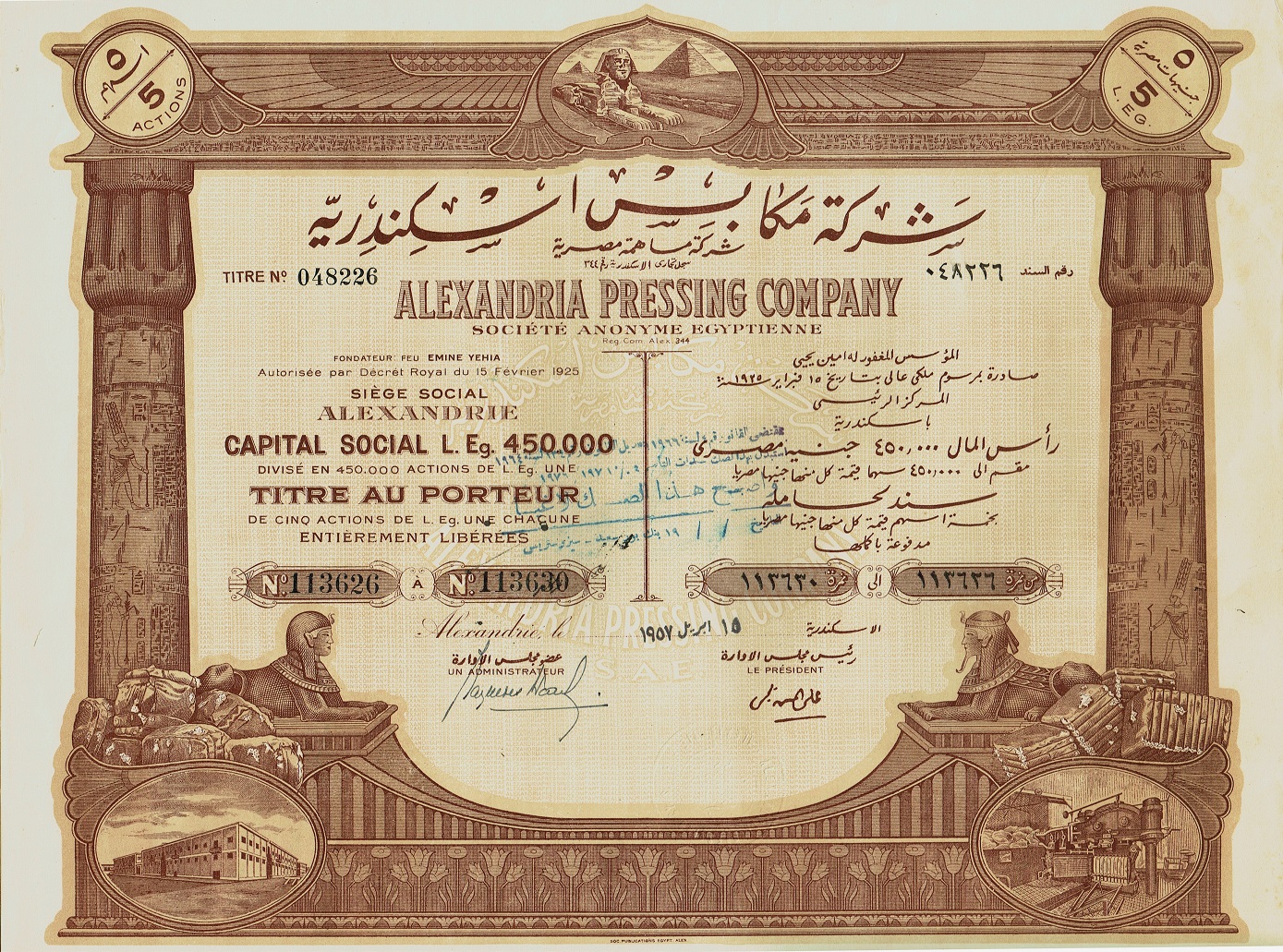
Images 6a and 6b: From Egypt, the shares from the Alexandria Pressing Company that were issued in the 1950s have a watermark showing the name of the Norwegian company ‘BORREGAARD’, the paper type ‘TUB SIZED LEDGER’ and the location of the paper mill ‘MADE IN NORWAY’.


I conclude this part in the series with one of my favorites: a share in The Dahramsi Morarji Chemical Co Ltd, Bombay (DMCC). Its watermark shows the line LUCKY PARCHMENT, a design of a jockey racing a horse, and the words RAG CONTAINING underneath. See images 7a and 7b below.

Parchment paper is not to be confused with “parchment”. The latter is a writing material made from animal skin. The former is a type of cellulose-based paper (made from wood pulp and cotton fibers) which has been treated chemically to make the paper stronger, more heat resistant and above all non-sticky.

You’ll find the words PARCHMENT also in the watermarks of shares from McLeod and Co, Ltd (1940s) and many other scripophily examples. In my example, LUCKY PARCHMENT is a parchment paper brand from the Indian paper company Ballarpur Paper and Straw Board Mills, Ltd.

RAG CONTAINING is another line of text in the DMCC watermark. Rag paper or cotton paper is primarily made of cotton linters or from used cloth (rags). Cotton paper may last many decades without any sign of deterioration, see also images 5a and 5b before.


Images 7a and 7b: This share in The Dahramsi Morarji Chemical Co Ltd was issued in 1968. The company's headquarters were located at Dr Dababhoy Naoroji Road in Mumbai. The certificate shows the coat of arms of the company, including a tiny map of India, and has a watermark of a racing jockey. 


The DMCC’s remarkable jockey watermark seems unrelated but it is not. I learned from scripophily expert Sayeed Cassim (see also here) that the Ballarpur paper company was founded by Karam Chand Thapar, who headed the Thapar Group of companies. The Thapar family was involved in race horse ownership, hence the jockey.

Time for a quick review. The first watermarks were formed, likely unexpectedly, in the production process of what we now call laid paper. Paper makers then added a logo, their coat of arms, or their name to the watermark design. Some of them further added a year, a paper type or brand, and also a location where the paper was made. If you haven’t done so already, you might start viewing your certificates against a window.

In part 3, I’ll show that paper manufacturers start adding watermark elements on behalf of one of their important customer segments: security printers.


F.L. 

This article was initially published in Scripophily magazine No. 114, December 2020. 
You might be interested to read : Watermarks in Scripophily - part 1 Introduction 


Sunday, January 17, 2021

HWPH kicks off '21 with large scripophily auction

Auctioneer Matthias Schmitt has compiled pretty much as 2000 lots of mainly antique bonds and shares for his 58th sale. The online event runs till 30 January, 10 AM. 

Collectors seek these genuine securities for their historic values or artistic features. I'll show you an Italian example from the auction of the first type later, but to start with, here is one of the latter type.


The SA Italiana per l'Impianto e l'Esercizio del Giardino Zoologico in Roma was founded in 1909. Today it is known as Bioparco di Roma. Its shares feature a gorgious vignette of wild animals, and sixteen others interacting with exuberant scrollwork and foliage. Click the image to enlarge. Creator of this Stile Liberty work was Giambattista Conti, aka Giovanni Battista Conti (1878-1970). He was known for his religious works and as an illustrator of children books. He became Director of the Vatican Restoration Institute. This rare certificate for 10 founders' share , lot 773 in the auction, starts at €1,000. 


HWPH is known for its Russian offerings and starts the feast with more than 250 lots from Russia and the former USSR. Two examples : 
  • L(ot)116 A 5-shares certificate, 1898, from the Rigaer Commerz-Bank, unusual large underprint  the imperial double-headed eagle holding the arms of the city of Riga, then still part of the Russian Empire.
  • A specimen bond from the Soviet Union's 1925 Internal Loan for the Reconstruction of the Economy, multicoloured Art Nouveau design, three vignettess, L151.


One of the Russian highlights is L154, a specimen bond from the 9% railway loan of 1927. The loan was issued to finance railway extensions connecting Uzbekistan and Kazakhstan with the Trans-Siberian Railway. The bond has a denomination of 25 Chervonets, a currency, fully convertible and backed by the gold standard, that was introduced by the Soviet Union to stabilize the hyperinflation. 


A major part of the sale consists of scripophily items related to Germany. Actually there are 700 of them. These can easily be queried online by means of key words like 'Freiburg', yielding 3 results, or 'Leipzig', 16 results. 


Allgemeine Elektricitäts-Gesellschaft, AEG, originated in 1882 when Emil Rathenau acquired licenses to use some of Thomas Edison's lamp patents in Germany. This extremely rare share from 1890, L917, bears Rathenau's facsimile signature. L918, a share in another Berlin company, has Rathenau's original signature. Rathenau died in 1915 when AEG pioneered in the development of aircraft and soon thereafter in film projectors as well. 


Nearly 300 lots represent scripophily from the USA, some picks :
  • L1714 shows a share number 1 in The Magirus Corporation of America, issued in 1926, and with vignette of a fire engine. Conrad Dietrich Magirus, born in Ulm, Germany, was the inventor of the mobile fire ladder. Today, the Magirus M68L is the fire engine with the highest turntable ladder in the world with a range of 68 meters.
  • The Los Angeles, San Diego and Yuma Railway Company, 1890 stock certificate, L1711, rare
  • The tracks of the Virginia and Tennessee Rail Road, a company that played a strategic role for the Confederacy, were destroyed during the American Civil War and later rebuilt. Its $1000 bond from 1853, shows off some of the finest vignettes on US railway securities. L1801, interesting start price at €40.
  • A section of 27 Confederate States of America bonds with start prices at €20 to €40, L1618 through 1644


The auction counts no less than eight 'piano' lots : 563, 1023, 1139, 1213, 1567, 1578, 1773 and 1886. This share in the Schomacker Piano Forte Manufacturing Company was issued in 1894. Pianists and high society figures like President Ulysses S. Grant preferred these fine and award-winning instruments. Schomacker pianos were called the “Gold String” pianos. H. W. Gray, who signed this share as President, patented a technique wherein the piano strings were gold plated through a process called electro-plating. The other signature we see here is the one of Henry C. Schomacker, son of Johan Heinrich Schomacker, founder of the business. L1773 


The offerings present bonds and shares from many more countries. Let me further mention some more noteworthy collectibles :
  • UK : One of the oldest Cunard Steam-Ship Company shares seen, 1888, with ship vignette, L532
  • Italy : Gucci Group NV, Dutch Gulden specimen stock certificate , vignettes of the Cattedrale di Santa Maria del Fiore, Florence, and Gucci craftsman inspecting a Gucci handbag, L598
  • Czechoslovakia : L727, Prvni Pražský Měštanský Pivovor, freely translated : The First Prague Civic Brewery, 1930, multicolor print with brewing vignetttes and of course, a drinking King
  • The sale includes a nice selection of Egyptian scripophily.


The Monte di Pietà, a church-run lending institution founded in Italy's 15th century, became a model for many charity institutions. Called “Monte’s” these organizations obtained their funds by means of bonds called “Luoghi di Monte” and evolved into banks and lending institutions. The bonds were registered, and guaranteed the investor a type of life annuity. This Monte non vacabile del Sale della Città di Firenze was issued as early as 1699! The loan was guaranteed by income from taxes on salt (Sale) and bears the arms of the House of Medici. L895 


Of course, there is much more to tell, but the best way is to see for yourself. Here are the auction details:
  • Date : 30 Januari 2021, online auction
  • Further info and catalogs, see here on HWPH
  • Live bidding is possible through Invaluable.com, see here, where you can find high quality images of the lots.

F.L.

PS : Did you like this post ? Thank you for sharing it on you favorite social media channel !

Thursday, June 4, 2020

Experts in mondial automobile and American railroad securities, look out ! F.H.W. kicks off its first online auction

Freunde Historischer Wertpapiere (FHW) has scheduled its next double day sale for June 26-27 2020. A milestone in its history, Jörg Benecke's auction team goes online for the first time with more than 2200 lots of historic bonds and share certificates.

This auctioneer offers a large cross-section of German scripophily, early and modern. On top of that the event features a voluminous American railway section and the wide-reaching automobile collection of Dr. Werner P. Schmidt.


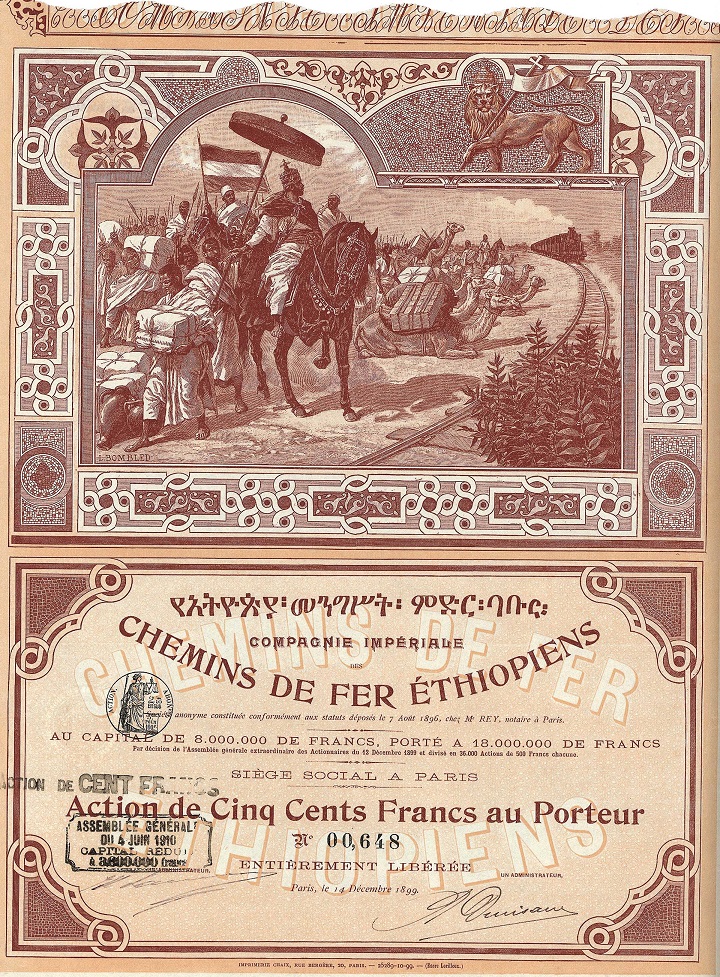
FHW's 117th auction opens with a classic in scripophily, a share in the Compagnie Impériale des Chemins de Fer Éthiopiens. Every auction participant will be able to bid on this stunning print from 1899. Each bid will be accepted and guaranteed at the start price. All proceeds goes to the German Church School in Addis Abeba. The school is the first one in Ethiopia in which blind and seeing children are taught jointly. 
image courtesy F.H.W. 


The American railroad section is huge and counts more than 450 lots. Some of the highlights :
  • L(ot) 58, California Railway, Oakland, 1897, certificate for 850 shares of $100, representing over 15% of the initial share capital, in numismatic terms ultra-rare, bidding starts at €240.
  • L72 Chautauqua Lake Railway Company, 5% $1000 bond, 1887, only 800 issued, printed by the reknown Homer Lee Bank Note Company, N. Y., check the vignette and the artwork on the title.
  • George Jay Gould I, investor and railroad executive, eldest son of Jay Gould, purchased in 1895, L162, a share representing 25% of The Galveston, Houston and Henderson Railroad Co. of 1882. The certificate is signed by him on the reverse. After the death of his first wife, actress Edit M Kingdon, he married his mistress Guinevere J Sinclair and moved to England. Top American railway history, as such, unique.


An example of the many rarities in the US railway section, this $50 shares certificate was issued by the Miami Valley Railway Company in 1877. The company, incorporated in Ohio, 1874, had its shares printed by the Krebs Lithographing Company from Cincinnati. L239 in the auction. 
image courtesy F.H.W. 


Collectors and investors will be interested in an exceptional variety of automobile scripophily. Over 450 lots from the W. P. Schmidt Collection will be offered. Dr. Werner P. Schmidt, recently deceased, was CFO of Volkswagen AG and succeeded in bringing together hundreds of bonds and shares from motorcar companies all over the world.

The collection includes scripophily from all top brands like FIAT, see image here, Benz L972, and Renault, L1239,  which is issued to Louis Renault himself, and many more.


One of the gems in the W. P. Schmidt collection is this 1920 5 x 200 Lire shares certificate from the world famous FIAT company. The name is an abbreviation for Fabbrica Italiana Automobili Torino.  The company soon exported its first cars and in 1910 a plant was built in Poughkeepsie, NY, to produce costly, luxury cars. L1048 in the sale starts at €1500 
image courtesy F.H.W. 


Historic, you could say "archeological", is L1272, a share from the Société des Moteurs Lenoir, 1859, founded by Etienne Lenoir, father of the combustion engine. Even older is L1124, a share certificate, 1835, in the London and Birmingham Steam Carriage Company, which produced steam engine driven cars.

Some more remarkable car builders spotted in the catalog :
  • L896 Aachener Stahlwaarenfabrik Fafnir-Werke, 1000 Reichsmark share, 1912. This German company produced the Fafnir automobiles and motorcycles, and also the Omnimobil motor kits allowing others to start motor vehichle production. Rare, bids invited from €500. 
  • L1006 Deutsche Last-Automobilfabrik AG, "DAAG", Rating, 1920 
  • L1216 RiCHARD Auto Manufacturing Company, Cleveland, Ohio, 1917. This stock certificate is signed by its founder François Richard. Check out the image in the catalog. You'll note how the brand name was changed into to RiCHARD - with a lower case i - in an attempt to encourage the more correct French-like pronunciation 'ree-SHARd'. An example of small but great automobile history, with an early automobile vignette as well.


Besides the US railway section and the W.P. Schmidt Collection, the 270 pages auction catalog includes the following chapters :

  • Confederate States of America
  • Germany Pre-1945
  • Germany DM era
  • Austro-Hungarian Empire/Austria, Switzerland, Italy and several more.

Indexes on collecting themes and German regions may help you find what you are looking for.  I checked out the sports entries and bumped into bobsledding scripophily !


This rare 300 Mark bond from the Herzogliche Bobsleighclub zu Gotha (Ducal Bobsled Club from Gotha) shows the still existing clubhouse. Opened in 1913 its bobsled track was one of the longest in Central Europe at the time with a length of 3600 metres. L1601 in the sale 
image courtesy F.H.W. 


There is a lot to discover in the sale. Here are the details :

  • Location : The event takes place at Wolfenbüttel, however, at the time of writing this, due to the covid-19 situation personal presence is likely not possible. Check out whether a visit is possible with the auction house. 
  • Date : 26 and 27 June, 2020
  • Further info, see here; PDF catalog see there; live bidding is possible through https://connect.invaluable.com/dwa/ 


F.L.

Friday, March 27, 2020

Connoisseurs of British railway securities will be thrilled at Boone's next scripophily auction

The 64th auction of Mario Boone takes place online with an exceptional range of high quality collectibles. Nearly 1,700 antique stocks and bonds spanning 4 centuries of financial history represent about 100 countries.

Boone's next auction is set for 4 April 2020. Included are many genuine founder shares from famous companies. This is one from the Assicurazioni Generali Austro-Italiche. 


The very first share from the world famous Generali insurance company

Following the Napoleonic Wars, Trieste became the main trading port and shipbuilding centre of the Austrian Empire. There insurance expert Joseph Lazarus Morpurgo founded the Assicurazioni Generali Austro-Italiche in 1831. His company provided insurances against risks of marine and land transport, flood, fire, and much more, hence the name GENERALI.  One of its notable employees was writer Franz Kafka who worked for Generali in Prague in 1907 and 1908. This is Generali's share number 1, issued in Trieste, 1832, and signed by Morpurgo. Lot 943 in the auction is a top item for any scripophily collector of insurance companies or Italian/Austrian finance history. 


Connoisseurs of British railway securities will be thrilled. More than 120 lots come from an old collection that illustrates the rich and pioneering history of British railways. Even if you are not into railway scripophily, this is an exceptional opportunity to check out this series (lot range 789 through 914). Let me mention here a few of these gems :
  • L793 Blaydon, Gateshead & Hebburn Railway, stunning vignette; 
  • from Ireland, L804 River Line, Cork Blackrock and Passage Railway
  • L803 Clarence Railway, 1828!; 
  • L809 Durham and Sunderland Railway, rare, wax seal;
  • Another stunning vignette can be seen on a Liverpool and Manchester Railway certificate, 1826!, L845. 
  • L877 comprises a share from as early as 1804 - eighteen hundred and four !!! - issued by the horse-operated Oystermouth Rail-Way or Tram-Road. This company commenced to carry passengers in 1807. 


Monmouthshire Railway and Canal Company share transfer certificate with large vignette of train and barge approaching bridge

The Monmouthshire Railway and Canal Company operated a canal and a network of railways in south-east Wales. It started as the Monmouthshire Canal Navigation and opened canals from Newport to Pontypool and to Crumlin from 1796. The unusual large vignette on this 1854 share transfer certificate shows a train and a horse-drawn barge nearing a canal bridge. Click to enlarge image, L869 in the auction. 


Auctioneer Boone provides an extensive catalog for this sale with every lot described in detail (download link see below). Among the nearly 1,700 antique securities you'll find hundreds of little masterpieces. Their designs reflects the art style in vogue and often include vignettes from illustrators. Some examples :
  • L422 Comptoir de la Bourse de Bruxelles, illustrated by Charles Posch
  • Constand Montald's work can be seen on L443, Grands Magasins à l'Innovation, Bruxelles 
  • Oriental elements are abundant on L384 Société Foncière de Syrie
  • L691 Gewerkschaft "Deutsche Nickel-Gesellschaft" displays a super mining vignette
  • My favorite Art Deco share is the 100 Gulden share from the Nederlandsche Bakkerij-Centrale, Amsterdam, 1917, a work by Johan Rudolf Bonnet created before he went to live in Bali, L972


multicolor printed share in the Anatolian Rug Manufactoring Company from Greece

A little masterpiece is this 25 shares certificate from The Anatolian Rug Manufacturing Co. Ltd., Athens, dated 1924. Printed in multicolor by Aspiotis Brothers, banknote printers from Corfu, the share is adorned with oriental elements and shows carpet knotters at work. Despite their obvious activities, the scene is filled with silence. Click the image to enlarge, one of them noticed your attention. L924 in the sale


The catalog's comprehensive country index lists nearly 100 countries. In particular large sections (each containing between 40 and 250 lots) are Belgium, France, Germany, UK, Romania, Russia, Sweden, Australia, Netherlands Indies and the USA. Scripophily from less obvious, often exotic places, like British North Borneo, Iraq, Djibouti and Suriname is present as well.


Chile's Government Junta proclaimed Chile as an autonomous republic within the Spanish monarchy in 1810. Eight years later Chile declared its independency in 1818 which would only be recognized in 1844. The Anglo Chilian Mining Association, formed in London, 1825, is one of the earliest companies formed in the new state. L1519 in the auction.


It is impossible to mention all items in this sale, but there is a way to find out more about them. Here are the auction details :
  • Location : Internet only
  • Date : 4 April 2020
  • Further info : 

F.L.

PS This auction also includes the first part of a unique collection of Indonesian scripophily (ca. 250 lots! ). Find out more about this here .


Boone's 64th auction catalog includes also an index of collecting themes (besides countries). The sports entry refers to more than 20 shares, including this French 1911 share in the Olympic Tennis Club de Wimereux, Boulogne-sur-Mer. Lot 610 

Tuesday, May 22, 2018

Italian State securities on the menu

Last year, the scripophily public welcomed a new edition of Alex Witula’s reference catalogue on Italian state securities. Titoli di Stato will be a delight to anyone interested in the collection, valuation and study of bonds and securities issued by the Italian government and the pre-Italian unification states as early as the 16th century. More than reason enough to have a talk with one of the most prolific authors in our field !

The volume starts with several chapters on the aspects of collecting antique securities. The actual cataloguing part is divided into the following chronological sections : Italian preunification states (pre-1861), Kingdom of Italy (1861-1946), Italian Republic (1946 – present). Each one of these is in turn subdivided into categorizing chapters. Titles are ordered by their authorizing law date and then by issue date. Each issue is described with name, denominations, place, vignette, color, possible variations, etc and also a value indication. The bulky compendium features about 700 images and historical paragraphs including maps.


Titoli di Stato – Italian State Bonds
Author: Alex Witula
Published by : Portafoglio Storico


FL Mr. Alex Witula, welcome in my virtual studio. Please tell me, what is your new book about?
ALEX The 5th edition of the catalogue of the “Italian public debt” is now available under its new name: “State bonds”. The change of the title of this book has a psychological reason: the collective consciousness in Italy considers the public debt as something negative. In this way I hope to get more readers not only from the collector’s side but also from the general public.


Repubblica Italiana 
Certificate for 20 Treasury bonds of 5,000 Lire, 1962 
Vignette : Nettuno offre doni a Venezia, by Giambattista Tiepolo (1696-1770) 


FL Why did you decide for another, 5th, edition ?
ALEX The result of this catalogue is a teamwork of several dozens of collectors with contributions of colleagues and friends. The previous, 4th, issue is dated 2012 and it took 5 years to get the new catalogue as near as complete, at least in its structure. The listing of all principalities and small states in the Italian peninsula before the unification of 1861 is now complete. For example, we’ve included certificates that have not even appeared yet on the market, for example, those from the Republic of Genoa. Many new certificates were added in the new issue. We increased the number of pages from 558 to 736. Last but not least: for the collectors it is important that they know new valuations of their bonds.


Monte di Pietà della Cità di Firenze
Nuovo Monte non vacabile, a loan for 4 luoghi of 100 Scudi, 1700, 
illustrated with two vignettes of Jesus and the coat of arms of the Medici in the middle


FL Alex, the book also covers scripophily from the Italian pre-unification states. I was surprised to see that the chapter for Granducato di Toscana, counting 74 pages with securities from 1591-1860, is the biggest part. Why is that?
ALEX Under the dynasty of the House of Medici (1494 – 1737) the Grand Duchy of Tuscany became a wealthy state. Their bank, the Medici bank, was the most important financial institution in Europe. The Medici’s introduced a system of irredeemable loans with strong written rules. For each loan the statutes were published in a form of a booklet called “provvisione” and each loan was guaranteed by income from taxes. For example, at the front page of the “Nuovo Monte del Sale”, page 40 in the catalogue, its guaranty is included in the name of the loan sale which means by taxes on salt.
ALEX Each loan was divided into certificates called luoghi with a unit value of 100 Scudi. A fraction of one luogo, not less than one-quarter, was offered in order to facilitate purchase by the less well-of. Once the bonds were placed, a new booklet was printed with the names of the holders and the number of certificates purchased. Printed on vellum the luoghi represent the origin of issues of state bonds.


The Monte di Pietà, founded in the 15th century, was the first church-run lending institution. It became a model for many charity institutions, called “Monte’s” which obtained their funds by means of bonds called “Luoghi di Monte”. These organisations evolved into banks and lending institutions. The bonds were registered, and guaranteed the investor a type of annuity. Some of these securities were transferable and redeemable but most were not until the death of the creditor.
In scripophily the term Monte can refer to the bond or to the issuer. This Monte Pubblico, a 4% 1000 Lire annuity bond from the Duchy of Milan, dates from 1770. 


FL When Italy becomes a kingdom, I see that the securities get more standardized in terms of layout, text, border and vignette design. What were the main printers of the Italian state bonds ?
ALEX Bonds issued before Italy’s unification have no indication of the printer. After 1861 a government printing office was established. On all state certificates there is a small indication of this printer: Officina Governativa delle Carte Valori Torino. Since 1928 its name changed to Istituto Poligrafico dello Stato – Officina Carte Valori.
FL Were there particular artists and designers involved in the production of state bonds?
ALEX During the Kingdom of Italy (1861-1946) the portraits of the Kings were designed by employees of the printing office, but only Lodovico Bigola became famous at the national level. Many treasury bonds issued after 1958, display parts of famous works from artists like Antonello da Messina, Tiepolo, Leonardo da Vinci, Raffaello and even Rubens.


With the unification of Italy, the government set up the Gran Libro - 'Great Ledger of the public debt of the Kingdom of Italy' - in which all debts of pre-unitary states were collected. This 3% bond from 1871 depicts Victor Emmanuel II (1820-1878), King of Sardinia from 1849 until 17 March 1861 when he became King of Italy. The portrait was designed by artist Lodovico Bigola, designer and engraver of Italian state bonds and stamps.


FL Alex, the catalogue also features Austro-Hungarian loans from the period 1868-1918. Can you tell us why these are included in your book?
ALEX In that chapter’s preliminary notes you will read that after WWI citizens who were resident in zones occupied by Italy, and accepted Italian citizenship, could exchange their Austrian and Hungarian State bonds for the Italian 5% Consolidated Loan. To prove this on the exchanged certificates you can find different fiscal stamps like those documented on pages 532-533. By the way, the two Corone stamp, page 534, is very rare and its value is about €150. Unfortunately, I’ve had only few of them.


The red revenue stamp with ‘ITALIAN TESORO’ annulation stamp, cancelled this 5.5% 7th Austrian war loan from 1917, indicating that it was exchanged for an Italian state bond.


FL Over the past decade have you seen any trends in collecting Italian government securities?
ALEX Rare items are available usually at auctions, while the price of commonly seen certificates has dropped down. Since Udo Hielscher’s book “Die Florentinischen Monti” was published by Verlag HWPH AG, there is interest especially on bonds issued by different Monti.
FL What is the item in your catalogue that realized the highest price so far at auction?
ALEX That was a Monte San Giovanni Battista – page 124 of the catalogue. It sold at €3,500 plus 20% auction fee at our 27th auction in 2012.
FL Alex, a catalogue like this stands for a lifework, something I have a lot of admiration and respect for. What was for you the most difficult step in producing the catalog? And do you have any tips for potential authors?
ALEX The catalogue is the result of team work. Sincerely it was not so difficult for me because of the enthusiastic cooperation of collectors specialized in state bonds. A tip for a potential author: just start and create synergies!


5% Regno D’Italia Prestito Redimibile, redeemable loan of the Kingdom of Italy, 1937 
Illustrated is Victor Emmanuel III, flanked by two fasces. He ruled Italy from 1900 to 1946, Ethiopia from 1936 to 1941 and Albania from 1939 to 1943. During his reign Italian Fascism rose and perished.


FL What is your most pleasant anecdote when producing the catalogue?
ALEX The co-author of the first and second edition of the catalogue was Mario Cecchi, who unfortunately has passed away. At that time he was a well-known certified public accountant in Siena and his office was located in the historical town center, on Piazza del Campo. We finished both editions exactly during the day of the Palio of Siena – the traditional world-famous horse race run since the thirteen century. After we terminated the work we watched the horse racing from his balcony: a great experience, specially seeing the event from the sixth floor and not from the ground!
FL Alex, did you use any particular sources, books, manuals and the like, for researching Italian securities? Are there stock exchange year-books available for Italy, comparable to Moody’s (USA), Saling (Germany) and Van Oss (the Netherlands)?
ALEX Yes, of course. The catalogue has a bibliography. The Manuale Hoepli “Il Debito Pubblico Italiano” is a kind of a handbook of Italian state bonds. But in my opinion the most important and interesting book, especially for the pre-unification period, is professor’s Felloni “Gli investimenti finanziari genovesi in Europa tra il Seicento e la Restaurazione”. Prof. Giuseppe Felloni, a professor emeritus of the University of Genoa, having access to the archive of the Banco di San Giorgio, could publish interesting statistics, for example, on the investments in different Monti bonds of the Grand Duchy of Tuscany by the Banco di San Giorgio and the Papal State and on investments of many European rulers in the Banco di San Giorgio.


Yearly income bond from the Papal States, issued in 1832.
Usually, the emblem of the Pope shows a tiara, but, as in this case when the certificate was printed, 
the version with an umbrella is put in place after the death or a resignation of a pope.


FL Do you collect yourself?
ALEX Yes, since many years I collect State bonds. A collection definitely helps to organize a catalogue.
FL Dear Alex, now I have to ask you a last but very serious question. Suppose you were convicted for excessive scripophily and exiled to a deserted island. What is your most favorite Italian government security that you would take with you?
ALEX I love to visit islands, but believe me, on a deserted island instead of a bond I’d prefer a survival kit!
FL Alex, I want to thank you for this interview and wish you a lot of success with the book.

Alex Witula's book Titoli di Stato, written in Italian, is published by Portafoglio Storico.
Price €65, IBSS members receive a 25% discount.
More info: www.portafoglio-storico.it or portafogliostorico@aruba.it


F.L.

An interesting read? Why not sign the Guest book ?