Showing posts with label transport. Show all posts

Thursday, October 27, 2022

Boone's 69th auction spans now 2 days. Among the stars are Ferdinand de Lesseps Suez Canal certificates and a 16th century loan from Antwerp.

Mario Boone scheduled its next sale of antique stocks and bonds for 5 and 6 November 2022. That's right, the auctioneer applies a new event format which starts in Antwerp with an international bourse on Saturday morning. The live auction kicks off at 2 PM in the same venue. On Sunday, the second part comprises of a internet/mailbid auction. 


Altogether more than 1700 lots will be hammered in Boone's upcoming auction.  This is an opportunity to see many stunning certificates like this one. Noted security printer Charles Crabbé produced this 1902 share from the Paris-based Crédit National Assurances. L(ot) 353 starts at €100.

Latin America is excellently represented. More than 300 lots fill several chapters : Latin America lot range 534-556 , The Carribbean Collection L729-861, Venezuala Collection L862-965. All of these are scheduled on Saturday, and then there is another Latin America chapter, L1518-1580, on Sunday.  

Some of the interesting items are :
  • The Cuban Central Railways Ltd £100 debenture from 1899 shows two small vignettes and is rare, L544.
  • Lots 806 through 828 includes several Panama Canal certificates.
  • L887 shows a frontal view of a steamship on a Orinoco Steamship Company bond printed in 1902 by the International Bank Note Co. from New York.
  • The Société de Recherches de Temascaltepec (Mexique) was organized to mine for silver in Temascaltepec. L1569


L548 in the auction is a share in the Syndicat des Placers Guyanais. The company was formed in 1913 to dig for alluvial gold and diamonds. An overseas department of France in South America, French Guiana's currency is the euro. Gold mining, often done illegally, is still one of its main industries today. Bidding starts at €200.


Included in the sale are several certificates signed by or issued to historic figures, such as:
  • members from the Rothschild banking family, L402 through 415, 
  • Paul Kruger, President of the South African Republic, L296
  • L499 shows the signature of Robert Surcouf, the French slave trader and privateer who raided British ships
  • A Nederlandsche Handel-Maatschappij share issued to the Dutch King Willem III, L441.
The auction catalog's Autographs index refers to many more personalities, including Ferdinand de Lesseps !


On March 23, 2021, container ship Ever Given gets stuck in the Suez Canal and disrupted global trade for six days. The consequences were incalculable: industries were impacted with shortages, e.g. of semiconductors. The non delivering of food resulted in price rises and livestock shipments were suspended.
The Suez Canal connects the Mediterranean Sea to the Red Sea. It was constructed by Ferdinand de Lesseps' Suez Canal company between 1859 and 1869.  
Boone offers a set of printer proof bonds from the company's 1879/80 loan, all different and unique. One of these is corrected by Ferdinand de Lesseps himself, and personally signed by him. His handwritten signature in scripophily is of the highest rarity. The set of certificates deserves a place in any top collection highlighting France, Egypt, Canals & Transport, and even World History. Start price €10,000 .


The 16-18th century chapter counts more than 50 lots of shares, bonds and related financial documents. Among these "prehistorics" are 
  • bonds from the Flemish cities Antwerp, Aalst and Oudenaarde (L480, L482, L484)
  • a 1759 share in the Compagnie Royale Prussienne de Bengale , L511
  • whaling and canal companies, L486 & L514
  • 18th & early 19th century French privateer companies, L489 through L499, and an American one, L533
  • a collection of 108 French lotteries issued between 1699 and 1828, L501
  • a put option certificate of the Bank of England as early as 1730, L516


An amazing discovery is L480, an Antwerp city bond for 100 Carolus Guilders from 1558. Issued on vellum, it has a large Antwerp city seal in red wax showing 'Het Steen', the still existing 13th century castle. The bond was part of a loan granted in 1555 by Charles V, Holy Roman Emperor and King of Spain.

At the start of the 16th century Antwerp belonged to the Habsburg Netherlands, then part of the Holy Roman Empire. The city was a major shipping base for Spanish and Portuguese merchants importing sugar and raw produce from overseas. Antwerp became the main business centre around the Atlantic. Its wealthy bankers lended money to governments in Europe.

Between 1555 and 1556, Charles V split his empire into an Austro-German and a Spanish branch. As a result of Charles's abdications, the Habsburg Netherlands were left to his son Philip II of Spain. Thus became Antwerp part of the Spanish Netherlands. 

During these decades war with France was never far away. Also the Catholic Church in the Spanish realm had to be defended against the upcoming Protestant Reformation. The loan was raised to finance the construction and maintenance of the fortifications of Antwerp, the so-called 'Spaanse omwalling' (Spanish ramparts). These were built on order of Charles V from 1542 onwards.
€5000 is the start price for this top item that has witnessed a florishing but turbulent Flemish and Spanish 16th century.


As usual the sale includes a large chapter of USA scripophily, presented in both the Saturday and Sunday sessions of the auction. 
  • There is an opportunity to buy a Southern State Bonds Collection as a single lot (L649-L728). When there is no buyer then the collection will be regrouped by state, each one then offered as one group lot. In turn, these, when not sold, will be split into single item lots. 
  • US railways are plenty. You can find an interesting review on this chapter on Coxrail News and Announcements, see here     


The National Glass Company from Pittsburgh, Pa., was a short-lived glass trust. It owned several factories in places like Dunkirk, Ind., Cumberland, Md. and Marietta, Oh. They specialized in colored table glassware and decorated lamps. This $1000 bond from 1901, a Western Bank Note print, starts at €50. L1708


It is impossible to address all items in this sale, but there is a way to find out more about them. Here are the auction details :
  • Dates
    • 5 November 2022, Antwerp Crowne Plaza Hotel
      • International Bourse 8h30-12h 
      • Live auction 14h-18h30
    • 6 November 2022, mailbid and online auction
  • Further info : 
    • online catalog & bidding, see here 
    • or via the Invaluable platform (large images), see there 
    • and the PDF version of the catalog can be found here 

Even if you are not a collector 5 November 2022 is an opportunity to see some great antique securities. The venue is the Antwerp Crown Plaza. The public bus stops right outside the place and takes you in 10 minutes to Antwerp Central Station. 

F.L.


PS : Did you like this post ? Thank you for sharing it on you favorite social media channel !

Tuesday, November 9, 2021

Shall we take the car, the plane, or the boat ?

Recently I was surprised by a vintage stock certificate. Its design was rather plain featuring an eagle vignette, frequently seen on American scripophily. But the name of the issuing company was SPACETRONICS, INC., and that was enough to get my attention.

My first guess was that the company developed radar equipment, missile guidance systems or something like that. But that turned out not to be the case. 


This story is about Walter A. Crowley (1917-2008). As an engineer he worked at General Motors, and later at Chrysler on guidance systems for missiles. Crowley also designed and built a Benson Gyrocopter but after two crashes he aimed his research at 'flight without height'. 

Crowley observed that blowing air into the center of a conical lampshade would cause it to rise and hover steadily above any surface, including water. In 1957 he developed an air cushion vehicle that could traverse land or sea without physical contact. 

A first test flight, or you could say test ride, occured in an in-house experiment with Crowley's ten year old son as the test pilot. Other prototype vehicles and outdoor tests followed. In the mean time he formed his Hydro-Air Transportation Company and filed a patent in 1958.

In this period Carl W. Bollum Sr. worked at the Washington office of the Army Ballistic Missiles Agency. Bollum was sent out to learn about Crowley's ideas. But, unlike himself, his office did not show further interest. 


Soon after Bollum left the army he founded Spacetronics. The company incorporated on October 8, 1958, under the laws of the District of Columbia. Spacetronics was located at Bethesda, Maryland, less than 10 miles away from Washington, D.C. Bollum was chairman of the board and president. 

Spacetronics acquired Crowley's company and its related patents and rights. In return Bollum promised to provide capital to develop Crowley's ideas. He hired Crowley as chief engineer and appointed him vice president. 

In that period the US Navy got interested in the so-called "ground-cushion phenomenon". Hearings sessions took place before the Committee on Science and Astronautics at the House of Representatives on 13, 14 and 15 April, 1959. Several projects on air cushion vehicles were discussed. The key people from Spacetronics were invited to present their developments. Other projects screened involved those from the Ford Motor Company and the Curtiss-Wright Corporation, among others.

At the start of the hearings, Admiral R. Bennett, Chief of Naval Research, USN, explained why the Navy and the Marine Corps was interested :  
"... such a ground proximity machine, used as an amphibious transport or an assault boat, with a low silhouette and moderate load-lifting capability would be extremely valuable in accelerating the ship-to-shore movement. Traveling 4 or 5 feet over the wave tops at speeds up top 50 mph and capable of negotiating beaches up to 15 percent slope, the vehicle would present a far less vulnerable target than our present craft ..."

Bollum, president of Spacetronics, knew how lucrative military contracts could be. His company built a heavy-duty prototype vehicle for the US Marine Corps. The machine could achieve a ground clearance of nearly 12 inches and was stable even as a dozen men moved around its deck. 


This Hydro-Air vehicle, aka a ground effect machine, built by Spacetronics, Inc.,  is designed for traversing swampy ground, snow or ice. A flexible skirt enables it to cross many obstructions. The horizontal propeller behind the driver maintains pressure in the hollow body. 
source: Aviation Week 1959-01-12, via the Internet Archive  


The company gets national coverage after The New York Times, on Sunday, October 11, 1959, publishes a special news article "Flying Platform Planned in U.S." :
A Washington concern announced last week that it was building a flying platform as a prototype for a cargo-carrying craft that would skim over water on an air cushion. The "Hydro-Air" vehicle, being built by Spacetronics, Inc., is similar to the Saunders-Roe Hovercraft that is under test in Britain. The American craft is scheduled to be unveiled next month.
When completed, the prototype will be tear-drop shaped, thirty-two feet long, twenty-four feet wide and two feet high. A horizontal propeller at the forward section will pump air downward to lift the craft just off the water. With aft-mounted fans, for forward propulsion, the vehicle will attain speeds up to fifty miles an hour, it was said.
Officials reported that there were essentially two designs for providing lift for such a vehicle. One is a "pelum chamber" [sic; should be 'plenum chamber' ], used on the Spacetronics craft, to provide a billowing volume of air, and the other "annular jets which gain lift by directing a curtain of air at the water surface", he said. The latter is the method used on the Saunders-Roe craft.


Around the same time the British worked on a much larger commercial vehicle, the "hovercraft, based on the earlier work by Christopher Cockerell and produced by the Sanders-Roe company. 

Both Cockerell's and Crowley's prototypes could not spark more military interest. Two main problems of these early crafts were inaccurate steering control and the stirring up of dust on land.

In 1960 the Spacetronics owners moved to Daytona Beach, Florida, with the intention to produce a commercial-type model for fishermen. 

They had some big ideas. In The International Teamster (a union magazine), issue Oct 1960, you can read that the company was designing a big cargo air truck. Allegedly Southern Airways, Inc., had ordered two of these from Spacetronics, envisioning trucking cargo over water on regular scheduled runs between Miami and the Bahama Islands.


Another far reaching idea from Spacetronics shows a train riding air cushions on a concrete rail
source: Popular Mechanics 1960-06: Volume 113, Issue 6, via the Internet Archive 


It is not clear what happened next, but the company was suddenly dissolved. Yet, Bollum still believed in the potential of Crowley's ideas. You can see here that in 1963 Bollum filed a patent for an "earth-skimming air vehicle" mentioning his name as the inventor.  

Walter A. Crowley went to develop new air cushion concepts at American Machine and Foundry in Stamford, Connecticut. In 1961 the Boeing Company hired him. There he developed an air-bearing system for moving heavy objects with compressed air, up to and including an entire 747 Jumbo Jet. In fact, in 1967, Boeing spun off a succesful subsidiary, Aero-Go, to commercialize all kinds of products based on Crowley's concepts : aero-planks, aero-pallets, air-cushion vehicles, scissor lift tables and much more. 

Crowley's original scale model and prototype hovercraft is on display in the Smithsonian Air Museum in Washington, D.C. 


Walter A. Crowley, research & development manager of Aero-Go, demonstrates the Terra Skipper while skimming over sand and sea at 30 miles an hour. 
Excerpt from The Seattle Times, Pictorial, November 24, 1968 as seen on aerogoeurope.de 8 Nov 2021  


F.L.


Something extra :
  • The Spacetronics, Inc., share illustrated here was issued to James Harold Scribner. Likely, this is Dr. James Harold Scribner, the first US Navy dentist to visit the South Pole and Antarctica. He participated in the first Operation Deep Freeze in 1955-56 with Admiral Byrd. Spacetronics was involved as a Navy contractor, and in the hearings sessions of 1959 (see main article)  the company envisioned its air cushion vehicles operating also in polar regions. The company's location was Bethesda, MD, where there was a dental clinic at the Bethesda Naval Hospital. From a good source I learned that Dr. Scribner was married to Dorothy Louise Scribner nee Meadows who worked as a navy nurse stationed at Bethesda!

Reference links :

Previous posts

Sunday, May 16, 2021

Scripophily : historic share certificates at SPINK auction

SPINK's Bonds and Shares Department recently put its next sale online. The auctioneer offers over 600 antique securities from Great Britain, USA, Russia, China, Rhodesia, Canada, and more. 

Antique bonds and shares often represent an important evolution in our industrial and financial history. With the help of artists, security printers produced these collectibles as little works of art.


L(ot) 79 in the auction is a share in the Compagnie Française de Tramways et d'Éclairage Électriques de Shanghaï.  Founded in 1906 the company built and operated the tramway network in the French concession of Shanghai. A first line opened in 1908 between Waitan and Xujiahui. Around the time this share was issued, 1929, its trams carried 60 million passengers. Bids start at £50

The British chapter consists of several sections such as metal mining, motorcar and cycles, railways, theatre and entertainment, a large series of tramway securities, and a rarely seen collection of taxi and bus operators.


Introduced in 1956 the red double-decker buses from London have become world famous. In the early 1900s bus companies replaced their horse-drawn buses with motorized versions. The London Power Omnibus was one of those. It operated routes in North London with Sterling motor buses from Edinburgh. This share, issued in 1906, shows two of its motor powered buses, one of them a double-decker. L313 in the auction possibly fetches £100


Collectors of Canadian scripophily will be pleased to see that several remarkable railway and automobile certificates are part of the offerings. A few examples :
  • The Chignecto Marine Transport Railway Company was set up to transport entire ships across the Isthmus of Chignecto. L416 
  • L427, Toronto, Grey and Bruce Railway Company, vignettes of steam train and steamboat, £100 bond issued 1884 and due after 999 years in 2883 ! 
  • Dominion Motors Limited, share certificate from 1931, rare, vignette of maple leaf and beaver


The Temiscouata Railway Company was chartered in 1885. A 113 miles line was completed from Rivière-du-Loup, Quebec, to Connor's, New Brunswick, in 1891. Poor's Manual of Railroads, Vol 26, 1893, reports for the year ending June 30, 1892, that TR's mileage reached 71,368 miles (1,130 for passengers), and 16,921 passengers and 24,294 tons of freight were moved. 
In 1950 the Canadian National Railway took over the operations of the Temiscouata Railway. In that same year, a USAF bomber dropped a nuclear bomb due to engine troubles near Rivière-du-Loup where TR had its principal office. The bomb was destroyed in a non-nuclear detonation before it hit the ground scattering nearly 100 pounds of uranium over the St. Lawrence River. 
This rare bond, possibly the only one known, was issued in 1890 for the St. Francis Branch of the railway. L426, bids accepted from £130 onwards


There is a lot more to see in the auction. A good number of Rhodesian scripophily is present. Australia has a nice section, and there are nearly 100 American mining certificates waiting for a new owner.


The Banque Commerciale de Palestine was established in 1909. This 2 Ottoman lira share shows the Dome of the Rock (Arabic: قبة الصخرة‎ , Hebrew: כיפת הסלע‎ ), the Islamic sacred place located on the Temple Mount in the Old City of Jerusalem. L84 in the auction


You can find more of these fascinating stocks and bonds in the SPINK online catalogue. Here are the auction details :
  • location & date : online only, this timed auction ends on : 26 May 2021, 11:00 AM
  • online catalogue see here  


F.L.


PS : Did you enjoy this post ? It would be helpful to me to share it on your favorite social media channel !

Friday, March 20, 2020

Selamat pagi ! Boone auctions Indonesian scripophily

Mario Boone's 64th auction takes place on 4 April. The sale offers about 1,700 lots of antique stocks and bonds from all corners of the world. I'll come back to these in a follow up post but now I want to discuss a unique scripophily collection that is part of the sale. 


aandeel uit 1895 van de Kediri-Stoomtrammaatschappij, Kediri Steam Tramway Company share from 1895

Boone's upcoming sale features the first part of a unique collection of Indonesian scripophily. This is a 1895 share from the Kediri-Stoomtrammaatschappij. The company, founded in the same year, ran a steam operated tramway service connecting Kediri with Pare and Jombang, East Java. Tens of sugar factories from the surrounding area used the line to deliver their produce in Kedira, a sugar trading hub. Lot 245 in the auction


Boone's upcoming sale includes the first part of an extraordinary collection of bonds and shares related to Indonesia's colonial history. This time almost 250 lots will be auctioned from many economic themes like mining, oil extraction, tobacco, agriculture, coffee, tea, sugar, rubber, forestry, construction & building, banking, insurance, shipping, railroads & tramways, transport, trading, shops, electric-water-lighting utilities, and more.


The Maatschappij tot Exploitatie van de Suikeronderneming Koning Willem II was founded in 1891 with a capital of 492,000 Gulden divided into 984 shares. Its sugar factory was located in Sidoardjo. L117 


Indonesia is a quite impressive country. Its name origins from the Greek words Indos (Ἰνδός) and nesos (νῆσος), meaning "Indian" and "islands". More than 17,000 islands are home to about 270 million people (2018), more or less 1/3rd of the population in Europe. Indonesians use about 540,000 kilometers of roads. The country occupies an area of 1.9 million km2, that is roughly 1/5th of Europe. Unlike Europe, the islands count 400 volcanoes, around 130 are active. Their eruptions in the distant past produced fertile lands, ideally suited for farming and coffee and tea estates. 


Lot 292 consists of a 1949 share and this preference share, 1937, both specimens, from Heineken's Nederlandsch-Indische Bierbrouwerij Maatschappij, Surabaya. The brewery company makes one of Indonesia's most popular beers, Bintang.


The collection covers dozens of locations from different islands, e.g. Java: Jogjakarta, Magelang, Besuki, Japara, Sidoarjo, Surabaya, Madoera, Probolinggo; Borneo: Benkajang, Balangan; Sulawesi: Pagoeat, Belang; and Sumatra: Tjenako, Langkat, Medan, Tamiang. Many more places and districts can be found in the catalog's lot descriptions.


NV "Prauwenveer Kalimas" from Surabaya operated a ferry service with Indonesian proas, L263


Auction details

  • Location : Internet only
  • Date : 4 April 2020
  • Further info : 
    • online catalog & bidding here, or via the Invaluable platform
    • PDF version of the catalog there 


From the Indonesia collection : a 1912, Art Nouveau style, share from Les Huileries de Sumatra, a palm oil producer. Lot 212 in the sale.


F.L.
NB : The latter image is for a short period available as an online jigsaw puzzle, check that out here.

Wednesday, July 10, 2019

AIA's summer sale is live

Archives International Auctions next sale takes place at their offices in River Edge, New Jersey on Wednesday, July 24th, 2019. Bob Schwartz, AIA's President, welcomes collectors to the company's  54th auction :
We are excited to offer over 900 lots of rare and desirable U.S., Chinese & Worldwide Banknotes, Scripophily, Coins, Historic Ephemera, and Security Printing Ephemera. We will be holding the auction from our new offices in River Edge, New Jersey. Included in the auction are numerous rare and desirable items consigned from numerous estates and longtime collections with many having never been offered previously at auction.
The sale includes scripophily from the USA, Brazil, France, Russia, China and a lot of other countries. 


L(ot) 445 United States Second Liberty Loan of 1917, issued, with United States Savings Bonds booklet.


L523 Beam-Fletcher Transportation Company, ca.1910-20 Specimen Stock Certificate


L705 Bullfrog Indian Springs Mines Company, issued 1907, Nevada


Further info :
  • Location : River Edge, New Jersey
  • Date : 24 July 2019
  • Further info : see here , live and absentee bidding here and a downloadable PDF catalogue there 

F.L. 

Tuesday, April 23, 2019

The Taylor and Sanderson Steam Shipping Company

In North East England, at the mouth of the River Wear, lies the city of Sunderland. Since mediaval times the city grew as a port, trading coal and salt, and a place where ships were built. Once called the "Largest Shipbuilding Town in the World", Sunderland was also home to Short Brothers Limited. This shipbuilding company built several steel screw steamers for another Sunderland company, The Taylor and Sanderson Steam Shipping Company Limited (T&S). 


John Wallace Taylor and John Sanderson established Taylor & Sanderson in 1877. Incorporated in 1899 as The Taylor & Sanderson Steam Shipping Company, Limited, the company exported coal with its own ships. Several of its vessels, built by Short Brothers, awaited a remarkable fate. 


The Thornhill, a steel screw steamer, was built in 1897 by Short Brothers for T&S. On 16 April 1907, the general cargo vessel caught fire. It sank about 800 miles of Barbados on passage New York for Pernambuco, Brazil.

Short Brothers completed the Coronation for T&S in 1903. On 12 January 1913, the ship made the passage Bremen for Sunderland in balast (without any cargo but with containers filled with sea water for stability). Close to its home port, it was wrecked at Ravenscar, North Yorkshire. The salvaged ship was sold to F W Horlock & Co.

August 1914, the Coronation, renamed Coralie Horlock, was captured at Hamburg. In 1917 she became a part of the Imperial German Navy where she served as a transport vessel and as a submarine target !

The Coronation survived World War I and was sold again, this time to a Spanish company. On passage Genoa for Barcelona, in ballast, there was a bunker explosion. Two days later on 6 June 1921 the ship sank in Cavalaire Bay, France. 


The Taylor & Sanderson Steam Shipping Co. Limited 
Ordinary shares of £5, 1913 
The company went into liquidation in 1917. 


The Wallace was another steel screw steamer that was constructed by Short Brothers in 1905 for T&S. Possibly named for John Wallace Taylor, managing director of T&S, the vessel was requisitioned by the Admiralty for service as a collier, a bulk cargo ship which carried coal. Sold in 1917 when T&S went into liquidation.


detail from the Taylor & Sanderson Steam Shipping Company share certificate
signatures from John Wallace Taylor and John Wallace Taylor Jr as Directors of the company 
John Wallace Taylor (1834-1927) was a member of the River Wear Commission. One of the stained-glass windows in St John's Methodist Church, Sunderland, is dedicated to him. His second son, Frederick William Taylor was a director of Sunderland Association Football Club. 


Short Brothers built two ships for T&S in 1905. Besides the Wallace, there was the Alexandra. First sold in 1916 and 1920 to British companies, it found a new owner from Norway in 1924. A/S Inger, Bergen, renamed the Alexandra into the Ingerfire. On 11 April 1943, in the middle of World War II, the ship, on passage Barrow for Halifax in ballast, was torpedoed by a German submarine U-571 in 51.29N - 42.59W, far away from any port as you can see here


The ships mentioned in this post were all general cargo steal screw steamers that were built by Short Brothers Ltd. Their sizes were more or less the same with these average dimensions : 355ft length (108m), 49ft breadth (15m), 22ft depth (7m). Their volumes were on average 3759 grt and 2376 nrt. 


In 1911 Short Brothers built a second Thornhill for T&S. This collier was requisitioned in 1915 by the Admiralty. She was modified into a "Q-ship". Q-ships were very special mystery ships also known as Q-boats or decoy vessels. The Thornhill became an armed merchant ship with concealed weaponry. 

A Q-ship was designed to lure German submarines into making surface attacks. By seeming an easy target, the U-boat captain was tempted to make a surface attack using the deck gun instead of one of his limited number of torpedoes. In that scenario the Q-ship had a chance to open fire and sink the submarine. 

The Thornhill was sent to operate in the Mediterranean as the HMS Wonganella. On its way back from Malta to the UK, early March 1917, a German submarine attacked the ship near Gibraltar. It suffered gunfire damage and carried casualties. Then, after having crossed the Atlantic first, she left Halifax, Nova Scotia, in early June and returned to the UK. During that passage the ship again was involved in actions with German submarines on 18 and 19 June near Queenstown (Cobh), Ireland. 

The Thornhill survived both World War I & II and was sold consecutively to 5 English and 4 Yugoslavian shipping companies. In 1959 the vessel ended at Yokohama with collision damage and was sold for breaking up at Kawasaki.


The T&S share has a vignette of its shipping flag bearing the company's initials. The flag is skilfully reproduced in the embossed company seal (lower left corner of the certificate). Flag colors: dark blue stripes on a white background, white 'T&S' letters in a red oval 
click image to enlarge 


F.L.

References


PS:  Interested in shipping flags or company seals? Then you may want to check the categories 'vexillology'  and 'sigillography'.

Saturday, March 30, 2019

Hunters of vintage stock certificates expected in Antwerp

During the weekend of April 6-7, the Crowne Plaza Hotel Antwerp becomes a mecca for scripophily. Many people have yet to discover this part of numismatics. Collecting antique and vintage stock certificates, aka scripophily, took off in the 1970s. People from all over the world are fascinated by the beauty and historic importance of these artefacts.


Antique stocks and bonds are, in comparison to coins, banknotes and stamps, much less available on the collector's market. Yet, keen collectors can still snap up amazing certificates at affordable prizes. The Boone auction house has been a specialist in scripophily for over four decades and is now holding its 62nd sale on the 6th of April in Antwerp.


share certificate in the Paul Boeckel trading company  with vignette of factory

Kohlen-Handel und Industrie Aktiengesellschaft "Paul Boeckel", 100 Rubel share, 1913, St. Petersburg
The company was formed in 1899 for the trade in coal, coke, pig-iron, cement, bricks and similar and to establish a coal-briquette factory.  Detail of the vignette can be seen at the top.
L(ot) 1255 in the auction, start price €100


More than 1600 lots will go on the block. Included are stocks and bonds from about 100 countries representing an equally large number of economic themes such as railways, technology, theatre, wine, casinos, gold mines, and much more.

The auction catalogue is available as a free PDF download. The work counts over 150 pages, provides a description for each lot and has extensive indexes on collecting topics. Hundreds of these antique securities have a splendid design made by renown artists like Hercule Louis Catenacci, Alphonse Mucha, Constant Montald, just to name a few. Others are signed by, or issued to celebrities like Jean-Baptiste Colbert, Alexander Hamilton and King Willem I.


Columba Belga share from 1894 multicolor print

Société Columba Belge de Navigation - Service direct d'Anvers au Canada 
This 500 Francs share was printed in 1894 by the Imprimerie du Journal La Bourse de Bruxelles. 
In the second part of the 19th century Canada eagerly welcomed Belgian immigrants. Steamship companies offered interesting package deals to farm families. In 1898 a permanent Canadian office in Antwerp provided lectures and specific travel advice. Soon some 2000 Belgians a year entered their new country. The Columba Belge line operated a service from Antwerp to Canada, using four ships. L293 in the auction, this rare example of maritime scripophily starts at €400. 


Boone's 62nd auction offers scripophily from all modern periods. Champagne Mumm, Siemens and Chrysler are some of today's famous names starring in the event. Moreover, the sale features certificates from the earliest modern period as well. These are rare, have a great historical importance and deserve a place in museums. Some examples :
  • L205 Austrian Imperial Loan, signed by Kaiser Carl VI, 1732
  • L773 Scottish bond from 1644 to finance war against England
  • L1540 United States of America government bond signed by Alexander Hamilton 1791
One of the highlights is a certificate from the West-Indische-Compagnie (Dutch West India Company).

Dutch West India Company transport share 1792

West-Indische-Compagnie, Middelburg, Transport share, 1792 
In 1621 investors founded the Dutch West India Company (WIC). The enterprise obtained by charter the rights for a trade monopoly in the Dutch West Indies including jurisdiction over Atlantic possessions and participation in the Atlantic slave trade. The most spectacular success for the WIC was Piet Heyn's seizure of the Spanish silver fleet in 1628. Heyn captured more than 11 million guilders of booty in gold, silver and expensive trade goods. The company further became instrumental in the Dutch colonization of the Americas including New Amsterdam that covered parts of present-day New York, Connecticut, Delaware, and New Jersey. Historic and extremely rare, L892 in the auction is expected to realize €10,000. 


The day after the sale, Mario Boone organizes his regular scripophily bourse internationally attended by dealers and visitors.

Auction details

  • Location : Antwerpen, Belgium
  • Date : auction 6 April 2019, bourse 7 April 2019
  • Further info : online catalogue here, and PDF version there 


F.L.

PS : You can find out more about the American railroads in the auction in this preview from Coxrail

Wednesday, November 22, 2017

Historic canals for sale in Spink London's scripophhily auction

Spink's upcoming Bond and Share Certificates of the World sale will take place on 29 November.  Over six hundred lots of scripophily are to come under Spink's London hammer. Represented are certificates from the UK, Ireland, USA, China, South Africa, Middle East & North Africa, Asia, Australia, Europe, Russia and Latin America. 


In particular wide ranges of collectible securities from Mexican railroads and US railways, bonds from the Confederate States of America, and a high quality collection of historic British canals, deserve a closer look from the advanced collector.

Spink UK's auction features a collection of canal companies, introduced as 'The property of a gentlemen'. Included are 49 lots with bond and shares from companies covering three centuries. Some of the highlights are a Mercy and Irwell Navigation share as early as 1724, a share in the Derby Canal Company, 1793, and a rare Basingstoke Canal Navigation mortgage bond from 1795.  


The share shown above was issued by the The Ribble Navigation Company in 1863. The company was formed to straighten the meandering Ribble river. Click the image to enlarge and notice how the company's printed seal (see detail on top) reappears in embossed form on the dark red paper seal. The share is part of lot 255 and is expected to fetch a minimum of £80.

Auction details
  • Location : London, UK
  • Dates : 29 November 2017
  • Further info : see SPINK , online catalogue here and PDF version there 


F.L.


Tuesday, September 20, 2016

Stocks are hip and shares are old school


Earlier, I explained that "share certificate" and "stock certificate" mean the same. I also believe different kinds of securities have evolved because of changing environments. Well, here is an example of adaptive evolution in scripophily. 

Check out the following two certificates :

  • double-click their images to enlarge them, 
  • and look for similarities and differences.

certificate No 1
Image courtesy : Geert Leemeijer 

certificate No 2
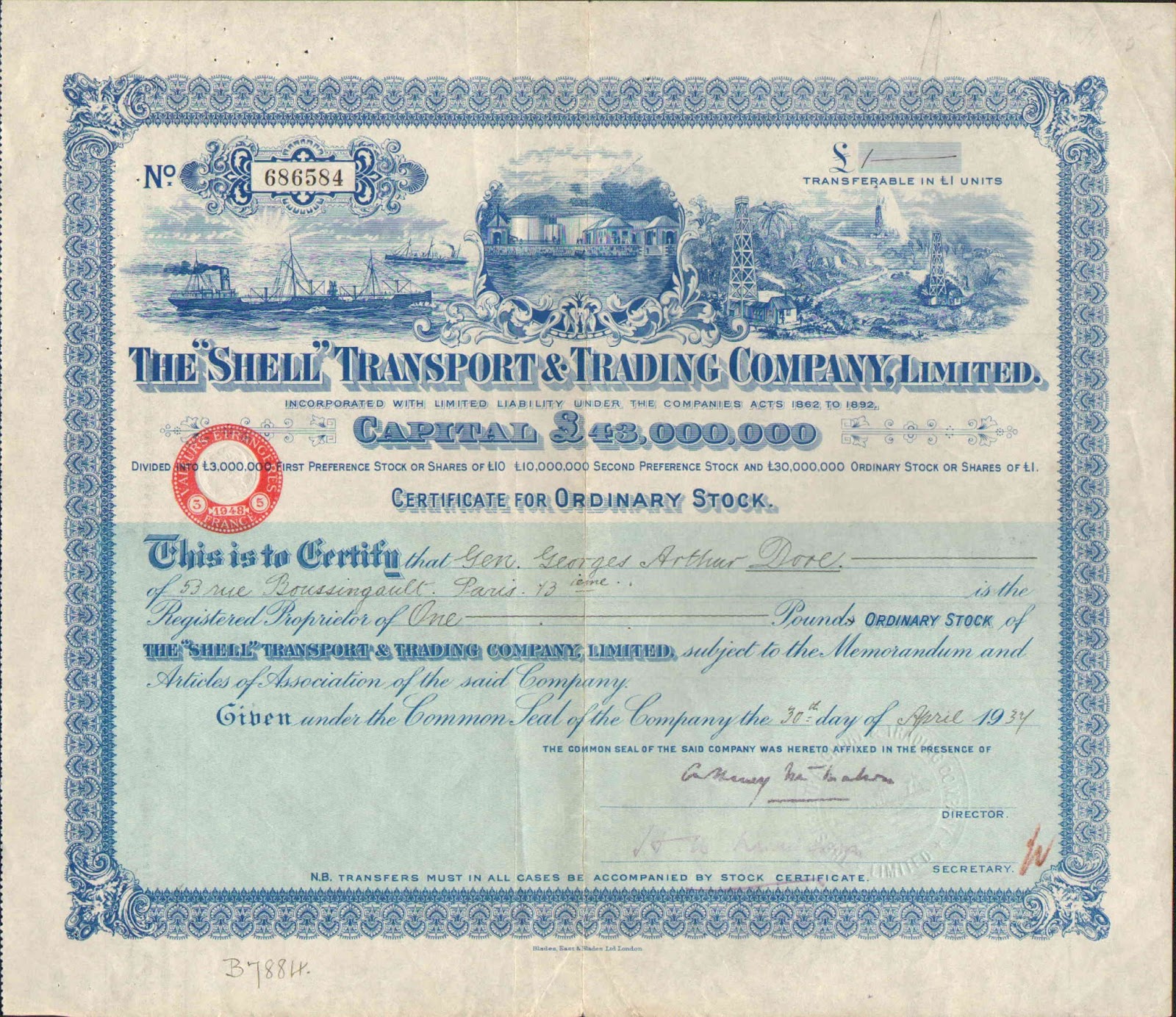
The "Shell" Transport and Trading Company Limited stock certificate
Image courtesy : Geert Leemeijer


This is an odd couple
Both look like standard certificates. They also resemble each other :
  • Both are issued by The "Shell" Transport & Trading Company, Ltd
  • Both are printed by Blades, East & Blades Ltd.  
  • And both state a capital of £43,000,000.
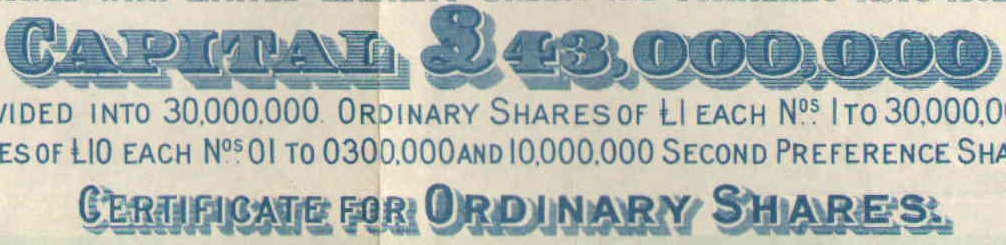
Yet, there is something strange about this pair. Did you notice that the first one is issued as a £1 ordinary share, and the second one as a £1 ordinary stock certificate ? You can verify this in these details.

detail from certificate No 1

detail from certificate No 2


Certificate No 1 was issued almost ten years earlier than certificate No 2. That raises the question why change the lettering from "share" to "stock" ? Why would a company want this : there is no change in the capital structure, and after all stock and share mean the same thing.

A matter of modern language ?
Geert Leemeijer aka Stockold Scripophily brought these two examples under attention in the Collectible Stocks & Bonds Facebook group. Geert suggested that over time the term stock certificate became more popular than share certificate. The different lettering on these securities was ".. a matter of modern language".

Here is an overview of the Shell examples provided by Geert with the date of issue and the stated capital :
  • shares
    • 1920 - £23,000,000 - 20 ordinary £1 bearer shares , blue
    • 1925 - £43,000,000 - 5 ordinary £1 bearer shares, brown
    • 1929 - £43,000,000 - ordinary £1 registered shares, blue
  • stocks
    • 1937 - £43,000,000 - ordinary £1 registered shares, blue
    • 1937 - £43,000,000 - 1 ordinary £1 bearer share, red
    • 1954 - £88,000,000 - ordinary £1 registered shares, blue
    • 1957 - £113,000,000 - ordinary £1 registered shares, blue

Two of these are displayed above, the others are grouped in the paste-up image below. The set illustrates the transition from share to stock for the Shell company.

share and stock certificates from the "Shell" Transport and Trading company
"Shares" in the upper row, "stocks" below.
The brothers Marcus and Sam Samuel founded The "Shell" Transport and Trading Company in 1897.
Their father imported and sold sea-shells and that's how the "Shell" company got its name. 
Image courtesy : Geert Leemeijer


Shell is not the only one
Other British companies also favoured stocks above shares. The UK section of Tabak-Peter shows the following examples :
  • British-American Tobacco Ltd
  • The Imperial Tobacco Company (of Great Britain and Ireland) Ltd. 
Earlier certificates from these companies are printed as shares and later ones as stocks.

Another example is the J. Lyons & Company Ltd.  J. Lyons started as a spin off from the Salmon & Gluckstein tobacco company at the end of the 19th century. The company expanded into a chain of teashops, ran high class restaurants and started to manufacture biscuits and later ice cream.

J. Lyons and Company Limited preference shares certificate overstamped as stock certificate

J. Lyons & Company, Limited
7% Preference "shares" of £1, 1923
The red stamp on the certificate, see below, tells us that 
The Shares referred to herein were converted into stock on the 24th June, 1940


J. Lyons developed original ideas about what the future of business could be like. After World War II they supported the EDSAC computing project at the University of Cambridge Mathematical Laboratory. In 1959 J. Lyons built their own computer, called Lyons Electronic Office I. Based on the EDSAC design, LEO I handled the company's accounts and logistics.

J. Lyons and  Company Limited stock certificate. A computer pioneer.
J. Lyons & Company Limited
7% Cumulative Preference "stocks" of £1, 1958
PS : Former British Prime Minister Margaret Thatcher worked 
as a food research chemist for the company around the 1950s.

UK stocks and shares in the Turbulent Thirties
Google's Ngram viewer displays charts that show how often terms, or phrases, occur in a corpus of books over a preselected number of years. The Y-axis shows the percentages of references to each term from all terms Google has indexed for a year (X-axis) in the entire corpus.


Google Ngram viewer chart shows a decline for the word share certificate in the British English corpus
Google Ngram viewer shows a decline for the term
share certificate from the 1930s till the early 1940s.
double-click image to enlarge

The corpus used in the chart is British English. It consists of books in the English language published in Great Britain. The chart illustrates a decline for the term share certificate over a period from the 1930s till the early 1940s (blue line). Meanwhile stock certificate saw an increase at the end of the 1930s. You can also check the same with the American English corpus, but the share certificate pattern is not repeated in that graph. According to Google Ngram's data, the term share certificate became more popular again from the 1960s.

Apparently during the 1930s it was trendy to speak of stock certificates in the UK. In this period a number of British companies preferred to market their securities as stock certificates instead of share certificates. Possibly this can be explained by the increase of intercontinental (American) aviation, radio, and film. A matter of adapting modern language.

F.L.

Related links