Showing posts with label catalogues and books. Show all posts

Tuesday, September 26, 2023

IBSS surprises members with full publications of Drumm & Henseler scripophily catalogues

The International Bond & Share Society is an association of people interested in scripophily. The society was founded in 1978 as a non-profit organization with the aim to promote, encourage and develop all aspects of scripophily. 

With members all over the world, the society publishes its flagship publication Scripophily three times a year.

Over a timespan of several months a small group of members cooperated in obtaining the copyrights of the pioneering Drumm & Henseler catalogs, digitizing those works, and making them available to its members as downloadable publications.  

The following catalogues can now be found on the IBSS site :


Italian Railways, by Drumm, Henseler, Witula


Ottoman Empire and Turkey, by Drumm, Henseler, Glasemann


Russian City Bonds, by Drumm, Henseler


Russian Railway Bonds, by Drumm, Henseler


You can find the publications here, but you must be logged in as a member to access this information. Still not a member ? Then this will help you out. 

F.L.


Saturday, July 2, 2022

Gigantic : Moody's Industrial Manual

"Moody's Industrial Manual for 1963 is the most comprehensive source of information on industrial corporations and enterprises available to the banker, investor, analyst and business executive."
Introduction, Moody's Industrial Manual 1963


The Moody's manuals are a treasure for scripophily researchers. They contain tons of information about the companies from which we collect antique stocks and bonds.


The American John Moody (1868 – 1958) was a financial analyst and investor. In 1900 he published his first manual providing details and ratings of company and government bonds. In 1909 he founded Moody's Investors Service to produce yearly manuals like the one illustrated here. 

Featured in the Industrial Manuals are thousands of profiles of industrial companies, mainly from the USA but also from Canada, Great Britain and other countries. For instance, Siemens & Halske, Honda Motor Co., Heijn (Albert), Ontario Steel Products Co., SIMCA Industries, Rolls-Royce and Montecatini are a few of the many non-American entries in the illustrated 1963 edition.


Here's an excerpt from a profile from the Stanley Aviation Corp, an aircraft equipment manufacturer. This is one of the smallest entries in the book. Medium-sized and large companies are listed with much bigger profiles, up to several pages. For instance, R. H. Macy & Co., Inc., is described in four pages; E. I. Du Pont de Nemours & Co. fills six pages.

The entries consists of : a company history, its capital structure, background, mergers and acquisitions, company name changes, subsidiairies, plants and properties, employee statistics, officers and directors, business activities and products, operating statistics, balance sheets, and much more. 


These books are gigantic. Issue 1963 measures about 21,5x28,5 cm, or 8.5x11.2 inch, and counts 3028 pages. It's thickness is 10,5 cm or 4.1 inch. It weighs 5 kg or 11 lbs. Don't put any of these on your flatbed scanner ! Some year editions are even bigger and consist of two volumes : monstrous. 

Illustrated below is an extract from the Alphabetical Index in the 1963 edition. The index section counts 114 pages with each page referring to about 130 company names ! 


I use manuals like this for looking up company details and identifying hard to read signatures. Let's try this with a 1960s specimen share from The Bendix Corporation. 

The manual has three pages on this company: 

"Incorporated in 1929 as the Bendix Aviation Corp., the company adopted its present name in 1960. Bendix and its subsidiaries produce a wide line of aviation, automotive, missile, electronic, marine, space and automation products, .."


What about the signature of Bendix' chairman ? Note that this is a facsimile signature, which is a reproduction by engraving, printing (like this example) or stamping of the manual signature.

The manual lists for Bendix over twenty officers and directors. One of them, our match, is listed both as Exec. Vice-President and Director : A. P. Fontaine. This information in turn allows me to find out more about the person :

Athanas P. Fontaine (1905-1989) was a pioneering airplane designer. After graduating in aeronautical engineering, he helped designing the Aeronca C-1, the first lightweight passenger plane in the US. An aircraft designer and project engineer he worked for several aircraft companies such as Fairchild Aircraft Corp and Republic Aircraft Corp. 
A. P. Fontaine headed Bendix' aircraft division in 1944 but left in 1946 and returned in 1952 to become director of engineering. He was chairman and chief executive of Bendix from 1965 to 1972. source: The New York Times, May 17, 1989


These books are valuable research tools. Unfortunately very few have been digitized. On this Moody's Manual Wikipedia page you'll find several links to editions from the 1910s and 1920s. A few of them actually lead to a fully browsable digitized version.

F.L. 


Previous posts


Sunday, May 22, 2022

Collecting antique stock certificates ? Go to the next level with Scripophily magazine !

Scripophily magazine is the world’s most comprehensive and insightful publication for passionate collectors and researchers of antique securities. Its 2022 April issue brings over 50 pages of scripophily news, in depth articles, book reviews, pictures of collector friends, auction reports and quality images of stunning, historic and rare stocks and bonds.


Scripophily magazine is illustrated with tons of gorgious stock certificates. This one from The Cincinnati Edison Electric Company is featured in the Deutsche Bank trilogy (© HIWEPA). The company was incorporated in the state of Ohio. Its $1 million capital was represented by 10,000 shares of $100. This certificate, issued in 1892 to the Deutsche Bank of Berlin, for 3,333 1/3 shares, represents a third of the capital. Image by Horst Klophaus 


Compelling tales, business plot twists and memorable personalities keep you spellbound. Scripophily magazine uncovers the stories of historic and artistic securities. In addition, reports from the auction markets help you to stay up-to-date. This periodical is the flagship of The International Bond and Share Society (IBSS) and appears three times a year.

Here is a summary on the topics brought in the latest issue :
  • Piers and Seaside Entertainment, interview with a collector 
  • Book review : Stamp Taxes in Nevada I. Silver Fever! Nevada Territory Stock Certificates, 1863-4, author Michael Mahler 
  • Book review : Michigan Copper Mining Stocks and Bonds, Part II, author Lee Degood
  • El Partido Revolucionario Cubano, a rare but fake bond emerged 
  • The Insanity Spreads, NFT technology flirts with Scripophily 
  • Dispatches from the Front, Bits and Pieces, market concerns with the Russo-Ukrainian War 
  • The Greenawalt Donation : Interview with David Mihaly of the Huntington Library 
  • Charles V Bond with phenomenal Face Value emerges (Spain)
  • Standing on the Shoulders of Giants, Terry Cox reflects on his US railway project coxrail.com 
  • The Howe Sound Co, copper mining in British Columbia 
  • Selling the Security, member contributions with share certificates promoting the business 
  • Studebaker, the family, stocks and bonds, and legacy
  • Deutsche Bank Part I : The History of "Deutsche Bank AG"
  • Boomtimes in the German Sugar Industry : 1850-1885 

On top of that the issue brings results and analysis on more than 20 auctions that took place during the preceding period in Germany, USA, China, Switzerland, UK, and other countries. You'll find out which auctions took place, what collecting themes are currently in demand and what price results are achieved for top pieces.


Subscribing to Scripophily magazine brings you valuable free extras: 
  1. The IBSS Directory brings you in contact with fellow collectors. Many of those are experts in their field, often share common interests with you, and possibly live nearby. The Directory contains members from more than 40 countries. 
  2. Upcoming events : Learn which auctions, collector bourses and society meetings will take place.
  3. Locate dealers and auctioneers : The Membership Directory also contains a list of dealers and auctioneers with further contact details. Most  auctioneers and dealers publish their catalogues either online or on paper.
  4. Access to the Experts : Being part of the International Bond and Share Society (IBSS) has provided me access to a network of experts in a variety of specialties related to the collection of Stocks and Bonds, always willing to led a hand and point me in the right direction.
  5. Access to all content on the IBSS website, including digital versions of previous issues of Scripophily magazine, the online forum, special theme galleries, and the like. 
  6. Newsflashes on the website focus on hot topics that can't wait for the next issue of the magazine. 
  7. Get extra credibility : being listed as a member is a good reference in any deals made remotely with parties previously unknown. 
A 1-year subscription only costs £25 or $35 or €28. The magazine is published by IBSS. More info : https://scripophily.org/membership/join/ 


F.L.

Related links


Tuesday, January 25, 2022

Use alternative search terms when searching digital publications

When you want to find something specific online, you key in a search term in the input field of a search engine such as Google. A search term can be a single word or a combination of words, e.g. “railway” or “railway company”. However, to get want you want, you may need to take an extra step.

The vignette shown here appears on a bond from The Utica and Black River Railroad Company. It is wide and gorgious, you can click the image to admire the scene in detail. 


The railroad's line originally ran from Utica, N.Y., to Philadelphia, N.Y. (Manual of the railroads of the United States 1874). 

The bond is illustrated below. According to coxrail.com its Frequency of Appearance is F1, which means this certificate "usually appears more than 10 times per year" on the collectors' market. Note that Cox's Frequency of Appearance system does not tell you anything about the value of a particular railroad stock or bond. You can find out more about this system here. 


The Utica and Black River Railroad Company, $1000 First Mortgage 4% Gold Bond Guaranteed, 1890, Cox catalog nr UTI‑125‑B‑50 


I tried to identify the signature of the person who signed the bond as President of the railroad. Sometimes that person turns out to be an important railroad entrepreneur, a philanthropist, or even a civil war veteran.  


An interesting source for researching railroad officials is The Biographical Directory of the Railway Officials of America. The 1885 edition, edited by E. H. Talbott and H. R. Hobart and pubished by The Railway Age Publishing Company, lists nearly 4000 names of :

  • Presidents and vice-presidents
  • general and assistant general managers
  • general, assistant, and division superintendents
  • general and assistant general freight agents
  • general and assistant general passenger and ticket agents
  • chief engineers
  • general agents, and 
  • other officers.

The 1885 edition of the book is available online. You can consult it here on archive.org. A PDF version can be downloaded there. 


The archive.org site provides a search function when the book is read online. I then keyed in the word combination "Black River", a snippet from The Utica and Black River RailRoad Company name. 
This yielded the following results that referred to the full company name :
  • B. H. Bail, General Freight Agent in 1883 to date [1885, the book's publication date] 
  • Edgar A. Van Horne, General Superintendent in 1883 to date
  • Albert Wilber, resident engineer in 1875

Interesting, but not what I was looking for. Though all of these were officials from our railroad, none of the names seem to match the signature.

Next I put in an alternative keyword : "Utica".
Now I got these outcomes :
  • B. H. Bail, General Freight Agent in 1883 to date
  • Theodore Butterfield, General Freight and Passenger Agent, Utica, N.Y.
  • J. F. Maynard, Vice-President and General Manager, Utica, N.Y. 
  • John Thorn, Director 1859, President 1859 to date 

Aha ! Got Ya. The signature present was the one from J. F. Maynard. 

Why the different results ? 
The reason is that the automatic process of converting old books in print to a computer-readable format is not error free: letter 'l' can be misread for number '1', sometimes a letter is worn off, etc. This illustrates my point: use alternative search terms to get the most out of your digital research activities. 

By the way, you can find the 1887 edition of the book here, and the 1893 edition there. Perhaps there are more editions available online.

I could have ended my post here, but there is something extra about this bond certificate that I wanted to share. The thing is, the certificate features two different embossed company seals, both hardly visible. 


The first seal was embossed on the guilloche figure that was printed in the lower left corner of the bond. You can see it much better when you inspect the reverse of the certificate. However, on the reverse you see a mirrored image, see the left image above. 

Luckily, the GNU Image Manipulation Program software allows me to rotate and mirror the image once more so it becomes readable (right image above). The seal depicts a locomotive and reads: 

THE UTICA AND BLACK RIVER RAILROAD COMPANY 
UTICA, N. Y. 


Then there is a second embossed seal, also difficult to detect. It is located on top of the "U" initial of the company title (top left corner). Also in this case we check the reverse of the certificate. It reads : 
ROME, WATERTOWN & OGDENSBURG
RAIL ROAD COMPANY
STATE OF NEW YORK
CONSOLIDATED 1885


The seal was embossed upon this printed text:

For Value Received, The Rome, Watertown and Ogdensburg Railroad Company hereby guarantees the punctual payment of the principal and interest of the within Bond according to the terms, tenor and effect thereof.


Since 1886 the Rome, Watertown and Ogdensburg RR started leasing the lines of the Utica and Black River RR. Both had been under one management since then. The former thus assured the bond buyer that he would see his money back in the end.  

F.L.


Previous posts 


Friday, December 24, 2021

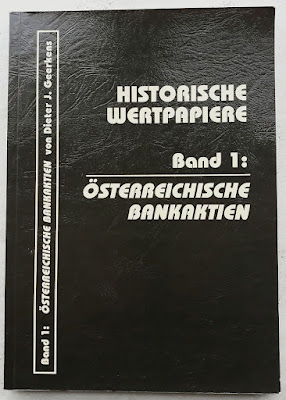
Reference book: Österreichische Bankaktien by Dieter J. Geerkens

Historische Wertpapiere Band 1: Österreichische Bankaktien is a reference catalog on antique bonds and shares from banking companies formed within the territory of Austria, including those banks set up during the Austro-Hungarian Empire. The book, a large format publication, was put together by author Dieter J. Geerkens. 


  • Title: Österreichische Bankaktien
  • Author : Dieter J. Geerkens
  • ID : no ID, published 1998 by Dieter J. Geerkens
  • Languages : German
  • Number of pages : 255
  • Images : more than 120 black and white and 150 page wide color images
  • Index : on company names; index located on page 51 


The  catalog entries are divided over two sections. 

A first small section, "Zwischenkatalog", describes the companies that lasted only a few months, and of which no securities are known (at least at the time when this book was published). This part includes about 40 companies that were founded just before or after the Vienna Stock Exchange Crash of 1873. Some examples are : Grazer Bankverein, Pfandlei-Anstalt Steyr, etc. 

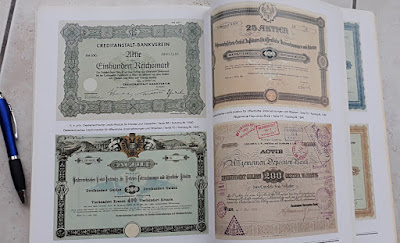
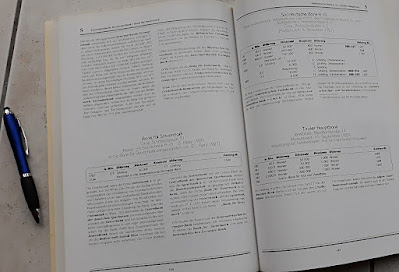
The second section, "Hauptkatalog", features about 140 banks with background information and a listing of their known securities. Each certificate has a catalog number referring to its entry in the price catalog chapter, and color photographs in the last part of the book. Some of the companies included are : British-Oesterreichische Bank- und Handels-Aktiengesellschaft, OrientBank (Palästinabank), Tiroler Hauptbank, etc.


Chapters
  • Vorwort und Erklärungen (Preface and explanations)
  • Kapitel 1 : Die Wiener Börse (Chapter 1 : The Vienna Stock Exchange) 
  • Kapitel 2: Die Banknoten (Chapter 2 : The banknotes)
    • Das Papiergeld
    • Verpfändung
    • Steueränderungen
    • Kriegsfinanzierung durch Steuern
    • Inflation
    • Bankozettel 1800
    • Wiener Stadt Banco Zettel Papiergeld anno 1800
    • Zollerhöhungen
    • Vorratsversteuerung
    • Der Friede von Austerlitz
    • Einlösungsscheine
    • Einlösungsdeputation
    • Keine neuen Steuern - Pferde vom Kaiserhaus
    • Staatsschulden-Tilgungsfonds
  • Kapitel 3: Die ersten Aktienbanken (Chapter 3: The first joint-stock banks)
    • Die Hofhaltung war kostspielig
    • Die privilegierte Oesterreichische Nationalbank
    • Die ersten Aktienbanken | Erneuerung des Notenbankprivilegiums 1841
  • Kapitel 4: Die Oesterreichisch-Ungarische Bank
    • Viertelaktie der Oesterreichischen Nationalbank
    • Aktie der Oesterreichischen Nationalbank
    • Interimsschein der Oesterreichischen Nationalbank
  • Kapitel 5: Die Bankgeschichte 1855 bis 1938 (Chapter 5: Banking history 1855 to 1938)
    • Der Wiener Börsenkrach 1873
    • 1873 bis 1914
    • Die Friedenszeiten von 1866 bis 1914
    • Erinnerungen an 1873
  • Kapitel 6: Historische Wertpapiere: Aktienbanken (Chapter 6: Historical securities: joint-stock banks)
    • Inhaltsverzeichnis der Aktienbanken
    • Zwischenkatalog
    • Hauptkatalog
  • Kapitel 7: Preiskatalog
  • Literaturverzeichnis (Literature list)
  • Anhang: Farbteil (Appendix: Color section)


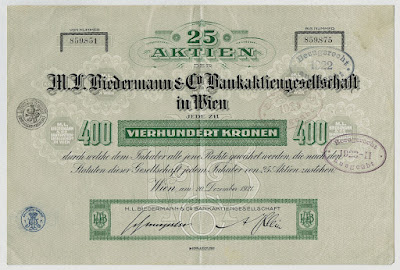
The M. L. Biedermann & Co. Bankaktiengesellschaft was originally founded in 1792 by Michael Lazar Biedermann, imperial Austrian court jeweler and co-founder of the Jewish community in Vienna. This  certificate for 25 shares of 400 Krone was issued in Vienna, 1921 and printed by H. Engel & Sohn. Other types of this share are illustrated in the catalog as number 1153, 1154 and 1157. 


The book was published almost 25 years ago, so the price indications (mentioned in Austrian Shilling) are not relevant anymore. Yet, this is a top work for anyone interested in the history of Austrian banking described and well illustrated in the first 50 pages of this volume. The color photographs are really well made! 


F.L.


Previous posts

Thursday, October 14, 2021

The Berner Alpenbahn Gesellschaft - Bern-Lötschberg-Simplon, new book from author Dr Peter Christen

In 1906 the Berner Alpenbahn-Gesellschaft Bern-Loetschberg-Simplon was founded with the purpose of building the second Swiss railway line through the Alps between the cantons Berne and Valais through the Loetschberg mountain. Today it runs under the name BLS and is the largest private railway in Switzerland.

This year, the scripophily public welcomed Dr. Peter Christen’s new book on the Bern–Lötschberg–Simplon Railway. More than reason enough to have a talk with the author! 


FL Welcome Peter in this virtual studio. We are honoured to have you here. Let’s start from the beginning. How did you become interested in scripophily? 

PC Thank you. My “scripophily career” started at Christmas 1980. I can remember very well. I then was a first-year student at the University of Geneva. At the train station on my way to Christmas visit home I bought a financial newspaper … and out fell a share of the “Builder Investment Group”. It was a special Christmas present from the newspaper to its readers. I immediately fell in love with old shares and bonds.Since that day I am into scripophily.

FL Peter, what is the greatest joy you get from collecting?

PC The most fascinating thing for me is the information gathering. First, I have a share or bond in front of me and I know very little about it. Then, when I start to investigate, I find all this interesting information about its history and all its connections it is leading to.


FL Can you tell us something about yourself regarding your “scripophily career”?

PC As a collector, I am definitely not a good role model: I do not specialize in one field. I collect items that are interesting and do have significant importance in economic history. This scope makes a collection really big. However, one of my main fields is collecting railways and more than 10 years ago I published a comprehensive catalogue for Swiss Railways and have published several articles about Swiss railway companies in different media. 


FL Oh yes, in 2014 you won the Journalistenpreis Historische Wertpapiere und Finanzgeschichte. If I am correct, you are the president of the Swiss Collectors Association SCRIPOPHILA HELVETICA, and you’re also a partner in the auction and trading house for historical securities HIWEPA AG. Now you have published a new book, “Die Berner Alpenbahn-Gesellschaft Bern-Lötschberg-Simplon BLS”. Why did you choose this subject?

PC I actually have hundreds of ideas of interesting things I could write about. There is just not enough time. But this year it is different. The idea for writing this book came up in February. “Thanks” to all these Covid restrictions I was forced to stay at home and could not go to my usual spring trekking holidays in Spain. So I decided spontaneously that I would write a book.

PC Finding a theme is definitely not a problem for me. A couple of years ago I wrote a short article (see here) about the “Finanzgeschichte der BLS Lötschbergbahn – Berner Alpenbahn” for my colleagues at HIWEPA. Together with the famous “Gotthardbahn” the BLS Lötschbergbahn – Berner Alpenbahn” was the second Swiss railway through the alps and has a very interesting history.

PC I took this article as a starting base and, for a couple of weeks, I investigated further into the story of the company, with – what at least I think – super interesting and new information about this railway and all its shares and bonds.


FL Well, you made me curious. Can you tell us briefly what makes this railway so interesting? What surprised you most?

PC The Berner Alpenbahn Bern-Lötschberg-Simplon, today BLS, was and is the second railway through the Swiss Alps and a very important link between Northern Europe and Italy. Its financial history is very interesting. Actually, at the beginning, nobody in Switzerland, except the people of the canton Berne, wanted to finance this project. Berne had to look elsewhere to raise the necessary funds and these were to come from an unexpected source.

PC I personally was surprised to find out that the Berner Alpenbahn and its shares and bonds even have some connections to an assassinated French president and even to the Compagnie Générale Aéropostale and its famous pilot and author Antoine de Saint-Exupéry. I think nobody knew about this connection until I found it. 

FL Wow, that’s sounds intriguing? Looking at the book cover we can detect a certificate in the background of the front cover. Why did you pick that particular certificate?

PC The background for the front cover is the bond of the Berner Alpenbahn-Gesellschaft issued for building the railway. Between 1906 and 1912, the company raised money with four issues of these decorative bonds.


FL The vignette invites us to have a closer look. Does it represent a real view in Switzerland?

PC Yes, the image in the vignette shows an aerial view of the main section of the railway in the Bernese Oberland. The bond also depicts the two shields of the main cantons along the line, Berne, in the left border, and Valais, on the right. On top of the certificate, you’ll see a winged railway wheel with Mercury and the electric bolts. It represents the BLS as the first electric railway through the Alps.

FL I’m sure our readers will be interested about the book format and content. What about that?

PC The book has 148 pages and many colour images especially with details of the old shares and bonds. The book has three chapters, first, the financial history of the company and, second, the detailed images, description and background of its shares and bonds and, third, the list and images of all issued shares and bonds of the company. You also can buy the book as e-Book. 


FL Where there any special sources that you used for your research? How long did it take you then to write it?

PC I especially researched all reports from the company itself, general history and other reports about the company. Further, I am always astonished how every year the information you can get through the Internet increases. As I already have written a shorter financial history about the company the information gathering did not take too much time. It took me three to four weeks the write the book then.

FL Now, it’s time for what I believe is one of the most difficult questions a collector may answer. If you could add any certificate in the world to your collection, what would it be, and why?

PC I would love to find a share or bond with the signature of James Watt. In the collector market, all important inventions, railways, canals, cars, airplanes, etc, do have shares or certificates but there is nothing on the extremely important invention of the steam engine. So, a share with the signature of James Watt would really be a sensational find. Maybe our collector friends from the UK will make this find ... but I doubt it.

FL Peter, I want to thank you for this interview and wish you a lot of success with the book.


Die Berner Alpenbahn-Gesellschaft Bern-Lötschberg-Simplon BLS Finanzgeschichte und Historische Wertpapiere, by Peter Christen, is published by Books on Demand :
  • ISBN: 978-3-753-40662-6
  • Price: CHF 29.80
The book can be ordered with hiwepa.ch, email info@hiwepa.ch, or at most bookshops and online bookstores. An e-Book version is available as well.

FL

This post was originally written for Scripophily magazine, published by IBSS.


Previous posts

Sunday, September 12, 2021

Exhibition : From Peking to Hankow

Train World is the official museum of the NMBS/SNCB, the National Railway Company of Belgium. It is situated in the old but renovated Schaerbeek railway station in the Brussels-Capital Region.

Until 10 October 2021, the museum hosts an interesting temporary exhibition about the history of one of China's most remarkable railways, the Peking–Hankow railway. The exhibit includes several antique government railway bonds.


From Peking to Hankow : a Belgian adventure in China tells the surprising story of China’s longest railway line, from Peking (Beijing) to Hankow (today Wuhan), connecting the North to the South in the early 20th century.

Thousands of people laboured on this immense operation for seven years. This feat was achieved by engineers, technicians and workmen, and Western and Chinese diplomats and financiers. Jean Jadot, a Belgian engineer coordinated and implemented this massive project.


During your visit, the main players in the saga, embodied by talking figures, will tell you some fascinating tales and take you back in time so that you can relive grand moments in the history of the railway.

The exhibition also showcases the impressive development of China’s current high-speed railways. Original works relating to the construction of the Peking-Hankow line and created by artists Li Kunwu (China) and François Schuiten (Belgium) add a contemporary artistic touch to the exhibition. 


Train World is over 8,000 square metres and displays 22 locomotives, royal train carriages, 1/10 scale models and 1,200 other railway related objects, including an original 19th century railway bridge. One of the principal objects to see is the oldest preserved locomotive (1845) in Continental Europe.

A large format hardcover catalog has been published in French and Dutch. The volume counts more than 270 pages and depicts some large illustrations from antique securities. The museum has these scripophily objects on loan from various lenders such as the National Bank of Belgium and BNP Paribas-Fortis. A small number of bonds and shares are actually on display.

Practical info :
  • Opening hours : 10:00 - 17:00, but closed on Mondays, the Peking-Hankow exhibition runs till 10 October 2021
  • Location : Princess Elisabeth place 5, Schaerbeek
  • More info here in English, in Dutch, in French and in German  

F.L.


Previous posts

Thursday, June 17, 2021

Book : Price list of Polish and Polish related securities

Poland counts several authors on the subject of antique stocks and bonds. Recently author Kamil Lipski published his price catalog for Polish securities. 

This 80 page publication, A5 format, consists of two sections. The first one is an alphabetical listing of Polish stocks and bonds issued by governments, cities, companies as well as companies operating in Poland but founded with foreign capital. The second section includes about 150 color images of stocks and bonds.


  • Title : Cena papierów wartościowych polskich i z Polską związanych, in English: Price list of Polish and Polish related securities
  • Author : Kamil Lipski
  • ID : ISBN 978-83-961041-0-6, published by Fischer Sp.z.o.o., 2021
  • Language : Polish
  • Number of pages : 80
  • Images : nearly 150 small color images of securities
  • Indexes : no separate index, catalog entries are listed in alphabetical order 


The main section of the book consists of a large table featuring 780 bonds and shares. Each entry is described with the following characteristics :
  • Nr : the catalog number of the certificate
  • Nazwa : name of the issuer
  • Emisja/kapital : emission, capital and/or data of the issue
  • Liczba i nominał akcji/obligacji : number and value of share/bond, denomination
  • Rodzaj : type, na okaziciela to bearer, or imienna registered, nominative
  • Cena (PLN) : price in Polish złoty
  • Uwagi, inne cenniki : comments and/or references to other catalogs

This handy book gives the novice an idea of what Polish scripophily can offer. As with all price guides, the indicated prices may reflect future price evolutions.   

You can contact the author at stareakcje.com.pl@gmail.com for more information. 


F.L.


Previous posts

Thursday, May 13, 2021

Reference catalogue : Bulgarian bonds

Scripophily literature about Bulgaria is sparse, but that is changing. 

Author Pitt Alan has compiled the first edition of a two-part volume on Bulgarian state securities. The two works are digital publications. I will tell you more about that immediately, but let us first have a closer look at the content.


Part I Long Term Bonds 

The first volume gives an overview of known long term bonds issued by the Bulgarian governments. It consists of 185 pages in which about 180 bonds are described. Part I counts 150 color illustrations in medium resolution. This volume is written in English.

Each entry addresses the following characteristics : catalogue number, title, face value, maturity, coupons, description, watermark, printer, mintage, rarity and price indication (where possible). Here's an overview of the chapters :
  • A. Government and Bank Loans (the largest chapter)
    • Principality of Bulgaria 16 April 1879 - 22 September 1908
    • Kingdom of Bulgaria 22 September 1908 - 15 September 1946
    • People's Republic of Bulgaria 15 September 1946 - 15 November 1990
    • Republic of Bulgaria 15 Nov 1990 - present day
  • B. Municipal Loans
  • C. Loans of Commercial Enterprises
  • D. Loans of Political Organizations
  • E. Loans of Various Entities


After the Russo-Turkish War, 1878, the Bulgarian state was reestablished as the Principality of Bulgaria. Officially, a vassal state of the Ottoman Empire, the principality was de facto independent. This £20 = 500 Francs = 500 Leva specimen bond was printed in London by Bradbury, Wilkinson & Co. It was part of the State Redeemable 6% Loan of 1888. Cat. Nr. A.1


Part II Treasury Bills 

Volume II discusses treasury bills, short term bonds, issued by the successive Bulgarian governments. This volume counts 107 pages illustrated with 250 color illustrations (obverse and reverse) in medium resolution. Here, the author added more in depth information to each treasury bill issue. This volume is written in both English and Bulgarian. 

An overview of the chapters of the 2nd volume :
  • A. 1st period - Pre World War I State Treasury Bills for guarantee of external state loans
  • B. 2nd period - World War I State Treasury Bills for covering budget deficit, issued 1917-1920, representing internal state loans
  • C. 3rd period - Between the two World Wars, State Treasury Bills for covering reparations and for new military expenses
  • D. 4th period - World War II State Treasury Bills representing internal loans
  • E. 5th period - State Treasury Bills issued after the democratic changes of 1989


At the end of World War II the USSR invaded Bulgaria. In 1946 a communist one-party people's republic was instituted. Bulgaria became one of the founding members of the Comecon in 1949. This Council for Mutual Economic Assistance, under leadership of the Soviet Union, enabled Bulgaria to strengthen its economic relationships with other Eastern Bloc countries and socialist states. This 20 leva interest-free bond from the State Loan for Development of National Economy was issued in 1952. Cat. A.30 


This is a digital password protected publication. How does it work ?

The two volumes appeared only in a digital and password protected format, namely PDF. They are available from eBay seller BC43L currently at the price of $25,94 each. See here. 

After purchasing one of these items on eBay, the buyer receives by email a download link and a password. Once downloaded, you can open the PDF file after providing the password. Each volume is also 'custom-generated' : the name of the buyer is printed at the bottom of each page next to the page number. 

One last thing to know, unlike the images shown in this article, the images in the volumes have a subtle digital watermark.


This 5% 12-month treasury bill of 5000 Leva was issued in 1918. Cat. B.106 
After World War I there was a shortage of paper money. The Kingdom of Bulgaria started using treasury bills as paper money by having them overprinted and verified with the handwritten signatures of three government officials (inspector, controller and cashier). The text in blue overprint shown on the example says (source : Bulgarian bonds, Part II, Pitt Alan) : 
The bill has the power of banknote, just for the interior of the Kingdom. 
With term until 31 December 1922 and up to the value of the principal amount. 
Leva 5,000 five thousand 5,000 Leva. 
Bulgarian National Bank


Peter Anguelov wrote these two volumes under the pseudonym Pitt Alan. No doubt collectors of Bulgarian and even Ottoman and Soviet scripophily, as well banknotes, will be interested. 


F.L.

Previous posts


Tuesday, April 20, 2021

Book : Dow Jones by Peter Jones

Dr. Peter D. Jones brings the stories behind the companies that formed the Dow Jones average in 1884, as well as the ones that were included in the DJIA as the index grew over the decades. The book deserves a place in any scripophily library. Let's have a closer look.


  • Title : Dow Jones by Peter Jones - A History of Dow Jones Stock Averages since 1884
  • Author : Peter D Jones
  • ID : ISBN 978-1-09830-506-2, published by BookBaby, 2020
  • Language : English
  • Number of pages : 350
  • Images : almost on every page, in color except for vintage photos, page wide images of stock certificates
  • Indexes : large index section spanning 11 pages each with 4 columns of keywords 

Peter Jones introduces the reader into the world of scripophily and the history of the Dow Jones stock market index. The book continues with the stories of companies that were included in the Dow Jones index.


The United States Steel Corporation entered the DJIA in 1907 after it bought the Tennessee Coal, Iron and Railroad Company, one of the initial index components. This $100,000 bond once belonged to industrialist Andrew Carnegie. He sold his share in US Steel to banker J. P. Morgan for $225 million. Carnegie was paid in 50-year gold bonds like the one shown here. The buyout was the largest industrial takeover in United States history. It made Carnegie the richest American.  Image courtesy : Peter Jones  


The publication consists of the following chapters :
  1. Scripophily - what is it ?
  2. Dow Jones Company and its averages
  3. First Transport average 1884 - 11 stocks
    • Chicago and Northwestern Railway, Delaware Lackawanna and Western Railroad, Lake Shore and Michigan Southern RW, Louisville and Nashville RR, Missoure Pacific, New York Central RR, Northern Pacific RR, Chicago Milwaukee and St. Paul RR, Union Pacific RR, Pacific Mail Steamship, Western Union Telegraph 
  4. First Industrial average 1896 - 12 stocks : 
    • American Cotton Oil, American Sugar Refining, American Tobacco, Chicago Gas, Distilling and Cattle Feeding, Laclede Gas Light, National Lead, North American Co, Tennessee Coal Iron and RR, US Leather, US Rubber, General Electric 
  5. Second DJIA 1916 - 20 stocks, including :
    • American Beet Sugar, American Can, American Car and Foundry, American Locomotive, American Smelting and Refining, AT&T, Anaconda Copper, Baldwin Locomotive, Central Leather, BF Goodrich, Republic Iron and Steel, Studebaker, Texaco, Utah Copper, Westinghouse Electric and Manufacturing 
  6. Third DJIA 1928 - 30 stocks, including : 
    • Allied Chemical, Atlantic Refining, Betlehem Steel, Chrysler, General Motors, General Railway Signal, International Harvester, International Nickel, Mack Truck, Paramount Publix, Postum (General Foods), Radio Corporation of America, Sears Roebuck, Standard Oil (EXXON), Texas Gulf Sulfur, Union Carbide, Victor Talking Machine, Woolworth, Wright Aeronautical 
  7. 30 longest surviving DJIA stocks, including :
    • Procter and Gamble, Honeywell, United Aircraft, DuPont, Eastman Kodak, Chevron, Goodyear, ALCOA, Johns-Manville, International Paper, Owens-Illinois Glass 
  8. Ten largest US companies
    • Apple, Alphabet (Google), Amazon, Microsoft, Walmart, Pfizer, Facebook 
  9. Appendices
    • Corporate structures
    • Richest people in US
    • How DJIA is calculated
    • 1884 DJTA railroad locations


The Nash Motors Company was in the DJIA30 from 1928 to 1930 and from 1932 to 1936. The company, founded by former General Motors president Charles W. Nash, pioneered with car heating and ventilation systems, unibody construction and seat belts. Nash Motors became American Motors Corporation (AMC). Image courtesy : Peter Jones

By bringing the story of America's large industrial companies in easy digestible chapters, the author also tells us the history of modern industrial America. Besides writing about successful entrepreneurs, inventions, technological advances and progress in society, Peter Jones also discusses union disputes, dishonest business practises, environmental abuse, etc. Yes, lots to be amused about.

Peter Jones is also the author of these numismatic books : Colonial History in Your Hands, Commemorative Coin Tales, The First Medals of America, The First Coins of America and Notable Notes. A description of these can be found here. 


This Google Inc. share shows the facsimile signatures of founders Larry Page and Sergey Brin. Peter Jones' book is one of the few scripophily works that also highlights modern technology stocks such as Apple, Microsoft, Amazon, Facebook and Google. Google was not included in the Dow Jones. Why can be read in the last chapter. Image courtesy : Peter Jones

A hard cover, it measures 11 x 8.5 inches (28 x 21,6 cm). You can purchase the book from the author himself. Mail your address and a check for $79 (includes US mailing) to : Peter Jones, Box 1, Windham Center, CT 06280. International mail typically costs about $50 extra.

I especially liked the author's personal anecdotes in several chapters.


F.L.


Wednesday, November 4, 2020

Book : Osakekirjat Kertovat

Pekka Kantanen and Kari J. Sillanpää introduce the readers into the world of scripophily. They compiled about 100 share certificates, mainly from Finland, in a charming A4-sized hard cover work. 


  • Title : Osakekirjat Kertovat - Aktiebreven Berättar - Share Certificates, Past and Present
  • Authors : Pekka Kantanen, Kari J. Sillanpää
  • ID : ISBN 951-9417-06-0, published by Kustannusosakeyhtiö, 1988
  • Languages : Finnish, Swedish, English
  • Number of pages : 184
  • Images : about 100 page wide images, one third in color
  • Indexes : no index


The book is trilingual. Every share discussed has a paragraph in Finnish, Swedish and English which is very interesting to learn the Finnish scripophily jargon. Besides a company background, the authors address various topics such as evolutions in Finnish corporate law, signatures of noteable persons, designs and printing aspects. 

Most of the shares featured are from Finland, or were issued under the Grand Duchy of Finland. The publication can interest also already advanced collectors because the book includes several remarkable shares that are rarely seen at auction, e.g. a Nokia share from 1886, a Suomen Kultaseppä Osakeyhtiö share printed with gold and silver, etc. The book can be found on e-commerce platforms.


F.L.


Previous post

Thursday, October 1, 2020

Buckle up! Scripophily magazine brings you into the world of antique stocks and bonds

Compelling tales, business plot twists and memorable personalities keep you spellbound. Scripophily magazine uncovers the stories of historic and artistic securities. In addition, reports from the auction markets help you to stay up-to-date. This periodical is the flagship of The International Bond and Share Society (IBSS) and appears three times a year.


In Scripophily magazine you'll find out about the latest discoveries. This rare share certificate realized £160 at SPINK's May 2020 auction. The most famous restaurant not only in Paris but also in the world, Maxim's was in 1926 owned by this British company. 


Scripophily magazine is the world’s most comprehensive and insightful publication for passionate collectors and researchers of antique securities. Its 2020 August issue brings 50 pages of scripophily news, in depth articles, pictures of collector friends, auction reports and quality images of stunning, historic and rare stocks and bonds. 

Here is a summary on the topics brought in the latest issue :
  • The History of Worldwide Scripophily Auctions, a review of Tim Welo's book 
  • Buying on Time, Was this share certificate bought on margin?, about the Lake Superior Iron and Chemical Company (NY)
  • Western Union Telegraph Company, letter to the editor about Gandhi and India's independence struggle 
  • Collectors Clearinghouse, learn about the Bridgeport & Port Jefferson Steamboat Company
  • Nothing New about FaceTime or Zoom, the American Televue Company
  • Dow Jones, a History of Dow Jones Averages Since 1884, review of Dr. Peter Jones' book  
  • Large Scale Snubbing went on in Cleveland in the 1920s, brings the story on The Gabriel Snubber Manufacturing Company
  • Misadventures in Mining : Dutch Investors and R. G. Dun at the Caribou Mine 
  • A Visit to the New York Stock Exchange Archives
  • (Kaiser) Ferdinand's Nordbahn
  • Watermarks in Scripophily, part 1 introduction
  • The Dow Jones Company and its Averages, extract from Dr Peter Jones' book
  • Pacific Mail Steamship, idem
  • Johan Colenbrander and Colenbranders Matabeleland Development Company
  • My British Railway Treasure, a testimony on collecting early British railway scripophily


Scripophily magazine, August 2020, features on its front cover a Isaac Newton signed document subscribing to shares in the South Sea Company. This unique and historic document from 1720 recently emerged at an American auction. 


Subscribing to Scripophily magazine brings you valuable free extras :
  1. The IBSS Directory brings you in contact with fellow collectors. Many of those are experts in their field, often share common interests with you, and possibly live nearby. The Directory contains members from more than 40 countries.
  2. The Newsletter, so you may keep up with what is going on.
  3. Access to all content on the IBSS website, including digital versions of previous issues of Scripophily magazine, the online forum, special theme galleries, and the like.
  4. Newsflashes on the website focus on hot topics that can't wait for the next issue of the magazine.
  5. Get extra credibility : being listed as a member is a good reference in any deals made remotely with parties previously unknown.

A 1-year subscription only costs £20 or $32 or €25. The magazine is published by IBSS. More info : https://scripophily.org/membership/join/


F.L.

Related links