Showing posts with label Spain. Show all posts

Tuesday, April 9, 2024

Antwerp Hilton hosts Boone's auction of historic share certificates.

Mario Boone's 72nd auction features more than 1500 lots of scripophily from all over the world. The word scripophily is a contraction of the English word “scrip”, a certificate entitling ownership right, and the Greek word "φίλος" (philos), meaning "friend". It refers to the field of collecting of antique stocks and bond certificates.


This 1905 share from the Grands Magasins du Printemps tells us what this famous department store from Paris stood for: "Bon Marché - Qualité -Nouveauté - Élégance", in English: Cheap - Quality - Novelty - Elegance. Today a chain of department stores, Printemps offered high quality goods at prices affordable for the middle class. The store pioneered with discount sales to clear outdated stock, and used window models to display the latest fashions. L(ot) 350 in the auction starts at €200 


Two auction catalog volumes are available online and can be downloaded separately as PDF documents. Nearly all of the 180 pages in the main catalog include color images and background stories of the certificates to be hammered. For easy retrieval purposes, search indexes help the collector on his quest for engravers, artists, security printers, Belgian provinces, more than 80 countries and an equal number of special interest themes. 

The TOP 80 auction highlights are documented in a separate volume with bigger pictures and more detailed descriptions. 


This fascinating share in the merchant frigate Le Saint Philippe was signed by its captain Jean Daragorry in 1746. At this time it was the practice to finance the fitting-out of a ship on a one voyage at a time basis.  Le Saint Philippe, equiped with 18 6-pound ball cannons and a crew of 80, sailed under Spanish flag to Campeche and Tabasco in Mexico. At this date, France and Spain were at war with England over the Austrian Succession. Lot 786 is one of the Top 80 highlights of the sale and is expected to realize at least €2,400. 


The auctioneer managed to present some old collections that now have become available to the market including Belgian coal mining, British Railroads, Belgian Trams in Italy, Chile and Brazil. Some of these (check the catalog) are first offered as a complete collection in one single group lot. Only if no bids are received for the complete collection the individual certificates will be auctioned one by one. 


The auction features a few airline stock certificates. This is L1518, a nominative share from the Navegação Aérea Brasileira, issued in Rio de Janeiro, 1941. The certificate is listed at a €50 start price, a steal if you ask me, but it may be hammered as part of a collection of 393 Brazilian securities, L862, that is first offered as a single group at €7000. 


The Boone auction will take place at a new venue, the Hilton Old Town hotel in the heart of Antwerp. It was built in neoclassicism style in 1859 and served as a hotel and department store. You might want to spend a weekend in Antwerp because the day after the auction a scripophily bourse is organized by Guy Bertrand at the same place.


This stock was issued in 1918 to Elizabeth Huidekoper, the wife of Henry P Kidder, co-founder of Kidder, Peabody & Co. A regular donor to charity causes she also made gifts to the Boston Museum of Fine Arts. The certificate is also signed by Alice Evelyn Hay Wadsworth, known for her "Wadsworthy" tactics. Both women were high-society figures. The Woman Patriot Publishing Company was a publisher of The Woman Patriot, a "National Newspaper for the Home and National Defense Against Woman Suffrage, Feminism and Socialism". L1218, a rare stock representing a remarkable era in the field of women’s rights and American suffrage, starts at €240. 

There is a lot to discover, so here are the auction details :
  • Location: Antwerp, Belgium (new venue: Antwerp Hilton Old Town)
  • Date:  27 April, 2024 
  • Further info: online catalog & bidding, see here on the auctioneer's website, or via the Invaluable platform, see there. The two PDF catalogs can be downloaded from the auctioneer's site.

F.L.


PS : Did you like this post ? Thank you for sharing it on you favorite social media channel !


Friday, February 9, 2024

FHW's 125th auction is online with exceptional antique stocks and bonds

Jörg Benecke has scheduled FHW's 125th sale for 2 March 2024. With his team he brought together 2000 lots of scripophily and related documents. The event, a live auction held at FHW's home base Wolfenbüttel, offers historic and beautiful antique stocks and bonds from all continents. 


A highlight in FHW's auction is L(ot)962, a 1858 share in the Eisenhütten-AG Blücher, an early steel company from Dortmund. Germany's Ruhr area counted almost 300 coal mines by the 1850s. Coal was exported or processed in coking ovens into coke, used in blast furnaces, producing iron and steel. This 200 Thaler share depicts Generalfeldmarschall Gebhard Leberecht von Blücher who won several battles against Napoleon’s troops. He joined Wellington at the Battle of Waterloo, his army playing a decisive role in the final victory. The vignette shows von Blücher wearing the Star of the Grand Cross of the Iron Cross awarded only twice in history. This rare and spectacular lithoprint by H. Kaufmann from Münster starts at €2,800. 


The Eisenhütten-AG Blücher certificate is part of the Deutschland bis 1945 chapter that includes about 650 lots. Some of the other historic items here are:
  • Deutsche Bank, Berlin, 200 Thaler share, 1881, extremely rare and a top object in any international finance collection 
  • Junkers Flugzeug- und Motorenwerke AG, 1000 shares certificate, from the Reichsbank archives
  • LLoyd-Werft Aktiengesellschaft, builder of boats, 10000 Mark share 1923, underprint of a sailboat and a hand emerging from the water rescuing a canoe.
  • Münchener Trambahn-Actien-Gesellschaft, 400 Mark share, 1882, rare founder's share 


Part of the 200 lots in the Deutschland ab 1945 chapter, is this BASF specimen 1000 shares certificate. BASF as we know it today was reorganized in 1952 and became the largest producer of chemicals in the world. In the 1960s and 1970s BASF succesfully sold computer tape and other storage devices. At the end of the 1970s the company marketed Hitachi's mainframe computers and soon thereafter launched their own line of business microcomputers like the BASF 7120 model. The certificate dates from 1967 and shows the Ludwigshafen production site.  L1457 starts at €500. 


A surprise is the sale of a complete collection of stocks and bonds related to Israel. About 130 certificates, spanning two centuries, are initially offered as one lot at €20,000, L24. In case of no bids, buyers have the opportunity to bid on the individual lots. 


This certificate from The Arab Cigarettes and Tombac Company Ltd is part of the Israel collection. The company was founded in Nazareth, which is the largest Arab city in Israel today. The company traded in cigarettes and tombac, a unwashed natural tobacco leaf used with the waterpipe. This unissued share of 1 Palestine pound with text in English and Arabic might be available from €240. 


Over 350 lots are comprised in the USA chapter. Among the many interesting items are: 
  • L1743 Florida Land Rock Phosphate Company, Western Bank Note engraving, 1894, unique vignette of phosphate miners in forest 
  • L1835 New Orleans, Opelousas and Great Westeren Rail Road Company, stock certificate, 1855, large train vignette, signed by Benjamin Franklin Flanders, Governor of Louisiana and mayor of New Orleans, who formed the 'Friends of Universal Suffrage' 
  • L1680 Central New England Railway Company, preferred stock, 1906, large Poughkeepsie Bridge vignette 
  • L1652 Apperson Bros. Automobile Company 


Steel engraving is the trademark of the American Bank Note Company. With no sales recorded during the past ten years in the coxrail.com database, this stock from the Tennesee based Morristown and Cumberland Gap Railroad can find a new home from €500 onwards. L1824 


The auction catalog counts over 200 pages. You'll find several more chapters in it, including two with items offered at half of their previous start price. So, lots to discover there. Here are the details :
  • Location : The event takes place at the company headquarters in Wolfenbüttel.
  • Date : 2 March, 2024
  • Further info, see here; PDF catalog see there; live bidding is possible through https://connect.invaluable.com/dwa/  


L277: Sociedad del Teatro Chapi de Villena, 25 pesetas share from 1915, vignette of the Spanish composer Ruperto Chapi, lovely Art Nouveau design, €150 


F.L.

PS : Did you like this post ? Thank you for sharing it on you favorite social media channel !

Thursday, October 27, 2022

Boone's 69th auction spans now 2 days. Among the stars are Ferdinand de Lesseps Suez Canal certificates and a 16th century loan from Antwerp.

Mario Boone scheduled its next sale of antique stocks and bonds for 5 and 6 November 2022. That's right, the auctioneer applies a new event format which starts in Antwerp with an international bourse on Saturday morning. The live auction kicks off at 2 PM in the same venue. On Sunday, the second part comprises of a internet/mailbid auction. 


Altogether more than 1700 lots will be hammered in Boone's upcoming auction.  This is an opportunity to see many stunning certificates like this one. Noted security printer Charles Crabbé produced this 1902 share from the Paris-based Crédit National Assurances. L(ot) 353 starts at €100.

Latin America is excellently represented. More than 300 lots fill several chapters : Latin America lot range 534-556 , The Carribbean Collection L729-861, Venezuala Collection L862-965. All of these are scheduled on Saturday, and then there is another Latin America chapter, L1518-1580, on Sunday.  

Some of the interesting items are :
  • The Cuban Central Railways Ltd £100 debenture from 1899 shows two small vignettes and is rare, L544.
  • Lots 806 through 828 includes several Panama Canal certificates.
  • L887 shows a frontal view of a steamship on a Orinoco Steamship Company bond printed in 1902 by the International Bank Note Co. from New York.
  • The Société de Recherches de Temascaltepec (Mexique) was organized to mine for silver in Temascaltepec. L1569


L548 in the auction is a share in the Syndicat des Placers Guyanais. The company was formed in 1913 to dig for alluvial gold and diamonds. An overseas department of France in South America, French Guiana's currency is the euro. Gold mining, often done illegally, is still one of its main industries today. Bidding starts at €200.


Included in the sale are several certificates signed by or issued to historic figures, such as:
  • members from the Rothschild banking family, L402 through 415, 
  • Paul Kruger, President of the South African Republic, L296
  • L499 shows the signature of Robert Surcouf, the French slave trader and privateer who raided British ships
  • A Nederlandsche Handel-Maatschappij share issued to the Dutch King Willem III, L441.
The auction catalog's Autographs index refers to many more personalities, including Ferdinand de Lesseps !


On March 23, 2021, container ship Ever Given gets stuck in the Suez Canal and disrupted global trade for six days. The consequences were incalculable: industries were impacted with shortages, e.g. of semiconductors. The non delivering of food resulted in price rises and livestock shipments were suspended.
The Suez Canal connects the Mediterranean Sea to the Red Sea. It was constructed by Ferdinand de Lesseps' Suez Canal company between 1859 and 1869.  
Boone offers a set of printer proof bonds from the company's 1879/80 loan, all different and unique. One of these is corrected by Ferdinand de Lesseps himself, and personally signed by him. His handwritten signature in scripophily is of the highest rarity. The set of certificates deserves a place in any top collection highlighting France, Egypt, Canals & Transport, and even World History. Start price €10,000 .


The 16-18th century chapter counts more than 50 lots of shares, bonds and related financial documents. Among these "prehistorics" are 
  • bonds from the Flemish cities Antwerp, Aalst and Oudenaarde (L480, L482, L484)
  • a 1759 share in the Compagnie Royale Prussienne de Bengale , L511
  • whaling and canal companies, L486 & L514
  • 18th & early 19th century French privateer companies, L489 through L499, and an American one, L533
  • a collection of 108 French lotteries issued between 1699 and 1828, L501
  • a put option certificate of the Bank of England as early as 1730, L516


An amazing discovery is L480, an Antwerp city bond for 100 Carolus Guilders from 1558. Issued on vellum, it has a large Antwerp city seal in red wax showing 'Het Steen', the still existing 13th century castle. The bond was part of a loan granted in 1555 by Charles V, Holy Roman Emperor and King of Spain.

At the start of the 16th century Antwerp belonged to the Habsburg Netherlands, then part of the Holy Roman Empire. The city was a major shipping base for Spanish and Portuguese merchants importing sugar and raw produce from overseas. Antwerp became the main business centre around the Atlantic. Its wealthy bankers lended money to governments in Europe.

Between 1555 and 1556, Charles V split his empire into an Austro-German and a Spanish branch. As a result of Charles's abdications, the Habsburg Netherlands were left to his son Philip II of Spain. Thus became Antwerp part of the Spanish Netherlands. 

During these decades war with France was never far away. Also the Catholic Church in the Spanish realm had to be defended against the upcoming Protestant Reformation. The loan was raised to finance the construction and maintenance of the fortifications of Antwerp, the so-called 'Spaanse omwalling' (Spanish ramparts). These were built on order of Charles V from 1542 onwards.
€5000 is the start price for this top item that has witnessed a florishing but turbulent Flemish and Spanish 16th century.


As usual the sale includes a large chapter of USA scripophily, presented in both the Saturday and Sunday sessions of the auction. 
  • There is an opportunity to buy a Southern State Bonds Collection as a single lot (L649-L728). When there is no buyer then the collection will be regrouped by state, each one then offered as one group lot. In turn, these, when not sold, will be split into single item lots. 
  • US railways are plenty. You can find an interesting review on this chapter on Coxrail News and Announcements, see here     


The National Glass Company from Pittsburgh, Pa., was a short-lived glass trust. It owned several factories in places like Dunkirk, Ind., Cumberland, Md. and Marietta, Oh. They specialized in colored table glassware and decorated lamps. This $1000 bond from 1901, a Western Bank Note print, starts at €50. L1708


It is impossible to address all items in this sale, but there is a way to find out more about them. Here are the auction details :
  • Dates
    • 5 November 2022, Antwerp Crowne Plaza Hotel
      • International Bourse 8h30-12h 
      • Live auction 14h-18h30
    • 6 November 2022, mailbid and online auction
  • Further info : 
    • online catalog & bidding, see here 
    • or via the Invaluable platform (large images), see there 
    • and the PDF version of the catalog can be found here 

Even if you are not a collector 5 November 2022 is an opportunity to see some great antique securities. The venue is the Antwerp Crown Plaza. The public bus stops right outside the place and takes you in 10 minutes to Antwerp Central Station. 

F.L.


PS : Did you like this post ? Thank you for sharing it on you favorite social media channel !

Sunday, May 22, 2022

Collecting antique stock certificates ? Go to the next level with Scripophily magazine !

Scripophily magazine is the world’s most comprehensive and insightful publication for passionate collectors and researchers of antique securities. Its 2022 April issue brings over 50 pages of scripophily news, in depth articles, book reviews, pictures of collector friends, auction reports and quality images of stunning, historic and rare stocks and bonds.


Scripophily magazine is illustrated with tons of gorgious stock certificates. This one from The Cincinnati Edison Electric Company is featured in the Deutsche Bank trilogy (© HIWEPA). The company was incorporated in the state of Ohio. Its $1 million capital was represented by 10,000 shares of $100. This certificate, issued in 1892 to the Deutsche Bank of Berlin, for 3,333 1/3 shares, represents a third of the capital. Image by Horst Klophaus 


Compelling tales, business plot twists and memorable personalities keep you spellbound. Scripophily magazine uncovers the stories of historic and artistic securities. In addition, reports from the auction markets help you to stay up-to-date. This periodical is the flagship of The International Bond and Share Society (IBSS) and appears three times a year.

Here is a summary on the topics brought in the latest issue :
  • Piers and Seaside Entertainment, interview with a collector 
  • Book review : Stamp Taxes in Nevada I. Silver Fever! Nevada Territory Stock Certificates, 1863-4, author Michael Mahler 
  • Book review : Michigan Copper Mining Stocks and Bonds, Part II, author Lee Degood
  • El Partido Revolucionario Cubano, a rare but fake bond emerged 
  • The Insanity Spreads, NFT technology flirts with Scripophily 
  • Dispatches from the Front, Bits and Pieces, market concerns with the Russo-Ukrainian War 
  • The Greenawalt Donation : Interview with David Mihaly of the Huntington Library 
  • Charles V Bond with phenomenal Face Value emerges (Spain)
  • Standing on the Shoulders of Giants, Terry Cox reflects on his US railway project coxrail.com 
  • The Howe Sound Co, copper mining in British Columbia 
  • Selling the Security, member contributions with share certificates promoting the business 
  • Studebaker, the family, stocks and bonds, and legacy
  • Deutsche Bank Part I : The History of "Deutsche Bank AG"
  • Boomtimes in the German Sugar Industry : 1850-1885 

On top of that the issue brings results and analysis on more than 20 auctions that took place during the preceding period in Germany, USA, China, Switzerland, UK, and other countries. You'll find out which auctions took place, what collecting themes are currently in demand and what price results are achieved for top pieces.


Subscribing to Scripophily magazine brings you valuable free extras: 
  1. The IBSS Directory brings you in contact with fellow collectors. Many of those are experts in their field, often share common interests with you, and possibly live nearby. The Directory contains members from more than 40 countries. 
  2. Upcoming events : Learn which auctions, collector bourses and society meetings will take place.
  3. Locate dealers and auctioneers : The Membership Directory also contains a list of dealers and auctioneers with further contact details. Most  auctioneers and dealers publish their catalogues either online or on paper.
  4. Access to the Experts : Being part of the International Bond and Share Society (IBSS) has provided me access to a network of experts in a variety of specialties related to the collection of Stocks and Bonds, always willing to led a hand and point me in the right direction.
  5. Access to all content on the IBSS website, including digital versions of previous issues of Scripophily magazine, the online forum, special theme galleries, and the like. 
  6. Newsflashes on the website focus on hot topics that can't wait for the next issue of the magazine. 
  7. Get extra credibility : being listed as a member is a good reference in any deals made remotely with parties previously unknown. 
A 1-year subscription only costs £25 or $35 or €28. The magazine is published by IBSS. More info : https://scripophily.org/membership/join/ 


F.L.

Related links


Friday, April 15, 2022

International auction & bourse weekend in Antwerp shows amazing historic securities and scripophily collections

A major player in the field of antique stock certificates, auctioneer Mario Boone scheduled his 68th scripophily auction and bourse on 30 April and 1 May 2022. On the agenda are about 1400 scripophily lots ready to go on the block. Boone managed to assemble exceptional rare and beautiful stocks and bonds from all continents. 

Part of the offerings are several thematic collections containing exceptional items. One of them is the Portuguese Railways collection consisting of 126 lots of Portuguese and Portuguese colonial railway certificates. The collection formed the basis of the 1990 published Boone-Shakespeare catalog on Spanish and Portuguese railway scripophily and it was further enlarged with new discoveries. Bidders will first have the opportunity to bid on the entire collection as a whole. Start price is set at €18,000. In case no bid is achieved, the auctioneer presents the lots one by one.


Founded in 1908 the Companhia Carris de Ferro do Porto operated the Porto tramways. This 5 shares of Rs10$00 certificate from 1909, only one known, shows a perspective of the Dom Luís I Bridge taken from Vila Nova de Gaia. Part of the Portuguese railway collection, Lot 617 (L618-L744). 


The Boone sale includes many highlights from the turbulent 18th century! That century saw the great powers waging several wars and expanding slave trading across the Atlantic but also the founding of Los Angeles, the discovery of the Rosetta Stone, the premiere of Mozart's Don Giovanni, and the invention of the steamboat and the power loom. Some of the historical items from this period are : 
  • L409 is a 2500 livres share from the Compagnie des Indes from 1770
  • From 1797, L285, a share from the Natur-Torfgräber Unternehmung zu Moosbrunn, a peat digging company in Lower Austria, is probably the oldest Austro-Hungarian share known.
  • The most mind-blowing lot in the sale, L516, is a 1777 founder share from the Iron Bridge company. Boone expects it to hammer at €18,000. 


This share in the Company for Building a Bridge across the River Severn, Ironbridge, Shropshire, England, dates from 1777. Opened in 1781, it was the first major bridge in the world to be made of cast iron. The share is signed by Abraham Darby III and John Wilkinson

Darby took over the iron-making business of his family. He became manager of the Coalbrookdale ironworks. The Darbys and other ironmasters like John Wilkinson perfected the technique of smelting iron with coke, instead of coal. This allowed them to produce cheaper and more cast iron. They started casting iron rails and wheels for railway wagons. 

John "Iron-Mad" Wilkinson invented a precision boring machine that could bore cast iron cylinders such as cannon barrels and piston cylinders used in steam engines. In 1787 he launched on the Severn an iron ship. In 1775 Wilkinson and local businessmen commissioned Abraham Darby III to build the Iron Bridge. 

Thanks to the bridge, its builders and their achievements, the area around Ironbridge is described by UNESCO as the "Birthplace of the Industrial Revolution". The monument gave its name to the town that grew around it. The Ironbridge Gorge Museum Trust runs 10 museums throughout the IronBridge Gorge World Heritage Site; they tell the story of the Industrial Revolution. 


Signatures of Abraham Darby III and John Wilkinson. 
Few people have had such a lasting impact on modern society. L516 


Another remarkable collection offered in the auction are 78 Panorama certificates. Before the advent of cinema audiences could visit a panorama or diorama attraction. Often implemented as large winding 360-degree paintings, and sometimes constructed as mobile attractions or in specialized theatres, these immersed the viewer in large topographic landscape views and historical events. The collection as a whole can be purchased, L9, starting at €8,000. In case no bid is achieved, the auctioneer presents the lots one by one, L10-87.


The Panorama collection includes attractions from Belgium, the Netherlands, Austria, France, the USA and more. This share in the French Royal London Panorama company dates from 1881. The company built its panorama in the former Saville House, Leicester Square, London, where it showed the battle of Waterloo. L65 


The printed catalog contains several indexes to help you find what you are looking for. The online versions can be searched by keywords. The largest country represented this time is the USA and, including a Confederate Bonds collection, counts over 300 lots. Many non-typical scripophily countries are represented as well such as Fiji, Pakistan, Kenya, San Marino and Uruguay.


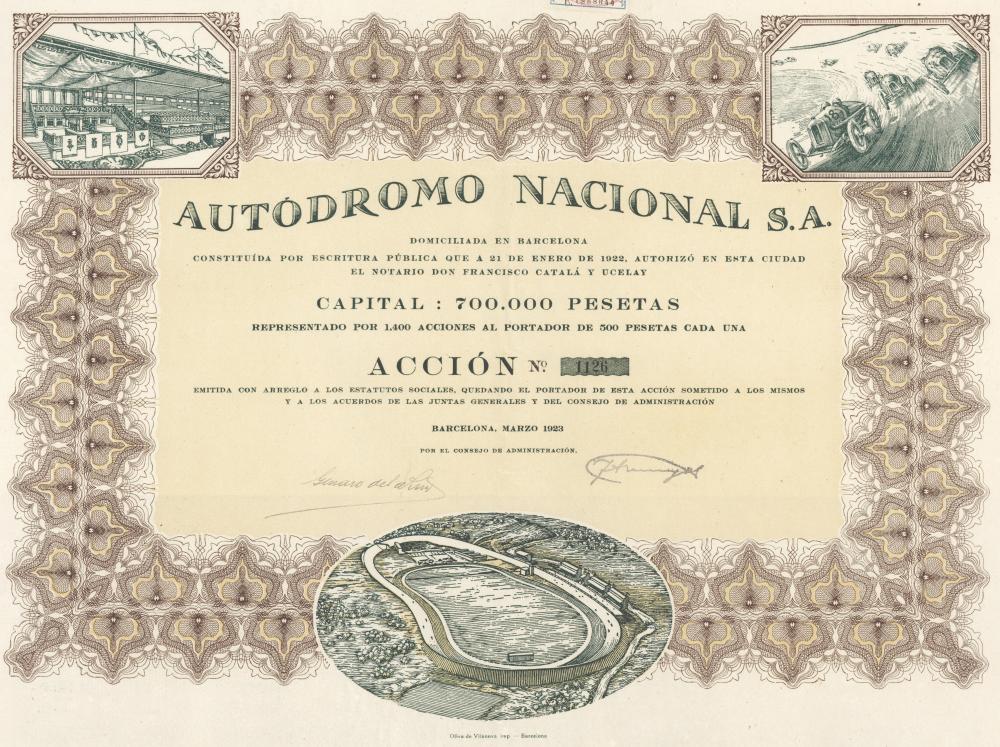
One of the lots mentioned under the "Sports" index, L927, is a 1923 share in the Autodrómo Nacional SA. Founded in 1922 the company built and operated the Terramar Autodrome, a racing circuit in Sant Pere de Ribes, Catalonia, Spain. In 1923 Alberto Divo won the first race with his Sunbeam at an average of 142 kilometers per hour. 


Even if you are not a collector the weekend of 30 April & 1 May is an opportunity to see some great antique securities. The venue is the Antwerp Crown Plaza. An airport shuttle from Brussels Airport to Antwerp (about 30 minutes) stops in front of the hotel. The public bus stops right outside the place and takes you in 10 minutes to Antwerp Central Station. 

Here are the auction details :
  • Location : Antwerp, Belgium
  • Dates
    • 30 April 2022, Boone's 68th live and internet auction
    • 1 May 2022, bourse of historic bonds and shares
  • Further info : 
    • online catalog & bidding, see here 
    • or via the Invaluable platform (large images), see there 
    • and the PDF version of the catalog can be found here 
F.L.


PS : Did you like this post ? Thank you for sharing it on you favorite social media channel !

Friday, October 1, 2021

The Compagnie des Indes Orientales : Boone reveals the oldest share ever auctioned in upcoming international collectors event

Mario Boone is a major player in the field of antique share certificates and financial documents. The auctioneer scheduled his 67th scripophily auction and bourse on 16 and 17 October 2021. On the agenda are about 1400 scripophily lots that will go on the block in Antwerp.

Boone succeeded in compiling exceptional rare and beautiful stocks and bonds from all continents, such as the oldest share to be auctioned, the oldest French railway share, a share purchased by Nobel prize laureate Max Planck, and many more amazing historic securities like this one.


Prior to the late 1890s color photography was the domain of a small number of researchers that build their own equipment. This share from 1897 is signed by the Belgian color photography pioneer Louis Ernest Dugardin who invented one of the first commercially available color cameras in the world. He founded in 1897 the Paris based Société Nationale de la Photographie des Couleurs et de Reproductions Artistiques Procédés L. Dugardin. This share was designed by the French Belle Epoque artist Lucien Métivet and printed by Imprimerie G. Richard. An amazing document, L(ot) 557 in the sale starts at €2000.


I'll point of out some more highlights of the sale in a moment, but first I'll say something about the bulky auction catalog that counts over 200 pages of data and images. Auction lots are grouped first by region, then by country. The main index lists over 90 countries. Large sections include Belgium, France, Russia, Germany, USA, Spain, Egypt, China, Great Britain and Italy. Collectors of scripophily from seldom-seen places like Papua New Guinea, Pakistan, Ghana, Monaco, Martinique, etc, will be surprised by what's going under the hamer.


The Monte Toro Fábrica de Quesos operated on the island of Menorca. This share shows scenes from the town of Es Mercadal at the foot of the Monto Toro, the highest point on the island, a woman making cheese, and grazing cows. The certificate was printed in 1901 in Barcelona by Imp. Luis Tasso. L1075 in the auction, bids accepted from €100 onwards. 


So, what about the top item of the sale ? Well, it's a share from the Compagnie des Indes Orientales issued more than 350 years ago in 1665. That was an eventful year :  the Second Anglo-Dutch War begins, King Charles II of England leaves London fleeing the Great Plague, the Qing invasion of Taiwan fails due to a typhoon, and the Compagnie des Indes Orientales sends twenty settlers to start the colonisation of Réunion.


The Compagnie des Indes Orientales was founded by Jean-Baptiste Colbert on 1 September 1664 to compete with the English and Dutch colonial trading companies. The company was granted a 50-year monopoly of French trade in the Indian and Pacific Oceans, from the Cape of Good Hope to the Straits of Magellan, with a concession in perpetuity for Madagascar and ‘all other islands and lands it could conquer’ (*).  The company also had to build churches and train priests in its territories. Several ‘comptoirs’ were established in various parts of India such as Puducherry and Chandannagar. 
This share of 6000 French Livres, 2000 Livres been paid, unique and of great historic importance, is the earliest share ever auctioned. Bids for L467 start at €44,000 
(*) The Compagnie des Indes, by Howard Shakespeare, Journal of the IBSS, Feb 1997 


At the end of the printed catalog, you'll find a list with over 100 indexes on themes, Belgian provinces, famous signatures, artists and printing companies. On top of that you can search through the online version with keywords.

There is nothing as fascinating as antique securities produced in gold print. A search through the digital catalog on keywords like "gold print", "printed in gold" and "gold, black" (co-occuring colors), yield some great results. You should see these. I've listed them by start price in ascending order : 
  • €30, L440 Basilique de Sainte Thérèse de l'Enfant-Jésus à Lisieux, 1933, Lisieux, Calvados
  • €40, L1173 The Port Rowan and Lake Shore Railway Company, 1880s, Port Dover, Ontario
  • €80, L702 Cooperative des Médecins et Pharmaciens de Grèce, 1924, Athens (see image below)
  • €200, L230 Szegedi Kereskedelmi es Iparbank, 1909, Szegeden, Hungary
  • €200, L524 Compagnie L'Union Service par Bateaux à Vapeur et Autres, 1840, Rouen, France
  • €1000, L459 Casino et Concerts Paganini, 1837, Paris
  • €1200, L1274 The Gold Mining Company, 1888, registered in West Virginia, mines at Mojave County, Arizona
  • €2000, L758 Barkschip: Grootmeester Nationaal, 1857, Dordrecht
  • €2000, L1169 Great Cariboo Gold Company, 1905, New York, but operations in British Columbia, Canada


L702 is a wonderful 5 shares certificate in the Cooperative des Médecins et Pharmaciens de Grèce. Issued in 1924, Athens, and produced in gold print. 


Boone auctions always include scripophily related to that little country somewhere near the center of Europe, Belgium (about 220 lots). Here are some interesting lots from that chapter in the sale :
  • L234 Algemeene Nederlandsche Maatschappij ter Begunstiging van de Volksvlijt, a Dutch share from 1825 to finance a new canal between Pommeroeul and Antoing (Hainaut province) 
  • L241 the oldest certificate seen, a bond, from A.C.E.C., and highly decorative too
  • L245 Société Européenne d'Automobiles, 1898, far ahead of its time targeting the European market, rare and prehistoric automobile manufacturer 


I didn't know that Belgium once tried to colonize Guatemala, did you ? Here's a share, L292, in the Compagnie Belge de Colonisation, Communauté de l'Union, issued in 1844. The company was founded with the help of King Leopold I of Belgium to administer Santo-Thomas de Guatemala, today known as Santo Tomàs de Castilla, Puerto Barrios. Leopold's goal was not only to exploit rich natural resources, but also to reduce crime in Belgium by sending the unemployed, the underprivileged and adventurers to the "promised land of Verapaz".  Many colonists died in the harsh conditions and the project was given up after 20 years. A rare object of Belgian international history, bidding starts at €200.


There is a lot more to discover in the auction. I almost forgot, if you are into Russian scripophily, then don't forget to check out that chapter as well. It includes interesting railway certificates but also a large section of Russian banking and credit securities. 

Before giving you further details and links for the event, I'll end this post with an incredibly beautifully produced work. Extremely rare and of historic economic importance, L451 is a share in the Chemin de Fer de Paris à St. Cloud et Versailles - Rive Droite de la Seine, the oldest French steam-powered railway. The share dates from 1837 and is signed by politician and financier Emile Pereire.


The auction catalog fully describes the history of this French railway company, the Chemin de Fer de Paris à St. Cloud et Versailles. Click the image above and below to see more details of this wonderful print. In the detail below, you see two angels below a column. They present the coat of arms of Paris. Above and at the left of the figures you can detect two light grey rosettes. All those details are produced in such a way that it gives the viewer a feeling of depth just like the raised relief on a medal. But that is only an optical illusion. In fact, the only color used for this print is black. The certificate's design was created by the best engraver of its time, Jacques-Jean Barre, who designed and engraved the first postage stamps of France. He was master engraver at the Monnaie de Paris producing designs for coins and medals. Absolutely stunning. Start price of L451 is €12,000.


Even if you are not a collector the weekend of 16 and/or 17 October is an opportunity to see some great antique securities. As for me, I am looking forward to meet again collector friends that I haven't seen for a long time. Here are the details :
  • Location : Antwerp, Belgium
  • Dates
    • 16 October 2021, Boone's 67th live and internet auction
    • 17 October 2021, bourse of historic bonds and shares
  • Further info : 
    • online catalog & bidding, see here 
    • or via the Invaluable platform (large images), see there 
    • and the PDF version of the catalog can be found here 


F.L.

PS : Did you like this post ? I'd love to see you sharing it on your favorite social media channel !


Monday, March 29, 2021

Collectibles from the undersea world and other rarities emerge in Boone's scripophily auction

The 66th auction of Mario Boone takes place online with an exceptional wide range of scripophily collectibles. More than 1,100 antique stocks and bonds span 4 centuries of financial history.

The sale includes several historic items and a number of old collections have been consigned for this occasion. Very special, and unseen before, is a scripophily collection of the undersea world. The companies represented here had goals that captured our imagination. Their shares often featured fantastic vignettes.


During the American Civil War hundreds of ships  were destroyed. This share from the Life Saving Raft Company, was issued in 1866 just after the war. The amazing vignette shows the company's life raft with shipwrecked sailors. Early lithograph produced by Henry Seibert and Brothers, New York, and part of the Diving/Submarines collection 


The Diving/Submarines collection consists of about 90 certificates from companies involved in diving operations, the ship wreck salvage business, underwater treasure hunting, production of submarines, insurance of maritime losses, diving and life saving equipment and maritime archaeology. The collection, L(ot) 1051, offered as a whole, starts at €4,000. In case no bid is received, it will be offered again in smaller lots. 

I'll come back to the other collections consigned for this sale but let me discuss first some of the top items in the sale.


One of the highlights in the auction is this previously unseen share from 1747. Formed in 1720 the Compañia Real de la Havana organized the trade between Spain and Cuba. The company controlled the export of tobacco, sugar, wood and other Cuban products but also slaves, as well as all import of European products needed in the colony. L771 in the auction starts at €5,000. Detailed image provided on the auctioneers Invaluable.com portal, see link below.

Here are some more lovely items from the Spanish chapter in the sale :
  • L772, an early copper engraving on vellum, boundless vignette all over the design, is a share from the Real Compañia de Comercio Establicida en Barcelona, dated around 1748 but unissued which explains the moderate start price of €400! 
  • Printed with a "gold" vignette of a mining operation, the San Juan Bautista (Teruel) silvermine share, 1857, belonged to the Duke of Rianzares, second husband of Queen Maria Cristina de Borbon, L775 
  • A great example of Art Nouveau design, L782, a share in the Nueva Plaza de Toros, shows off the bullring of Barcelona


Let's jump to the present. Everyone knows how to download a PDF auction catalog and read it with the Acrobat Reader application. Both PDF and Acrobat Reader were developed by Adobe Systems. The company was founded in 1982 by ex-Xerox PARC employees John Warnock and Charles Geschke. This specimen stock certificate bears the facsimile of Charles M. Geschke. In 1992 he was kidnapped from Adobe's parking lot. Four days later the FBI found and saved Geschke. L1043, a very interesting collectible from the software industry, starts at €50 

Regarding American scripophily there is lots more to find. This auction chapter includes a top collection of ninety early USA (1816-1860) certificates, lot range 884 through 976. A few examples :
  • L886, Thomaston Coal and Mineral Company, 1819!, then part of Massachusetts, today Maine
  • L910, Philadelphia Museum Company, previously Peale's American Museum, share from 1840
  • L943, West End Land Association, 1854, vignettes of villa and native Americans
The American 'regular' section, lot range 977-1044, has some more surprises, so don't forget that part. 

The Russian chapter consists of nearly 100 lots and kicks off with another highlight :  L678, a share in the Warsaw-Vienna Railway Company. In 1814 Alexander I of Russia was made king of Poland at the Congress of Vienna. His succesor Nicholas I approved the construction of the Warsaw-Vienna Railway. Its 1839, unissued, share shows the vignette of the Russian imperial double-headed eagle. Besides tsarist era scripophily, the chapter includes several soviet certificates as well.


The Azoff Steam Ship Company, founded in 1871, serviced the harbors at the Sea of Azov and the River Don. In the Soviet period the company became an asset of the Ministry of the Maritime Fleet (Minmorflot). This 1895 specimen share was printed by Typography Brothers Schumacher. The printing house finds its origins in the 18th century print shop of the Russian Academy of Sciences. The shop was founded by Johann Daniel Schumacher, secretary of the academy and librarian to the Tsar, and his brother Johann-Jacob, professor of architecture at the St-Petersburg university. L691 

Here is an overview of the other collections that will go on the block in this auction : 
  • L5, Collection of 16 Red Cross certificates
  • L187, Collection of 46 Austrian World War I bonds 
  • L321, Collection of 84 royal loans of France under the form of life rentes (cfr. the catalogue France, The Royal Loans by Howard Shakespeare), period 1689-1787 
  • L322-333, Corsica collection
  • Lot 625-677: Rolf Büchsenschütz collection of Romania (part)
  • L1080-1117, Fire fighting collection

The printed catalog contains several indexes to help you find what you are looking for.  The online versions can be searched by keywords. 


At the start of the 20th century, Ghent, Ypres, Bruges and other Flemish cities still counted many female lace workers. During WWI, war lace was bought by soldiers as a gift for the home front in England or America. This handicraft would disappear, partly because in the Congo, then a Belgian colony, nuns taught lace-making techniques in the missions. The Congolese women and children produced large quantities of lace at very low wages. De Vrouwelijke Beroepsbonden, in English: The Women's Occupational Unions, was a cooperative from Ghent founded in 1914. This unissued share shows vignettes of a lace worker and two seamstresses. Printed by Litho. F. & R. Buyck Frères. L229 


It is impossible to mention all items in this sale, but there is a way to find out more about them. Here are the auction details :
  • Location : Internet only
  • Date : 10 April 2021
  • Further info : 


F.L.

PS : Did you like this post ? Thank you for sharing it on you favorite social media channel !

Wednesday, November 25, 2020

Watermarks in Scripophily – part 1 Introduction

This article is an introduction into a lesser known aspect of securities : watermarks. If you don’t know what a watermark is then hold a banknote toward a light source. Against the light a design appears, at least this is the case on many banknotes. 

Watermarks can be seen on official documents, banknotes, stamps, cheques and also bonds and shares. When you investigate a new entry for your collection, you want to look for a watermark. 

However, most certificates don’t show watermarks; no wonder that many collectors overlook this feature. Yet, now and then you will be surprised by what emerges from the dark side. 


image 1a. The shortlived Nira Valley Sugar Co had a factory at Malegaon in Maharashtra, India. It operated a narrow gauge railway at its sugar cane mill. This share was issued to Maharaja Ganshyamsinhji Ajitsinhji of Dhrangadhra, Bombay, 1920.  
image 1b. Viewed against a window on a sunny day, the share reveals in the lower border a watermark of the paper manufacturer "STANLEY". The four black dots in the corners of the ‘watermark’ image are the silhouettes of little magnets used to hold the certificate in place on a semi-transparant screen when photographed. Click image to enlarge


Watermarks were first developed as the paper manufacturer’s hallmark. Early Italian paper manufacturers from the 13th century started experimenting with this idea. Watermarks that were created by the paper makers themselves are a first category of watermarks in scripophily. See image 1a en 1b as an example. 

How are these things created ? Watermarks are drawings created in paper during the paper manufacturing process. They are produced by having a design raised on the rolls through which the paper pulp is passed during manufacture. 

The designs applied on the rolls cause density variations in the produced paper. In turn, these density variations make an image or a pattern appear in the paper in the form of various shades of lightness and darkness.


image 2a. The Tambracherry Estates & Wynaad Gold Mining Co Ltd had mining operations in the Indian state of Kerala but eventually purchased estates for the cultivation of coffee, tea, and the like. £1 shares, London, 1882.  

image 2b. Written upwards along the right border, a watermark shows “WATERLOW & SONS”, the printer of this certificate. The watermark image was taken on a cloudy day, hence the darker appearance.


Printers of banknotes realized that watermarks in notes could be used as an extra anticounterfeiting device. Halfway through 17th century Stockholms Banco was the first bank that applied a watermark in a banknote; it revealed the word ‘BANCO’. 

Later, security printers adopted the technique and occasionally applied tailor-made watermarks that identified the printing house. This type of watermarks forms a second category. See the Waterlow & Sons example, images 2a & 2b.

In addition to watermarks from paper manufacturers and printers, governments and companies have issued certificates that were produced with customized watermarks. In most cases these comprise the name of the issuer, or the latter’s coat of arms or logo. This is a third category of watermarks in scripophily. As an example, see images 3a en 3b. 


image 3a. Some issuers of securities ordered their own watermark. Here is a Reserve Bank of India certificate for Rs100 issued in 1935. 

image 3b. The entire watermark design almost forms a share on its own including the name ‘RESERVE BANK OF INDIA’ in front of large sun with rays, and a triple line border, all around the certificate. Click image to enlarge


There is little scripophily literature that addresses these features. I know of two books : World War II Remembered, by C Frederick Schwan & Joseph E Boling, and Alexander Kipfer’s Historische Wertpapiere der Spanischen Königlichen und privaten Handelsgesellschaften des 18. Jahrhunderts. 

The comprehensive Schwan/Boling volume describes numismatics, in the broadest sense, including bonds, issued by the WW II powers, and where applicable watermarks are described or illustrated. You can find more details on this work here.

Kipfer’s book describes the securities of the 18th century Spanish trading companies. Also here a handfull of these have been identified as bearing watermarks. 


images 4a and 4b. The Real Compañia de Filipinas took over the Real Compañia de Comercio Establecida en Barcelona in 1785. As a result the company obtained a trade monopoly with the Philippines. Depending on the paper that was used, some of its 250 pesos shares from 1785 display a watermark, others don’t. Alexander Kipfer spotted the stylishly elaborated letters 'AF' on some shares from this company. 
The Schweizer Finanz Museum provided the left image. The other one  was taken from the Alexander Kipfer's book with permission of the publisher Haag & Herchen GmbH.


I'm planning some follow-up articles for later to illustratie the variety that exists in these watermarks on bonds and shares : 
  • Watermarks by paper manufacturers
  • Watermarks by printers
  • Watermarks by companies & governments
  • Watermarks that really stand out


image 5a. and 5b. Examples from the third category, custom watermarks used by companies or governments, can be astonishing. 
This Indian Post Office 5-Year Cash Certificate for 20 Rupees, 1935, shows off its watermarks created in several shades of dark and light. You can detect a repeating pattern made up of the words GOVT of INDIA and the Star of India emblem. Joe Boling, co-author of WW II Remembered, identified the dark letters as the British royal cipher, GRI, which stands for Georgius Rex Imperator, or George, King (of Britain) and Emperor (of India). Click image to enlarge


If you have a certificate with a remarkable watermark, then you can email me an image. But be carefull while handling the certificate. You don't want to end up with a torn corner or a heavy fold.

F.L.

This article was published in Scripophily magazine No. 113, August 2020.
You might be interested to read : Watermarks in Scripophily - part 2 Paper manufacturers 


Previous posts