Showing posts with label computers. Show all posts

Friday, February 9, 2024

FHW's 125th auction is online with exceptional antique stocks and bonds

Jörg Benecke has scheduled FHW's 125th sale for 2 March 2024. With his team he brought together 2000 lots of scripophily and related documents. The event, a live auction held at FHW's home base Wolfenbüttel, offers historic and beautiful antique stocks and bonds from all continents. 


A highlight in FHW's auction is L(ot)962, a 1858 share in the Eisenhütten-AG Blücher, an early steel company from Dortmund. Germany's Ruhr area counted almost 300 coal mines by the 1850s. Coal was exported or processed in coking ovens into coke, used in blast furnaces, producing iron and steel. This 200 Thaler share depicts Generalfeldmarschall Gebhard Leberecht von Blücher who won several battles against Napoleon’s troops. He joined Wellington at the Battle of Waterloo, his army playing a decisive role in the final victory. The vignette shows von Blücher wearing the Star of the Grand Cross of the Iron Cross awarded only twice in history. This rare and spectacular lithoprint by H. Kaufmann from Münster starts at €2,800. 


The Eisenhütten-AG Blücher certificate is part of the Deutschland bis 1945 chapter that includes about 650 lots. Some of the other historic items here are:
  • Deutsche Bank, Berlin, 200 Thaler share, 1881, extremely rare and a top object in any international finance collection 
  • Junkers Flugzeug- und Motorenwerke AG, 1000 shares certificate, from the Reichsbank archives
  • LLoyd-Werft Aktiengesellschaft, builder of boats, 10000 Mark share 1923, underprint of a sailboat and a hand emerging from the water rescuing a canoe.
  • Münchener Trambahn-Actien-Gesellschaft, 400 Mark share, 1882, rare founder's share 


Part of the 200 lots in the Deutschland ab 1945 chapter, is this BASF specimen 1000 shares certificate. BASF as we know it today was reorganized in 1952 and became the largest producer of chemicals in the world. In the 1960s and 1970s BASF succesfully sold computer tape and other storage devices. At the end of the 1970s the company marketed Hitachi's mainframe computers and soon thereafter launched their own line of business microcomputers like the BASF 7120 model. The certificate dates from 1967 and shows the Ludwigshafen production site.  L1457 starts at €500. 


A surprise is the sale of a complete collection of stocks and bonds related to Israel. About 130 certificates, spanning two centuries, are initially offered as one lot at €20,000, L24. In case of no bids, buyers have the opportunity to bid on the individual lots. 


This certificate from The Arab Cigarettes and Tombac Company Ltd is part of the Israel collection. The company was founded in Nazareth, which is the largest Arab city in Israel today. The company traded in cigarettes and tombac, a unwashed natural tobacco leaf used with the waterpipe. This unissued share of 1 Palestine pound with text in English and Arabic might be available from €240. 


Over 350 lots are comprised in the USA chapter. Among the many interesting items are: 
  • L1743 Florida Land Rock Phosphate Company, Western Bank Note engraving, 1894, unique vignette of phosphate miners in forest 
  • L1835 New Orleans, Opelousas and Great Westeren Rail Road Company, stock certificate, 1855, large train vignette, signed by Benjamin Franklin Flanders, Governor of Louisiana and mayor of New Orleans, who formed the 'Friends of Universal Suffrage' 
  • L1680 Central New England Railway Company, preferred stock, 1906, large Poughkeepsie Bridge vignette 
  • L1652 Apperson Bros. Automobile Company 


Steel engraving is the trademark of the American Bank Note Company. With no sales recorded during the past ten years in the coxrail.com database, this stock from the Tennesee based Morristown and Cumberland Gap Railroad can find a new home from €500 onwards. L1824 


The auction catalog counts over 200 pages. You'll find several more chapters in it, including two with items offered at half of their previous start price. So, lots to discover there. Here are the details :
  • Location : The event takes place at the company headquarters in Wolfenbüttel.
  • Date : 2 March, 2024
  • Further info, see here; PDF catalog see there; live bidding is possible through https://connect.invaluable.com/dwa/  


L277: Sociedad del Teatro Chapi de Villena, 25 pesetas share from 1915, vignette of the Spanish composer Ruperto Chapi, lovely Art Nouveau design, €150 


F.L.

PS : Did you like this post ? Thank you for sharing it on you favorite social media channel !

Wednesday, May 24, 2023

HSK presents American scripophily, bonds and shares from Northern Germany and the H-W Schmidt collection of German banking securities

Hanseatisches SammlerKontor für Historische Wertpapiere (HSK) plans its next auction of stocks and bonds on June 3, 2023 at its headquarters in Wolfenbüttel. Over 1200 lots are described in full in a 200 pages counting auction catalogue. All lots can be checked out online as well.


This 1000 mark share from the Landbank, Berlin, featuring a Jugendstil design, was printed in 1897 by the Reichsdruckerei. Only a handfull of these certificates are known. This one is part of the H-W Schmidt collection. L(ot) 762 in the auction starts at €800. 


The Hans-Werner Schmidt Collection of German banking securities forms a major section in this auction. This collection consists of lots 677 through 816 and has been assembled over several decades. A few examples:
  • Rarely seen is the bold industrial artwork of the 10000 mark share in the Ostbayerische Industrie- und Handelsbank AG, Furth i.W., 1923, L778.
  • L751, Herzogl. Sächs. Landrentenbank in Coburg, 100 mark bond, issued in 1911.
  • One of the most spectacular typographical designs in scripophily is the multicolor share certificate from the Preussische Boden Credit Actienbank, Berlin, 1873. L783


The 1873 founder share of the Stadttheater-Gesellschaft zu Hamburg is the top highlight in HSK's auction. The new stone building of the Hamburg State Opera was inaugurated in 1827. In 1873 the building was renovated in Gründerzeit style, as illustrated in the large underprint of the certificate. Gustav Mahler was the company's musical director from 1891 to 1897. In World War II Hamburg was an easy to find target and the opera house was destroyed by fire-bombing. Rebuilt in the early 1950s by Bauhaus architect Gerhard Weber, the Staatsoper reopened in 1955 with Mozart's Die Zauberflöte. L515 starts at €10,000. 


About 900 lots of German scripophily are presented in several sections:
  • L315-446 Bremen and Niedersachsen, for example L348 Deutsche Petroleum-Bohr-Gesellschaft, 1881, illustrated with an oil field vignette 
  • L447-519 Hamburg, e.g. L515 Stadttheater-Gesellschaft zu Hamburg, image see above 
  • Lot range 520 through 645 consists of a collection of Hamburg related zero numbered specimen certificates from the Deutsche Mark period. 
  • L646-676 Schleswig-Holstein and Mecklenburg-Vorpommern, such as L650, two shares in the Flensburg-Ekensunder Dampfschiffs-Gesellschaft, based in the very north of Germany.
  • L677-818 H-W Schmidt collection of German banking securities, see above
  • L817-1046 Germany before 1945, including L817 a 1852 share from the Aachen-Mastrichter Eisenbahn-Gesellschaft, bilingual in German and Dutch, two coat of arms 'Gott mit uns' and 'Je Maintiendrai', elaborate floral design.
  • L1047-1239 Germany from 1945 onwards, e.g. L1110 Deutsche Lufthansa Aktiengesellschaft, Köln, 1997, illustrated with a world map vignette


Polish Auschwitz survivor Jack Tramiel - who later formed Atari Corporation - founded in 1954 the Commodore Portable Typewriter Company. In 1955 the company was reincorporated in Canada as Commodore Business Machines, Inc., and went public on the NYSE under the name Commodore International Limited in 1962. Already in the early 1970s the company produced electronic programmable calculators. Reorganized in 1976, CIL moved its financiel headquarters to the Bahamas. Launched in 1977 the Commodore PET personal computer helped to bring personal computers to widespread use. L63 starts at €100. 


The American section counts 200 lots including several certificates signed by or issued to Thomas A. Edison, L79, L196, L197 and L78.  A Pan American Airways Corporation stock certificate from 1945, L155,  is issued to Sherman M. Fairchild who also signed it on reverse.  
Some other examples:
  • L106 is a bond from The Huntingdon and Broad Top Mountain Rail Road and Coal Company, large railway bridge vignettte, issued in 1862.
  • A lovely banking vault vignette adorns a Lowry Banking Company stock certificate, Georgia, 1894. L120
  • L26 The American Quick-Transit Steamship Company, 1882, Boston, Mass., depicts a large ocean steamer.


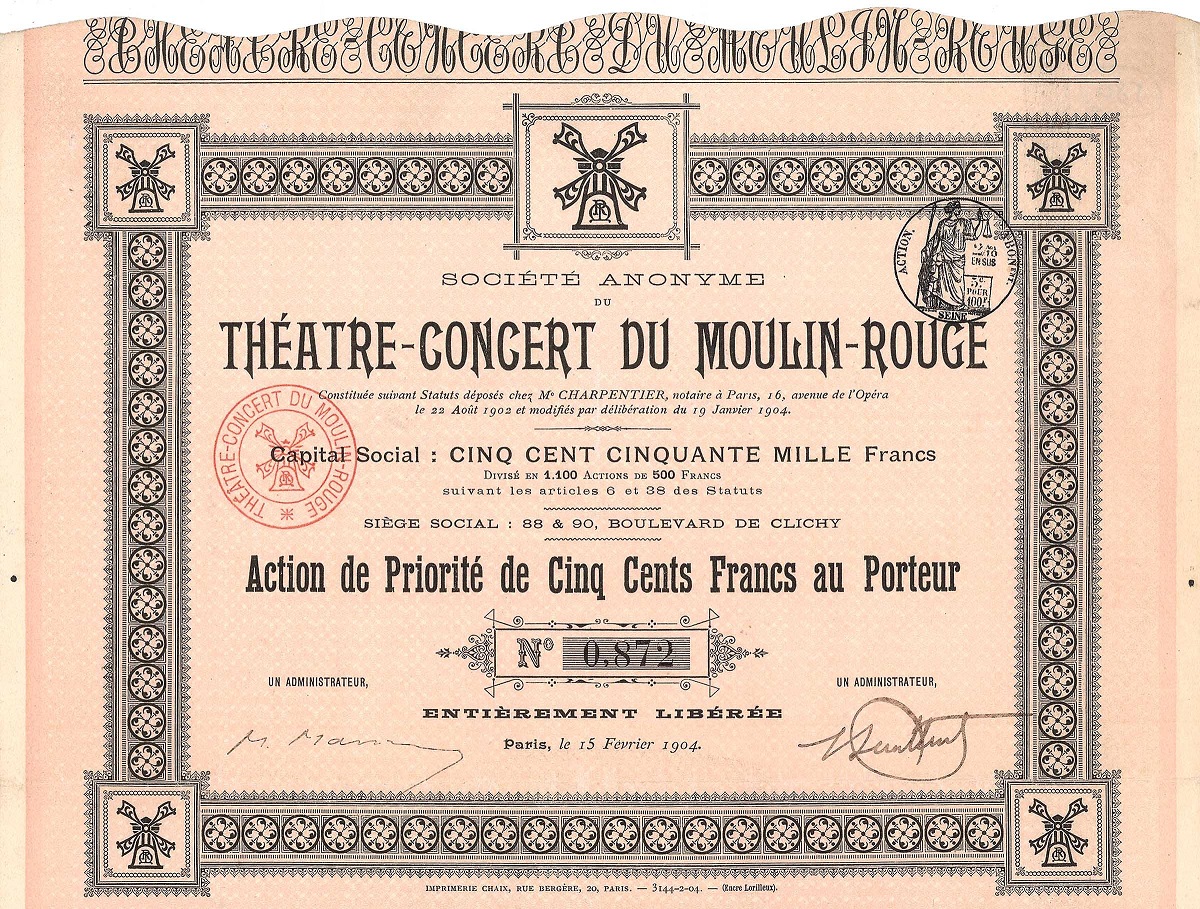
The European section in HSK's 42nd auction includes objects such as this 1904 share from the Société Anonyme du Théatre-Concert du Moulin-Rouge. Located in the Boulevard de Clichy, Paris, this cabaret became a world famous attraction with its can-can danse. Bids start at €200 for L292.


There is a lot more to discover in the catalog, so here are the details :

F.L.


PS : Did you like this post ? Thank you for sharing it on you favorite social media channel !

Wednesday, February 9, 2022

FHW presents unique stocks and bonds from the Austro-Hungarian Empire

FHW's upcoming auction takes place on February 26, 2022 in Wolfenbüttel, Germany. The town is home to both the world-famous Jägermeister distillery and the headquarters of the Freunde Historischer Wertpapiere.  

The sale includes 1910 lots of scripophily: antique share certificates and bonds from all continents will go under the hammer. Large sections include the Austro-Hungarian Empire, USA, Germany pre 1945, Germany DM era, Russia and the Baltic States, and China.


The Zillertal Railway is one of the most popular attractions in Tyrol. Its line opened in 1902 and runs along the Ziller river between Jenbach and Mayrhofen. Tourists and railway enthusiasts from all over the world enjoy a ride with the company's steam operated trains. This founder share, issued in 1903, designed in lovely Art Nouveau style, features vignettes from Jenbach, Zell am Ziller and Fügen. L(ot) 497 in the auction, Zillerthalbahn AG, starts at €1,500


The k. u. k. Doppelmonarchie, aka the Austro-Hungarian Empire, existed between 1867 and 1918. The "kaiserlich und königlich" refers to "imperial (Austria)" and "royal (Hungary)".  The state comprised Austria, Hungary and parts of todays Italy, Serbia, Croatia, Romania, Slovakia, Czech Republic, Poland and Ukrain. As such it was the second-largest country in Europe after the Russian Empire at over 620,000 km2. 

The sale features 350 k.u.k. lots including a lovely Zillerthalbahn share, image shown above. Some more examples from other Austro-Hungarian certificates are:

  • Actiengesellschaft der Liesinger Bräuerei, share from 1872, wide vignette of the brewery buildings, L153. 
  • Several hotel companies are included in the the k.u.k. section such as 
    • L164, Actien-Gesellschaft Hotel Goldenes Lamm, 1872, lodgings vignette in the underprint 
    • US President Theodore Roosevelt once stayed in the Hotel Krantz, L272 and L273
    • The luxury Grandhotel Pupp is located in Karlovy Vary (Karlsbad), Czech Republic, and can be admired in the movies Last Holiday, starring Queen Latifah, and Casino Royale, with James Bond. L274 
  • Railway collectors will appreciate the tens of railway companies that are included in this section. Some examples are: 
    • Grazer Tramway-Gesellschaft, L264, 
    • Innsbrucker Mittelgebirgsbahn, L279, and, 
    • one of the highlights in the auction, L310, K. K. Priv. Prager Eisenbahngesellschaft, Prague, share from 1828, one of the oldest railway companies in continental Europe.


Included in the Austro-Hungarian section is this Spar- und Kredit-Verein des Janus share. This bank was formed by the Janus wechselseitige Lebensversicherung-Anstalt, a mutual life insurance business, to provide financial services to its members. The amazing vignette shows a portrait of Janus with the two faces. This Roman god controlled the beginning and ending of conflicts. The certificate, issued in 1914, was produced by M. Salzer, one of the oldest printing companies of Austria. Matthäus Salzer (1799-1878) expanded the printing works of the Salzer family into a factory. He bought in 1866 the Carl Ueberreuter printing house. L430 in the auction starts at €200 


The auction includes two German scripophily sections presented by more than 400 lots : 
  1. Germany before 1945, lot range 1142 through 1429, and 
  2. Germany after 1945 'DM era', range 1430 - 1620. 
  3. On top of that you can add the "50% vom letzten Ausruf" section, range 695 - 1141, which contains many German items unsold in previous auctions but now listed at 50% of the original start price.

The printed (PDF) catalog contains indexes on themes and German regions. The online sites provide key word search functions. I tried the word Magdeburg and found more than twenty lots such as L943, a rare 200 Thaler share from 1872 in the Magdeburger Brückebau-Anstalt in Buckau bei Magdeburg with corner vignettes of bridges.


Vignettes on antique securities often display smoking chimneys alluding to productivity and profitability. Being a child of its time, this specimen share from the MEMBRAN Aktiengesellschaft für Finanzinformationssysteme delivers the same message by means of a then expensive desktop computer system with two diskette disk drives. Issued in 1987, Berlin, L1558 is part of the 200 lots counting DM era section.

In its auctions FHW features top American items, especially scripophily from railroad companies. This time the USA section includes about 300 lots.  Some examples are : 

  • a rare Colorado Northern Railway Company share, L1698, with vignette of a train exiting a tunnel, starts at €500
  • Civil War Major General Grenville Mellen Dodge who later became the Union Pacific's chief engineer signed the Denver, Texas and Forth Worth Railroad bond, rare, L1711
  • L1769, Chicago and Oak Park Elevated Railroad Company, stock certificate from 1908, great vignette of steam train on elevated track


From the USA section, this share in The Defender Gold Mining Company not only looks spectacular but tells a surprising story as well. Incorporated in Colorado the company prospected in the Cripple Creek gold district. It was founded in 1895 when the American sloop Defender defeated its British challenger, the Valkyrie III, in the America's Cup race. The share shows the winner, the "Auld Mug" trophy, shipping ropes and the company name, all of them in gold-print. L1706 in the sale 


There is a lot to discover in the auction, so here are the details :


F.L.


PS : Did you like this post ? I do appreciate it if you can share it on you favorite social media channel !

Sunday, September 26, 2021

The Walkman share

In the movie Guardians of the Galaxy, underdog Peter Quill “Star-Lord”, portrayed by Chris Pratt, faces the galaxy’s worst criminals. Using a Walkman he listens to Rupert Holmes’ catchy Escape (Piña Colada) song in order to stay connected with the Earth and the family he lost. 

SONY introduced in 1979 the Walkman, a portable cassette player that allowed you to listen to music while on the move with a small headset. The player fit in your hand and you could clip it onto your belt. By the time Sony had stopped production, 30 years later, they had built about 200 million cassette-based Walkmans.


This SONY specimen share certificate was printed by the Dai Nippon Printing Company and dates from 1975. The red characters in the center are 見本 : Mihon, meaning ‘specimen’. Note the odd denomination of 1-99 (number of shares) which suggests that the certificate was a presentation model. 


Masaru Ibuka and Akio Morita both served in the Imperial Japanese Navy during WW II. In 1946 they formed Tokyo Tsushin Kogyo (Tokyo Telecommunications Engineering Corporation) which became Sony in 1958.

The company would become world famous with electronic products, such as the portable transistor radio, cassette players, televisions, video recorders, the Discman, digital cameras, Vaio laptop computers, Playstations and humanoid robots. SONY Corporation is now owned by SONY Group Corporation which is, among many other things, one of the largest music companies and film studios today.

Sony’s stock was first listed on the Tokyo Stock Exchange in December 1958. It became a part of the Nikkei 225 stock market index. Sony was listed on the NYSE in September 1970 as the first Japanese company to appear on an any American stock exchange.


Collecting Japanese shares is challenging, especially if you don’t read the language. Luckily modern ones are bilingual showing the text in both Japanese and English. You can read that the certificate illustrated above mentions a capital of 424,000,000 shares of 50 Yen with date of issuance Nov 1, 1975.

I cannot read Japanese but with the help of a dear collector friend I’ve learned to recognize some “phrases” on antique bonds and shares from Japan. The older certificates have to be read in a “right to left and top to bottom” direction. Modern certificates print Japanese from left to right, as is the case here. 

The bold characters in black are ソニー株式会社株券.  
This can be split into three parts:
  • ソニー, SONY; 
  • 株式会社, kabushikigaisha, Corporation or ‘Co Ltd’ , which is in turn formed by 
    • 株式, kabushiki, stock 
    • and 会社, kaisha,company; 
  • 株券, kabuken, stock certificate. 
Together it says “stock certificate of the SONY Corporation”.  


In the lower right corner, you see the western facsimile signature of President Kazuo Iwama (1919–1982). He was a geophysics engineer lured away from his research job at the seismology research center of Tokyo University by his brother-in-law and SONY co-founder Akio Morita. Kazuo Iwama’s Japanese signature is shown in black right above the lower border: 岩間 和夫.

Japanese shares usually show red seals. These are carved in a traditional formal font style and are hard to interpret by most people. These official seals have a legal impact and must be registered with the local authorities and are used as a formal signature with all kinds of business transactions.


The red rectangular seal is the official company seal with characters written in the traditional way (special font, left to right/top to bottom). It says “seal of the Sony Corporation”. The red round seal has an outer ring mentioning the name of the company, thus ‘SONY Corporation’. The inner circle says ‘seal of the president’.


Finding SONY scripophily is not straightforward. Not often, an ADR stock certificate becomes available on the collectors market. These were printed by the American Bank Note Company in American standard format and with a vignette of a woman encircled by electrons. This specimen ADR dates from 1995. American Depositary Receipts (ADR) are negotiable securities issued by a bank that represents shares in foreign stock. ADRs trade on a American stock exchange. 


As for the Guardians of the Galaxy movie, Sony Pictures Imageworks, a Canadian unit of Sony Pictures Entertainment’s Motion Picture Group, provided some of the visual effects and digital animation for the film.

FL

This post is based on an article written for Scripophily magazine, published by IBSS.

Saturday, August 14, 2021

Watermarks in Scripophily - part 2 Paper manufacturers

In Watermarks in Scripophily – part 1 I introduced you into the world of watermarks specifically on bonds and shares. This time we’ll talk about watermarks created by the paper makers themselves, perhaps the most obvious category of watermarks in scripophily. 

The first watermarks appeared in Italy during the 13th century. They were used to identify the papermaker or the trade guild that manufactured the paper. An interesting question is whether watermarks were invented, or just a side effect in the production process?


images 1a and 1b: When viewed against a light source, this Nira Valley Sugar Co share reveals a watermark pattern of bold vertical and faint horizontal lines. This is an example of laid paper. A detail of the pattern is shown here below. Click images to enlarge. The actual company and its share was described and illustrated in part 1 of this series, see here


European paper was initially made by dipping a wooden-framed screen, a lattice of metal wires, into a tub of warm water and cellulose fibers, scooping up this pulp, and then letting the water drain out. The cellulose came from cotton linters or recycled cloth (rag), and only much later wood fibers were used too. 

The cellulose fibers subsequently matted into a thin layer against the screen. For hundreds of years these screens had a rectangular design with widely-spaced vertical “chain” wires and closely-spaced horizontal “laid” wires tied on top of the chain wires.

In the process the wires in the screen compress the pulp fibres and reduce their thickness. The resulting patterned portion of the paper is thinner and lets more light through than the surrounding paper. 

The laid wires yield faint lines in the watermark. Chain wires have a greater impact and are responsible for the bolder lines. This type of paper is known as laid paper. A nice example can be seen above in images 1a and 1b.


images 2a and 2b: The Swedish immigrant Willgodt T. Odhner invented the Arithmometer, a pinwheel calculator. Following the Russian revolution, his company moved from St. Petersburg to Göteborg, Sweden. This 1918 share’s watermark reveals a coat of arms of the paper manufacturer Lessebo, a crowned beehive with the date 1719. The words ‘Handgjord Post’ translate as ‘handmade post’. Image courtesy Wilhelm Leiter 


Paper makers found out that they could add special designs to the watermark by sewing wire designs to the screen frame. A paper maker could now incorporate its coat of arms, a logo, or its name into the watermark. The product could now be identified and became difficult to counterfeit. An interesting example is the Original-Odhner share, see images 2a and 2b.

Often paper makers have a remarkable history. The Original-Odhner’s share’s paper manufacturer is Lessebo Paper. The paper mill was originally an iron mill established in the 17th century. In the 1690s the mill started making heavy paper for paper cartridges used for containing a bullet and gunpowder. In 1719 the mill gained permission to manufacture paper, a date that you see in the company’s coat of arms (image 2a). Lessebo Paper still manufactures hand-made paper today.

Over time, the production of watermarks became mechanized. During manufacture paper pulp is passed through rolls with a raised design. The designs applied on the rolls cause density variations in the produced paper. In turn, these density variations make an image or a pattern appear in the paper in the form of various shades of lightness and darkness. We speak of multi-tonal watermarks.

A relevant example can be seen in part 1, see there, namely the Indian Post Office 5-Year Cash Certificate. That paper shows light, dark and even multi-tonal watermarks giving the viewer an impression of depth. Another fine example can be seen on a Olivetti bond, see images 3a and 3b.


Images 3a and 3b: Ing. C. Olivetti & C. was founded in 1908 as a typewriter manufacturer and evolved into computers and smartphones. This certificate, issued 1948, has a watermark pattern, a repeating design that is applied all over the surface of the paper. Watermark patterns can be seen on many Russian railway bonds. In most cases it is not possible to detect whether patterns like these were designed by the paper manufacturer, or by commission of the certificate’s printer or issuer. The pattern on this Olivetti bond consists of diagonally placed geometrical figures. The multi-tonal shade gives you an impression of depth and the pattern appears as a structure of ‘buttons’, looking like bubble wrap plastic, something I usually cannot resist popping! 


In the 1700s James Whatman started a paper making business in Maidstone, Kent. He experimented with the wire screen used in the process. Whatman replaced the lattice of laid and chain wires with a screen of a much finer woven mesh of wires. As a result, the paper was formed on a much more uniform surface and showed no watermark pattern of lines, unless a wire design had been sewn to the screen. This type of handmade paper is called wove paper, and its invention led to what we know as modern paper today.

Whatman was probably the first paper company that added a year to its watermark, see image 4b. You may discover on your certificates watermarks by other paper makers incorporating a year as well. The shares in the United Commercial Bank, Calcutta, issued in the 1960s, show the T H Saunders (or parts of it) name with the year 1946. That company was founded by Thomas Harry Saunders. Famous for its diversity in watermark designs used on stamps, bills of exchange, securities, and the like, Saunders won medals at international exhibitions for his light and shade watermarks that were used to prevent frauds.


Images. 4a and 4b: Established in the 1840s as the Auckland Hotel, Kolkata’s Great Eastern Hotel, today known as the LaLiT Great Eastern, hosted many notable persons like Nikita Khrushchev, Elizabeth II, Dave Brubeck and M K Gandhi. This 1937 share was printed on wove paper. Its watermark shows the WHATMAN name, ‘HAND MADE’ and the year ‘1916’. 


You cannot interpret a year in a watermark as the year of paper production or as a print date. It should be seen as “paper produced not earlier than” because mills did not always update their watermarks.

Besides their name and coat of arms, paper mills sometimes added to the watermark an indication of the paper brand and the paper quality. That made it easy for stationery businesses and printers to look up the right type of paper in their inventory. As an example, I show here an American paper, see images 5a and 5b.


Images 5a and 5b: The Q1 Corporation was a pioneering microcomputer company. In 1972 they delivered the world’s first personal computer based on an 8-bit general purpose microprocessor, the Intel 8008. The share bears the watermark of the Strathmore Paper Co, founded in 1892, West Springfield, Massachusetts. The watermark shows the brand ‘Strathmore Script’ and its quality ‘100% Cotton Fibre’. Cotton fibres are strong yet soft and create a uniform paper surface that is strong and flexible. 100% cotton paper is often used for banknotes. 


In some cases, paper makers add to their watermark the location where the paper was made. Some examples from Indian shares: The Rajnagar Spg. Wvg. & Manufacturing Co Ltd, preference share, 1945, was ‘MADE IN ENGLAND’ and a 100 Rupees share in The Birla Mills Ltd, 1920, reveals ‘MADE IN CANADA’.

More of a surprise is a 100 Rs share from The Gold Mohur Mills Ltd, 1926, Bombay, telling us ‘MADE IN AUSTRIA’. Another example that illustrates the export of quality paper products is shown in images 6a and 6b.


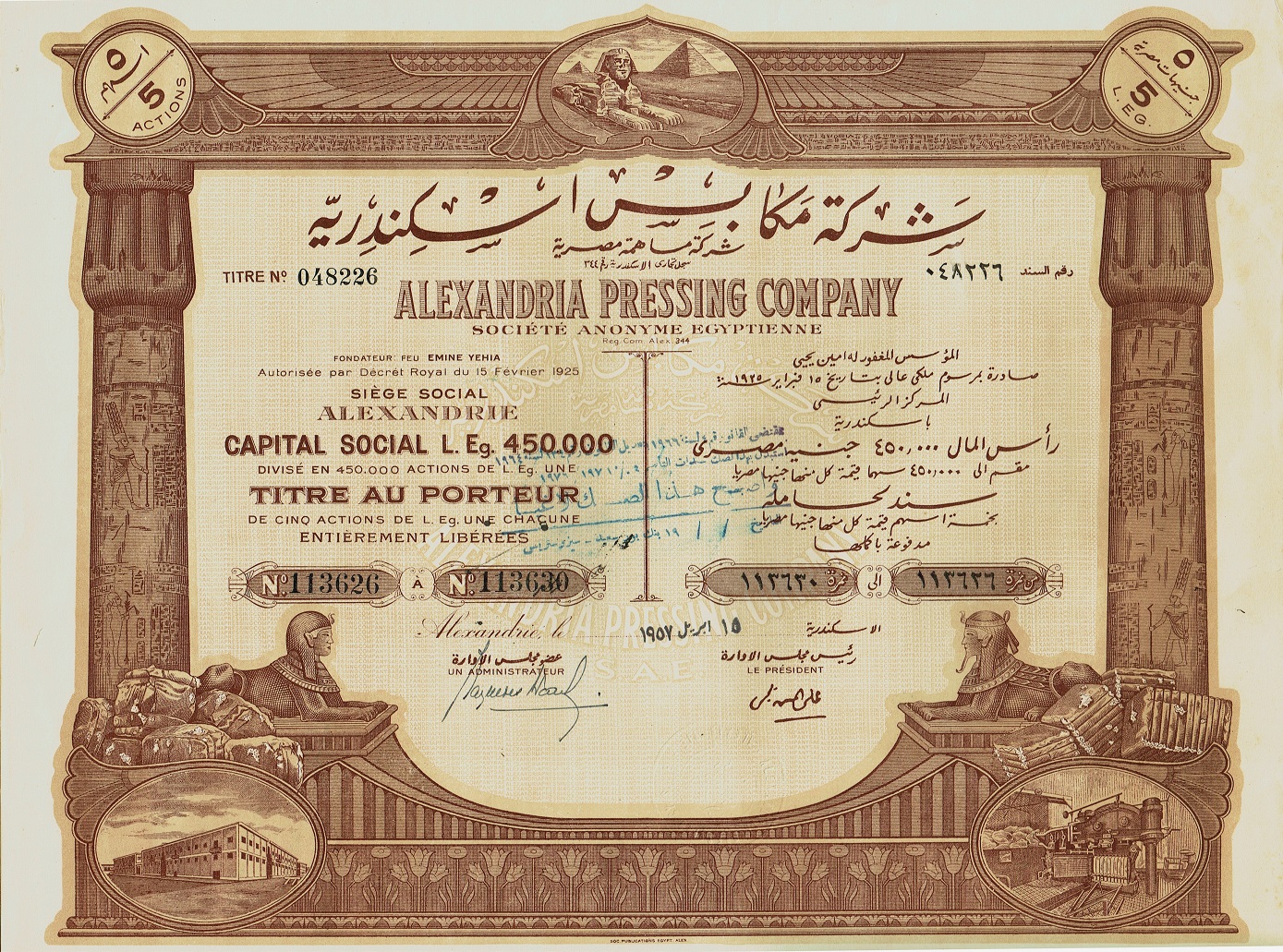
Images 6a and 6b: From Egypt, the shares from the Alexandria Pressing Company that were issued in the 1950s have a watermark showing the name of the Norwegian company ‘BORREGAARD’, the paper type ‘TUB SIZED LEDGER’ and the location of the paper mill ‘MADE IN NORWAY’.


I conclude this part in the series with one of my favorites: a share in The Dahramsi Morarji Chemical Co Ltd, Bombay (DMCC). Its watermark shows the line LUCKY PARCHMENT, a design of a jockey racing a horse, and the words RAG CONTAINING underneath. See images 7a and 7b below.

Parchment paper is not to be confused with “parchment”. The latter is a writing material made from animal skin. The former is a type of cellulose-based paper (made from wood pulp and cotton fibers) which has been treated chemically to make the paper stronger, more heat resistant and above all non-sticky.

You’ll find the words PARCHMENT also in the watermarks of shares from McLeod and Co, Ltd (1940s) and many other scripophily examples. In my example, LUCKY PARCHMENT is a parchment paper brand from the Indian paper company Ballarpur Paper and Straw Board Mills, Ltd.

RAG CONTAINING is another line of text in the DMCC watermark. Rag paper or cotton paper is primarily made of cotton linters or from used cloth (rags). Cotton paper may last many decades without any sign of deterioration, see also images 5a and 5b before.


Images 7a and 7b: This share in The Dahramsi Morarji Chemical Co Ltd was issued in 1968. The company's headquarters were located at Dr Dababhoy Naoroji Road in Mumbai. The certificate shows the coat of arms of the company, including a tiny map of India, and has a watermark of a racing jockey. 


The DMCC’s remarkable jockey watermark seems unrelated but it is not. I learned from scripophily expert Sayeed Cassim (see also here) that the Ballarpur paper company was founded by Karam Chand Thapar, who headed the Thapar Group of companies. The Thapar family was involved in race horse ownership, hence the jockey.

Time for a quick review. The first watermarks were formed, likely unexpectedly, in the production process of what we now call laid paper. Paper makers then added a logo, their coat of arms, or their name to the watermark design. Some of them further added a year, a paper type or brand, and also a location where the paper was made. If you haven’t done so already, you might start viewing your certificates against a window.

In part 3, I’ll show that paper manufacturers start adding watermark elements on behalf of one of their important customer segments: security printers.


F.L. 

This article was initially published in Scripophily magazine No. 114, December 2020. 
You might be interested to read : Watermarks in Scripophily - part 1 Introduction 


Monday, July 5, 2021

Scripophily Puzzle No. 5 - solution

There was one scripophily detective that solved Puzzle No. 5. In order to solve the puzzle I provided three visual cues. These were images of an antique stock certificate, a banknote from India and a bronze commemorative coin. The common link between these three is a famous person. 

The correct answer for the puzzle is ... da-dum-da-dum-da-dum ... Steve Jobs.


The first image in the puzzle showed a stock certificate from the Xerox Corporation. The company is known for its multifunction office systems that scan, print, copy, email and fax. In 1973, about fifty years ago, Xerox's Palo Alto Research Center (PARC) was working on a small but groundbreaking computer, the Xerox Alto.  

Three years later Steve Jobs, Steve Wozniak and Ronald Wayne founded the Apple Computer Company. In 1977 the Apple II computer was released. At that time microcomputers were not the user-friendly systems that we know today. The Apple II however offered color graphics. It sold well but attracted mainly computer enthousiasts.


In 1979 Steve Jobs managed to visit Xerox PARC with several Apple engineers to see a demonstration of the Xerox Alto. Xerox granted them three days of access to the PARC facilities in return for the option to buy 100,000 shares of Apple for $1 million.

The Xerox Alto system must have looked phenomenal to the visitors. It supported a GUI (Graphical User Interface) that interacted with a computer mouse. Its innovative software included the first WYSIWYG (What You See Is What You Get) document editing system, an email client, a network-based multi-person video game, and lots more. 

Apple used the Xerox Alto concepts to introduce its next generation of systems, the Apple Lisa and the Macintosh. 


The second visual clue in our puzzle was an Indian banknote. We'll skip this one for a moment and talk about the third clue : a commemorative bronze medal. Illustrated is the reverse, the obverse was shown in the Puzzle No. 5 challenge, see here

The medal was issued to commemorate IBM's 33rd anniversary (1914-1947) under the leadership of Thomas Watson Sr. After World War II the company became the biggest manufacturer of mainframe computers. Watson conceived the slogan "THINK" by which he meant "to take everything into consideration .. and then act". 

THINK signs were hung on the wall of every room in every building. Employees carried a THINK notebook in which to record ideas. IBM's monthly magazine Time was renamed 'Think'. Decades later IBM products like the ThinkPad laptop computers still honor the idea behind the slogan. The word was a part of IBM's corporate culture. 


In the 1980s IBM released several versions of its successful IBM Personal Computer. Apple, with its showpiece, the Macintosh, was unable to gain much market share from IBM and the many IBM PC clone manufacturers. In 1985 Steve Jobs leaves Apple after a management struggle. For a decade Apple failed to come up with profitable products, and it was only weeks away from bankruptcy when Jobs returned in 1997.

Steve Jobs then asked three advertising agencies to present new ideas for a marketing campaign that reflected his philosophy. The slogan "THINK DIFFERENT" was the outcome and was a response to IBM's slogan "Think." 

The THINK DIFFERENT campaign included promotional magazine ads and large billboard posters that had black and white photographs of revolutionary people and events. One ad had a photo of Einstein, another a photo of John Lennon and Yoko Ono. Another one had a photo of Mahatma Gandhi. The campaign was a huge success. The Apple iMac debuted in 1998.


The remaining visual clue was an Indian banknote. The 500 Rupees note, introduced in 1987, shows Mahatma Gandhi on the obverse. On the reverse we see Gandhi and his followers at the Dandi March.  

Steve Jobs was an admiror of Gandhi. He reportedly started wearing round, wire rim glasses just like Gandhi did. When asked by Time Magazine who would be the Person of the Century in 1999, he replied 'Gandhi'. 

Gandhi appeared on one of the posters from the THINK DIFFERENT campaign. Be the change you wish to see in the world, said Gandhi. No doubt, Steve Jobs (1955-2011) wanted to change the world too. And he did.


A quick wrap up. The clues of Puzzle No. 5 lead to the solution "Steve Jobs" in the following way:
  • stock certificate from Xerox Corporation : Xerox Alto computer
  • commemorative IBM medal : THINK slogan
  • 500 Rupees banknote from India : Mahatma Gandhi
Scripophily detective RS provided a correct answer. Great job. You are now entitled a portion of "eternal fame".

Friday, June 4, 2021

Hidden image emerges from Télémécanique stock certificate

The first time I inspected this 37 year old stock certificate from La Télémécanique Électrique I saw that it was a rather plain print. Somehow, I felt that there was more in the design than one could see at first sight. 

The share is illustrated hereby. You can click the image to enlarge it. You may not detect anything special. Perhaps - and this is the same experience as if you would have the certificate right in front of you in real - some very faint lines in the lower right corner may attract your scrutinizing look. 


Télémécanique was known as a pioneer in industrial automation. Its starts in 1924 when Michel le Gouellec acquired the Manufacture d´Appareillage Électrique in Nanterre, France. That same year MAE inventor André Blanchet files his patent for a contactor. This was an electrically-controlled switch used for switching on and off electric motors, lighting, heating, etc. The company adopted the name Télémécanique Électrique in 1928. 

The company evolved into a developer of process control computers. In 1967 it acquired the Automation Division of MORS, which had developed the MAT 01 industrial computer.  Two years later Télémécanique started introducing their own mini-computers. In 1975 their Solar 16 model was well received and competed against the PDP-11 and the Nova from American competitors DEC and Data General.


So far for a bit of history. Now, I told you that there was more to see on that Télémécanique stock certificate. The nice trick that I am going to tell you about can be used not only for share certificates but also for old prints, maps and even vintage photographs. 

In Reduce Contrast to Reveal a Hidden Underprint, see here, I showed how you can use image editing software to apply reduced contrast to an image with a subtle underprint. Decreasing contrast, yields more visible shades of darker and lighter pixels, with a clearer image as a result. However, that approach did not work in this example. The color print was too faint for these basic contrast functions to be effective.

The software tool I needed now had to offer a a stronger contrast and color altering feature. That tool was GIMP.


GIMP is a free and open-source raster graphics editor used for image editing and many more specialized tasks. It was initially developed at the University of California, Berkeley, and named General Image Manipulation Program. You can download it here at www.gimp.org .

The functionality I used here was located under the "Colors" Menu, named 'Levels'. It makes an image lighter or darker, changes contrast or corrects a predominant color cast (unwanted tint). The graph - a histogram - shown when invoking the function represents the statistical distribution of color values in the image. You can play around with three triangles as sliders: one black for dark tones (Shadows), one grey for midtones (Gamma), and one white for light (Highlights) tones. 

The image above shows the result, a pretty dramatic evolution of my nice scan. It revealed more details of that underprint though most still not clear, except for a clearly identifiable computer shown in the lower right corner. Mission completed !


What has become of the Télémécanique company? Well, under général de Gaulle, the French government had been trying to establish a strong computer industry, one that could thrive independently from the big American computer companies. 

Under that government pressure Télémécanique had to merge its computer division in 1976 with the mini-computer division from Compagnie Internationale pour l'Informatique (CII), into a separate company called Société Européenne de Mini-informatique et Systèmes (SEMS). 

The group Schneider Electric absorbed the remaining company in 1988. Télémécanique is now a major brand within that group involved in industrial automatisation.


F.L.


Previous posts

Tuesday, April 20, 2021

Book : Dow Jones by Peter Jones

Dr. Peter D. Jones brings the stories behind the companies that formed the Dow Jones average in 1884, as well as the ones that were included in the DJIA as the index grew over the decades. The book deserves a place in any scripophily library. Let's have a closer look.


  • Title : Dow Jones by Peter Jones - A History of Dow Jones Stock Averages since 1884
  • Author : Peter D Jones
  • ID : ISBN 978-1-09830-506-2, published by BookBaby, 2020
  • Language : English
  • Number of pages : 350
  • Images : almost on every page, in color except for vintage photos, page wide images of stock certificates
  • Indexes : large index section spanning 11 pages each with 4 columns of keywords 

Peter Jones introduces the reader into the world of scripophily and the history of the Dow Jones stock market index. The book continues with the stories of companies that were included in the Dow Jones index.


The United States Steel Corporation entered the DJIA in 1907 after it bought the Tennessee Coal, Iron and Railroad Company, one of the initial index components. This $100,000 bond once belonged to industrialist Andrew Carnegie. He sold his share in US Steel to banker J. P. Morgan for $225 million. Carnegie was paid in 50-year gold bonds like the one shown here. The buyout was the largest industrial takeover in United States history. It made Carnegie the richest American.  Image courtesy : Peter Jones  


The publication consists of the following chapters :
  1. Scripophily - what is it ?
  2. Dow Jones Company and its averages
  3. First Transport average 1884 - 11 stocks
    • Chicago and Northwestern Railway, Delaware Lackawanna and Western Railroad, Lake Shore and Michigan Southern RW, Louisville and Nashville RR, Missoure Pacific, New York Central RR, Northern Pacific RR, Chicago Milwaukee and St. Paul RR, Union Pacific RR, Pacific Mail Steamship, Western Union Telegraph 
  4. First Industrial average 1896 - 12 stocks : 
    • American Cotton Oil, American Sugar Refining, American Tobacco, Chicago Gas, Distilling and Cattle Feeding, Laclede Gas Light, National Lead, North American Co, Tennessee Coal Iron and RR, US Leather, US Rubber, General Electric 
  5. Second DJIA 1916 - 20 stocks, including :
    • American Beet Sugar, American Can, American Car and Foundry, American Locomotive, American Smelting and Refining, AT&T, Anaconda Copper, Baldwin Locomotive, Central Leather, BF Goodrich, Republic Iron and Steel, Studebaker, Texaco, Utah Copper, Westinghouse Electric and Manufacturing 
  6. Third DJIA 1928 - 30 stocks, including : 
    • Allied Chemical, Atlantic Refining, Betlehem Steel, Chrysler, General Motors, General Railway Signal, International Harvester, International Nickel, Mack Truck, Paramount Publix, Postum (General Foods), Radio Corporation of America, Sears Roebuck, Standard Oil (EXXON), Texas Gulf Sulfur, Union Carbide, Victor Talking Machine, Woolworth, Wright Aeronautical 
  7. 30 longest surviving DJIA stocks, including :
    • Procter and Gamble, Honeywell, United Aircraft, DuPont, Eastman Kodak, Chevron, Goodyear, ALCOA, Johns-Manville, International Paper, Owens-Illinois Glass 
  8. Ten largest US companies
    • Apple, Alphabet (Google), Amazon, Microsoft, Walmart, Pfizer, Facebook 
  9. Appendices
    • Corporate structures
    • Richest people in US
    • How DJIA is calculated
    • 1884 DJTA railroad locations


The Nash Motors Company was in the DJIA30 from 1928 to 1930 and from 1932 to 1936. The company, founded by former General Motors president Charles W. Nash, pioneered with car heating and ventilation systems, unibody construction and seat belts. Nash Motors became American Motors Corporation (AMC). Image courtesy : Peter Jones

By bringing the story of America's large industrial companies in easy digestible chapters, the author also tells us the history of modern industrial America. Besides writing about successful entrepreneurs, inventions, technological advances and progress in society, Peter Jones also discusses union disputes, dishonest business practises, environmental abuse, etc. Yes, lots to be amused about.

Peter Jones is also the author of these numismatic books : Colonial History in Your HandsCommemorative Coin TalesThe First Medals of AmericaThe First Coins of America and Notable Notes. A description of these can be found here


This Google Inc. share shows the facsimile signatures of founders Larry Page and Sergey Brin. Peter Jones' book is one of the few scripophily works that also highlights modern technology stocks such as Apple, Microsoft, Amazon, Facebook and Google. Google was not included in the Dow Jones. Why can be read in the last chapter. Image courtesy : Peter Jones

A hard cover, it measures 11 x 8.5 inches (28 x 21,6 cm). You can purchase the book from the author himself. Mail your address and a check for $79 (includes US mailing) to : Peter Jones, Box 1, Windham Center, CT 06280. International mail typically costs about $50 extra.

I especially liked the author's personal anecdotes in several chapters.


F.L.