Showing posts with label textile. Show all posts

Tuesday, February 27, 2024

Swastikas for prosperity

Last year's Holabird Americana’s Big Bonanza Auction included a share in the Swastika Mining and Development Company. The item sold for $80. Scripophily magazine no.121 said: “The swastika was said to be a good luck symbol in western Native American culture and it appears on a few certificates”. That’s only a part of the truth.


Fig. 1 The Swastika Mining and Development Company owned claimes at Lakeview, Idaho, and a lime quarry at Lake Pend Oreille. This share was issued in 1910, and shows two swastikas in the masthead and one in the embossed seal. 


We usually recognize the Swastika symbol as the symbol of Nazis, which we can also find on Nazi era bonds. However it is a much older symbol. In North America, the Tlinglit and the Hopi applied the symbol to decorate objects like baskets up to the 20th century. The Ancient Greeks, the Romans, the Celts, Germanic and Baltic tribes, as well as the Vikings knew about the swastika. The swastika is one of the most common symbols on Mesopotamian coins.


Fig. 2 Detail of the tomb of Bishop William Edington (d. 1366) in Winchester Cathedral. Note the swastika on the vestments of the effigy of Bishop William Edington. Atrribution: Ealdgyth, CC BY-SA 3.0, via Wikimedia Commons 


The word swastika comes from Sanskrit, the lingua franca in ancient South Asia and generally means ‘beneficial for well-being and prosperity’. The Sanskrit philologist Pāṇini from Ancient India wrote down the word approximately around 500 BC, but the symbol predates even the pyramids of Egypt.


Fig.3 Details of swastikas on Indian shares. Top row, left to right: Kesoram Cotton Mills, Gourepore Co, Scindia Steam Navigation, Bottom row, left to right: Indore Malwa United Mills, Jodhpur Commercial Bank 

The swastika icon has a spiritual significance in Indian religions. Swastikas can be seen on many buildings, statues and in homes in Asia and especially in India. It is an auspicious symbol for Hindus and can be used when starting anything new. The swastika often decorates the opening pages of personal and ledger account books. What follows are some examples in Indian scripophily. I grouped the details in figure 3.


Fig.4 The Indore Malwa United Mills Ltd, Rs100 share, 1949 


Sir Sarupchand Hukumchand was an important opium trader and a pioneer in the cotton Industry of central India. He founded the Indore Malwa United Mills in 1909 at Indore. In the 1950s the company employed about 3,000 textile workers that worked more than 1,400 looms. The underprint of its share shows the Goddess Lakshmi giving lots of coins. A minuscule swastika was incorporated in the border design right below the hoard (Fig. 3 and 4).


Fig.5 The Scindia Steam Navigation Co Ltd, 1 share of Rs15, 1948 


The Scindia Steam Navigation Company was founded in 1919 by Walchand Hirachand, Narottam Morarjee, Kilachand Devchand and Lallubhai Samaldas. Back then the sea routes in the British Empire were controlled by British companies. The company's flag ship SS Loyalty was the first Indian owned ship to sail to the United Kingdom. The vignette on the share, Fig. 5, depicts the SS Loyalty. The ship was purchased from Maharaja Madho Rao Scindia of Gwalior. Note the tax duty stamp with swastika.


Fig. 6 The Gourepore Co, Ltd, ordinary shares of Rs100, 1929 


What appears to be a rather plain certificate, the share of the Gourepore Company comes with a surprise feature to the meticulous researcher. This jute mill was registered in 1893. Its factory at Naihati, now part of the Kolkata Metropolitan area, had its own train carrying coal to its power house. The underprint of the certificate, Fig. 6 and 3, consists of a pattern of 2.5 mm² sized swastikas covering most of the surface.


Fig.7 Kesoram Cotton Mills Ld, 100 ordinary shares of Rs10, 1955 


Registered in 1919, the Kesoram Cotton Mills from Calcutta was managed by the Birla brothers. On 16 August 1946, Direct Action Day was announced by the All-India Muslim League leading to large-scale lethal violence between Muslims and Hindus in Calcutta. More than 300 labourers of the Kesoram Cotton Mills were killed. The company’s share certificate from 1955 shows an embossed company seal with swastika (Fig. 7 & 3). The business evolved into today’s industrial group Kesoram Industries Ltd.


Fig.8 Jodhpur Commercial Bank Ltd, ordinary shares of Rs10 paid Rs5, 1946 


The Jodhpur Commercial Bank was established in 1944 in Jodhpur but soon opened branches in Kuchaman, Merta City and Pali, all three in Rajasthan, but also in Nagpur and Bombay. Jodhpur’s impressive Mehrangarth Fort is illustrated on the company’s share certificate, figure 8. Note the swastika in the 100 shares denomination. 

As a symbol of good luck the swastika had a major revival in Europe and North America in the 19th and early 20th century (that lasted till World War II). Scout groups used the icon on badges, even the US Army’s 45th infantry division used it as a sleeve insignia. Carlsberg has put it on its beer labels. Metal watch fobs in the form of a swastika with Coca-Cola logo are now selling at auctions for hundreds of dollars.


Fig.9 The Ericsson Shipping Co, Ltd, shares of £1, 1915, image courtesy aktien.gutowski.de 


I end this article with a share from the Ericsson Shipping Company. This company from Newcastle-on-Tyne experimented with ships built with a corrugated steel hull. This design increased the longitudinal strength of a ship without any corresponding increase of weight. Its certificate shows a sectional view of a ship’s hull on the left. 

The Ericsson shipping flag consists of a swastika for good luck. However, its SS Monitoria was sunk on 21 Oct 1915 by a U-boat. Their SS Willingtonia, built in 1918, was hit by a torpedo the very same year. So much for good luck.


FL


Previous posts

Monday, October 30, 2023

Madras Gymkhana hosted scripophily talk

Are you curious about Indian scripophily ? Well, this could be an interesting tip for you.

On July 2, 2023, the Cultural Hub of the Madras Gymkhana Club hosted a scripophily talk. The speaker was Chennai-based Mr Sayeed Cassim who was interviewed by Mr Amarnath from MD Paterson Securities. 


Mr Amarnath, Mr Sayeed Cassim and the team of the cultural subcommittee of the Madras Gymkhana Club that organized the talk and presentation. The event was recorded and is available on YouTube.  


When it comes to Indian scripophily, you can't miss the many, often charming, antique securities. In the 19th century the creation of securities, mostly for British companies, was done in England and followed a British design tradition. Since the 1900s Indian printers developed their own lettering styles and ornaments, resulting in a unique range of bond and share certificates.  Here's an example from the Minerva Mills Limited.


This Minerva Mills Ltd share was issued on Oct 4, 1920, to Devidas Jekisondas Desai. The certificate represents a share of Rs.100, 20 Rs. been paid up. It features an embossed company seal and a one anna tax stamp in the lower and upper right corners, resp. 


In this event Mr Sayeed Cassim presents antique share and bond certificates issued during India's pre-independence era from companies like the Imperial Bank of India and the Madras Railway Company. Some of the early certificates are printed on vellum and linen. Other scrip on display are beautiful examples of India's unique style of securities. 


The recording of the talk and presentation takes almost an hour. In the beginning the sound quality is not optimal but I encourage you to continue watching, explore and enjoy. 

Well done, Mr Sayeed Cassim, and thank you for supporting the hobby!


F.L. 


Thursday, May 4, 2023

The image tricks your eyes

Since the 1900s Indian security printers developed their own lettering styles and ornaments. Distinguishing themselves from the British design tradition, their work resulted in a unique range of bond and share certificates.

Here is an example from The Ahmedabad New Textile Mills Co. Ltd: a one 4% (Free of Income Tax) Redeemable Cumulative Second Preference Share of Rs.50, issued on 1 March 1947.  


The Ahmedabad New Textile Mills Co. Ltd was established in 1916 by Jivanlal Girdharlal. In 1923 the neighbouring Zaveri Spinning and Weaving Mills was taken over. ANTM produced saris, dhotis, voile and the like. After World War II it had more than 900 looms and provided work to 2,000 employees. 


Have a look at the circular geometric pattern in the upper left corner of the share certificate. In that figure, the middle circle is formed by a black line. 

Can you notice that the first word of the company name, namely 'The', blends in perfectly? The circle's black line changes into the color blue and connects at the same time with the blue outline of the black T character. 


The image tricks your eyes. We still see a full circle. But take away the T-letter, and the circle is broken. Remove the circle and the T is incomplete. Great, isn't it.

F.L.


Wednesday, September 21, 2022

Over 1500 lots of historic securities go on the block in FHW's upcoming sale, including an amazing share from Frederick the Great's Chinese trading company !

Freunde Historischer Wertpapiere (FHW) has scheduled its next sale for October 8, 2022. This time the auctioneer selected more than 1500 lots of historic bonds and share certificates. Major sections have been reserved for scripophily from Germany, the German DM era, USA and a series of more than 200 lots from other countries worldwide.


One of the highlights in the sale is this share in the Hippodrom-A.-G. Frankfurt am Main. The company was founded in 1897. Its main building was used to promote equestrian sports in public events and festivities and had the largest indoor riding arena of Germany. Allied bombing destroyed the hippodrome during WW II. Reportedly only four of these shares were discovered in the 1980s. L(ot) 756 in the auction is expected to realize €2,800. 


The German chapter presents over 750 lots from the pre-DM period and covers all regions and branches. A dedicated Deutschland Top 20 section, lot range 748-767, bundles the high-end items.  The auction also includes the Klaus H Reifenrath Collection consisting of 69 rare Kux and mining shares from the Siegerländer Erzrevier mining area.


The auction includes several shares designed in Art Deco. This one, issued in 1922 by the Mechanische Buntweberei J. Sim. Fleißner Aktiengesellschaft, a textile company from Münchberg, illustrates one of the company's modern fabric designs. L730 starts at €100. 


All lots are well-illustrated with high quality images on the Invaluable online platform. However, the Top 20 section includes even more in-depth information with extra illustrations in the catalog's PDF version (links see further below). 

Some examples from the German chapter  :
  • The Central-Afrikanische Seeen-Gesellschaft operated gold mines and saltworks in the African Great Lakes region, then part of German East Africa. Seeen is German for lakes. This 1000 mark share was issued in Hamburg, 1902 and starts at €900, L384.
  • The 1855 share from the Steinkohlenbau-Verein zu Rochlitz, a coal mine company, shows the city of Rochlitz, gnomes at work and an explosion in their mine, mined rock with imprints of fossilized plants and lots more. Extremely rare, this is in my opinion the most awesome German share certificate. L763, a top item, starts at €9,000.
  • L926 starts at €320. The share from the Sundwiger Eisenhütte Maschinenbau-Actiengesellschaft displays a lovely Jugendstil design.

Time to highlight the absolute top item in the auction.


Four years after Frederick the Great became King in Prussia he annexed in 1744 the independent city-state of Embden (Emden), then the most important trade port on the North Sea. Eager to give Prussia a share of the Asian trade similar to the V.O.C. or the British East India Co., Frederick the Great granted the privilige in 1751 to found the Emden Trading Company
The company, also known as the Königlich Preußische Asiatische Compagnie in Embden nach Canton und China (Royal Prussian Asiatic Company in Emden to Canton and China) was allowed to conclude contracts with foreign Asian rulers in the name of the King of Prussia. The Emden company owned four ships that made six voyages to Canton bringing back tea, porcelain and other goods. 
The company operated independently - the king's main interest was filling the Prussian (war) treasury - and became the first modern German stock corporation, i.e. without state influence.


The share, L760 in the auction, issued in 1752 for 500 Reichsthaler in Friderichs d'Or is the oldest German share known. 
It is also the oldest share in the German language. A complete translation of the text on the obverse, as well as a hint on its non-German provenance, can be found in the latest issue of Scripophily magazine, No. 119 August 2022. 
The clipping shown here says [..the Company's ships which shall sail] to Canton in China as well as other places in India .. . The document must be the oldest known share mentioning the word China as well. Start price €50,000.


The sale's Deutsche Mark section comprises of more than 230 lots, including a Top 20 chapter. To mention a few : L1146 is a 20 shares certificate in the Erste Kulmbacher Actienbrauerei AG (EKU), 1990, showing the company's logo with crown and prize medals, €75; L1249 Teutoburger Wald-Eisenbahn-Gesellschaft, Hamburg, 1951, unissued share, starts at €200. 


The Aachener Kleinbahn-Gesellschaft and the Rheinischen Elektricitäts- und Kleinbahnen AG merged in 1942 into the Aachener Strassenbahn und Energieversorgungs-AG (ASEAG). The company provided local public transport in the Aachen city region. During the Battle of Aachen, 1944, Allied troops used tramcars loaded with explosives and ammunition as rolling bombs on the sloping routes from Siegel and Grundhaus to the city center, which, however, caused little damage. This share, from 1954, shows a high voltage power pole and tram car in the underprint. Bids for L1088 are welcome from €40 onwards. 


The USA section features more than 200 lots. Here are some interesting examples to look for:
  • L1429 is stock certificate in the Lamb's Run Oil Company coming from an old collection. Printed by Chandler from Philadelphia, 1865, it shows two vignettes of early oil derricks. The company was incorporated in Venango County, Pennsylvania where the biggest oilboom sparked only a few years earlier. €100
  • Confederate States of America, 8% $100 bond from 1862, large vignette of the city of Richmond and portrait of C. G. Memminger, L1378, €300
  • €380 may buy you a Laramie, Hahns Peak and Pacific Railway Company 100 common shares certificate issued in 1912. The company was incorporated in Wyoming. The shares of this company are illustrated with 3 vignettes of a locomotive, lumberjacks and miners at work, Cox cat nr LAR-083-S-51. L1430


This share from the Compañia Ron Bacardi can be found in the sale's Ausland section (foreign countries). The company was founded in 1862 in Cuba and became worldwide known for its white rum and derived cocktails such as the Cuba Libre and the Daiquiri. The share depicts bats, the company logo, a bottle of Bacardi rum and many of its prize medals won at contests. It is issued to Emilio Bacardi y Rossell, great grandchild of Facundo Bacardi Massó, founder of Bacardi, and grandchild of Emilio Bacardi Lay, mayor of Santiago de Cuba. Note that the certificate was issued in 1955 during the Cuban Revolution. The Bacardi family left the country in 1960 after the government confiscated the company's assets in 1960. L102 starts at €150. 


There is a lot more to discover in the sale, so here are the details :


F.L.


PS : Did you like this post ? Thank you for sharing it on you favorite social media channel !


Monday, September 6, 2021

HWPH stars Shanghai Stock Exchange predecessor in double session sale

Historisches Wertpapierhaus AG (HWPH) has scheduled its next international event for 18 and 19 September 2021. Specialist Matthias Schmitt and his team brought together over 2,300 lots of historic securities and related documents for this special occasion. 

The first leg of the auction is both a live and an online event and takes place in Zorneding, near Munich. The second part is an online only sale and happens the next day. 

The offerings are peppered with German rarities but also includes many desirable antique stock certificates from states like Russia, Sweden, Italy, and much more.

A dedicated 50 Highlights catalog has been compiled for the top lots in the sale. One of the highlights in the auction is a share in the Shanghai Securities and Commodities Exchange  Company Ltd from the 1920s. 


After the first turbulent years of the Republic of China, "Father of the Nation" Sun Yat-sen wanted to develop a stable national economy. A stock exchange, headed by Chinese people, was part of that plan. Together with Zhu Zhixin and Yu Qiaqing, he proposed in 1916 the formation of the Shanghai Securities and Commodities Exchange. But the military regime at Beijing blocked the initiative. When at the end of 1918 Japanese businessmen started their Share Co. Ltd in Shanghai in order to control the exchange market, the founding of the Shanghai Securities and Commodities Exchange Co. Ltd was reproposed and approved in 1919. The new exchange was inaugurated on July 1, 1920, and Yu Qiaqing was its first chairman. Shanghai became the financial center of the Far East. The exchange merged with the Shanghai Chinese Merchant Exchange to form the Shanghai Stock Exchange in 1929. This rare stock certificate, 100 shares of 50 yuan, was issued in 1925. Its vignette shows the exchange building and features early microprinting in the underprint. L(ot) 702 in the auction is expected to realise at least €9000.


The lion's share of the sale involves German securities. The auction's online catalog allows searching for your interests by means of country as well as thematic indexes. A keyword search using the word Nürnberg yields more than twenty lots, including a stunning share, interesting from an art history perspective as well, in the Tiergarten Nürnberg.


Hermann Gradl used to design Art Nouveau decorations for the Nymphenburg porcelain works in Munich. In 1907 he became a teacher at the Nuremberg School of Applied Arts. He designed the share of the newly founded Tiergarten Nürnberg AG in 1911. The zoo received 800,000 visitors in 1918. By then Gradl was as a succesful painter of German landscapes. 
Tiergarten Nürnberg survived the hyperinflation years but after the Nazis seized power, the zoo had to make way for the Nazi party rally grounds in Feb 1939. Two years earlier Adolf Hitler saw several Gradl paintings in the studio of architect Franz Ruff. The latter finished the Party Congress Hall on the new party rally grounds. Hitler arranged a meeting with Gradl and ordered six huge landscape paintings for the New Reich Chancellery in Berlin. 70,000 Reichsmarks were paid as an advance. After delivery of the works in 1941, Gradl was "asked" to join the NSDAP and he received the remainder of his fee totalling 120,000 RM. 
The Nuremberg Zoo was almost entirely destroyed during World War II. By the late 1950s it was rebuilt and today it is one of the largest zoos in Europe. L365 in the sale  


The auctioneer provided a dedicated catalog - in Russian - for the more than 200 Russian offerings : 59-й аукцион антикварных ценных бумаг. Some examples from this category :
  • L704,  a share in the Gesellschaft der Anstalt für künstliches Mineralwasser in St. Petersburg, the first company traded on the Saint Petersburg bourse, issued to and signed by Baron Ludwig von Stieglitz, court banker of Tsars Alexander I and Nicolas I. Large vignette of the building, 1834, reportedly unique 
  • L709, Moskau-Yaroslav-Archangelsk-Eisenbahn-Gesellschaft, 4% 1000 Rubel bond, 1895, 2nd emission 
  • A coat of arms, showing Archangel Michael with sword and shield and the Tsar crown on top of it, adorns a pink and black printed 5000 Rubel specimen bond from the Société du Crédit Foncier de la Ville de Kief, L765
  • L902, Trans-Alaska-Siberian Railway Company, stock certificate, 1906, issued to and signed by the French Baron Léon Loicq de Lobel known for his proposal to build a bridge-and-tunnel link between Siberia and Alaska. The project was authorized by Tsar Nicholas II of Russia.


The sale includes more than 40 Italian lots. To name a few : Banco di Roma, L1055, Fabbrica Automobili "Nazzaro", L149, and shipping company La Polare, L184. The certificate illustrated here is a 1925 share in the Industria della Maglia Dott. Francesco Floris, a textile company from Florence. Gaetano Spinelli, an Italian painter, made the wonderful monochromic print for the certificate's central vignette. Spinelli's works are displayed in the Uffizi Gallery, Florence, and Rome's Galleria Nazionale d'Arte Moderne e Contemporanea, among others. L167. 


The auction offers historic and beautiful antique stocks and bonds from all continents spanning 5 centuries of financial history. There is much more to tell, but the best way is to see for yourself. Here are the auction details:
  • Dates and place : 
    • 18 September 2021, live (and online) auction, Zorneding, followed by a meeting for EDHAC members 
    • 19 September 2021, online auction
  • Further info, catalogs and search tools, see here on HWPH. Live bidding is possible through Invaluable.com, see there, where you can find high quality images of the lots. 
F.L.


PS : Did you like this post ? Thank you for sharing it on you favorite social media channel !

Saturday, August 14, 2021

Watermarks in Scripophily - part 2 Paper manufacturers

In Watermarks in Scripophily – part 1 I introduced you into the world of watermarks specifically on bonds and shares. This time we’ll talk about watermarks created by the paper makers themselves, perhaps the most obvious category of watermarks in scripophily. 

The first watermarks appeared in Italy during the 13th century. They were used to identify the papermaker or the trade guild that manufactured the paper. An interesting question is whether watermarks were invented, or just a side effect in the production process?


images 1a and 1b: When viewed against a light source, this Nira Valley Sugar Co share reveals a watermark pattern of bold vertical and faint horizontal lines. This is an example of laid paper. A detail of the pattern is shown here below. Click images to enlarge. The actual company and its share was described and illustrated in part 1 of this series, see here


European paper was initially made by dipping a wooden-framed screen, a lattice of metal wires, into a tub of warm water and cellulose fibers, scooping up this pulp, and then letting the water drain out. The cellulose came from cotton linters or recycled cloth (rag), and only much later wood fibers were used too. 

The cellulose fibers subsequently matted into a thin layer against the screen. For hundreds of years these screens had a rectangular design with widely-spaced vertical “chain” wires and closely-spaced horizontal “laid” wires tied on top of the chain wires.

In the process the wires in the screen compress the pulp fibres and reduce their thickness. The resulting patterned portion of the paper is thinner and lets more light through than the surrounding paper. 

The laid wires yield faint lines in the watermark. Chain wires have a greater impact and are responsible for the bolder lines. This type of paper is known as laid paper. A nice example can be seen above in images 1a and 1b.


images 2a and 2b: The Swedish immigrant Willgodt T. Odhner invented the Arithmometer, a pinwheel calculator. Following the Russian revolution, his company moved from St. Petersburg to Göteborg, Sweden. This 1918 share’s watermark reveals a coat of arms of the paper manufacturer Lessebo, a crowned beehive with the date 1719. The words ‘Handgjord Post’ translate as ‘handmade post’. Image courtesy Wilhelm Leiter 


Paper makers found out that they could add special designs to the watermark by sewing wire designs to the screen frame. A paper maker could now incorporate its coat of arms, a logo, or its name into the watermark. The product could now be identified and became difficult to counterfeit. An interesting example is the Original-Odhner share, see images 2a and 2b.

Often paper makers have a remarkable history. The Original-Odhner’s share’s paper manufacturer is Lessebo Paper. The paper mill was originally an iron mill established in the 17th century. In the 1690s the mill started making heavy paper for paper cartridges used for containing a bullet and gunpowder. In 1719 the mill gained permission to manufacture paper, a date that you see in the company’s coat of arms (image 2a). Lessebo Paper still manufactures hand-made paper today.

Over time, the production of watermarks became mechanized. During manufacture paper pulp is passed through rolls with a raised design. The designs applied on the rolls cause density variations in the produced paper. In turn, these density variations make an image or a pattern appear in the paper in the form of various shades of lightness and darkness. We speak of multi-tonal watermarks.

A relevant example can be seen in part 1, see there, namely the Indian Post Office 5-Year Cash Certificate. That paper shows light, dark and even multi-tonal watermarks giving the viewer an impression of depth. Another fine example can be seen on a Olivetti bond, see images 3a and 3b.


Images 3a and 3b: Ing. C. Olivetti & C. was founded in 1908 as a typewriter manufacturer and evolved into computers and smartphones. This certificate, issued 1948, has a watermark pattern, a repeating design that is applied all over the surface of the paper. Watermark patterns can be seen on many Russian railway bonds. In most cases it is not possible to detect whether patterns like these were designed by the paper manufacturer, or by commission of the certificate’s printer or issuer. The pattern on this Olivetti bond consists of diagonally placed geometrical figures. The multi-tonal shade gives you an impression of depth and the pattern appears as a structure of ‘buttons’, looking like bubble wrap plastic, something I usually cannot resist popping! 


In the 1700s James Whatman started a paper making business in Maidstone, Kent. He experimented with the wire screen used in the process. Whatman replaced the lattice of laid and chain wires with a screen of a much finer woven mesh of wires. As a result, the paper was formed on a much more uniform surface and showed no watermark pattern of lines, unless a wire design had been sewn to the screen. This type of handmade paper is called wove paper, and its invention led to what we know as modern paper today.

Whatman was probably the first paper company that added a year to its watermark, see image 4b. You may discover on your certificates watermarks by other paper makers incorporating a year as well. The shares in the United Commercial Bank, Calcutta, issued in the 1960s, show the T H Saunders (or parts of it) name with the year 1946. That company was founded by Thomas Harry Saunders. Famous for its diversity in watermark designs used on stamps, bills of exchange, securities, and the like, Saunders won medals at international exhibitions for his light and shade watermarks that were used to prevent frauds.


Images. 4a and 4b: Established in the 1840s as the Auckland Hotel, Kolkata’s Great Eastern Hotel, today known as the LaLiT Great Eastern, hosted many notable persons like Nikita Khrushchev, Elizabeth II, Dave Brubeck and M K Gandhi. This 1937 share was printed on wove paper. Its watermark shows the WHATMAN name, ‘HAND MADE’ and the year ‘1916’. 


You cannot interpret a year in a watermark as the year of paper production or as a print date. It should be seen as “paper produced not earlier than” because mills did not always update their watermarks.

Besides their name and coat of arms, paper mills sometimes added to the watermark an indication of the paper brand and the paper quality. That made it easy for stationery businesses and printers to look up the right type of paper in their inventory. As an example, I show here an American paper, see images 5a and 5b.


Images 5a and 5b: The Q1 Corporation was a pioneering microcomputer company. In 1972 they delivered the world’s first personal computer based on an 8-bit general purpose microprocessor, the Intel 8008. The share bears the watermark of the Strathmore Paper Co, founded in 1892, West Springfield, Massachusetts. The watermark shows the brand ‘Strathmore Script’ and its quality ‘100% Cotton Fibre’. Cotton fibres are strong yet soft and create a uniform paper surface that is strong and flexible. 100% cotton paper is often used for banknotes. 


In some cases, paper makers add to their watermark the location where the paper was made. Some examples from Indian shares: The Rajnagar Spg. Wvg. & Manufacturing Co Ltd, preference share, 1945, was ‘MADE IN ENGLAND’ and a 100 Rupees share in The Birla Mills Ltd, 1920, reveals ‘MADE IN CANADA’.

More of a surprise is a 100 Rs share from The Gold Mohur Mills Ltd, 1926, Bombay, telling us ‘MADE IN AUSTRIA’. Another example that illustrates the export of quality paper products is shown in images 6a and 6b.


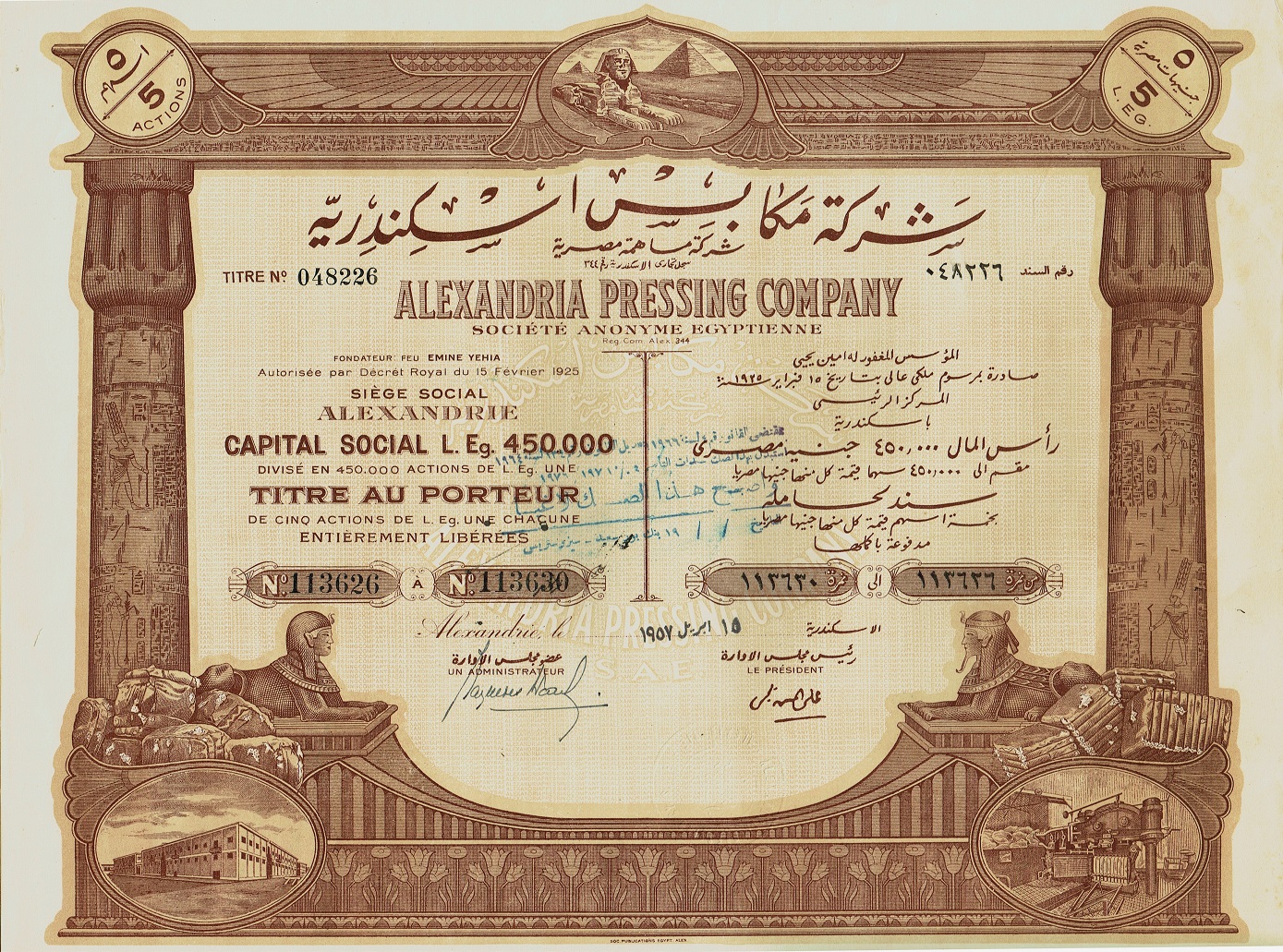
Images 6a and 6b: From Egypt, the shares from the Alexandria Pressing Company that were issued in the 1950s have a watermark showing the name of the Norwegian company ‘BORREGAARD’, the paper type ‘TUB SIZED LEDGER’ and the location of the paper mill ‘MADE IN NORWAY’.


I conclude this part in the series with one of my favorites: a share in The Dahramsi Morarji Chemical Co Ltd, Bombay (DMCC). Its watermark shows the line LUCKY PARCHMENT, a design of a jockey racing a horse, and the words RAG CONTAINING underneath. See images 7a and 7b below.

Parchment paper is not to be confused with “parchment”. The latter is a writing material made from animal skin. The former is a type of cellulose-based paper (made from wood pulp and cotton fibers) which has been treated chemically to make the paper stronger, more heat resistant and above all non-sticky.

You’ll find the words PARCHMENT also in the watermarks of shares from McLeod and Co, Ltd (1940s) and many other scripophily examples. In my example, LUCKY PARCHMENT is a parchment paper brand from the Indian paper company Ballarpur Paper and Straw Board Mills, Ltd.

RAG CONTAINING is another line of text in the DMCC watermark. Rag paper or cotton paper is primarily made of cotton linters or from used cloth (rags). Cotton paper may last many decades without any sign of deterioration, see also images 5a and 5b before.


Images 7a and 7b: This share in The Dahramsi Morarji Chemical Co Ltd was issued in 1968. The company's headquarters were located at Dr Dababhoy Naoroji Road in Mumbai. The certificate shows the coat of arms of the company, including a tiny map of India, and has a watermark of a racing jockey. 


The DMCC’s remarkable jockey watermark seems unrelated but it is not. I learned from scripophily expert Sayeed Cassim (see also here) that the Ballarpur paper company was founded by Karam Chand Thapar, who headed the Thapar Group of companies. The Thapar family was involved in race horse ownership, hence the jockey.

Time for a quick review. The first watermarks were formed, likely unexpectedly, in the production process of what we now call laid paper. Paper makers then added a logo, their coat of arms, or their name to the watermark design. Some of them further added a year, a paper type or brand, and also a location where the paper was made. If you haven’t done so already, you might start viewing your certificates against a window.

In part 3, I’ll show that paper manufacturers start adding watermark elements on behalf of one of their important customer segments: security printers.


F.L. 

This article was initially published in Scripophily magazine No. 114, December 2020. 
You might be interested to read : Watermarks in Scripophily - part 1 Introduction 


Monday, March 29, 2021

Collectibles from the undersea world and other rarities emerge in Boone's scripophily auction

The 66th auction of Mario Boone takes place online with an exceptional wide range of scripophily collectibles. More than 1,100 antique stocks and bonds span 4 centuries of financial history.

The sale includes several historic items and a number of old collections have been consigned for this occasion. Very special, and unseen before, is a scripophily collection of the undersea world. The companies represented here had goals that captured our imagination. Their shares often featured fantastic vignettes.


During the American Civil War hundreds of ships  were destroyed. This share from the Life Saving Raft Company, was issued in 1866 just after the war. The amazing vignette shows the company's life raft with shipwrecked sailors. Early lithograph produced by Henry Seibert and Brothers, New York, and part of the Diving/Submarines collection 


The Diving/Submarines collection consists of about 90 certificates from companies involved in diving operations, the ship wreck salvage business, underwater treasure hunting, production of submarines, insurance of maritime losses, diving and life saving equipment and maritime archaeology. The collection, L(ot) 1051, offered as a whole, starts at €4,000. In case no bid is received, it will be offered again in smaller lots. 

I'll come back to the other collections consigned for this sale but let me discuss first some of the top items in the sale.


One of the highlights in the auction is this previously unseen share from 1747. Formed in 1720 the Compañia Real de la Havana organized the trade between Spain and Cuba. The company controlled the export of tobacco, sugar, wood and other Cuban products but also slaves, as well as all import of European products needed in the colony. L771 in the auction starts at €5,000. Detailed image provided on the auctioneers Invaluable.com portal, see link below.

Here are some more lovely items from the Spanish chapter in the sale :
  • L772, an early copper engraving on vellum, boundless vignette all over the design, is a share from the Real Compañia de Comercio Establicida en Barcelona, dated around 1748 but unissued which explains the moderate start price of €400! 
  • Printed with a "gold" vignette of a mining operation, the San Juan Bautista (Teruel) silvermine share, 1857, belonged to the Duke of Rianzares, second husband of Queen Maria Cristina de Borbon, L775 
  • A great example of Art Nouveau design, L782, a share in the Nueva Plaza de Toros, shows off the bullring of Barcelona


Let's jump to the present. Everyone knows how to download a PDF auction catalog and read it with the Acrobat Reader application. Both PDF and Acrobat Reader were developed by Adobe Systems. The company was founded in 1982 by ex-Xerox PARC employees John Warnock and Charles Geschke. This specimen stock certificate bears the facsimile of Charles M. Geschke. In 1992 he was kidnapped from Adobe's parking lot. Four days later the FBI found and saved Geschke. L1043, a very interesting collectible from the software industry, starts at €50 

Regarding American scripophily there is lots more to find. This auction chapter includes a top collection of ninety early USA (1816-1860) certificates, lot range 884 through 976. A few examples :
  • L886, Thomaston Coal and Mineral Company, 1819!, then part of Massachusetts, today Maine
  • L910, Philadelphia Museum Company, previously Peale's American Museum, share from 1840
  • L943, West End Land Association, 1854, vignettes of villa and native Americans
The American 'regular' section, lot range 977-1044, has some more surprises, so don't forget that part. 

The Russian chapter consists of nearly 100 lots and kicks off with another highlight :  L678, a share in the Warsaw-Vienna Railway Company. In 1814 Alexander I of Russia was made king of Poland at the Congress of Vienna. His succesor Nicholas I approved the construction of the Warsaw-Vienna Railway. Its 1839, unissued, share shows the vignette of the Russian imperial double-headed eagle. Besides tsarist era scripophily, the chapter includes several soviet certificates as well.


The Azoff Steam Ship Company, founded in 1871, serviced the harbors at the Sea of Azov and the River Don. In the Soviet period the company became an asset of the Ministry of the Maritime Fleet (Minmorflot). This 1895 specimen share was printed by Typography Brothers Schumacher. The printing house finds its origins in the 18th century print shop of the Russian Academy of Sciences. The shop was founded by Johann Daniel Schumacher, secretary of the academy and librarian to the Tsar, and his brother Johann-Jacob, professor of architecture at the St-Petersburg university. L691 

Here is an overview of the other collections that will go on the block in this auction : 
  • L5, Collection of 16 Red Cross certificates
  • L187, Collection of 46 Austrian World War I bonds 
  • L321, Collection of 84 royal loans of France under the form of life rentes (cfr. the catalogue France, The Royal Loans by Howard Shakespeare), period 1689-1787 
  • L322-333, Corsica collection
  • Lot 625-677: Rolf Büchsenschütz collection of Romania (part)
  • L1080-1117, Fire fighting collection

The printed catalog contains several indexes to help you find what you are looking for.  The online versions can be searched by keywords. 


At the start of the 20th century, Ghent, Ypres, Bruges and other Flemish cities still counted many female lace workers. During WWI, war lace was bought by soldiers as a gift for the home front in England or America. This handicraft would disappear, partly because in the Congo, then a Belgian colony, nuns taught lace-making techniques in the missions. The Congolese women and children produced large quantities of lace at very low wages. De Vrouwelijke Beroepsbonden, in English: The Women's Occupational Unions, was a cooperative from Ghent founded in 1914. This unissued share shows vignettes of a lace worker and two seamstresses. Printed by Litho. F. & R. Buyck Frères. L229 


It is impossible to mention all items in this sale, but there is a way to find out more about them. Here are the auction details :
  • Location : Internet only
  • Date : 10 April 2021
  • Further info : 


F.L.

PS : Did you like this post ? Thank you for sharing it on you favorite social media channel !

Friday, March 27, 2020

Connoisseurs of British railway securities will be thrilled at Boone's next scripophily auction

The 64th auction of Mario Boone takes place online with an exceptional range of high quality collectibles. Nearly 1,700 antique stocks and bonds spanning 4 centuries of financial history represent about 100 countries.

Boone's next auction is set for 4 April 2020. Included are many genuine founder shares from famous companies. This is one from the Assicurazioni Generali Austro-Italiche. 


The very first share from the world famous Generali insurance company

Following the Napoleonic Wars, Trieste became the main trading port and shipbuilding centre of the Austrian Empire. There insurance expert Joseph Lazarus Morpurgo founded the Assicurazioni Generali Austro-Italiche in 1831. His company provided insurances against risks of marine and land transport, flood, fire, and much more, hence the name GENERALI.  One of its notable employees was writer Franz Kafka who worked for Generali in Prague in 1907 and 1908. This is Generali's share number 1, issued in Trieste, 1832, and signed by Morpurgo. Lot 943 in the auction is a top item for any scripophily collector of insurance companies or Italian/Austrian finance history. 


Connoisseurs of British railway securities will be thrilled. More than 120 lots come from an old collection that illustrates the rich and pioneering history of British railways. Even if you are not into railway scripophily, this is an exceptional opportunity to check out this series (lot range 789 through 914). Let me mention here a few of these gems :
  • L793 Blaydon, Gateshead & Hebburn Railway, stunning vignette; 
  • from Ireland, L804 River Line, Cork Blackrock and Passage Railway
  • L803 Clarence Railway, 1828!; 
  • L809 Durham and Sunderland Railway, rare, wax seal;
  • Another stunning vignette can be seen on a Liverpool and Manchester Railway certificate, 1826!, L845. 
  • L877 comprises a share from as early as 1804 - eighteen hundred and four !!! - issued by the horse-operated Oystermouth Rail-Way or Tram-Road. This company commenced to carry passengers in 1807. 


Monmouthshire Railway and Canal Company share transfer certificate with large vignette of train and barge approaching bridge

The Monmouthshire Railway and Canal Company operated a canal and a network of railways in south-east Wales. It started as the Monmouthshire Canal Navigation and opened canals from Newport to Pontypool and to Crumlin from 1796. The unusual large vignette on this 1854 share transfer certificate shows a train and a horse-drawn barge nearing a canal bridge. Click to enlarge image, L869 in the auction. 


Auctioneer Boone provides an extensive catalog for this sale with every lot described in detail (download link see below). Among the nearly 1,700 antique securities you'll find hundreds of little masterpieces. Their designs reflects the art style in vogue and often include vignettes from illustrators. Some examples :
  • L422 Comptoir de la Bourse de Bruxelles, illustrated by Charles Posch
  • Constand Montald's work can be seen on L443, Grands Magasins à l'Innovation, Bruxelles 
  • Oriental elements are abundant on L384 Société Foncière de Syrie
  • L691 Gewerkschaft "Deutsche Nickel-Gesellschaft" displays a super mining vignette
  • My favorite Art Deco share is the 100 Gulden share from the Nederlandsche Bakkerij-Centrale, Amsterdam, 1917, a work by Johan Rudolf Bonnet created before he went to live in Bali, L972


multicolor printed share in the Anatolian Rug Manufactoring Company from Greece

A little masterpiece is this 25 shares certificate from The Anatolian Rug Manufacturing Co. Ltd., Athens, dated 1924. Printed in multicolor by Aspiotis Brothers, banknote printers from Corfu, the share is adorned with oriental elements and shows carpet knotters at work. Despite their obvious activities, the scene is filled with silence. Click the image to enlarge, one of them noticed your attention. L924 in the sale


The catalog's comprehensive country index lists nearly 100 countries. In particular large sections (each containing between 40 and 250 lots) are Belgium, France, Germany, UK, Romania, Russia, Sweden, Australia, Netherlands Indies and the USA. Scripophily from less obvious, often exotic places, like British North Borneo, Iraq, Djibouti and Suriname is present as well.


Chile's Government Junta proclaimed Chile as an autonomous republic within the Spanish monarchy in 1810. Eight years later Chile declared its independency in 1818 which would only be recognized in 1844. The Anglo Chilian Mining Association, formed in London, 1825, is one of the earliest companies formed in the new state. L1519 in the auction.


It is impossible to mention all items in this sale, but there is a way to find out more about them. Here are the auction details :
  • Location : Internet only
  • Date : 4 April 2020
  • Further info : 

F.L.

PS This auction also includes the first part of a unique collection of Indonesian scripophily (ca. 250 lots! ). Find out more about this here .


Boone's 64th auction catalog includes also an index of collecting themes (besides countries). The sports entry refers to more than 20 shares, including this French 1911 share in the Olympic Tennis Club de Wimereux, Boulogne-sur-Mer. Lot 610