Showing posts with label forestry. Show all posts

Wednesday, May 27, 2020

Did you miss Scripophily magazine in 2019 ? On purpose ?

Scripophily is the world’s most comprehensive and insightful publication for passionate collectors and active researchers of antique securities. This three-yearly periodical, printed on high quality paper, is the flagship of The International Bond and Share Society (IBSS).


Scripophily magazine discusses hundreds of auction highlights. Issue 109, April 2019, mentioned this certificate in the report on Boone's October 2018 auction. It is a dividend share in The Compagnie Belge-Néerlandaise de Sambas (Borneo). This Belgian enterprise obtained concessions for mining, agricultural and forestry operations from the sultan of Sambas. Its 1899  share realized €180 in the auction. 
courtesy : www.booneshares.com 


If you don't know the magazine then here are 4 takeaways :
  1. Enjoy fascinating stories on the people and organizations that issued the old stock and bond certificates. 
  2. Read about the latest market and auction reports.
  3. Stay up-to-date on important news, and gossip. Scripophily magazine informs you about new discoveries, announcements by collector clubs and scripophily related exhibitions, publication of books, rumours and fait-divers about our hobby, events and bourses, and much more.
  4. Scripophily magazine is the only English language journal covering topics from all over the world about any theme thinkable.


The three 2019 issues of Scripophily magazine counted over 120 pages, reported on about 100 auctions, featured around 400 images, and were shipped to over three hundred members on all continents. 


On top of that, subscribing to Scripophily magazine brings you valuable free extras :
  • The IBSS Directory brings you in contact with fellow collectors. Many of those are experts in their field, often share common interests with you, and possibly live nearby. The Directory contains members from more than 40 countries.
  • The Newsletter, so you may keep up with what is going on
  • Access to all content on the IBSS website, including digital versions of previous issues of Scripophily magazine, the online forum, special theme galleries, and the like.
  • Newsflashes on the website focus on hot topics that can't wait for the next issue of the magazine. 
  • Get extra credibility : being listed as a member is a good reference in any deals made remotely with parties previously unknown. 

What's the catch ? 
Well, the subscription fee is ridiculous, that's all. Subscribing to IBSS's magazine costs you only £20 or $32 or €25, true ! I looked it up. The price is still the same as it was in 2013. How much longer will it stay like that. Now that you know it, don't miss this boat.

F.L. 

Related links

Thursday, October 18, 2018

French scripophily terms 2.0

Do you agree that France is the nation that has left us the most decorative bond and share certificates  ? If you know a little French, it is often possible to derive from the lettering on those certificates what the issuing companies were all about. 

Actually, we can find bonds and shares from all over the world with text written in French. Besides France, some of the better known examples of French speaking countries are Canada, Switzerland, Belgium and Luxembourg. 


Let's spin a globe and pick a spot. There is a good chance we know "French" scripophily from a country marked by our finger, such as : Madagascar, Vietnam, New Caledonia and Guadeloupe. In fact, every continent has some states with bonds and shares written in French. Then there are also the many French language certificates issued by companies operating abroad, many of these were Belgian. We find actions de capital and parts de fondateur in Russia, Egypt, China, Ottoman Empire, Spain, Brazil, and again, much more. 

One of the readers of the blog, came across the 100 French Scripophily terms on this site and suggested some extra entries for it. Wonderful, thank you for that. You can check out the enhanced list here.


Here is a little test to help you sharpen your French skills. Try to find the meaning of following terms printed on the illustrated share below :
  • magasin
  • bois
  • scieries
  • société anonyme
  • capital social
  • part de fondateur
  • sans désignation de valeur
  • administrateur
Of course, you can use the 100 French Scripophily terms cheat sheet.


Click the image of this Belgian share to enlarge. 
Can you locate the French terms from the little test ? 


Test passed ? You will see that exercising your French scripophily skills will not only keep your mind sharp, but it will also prove to be useful soon :
  • the upcoming Boone auction features hundreds of French scripophily certificates, and, 
  • rumor has it that a new, free scripophily newsletter, in French, is born, but more on that in the next issue of Scripophily magazine and in a later blog post. 


F.L.


Enjoyed reading this post, why not share it ?

Friday, December 25, 2015

Scripophily magazine 98


It's only a matter of one or two weeks before you can expect the next issue of Scripophily magazine in the mailbox. For those who are not subscribed, here is an overview of the stories from the last August issue :
  • The Anderson Motor Company
  • $100,000 Denomination Chinese 1937 Liberty Bond print inconsistencies , about counterfeit Chinese bonds
  • Rarity Key System , a joined communication by several auction houses 
  • The bonds issued under the forced loans of Jérôme Bonaparte , a story on Westphalia Kingdom finance 
  • Rafting Scripophily , highlights early timber logging and transport companies in the US
  • Embossed British revenue stamps , did you know about the junction between British revenue stamps and stocks and bonds?
  • Charles A Stoneham & Co mining curb brokers , a story on a remarkable mining stock brokerage firm
  • Sensation at 5 centimes in 'Le Petit Journal', an updated article about this famous French newspaper company 
  • An early IBM predecessor company, about the Computing-Tabulating-Recording Co
  • China's Historic Foreign Bonds, by J M Thompson and M D Perry , book review 
  • Pictorial Stock Certificates - Lithography and Engravings for the Graphic Art Collector, by B Brown , book review 
  • Cox's Corner : We're not getting any younger , tips about specializing your collection
  • other periodical topics : society matters, news, bourse reviews, auction reviews, events calendar, member classifieds, book reviews, interviews and lots of pictures of collector friends and scripophily
Did you know about the previously rare Suez canal company
where about 50 hoard certificates recently appeared?
Read about it in Scripophily magazine Nr 98 Aug 2015
-
image from Wikipedia:
Suez Canal from 1881 Young Persons' Cyclopedia of Persons and Places


Scripophily magazine is a publication from the International Bond & Share Society.

F.L.

Related links

Saturday, May 26, 2012

Reduce contrast to reveal a hidden underprint

What is an underprint ?
When two different designs are printed over one another, then we speak of a design with an underprint. 
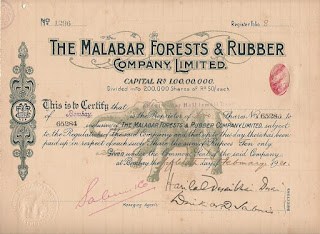
image of a share of 50 Rupees in the Indian Malabar Forests and Rubber Company
Malabar Forests and Rubber Company
Shares of 50 Rupees (10 Rs. paid up)
Bombay, 1921
double-click to enlarge

On the example above, we can distinguish two printing designs : an elephant (the underprint design) and the main design containing the share's text that was printed on top of the underprint.

Some underprints may look hazy or even be hidden
Not all underprints are so clearly recognizable as our fierce elephant shown above. A good example is a certificate of the Charbonnages André Dumont, a Belgian coal mining company.

image of World War II emergency note issued by the Belgian coal mine Charbonnages André Dumont
Société Anonyme des Charbonnages Andre Dumont
English: André Dumont Coal Mines company
Kasbon 10 Frank, unsigned
17 May 1940, Waterschei (Limburg province, Belgium)

Well, you actually can't call this a bond, though the word 'Kasbon' (English: savings certificate) is printed on  the certificate. From Schwan-Boling's World War II Remembered, we learn that it is a local Belgian emergency note printed between the initial German attack, 10 May 1940 and the Belgian surrender on 28 May 1940. Due to the initial chaos several communities were forced to issue emergency currency.

So far for history. The image shown is not a bad scan. The actual piece is just printed in such subtle colors. Reducing contrast is the trick that will result in an image with a more recognizable underprint, as you can see here.

Image of the same certificate, but with strongly reduced contrast settings.
Double-click to enlarge.

For the record, I am not in favor of embellishing images of scripophily papers. Images should represent the true look of the certificate. However, I see no problem in editing images for researching purposes.

What is contrast ?
In digital image editing, the word contrast stands for the difference between dark and light. When increasing contrast, the darker pixels are pushed towards black and the lighter pixels towards white.  Otherwise said, the difference between the tone of a darker pixel and a lighter pixel is increased. The opposite action, decreasing contrast, yields more visible shades of darker and lighter pixels.
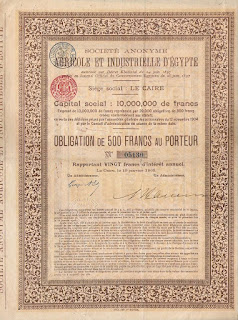

image of a bond issued by the Agricultural and Industrial Company of Egypt
Société Anonyme Agricole et Industrielle d'Egypte
4% Bond for 500 francs, Cairo, 1905
Printed by Imp. VVe. Monnom, Bruxelles 

Hard to tell at first sight and even at second sight : 
there is an interesting underprint present.

How can you decrease the contrast ?
You need a digital image editor which is a piece of software that you use to edit digital images. I have tried the following software products : MS Digital Image 2006 Standard  Edition Editor and Picasa 3, both locally installed on my desktop, and Pixlr Editor an online photo editing software, see here . The latter allows you to upload your image, edit and share it to other social platforms or download it back to your desktop.

Something that struck me was that each of these softwares handle a different name for the contrast editing function. In the mentioned products, this is the function that you should apply for decreasing contrast :
  • MS Digital Image 2006 : in the Touch-up menu, decrease Contrast 
  • Picasa 3 : in the Tuning tab features, increase Shadows (yes 'decreasing contrast' has the same meaning as 'increasing shadows')
  • Pixlr Editor : in the Adjustment menu, increase Contrast in combination with a decrease of Brightness


Société Anonyme Agricole et Industrielle d'Egypte
detail of the underprint of the bond listed above
After reducing contrast in Picasa, the remnants of an ancient temple appear.
Double-click to enlarge.

What if the underprint is still not clear ?
To illustrate this topic, I'll use the Japanese bond depicted below.

This  patriotic WWII bond was issued by the Japan Hypothec Bank in 1942.  Between Dec 1937 and Aug 1945 this bank sold over 4.2 billion Yen in war bonds, most of them in denominations of  15 Yen or less. This particular bond shows a falling bomb with the Japanese name 大東亜戦争 which means Greater East Asia War. The term was introduced to mark the period when Japan extended the war from a regional conflict in China to a wider war all over South-East Asia and the Pacific. The red rays behind the bomb are derived from the Japanese military flag and represent the sun.

Schwan-Boling's book mentions that the bond was printed by the Toppan Printing Company from Tokyo. As an anti counterfeiting measure, the large red serial number was printed on the face and back of the certificate. The number on the back was the mirror image and aligned perfectly with the one on the face.  Extremely difficult to reproduce.

image of a patriotic war bond issued by the Japan Hypothec Bank for the Greater East Asia War 

5 Yen patriotic wartime bond 1942
issued by the Nippon Kangyo Ginko (English: Japan Hypothec Bank)
-
The blue round logo of the bank is printed at the top
and is repeated several times as a watermark.
double-click to enlarge

There is also an underprint but it is hardly noticeable. So, as I did before with the other certificates, I scanned the certificate and reduced the contrast in the image. This was the result : no significant improvement. The underprint was still unclear.

The underprint is still not very visible after reducing contrast.

Miserable molecule of mildew! The only thing I could think off, was using the edited image, not the originally scanned image, again as input for the image editor software. So I reduced the contrast on that "second generation" image, and that gave a better result. Now, you can see that a map appears in the underprint. Visible is : China, the South Korea peninsula, Japan's major islands Hokkaido and Honshu, and Taiwan as well.

Double-click to enlarge and detect a map of South East Asia.

Summary of the procedure

  1. Scan the certificate with an underprint.
  2. By means of a digital image editing software, see some examples above, reduce the contrast drastically, and save the resulting image.
  3. If the underprint is still not clear, then repeat step two, but instead of using the original scan, use the resulting image from that step.

Another example where I reduced the contrast of an underprint, can be seen here 
I'm sure that some of you have similar certificates.
Were you able to reveal the barely visible underprint ?
Did you follow the same approach ?  

F.L.

p.s. Concerning the bond with the hidden map: to be honest, I am a bit disappointed that I didn't find a spot on the map marked with an "X".   8)


N.B. More nice examples of underprints can be found here and there .

Friday, December 9, 2011

Book : Terra Australis


  • Title : Terra Australis - An Adventurous Financial History of Australian Shares and Loans / Abenteuer australischer Finanzgeschichte in Aktien und Anleihen
  • Authors : Michael P.A. Liebig
  • ID: ISBN 3-89090-706-7, published by Markt & Technik Verlag AG, 1988
  • Languages : English, German
  • Number of pages : 175
  • Images : black & white, multiple images on almost every page
  • Indexes : no indexes
In this book the author takes the reader on a journey through the historical development of Australia. Many images from share certificates, maps, engravings and other ephemera are included. Certificates seen from the following themes : banking, agriculture, schools, state bonds, textile, tobacco, mining (coal, copper, tin, etc.) , gold, food, oil, railways, transport, forestry, shipping, automobiles, aviation, metal works, film, breweries, sports.
Chapters :
  • A Passage through History
  • The Share conquers Australia
  • 50 Years after James Cook
  • Pressing for Gold
  • Australia under Steam
  • From Hell to Hope
  • Australia becomes mobile
  • Flying Doctors, Cackling of Hens and a School in the Air
  • And to conclude
A must have for the serious collector of Australian scripophily !
F.L.
  
NB:
Did anyone compile an index of the shares illustrated in this book ?
I would be happy to add the index to this post.