Showing posts with label shipping. Show all posts

Tuesday, December 23, 2025

Cruising the Nile in the winter

At the age 17, mystery novel author Agatha Christie spent the winter of 1907–1908 with her mother in Egypt. They stayed for three months at the Gezirah Palace hotel in Cairo, participated in social events and visited some of Egypts ancient monuments. 

Christie would visit Egypt again later, and write several Egypt-set novels, including Death on the Nile featuring detective Hercule Poirot.


The Nile Express Steamers Co. 
5 founder shares, Cairo, 1906  
Printed in Cairo by Baader & Gross 

The Express Nile Steamers Company (ENSCo) was organized in April 1906 with a capital of 30000 Egyptian pounds. The company offered Nile cruises to rich Westerners, and Britons in particular. ENSCo's trip from Cairo to Luxor took 7 days, back in 4.5 days. And within a year the route was extended from Luxor to Aswan taking another two days.


ENSCo's first ship was launched at Giza on 14 Nov 1906. Miss Bassie Ems, the daughter of the company's director general, baptised the 'America' graciously. The triple decked vessel with cabins for 54 first-class passengers featured saloons for dining and smoking. Passengers enjoyed the Nile views behind glass windows that shielded them from wind and cold. 

In 1908 Baedeker publishes its Egypt and The Sudan, Handbook for Travellers. The book includes tips for traveling aboard a Nile steamer: 

"Passengers by steamer should beware of the risk of catching cold by leaving the windows of their cabin open ; and it is well to remember (e.g. when shaving) that the steamers sometimes run aground, especially above Luxor. Liability to delay through this last fact makes it impossible to be sure of reaching Cairo in time to make connection with the ocean-steamers."
Exciting times, if you ask me! I wonder whether Agatha Christie got bored on her three-month stay. I would have gone on a cruise. Did she? Well, that's a question that only Mr Hercule Poirot could solve. 

Merry Christmas!

F.L.

References

  • Launch of the America, Egyptian Gazette (1906-11-15) 
  • Egypt and the Sûdân; handbook for travellers, 1914, Karl Baedeker 

  • Previous posts


    Monday, May 27, 2024

    Over 1400 lots of scripophily will be auctioned at HSK's headquarters in Wolfenbüttel

    Hanseatisches SammlerKontor für Historische Wertpapiere (HSK) plans its next auction of stocks and bonds on June 1, 2024 at its headquarters in Wolfenbüttel. More than 1400 lots are described in full in a 230 pages counting auction catalogue. All lots can be viewed online as well.


    Briar root wood (heather, bruyère in French) is a type of wood used for making smoking pipes. It is known for its heat and fire resistance. Due to its hardness the wood surface can be smoothed and polished, while at the same time its porosity absorbs the smoking condensates. This share in the Bruyère-Pfeifen Aktiengesellschaft from Hamburg was issued in 1921. Printed by Jagdmann & Bohm, its stunning Art Deco design is adorned with more than one hundred Bruyère pipes. Extremely rare, L(ot) 518 starts at €1400. 


    The auction includes several German chapters: Bremen und Niedersachsen, Hamburg, Schleswig-Holstein, Mecklenburg-Vorpommern, Germany before 1945, German railways securities issued in Reichsmarks, Germany railways securities issued in Deutsche Mark and Germany after 1945. 


    Leonhard Fanto (Vienna, 1874 - Dresden, 1940) was an Austrian artist known for his costume paintings and genre scenes from the Balkans. He became director for costume and set design at the Dresden Semper Opera. In his composition for this scrip receipt in the German 6th war loan of 1917, Fanto included an emerging submarine. L706 starts at €100.  


    The auction features scripophily from all over the world with strong sections of European and American stocks and bonds. 


    L35, stock certificate in The Berkeley Athletic Association, New York, 1891. Start price €380 

    There is a lot more to discover in the catalog, so here are the details :

    F.L.

    Tuesday, April 9, 2024

    Antwerp Hilton hosts Boone's auction of historic share certificates.

    Mario Boone's 72nd auction features more than 1500 lots of scripophily from all over the world. The word scripophily is a contraction of the English word “scrip”, a certificate entitling ownership right, and the Greek word "φίλος" (philos), meaning "friend". It refers to the field of collecting of antique stocks and bond certificates.


    This 1905 share from the Grands Magasins du Printemps tells us what this famous department store from Paris stood for: "Bon Marché - Qualité -Nouveauté - Élégance", in English: Cheap - Quality - Novelty - Elegance. Today a chain of department stores, Printemps offered high quality goods at prices affordable for the middle class. The store pioneered with discount sales to clear outdated stock, and used window models to display the latest fashions. L(ot) 350 in the auction starts at €200 


    Two auction catalog volumes are available online and can be downloaded separately as PDF documents. Nearly all of the 180 pages in the main catalog include color images and background stories of the certificates to be hammered. For easy retrieval purposes, search indexes help the collector on his quest for engravers, artists, security printers, Belgian provinces, more than 80 countries and an equal number of special interest themes. 

    The TOP 80 auction highlights are documented in a separate volume with bigger pictures and more detailed descriptions. 


    This fascinating share in the merchant frigate Le Saint Philippe was signed by its captain Jean Daragorry in 1746. At this time it was the practice to finance the fitting-out of a ship on a one voyage at a time basis.  Le Saint Philippe, equiped with 18 6-pound ball cannons and a crew of 80, sailed under Spanish flag to Campeche and Tabasco in Mexico. At this date, France and Spain were at war with England over the Austrian Succession. Lot 786 is one of the Top 80 highlights of the sale and is expected to realize at least €2,400. 


    The auctioneer managed to present some old collections that now have become available to the market including Belgian coal mining, British Railroads, Belgian Trams in Italy, Chile and Brazil. Some of these (check the catalog) are first offered as a complete collection in one single group lot. Only if no bids are received for the complete collection the individual certificates will be auctioned one by one. 


    The auction features a few airline stock certificates. This is L1518, a nominative share from the Navegação Aérea Brasileira, issued in Rio de Janeiro, 1941. The certificate is listed at a €50 start price, a steal if you ask me, but it may be hammered as part of a collection of 393 Brazilian securities, L862, that is first offered as a single group at €7000. 


    The Boone auction will take place at a new venue, the Hilton Old Town hotel in the heart of Antwerp. It was built in neoclassicism style in 1859 and served as a hotel and department store. You might want to spend a weekend in Antwerp because the day after the auction a scripophily bourse is organized by Guy Bertrand at the same place.


    This stock was issued in 1918 to Elizabeth Huidekoper, the wife of Henry P Kidder, co-founder of Kidder, Peabody & Co. A regular donor to charity causes she also made gifts to the Boston Museum of Fine Arts. The certificate is also signed by Alice Evelyn Hay Wadsworth, known for her "Wadsworthy" tactics. Both women were high-society figures. The Woman Patriot Publishing Company was a publisher of The Woman Patriot, a "National Newspaper for the Home and National Defense Against Woman Suffrage, Feminism and Socialism". L1218, a rare stock representing a remarkable era in the field of women’s rights and American suffrage, starts at €240. 

    There is a lot to discover, so here are the auction details :
    • Location: Antwerp, Belgium (new venue: Antwerp Hilton Old Town)
    • Date:  27 April, 2024 
    • Further info: online catalog & bidding, see here on the auctioneer's website, or via the Invaluable platform, see there. The two PDF catalogs can be downloaded from the auctioneer's site.

    F.L.


    PS : Did you like this post ? Thank you for sharing it on you favorite social media channel !


    Tuesday, February 27, 2024

    Swastikas for prosperity

    Last year's Holabird Americana’s Big Bonanza Auction included a share in the Swastika Mining and Development Company. The item sold for $80. Scripophily magazine no.121 said: “The swastika was said to be a good luck symbol in western Native American culture and it appears on a few certificates”. That’s only a part of the truth.


    Fig. 1 The Swastika Mining and Development Company owned claimes at Lakeview, Idaho, and a lime quarry at Lake Pend Oreille. This share was issued in 1910, and shows two swastikas in the masthead and one in the embossed seal. 


    We usually recognize the Swastika symbol as the symbol of Nazis, which we can also find on Nazi era bonds. However it is a much older symbol. In North America, the Tlinglit and the Hopi applied the symbol to decorate objects like baskets up to the 20th century. The Ancient Greeks, the Romans, the Celts, Germanic and Baltic tribes, as well as the Vikings knew about the swastika. The swastika is one of the most common symbols on Mesopotamian coins.


    Fig. 2 Detail of the tomb of Bishop William Edington (d. 1366) in Winchester Cathedral. Note the swastika on the vestments of the effigy of Bishop William Edington. Atrribution: Ealdgyth, CC BY-SA 3.0, via Wikimedia Commons 


    The word swastika comes from Sanskrit, the lingua franca in ancient South Asia and generally means ‘beneficial for well-being and prosperity’. The Sanskrit philologist Pāṇini from Ancient India wrote down the word approximately around 500 BC, but the symbol predates even the pyramids of Egypt.


    Fig.3 Details of swastikas on Indian shares. Top row, left to right: Kesoram Cotton Mills, Gourepore Co, Scindia Steam Navigation, Bottom row, left to right: Indore Malwa United Mills, Jodhpur Commercial Bank 

    The swastika icon has a spiritual significance in Indian religions. Swastikas can be seen on many buildings, statues and in homes in Asia and especially in India. It is an auspicious symbol for Hindus and can be used when starting anything new. The swastika often decorates the opening pages of personal and ledger account books. What follows are some examples in Indian scripophily. I grouped the details in figure 3.


    Fig.4 The Indore Malwa United Mills Ltd, Rs100 share, 1949 


    Sir Sarupchand Hukumchand was an important opium trader and a pioneer in the cotton Industry of central India. He founded the Indore Malwa United Mills in 1909 at Indore. In the 1950s the company employed about 3,000 textile workers that worked more than 1,400 looms. The underprint of its share shows the Goddess Lakshmi giving lots of coins. A minuscule swastika was incorporated in the border design right below the hoard (Fig. 3 and 4).


    Fig.5 The Scindia Steam Navigation Co Ltd, 1 share of Rs15, 1948 


    The Scindia Steam Navigation Company was founded in 1919 by Walchand Hirachand, Narottam Morarjee, Kilachand Devchand and Lallubhai Samaldas. Back then the sea routes in the British Empire were controlled by British companies. The company's flag ship SS Loyalty was the first Indian owned ship to sail to the United Kingdom. The vignette on the share, Fig. 5, depicts the SS Loyalty. The ship was purchased from Maharaja Madho Rao Scindia of Gwalior. Note the tax duty stamp with swastika.


    Fig. 6 The Gourepore Co, Ltd, ordinary shares of Rs100, 1929 


    What appears to be a rather plain certificate, the share of the Gourepore Company comes with a surprise feature to the meticulous researcher. This jute mill was registered in 1893. Its factory at Naihati, now part of the Kolkata Metropolitan area, had its own train carrying coal to its power house. The underprint of the certificate, Fig. 6 and 3, consists of a pattern of 2.5 mm² sized swastikas covering most of the surface.


    Fig.7 Kesoram Cotton Mills Ld, 100 ordinary shares of Rs10, 1955 


    Registered in 1919, the Kesoram Cotton Mills from Calcutta was managed by the Birla brothers. On 16 August 1946, Direct Action Day was announced by the All-India Muslim League leading to large-scale lethal violence between Muslims and Hindus in Calcutta. More than 300 labourers of the Kesoram Cotton Mills were killed. The company’s share certificate from 1955 shows an embossed company seal with swastika (Fig. 7 & 3). The business evolved into today’s industrial group Kesoram Industries Ltd.


    Fig.8 Jodhpur Commercial Bank Ltd, ordinary shares of Rs10 paid Rs5, 1946 


    The Jodhpur Commercial Bank was established in 1944 in Jodhpur but soon opened branches in Kuchaman, Merta City and Pali, all three in Rajasthan, but also in Nagpur and Bombay. Jodhpur’s impressive Mehrangarth Fort is illustrated on the company’s share certificate, figure 8. Note the swastika in the 100 shares denomination. 

    As a symbol of good luck the swastika had a major revival in Europe and North America in the 19th and early 20th century (that lasted till World War II). Scout groups used the icon on badges, even the US Army’s 45th infantry division used it as a sleeve insignia. Carlsberg has put it on its beer labels. Metal watch fobs in the form of a swastika with Coca-Cola logo are now selling at auctions for hundreds of dollars.


    Fig.9 The Ericsson Shipping Co, Ltd, shares of £1, 1915, image courtesy aktien.gutowski.de 


    I end this article with a share from the Ericsson Shipping Company. This company from Newcastle-on-Tyne experimented with ships built with a corrugated steel hull. This design increased the longitudinal strength of a ship without any corresponding increase of weight. Its certificate shows a sectional view of a ship’s hull on the left. 

    The Ericsson shipping flag consists of a swastika for good luck. However, its SS Monitoria was sunk on 21 Oct 1915 by a U-boat. Their SS Willingtonia, built in 1918, was hit by a torpedo the very same year. So much for good luck.


    FL


    Previous posts

    Saturday, September 30, 2023

    FHW auction features more than 1500 historic bonds and shares including several German collections

    Freunde Historischer Wertpapiere (FHW) has scheduled its 124th sale for October 7, 2023. This time the auctioneer selected more than 1500 lots of historic bonds and share certificates. Major sections have been reserved for scripophily from the USA, Germany, the German DM era, and a series of more than 300 lots from other countries.


    One of the auction's highlights is this gorgeous share from the Société des Fermes Réunies du Kurhaus et de la Banque de Nauheim Hesse Électorale. It was the Frenchman Jacques Roland Viali who founded the casino and the accompanying health resort. In addition to the roulette hall, there was also a reading room, a concert hall and a dance hall. Spa guests strolled in the adjoining parc around the large pond and boats were purchased to provided more entertainment. Within a year after its opening, 1 Jan 1854,  Nauheim received city rights, and soon new avenues were constructed. Few companies would change a town's history so quickly. This 1854 share, with Viali signature, is part of the Deutschland Top 20 chapter and starts at €2,600. L(ot) 626 in the auction


    Traditionally FHW is know for its strong emphasis on German scripophily. On top of that, several collections are now going under the hammer. The Hans-Werner Schmidt collection of Oberfranken (Upper Franconia) features 338 certificates in 146 lots from all themes, including brewery shares, such as L162, a rare share from the Erste Bamberger Export-Bierbrauerei Frankenbrau


    Collectors of DM securities will be pleased to find a large section in the catalog counting almost 400 lots of securities from the Deutsche Mark era. However, this SchmidtBank KGaA 1000 shares certificate, is part of the Hans-Werner Schmidt Oberfranken collection, L225. Bidding starts at €500. 

    The USA forms the largest non-German chapter in the sale with about 200 lots such as:
    • L1350, Barkley-Grow Aircraft Corp, stock certificate, 1936, airplane vignette, €240 
    • L1419, Massachusetts Fish Co, specimen share, 1907, crowded harbour scene, €100 
    • L1461, Petaluma and Sebastopol Railroad, stock certificate, 1889, rare, €600 


    The Sebago and Long-Pond Steam-Navigation Company built its Fawn steamboat in 1847. It had a shallow hull to navigate Maine's winding Songo River, with passengers asked to shift sides as ballast to keep both paddlewheels in the water around sharp curves. This 1848 share features three vignettes, two paddlewheel steamers and a church, and a green company seal. L1483, €400 


    There is a lot more to discover in the sale, so here are the details :


    F.L.

    Saturday, April 29, 2023

    Auctioneer Boone celebrates 40th anniversary in Antwerp: oldest stock exchange building houses international scripophily auction and bourse

    Mario Boone's 70th scripophily event spans 4 days! On Saturday May 6, a live auction with nearly 800 lots of historic and splendid antique shares and bonds takes place at the "Handelsbeurs" in Antwerp, the oldest stock exchange building in the world.

    An international scripophily bourse with free entrance for any visitor is organized at the same location on Sunday May 7. A great opportunity to see antique securities in the center of Antwerp.

    On Monday 8 and Tuesday 9 May, roughly 1500 more interesting lots will be sold through the Invaluable platform (live internet auctioning) or via the usual absentee bidding options.


    This 1884 share in the Fabrica de Faianças das Caldas da Rainha, a porcelain factory from Portugal, is superbly designed and printed. Against a background of tiles the drawing combines a still life with more than 10 animals. Can you find them? L(ot) 463 starts at €1000. 


    Saturday morning kicks off with a section of some 200 lots from Belgium Congo, Ruanda-Urundi and Belgium, including a 1899 Banque Coloniale de Belgique share certificate showing African scenes, L(ot) 6, and L34, a brewery share in the Brasserie de Stanleyville from 1949, both starting at €50. 

    Noteworthy in the Belgian chapter are:  L82, Exposition Internationale Coloniale et d'Art Flamand Anvers 1930, a share subscription for the colonial exhibition in 1930, start price €50, and L84, a $500 gold bond from the City of Antwerp. Not to be missed is L97, Compagnie Internationale des Telephones, the oldest Belgian telephone share, 1881, with a large underprint of an early telephone. 


    The Société de Zoologie in Antwerp, one of the oldest zoos in Europe, was founded in 1843. Its shareholders could enter the zoo for free on showing their share, hence the folds. Printed in 1843 by Joseph-Ernest Buschmann and designed by his brother and painter Gustave Buschmann. L299, €300 


    More Belgian's, and this applies to other countries too, can be found in a mammoth World Highlights section, lot range 193-775. Some examples :
    • The Société Anonyme d'Horticulture et de Botanique de Gand was founded by botanists who started holding botanic exhibitions known as "Gentse Floraliën". Its share from 1835, decorated with flowers, is extremely rare, L294.
    • A top object in any art collection is the 1897 share from the Compagnie Fermière des Eaux Minerales de Genval. It is designed by Art Nouveau architect, painter and designer Paul Cauchie, known for his sgraffito technique. Only three certificates were found in the 1990s, and this is the last one available. L310 starts at €10,000 and can be seen in detail on the auctioneer's brand new website here.
    • The world famous Lotus Bakeries is listed on Euronext Brussels and run by Jan Boone, the grandson of founder Jan Boone sr. This specimen founder share of the Banket- en Peperkoekbakkerij "LOTUS" voorheen "Boone Gebroeders" dates from 1934 and is the only one known to the auctioneer, L318.


    Then part of of the French colonies, the Mekong delta with its shallow waters was the perfect place to use "de Lambert hydroglisseurs", aka airboats. This 1920 share from the Société Anonyme des Hydroglisseurs "de Lambert", L228, starts at €200. 


    In the Australasia, Asia and Africa sections I spotted these items:
    • Bank of Australia, Sydney, 1833, early share printed on vellum, L193
    • L205 is a nominative share from the Société Provinciale Privilégiee du Fokien - Hoa-Hu, China, 1902, company set up by diplomat Paul Claudel, Chinese landscape.
    • Opium shares are rarely seen. L226 is a nominative share from the Société Fermière de l'Opium au Tonkin, issued in Hanoi, 1887.
    Lot range 271 through 279 comes from a diamond collection and includes scarce items such as a 1889 share from The Borneo Diamond Exploration Syndicate. 


    This 100 soles share in the Compañia Explotadora de Perlas de Sechura, Lima, 1902, is part of a collection of 214 bonds and shares from Peru, L676. 


    The European chapter is the largest one with over 300 lots, L280-L595. This blog format doesn't lend itself for enumerating all lots. Here are some of many astonishing historic securities:
    • L375 and L376 are two Eiffel companies: Société de Constructions de Levallois-Perret and the Société de la Tour Eiffel both showing the Eiffel tower.
    • Christiana Bye og dens Oplands Korn-Selskab, freely translated as Christiania Town and its Upland Grain Company: extremely early Norwegian share, dated 1810, from the time when Denmark ruled Christiania, today Oslo, L451
    • A Swiss watch collection, L563 through L574, includes names like LeCoultre, Tissot and Longines.


    L338, Compagnie Générale Maritime, 1856, signed by politician and financier Emile Pereire, gorgious design by painter and engraver Melchior Péronard, €3000 


    Over 50 lots of securities and related documents are featured in the 16th-18th century section, including:
    • A 1679! bond from the city of Enghien, Haunaut province, in need for financial resources under French occupation, 4 wax seals, L596
    • On Aug 27, 1701, Philip V, King of Spain and Louis XIV signed a treaty granting France the exclusive privilege to supply the Spanish colonies in the Americas with African slaves. This right was called the "Asiento". Issued in 1703 for 3000 Livres this share in the Compagnie Royale de l'Assiente, is an important evidence of imperialistic slave-trading practises in the 18th century and extremely rare, L607.


    Rio de Janeiro Tramway Light and Power Company Limited, 1 share, text in English, French and German, 1909, facsimile signature of electrical engineer and entrepreneur Frederik Stark Pearson, L664, €200


    The Latin America chapter, lots 657 through 677, include several remarkable collection lots. Each of these will be offered as a single group, and only when no bids are made, each collection will split and offered into single item lots in the online sessions on the following Monday & Tuesday:
    • L658 collection of Brasilian government bonds
    • L659 collection of Brasilian state bonds
    • L660 collection of Brasilian railroad certificates
    • L661 collection of Brasilian port/shipping certificates
    • L662 collection of Brasilian Industrial securities
    • L670 collection of Mexican scripophily
    • L676 collection of bonds and shares from Peru 
    More Latin Americ scripophily, as is the case for other themes, will be auctioned on the two online sessions on 8 & 9 May 2023.


    L682, New Jersey Southern Rail Road Company, $1000 bond, 1873 signed by railway tycoon Jay Gould, extremely rare, €12000


    The American section of the Saturday highlights is divided in three chapters : Jay Gould , railroads, and various themes. To name a few:
    • The 50 cents bond, 1841, from the Ocmulgee and Flint River Rail Road Company is not only small in size and value, but rare as well. L689
    • L763 is stock certificate from The Kansas City Distilling Company, a whisky maker, view of the distillery, 1889
    • The World's Columbian Exposition was held in Chicago in 1893. It's share shows a lovely vignette of an allegorical woman and an underprint of the exposition site. L765
    A tip for American railway collectors, you should check out Coxrail on this auction, see here


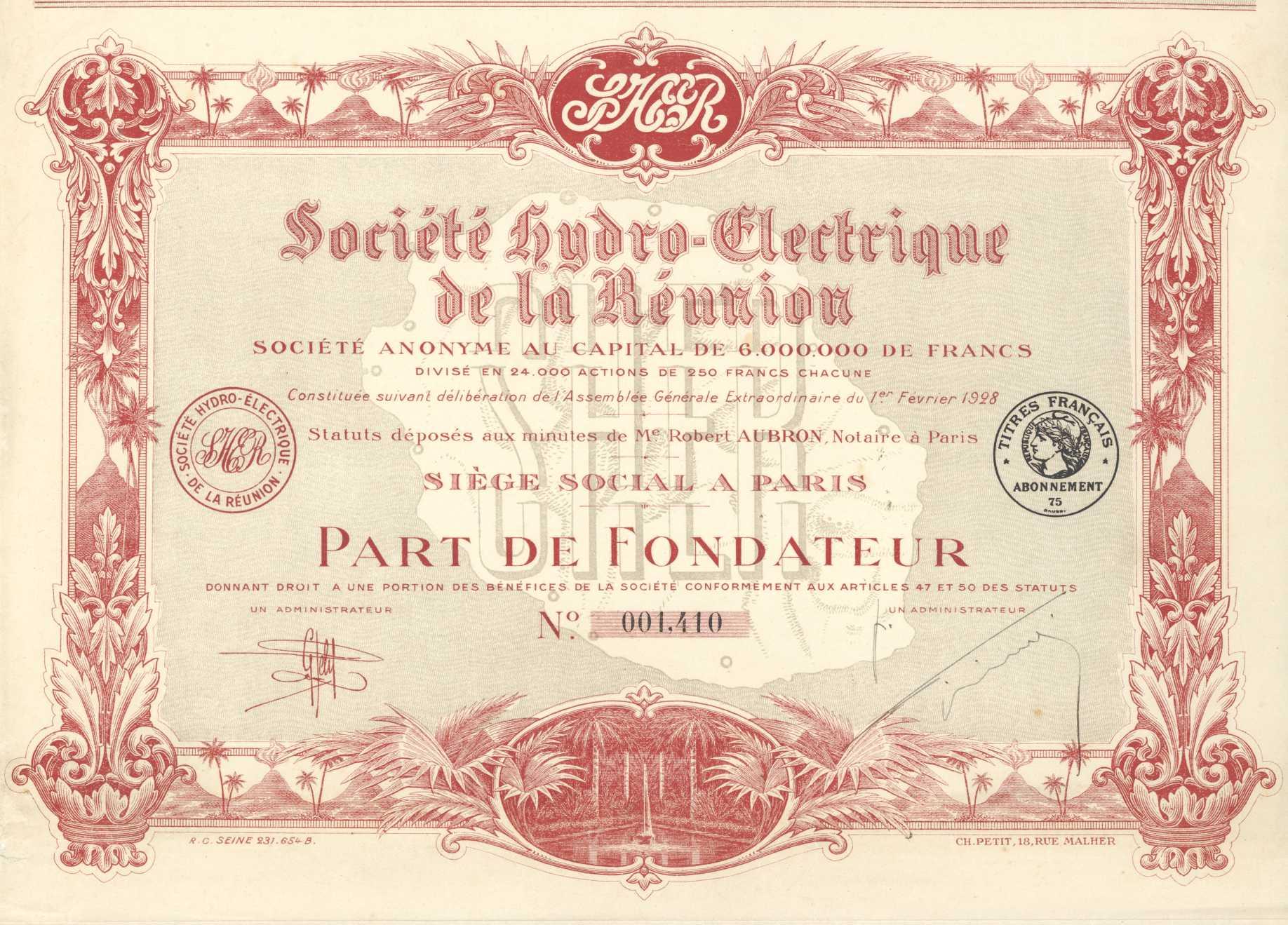
    Société Hydro-Electrique de la Réunion, founder's share, 1928, map of Réunion in underprint and border with a pattern of volcanos, likely the Piton de la Fournaise, L927, €50 


    The online sessions of this event are scheduled the days after the bourse on Sunday. These offer another 1500 lots of scripophily (or a bit less when the Latin American collections are hammered on the preceding Saturday - see above). Use the catalog's indexes or the search functions on the auctioneer's new website to find what you need.

    The weekend of 6 & 7 May is a chance to see some great antique securities. The venue is the Handelsbeurs Antwerpen. 

    Here are the auction details :
    F.L.


    PS : Did you like this post ? Thank you for sharing it on you favorite social media channel !


    Tuesday, February 14, 2023

    FHW auctions the Gottfried Schultz collection of worldwide automobile securities

    Freunde Historischer Wertpapiere (FHW) has scheduled its 123rd sale for March 4, 2023. This time the auctioneer selected nearly 2000 lots of historic bonds and share certificates. 

    FHW reserved major sections for scripophily from the Austro-Hungarian Empire, Germany, the German DM era, and the USA. Over 400 lots from previous auctions are grouped in a "50% from previous callout" section. On top of that about 900 lots of automobile related securities will attract the attention of collectors worldwide. 


    In 1928 Harry J. Wolfington signed this stock certificate from Alex. Wolfington's Son, Inc., as President. At the age of 14 he joined the carriage body business founded in 1876 by his father Alexander. Seeing business opportunities with the rise of the automobile, he turned to the production of bodies for luxurious buses and carbodies for Stutz, Pierce-Arrow and Duesenberg. The latter's convertible 1929 Phaeton Royale is legendary. L(ot) 725 starts at €750 and is part of the Schultz automobile collection. 


    The bulky Automobile section includes nearly 900 lots of antique securities from lesser known companies but also resounding names appear on the block such as : L923 Duesenberg Automobile and Motors, L1059 Hansa-Lloyd Werke, L1116 Hispano Suiza, L1329 Rolls-Royce and L1491 Automobiles Delahaye.  Food for specialists!


    No doubt two top pieces in FHW's Automobile section are a 1908 share from the Établissements De Dion-Bouton, L957, signed by Georges Bouton, as well as a 1919 bond from the same company with facsimile signature of Albert De Dion, L958. In 1900 De Dion-Bouton was the largest automobile manufacturer in the world. Its cars and engines were all being made by hand; the assembly line had not yet been introduced. 


    A major part of the offerings consists of antique bonds and shares from Germany with pre- and post-DM eras each in a dedicated section. Some examples:
    • L1621, a specimen share from the Credit-Bank Nürnberg eGmbH, 1924, large underprint of building, originating from a sample book printed by the Universitätsdruckerei H. Stürtz, Würzburg
    • A 1837 interim share in the Rhein-Weser-Eisenbahn-Gesellschaft depicts a train entering a tunnel. Daring for the time! Early and only certificate known. L1682
    • L1722, Basalt-Actien-Gesellschaft aka Basalt-AG extracts basalt, limestone, sandstone, granite and other rock from quarries in Germany and Europe. A large vignette on its DM100 share, 1973, depicts a worker handling basalt chunks.


    The world's first passenger airline, Deutsche Luftschiffahrts-Aktiengesellschaft (DELAG), was organized in 1909 as a subsidiary of the Zeppelin airship construction company. DELAG's airships made air travel possible first between Germany's cities, later to the Mediterranean and then across the Atlantic with destinations in the US and South America. Its LZ 127 Graf Zeppelin measured over 230 meters long and cruised at 117km/h with a 15,000 kg payload. In 1929 it made a round-the-world flight (including stops) in 21 days, the fastest circumnavigation of the globe at the time. This share was printed by Osterrieth in 1910. L1626 


    There is a lot to discover in the sale. Here are the details :


    FHW's 123rd auction includes a Austro-Hungarian Empire section, L18 through L209. However, this 1895 share in the Magyar Folyam- és Tengerhajózási Részvény Társasag (Hungarian River and Sea Shipping Joint Stock Company) can be found in the "50% from previous callout" section.  


    F.L.


    PS : Did you like this post ? Thank you for sharing it on you favorite social media channel !

    Tuesday, December 27, 2022

    The most expensive share sold at auction in 2021

    In its last Summer edition, Scripophily magazine lists the top 25 scripophily auction lots from 2021. Ranked on number one is a share from the Compagnie des Indes Orientales. It was issued as early as 1665.


    This Compagnie des Indes Orientales share was offered at auction in Antwerp by Booneshares on 16 October 2021. Starting at €44,000 it rose to €120,000. 
    image courtesy Booneshares 


    It was the French minister of finance, Jean-Baptiste Colbert, who founded in 1664 the Compagnie des Indes Orientales with authorization of Sun King Louis XIV.  The purpose of the company: to compete against the English and Dutch colonial trading companies.

    The company was granted a 50-year monopoly of French trade in the Indian and Pacific Oceans, from the Cape of Good Hope to the Straits of Magellan, with a concession in perpetuity for Madagascar and ‘all other islands and lands it could conquer’. The company also had to build churches and train priests in its territories.

    This certificate was issued in 1665, an eventful year:  the Second Anglo-Dutch War begins, King Charles II of England leaves London fleeing the Great Plague, the Qing invasion of Taiwan fails due to a typhoon, and the Compagnie des Indes Orientales sends twenty settlers to start the colonisation of Réunion.


    The blazon of the Compagnie des Indes Orientales includes the Latin phrase Florebo quocumque ferar. Meaning 'I will flourish wherever I go' it became the motto of Réunion Island. 


    The company had interests all around the coasts of Africa, Madagascar, Réunion, the coasts of the Arabian Peninsula and India, as well as islands in Southeast Asia, even China and Japan. Several ‘comptoirs’ were established in various parts of India such as Puducherry and Chandannagar. Especially Indian cotton was in demand on the French market.

    In 1720 the Indes Orientales merged with John Law's Compagnie d'Occident to form the Compagnie des Indes.

    The certificate is the oldest French share known today, as well as the oldest one from a company active on the Peninsula of India. It is also the oldest share ever offered at any auction world wide. 

    The share was printed as a standardized form and issued for 6000 French Livres, 2000 Livres been paid. Its features include transfers of ownership, hence it was tradeable and transferable. 

    Only two other certificates like this one are known to have survived. Being one of the top items at the Swiss Finance Museum, this is the only one that is on display for the public.

    Bidding started at €44,000. The hammer fell at €120,000 and that's without buyer's premium.


    F.L.

    Further references

    Thursday, April 7, 2022

    April sees a new Spink London auction of world bonds & share certificates

    SPINK's Bonds and Shares Department has put its latest sale of 2022 online. The auctioneer offers over 600 antique securities from all continents. This online auction ends at 11AM, April 19, 2022. One of the highlights in the auction is this China Mercantile Co. share from the Qing dynasty, L(ot) 102.


    The China Mercantile Co. was founded in 1903 as a trading and holding company. The company owned a bank, a porcelain factory, and an export freight company. San Fransico was one its major destinations. The company traded in Chinese and oriental products, tea, silk goods, baskets, brooms, brushes, brass goods, jewelry and art goods. This $20 shares certificate, printed in London by Gilbert & Rivington, dates from 1905 and shows two flags : the Qing dynasty flag with dragon, and possibly the company flag. Rare, L102 


    Scripophily from the UK is richly represented. More than 170 lots are divided in separate sections: aviation, bridges/docks/piers, commercial & industrial, hotels & entertainment, mining, motors & cycles, railways & engineering, shipping & shipbuilding. Some of the many interesting items are: 
    • L258 is a stock certificate in the Southport and Cheshire Lines Extension Railway, issued in 1890, with vignette and embossed seal of early locomotive. 
    • Shares certificates from The Fairey Aviation Company Limited are rarely seen. The company built biplane torpedo bombers and other aircraft. Its share, L282 in the sale, was issued in 1956, a year before Fairey built the Rotodyne vertical takeoff airliner. 
    • Roach River Oyster Fishery Company, Limited, 1913, vignette and fine embossed seal of fishing boat, L406 


    The UK Mining section consists of 51 lots. This is L323, a 5 shares certificate from the St. Gennys Mining Company, St. Gennys, North Cornwall. Printed on vellum and issued in 1835, this is an early and striking example of using guilloches as a security printing feature. 


    The auctions includes stocks and bonds from Africa, Asia, Europe, Oceania, and South America. Dedicated sections contain scripophily from the USA, Confederate States of America, Canada, Australia and New Zealand. 


    New Zealand counts 17 lots in the sale. This is L65, a bilingual 5 shares certificate from 1904 in The New Zealand Consolidated Gold Mines, Limited. Maori warriors adorn this print by Eden Fisher & Co. 


    There is lots more to discover in this sale, so here are the details :
    • Location : this is an Internet only sale
    • Date:  Apr 19, 2022, 11 AM
    • Further info : see here , PDF catalog there 


    F.L.


    PS : Do you like these posts ? You can help me by sharing this post on your favorite social media channel !

    Tuesday, November 9, 2021

    Shall we take the car, the plane, or the boat ?

    Recently I was surprised by a vintage stock certificate. Its design was rather plain featuring an eagle vignette, frequently seen on American scripophily. But the name of the issuing company was SPACETRONICS, INC., and that was enough to get my attention.

    My first guess was that the company developed radar equipment, missile guidance systems or something like that. But that turned out not to be the case. 


    This story is about Walter A. Crowley (1917-2008). As an engineer he worked at General Motors, and later at Chrysler on guidance systems for missiles. Crowley also designed and built a Benson Gyrocopter but after two crashes he aimed his research at 'flight without height'. 

    Crowley observed that blowing air into the center of a conical lampshade would cause it to rise and hover steadily above any surface, including water. In 1957 he developed an air cushion vehicle that could traverse land or sea without physical contact. 

    A first test flight, or you could say test ride, occured in an in-house experiment with Crowley's ten year old son as the test pilot. Other prototype vehicles and outdoor tests followed. In the mean time he formed his Hydro-Air Transportation Company and filed a patent in 1958.

    In this period Carl W. Bollum Sr. worked at the Washington office of the Army Ballistic Missiles Agency. Bollum was sent out to learn about Crowley's ideas. But, unlike himself, his office did not show further interest. 


    Soon after Bollum left the army he founded Spacetronics. The company incorporated on October 8, 1958, under the laws of the District of Columbia. Spacetronics was located at Bethesda, Maryland, less than 10 miles away from Washington, D.C. Bollum was chairman of the board and president. 

    Spacetronics acquired Crowley's company and its related patents and rights. In return Bollum promised to provide capital to develop Crowley's ideas. He hired Crowley as chief engineer and appointed him vice president. 

    In that period the US Navy got interested in the so-called "ground-cushion phenomenon". Hearings sessions took place before the Committee on Science and Astronautics at the House of Representatives on 13, 14 and 15 April, 1959. Several projects on air cushion vehicles were discussed. The key people from Spacetronics were invited to present their developments. Other projects screened involved those from the Ford Motor Company and the Curtiss-Wright Corporation, among others.

    At the start of the hearings, Admiral R. Bennett, Chief of Naval Research, USN, explained why the Navy and the Marine Corps was interested :  
    "... such a ground proximity machine, used as an amphibious transport or an assault boat, with a low silhouette and moderate load-lifting capability would be extremely valuable in accelerating the ship-to-shore movement. Traveling 4 or 5 feet over the wave tops at speeds up top 50 mph and capable of negotiating beaches up to 15 percent slope, the vehicle would present a far less vulnerable target than our present craft ..."

    Bollum, president of Spacetronics, knew how lucrative military contracts could be. His company built a heavy-duty prototype vehicle for the US Marine Corps. The machine could achieve a ground clearance of nearly 12 inches and was stable even as a dozen men moved around its deck. 


    This Hydro-Air vehicle, aka a ground effect machine, built by Spacetronics, Inc.,  is designed for traversing swampy ground, snow or ice. A flexible skirt enables it to cross many obstructions. The horizontal propeller behind the driver maintains pressure in the hollow body. 
    source: Aviation Week 1959-01-12, via the Internet Archive  


    The company gets national coverage after The New York Times, on Sunday, October 11, 1959, publishes a special news article "Flying Platform Planned in U.S." :
    A Washington concern announced last week that it was building a flying platform as a prototype for a cargo-carrying craft that would skim over water on an air cushion. The "Hydro-Air" vehicle, being built by Spacetronics, Inc., is similar to the Saunders-Roe Hovercraft that is under test in Britain. The American craft is scheduled to be unveiled next month.
    When completed, the prototype will be tear-drop shaped, thirty-two feet long, twenty-four feet wide and two feet high. A horizontal propeller at the forward section will pump air downward to lift the craft just off the water. With aft-mounted fans, for forward propulsion, the vehicle will attain speeds up to fifty miles an hour, it was said.
    Officials reported that there were essentially two designs for providing lift for such a vehicle. One is a "pelum chamber" [sic; should be 'plenum chamber' ], used on the Spacetronics craft, to provide a billowing volume of air, and the other "annular jets which gain lift by directing a curtain of air at the water surface", he said. The latter is the method used on the Saunders-Roe craft.


    Around the same time the British worked on a much larger commercial vehicle, the "hovercraft, based on the earlier work by Christopher Cockerell and produced by the Sanders-Roe company. 

    Both Cockerell's and Crowley's prototypes could not spark more military interest. Two main problems of these early crafts were inaccurate steering control and the stirring up of dust on land.

    In 1960 the Spacetronics owners moved to Daytona Beach, Florida, with the intention to produce a commercial-type model for fishermen. 

    They had some big ideas. In The International Teamster (a union magazine), issue Oct 1960, you can read that the company was designing a big cargo air truck. Allegedly Southern Airways, Inc., had ordered two of these from Spacetronics, envisioning trucking cargo over water on regular scheduled runs between Miami and the Bahama Islands.


    Another far reaching idea from Spacetronics shows a train riding air cushions on a concrete rail
    source: Popular Mechanics 1960-06: Volume 113, Issue 6, via the Internet Archive 


    It is not clear what happened next, but the company was suddenly dissolved. Yet, Bollum still believed in the potential of Crowley's ideas. You can see here that in 1963 Bollum filed a patent for an "earth-skimming air vehicle" mentioning his name as the inventor.  

    Walter A. Crowley went to develop new air cushion concepts at American Machine and Foundry in Stamford, Connecticut. In 1961 the Boeing Company hired him. There he developed an air-bearing system for moving heavy objects with compressed air, up to and including an entire 747 Jumbo Jet. In fact, in 1967, Boeing spun off a succesful subsidiary, Aero-Go, to commercialize all kinds of products based on Crowley's concepts : aero-planks, aero-pallets, air-cushion vehicles, scissor lift tables and much more. 

    Crowley's original scale model and prototype hovercraft is on display in the Smithsonian Air Museum in Washington, D.C. 


    Walter A. Crowley, research & development manager of Aero-Go, demonstrates the Terra Skipper while skimming over sand and sea at 30 miles an hour. 
    Excerpt from The Seattle Times, Pictorial, November 24, 1968 as seen on aerogoeurope.de 8 Nov 2021  


    F.L.


    Something extra :
    • The Spacetronics, Inc., share illustrated here was issued to James Harold Scribner. Likely, this is Dr. James Harold Scribner, the first US Navy dentist to visit the South Pole and Antarctica. He participated in the first Operation Deep Freeze in 1955-56 with Admiral Byrd. Spacetronics was involved as a Navy contractor, and in the hearings sessions of 1959 (see main article)  the company envisioned its air cushion vehicles operating also in polar regions. The company's location was Bethesda, MD, where there was a dental clinic at the Bethesda Naval Hospital. From a good source I learned that Dr. Scribner was married to Dorothy Louise Scribner nee Meadows who worked as a navy nurse stationed at Bethesda!

    Reference links :

    Previous posts