Showing posts with label Ottoman Empire. Show all posts

Tuesday, September 26, 2023

IBSS surprises members with full publications of Drumm & Henseler scripophily catalogues

The International Bond & Share Society is an association of people interested in scripophily. The society was founded in 1978 as a non-profit organization with the aim to promote, encourage and develop all aspects of scripophily. 

With members all over the world, the society publishes its flagship publication Scripophily three times a year.

Over a timespan of several months a small group of members cooperated in obtaining the copyrights of the pioneering Drumm & Henseler catalogs, digitizing those works, and making them available to its members as downloadable publications.  

The following catalogues can now be found on the IBSS site :


Italian Railways, by Drumm, Henseler, Witula


Ottoman Empire and Turkey, by Drumm, Henseler, Glasemann


Russian City Bonds, by Drumm, Henseler


Russian Railway Bonds, by Drumm, Henseler


You can find the publications here, but you must be logged in as a member to access this information. Still not a member ? Then this will help you out

F.L.


Sunday, May 16, 2021

Scripophily : historic share certificates at SPINK auction

SPINK's Bonds and Shares Department recently put its next sale online. The auctioneer offers over 600 antique securities from Great Britain, USA, Russia, China, Rhodesia, Canada, and more. 

Antique bonds and shares often represent an important evolution in our industrial and financial history. With the help of artists, security printers produced these collectibles as little works of art.


L(ot) 79 in the auction is a share in the Compagnie Française de Tramways et d'Éclairage Électriques de Shanghaï.  Founded in 1906 the company built and operated the tramway network in the French concession of Shanghai. A first line opened in 1908 between Waitan and Xujiahui. Around the time this share was issued, 1929, its trams carried 60 million passengers. Bids start at £50

The British chapter consists of several sections such as metal mining, motorcar and cycles, railways, theatre and entertainment, a large series of tramway securities, and a rarely seen collection of taxi and bus operators.


Introduced in 1956 the red double-decker buses from London have become world famous. In the early 1900s bus companies replaced their horse-drawn buses with motorized versions. The London Power Omnibus was one of those. It operated routes in North London with Sterling motor buses from Edinburgh. This share, issued in 1906, shows two of its motor powered buses, one of them a double-decker. L313 in the auction possibly fetches £100


Collectors of Canadian scripophily will be pleased to see that several remarkable railway and automobile certificates are part of the offerings. A few examples :
  • The Chignecto Marine Transport Railway Company was set up to transport entire ships across the Isthmus of Chignecto. L416 
  • L427, Toronto, Grey and Bruce Railway Company, vignettes of steam train and steamboat, £100 bond issued 1884 and due after 999 years in 2883 ! 
  • Dominion Motors Limited, share certificate from 1931, rare, vignette of maple leaf and beaver


The Temiscouata Railway Company was chartered in 1885. A 113 miles line was completed from Rivière-du-Loup, Quebec, to Connor's, New Brunswick, in 1891. Poor's Manual of Railroads, Vol 26, 1893, reports for the year ending June 30, 1892, that TR's mileage reached 71,368 miles (1,130 for passengers), and 16,921 passengers and 24,294 tons of freight were moved. 
In 1950 the Canadian National Railway took over the operations of the Temiscouata Railway. In that same year, a USAF bomber dropped a nuclear bomb due to engine troubles near Rivière-du-Loup where TR had its principal office. The bomb was destroyed in a non-nuclear detonation before it hit the ground scattering nearly 100 pounds of uranium over the St. Lawrence River. 
This rare bond, possibly the only one known, was issued in 1890 for the St. Francis Branch of the railway. L426, bids accepted from £130 onwards


There is a lot more to see in the auction. A good number of Rhodesian scripophily is present. Australia has a nice section, and there are nearly 100 American mining certificates waiting for a new owner.


The Banque Commerciale de Palestine was established in 1909. This 2 Ottoman lira share shows the Dome of the Rock (Arabic: قبة الصخرة‎ , Hebrew: כיפת הסלע‎ ), the Islamic sacred place located on the Temple Mount in the Old City of Jerusalem. L84 in the auction


You can find more of these fascinating stocks and bonds in the SPINK online catalogue. Here are the auction details :
  • location & date : online only, this timed auction ends on : 26 May 2021, 11:00 AM
  • online catalogue see here  


F.L.


PS : Did you enjoy this post ? It would be helpful to me to share it on your favorite social media channel !

Thursday, May 13, 2021

Reference catalogue : Bulgarian bonds

Scripophily literature about Bulgaria is sparse, but that is changing. 

Author Pitt Alan has compiled the first edition of a two-part volume on Bulgarian state securities. The two works are digital publications. I will tell you more about that immediately, but let us first have a closer look at the content.


Part I Long Term Bonds 

The first volume gives an overview of known long term bonds issued by the Bulgarian governments. It consists of 185 pages in which about 180 bonds are described. Part I counts 150 color illustrations in medium resolution. This volume is written in English.

Each entry addresses the following characteristics : catalogue number, title, face value, maturity, coupons, description, watermark, printer, mintage, rarity and price indication (where possible). Here's an overview of the chapters :
  • A. Government and Bank Loans (the largest chapter)
    • Principality of Bulgaria 16 April 1879 - 22 September 1908
    • Kingdom of Bulgaria 22 September 1908 - 15 September 1946
    • People's Republic of Bulgaria 15 September 1946 - 15 November 1990
    • Republic of Bulgaria 15 Nov 1990 - present day
  • B. Municipal Loans
  • C. Loans of Commercial Enterprises
  • D. Loans of Political Organizations
  • E. Loans of Various Entities


After the Russo-Turkish War, 1878, the Bulgarian state was reestablished as the Principality of Bulgaria. Officially, a vassal state of the Ottoman Empire, the principality was de facto independent. This £20 = 500 Francs = 500 Leva specimen bond was printed in London by Bradbury, Wilkinson & Co. It was part of the State Redeemable 6% Loan of 1888. Cat. Nr. A.1


Part II Treasury Bills 

Volume II discusses treasury bills, short term bonds, issued by the successive Bulgarian governments. This volume counts 107 pages illustrated with 250 color illustrations (obverse and reverse) in medium resolution. Here, the author added more in depth information to each treasury bill issue. This volume is written in both English and Bulgarian. 

An overview of the chapters of the 2nd volume :
  • A. 1st period - Pre World War I State Treasury Bills for guarantee of external state loans
  • B. 2nd period - World War I State Treasury Bills for covering budget deficit, issued 1917-1920, representing internal state loans
  • C. 3rd period - Between the two World Wars, State Treasury Bills for covering reparations and for new military expenses
  • D. 4th period - World War II State Treasury Bills representing internal loans
  • E. 5th period - State Treasury Bills issued after the democratic changes of 1989


At the end of World War II the USSR invaded Bulgaria. In 1946 a communist one-party people's republic was instituted. Bulgaria became one of the founding members of the Comecon in 1949. This Council for Mutual Economic Assistance, under leadership of the Soviet Union, enabled Bulgaria to strengthen its economic relationships with other Eastern Bloc countries and socialist states. This 20 leva interest-free bond from the State Loan for Development of National Economy was issued in 1952. Cat. A.30 


This is a digital password protected publication. How does it work ?

The two volumes appeared only in a digital and password protected format, namely PDF. They are available from eBay seller BC43L currently at the price of $25,94 each. See here

After purchasing one of these items on eBay, the buyer receives by email a download link and a password. Once downloaded, you can open the PDF file after providing the password. Each volume is also 'custom-generated' : the name of the buyer is printed at the bottom of each page next to the page number. 

One last thing to know, unlike the images shown in this article, the images in the volumes have a subtle digital watermark.


This 5% 12-month treasury bill of 5000 Leva was issued in 1918. Cat. B.106 
After World War I there was a shortage of paper money. The Kingdom of Bulgaria started using treasury bills as paper money by having them overprinted and verified with the handwritten signatures of three government officials (inspector, controller and cashier). The text in blue overprint shown on the example says (source : Bulgarian bonds, Part II, Pitt Alan)
The bill has the power of banknote, just for the interior of the Kingdom. 
With term until 31 December 1922 and up to the value of the principal amount. 
Leva 5,000 five thousand 5,000 Leva. 
Bulgarian National Bank


Peter Anguelov wrote these two volumes under the pseudonym Pitt Alan. No doubt collectors of Bulgarian and even Ottoman and Soviet scripophily, as well banknotes, will be interested. 


F.L.

Previous posts


Wednesday, May 29, 2019

Reference Book : Stocks and bonds from the Corinth Canal

Not so long ago the Greek mainland was still connected to the Peloponnesus peninsula by a land bridge, 6.4 km wide, named the Isthmus of Corinth. When you sail, let's say, from Patras, in the northern Peloponnesus, all the way around the peninsula, to Piraeus, Athens' ancient navy base, you cover a distance of about 420 nautical miles, or 780 km. The same trip over land takes only 220 km. 

Roman emperor Nero was the first who started the construction of a canal through the narrow Isthmus of Corinth. He must have thought that transporting goods and troops from the Ionian coast cities to the ports on the Aegean Sea could go faster. It's hard to imagine now, but before, labourers, slaves, rolled boats on logs across the land to bridge the gap, so to speak. Nero's project started in 67 AD and employed thousands of slaves. When he died the next year, so did the project.


Cover of the book "Der Kanal von Korinth" by author Hans-Georg Glasemann


In Der Kanal von Korint, author Hans-Georg Glasemann brings the story of the Corinth Canal from both a historical and a financial angle. The shares and bonds issued by the three companies that built and operated the Corinth Canal are featured in the book's catalog section. The book, written in German, is aimed at the collector of old securities, and anyone who is interested in the historical background of this interesting canal project.


detail from a vignette on a Canal Maritime de Corinthe share certificate showing sea routes around Greece

This is a detail from a vignette on a share from the Société Internationale du Canal Maritime de Corinthe. You can recognize the boot of Italy on the left, Greece in the middle and the Asian part of Turkey on the right. Dashed lines show the ancient sea routes around Greece. New routes running through a canal near the city of Corinth are marked by full lines. Note, when this share was issued in 1882, large parts of the Balkans, including the northern part of Greece, belonged to "Turquie", the Ottoman Empire. 


Here is an overview of the book's chapters :
  • Historische Betrachtung
    • Träume vom Korinther Kanal in der Antike
    • Internationale Gesellschaft des Seekanals von Korinth 1882
    • Griechische Gesellschaft des Kanals von Korinth 1890
    • Neue Gesellschaft des Kanals von Korinth 1907
    • Kanal von Korinth - heute
    • Biografien
      • István Türr (1825-1908), ungarischer Freiheitsheld
      • Béla Gerster (1850-1923), ungarischer Ingenieur
      • Ferdinand de Lesseps (1805-1894), französischer Diplomat und Kanalbauer
  • Katalogteil
    • Erläuterungen zu den Wertpapieren
    • Société Internationale du Canal Maritime de Corinthe 1882-1890
    • Société Hellénique du Canal de Corinthe 1890-1907
    • Nouvelle Société Anonyme du Canal de Corinthe 1907-1980
  • Literaturhinweise

Freely translated, these are the chapters in English :
  • Historical consideration
    • Dreams of the Corinthian channel in Antiquity
    • International Company of the Sea Canal of Corinth 1882
    • Greek Corinth Canal Company 1890
    • New Corinth Canal Company 1907
    • Channel of Corinth - today
  • Biographies
    • István Türr (1825-1908), Hungarian freedom fighter
    • Béla Gerster (1850-1923), Hungarian engineer
    • Ferdinand de Lesseps (1805-1894), French diplomat and canal builder
  • Catalog section
    • Explanations on the securities catalogued
    • Société Internationale du Canal Maritime de Corinth 1882-1890
    • Société Hellénique du Canal de Corinth 1890-1907
    • Nouvelle Société Anonyme du Canal de Corinth 1907-1980
  • References


vignette showing cross section of the proposed Corinth Canal project

Another vignette on the Canal Maritime de Corinthe share shows a cross section of the proposed project. The canal would be excavated at sea level requiring no locks. 


In the first part of the book, the author pilotes the reader through the canal's history. It starts more than 1800 years after emperor Nero's attempt, in 1882, when the Société Internationale du Canal Maritime de Corinthe initiated the excavation of the Corinth Canal. At the head of the company stood the hungarian István Türr (1825-1908). He appointed Gerster Béla (1850-1923), also a hungarian, as the project's chief engineer. The expenses grew bigger than planned and the company went bankrupt in 1890.

But the digging was continued by a new Greek company, the Société Hellénique du Canal de Corinthe, with success. The official opening of the canal took place in 1893 in the presence of King George I. In 1907 the Nouvelle Société Anonyme du Canal de Corinthe took over the canal exploitation until 1980. The canal's depth turned out to be insufficient for the large cargo ships of today. The canal is now a leisure attraction.


500 French francs share in the Société Internationale du Canal Maritime de Corinthe, 1882

500 French francs share in the Société Internationale du Canal Maritime de Corinthe, 1882 
Catalog number KK-010, part of an issue of 60000 bearer shares of 500 francs 
image : eWertpapiermuseum EDHAC 


The book's catalog section groups the Corinth Canal securities by company and by issue. Entries include a catalog number, a value indication, an image, circulation and other details on the particular issue. Some more details about the book :
  • Title : Der Kanal von Korinth - Historische Wertpapiere 1882-1977, in English : The Corinth Canal - Securities 1882-1977
  • Author : Hans-Georg Glasemann
  • ID : ISBN 978-3-74945-231-6, published by BoD - Books on Demand, Norderstedt, 2019 
  • Languages : German
  • Number of pages : 60
  • Images : over 40 color images, mostly from securities, including some black and white pictures
  • Index : no index, but companies and securities are organized in the catalog section by company and issue


The 500 French francs share in the Société Internationale du Canal Maritime de Corinthe, 1882, is illustrated with both faces of a Corinth Stater.

The designer of the Canal Maritime de Corinthe share clearly invested some time in researching the ancient city-state of Corinth. The columns drawn on both sides of the print are typical Corinthian with capitals decorated with acanthus leaves. The coins placed on both columns are actually both sides of a Corinth Stater, ca 345-307 BC. The obverse shows a flying Pegasus with a Koppa sign Ϙ below its belly. The Ϙ is used in the archaich spelling of the city name Ϙόρινθος (Korinthos). The reverse shows the goddess Athena with an upward tipped Corinthian helmet.  
image : via Wikipedia, Classical Numismatic Group, Inc.


Hans-Georg Glasemann's work can be ordered from BoD in print and as an E-book, here. The book is part of a trilogy on historic canals. The second book, about the Panama Canal, appeared just recently. The third one will cover the Suez Canal. 


F. L. 


PS : 
Hans-Georg Glasemann maintains his own blog about antique securities. 
Please check his Nonvaleurs Blog 

Wednesday, October 10, 2018

SPINK to sell New Zealand stock at online auction

SPINK's next scripophily auction is set for October 17, 2018. This online sale counts about 500 lots of antique bonds and shares from the UK, Russia, China, Mexico, Egypt, USA and many more states. The auction starts with an important range of New Zealand scripophily.


share from the Land and Loan Company of New Zealand, 1884

The Land & Loan Company of New Zealand Limited provided credit for farmers and traders in wool and frozen sheep meat. Meat and dairy exports to Britain would form the basis for economic growth in New Zealand. Bids for this rare 1884 share, lot 15 in the auction, can start at £60. 


detail from a share in the Land & Loan Company of New Zealand comparing vignettte and embossed company seal

Detail from the Land & Loan Company of New Zealand certificate above. 
The vignette illustrates the company seal showing a ship and sheep. The vignette's design is skillfully repeated in the company's embossed seal. 
Click image to enlarge. 


Bonds and shares from New Zealand are hardly seen at auctions. SPINK included this time more than sixty lots. Among the highlights you can find a share from the Dunedin Stock Exchange, L(ot) 13. The New Zealand Times Company share, L18 in the auction, issued in Wellington, 1900, may be purchased from £120. Some certificates show a Māori vignette, such as L39 and L40, two different types from The London & New Zealand Exploration Company, but also on a Taitapu Gold Estates certificate from 1899, L54.


early share in the Timaru Landing and Shipping Company, 1868

From Timaru, located on New Zealand's South Island, this £10 share in the Timaru Landing and Shipping (Limited), L57, was issued in 1868. Equally rare and early, it is estimated at £120-150. 


The Far East section contains mainly lots from China. An uncancelled Shanghai Power Company share, L139, printed by American Bank Note Co, with text in Chinese and English, starts from £180. L141 is a 200 silver dollar share in the Tai Seng Opium Firm from Macau, dated 1918. £400 may buy you this extraordinary topic in scripophily. The section counts many Chinese government loans offered either in group lots or as a single item such as a 1912 5% Gold 'Crisp' Loan, bond for £1000, L99.


share certificate from The Shanghai Land Investment Company with Chinese drawing

L137, two shares from the Shanghai Land Investment Company, incorporated in Hong Kong, show a Chinese workman painting a house at the top of a ladder. Both certificates, signed by philantropist Sir Horace Kadoorie, can be acquired from £80. 


Some twenty lots of African company securities are next, often richly decorated, e.g. L170 Compagnie Impériale des Chemins de Fer Éthiopiens,  L172 Compagnie Générale de l'Afrique Française, French Congo, L174 Charterland Goldfields Limited, Rhodesia.


share from The Ottoman Company Limited with vignette of Ottoman merchant and dromedary

The Ottoman Company Limited, formed in 1865 to finance the Bank of Turkey, failed the following year as a result of the Panic of 1866. Its £20 share, 1865, printed by Bradbury, Wilkinson & Co, has one of the finest engravings in scripophily. L159, in the auction, estimated at £50-60.


Great Britain contains over 50 lots including several pre-Irish independence ones. L253, The Derby Canal Company share, printed on vellum, with waxed paper seal and rare, was issued in 1793.  L269, a trio, contains a share in The Atlantic Royal Mail Steam Navigation Co Ltd, 1860, wonderful vignette of a paddle steamer and issued to "The Most Honorable The Marquis of Clanricarde of Portumna Castle County Galway" (sic). Another share, from The Boy Messengers and Electric Call Company, L273, is signed by Patrick Bowes-Lyon, uncle of Elizabeth the Queen Mother, who won the mens doubles Wimbledon championship in 1887. Modestly estimated at £40-50.


share from The Navan & Kingscourt Railway Company

The Navan and Kingscourt Railway Company opened the section that connected the Irish towns of Kingscourt and Navan in 1875, at that time still part of Great Britain. This £10 share, issued 1871, Dublin, is part of a trio, L297 in the auction. 


The sale covers many other European countries. E.g. collectors of 18th century securities will be impressed by the caligraphy and the fine printing of the company seal on a Canal de Richelieu share from 1753, L206, bids welcomed from £200 onwards. Lots of Art Nouveau, Jugendstil and Belle Époque material ready for the block, such as a Théatre-Concert du Moulin-Rouge share from 1904, with the famous windmill logo's inclusive, £80, L220.


vignette of sailing ship on Confederate States of America Treasury Note

The SPINK auction features scripophily from the Confederate States of America as well. This $100,000 5% treasury note, was issued in the last months of the American Civil War on February 1, 1864, Richmond. Click the image and see the enlarged sailing ship vignette. L381, estimated £120 to £150. 


Matching time zones, scripophily from The Americas tops off the sale with over 150 lots. Bidding can start at £140 for an extremely early Peruvian Treasury Loan issued during the Peru's fight for independence from Spain, L368. A specimen share from the Canadian Western Lumber Company, with felled timber in the vignette, was printed circa 1910 by Waterlow & Sons, L358. Catalogued on Coxrail.com as LAC-360-B-30, the only one known, L422, a $1000 bond in the Lackawanna and Bloomsburg Rail-Road Company, 1855, can possibly be snapped up for £80.


Banco de Buenos Aires share with large underprint scene

Banco de Buenos Aires, share of 10 Pesos, 1911, with a nowadays controversial but mega underprint scene of natives listening to a conquistador with priest. L346 in the auction. 


You can find more of these fascinating stocks and bonds in the SPINK online catalogue. Here are the auction details :

  • date : 17 October 2018, 11:00 AM
  • location : online auction
  • online catalogue and further info, see here  


F.L.

Wednesday, September 19, 2018

Saved at the last minute

Do you think that shares certificates have a life of their own ?  Yes, I think so. Shares are born, find a companion and even get a career. And they retire, and some of them face a horrible end.

Share certificates are born in a split second the moment they are printed. Some of them can be quite large, others are small. Many shares look rather plain, and believe me, there are some real uglies out there. But there also a lot of beauties you can't keep your eyes off. Pretty soon they get their serial number and the signatures of the company officers they represent.


share in the Tôt-Lam tea company from Indochina, dated 1912

A real knockout, this Tôt-Lam tea share from 1912 sold for €800 in Mario Boone's Apr 2018 auction. 
courtesy Mario Boone 


Already from birth, share certificates speak their mother tongue. Some can speak two languages, and a few of them are real polyglots. In fact, they need to talk, some can be really mouthy, in order to attract a companion, a human companion. People are fond of shares, because of their looks and their gossip, and especially because shares support the ambitions of people. You can find out more about that in this short introduction later.


Share from the Société Financière d'Égypte with text in four languages

This share from the Société Financière d'Égypte was issued in 1863. The construction of the Suez Canal, which was still in progress, made Egypt, then part of the Ottoman Empire, commercially and strategically important to foreign powers. The share is a true "polyglot" and speaks French, English, Arabic and Italian. 


A share starts its career as soon as it is issued. Then it has been purchased by its companion, the owner of the share. The latter's name is often written on the front. The share keeps talking on and on. 
"Please keep me, I'm still in a top shape"
"Hey, can't you give me a nice coupon cut ?"
"Sorry, I'm not feeling well this quarter"
"Did you see that? That bully stamped me on the forehead !"
The certificate is whining all the time, but as lang as things go well, share and owner stay together.

Some share certificates are born under a lucky star. They are issued to or signed by a pioneering entrepreneur, a Nobel Prize winner, a President of a nation, or even a rockstar. In that case, these shares can see the world, experience adventures or witness important events. Of course, they brag about it. Can you imagine the jealousy that is between them ?


Scindia Steam Navigation share certificate with signature of Sumati Moraree

Sumati S. Morarjee signed this share in the Scindia Steam Navigation Company (SSNC). Sumati Morarjee was married to Shanti Kumar, son of Narottam Morarjee, the founder of the SSNC. A close friend of Mahatma Gandhi, she took care of Gandhi at her home while he was recovering from appendicitis (1924) and after his release from prison in Poona (1944). Sumati became in full charge of the SSNC by 1946. She was the first female ship magnate and the first woman in the world to head an organisation of ship owners - the Indian National Steamship Owners Association. 


During their career shares incur creases, tear and receive ink stamps. They can look weary, but all that is an illusion. These physical characteristics point to hardened veterans that have been on a mission all the time. Make no mistake. The ink stamps received are service ribbons awarded for heroic action in stressful financial operations such as capital increases, currency conversions and par value reductions.

When share certificates retire they are appointed Commander in the Order of the Grand Cancellation and proudly wear the ultimate medal : a String of Cancellation Holes, a Cancelling Pen Stroke, a Cancellation Stamp or any of those combinations.


share in the London and North Eastern Railway Company (LNER)

The London and North Eastern Railway Company (LNER) was one of the "Big Four" in the Interwar Period. The company also operated several ships. Many of these were lost in World War II. The SS Archangel was bomded and sunk off the East coast of Scotland (1941). The SS Malines was torpedoed off Port Said (1942), and the SS Amsterdam struck a mine off Normandy, France (1944). This LNER share started its career in 1927 and wears now with great satisfaction its medal, the String of Cancellation Holes.


And they lived happily ever after! Well, only a few do. The other day I saw this McLeod and Company share. McLeod built and owned several railways in and around Calcutta. 


ordinary shares certificate from McLeod and Company, Limited

McLeod's railways, managed by McLeod Light Railways, were organized as separate companies, e.g. Kalighat Falta Railway, Ahmedpur-Katwa Light Railway, Burdwan-Katwa Light Railway and Bankura Damodar Railway. McLeod also operated textile mills in India. 


Born with serial number 3829, the McLeod share started its career in 1948. McLeod-3829 was decorated with tax stamps and pen stroke cancellations. All of a sudden I felt disturbed because of a conspicuous ink stamp that was put upside down on the document. I turned the paper for a better look.


ink stamp with text  Surrendered for dematerialisation


My goodness ! SURRENDERED FOR DEMATERIALISATION. Just like banknotes, at the end of their life cycle, share certificates are shredded and sent to the incinerator. I knew that, but still, I was shocked. 

Then I saw the smile on McLeod-3829 that told me that a kind person had saved it from the worst. Phew. I winked at it, "You are safe with me now", and I gave the poor share a big hug. Oops !  


F.L.


NB: Thank you for signing the Guest book

Tuesday, August 28, 2018

The Drumm Ottoman Collection comes up for sale

For the first time in its existence THE reference collection of Ottoman and Turkish scripophily is going to be auctioned. The event takes place on 15 September 2018 and is organized by HWPH Historisches Wertpapierhaus AG. Place to be is Würzburg, Germany. 


Smyrna Cassaba railway specimen bond from 1894

This 1894 specimen bond from the Smyrna Cassaba railway is one of the 274 certificates from the Drumm CollectionThe Ottoman Government sold the Smyrna Cassaba concession to Georges Nagelmackers, founder of Wagons-Lits, known for the Orient Express trains. 


Ulrich Drumm gathered over several decades the collection of 274 certificates from the Ottoman Empire and the Turkish State. It will be sold as a single group lot, lot 682 in HWPH's upcoming September auction. The collection formed the basis for the Drumm, Henseler, Glasemann catalogue Ottomanisches Kaiserreich und Türkei - Aktien und Anleihen, 1854-1938. The catalogue has been the standard work for Ottoman scripophily collectors since its year of publishing. 


Drumm founded Freunde Historischer Wertpapiere in 1974 with Alfons W. Henseler. This company specialized in auctions for antique stocks and bonds. FHW also started the publication of a magazine for collectors, the Zeitung für Historische Wertpapiere

Between 1975 and 1986 Drumm's company launched the Historische Wertpapiere series of reference catalogues. After publishing volumes on "Russian Railways", "Chinese Shares and Bonds", "Russian City Bonds" and "Austrian Railways", Vol 5 "Ottoman Empire and Turkey" appeared in 1983. The last volume in the series included "Italian Railways".


This certificate is illustrated and identified in the Drumm catalogue under entry TR1265c. Issued in 1910, Constantinople, it is an extremely rare 10 shares certificate from the Banque de Turquie pour favoriser le Commerce et l'Industrie.  


In the 19th century the Ottoman Empire included for some time parts of the Balkan, Greece, Palestine, Syria, Iraq, Egypt and Algeria. The Société du Chemin de Fer Ottoman de Jaffa à Jérusalem et Prolongements issued this 500 Francs bond in 1894. This is one of the certificates that Drumm added to the collection after the catalogue appeared.


Auctioneer Matthias Schmitt has high expectations of this exceptional collection. Included are many rare and important securities from the Ottoman Empire and the early Turkish state. More, after the publication of the book, Drumm extended the collection. Schmitt adds :
Just take these three examples (illustrated in this post), the combined value of these three certificates alone already make up for 20% of the ask price.

A detailed list of the items (lot 682) is available on request from the auctioneer :

  • Further info : HWPH's 50th Public Auction, see here, the Drumm Collection, see there  
  • Location : Würzburg, Germany
  • Date : 15 September 2018 


F. L.


Monday, September 7, 2015

Syria


view of the city of Damascus and the Umayyad Mosque


Millions of Syrian families have left their destroyed country in search for better human conditions. So far, a few hundred thousand parents and children made a dangerous journey to Europe in order to find a better life. There are many more to come. Few of Europe's national leaders recognize the current scale of this tragedy and realize how the refugee problematics will evolve. These capable politicians are prepared to take fully fledged measures. Bravo Germany, "a strong country will manage", indeed.

Other European politicians do not dare to take the right decisions. They forgot that, long ago, our great-grandparents were also, in times of war, on the run with children and elderly. And our great-grandparents sought and found protection in European countries too.

Yes, this is not the usual scripophily post, but I feel upset about how slow some of our national leaders are addressing the situation. They should be aware that the decision whether or not to provide shelter, relief and care, is not a political but a humane one.

F.L.

Société Foncière de Syrie
Share of 500 Francs, Paris, 1923
design by Lucien Leclerc
Source: Wertpapierwelt
double-click image to enlarge


Société Ottomane du Chemin de Fèr de Damas-Hamah et Prolongements
Share of 500 Francs, Constantinople, 1901
Printed by Chaix, Paris
Source: Wertpapierwelt

Société Anonyme de la Fabrication Ciments et de Produits Constructives
Nominative share, 1950, Aleppo
Source : Boone Auction Sep 2006

Syrian Ottoman Railway Company Limited
One preference share, 1893, London
Source: Wertpapierwelt

Tramways et Électricité de Damas Société Anonyme
share of 500 Francs, Brussels, 1928
printed by J. Verschueren
Source: Wertpapierwelt

Fabrication de la Bière, Société Anonyme Syrienne
Share of 200 Syrian Pounds, 1959, Aleppo
Source : Boone Auction Sep 2006

Thursday, December 5, 2013

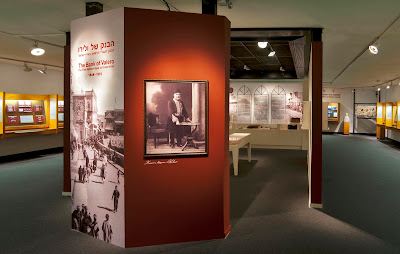
Exhibition : The Bank of Valero - The First Hebrew Bank in Eretz Israel 1848-1915

The Eretz Israel Museum, located near Tel Aviv, focuses on the history and culture of Israel. Artifacts, from the 4th millennium BCE to the present, are showcased in several thematic pavilions. One of these, the Kadman Numismatic Pavilion, features coins, bank notes, etcetera. The Alexander Pavilion of Postal History and Philately tells us the postal history of Israel from the mid-19th century until the founding of the state in 1948 by showing us envelopes, letters, rare stamps and much more. The museum also includes a planetarium.


Valero Bank exhibition in Israel Palestine , photo by Leonid Padrul-Kwitkowski
The Valero Bank exhibition
Curator: Cecilia Meir
image source: Eretz Israel Museum

photographer: Leonid Padrul-Kwitkowski
double-click image to enlarge

The museum has prolonged its temporary exhibition The Valero Bank until December 31, 2014. The exhibition deals with the activities from the bank that took place in Jerusalem in the 19th and early 20th century. In this period Palestine was under Ottoman rule, a situation that lasted until World War I.

Ya'akov (Jakob) Valero (1813–1874) opened his bank, Jacob Valero & Company, in 1848. Under the direction of his son Haim Aharon Valero (1845–1923) the Valero Bank acted as catalyst in the early development of the Eretz Israel/Palestine region and supported its Jewish community towards the modernization of the 20th century. The bank’s capital and services were employed in the acquisition of land and building. At a certain point in time, when money for trade was scarce, the bank issued also its own currency : notes that came in one and five piastre denominations.

The Valero bank provided services for the Ottoman government and was often asked to support the government by providing loans or by purchasing government bond issues. The bank carried out financial transactions with numerous banks in Palestine and throughout the world, among them banks that belonged to the Rothschild family, but also with other governments such as the Russian Empire and the Austro-Hungarian Empire.

Rothschild check Jerusalem Valero bank in Austro-Hungarian krone
Valero Bank check for 227.81 Austro-Hungarian crowns
made out by S.M. Rothschild to Assad C. Kayat
signed by Aharon Valero and issued February 12 1903, Jerusalem

image source: Eretz Israel Museum
double-click image to enlarge

Jewish pre-WWI banking history is an unusual subject in scripophily. Even with only a very few certificates on display, the engaging story of the Valero Bank makes the exhibition worthy of a visit. 

Thursday, April 11, 2013

Book : Edouard Empain

Edouard Empain, Belgian captain of industry, is known for building the Paris Métro and the district of Heliopolis in Cairo. In this book, author Jacques Simar brings us the story of Baron Empain and an overview of the industrial empire that Empain built up all over the world.

cover of the book Edouard Empain - de l'empire industriel .. aux titres de collection

double-click to enlarge image

from left to right:

Ateliers de Constructions Electriques de Charleroi
The Cairo Electric Railways and Heliopolis Oases Company
Chemins de Fer du Congo Supérieur aux Grands Lacs Africains
Compagnie de Chemin de Fer Métropolitain de Paris

background:

Edouard Empain ( 1852 - 1929 )

  • Title : Edouard Empain, Esprit Fécond, Entrepreneur Conquérant, English : Edouard Empain, a first rank entrepreneur from Belgium
  • Author : Jacques Simar
  • ID : no ISBN number, published by The Scripophily Center, 2013, see here
  • Languages : French, but a good summary in English and Dutch is provided
  • Number of pages : 107
  • Images : about 100 color images

Chapters
  1. Premières années et premiers défis 1852 - 1881  (English: first years and first challenges)
  2. Développement de l' empire 1879 - 1929 (development of the business empire)
  3. Le système Empain ( the Empain system )
  4. La collection des titres Empain ( the collection of Empain scripophily )
  5. Summary in Dutch
  6. Summary in English
  7. Remerciements (Thanks)
  8. Annexes : sociétés du groupe Empain ( Appendices : companies of the Empain group )
  9. Source des illustrations ( source of illustrations )
  10. Notes
Chapter 2, being the largest one, gives us an overview of the activities and realizations of Empain's  companies in the Ottoman Empire, Chili, Syria, Netherlands, Russia, Spain, China, Belgian Congo and, of course, Belgium, France and Egypt.

The book is richly illustrated with images of shares and bonds of companies active in railways, banking, metal works, electric power, gas distribution, chemical industry, tourism and hotels, canals, real estate, shipping and mining. Several of the certificates depicted are very rare.

What else is there in the book ? Well, the work includes also : 
  • an overview diagram of the Empain family dynasty
  • several maps : routes of the Tramways du Caire, the concession of the Cairo Electric Railways and Heliopolis Oasis company, the railway network of Belgian Congo, routes of the Lung-Hai railway in northern China
  • long term stock charts of companies
  • classifications of the companies in the Empain group by country and in chronological order

A reference catalogue as well
Chapter 4 contains a reference catalogue section. Included are the stocks and bonds of the Empain companies surfaced in scripophily so far.  More than 500 securities from about 110 companies are represented  and ordered by country. Interesting, each entry contains a value indication between 1 and 5.

A book that fits in your laptop bag. Top !
Still available from the publisher, see here, at 30 Euro.

F.L.

NB : 
What is your favorite share depicted in the book ?
Mine is the 500 Francs bond from 1895 issued by the Tramways de Kischinew.

Wednesday, August 18, 2010

Reference catalogue : Ottoman Empire and Turkey, Share certificates and Bonds, 1854-1938


  • Title : Historische Wertpapiere, Band V, Ottomanisches Kaiserreich und Türkei - Aktien und Anleihen, 1854-1938
  • Authors : Drumm, Henseler, Glasemann
  • ID: without publication number, published by Freunde Historischer Wertpapiere, 1983
  • Languages : German, introductions also in English and French
  • Number of pages : 237
  • Images : black & white, on average 1 per 2 pages
  • Indexes : alphabetic, but main ordering consists of 2 sections : 1. shares (by date), 2. bonds (by date)
This catalogue includes certificates from private companies and issued by the Ottoman state.