Showing posts with label philately. Show all posts

Friday, December 13, 2019

Museums Victoria deliver engaging online experience

The Museums Victoria (MV) manages the Melbourne Museum, the Immigration Museum, Scienceworks and Melbourne's Royal Exhibition Building. Its history goes back to the founding of the National Museum of Victoria in 1854.

Today, MV is home to over 17 million historic artefacts and science objects and welcomes more than 2 million visitors per year. Its MV Collections site gives virtual visitors a fresh and adequate experience by means of modern Internet techniques.


company seal on Federal Bank of Australia share certificate from the Museums Victoria Collections

Company seal of The Federal Bank of Australia Limited, detail from the certificate below 
image attribution : Museums Victoria, https://collections.museumvictoria.com.au/items/1114702 


The many MV collections relate to geology, palaeontology, zoology, and, social, indigenous, cultural, economic and technological history. Its Trade Literature Collection contains over 60,000 business brochures, advertisements, product catalogues and the like. The Numismatics & Philately Collection comprises thousands of coins, paper money, medals, stamps and some scripophily as well.

A considerable part of its records, more than 1 million, together with 150 000 images, has been digitized and put available online on the Museums Victoria Collections site. Here's is one of the listed share certificates, indicated as item 1114702.


Federal Bank of Australia share certificate from the Museums Victoria Collections

This share certificate in The Federal Bank of Australia Limited , printed by Sands & McDougall, Melbourne, was issued in 1887. Established in 1881 this bank started to issue its own banknotes in Melbourne, Sydney and Adelaide. A speculative boom in Australian real estate led to the Australian banking crisis of 1893 and the bank was forced to close down.
image attribution : Museums Victoria, https://collections.museumvictoria.com.au/items/1114702


On MV's 'item 1114702' page, see THERE, you can see the image as shown here. But there is more. The page gives you a summary and a description of what you see. And, just as if you were attending a guided tour, an explanation is given on the significance of the displayed item.

The overview concludes with a list of clickable keywords letting you discover more about the related collection, collecting areas and classifications, people, places, dates, articles and images, possibly of other scripophily. Wow! It is from functionality like this where this site's added value comes from. For free, and a few mouse-clicks away.


F.L.

Related links


NB: More Australia related posts ? Check these   


Monday, May 6, 2019

Denver exhibition shows New York Stamp Taxes on Bonds

" Bonds bearing New York’s Mortgage Endorsement, Secured Debt and Tax on Investments stamps are arguably the most visually stunning items ever to bear stamps. "


Secured Debt 25¢, 75¢, $3.75 and $7.50 issued in 1916 to enable payment of the 75¢ per $100 tax rate 
courtesy Michael Mahler


Author Michael Mahler is an expert in American fiscal philately : "For a century the stunning bonds and the stamps they bore were unknown to philatelists. Only now, one hundred years later, these stamps and the bonds that bear them, have emerged as a significant subfield of fiscal philately."  

Each type of stamp discovered tells its own chapter in the fiscal history of the State of New York. With a unique exhibit of bonds bearing these stamps, Michael Mahler will participate in the 2019 George Brett Cup Competition


This $50,000 bond from the United States Steel Corporation was issued in 1901 to Andrew Carnegie. The bond is stamped with Secured Debt $100 (x2) and $50 (upper right corner). The stamps were canceled July 23, 1912, but the bond was canceled only a year later. 
courtesy Michael Mahler


The George Brett Cup competition, for best 20th century philatelic exhibit, is organized at the annual ROMPEX show in Denver May 24-26. 

The New York State Stamp Taxes on Bonds, 1910-1920 exhibit features 40 display panels of about 18x24 inch, each one having one to four bonds. Probably about 120 bonds will be on display. 


New York Stamp Taxes on Bonds, 1910-1920 
book by Michael Mahler 


Michael Mahler wrote also a book on this topic. New York Stamp Taxes on Bonds 1910-1920 counts more than 200 pages and is illustrated with hundreds of color images of bonds and stamps. 

The book can be ordered from Amazon here. But, if you know the International Bond & Share Society, you should check out the IBSS site. For Michael Mahler has provided a PDF version of his latest book there.


Good luck to Michael with the exhibit competition !

F.L.

Related links


Monday, November 19, 2018

Incorporated in Southern Rhodesia

Who knows about a country called Southern Rhodesia? The name appears on two revenue stamps that were put on top of a share in the Rhodesia Tea Estates Limited.

It was Cecil Rhodes (1853–1902), founder of the De Beers diamond mining company, who gave his name to Rhodesia, an area equal to modern Zimbabwe and Zambia. Rhodes' British South Africa Company began exploitation of the Rhodesian territory in the 1890s with the help of paramilitary forces. In 1923 the southern part became the Colony of Southern Rhodesia, now Zimbabwe. The northern part became in the following year the Protectorate of Northern Rhodesia, Zambia today.


Southern Rhodesia revenue stamps with the colony's coat of arms (detail from the share below) 
The shield of Southern Rhodesia features a lion and two thistles, taken from the family arms of Cecil Rhodes who gave his name to Rhodesia. Click the image to enlarge it, the Rhodes' lion is located above the mining pick, somewhat hidden under the ink stamp. 


It was in 1924 that tea was first planted commercially in the country. At that time Arthur Ward and Grafton Philips decided to start a tea plantation in the Chipinge district of Zimbabwe's Eastern Highlands. Mrs Florence Philips had brought tea seeds from Assam. None of them had an idea how much rain fell in the area. Meteorological records were unexisting. 

The next year it became clear that the rainfall was much below the required 1270 mm per year. Ward and Phillips decided to experiment with irrigating their plantation with water from the Tanganda River which flowed through their estate. The experiment was successful and marked the beginning of Tanganda tea production. Ward and Phillips (Pty) Ltd was established in 1930 and cultivated 3.5 hectares of tea. The Meikles family, owners of the Meikles Hotel in Harare, also got involved with the business which expanded into the Rhodesia Tea Estates Limited.


The Rhodesia Tea Estates Limited with registered office in Umtali (Mutare), is known today as the Tanganda Tea Company, a subsidiary of Meikles Ltd


In 1953 Great Britain united Northern and Southern Rhodesia with Nyasaland into the Federation of Rhodesia and Nyasaland, much against the will of the people in the three territories. A few hundred thousands Europeans, mainly living in Southern Rhodesia and owning most of the land, ruled now over millions of Africans who wanted universal suffrage, land ownership and better wages. The federation lasted for 10 years. 

In 1964 Northern Rhodesia and Nyasaland became independent under the names Zambia and Malawi. Southern Rhodesia unilaterally declared independence as the state of Rhodesia in 1965. Yet, its white minority still refused to bring in majority rule. Opposing nationalist groups started a guerilla war and were supported by foreign countries. The war lasted till the end of 1979. The next year, the country became the Republic of Zimbabwe in 1980 and was governed by a black African majority.


The Rhodesia Tea Estates share was issued only a few months before the Federation of Rhodesia and Nyasaland fell apart at the end of 1963.  


The Tanganda Tea Company, formerly the Rhodesia Tea Estates Limited, established the Avontuur/Petronella tea estate in 1990. The last previous estate, Jersey and Zona, dated from 1944. The company's production has risen to about 10,000 tons of tea per year, about 50% of Zimbabwe's tea output. Major company brands include, Tanganda, Stella, Silver, Joko, Tanganda Special Blend, Tanganda Tips, Fresh Leaves, Tanganda Healthi Green, Nella Rooibos bags and Natra Fresh Rooibos. 


F.L.


Related links


Friday, December 25, 2015

Scripophily magazine 98


It's only a matter of one or two weeks before you can expect the next issue of Scripophily magazine in the mailbox. For those who are not subscribed, here is an overview of the stories from the last August issue :
  • The Anderson Motor Company
  • $100,000 Denomination Chinese 1937 Liberty Bond print inconsistencies , about counterfeit Chinese bonds
  • Rarity Key System , a joined communication by several auction houses 
  • The bonds issued under the forced loans of Jérôme Bonaparte , a story on Westphalia Kingdom finance 
  • Rafting Scripophily , highlights early timber logging and transport companies in the US
  • Embossed British revenue stamps , did you know about the junction between British revenue stamps and stocks and bonds?
  • Charles A Stoneham & Co mining curb brokers , a story on a remarkable mining stock brokerage firm
  • Sensation at 5 centimes in 'Le Petit Journal', an updated article about this famous French newspaper company 
  • An early IBM predecessor company, about the Computing-Tabulating-Recording Co
  • China's Historic Foreign Bonds, by J M Thompson and M D Perry , book review 
  • Pictorial Stock Certificates - Lithography and Engravings for the Graphic Art Collector, by B Brown , book review 
  • Cox's Corner : We're not getting any younger , tips about specializing your collection
  • other periodical topics : society matters, news, bourse reviews, auction reviews, events calendar, member classifieds, book reviews, interviews and lots of pictures of collector friends and scripophily
Did you know about the previously rare Suez canal company
where about 50 hoard certificates recently appeared?
Read about it in Scripophily magazine Nr 98 Aug 2015
-
image from Wikipedia:
Suez Canal from 1881 Young Persons' Cyclopedia of Persons and Places


Scripophily magazine is a publication from the International Bond & Share Society.

F.L.

Related links

Monday, August 17, 2015

Digest of scripophily readings XVII


New online scripophily articles and references, August 2015


Don Mesler's blog
A retired stockbroker, investment adviser, and convertible bond trader, Don Mesler has examined innumerable stock and bond certificates. With more than 25 years of collecting experience, he has an eye for distinct themes and vignettes in US scripophily. Something you can witness on his sleekly designed Scripophile blog, see here. Don recently teamed up with Lawrence Falater (author of American Automobile Certificates) to co-author American Brewers Stock and Bond Certificates. Thank you for sharing all these beauties, Don, happy to follow along !

Annuaire Desfossés
In 1907, E. Desfossés & Fabre Frères, Paris, started publishing a yearly directory, the Annuaire Desfossés. These manuals describe local and international securities, issued by governments, municipalities and companies, and traded on the French interbank market. Information included with the entries :  nationality, date of establishment, object, registered office, duration, social capital, detail of the distribution of profits, names of directors, highest and lowest quotations, authorized amount, issue amount, nominal value, interest coupon due, and much more.

Annuaire Desfossés, excertp from the large table of contents 1907 edition
Annuaire Desfossés
Valeurs Cotées en Banque à la Bourse de Paris
excerpt from the large table of contents, 1907 edition 

From 1912 the editor included also the values ​traded ​on the official stock market. Twenty years later, in 1932, regional securities from the provincial exchanges, over-the-counter ​and a large number of colonial values were added to the directory. Following an agreement between the Société Anonyme Cote Desfossés and the Société d’Éditions Économiques et Financières (SEF), a single directory is published annually, from 1950 until 1981, under the name Desfossés-SEF. It consists of two volumes. The first includes a section on loans and information related to corporate law. The second includes records on companies. Source : Centre des Archives Économiques et Financières (CAEF) 

The first four editions of the directory have been digitized by Gallica, the digital library of the Bibliothèque Nationale de France. You can query and download the books for the years 1907, 1908, 1909 and 1910, right here . Once on the page, open up a book from the list by clicking its title. When the book opens up in your browser, you'll find a link to download (in French: Téléchargement). Accepting the usage conditions, click "Envoyer" (send) after which a PDF file is being prepared for you. The files can be easily searched for keywords in French, e.g. "Mexique" or "mine d'or".


Scripophily magazine featuring Million Dollar Bank certificate

Scripophily magazine
In addition to the online sources above, the last April 2015 No.97 issue of Scripophily magazine contains the following stories :
  • Life among the aggregators, about "auction house aggregator" companies and their online databases
  • Stocks on stamps
  • US war bonds
  • Warner Company, profile and history
  • The world's first investment trust, The Million Bank , 17th-18th century banking in Great Britain
  • Scripophily and the first American colony in Cuba
  • Trust this bank , a historic overview of US trust companies and banking
  • French annuities (18th century)
  • The railroad that run for only one day , about the Lawrenceburgh & Indianapolis Rail-Road Company
  • Mucha do about securities (Alfonse Mucha)
  • Cox's Corner : Upside-down is the new normal, reflections about abnormal pricing situations
  • other periodical topics : society matters, news, bourse reviews, auction reviews, events calendar, member classifieds, book reviews, interviews and lots of pictures of collector friends and scripophily

Scripophily magazine is a publication from the International Bond & Share Society.

F.L.
Signed the Guest book, yet ?

Thursday, July 30, 2015

Petition for preserving the right to privately collect !

Scripophily, stamps, coins, books, furniture, ceramics, phonograph records, toys, paintings, letters and many more physical objects are part of our cultural heritage. The current draft on the new German Law on the Protection of Cultural Property affects private collecting of all of these artefacts. The new law will impose some guidelines impossible to follow even for the most meticulous collector. 


So far, representatives from the collecting and trading parties, have been involved far too little in the process. Ursula Kampmann from MünzenWoche|CoinsWeekly has initiated an online petition to illustrate how many people in Germany and beyond actually support private collecting.

Though this is a German law, the country plays an important role in the current and future European law-making process. And that is why it is important for you, to sign the Petition for preserving the right to privately collect. Show the German government that foreign collectors and dealers take a great interest in the current draft bill, too. 

You can sign the petition HERE , please do it now so you will not forget it. 

After you signed it, email the message to your collector friends, and post the message on your social media accounts. Every single vote is needed to fulfill a target of 120.000 supporters within the next 33 days from now.

F.L.
Signed on 30 July 2015

Further background information


Thursday, December 5, 2013

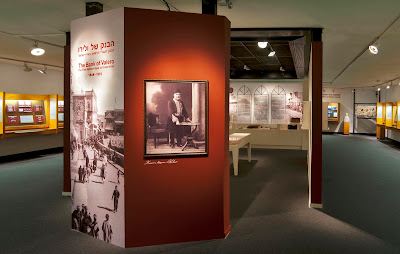
Exhibition : The Bank of Valero - The First Hebrew Bank in Eretz Israel 1848-1915

The Eretz Israel Museum, located near Tel Aviv, focuses on the history and culture of Israel. Artifacts, from the 4th millennium BCE to the present, are showcased in several thematic pavilions. One of these, the Kadman Numismatic Pavilion, features coins, bank notes, etcetera. The Alexander Pavilion of Postal History and Philately tells us the postal history of Israel from the mid-19th century until the founding of the state in 1948 by showing us envelopes, letters, rare stamps and much more. The museum also includes a planetarium.


Valero Bank exhibition in Israel Palestine , photo by Leonid Padrul-Kwitkowski
The Valero Bank exhibition
Curator: Cecilia Meir
image source: Eretz Israel Museum

photographer: Leonid Padrul-Kwitkowski
double-click image to enlarge

The museum has prolonged its temporary exhibition The Valero Bank until December 31, 2014. The exhibition deals with the activities from the bank that took place in Jerusalem in the 19th and early 20th century. In this period Palestine was under Ottoman rule, a situation that lasted until World War I.

Ya'akov (Jakob) Valero (1813–1874) opened his bank, Jacob Valero & Company, in 1848. Under the direction of his son Haim Aharon Valero (1845–1923) the Valero Bank acted as catalyst in the early development of the Eretz Israel/Palestine region and supported its Jewish community towards the modernization of the 20th century. The bank’s capital and services were employed in the acquisition of land and building. At a certain point in time, when money for trade was scarce, the bank issued also its own currency : notes that came in one and five piastre denominations.

The Valero bank provided services for the Ottoman government and was often asked to support the government by providing loans or by purchasing government bond issues. The bank carried out financial transactions with numerous banks in Palestine and throughout the world, among them banks that belonged to the Rothschild family, but also with other governments such as the Russian Empire and the Austro-Hungarian Empire.

Rothschild check Jerusalem Valero bank in Austro-Hungarian krone
Valero Bank check for 227.81 Austro-Hungarian crowns
made out by S.M. Rothschild to Assad C. Kayat
signed by Aharon Valero and issued February 12 1903, Jerusalem

image source: Eretz Israel Museum
double-click image to enlarge

Jewish pre-WWI banking history is an unusual subject in scripophily. Even with only a very few certificates on display, the engaging story of the Valero Bank makes the exhibition worthy of a visit. 

Tuesday, January 15, 2013

Hunt down your collectible with Google Images

A picture is worth a thousand words.

In this article you will learn about an alternative and easy way to seek information about your collectible. The method is applicable to any object such as a coin, a banknote, a postage stamp, et cetera. And because scripophily is the main subject of this blog, I'll use a share certificate as an example in the procedure explained below.

Sine Laboratory Compay Limited
Share certificate, 1948, Shanghai
double-click image to enlarge

When conventional search methods yield nothing at all
Do you recognize this situation? I 'google' for a company name that appears on a share certificate and find no results. Then I retry the search with other search engines. OK. Now I initiate a search operation on my local computerfiles and hope some Excel or PDF document will show up in the results. Alas. I do not want to give up yet. Next I check out my bookcase for any reference books in which the name might appear in their indexes. As I was beginning to fear : nada, nothing, rien de knots, niente. When this happens, well .. %&$#?@!  ... there are no words for it. Stuck with a certificate I know nothing about, I end up storing it in an album and hope another attempt,  maybe next year, will yield better results. 

Google Images
Most of us already know how to use Google Images : you enter a search term and the result shows images that correspond to the term or phrase entered. However, in 2011 Google came up with a new feature. It allows you, instead of entering a search term, to upload an image. Any image, therefore also an image of your collectible. Holy smokes!

You can take out that untraceable certificate from its album, the one you put away a year ago. Scan it, or take a picture of it with your smartphone, and upload the image to Google Images. Unless your certificate is a rare piece, Google will likely find you similar images and links to corresponding webpages. It doesn't matter if the text on your share is in your familiar alphabet or not.

Saturday, December 15, 2012

Uncharted - Gopuram from India


The share certificate of the Sri Brahmavidyambal Electric Supply Corporation Limited depicts a gopuram, a temple gateway. The vignette shows that the gopuram is located at a riverside or a lake.

Who can tell me something more about this particular monument ?
Where is it located ?


gopuram depicted on share certificate from India

A gopuram is a pyramidal tower gate in Hindu temple complexes. People in Southern India and Sri Lanka started building them since the 10th century. Some of these towers reach a height up to 75 meters. The kings, who have been building these temple complexes, often installed huge water tanks to the sanctuary. So, my earlier remark about the riverside in the vignette is likely misleading. It is possible that the vignette shows such a holy water tank.

share of Sri Brahmavidyambal Electric Supply Corporation, Limited
The Sri Brahmavidyambal Electric Supply Corporation, Limited
Certificate for 3 shares of 200 Rupees
Ramachandrapuram, 1927
double-click to enlarge image

I have no further information about the gopuram except for what can be derived from the share certificate :
  • company name : The Sri Brahmavidyambal Electric Supply Corporation Limited
  • location : Ramachandrapuram
  • registered : princely state of Pudukkottai (Pudukottah)
  • issued : 26 Nov 1927
  • capital : 400000 Rupees
  • printer : Solden and Company, Madras

Near the upper right corner of the certificate you can see a revenue stamp, issued by the princely state of Pudukkottai (Pudukottah) which is located in the Indian state Tamil Nadu. It shows a portrait of a boy, who will become the last ruler of Pudukkottai.


Rajagopala Tondaiman was born in 1922. One year after this share was issued, at the age of six, he was appointed to succeed Martanda Bhairava in 1928 as the Raja of Pudukkottai. Till 1929, the latter's brother Raghunatha Pallavarayar served as regent until February 1929. Thereafter, the state was governed by a council of regency appointed by the British and this situation lasted till January 1944. Rajagopala then took over the administration. Four years later, Rajagopala acceded to the dominion of India. As a sportsman, he will serve as the president of several sports clubs, including the Tamil Nadu Cricket Association (TNCA). Surprisingly, or not, the logo of the TNCA shows a gopuram.

Image by Aravind Sivaraj
Wikipedia


F.L.

Who can tell me more about this particular monument on the certificate? Where is it located ? 
Can someone provide further information on the Sri Brahmavidyambal Electric Supply Corporation ?

Wednesday, May 16, 2012

Digest of scripophily readings III

New online scripophily articles and references, 16 May 2012

Flickr Photostream of Museum of American Finance
Images of objects and documents in the collection of the Museum of American Finance, NYC, can be found here . Several rare stocks and bonds are listed.

Commercial overprints of Great Britain
I'd like to refer to a wonderful blog, namely the blog of the COSGB, or Commercial Overprint Society of Great Britain. Commercial overprints are postage or revenue stamps that have been commercially printed with the name of the user prior to being used. " In Great Britain, Ireland, and New Zealand, these stamps were used to pay an excise tax and were applied to receipts of various sorts."  Besides the lovely images of these stamps, each blog post is dedicated to one company. Just to pick one out : here is the link to Imperial Chemical Industries (ICI). You really should have a quick look.

WWII Danzig bonds
A small article - in German - was written by Rollo Steffens on Gdansk scripophily (German: Danzig), see here .

German football league bonds
Are fan bonds a good investment? Find out for yourself in this (German) article , written by Henning Eberhardt for Spiegel Online.


Front cover of scripophily magazine Der AktienSammler April 2012
double-click to enlarge

der aktienSammler 
In addition to the articles above, the latest April 2012 No.2/12 issue of der aktiensammler magazine, contains the following stories (in German) :
  • Vereinigte Dampfschiffahrts-Gesellschaft des Thuner- & Brienzersees , or in English: United Steamship Company of Lake Thun and Brienz (shipping in Switzerland)
  • Die Firmengruppe "Rostock" Elmshorn, or in English: the "Rostock" Elmshorn corporate group  (food trade and processing in Germany)
  • John Law, two contributions on related scripophily
  • Kreditfinanzierung auf English und das erste Papiergeld in Europa, English : Credit Financing in England and the first paper money in Europe  (part 8 in a series on the evolution of money)
  • Florida Panthers Holding: Der "Rat-Trick"  (ice hockey)
  • Die Erste Russische Lokalbahngesellschaft: Kennerblick gefragt, in English : the First Russian Local Railway Company: an expert eye needed
  • Der Spekulation ist nichts zu schwör, or freely translated: No limits to speculation (about the current wave of speculation in Mexican bonds and shares)
  • other periodical topics : Auction Reviews, Collector's Portrait, Events Calendar, Classifieds

F.L.

Friday, May 4, 2012

The Pilatus Railway

Ascending a mountain with a cog railway is an exciting thing to do. Once I've taken a seat I impatiently await that first bump when the locomotive starts pulling or pushing the train upwards.  Hundreds of meters higher, I hope the trip will reach its destination safely. It is ridiculous to think the car would break from the tracks and run back at dazzling speed down the mountain. Fortunately when more awesome landscapes emerge I forget my irrational fear of heights.

Image source : Pilatus Bahnen

Pilatus Bahn
At the heart of Switzerland, the Pilatus Railway, or Pilatusbahn in German, runs from Alpnachstad, on Lake Lucerne, to a terminus near the summit of Mount Pilatus at an altitude of 2,132 m (6,995 ft). The line started operating 4 June 1889, about 125 years ago. Some details :
  • length : 4.6 km
  • vertical climbing distance: 1,629 m
  • rail gauge : 800 mm
  • downhill speed : 9km/h
  • uphill speed : 10km/h
  • maximum incline : 48%
The railway was electrified on 15 May 1937.


Share of 500 Francs in the Pilatus-Bahn-Gesellschaft from Alpnach
Pilatus-Bahn-Gesellschaft
English : Pilatus Railway company
Share of 500 Swiss Francs
Alpnach, 1888
double-click to enlarge

Saturday, May 14, 2011

Cyril Bouda's Mercury

Many old shares certificates show vignettes of concepts such as a locomotive, a coat-of-arms, an allegorical figure or a ship. These vignettes are mostly shaped in a technical, meaningless way. By all means, this bond is an exception to that rule.

Czechoslovak bond certificate designed by Cyril Bouda
3% bond of 10000 Czechoslovak Koruna
state loan of the Republic of Czechoslovakia
1936, printed by Melantrich
double-click to enlarge
Look at that Mercury !
The bond shown here, is designed by Cyril Bouda. Your attention is immediately drawn to this giant Mercury depicted along almost the full length of the certificate (35 cm). Just look at it.
This is not the usual cheerful, speeding, half-naked Mercury that we see so often on old shares. What we see here is a modern Mercury, standing, dressed like an industrial worker and carrying a sledge-hammer instead of a mythical caduceus. Bouda’s Mercury is looking preoccupied and even weary at the coat-of-arms of Czechoslavakia.

Saturday, April 23, 2011

Reference catalogue : World War II Remembered


  • Title : World War II Remembered, history in your hands - a numismatic study
  • Authors : C. Frederick Schwan, Joseph E. Boling
  • ID : ISBN 0-931960-40-1, published by BNR Press 1995
  • Languages : English
  • Number of pages : 864
  • Images : black and white, almost on every page and often more than 1 page
  • Indexes : 1. by Country/Territory, 2. by keyword

This catalogue, a heavy large format book, is astonishing, phenomenal, enlightening. It describes the numismatic objects in the broad sense issued during World War II by governmental and nongovernmental organizations : allied nations, axis nations, occupied nations, occupation governments, armies, governments-in-exile, local authorities, army camps, local companies and merchants, and even psychiatric institutions. 

Numismatic objects discussed : notes, coins, gold coinage, camp money, checks, orders, decorations and medals, loans and bonds, counterfeits, numismatic ephemera, postage stamps, lottery tickets, ...
The Country quick list contains about 150 countries or political territories.

Bonds and loans are included for the following territories : Australia, Bulgaria, Burma, Brazil, Canada, China, France, Germany, Great Britain, Hungary, India, Japan, Korea, Malaya, Mongolia, Newfoundland, New Zealand, Palestine, Poland, Straits Settlements, Taiwan, USA, USSR, Yugoslavia