Showing posts with label bridges. Show all posts

Friday, April 15, 2022

International auction & bourse weekend in Antwerp shows amazing historic securities and scripophily collections

A major player in the field of antique stock certificates, auctioneer Mario Boone scheduled his 68th scripophily auction and bourse on 30 April and 1 May 2022. On the agenda are about 1400 scripophily lots ready to go on the block. Boone managed to assemble exceptional rare and beautiful stocks and bonds from all continents. 

Part of the offerings are several thematic collections containing exceptional items. One of them is the Portuguese Railways collection consisting of 126 lots of Portuguese and Portuguese colonial railway certificates. The collection formed the basis of the 1990 published Boone-Shakespeare catalog on Spanish and Portuguese railway scripophily and it was further enlarged with new discoveries. Bidders will first have the opportunity to bid on the entire collection as a whole. Start price is set at €18,000. In case no bid is achieved, the auctioneer presents the lots one by one.


Founded in 1908 the Companhia Carris de Ferro do Porto operated the Porto tramways. This 5 shares of Rs10$00 certificate from 1909, only one known, shows a perspective of the Dom Luís I Bridge taken from Vila Nova de Gaia. Part of the Portuguese railway collection, Lot 617 (L618-L744). 


The Boone sale includes many highlights from the turbulent 18th century! That century saw the great powers waging several wars and expanding slave trading across the Atlantic but also the founding of Los Angeles, the discovery of the Rosetta Stone, the premiere of Mozart's Don Giovanni, and the invention of the steamboat and the power loom. Some of the historical items from this period are : 
  • L409 is a 2500 livres share from the Compagnie des Indes from 1770
  • From 1797, L285, a share from the Natur-Torfgräber Unternehmung zu Moosbrunn, a peat digging company in Lower Austria, is probably the oldest Austro-Hungarian share known.
  • The most mind-blowing lot in the sale, L516, is a 1777 founder share from the Iron Bridge company. Boone expects it to hammer at €18,000. 


This share in the Company for Building a Bridge across the River Severn, Ironbridge, Shropshire, England, dates from 1777. Opened in 1781, it was the first major bridge in the world to be made of cast iron. The share is signed by Abraham Darby III and John Wilkinson

Darby took over the iron-making business of his family. He became manager of the Coalbrookdale ironworks. The Darbys and other ironmasters like John Wilkinson perfected the technique of smelting iron with coke, instead of coal. This allowed them to produce cheaper and more cast iron. They started casting iron rails and wheels for railway wagons. 

John "Iron-Mad" Wilkinson invented a precision boring machine that could bore cast iron cylinders such as cannon barrels and piston cylinders used in steam engines. In 1787 he launched on the Severn an iron ship. In 1775 Wilkinson and local businessmen commissioned Abraham Darby III to build the Iron Bridge. 

Thanks to the bridge, its builders and their achievements, the area around Ironbridge is described by UNESCO as the "Birthplace of the Industrial Revolution". The monument gave its name to the town that grew around it. The Ironbridge Gorge Museum Trust runs 10 museums throughout the IronBridge Gorge World Heritage Site; they tell the story of the Industrial Revolution. 


Signatures of Abraham Darby III and John Wilkinson. 
Few people have had such a lasting impact on modern society. L516 


Another remarkable collection offered in the auction are 78 Panorama certificates. Before the advent of cinema audiences could visit a panorama or diorama attraction. Often implemented as large winding 360-degree paintings, and sometimes constructed as mobile attractions or in specialized theatres, these immersed the viewer in large topographic landscape views and historical events. The collection as a whole can be purchased, L9, starting at €8,000. In case no bid is achieved, the auctioneer presents the lots one by one, L10-87.


The Panorama collection includes attractions from Belgium, the Netherlands, Austria, France, the USA and more. This share in the French Royal London Panorama company dates from 1881. The company built its panorama in the former Saville House, Leicester Square, London, where it showed the battle of Waterloo. L65 


The printed catalog contains several indexes to help you find what you are looking for. The online versions can be searched by keywords. The largest country represented this time is the USA and, including a Confederate Bonds collection, counts over 300 lots. Many non-typical scripophily countries are represented as well such as Fiji, Pakistan, Kenya, San Marino and Uruguay.
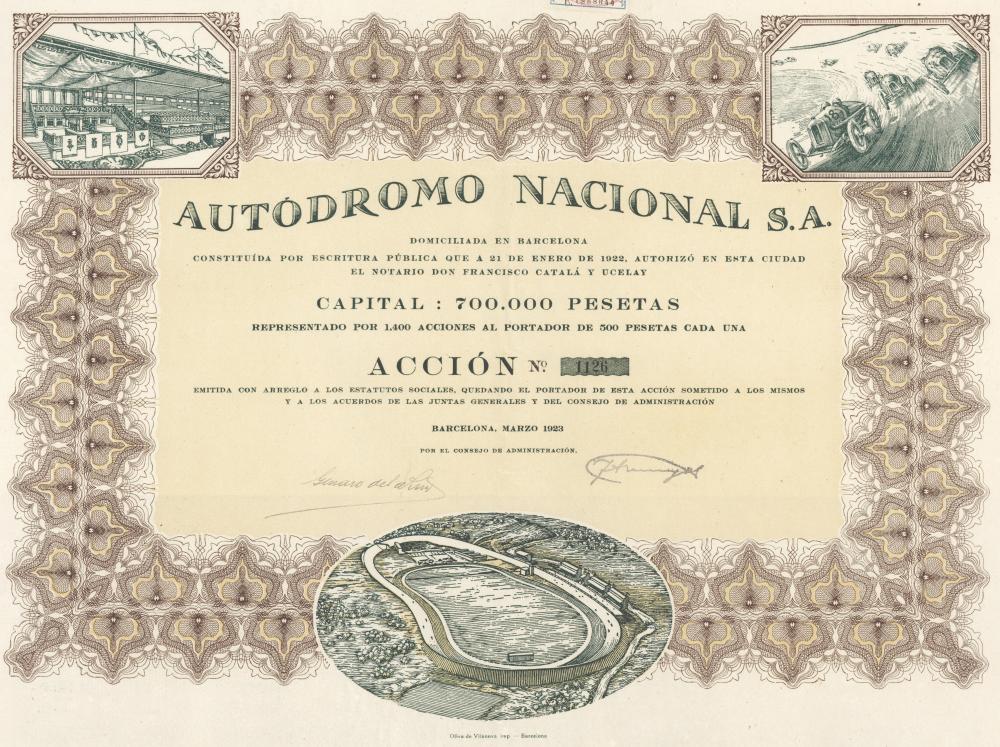


One of the lots mentioned under the "Sports" index, L927, is a 1923 share in the Autodrómo Nacional SA. Founded in 1922 the company built and operated the Terramar Autodrome, a racing circuit in Sant Pere de Ribes, Catalonia, Spain. In 1923 Alberto Divo won the first race with his Sunbeam at an average of 142 kilometers per hour. 


Even if you are not a collector the weekend of 30 April & 1 May is an opportunity to see some great antique securities. The venue is the Antwerp Crown Plaza. An airport shuttle from Brussels Airport to Antwerp (about 30 minutes) stops in front of the hotel. The public bus stops right outside the place and takes you in 10 minutes to Antwerp Central Station. 

Here are the auction details :
  • Location : Antwerp, Belgium
  • Dates
    • 30 April 2022, Boone's 68th live and internet auction
    • 1 May 2022, bourse of historic bonds and shares
  • Further info : 
    • online catalog & bidding, see here 
    • or via the Invaluable platform (large images), see there 
    • and the PDF version of the catalog can be found here 
F.L.


PS : Did you like this post ? Thank you for sharing it on you favorite social media channel !

Wednesday, October 18, 2017

Uranium from Belgian Congo and more at Boone's 59th Auction

This Saturday, Boone's upcoming sale will take place in Brussels. The auction includes over 1,300 lots of historic bonds and shares and ends with the sale of a phenomenal, you can say epic, collection of Belgian banknotes. The event concludes with an international scripophily bourse on Sunday.

The auction's scripophily section features material from almost 90 countries. Top piece is a 1777 share in the Iron Bridge Trust, regarded by UNESCO as the symbol of the Industrial Revolution. Second highlight in the auction is a 1922 specimen certificate from Union Minière du Haut-Katanga, a star item in any Belgian Congo or world mining collection.


Lot 136 in the auction : Société Union Minière du Haut-Katanga , 1922

Union Minière du Haut-Katanga (UMHK) mined copper, uranium, radium, cobalt, gold and other minerals in Belgian Congo between 1906 and 1966. By the 1930s the company had a virtual monopoly of the world uranium market. The rich uranium ore was refined in UMHK's plant at Olen, Belgium. In the 1940s the Americans purchased tonnes of uranium to be used for their atomic bomb program. During WWII the Nazis captured over 1000 tonnes of uranium stored at Olen. It was recovered by US forces at the end of the war.
click image to enlarge


Mario Boone, 59th Auction and Bourse of Historic Shares and Bonds
Depicted is lot 525, Iron Bridge Trust, 1777.
According to UNESCO, the company marks the beginning of the Industrial Revolution.


A special catalogue has been printed for the sale of a unique collection of Belgian papermoney from as early as 1848 right until the introduction of the euro.


Auction details

  • Location : Brussels
  • Dates :  21 Oct  (Auction) 2017, 22 Oct  (bourse) 
  • Further info : see here 


F.L.

Sunday, May 28, 2017

Kawasaki in the year 2889

We are in the year 2889. By then, all objects in museums are virtualized. People can download a perfect but scaled copy of any thinkable museum object and have it rendered in their living room as a tangible three-dimensional image. The objects that are speaking volumes are the ones the general public like the most. And you? Well, you are an archaeologist specialized in 20th century financial artefacts.

That day you are excavating a chamber at an ancient site which seems to be an office building from the 1960s. Yes, that is funny, back then people used to assemble all day long in a dedicated building to do office work. Anyway, the chamber you are working on, contains a safe weighing about 100 pounds. Your hand-scanner tells you there are documents inside the safe. With your tools, you manage to open it in no time. Wow, the parcel inside contains a set of old stock certificates. In the 20th century, people printed shares on paper for representing ownership in companies. Most of these certificates perished. One of the shares stands out from the others. It is speaking volumes.


With a PhD in Ancient Oriental Languages and Cultures, you translate the long line of characters on top. It is ancient Japanese, and you need to read it in the old way : from right to left. 


'Kabushiki Kaisya', 株式會社 are the first words and mean stock/limited company. A common term on Japanese certificates. You mouth the following word much slower : 'Kawa', , and 'saki', 崎, 'together Kawasaki', 川崎. Aha, that's interesting, halfway now. 
Already from the start you identified the last two symbols, 'Kabuken',  株券, 'share certificate'. Then you speak loudly, 'Zōsen', 造船, 'shipbuilding .. Tokoro, place', 所. 'Wait a minute, together they form Zōsensho, shipyard !',  造船所. You have figured it out : 'Kabushiki Kaisya Kawasaki Zōsensho Kabuken! I found a share in the Kawasaki Shipyard Co. Ltd '. With your hand-scanner you look up the flag printed on the share. Yep, that is the one.


Six months later, a new exhibition of the objects unearthed by you is launched at the Central Museum. The Kawasaki share is one of the highlights. As one of the museum's educators, you are leading a school group around the show. Of course, you spend time on the Kawasaki and explain all about the way business initiatives and innovations were financed 900 years ago. Some of the kids are babbling on anything but the tour, others look a bit bored. One of the kids raises its arm. 'Yes ?'. The group now turns quiet and looks at you first, then at the kid who says, 'If this piece of paper was meant to finance a business, what type of business would that have been?' The other kids are speechless and are now all staring at you.


Happy with the question and all the attention you have, you clarify 'Well, that could be anything you can think of, but in this case, you can see from the vignettes, the little pictures on the certificate, what this company was all about.' Now, for the first time, all the kids turn to the display case and inspect the Kawasaki share. 'They made ships !', shouts one of them and they all look at you again. 'That is correct ! The Kawasaki Shipyard Company was founded in 1896 and already one year later the company completed the Ivomaru, its first ship. If you look carefully, you can see a drawing of the shipyard behind the lettering. At Kawasaki they were very inventive. In 1906 they completed their first submarine. They even made battlecruisers like the Haruna, which was a warship of the Imperial Japanese Navy during World War I and II !'.

After reducing contrast, the underprint of the Kawasaki share reveals 
an image of a dockyard with ships under construction.
click to enlarge image

'And they also made cars .. and airplanes .. and locomotives !', they tell each other and leave their finger prints all over the display case. The kid that posed the first question, raises its arm again. 'Yes?', you wonder amused, 'What's your name ?'. The whole group answers instead, 'Sidney!'. 'Yes, Sidney, what is it ?'  Again, the group turns quiet and Sidney continues, 'These large vertical signs, they look like a cartouche. Is this from a Pharaoh ?' To everyone's reassurance you can not suppress a smile. 'Sidney, that's is actually a good question. A cartouche, an oval with a horizontal line at one end, encloses a royal name and was used in Ancient Egypt.' The boys and girls look disappointed but turn their heads to the share certificate again when you proceed, 'But, as is the case with this Kawasaki share, a signature of a high official or very important person was often printed in such a vertical way.'

printed signature of Matsukata Kōjirō, president of Kawasaki Shipyard company
'Do you see these five large vertically written characters over here?', and with your light pen you point out the position on the share. 'The first two stand for Matsukata.' , 松方. Some children try to mumble the word. 'The last three are Kōjirō.', 幸次郎 . 'So from top to bottom you read Matsukata Kōjirō.', 松方幸次郎. 'Now repeat all together !' They all chant Matsukato Kōjirō in unison. 

'Matsukata Kōjirō was born in 1865, that's more than a 1,000 years ago, and he was the son of the Prime Minister of Japan. Kōjirō became president of the Kawasaki Shipyard Company in 1896.' 

'Was he rich ?', someone asks. 'Oh yes, his business was very successful for some time. Kōjirō also wanted to give something in return to the people in his country. With the fortune he accumulated, he bought lots of Western European and Japanese art and wanted to build an art museum. Unfortunately he died in 1950 before he could realize his dream. But soon large parts of his collection found a home in Japan's National Museum of Western Art in Ueno and the Tokyo National Museum.'

'I have another question', adds Sidney, 'My dad rides a Kawasaki motorbike, why don't we see a motorbike on the share ?'  Some kids nod, they obviously know Sidney's father. 'Great question Sidney.' The group is proud to have Sidney on board. 'You see, this share was issued in 1921', and you point out the date 大正拾年 on the Kawasaki share. 'In Japan, years were then expressed as the number of years in the reign of the emperor starting with 1. 大正 represents Emperor Taishō, 拾 stands for 10 and 年 is the word for year. Taishō's first year of reign is 1912. So the date we see here is 1912 + 10 -1 which results in 1921. Now, that was easy, isn't it ?'. Everyone in the group tries to convince one another that it was easy. So you continue, 'Kawasaki started producing motorcycles more than 30 years later; therefore we see no motorbike on the share. The first motorbikes were produced by Kawasaki's Aircraft Division. That's why the emblem's on their fuel tanks looked like the Kawasaki flag within a wing.'

Later at home, Sidney tells mom and dad about the museum visit. The child activates the home visualizer and downloads a virtual replica of the Kawasaki share. It rotates slowly in the air when Sidney walks around it. 'Omigosh!'  The floor lamp shines through the image and a large watermark becomes visible.


Reading from right to left the watermark of the Kawasaki share says 
壹拾  株券 : 1x10  share certificates
株式 會社 : Kabushiki Kaisya  = Co., Ltd.
川崎 造船所 Kawasaki Shipyard
In 1969 the Kawasaki Shipyard company merges with its earlier spin-offs, 
Kawasaki Rolling Stock Manufacturing and Kawasaki Aircraft, 
into Kawasaki Heavy Industries.


F.L.

Related links


The Tokyo Motor Show 2013 featured the Kawasaki J Concept motorbike.
Image by Morio [CC BY-SA 3.0], via Wikimedia Commons


Tuesday, January 24, 2017

Archives International Auctions - US Feb 2017

Spread over two days, AIA's 38th Sale features banknotes, bond and share certificates, coins, security printing and related ephemera. Over 500 lots of worldwide scripophily are included in particular from China and US railway companies. For instance, lot 327 is a specimen bond from the New York Connecting Railroad Company.


This New York Connecting Railroad Company bond shows Hell Gate Bridge.
In 1942 Nazi Operation Pastorius landed secret agents on American soil. Their aim was to destroy the Hell Gate bridge and other strategic targets. The operation failed. 

In 1892, the Pennsylvania Railroad (PRR), together with the New York, New Haven and Hartford Railroad, founded the New York Connecting Railroad Company (NYCRR). The latter company wanted a rail link between Astoria in Queens and Randalls and Wards Islands in Manhattan. A bridge over Hell Gate, a narrow strait of the East River, was needed to complete that section.

The PRR turned to civil engineer Gustav Lindenthal (1850-1935) and asked him to design the bridge for the NYCRR. Lindenthal was a pioneer in bridge construction. He designed lighter and cheaper bridges that did not need to support the full load of a train. Lindenthal accepted the assignment. Construction of the Hell Gate Bridge started in 1912. When the bridge was completed in 1916 it was the world's longest steel arch bridge (1,017 feet 6 inches, 310.1 meters) and included four railroad tracks. NYCRR's entire track was officially opened on Jan 17, 1918. 


The 1913 4.5% 1st Mortgage Gold Coupon bond specimen, lot 327 in the auction, is a new entry for the Coxrail database of US railway securities (cat. NEW-570 B-66). It differs in the following aspects: $1000 denomination, new color, but also the vertical format (click image to enlarge). 
The vignette is curious. When the bonds were issued 1913, the Hell Gate bridge was not built yet. Amazing how well the bridge on the bond resembles the resulting bridge that was to be finished three years later. 


Archives International Sale 38
Chinese, Asian, U.S. & Worldwide Banknotes, Scripophily & Coins

Auction details
  • Date : Feb 7 & 8, 2017
  • Place : Fort Lee, NJ 
  • Further info : see here, catalogue see there 


F.L.


Sunday, October 25, 2015

La Belle France under the hammer


Lot 400 Compagnie Générale des Services Publics de Paris et la France
This 1906 founder's share shows the map of France in the underprint 
surrounded by not less than 10 coats of arms of French cities : Paris, Marseille, 
Toulouse, Bordeaux, Rouen, Nice, Nantes, Lyon, Lille and St. Étienne.
double-click image to enlarge


Next Friday and Saturday, Mario Boone's 55th international auction of antique stocks & bonds will take place in the heart of Brussels (Hotel NH Carrefour de l'Europe). I've announced this event in my previous post. This time, I want to bring to your attention a special collection to be auctioned during the happening.

Lot 368 : Société de Constructions de Levallois-Perret
Certificat nominatif d'actions de 100 Francs, issued 1939
Formed Paris, 1893, as successors to Compagnie des Etablissements Eiffel
Rarity indication R10 (3-5 pieces known)

Société de Constructions de Levallois-Perret
detail from the certificate above
1866 Gustave Eiffel set up his own engineering office
 at 48 Rue Fouquet in Levallois-Perret. The street
was later renamed into Rue Gustave Eiffel.

France, a Walhalla in scripohily
There is no other nation that has left us so many decorative bond and share certificates like France. For many years, I've been studying auction guides, and I don't think that other countries count more artists, engravers or lithographers. I started to believe I had a good idea of what French scripophily could offer. Boy, am I wrong ! Splendour .. amazement .. rarity .. significance .. these are words that instantly crossed my mind when flipping through this collection's catalogue.

1899 share certificate of the Société de l'Ascenseur de la Terrasse de Saint-Germain-en-Laye
Lot 360 : Société de l'Ascenseur de la Terrasse de Saint-Germain-en-Laye
Share of 100 francs, 1899, Paris

Société de l'Ascenseur de la Terrasse de Saint-Germain-en-Laye
detail from the certificate above
design by Ch. Lapierre and engraving by A. Napier
printed by Imprimerie G. Richard
La Belle France
In this special auction 500 French stocks and bonds will be sold separately. The collection was brought together over a period of 25 years by an European collector, wishing to stay anonymous. Auctioneer Mario Boone says : “In my view, the greatest joy that comes with being an auctioneer is the privilege that one gets to see, catalogue and research truly superb collections such as this one. Despite being a leading auctioneer of French scripophily since many years, I have never before come across so many rarities and novelties as in this collection. That we can auction this collection, which has been built and treasured for decades, is deeply honouring.”

Lot 291 : Revillon Frères
500 francs share, Paris 1908
The company had fur shops in Paris, London, New York,
Moscow, Montreal and elsewhere
Only two pieces known according to the auctioneer

Revillon Frères
detail from the certificate above
grandiose design by A. Antigue
printed by Imp. Lahure

À chacun son goût
The collection covers three centuries, all major industries and themes and is also geographically most interesting. It includes not only, as mostly seen, Paris-issued shares, but also many pieces from other French cities and departments. Besides French colonial shares, the auction contains sections with French companies operating in Australasia, Asia, Africa, Europe, Latin and North America including California Gold Rush certificates. 

Lot 171 : Société Anonyme pour l'Amélioration, l'Education et
la Vente des Chevaux de Luxe de Race Française

Action de 1000 Frances à un quatre centième, 1837

Société Anonyme pour l'Amélioration, l'Education et la Vente 
des Chevaux de Luxe de Race Française
detail from the certificate above
Design and lithography by Ferdinand Séré
Printed by C. Adrien from Paris

Practical info 

  • Auction date: 30 October & 1 November 2015 
  • Place: Brussels, Belgium
  • Further info, see here  


Lot 82 : Entreprise de Déchargement des Ports de Paris
100 Francs share, 1924, Paris
printed by Imp. Spéciale pour Titres

100 Words to improve your French scripophily skills
If you start collecting stocks and bonds from France, you need to learn a bit of French. Many words can easily be understood because they are written similarly to the corresponding word in English. Some examples : automobiles, fruits coloniaux (colonial fruit), banque (bank), compagnie (company), edit (edict), funiculaire (funicular) and navigation.
However, other expressions are less obvious to derive. Here is a list of 100 French terms that you will observe sooner or later on those nice papers. You will also find out that the French language often provides words that are pleasant to pronounce, e.g. tuilerie and messagerie fluviale

F.L.

Lot 361 : Société Pyrénéenne d'Entreprises
500 Francs share, 1919, Paris
The company was founded in 1919 to make dams,
hydroelectric facilities and bridges in the Pyrenees.
printed by Union des Arts Graphiques


Thursday, July 14, 2011

Reference catalogue : Swedish Share Certificates Before 1850

  • Title : Svenska Aktiebrev Före 1850 - Swedish Share Certificates Before 1850 - Schwedische Aktien Vor 1850
  • Authors : Birger Strandberg, Björn Franzén
  • ID: ISBN 91-630-0421-6, published by AB Aktiesamlaren BJB, 1991
  • Languages : Swedish, English, German
  • Number of pages : 220
  • Images : mostly in black and white, a few in color, almost on every 2 pages
  • Indexes : index by date of issue on page 14
This catalogue gives an overview of Swedish share certificates issued before 1850 :
  • 16 shares dated between 1728 and 1799
  • 80 shares dated between 1800 and 1850
Many companies listed were active in the field of mining, canals, bridges, banking, shipping, shipyards, early trading companies, health resorts, sports and recreation and many more. Less usual themes included : a billiard club, swimming and horse riding schools, and even a 'share in a stallion' is present.  Many rarities.
F.L.

Sunday, August 29, 2010

Seal stories

When examining a new certificate I always look for the presence of a seal. I hope a remarkable scenery will be present on it. Some of these seals are so striking that they can not possibly be overlooked at. Others, the embossed ones, are hardly noticeable but can just be as surprising as well.
(tip: double-click the images for more details)

Gold paper seal, embossed after being attached to the document
Texas Short Line Railway Company, 1902

In the Middle Ages, seals were made on bee wax. They were used for guaranteeing authenticity of documents and for sealing closed documents. On shares and bonds, seals are also used for authentication. More, the presence of a beautifull gold paper seal, serving as a quality label, helped issuers to attract potential buyers. Seals were also meant to make it more difficult to counterfeit a certificate. Sometimes, they were also used as proof that obligatory taxes were paid.
Seals on certificates can show the name of the issuer, a pictorial emblem representing the issuer such as a coat of arms, an incorporation date, or a picture of the kind of activity that was involved.
Seal integrated in the print design
RCA Corporation (specimen) 1977