Showing posts with label Egypt. Show all posts

Tuesday, December 23, 2025

Cruising the Nile in the winter

At the age 17, mystery novel author Agatha Christie spent the winter of 1907–1908 with her mother in Egypt. They stayed for three months at the Gezirah Palace hotel in Cairo, participated in social events and visited some of Egypts ancient monuments. 

Christie would visit Egypt again later, and write several Egypt-set novels, including Death on the Nile featuring detective Hercule Poirot.


The Nile Express Steamers Co. 
5 founder shares, Cairo, 1906  
Printed in Cairo by Baader & Gross 

The Express Nile Steamers Company (ENSCo) was organized in April 1906 with a capital of 30000 Egyptian pounds. The company offered Nile cruises to rich Westerners, and Britons in particular. ENSCo's trip from Cairo to Luxor took 7 days, back in 4.5 days. And within a year the route was extended from Luxor to Aswan taking another two days.


ENSCo's first ship was launched at Giza on 14 Nov 1906. Miss Bassie Ems, the daughter of the company's director general, baptised the 'America' graciously. The triple decked vessel with cabins for 54 first-class passengers featured saloons for dining and smoking. Passengers enjoyed the Nile views behind glass windows that shielded them from wind and cold. 

In 1908 Baedeker publishes its Egypt and The Sudan, Handbook for Travellers. The book includes tips for traveling aboard a Nile steamer: 

"Passengers by steamer should beware of the risk of catching cold by leaving the windows of their cabin open ; and it is well to remember (e.g. when shaving) that the steamers sometimes run aground, especially above Luxor. Liability to delay through this last fact makes it impossible to be sure of reaching Cairo in time to make connection with the ocean-steamers."
Exciting times, if you ask me! I wonder whether Agatha Christie got bored on her three-month stay. I would have gone on a cruise. Did she? Well, that's a question that only Mr Hercule Poirot could solve. 

Merry Christmas!

F.L.

References

  • Launch of the America, Egyptian Gazette (1906-11-15) 
  • Egypt and the Sûdân; handbook for travellers, 1914, Karl Baedeker 

  • Previous posts


    Sunday, April 28, 2024

    The Case of the Missing Farmers – Egyptologist traces back Crédit Agricole d’Égypte vignettes

    The share of the Crédit Agricole d’Égypte is one of the most decorative securities from Egypt. It is adorned with oriental and pharaonic elements. In the underprint you recognize lotus flowers, a temple and the harbour of Alexandria. The lower border shows a pharaoh with two agricultural drawings showing what seems like ancient Egyptian texts. 

    It turns out that the certificate’s design has a connection with a lost temple from ancient times and with Germany’s Berlin from the 1850s as well. 


    Crédit Agricole d'Égypte
    5 shares of 4 Egyptian pounds, issued in Cairo, 1934 
    click image to enlarge  


    The Crédit Agricole d'Égypte (CAE) was established in 1931 with registered office in Cairo. Half of the capital of 1 million Egyptian pounds was subscribed by the government. The bank applied low interest rates to small cultivators and agricultural cooperative societies. By 1940 the bank ran over 100 branches all over Egypt. CAE changed its name in 1948 to the Agricultural and Cooperative Credit Bank. The bilingual 5-shares bearer certificate shown here, was issued in 1934.

    We know of several bonds and shares that are illustrated with hieroglyphic-like texts and pharaonic elements. Scripophily from Egypt is therefore one of my favorite themes.  


    On top of the CAE certificate we see the goddess Nekhbet, depicted as a vulture. She protects the symbol of the Kingdom of Egypt (1922-1953): three stars and a crescent moon. 


    Some certificates have genuine Ancient Egyptian words in their design. A Belgian Egyptologist helped me to translate these texts on a number of certificates. You can read more about that in my blog article Hieroglyphs in scripophily deciphered!, Aug, 2018, and as well as in Scripophily magazine, No.111, Dec 2019. 

    However, the texts on the CAE share seemed incomplete and were drawn too crudely. They could not be translated correctly. And there ended the story for that certificate … at least I thought so. 


    '5 shares' in Arabic 


    Four years went by and then I got an email from Sandra Ottens in Sep, 2023. What a surprise when she wrote me that she had solved the puzzle of this CAE share. 

    Ottens obtained a MA at University Leiden with a speciality in Egyptology.  She wrote that she had read in 2019 about ‘scripophily’ on the Facebook page of the Leuven-based ‘Pyramids & Progress’ project (1). The post referred my blog article from 2018. 
    (1) The Pyramids & Progress project was a research project on Belgian expansionism and the making of Egyptology. See here  

    Intrigued by the unidentified texts on the CAE share, Ottens started researching the images because these looked familiar to her. During her study of ancient tombs with the Leiden Mastaba Study Group she had seen a lot of similar texts and images. She consulted several sources but without any results and eventually put that puzzle aside for several years.


    Last summer Ottens resumed her research on the CAE certificate. On her own blog Egyptoblogie, see here, you can read about the many steps she undertook. She found the solution in a book from Karl Richard Lepsius.

    Lepsius was an Egyptologist from the 19th century. In 1842, he was commissioned by King Frederich Wilhelm IV of Prussia to lead an archeological expedition to Egypt and the Sudan. With his team he documented as much as possible the ancient places. After his return Lepsius became professor of Egyptology at Berlin University in 1846. 


    Karl Richard Lepsius (1810-1884)
    image: Ernst Milster, Public domain, via Wikimedia Commons 


    Lepsius compiled his 12 volume compendium Denkmäler aus Aegypten und Aethiopien (Monuments from Egypt and Ethiopia) over a time span of 10 years. These works describe plates of ancient Egyptian inscriptions, monuments, maps, temple drawings, tomb walls and landscapes.

    On her quest Sandra Ottens went through Lepsius’ volumes and then came to Volume IV, Section II, page 107. That page contained an image of a tomb relief that referred to ‘Grab 2 in Sauiet el Meitin’. The tomb was located in Zawyet Sultan in Middle Egypt. The tomb owner was identified as Khunes who probably lived during the reign of pharaoh Teti (early 6th dynasty, around 2300 BC). 


    Karl Richard Lepsius’ Denkmäler aus Aegypten und Aethiopien, Volume IV, Section II, page 107, features the scenes from the CAE share certificate. 


    On that page Ottens recognized the reaping scene from the lower left border of our certificate. On the original tomb relief it is part of the scene in which several men are harvesting grain with sickles (lowest line of inscriptions at right in the image above). 

    She explains: “The much more clearly drawn hieroglyphs can be translated as ‘Harvesting of grain by the servants of the king’ (Azx it in Hmw nswt)”. 


    The reaping scene 


    And Ottens locates also the ploughing scene on the same relief drawing (upper line of inscriptions at right on the page from Lepsius' book).

    She clarifies: “The ploughing scene shows two men driving an ox-drawn plough across a field. The text reads: ‘Revitalising (the land) with a plough’ (skA m hb) and ‘press your hand down’ (wAH a=k) (2). ” 
    (2) Sandra Ottens: The ‘=’ is a grammatical addition in the transliteration to link the suffix ‘k’, represented by the small basket, meaning ‘your(s)’, with the ‘a’, meaning ‘hand or arm’, represented by the arm. The sentence is apparently an encouragement for the depicted farmer to press the plough firmly down to make furrows in the ground.


    The ploughing scene 


    And as if she can read my restless scripophily mind, she adds that the tomb with the scenes does not exist anymore. What a scripophily attraction wouldn't that have been? In 2020 the Zawyet Sultan mission confirmed that the tomb was largely destroyed by limestone quarrying several years after Lepsius visited the place.  

    Puzzle solved! What a journey in history. If you think about it, it is amazing how much time jumps were made to tell this story:
    • ca 2300 BC: During Teti’s reign, in Zawyet Sultan (Middle Egypt), the tomb of an Egyptian official named Khunes is embellished with relief drawings and texts.
    • 1840s: Prussian Egyptologist Lepsius visits the tomb and documents the tomb reliefs.
    • 1850s: Lepsius publishes his Denkmäler aus Aegypten und Aethiopien.
    • ca 1930: A so far unknown artist designs the CAE share and gets inspiration most certainly from Lepsius’ Denkmäler aus Aegypten und Aethiopien
    • 2019: A blogpost featuring the CAE certificate with ancient Egyptian texts catches the attention of Dutch Egyptologist Sandra Ottens.
    • 2023: Ottens solves the puzzle in 2023 by researching the works of Lepsius.


    Egyptologist Sandra Ottens 


    My sincere thanks to Sandra Ottens for sharing her exciting piece of research. You can read her findings on her original blogpost here:  Sandra Ottens original blogpost The Case of the Missing Farmers .
     
    F.L.

    I wrote this article for Scripophily magazine No 123-January 2024, a publication by IBSS.

    Thursday, October 27, 2022

    Boone's 69th auction spans now 2 days. Among the stars are Ferdinand de Lesseps Suez Canal certificates and a 16th century loan from Antwerp.

    Mario Boone scheduled its next sale of antique stocks and bonds for 5 and 6 November 2022. That's right, the auctioneer applies a new event format which starts in Antwerp with an international bourse on Saturday morning. The live auction kicks off at 2 PM in the same venue. On Sunday, the second part comprises of a internet/mailbid auction. 


    Altogether more than 1700 lots will be hammered in Boone's upcoming auction.  This is an opportunity to see many stunning certificates like this one. Noted security printer Charles Crabbé produced this 1902 share from the Paris-based Crédit National Assurances. L(ot) 353 starts at €100.

    Latin America is excellently represented. More than 300 lots fill several chapters : Latin America lot range 534-556 , The Carribbean Collection L729-861, Venezuala Collection L862-965. All of these are scheduled on Saturday, and then there is another Latin America chapter, L1518-1580, on Sunday.  

    Some of the interesting items are :
    • The Cuban Central Railways Ltd £100 debenture from 1899 shows two small vignettes and is rare, L544.
    • Lots 806 through 828 includes several Panama Canal certificates.
    • L887 shows a frontal view of a steamship on a Orinoco Steamship Company bond printed in 1902 by the International Bank Note Co. from New York.
    • The Société de Recherches de Temascaltepec (Mexique) was organized to mine for silver in Temascaltepec. L1569


    L548 in the auction is a share in the Syndicat des Placers Guyanais. The company was formed in 1913 to dig for alluvial gold and diamonds. An overseas department of France in South America, French Guiana's currency is the euro. Gold mining, often done illegally, is still one of its main industries today. Bidding starts at €200.


    Included in the sale are several certificates signed by or issued to historic figures, such as:
    • members from the Rothschild banking family, L402 through 415, 
    • Paul Kruger, President of the South African Republic, L296
    • L499 shows the signature of Robert Surcouf, the French slave trader and privateer who raided British ships
    • A Nederlandsche Handel-Maatschappij share issued to the Dutch King Willem III, L441.
    The auction catalog's Autographs index refers to many more personalities, including Ferdinand de Lesseps !


    On March 23, 2021, container ship Ever Given gets stuck in the Suez Canal and disrupted global trade for six days. The consequences were incalculable: industries were impacted with shortages, e.g. of semiconductors. The non delivering of food resulted in price rises and livestock shipments were suspended.
    The Suez Canal connects the Mediterranean Sea to the Red Sea. It was constructed by Ferdinand de Lesseps' Suez Canal company between 1859 and 1869.  
    Boone offers a set of printer proof bonds from the company's 1879/80 loan, all different and unique. One of these is corrected by Ferdinand de Lesseps himself, and personally signed by him. His handwritten signature in scripophily is of the highest rarity. The set of certificates deserves a place in any top collection highlighting France, Egypt, Canals & Transport, and even World History. Start price €10,000 .


    The 16-18th century chapter counts more than 50 lots of shares, bonds and related financial documents. Among these "prehistorics" are 
    • bonds from the Flemish cities Antwerp, Aalst and Oudenaarde (L480, L482, L484)
    • a 1759 share in the Compagnie Royale Prussienne de Bengale , L511
    • whaling and canal companies, L486 & L514
    • 18th & early 19th century French privateer companies, L489 through L499, and an American one, L533
    • a collection of 108 French lotteries issued between 1699 and 1828, L501
    • a put option certificate of the Bank of England as early as 1730, L516


    An amazing discovery is L480, an Antwerp city bond for 100 Carolus Guilders from 1558. Issued on vellum, it has a large Antwerp city seal in red wax showing 'Het Steen', the still existing 13th century castle. The bond was part of a loan granted in 1555 by Charles V, Holy Roman Emperor and King of Spain.

    At the start of the 16th century Antwerp belonged to the Habsburg Netherlands, then part of the Holy Roman Empire. The city was a major shipping base for Spanish and Portuguese merchants importing sugar and raw produce from overseas. Antwerp became the main business centre around the Atlantic. Its wealthy bankers lended money to governments in Europe.

    Between 1555 and 1556, Charles V split his empire into an Austro-German and a Spanish branch. As a result of Charles's abdications, the Habsburg Netherlands were left to his son Philip II of Spain. Thus became Antwerp part of the Spanish Netherlands. 

    During these decades war with France was never far away. Also the Catholic Church in the Spanish realm had to be defended against the upcoming Protestant Reformation. The loan was raised to finance the construction and maintenance of the fortifications of Antwerp, the so-called 'Spaanse omwalling' (Spanish ramparts). These were built on order of Charles V from 1542 onwards.
    €5000 is the start price for this top item that has witnessed a florishing but turbulent Flemish and Spanish 16th century.


    As usual the sale includes a large chapter of USA scripophily, presented in both the Saturday and Sunday sessions of the auction. 
    • There is an opportunity to buy a Southern State Bonds Collection as a single lot (L649-L728). When there is no buyer then the collection will be regrouped by state, each one then offered as one group lot. In turn, these, when not sold, will be split into single item lots. 
    • US railways are plenty. You can find an interesting review on this chapter on Coxrail News and Announcements, see here     


    The National Glass Company from Pittsburgh, Pa., was a short-lived glass trust. It owned several factories in places like Dunkirk, Ind., Cumberland, Md. and Marietta, Oh. They specialized in colored table glassware and decorated lamps. This $1000 bond from 1901, a Western Bank Note print, starts at €50. L1708


    It is impossible to address all items in this sale, but there is a way to find out more about them. Here are the auction details :
    • Dates
      • 5 November 2022, Antwerp Crowne Plaza Hotel
        • International Bourse 8h30-12h 
        • Live auction 14h-18h30
      • 6 November 2022, mailbid and online auction
    • Further info : 
      • online catalog & bidding, see here 
      • or via the Invaluable platform (large images), see there 
      • and the PDF version of the catalog can be found here 

    Even if you are not a collector 5 November 2022 is an opportunity to see some great antique securities. The venue is the Antwerp Crown Plaza. The public bus stops right outside the place and takes you in 10 minutes to Antwerp Central Station. 

    F.L.


    PS : Did you like this post ? Thank you for sharing it on you favorite social media channel !

    Saturday, August 14, 2021

    Watermarks in Scripophily - part 2 Paper manufacturers

    In Watermarks in Scripophily – part 1 I introduced you into the world of watermarks specifically on bonds and shares. This time we’ll talk about watermarks created by the paper makers themselves, perhaps the most obvious category of watermarks in scripophily. 

    The first watermarks appeared in Italy during the 13th century. They were used to identify the papermaker or the trade guild that manufactured the paper. An interesting question is whether watermarks were invented, or just a side effect in the production process?


    images 1a and 1b: When viewed against a light source, this Nira Valley Sugar Co share reveals a watermark pattern of bold vertical and faint horizontal lines. This is an example of laid paper. A detail of the pattern is shown here below. Click images to enlarge. The actual company and its share was described and illustrated in part 1 of this series, see here. 


    European paper was initially made by dipping a wooden-framed screen, a lattice of metal wires, into a tub of warm water and cellulose fibers, scooping up this pulp, and then letting the water drain out. The cellulose came from cotton linters or recycled cloth (rag), and only much later wood fibers were used too. 

    The cellulose fibers subsequently matted into a thin layer against the screen. For hundreds of years these screens had a rectangular design with widely-spaced vertical “chain” wires and closely-spaced horizontal “laid” wires tied on top of the chain wires.

    In the process the wires in the screen compress the pulp fibres and reduce their thickness. The resulting patterned portion of the paper is thinner and lets more light through than the surrounding paper. 

    The laid wires yield faint lines in the watermark. Chain wires have a greater impact and are responsible for the bolder lines. This type of paper is known as laid paper. A nice example can be seen above in images 1a and 1b.


    images 2a and 2b: The Swedish immigrant Willgodt T. Odhner invented the Arithmometer, a pinwheel calculator. Following the Russian revolution, his company moved from St. Petersburg to Göteborg, Sweden. This 1918 share’s watermark reveals a coat of arms of the paper manufacturer Lessebo, a crowned beehive with the date 1719. The words ‘Handgjord Post’ translate as ‘handmade post’. Image courtesy Wilhelm Leiter 


    Paper makers found out that they could add special designs to the watermark by sewing wire designs to the screen frame. A paper maker could now incorporate its coat of arms, a logo, or its name into the watermark. The product could now be identified and became difficult to counterfeit. An interesting example is the Original-Odhner share, see images 2a and 2b.

    Often paper makers have a remarkable history. The Original-Odhner’s share’s paper manufacturer is Lessebo Paper. The paper mill was originally an iron mill established in the 17th century. In the 1690s the mill started making heavy paper for paper cartridges used for containing a bullet and gunpowder. In 1719 the mill gained permission to manufacture paper, a date that you see in the company’s coat of arms (image 2a). Lessebo Paper still manufactures hand-made paper today.

    Over time, the production of watermarks became mechanized. During manufacture paper pulp is passed through rolls with a raised design. The designs applied on the rolls cause density variations in the produced paper. In turn, these density variations make an image or a pattern appear in the paper in the form of various shades of lightness and darkness. We speak of multi-tonal watermarks.

    A relevant example can be seen in part 1, see there, namely the Indian Post Office 5-Year Cash Certificate. That paper shows light, dark and even multi-tonal watermarks giving the viewer an impression of depth. Another fine example can be seen on a Olivetti bond, see images 3a and 3b.


    Images 3a and 3b: Ing. C. Olivetti & C. was founded in 1908 as a typewriter manufacturer and evolved into computers and smartphones. This certificate, issued 1948, has a watermark pattern, a repeating design that is applied all over the surface of the paper. Watermark patterns can be seen on many Russian railway bonds. In most cases it is not possible to detect whether patterns like these were designed by the paper manufacturer, or by commission of the certificate’s printer or issuer. The pattern on this Olivetti bond consists of diagonally placed geometrical figures. The multi-tonal shade gives you an impression of depth and the pattern appears as a structure of ‘buttons’, looking like bubble wrap plastic, something I usually cannot resist popping! 


    In the 1700s James Whatman started a paper making business in Maidstone, Kent. He experimented with the wire screen used in the process. Whatman replaced the lattice of laid and chain wires with a screen of a much finer woven mesh of wires. As a result, the paper was formed on a much more uniform surface and showed no watermark pattern of lines, unless a wire design had been sewn to the screen. This type of handmade paper is called wove paper, and its invention led to what we know as modern paper today.

    Whatman was probably the first paper company that added a year to its watermark, see image 4b. You may discover on your certificates watermarks by other paper makers incorporating a year as well. The shares in the United Commercial Bank, Calcutta, issued in the 1960s, show the T H Saunders (or parts of it) name with the year 1946. That company was founded by Thomas Harry Saunders. Famous for its diversity in watermark designs used on stamps, bills of exchange, securities, and the like, Saunders won medals at international exhibitions for his light and shade watermarks that were used to prevent frauds.


    Images. 4a and 4b: Established in the 1840s as the Auckland Hotel, Kolkata’s Great Eastern Hotel, today known as the LaLiT Great Eastern, hosted many notable persons like Nikita Khrushchev, Elizabeth II, Dave Brubeck and M K Gandhi. This 1937 share was printed on wove paper. Its watermark shows the WHATMAN name, ‘HAND MADE’ and the year ‘1916’. 


    You cannot interpret a year in a watermark as the year of paper production or as a print date. It should be seen as “paper produced not earlier than” because mills did not always update their watermarks.

    Besides their name and coat of arms, paper mills sometimes added to the watermark an indication of the paper brand and the paper quality. That made it easy for stationery businesses and printers to look up the right type of paper in their inventory. As an example, I show here an American paper, see images 5a and 5b.


    Images 5a and 5b: The Q1 Corporation was a pioneering microcomputer company. In 1972 they delivered the world’s first personal computer based on an 8-bit general purpose microprocessor, the Intel 8008. The share bears the watermark of the Strathmore Paper Co, founded in 1892, West Springfield, Massachusetts. The watermark shows the brand ‘Strathmore Script’ and its quality ‘100% Cotton Fibre’. Cotton fibres are strong yet soft and create a uniform paper surface that is strong and flexible. 100% cotton paper is often used for banknotes. 


    In some cases, paper makers add to their watermark the location where the paper was made. Some examples from Indian shares: The Rajnagar Spg. Wvg. & Manufacturing Co Ltd, preference share, 1945, was ‘MADE IN ENGLAND’ and a 100 Rupees share in The Birla Mills Ltd, 1920, reveals ‘MADE IN CANADA’.

    More of a surprise is a 100 Rs share from The Gold Mohur Mills Ltd, 1926, Bombay, telling us ‘MADE IN AUSTRIA’. Another example that illustrates the export of quality paper products is shown in images 6a and 6b.


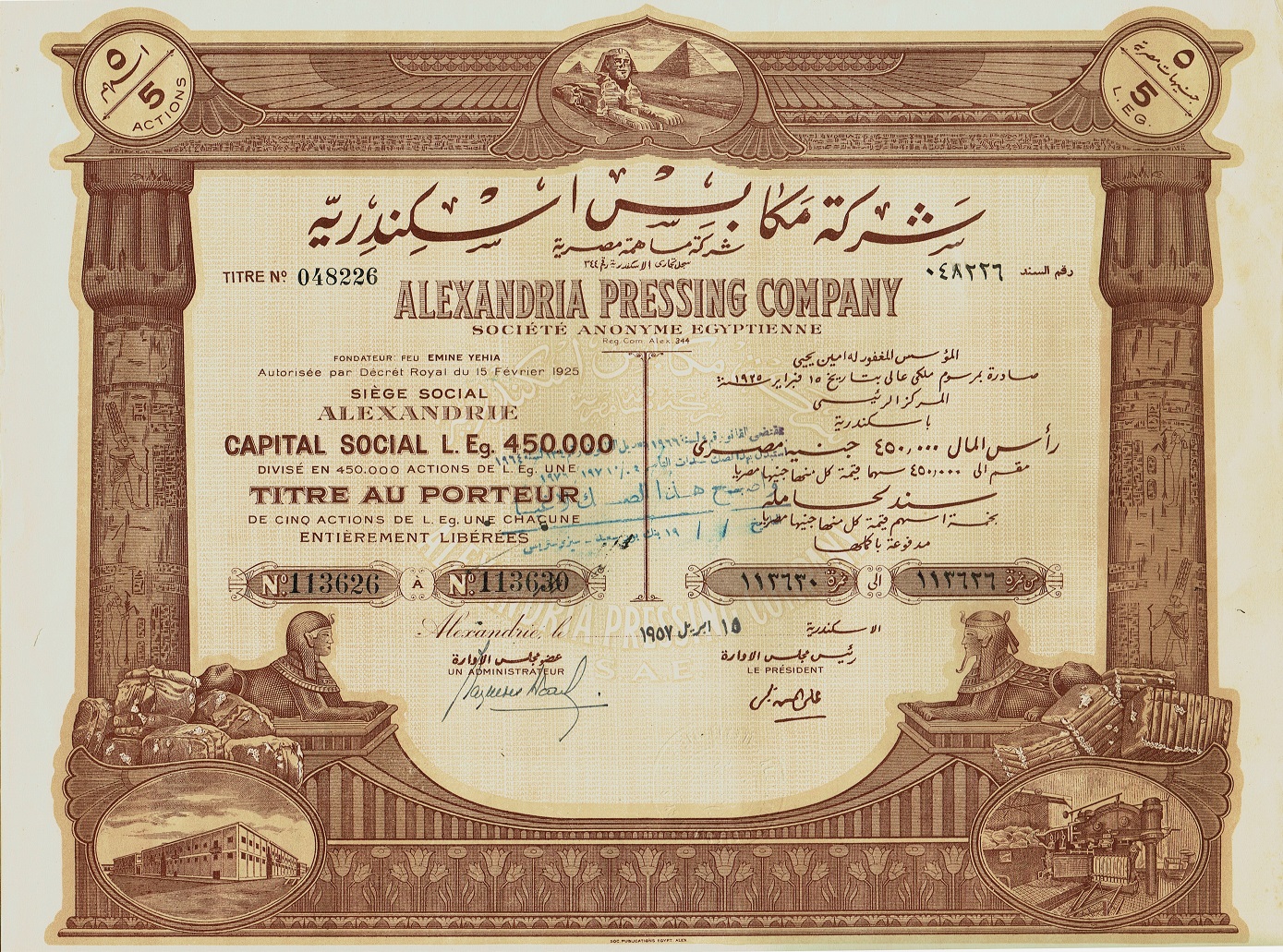
    Images 6a and 6b: From Egypt, the shares from the Alexandria Pressing Company that were issued in the 1950s have a watermark showing the name of the Norwegian company ‘BORREGAARD’, the paper type ‘TUB SIZED LEDGER’ and the location of the paper mill ‘MADE IN NORWAY’.


    I conclude this part in the series with one of my favorites: a share in The Dahramsi Morarji Chemical Co Ltd, Bombay (DMCC). Its watermark shows the line LUCKY PARCHMENT, a design of a jockey racing a horse, and the words RAG CONTAINING underneath. See images 7a and 7b below.

    Parchment paper is not to be confused with “parchment”. The latter is a writing material made from animal skin. The former is a type of cellulose-based paper (made from wood pulp and cotton fibers) which has been treated chemically to make the paper stronger, more heat resistant and above all non-sticky.

    You’ll find the words PARCHMENT also in the watermarks of shares from McLeod and Co, Ltd (1940s) and many other scripophily examples. In my example, LUCKY PARCHMENT is a parchment paper brand from the Indian paper company Ballarpur Paper and Straw Board Mills, Ltd.

    RAG CONTAINING is another line of text in the DMCC watermark. Rag paper or cotton paper is primarily made of cotton linters or from used cloth (rags). Cotton paper may last many decades without any sign of deterioration, see also images 5a and 5b before.


    Images 7a and 7b: This share in The Dahramsi Morarji Chemical Co Ltd was issued in 1968. The company's headquarters were located at Dr Dababhoy Naoroji Road in Mumbai. The certificate shows the coat of arms of the company, including a tiny map of India, and has a watermark of a racing jockey. 


    The DMCC’s remarkable jockey watermark seems unrelated but it is not. I learned from scripophily expert Sayeed Cassim (see also here) that the Ballarpur paper company was founded by Karam Chand Thapar, who headed the Thapar Group of companies. The Thapar family was involved in race horse ownership, hence the jockey.

    Time for a quick review. The first watermarks were formed, likely unexpectedly, in the production process of what we now call laid paper. Paper makers then added a logo, their coat of arms, or their name to the watermark design. Some of them further added a year, a paper type or brand, and also a location where the paper was made. If you haven’t done so already, you might start viewing your certificates against a window.

    In part 3, I’ll show that paper manufacturers start adding watermark elements on behalf of one of their important customer segments: security printers.


    F.L. 

    This article was initially published in Scripophily magazine No. 114, December 2020. 
    You might be interested to read : Watermarks in Scripophily - part 1 Introduction 


    Thursday, January 17, 2019

    Spink UK sells Branston Railway Museum gems

    SPINK's Bonds and Shares Department has put its first sale of 2019 online with a new look and functionality. The auctioneer offers over 500 antique securities including a large collection of scarce bonds and shares belonging to the Branston Railway Museum. The online auction ends at 11 AM GMT on Jan 25, 2019.


    1885 bond from the Cie Universelle du Canal Maritime de Suez

    Three 500 Francs bonds from the Compagnie Universelle du Canal Maritime de Suez make their entrance at the sale, lots 7-9. The famous Suez Canal Company was founded in 1858 by Ferdinand de Lesseps (1805-94). These bonds from 1885 have the printed signature of the wealthy Prince Auguste Louis Albéric d'Arenberg (1837-1924), then President of the company. Prince d'Arenberg's son Ernest, Lieutenant in France's 32nd Infantry Regiment, was killed on the battle fields of WWI on March 21, 1915. 


    The SPINK sale presents over 500 lots of historic and beautiful stocks and bond certificates from all continents representing more than 50 countries. Some examples :
    • L(ot) 87 Hiroshima Spinning and Weaving Co, Meiji 15 (1882), rare Japanese scripophily
    • L81 Mongolia State Loan, group lot of 7 Mongolian state bonds from the 1950s
    • L130 Portuguese Loan 5% £100 Sterling 1823, early state loan from Portugal
    • L146 Trans-Alaska-Siberian Railway Company, 1906, the company was authorized by Czar Nicholas II of Russia to build a tunnel from Alaska to Russia


    This Atlantic and Lake Superior Railway Company bond includes a beaver vignette

    Collectors of Canadian scripophily will be surprised to find a 50 lots counting section, including this £100 bond from 1895 in The Atlantic and Lake Superior Railway Company (with beaver vignette), L421.


    The British chapter consists of several sections such as canals, government, railways, etc. One of the early certificates is an amazing River Nene Navigation Join Stock from 1762 with nine wax seals and one lead seal, L312. Other interesting earlies : Itchen Bridge and Roads, 1835, arms of Southampton, wax seal, L354, and Durham County Coal Company from 1838, shield of Durham, L352.


    The North of Scotland & Orkney & Shetland Steam Navigation Company was pioneering in Norwegian cruising.

    This share in the North of Scotland and Orkney and Shetland Steam Navigation Company (NSOS) represents a milestone in shipping and tourism history. The certificate was issued in 1882 to Alexander Hall Wilson, director of Aberdeen shipbuilder Hall, Russell & Company, Limited. The NSOS introduced Norwegian cruising in 1886. It was a profitable operation from the start. To meet further demand the company ordered a new ship, the St. Sunniva. No surprise, it was built by Hall Russell. The St. Sunniva was the world's first purpose-built cruise ship and was a great success. 
    L331 in the auction.


    Several rare British government bonds are part of the offerings. L307 is a specimen 5% National War Bond 1918-1928, unseen in issued form. A great vignette of the Houses of Parliament with Big Ben adorns a specimen £50 Treasury Bond from 1925, L311.


    Blackpool and Lytham Railway share certificate with embossed seal depicting lighthouse

    This Blackpool and Lytham Railway Company share from 1861 is extremely rare. Embossed company seal with lighthouse in the lower left corner. From the Branston Railway Museum Collection, L173 in the auction.


    The auction features the scripophily collection of railways, tramways and canals, assembled by the Branston Railway Museum, L164 to L300. The private museum is being closed and its collections disposed of during the year. Some of the many noteworthy lots in this collection are : L165 Oakham Canal, L170 Belfast and Northern Counties Railway Company and L200 Fleetwood, Preston & West Riding Junction Railway Company.


    Isle of Man Tramways and Electric Power Co share certificate with triskelion coat of arms

    This Isle of Man Tramways and Electric Power Company share, issued 1900, with the island's triskelion coat of arms, is part of a group lot of four certificates, estimated at £70-£90.


    You can find more of these fascinating stocks and bonds in the SPINK online catalogue. Here are the auction details :
    • date : 25 Jan 2019, 11:00 AM
    • location : online auction
    • online catalogue and further info, see here  


    F.L.


    What is Scripophily ?, a quick introduction   

    Sunday, October 21, 2018

    Historic figures and Rumanians star in Boone's next auction of antique securities

    Boone's 61th Auction of shares and bonds features more than 1600 lots covering about all fields of scripophily interest. The sale catalogue is available online and as an offline PDF document. Nearly all of its 200 pages include color images and background stories of the certificates to be sold. For easy retrieval purposes, search indexes help the collector on his quest for engravers, artists, security printers, Belgian provinces, more than 80 countries and an equal number of special interest themes. 

    I noted several certificates signed by or issued to historic figures in the Autographs index. Here are some dazzling names. The Great Britain section begins with a royal series of financial documents : King Charles I, 1632, L(ot) 521, Queen Anne, 1713, L523, King George I, 1723, L524, King George II, 1745, L525 and King George III, 1790, L526. All, unique, representing the Early Modern Britain period, welcome bids from €2000.


    Compagnie Universelle du Canal Maritime de Suez 
    Dividend share, 1884, Paris, signed as Director by (Ferdinand) V(icomte ) de Lesseps 
    Hercule Catenacci designed the share with pharaonic motifs and Egyptian street views. 
    click image to enlarge 


    Few personalities have made such an impact on global trade as Ferdinand de Lesseps. Right at the outset of the Second Industrial Revolution, de Lesseps' Suez Canal opened in 1869. Combined with the American transcontinental railroad, it allowed the world to be circled in record time. L182, a dividend share in the Compagnie Universelle du Canal Maritime de Suez, 1884, is the only known scripophily with an original autograph de Lesseps. Start price €2000. 

    From 1839, a share in the Moulins à Vapeur de Sclessin, a steam-powered grain mill, L218, is issued to industrialist John Cockerill from Lancashire. Cockerill is considered the founder of the Belgian manufacturing industry. Surprisingly, bidding on this extremely rare and one of the most important Belgian scripophily objects can start as low as €800. 

    Of course, the Americans are also part of the show. Bidding can start at €500 for an Oroya Leonesa Ltd gold mine share, L1133, signed by Herbert C. Hoover, 31st President of the US. You can find John Paul Getty and George F. Getty II on a duo lot, L1275, comprising a Mission Development stock and a pay roll check. A Northern Pacific Railroad Company share, L1195, signed on the back transfer note by John Pierpont Morgan may be acquired from €100.


    Another stunning signature certificate from the Neamul Romanesc Societate Cooperativa, a company formed for the commerce and industry of printing, packaging and publishing. The company printed its own shares. This one, dated 1908, is signed by historian, playwright and Prime Minister of Rumania (1931-32) Nicolae Iorga. A commando of the fascist Iron Guard party assassinated "the greatest-ever mind in Rumania" in 1940. Lot 1591 in the auction. 


    The Nicolae Iorga share, L1591, is one of an exciting group of about 360 rare, historic and superbly designed bonds and shares from Rumania. In pole position here is a bond of 100 Austrian Ducats issued by the Principality of Wallachia in 1834. Twenty-five years later, Wallachia would form together with Moldavia the State of Romania in 1859. The certificate, L1281, can find a new owner from €1400.


    The Banca "Oborul" is named after the Obor district in Bucharest. Its 50 Lei  share, Art Nouveau style, starts at €200. L1403  


    Art Nouveau became also in Rumania a popular style around the 1900s. Decorative elements, inspired by natural forms and the curved lines of plants, found its way on many gorgious security designs like those of the Creditul International, L1410, Banca Grivita, L1406 and Bukowinaer Landesbank, L1390.


    This share in the Allgemeine Versicherungsbank Transsylvania A.G. was issued on Jun 21, 1918, only a few months before Transylvania, also known as Siebenbürgen, became a part of Rumania Dec 1, 1918. Illustrated are the arms of the seven provinces of Transylvania. L1420, €100 


    The Rumanian sales section consists of the following subsections, between parentheses the number of lots is mentioned to illustrate the extraordinary range of scripophily : State & City Bonds (36), Railroads (27), Oil (23), Banking (138), Various Industries (135).

    Soviet related scripophily can often be fascinating. At the end of WW II, the country was occupied by Soviet troops. In Feb 1946, the Uzinelle Metallurgice "Vulcan" issued new shares. In the same year the Communists organized and "won" the elections in Rumania. The company recovered from the war and already at the end of the decade production increased quickly. L1639 contains a duo of these 1946 issued "Soviet" shares and starts at €60.


    The Romania Carbonifera certificate for 10 shares of 500 Lei was issued in 1920. Click the image to enlarge and admire the drawing of coalminers at work. L1556, €100 


    On top of what has been discussed so far, another 1200 scripophily lots, 1639 in total, will be part of the sale. A few of the many worth looking at :

    • L118 Kathiawar Industries, India
    • L132 Manufactures Indochinoises de Cigarettes, Indochina
    • L150 Nanyo Yashi KK, Southern Coco-Nut Estate & Trading Co, Japan
    • L240 Expedition Antarctique Belge, Belgium
    • L472 Baden-Baden Co Ltd, Germany
    • L580 Agricultural and Commercial Bank of Ireland
    • L793 First Society of Silkworm Breeders in Kutaisi Government, Russia
    • L861 Stora Kopparbergs Läns Och Bergslags Enskilde Bank-Bolag, Sweden
    • L902 Ottoman National Economic Joint Stock Company of Konya, Turkey
    • L1075 Cardenas Sabanilla Petroleum, Cuba


    One of the French top pieces in the sale, this 100 Francs share in the Société de Constructions de Levallois-Perret, a successor to the Compagnie des Etablissements Eiffel, was issued in 1939 but printed in the 1890s. Only a handful known, this historic piece may be acquired from €1200. L456 in the auction. 


    There is lots more to discover from other countries and all kinds of collecting themes in this auction. The day after the sale, Mario Boone organizes his regular scripophily bourse internationally attended by dealers and visitors.

    Auction details

    • Location : Antwerpen, Belgium
    • Date : auction 27 October 2018, bourse 28 October 2018
    • Further info : online catalogue  here, and PDF version there 


    F.L.

    PS : You can find out more about the Americal railroads in the auction in this preview from Coxrail

    Wednesday, September 19, 2018

    Saved at the last minute

    Do you think that shares certificates have a life of their own ?  Yes, I think so. Shares are born, find a companion and even get a career. And they retire, and some of them face a horrible end.

    Share certificates are born in a split second the moment they are printed. Some of them can be quite large, others are small. Many shares look rather plain, and believe me, there are some real uglies out there. But there also a lot of beauties you can't keep your eyes off. Pretty soon they get their serial number and the signatures of the company officers they represent.


    share in the Tôt-Lam tea company from Indochina, dated 1912

    A real knockout, this Tôt-Lam tea share from 1912 sold for €800 in Mario Boone's Apr 2018 auction. 
    courtesy Mario Boone 


    Already from birth, share certificates speak their mother tongue. Some can speak two languages, and a few of them are real polyglots. In fact, they need to talk, some can be really mouthy, in order to attract a companion, a human companion. People are fond of shares, because of their looks and their gossip, and especially because shares support the ambitions of people. You can find out more about that in this short introduction later.


    Share from the Société Financière d'Égypte with text in four languages

    This share from the Société Financière d'Égypte was issued in 1863. The construction of the Suez Canal, which was still in progress, made Egypt, then part of the Ottoman Empire, commercially and strategically important to foreign powers. The share is a true "polyglot" and speaks French, English, Arabic and Italian. 


    A share starts its career as soon as it is issued. Then it has been purchased by its companion, the owner of the share. The latter's name is often written on the front. The share keeps talking on and on. 
    "Please keep me, I'm still in a top shape"
    "Hey, can't you give me a nice coupon cut ?"
    "Sorry, I'm not feeling well this quarter"
    "Did you see that? That bully stamped me on the forehead !"
    The certificate is whining all the time, but as lang as things go well, share and owner stay together.

    Some share certificates are born under a lucky star. They are issued to or signed by a pioneering entrepreneur, a Nobel Prize winner, a President of a nation, or even a rockstar. In that case, these shares can see the world, experience adventures or witness important events. Of course, they brag about it. Can you imagine the jealousy that is between them ?


    Scindia Steam Navigation share certificate with signature of Sumati Moraree

    Sumati S. Morarjee signed this share in the Scindia Steam Navigation Company (SSNC). Sumati Morarjee was married to Shanti Kumar, son of Narottam Morarjee, the founder of the SSNC. A close friend of Mahatma Gandhi, she took care of Gandhi at her home while he was recovering from appendicitis (1924) and after his release from prison in Poona (1944). Sumati became in full charge of the SSNC by 1946. She was the first female ship magnate and the first woman in the world to head an organisation of ship owners - the Indian National Steamship Owners Association. 


    During their career shares incur creases, tear and receive ink stamps. They can look weary, but all that is an illusion. These physical characteristics point to hardened veterans that have been on a mission all the time. Make no mistake. The ink stamps received are service ribbons awarded for heroic action in stressful financial operations such as capital increases, currency conversions and par value reductions.

    When share certificates retire they are appointed Commander in the Order of the Grand Cancellation and proudly wear the ultimate medal : a String of Cancellation Holes, a Cancelling Pen Stroke, a Cancellation Stamp or any of those combinations.


    share in the London and North Eastern Railway Company (LNER)

    The London and North Eastern Railway Company (LNER) was one of the "Big Four" in the Interwar Period. The company also operated several ships. Many of these were lost in World War II. The SS Archangel was bomded and sunk off the East coast of Scotland (1941). The SS Malines was torpedoed off Port Said (1942), and the SS Amsterdam struck a mine off Normandy, France (1944). This LNER share started its career in 1927 and wears now with great satisfaction its medal, the String of Cancellation Holes.


    And they lived happily ever after! Well, only a few do. The other day I saw this McLeod and Company share. McLeod built and owned several railways in and around Calcutta. 


    ordinary shares certificate from McLeod and Company, Limited

    McLeod's railways, managed by McLeod Light Railways, were organized as separate companies, e.g. Kalighat Falta Railway, Ahmedpur-Katwa Light Railway, Burdwan-Katwa Light Railway and Bankura Damodar Railway. McLeod also operated textile mills in India. 


    Born with serial number 3829, the McLeod share started its career in 1948. McLeod-3829 was decorated with tax stamps and pen stroke cancellations. All of a sudden I felt disturbed because of a conspicuous ink stamp that was put upside down on the document. I turned the paper for a better look.


    ink stamp with text  Surrendered for dematerialisation


    My goodness ! SURRENDERED FOR DEMATERIALISATION. Just like banknotes, at the end of their life cycle, share certificates are shredded and sent to the incinerator. I knew that, but still, I was shocked. 

    Then I saw the smile on McLeod-3829 that told me that a kind person had saved it from the worst. Phew. I winked at it, "You are safe with me now", and I gave the poor share a big hug. Oops !  


    F.L.


    NB: Thank you for signing the Guest book