Scripophily is the world’s most comprehensive and insightful publication for passionate collectors and active researchers of antique securities.
The magazine uncovers the stories and features of historic and artistic securities. It brings tales of famous and forgotten business plot twists and memorable personalities. In addition, reports from the auction markets help you to stay up-to-date.
Scripophily, a three-yearly periodical, printed on high quality paper, is the flagship of The International Bond and Share Society (IBSS).
Here is an overview on the topics brought in the latest issue :
Events Calendar
Michigan Copper Mining Stock Discovered
Boone To Celebrate 40 years with International Scripophily Event in Antwerp
Earliest known German Stock Hammered Down at 72,000 Euros
Bang-Up Scripophily at Bonhams New York
National Show Back on Track! (27 & 28 Jan 2023, Crown Plaza-Dulles Airport)
Banks in Transition: From Counters to Apps (Swiss Finance Museum new exhibition)
Address on Stock Leads to Present Day
eBay Seller Name Fraudulently Used to Pitch Scam
Letter to the Editor
Lingenfelter Collection Donated to the University of California at San Diego
EDHAM wins Wikipedia Award and awards Professor Wanner Prize
$2.4 Million for one Bond (Marchel Duchampat Christie's)
The Winpennys of Manyunk
Specialization in Our Hobby
Deutsche Bank Part III: Shares in Deutsche Bank as a Mirror of German Currency History
W. Y. O. D. and Other Strange Mining Company Names
Modernizing Certificates
Agua Suja Mining Co., Ltd - Diamonds in Brazil
Charles Yerkes and the West Chicago Street Railroad
Until 2010 LLoyd Aéreo Boliviano was the principal airline of Bolivia. Founded in 1925, LAB is one of the earliest airlines in the world. This share, issued in 1926 La Paz, sold in HWPH's Sep 2022 auction for €160.
In its current issue Scripophily reports on exceptional auction activity from recent months. Five-digit amounts are hammered for top historic items, such as:
John D. Rockefeller Standard Oil Company founders' stock certificate (Bonhams, $28,000)
the oldest known German share certificate from the Embden Asiatic Company which traded with China (FHW, €72,000)
Oost-Indische Compagnie aka V.O.C. bond (HWPH, €40,000)
the oldest loan of the City of Antwerp from 1558 (Booneshares, €36,000)
Nikola Tesla owned share in the Nikola Tesla Company (Bonhams, $28,000)
and a share owned by Frederick-William III of Prussia (HWPH, €25,000)
More details and images on these recent scripophily highlights, and many other discoveries, can be found in the 48 pages counting December issue.
Subscribing to IBSS's magazine costs you only £28, $35 or €32. What are you waiting for ?
Over 400 lots of scripophily go on Spink's E-block. This online sale already started Jan 9 15:00. The bidding window closes on January 22 11:00. At stake are antique stocks and bonds from many countries. Larger sections include UK, China, Australia, South Africa, and the Confederate States of America.
Henry Bradbury and Robert Wilmot Wilkinson organised in 1856 The Bradbury, Wilkinson & Company in London. The business specialized in the engraving and printing of banknotes, postage stamps and securities. Companies and governments from all over the world commissioned the company to print their bonds and shares. The certificate shown here was produced for the Province of Westphalia 7% Sterling Loan of 1926. The £835,000 loan consisted of 470 bonds of £500 and 6000 bonds of £100. This specimen bond is of the highest rarity. L193 in the auction
The City of Moscow Gas Company Limited obtained a 30-years concession for the gas lighting of Moscow. The contract was signed on January 29, 1865, and the company began construction of a plant on Nizhne-Susalsky Blind Alley, laying of a gas network and installation of gas lamps. By 1867, there were already over 4,000 gas lamps on the city streets. This is £20=500Francs bond from 1867 has serial nr. 1. L237 in the auction
source: Pioneers of the Methane Age, by Alexander Yefimov and Lyudmila Volkova, Oil of Russia, Lukoil International Magazine, http://www.oilru.com/or/23/389/, consulted 16th Jan 2020.
More fascinating scripophily can be seen online. Here are the details :
Archives International Auctions offers about 1,000 lots of banknotes, scripophily and security printing ephemera at its sale this Thursday, 27th Sep 2018. This public and online event takes place at Fort Lee, New Jersey, and includes about 700 lots of antique stocks and bonds.
Lot 628 : Swiftsure Oil Transport, Incorporated
7% Gold Serial Bond, Ninth Series, $1000, 1920, specimen
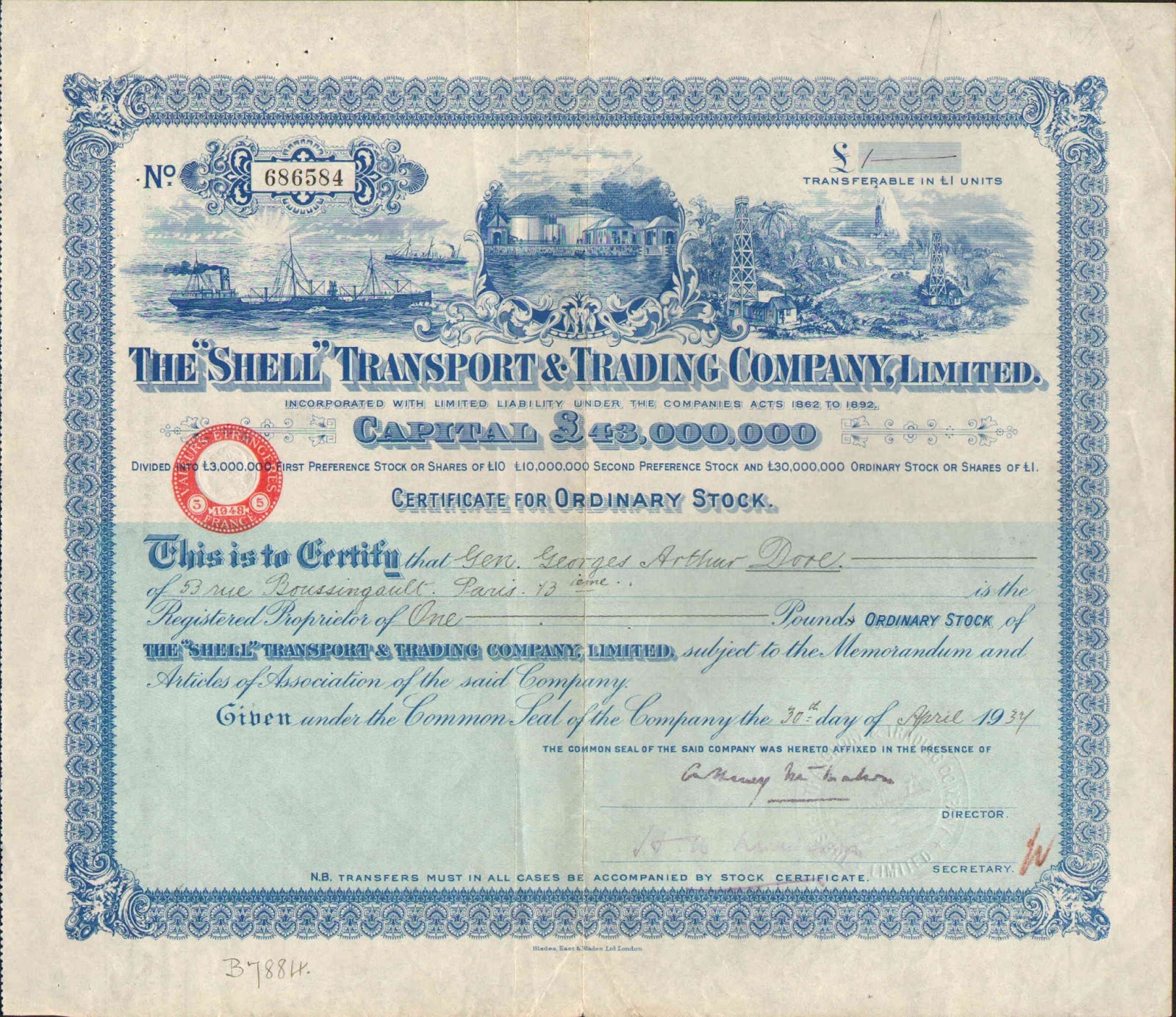
Earlier, I explained that "share certificate" and "stock certificate" mean the same. I also believe different kinds of securities have evolved because of changing environments. Well, here is an example of adaptive evolution in scripophily.
Both look like standard certificates. They also resemble each other :
Both are issued by The "Shell" Transport & Trading Company, Ltd.
Both are printed by Blades, East & Blades Ltd.
And both state a capital of £43,000,000.
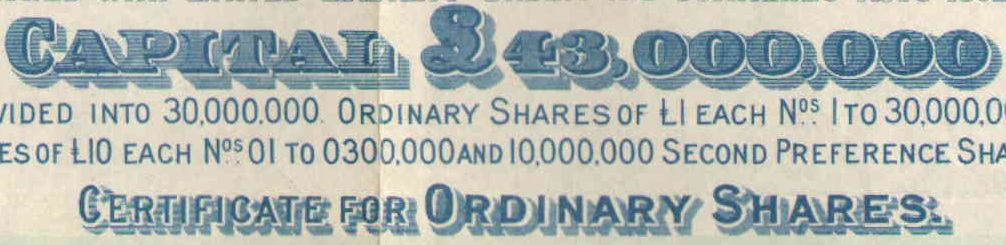
Yet, there is something strange about this pair. Did you notice that the first one is issued as a £1 ordinary share, and the second one as a £1 ordinary stock certificate ? You can verify this in these details.
detail from certificate No 1
detail from certificate No 2
Certificate No 1 was issued almost ten years earlier than certificate No 2. That raises the question why change the lettering from "share" to "stock" ? Why would a company want this : there is no change in the capital structure, and after all stock and share mean the same thing.
A matter of modern language ?
Geert Leemeijer aka Stockold Scripophily brought these two examples under attention in the Collectible Stocks & Bonds Facebook group. Geert suggested that over time the term stock certificate became more popular than share certificate. The different lettering on these securities was ".. a matter of modern language".
Here is an overview of the Shell examples provided by Geert with the date of issue and the stated capital :
1925 - £43,000,000 - 5 ordinary £1 bearer shares, brown
1929 - £43,000,000 - ordinary £1 registered shares, blue
stocks
1937 - £43,000,000 - ordinary £1 registered shares, blue
1937 - £43,000,000 - 1 ordinary £1 bearer share, red
1954 - £88,000,000 - ordinary £1 registered shares, blue
1957 - £113,000,000 - ordinary £1 registered shares, blue
Two of these are displayed above, the others are grouped in the paste-up image below. The set illustrates the transition from share to stock for the Shell company.
"Shares" in the upper row, "stocks" below.
The brothers Marcus and Sam Samuel founded The "Shell" Transport and Trading Company in 1897. Their father imported and sold sea-shells and that's how the "Shell" company got its name.
Other British companies also favoured stocks above shares. The UK section of Tabak-Peter shows the following examples :
British-American Tobacco Ltd
The Imperial Tobacco Company (of Great Britain and Ireland) Ltd.
Earlier certificates from these companies are printed as shares and later ones as stocks.
Another example is the J. Lyons & Company Ltd. J. Lyons started as a spin off from the Salmon & Gluckstein tobacco company at the end of the 19th century. The company expanded into a chain of teashops, ran high class restaurants and started to manufacture biscuits and later ice cream.
J. Lyons & Company, Limited
7% Preference "shares" of £1, 1923
The red stamp on the certificate, see below, tells us that
The Shares referred to herein were converted into stock on the 24th June, 1940
J. Lyons developed original ideas about what the future of business could be like. After World War II they supported the EDSAC computing project at the University of Cambridge Mathematical Laboratory. In 1959 J. Lyons built their own computer, called Lyons Electronic Office I. Based on the EDSAC design, LEO I handled the company's accounts and logistics.
J. Lyons & Company Limited
7% Cumulative Preference "stocks" of £1, 1958
PS : Former British Prime Minister Margaret Thatcher worked
as a food research chemist for the company around the 1950s.
UK stocks and shares in the Turbulent Thirties
Google's Ngram viewer displays charts that show how often terms, or phrases, occur in a corpus of books over a preselected number of years. The Y-axis shows the percentages of references to each term from all terms Google has indexed for a year (X-axis) in the entire corpus.
Google Ngram viewer shows a decline for the term share certificate from the 1930s till the early 1940s. double-click image to enlarge
The corpus used in the chart is British English. It consists of books in the English language published in Great Britain. The chart illustrates a decline for the term share certificate over a period from the 1930s till the early 1940s (blue line). Meanwhile stock certificate saw an increase at the end of the 1930s. You can also check the same with the American English corpus, but the share certificate pattern is not repeated in that graph. According to Google Ngram's data, the term share certificate became more popular again from the 1960s.
Apparently during the 1930s it was trendy to speak of stock certificates in the UK. In this period a number of British companies preferred to market their securities as stock certificates instead of share certificates. Possibly this can be explained by the increase of intercontinental (American) aviation, radio, and film. A matter of adapting modern language.
The "World Auction Sales" table in Scripophily magazine reports the performances of auctions over the preceding period. Auctions are measured by the number of lots offered, sell ratio and the corresponding turnover. Also, included is eBay as an auction platform. Did you know that, over the period Dec 2015 - Feb 2016, the average lot price recorded in eBay's scripophily section was €14 in Europe, and €23 in the US(*).
(*) after applying cleansing operations on the data, such as eliminating double counted lots, because some auctioneers sell simultaneously through eBay
Scripophily magazine No. 100 - April 2016
Scripophily magazine was first published in 1982 under the name The Bond & Share Society Journal. In April 2016 the International Bond & Share Society honoured the joyous occasion of the journal's hundredth publication with a separate 44-page commemorative section, printed nostalgically in black and white on A5 paper size. The magazine has come a long way. Editor Max Hensley explains:
A technological advance of great importance for Scripophily (magazine) has been the Internet. The Dec 2015 issue contained an article written in Turkey, edited in the US and composed in the UK, all within weeks. This would have been impossible before the internet.
Editor Max adds that today, the magazine appears on high quality paper, articles are longer and brought with more images in full color. Journals from the 1990s contained an average of 5 auction reports whereas now the issue reports about twenty to thirty auctions. Every issue was produced " .. without paying a penny for content."
" The hollow surprise of the Londonderry Gold Mine is one of the articles from the commemorative section in Scripophily magazine, written by Anne Marie Hendy. It reads like Harry Potter." , says this unshaven blogger.
As usual, this issue brings society matters, market news, bourse reviews, auction reviews, an events calendar, member classifieds, book reviews, interviews and lots of pictures of collector friends and bonds and shares. The commemorative section contains the following set of snapshots from the first two decades :
Out of the ordinary bonds in out of the way auction, a comic essay
The formation of British companies to 1856
Further "nuggets" from Western Australia : The hollow surprise of the Londonderry Gold Mine
Coastal shipping - a brief, about British coastal shipping scripophily
The expensive business of raising railway loans : the Shanghai-Nanking Loan Agreement
The "Train Renard"
Auction reports, reports on the F.H.W. and Witula auctions from 1992
Dome and Lakeshore - two top Ontario gold mines
Trillion $$$ Standard Oil stock comes home !
UK Tramways - a neglected field of scripophily
The King George's Sound Company - the American/Chinese fur trade in 1785
Philoscripy? Bonditry? Shyloxis? , explains the origins of the word scripophily
Dangerous Edison forgeries on the market
HP Magazin, a summary from HP magazine Jan 1996
Share companies in Soviet Russia
A major art thief signs shares, the story of Arsène Goedertier and the Plantexel company
The man who robbed the Robber Barrons, about William Mann, founder of the Mann's Boudoir Car Company
Otto Mears, Colorado railroad pioneer
Art Nouveau-Jugendstil
Scripophily in Tokyo
Go West, yunger Mann ! , German immigrants in Texas
New online scripophily articles and references, April 2015
Recueil des Sociétés Coloniales et Maritimes 1902
This online "Manual of Colonial and Shipping Companies 1902" consists of the following parts
Colonial companies from Belgium, France, Germany, United Kingdom, Portugal and the Netherlands operating in Africa, Asia, America and Oceania
Shipping companies from Belgium, France, Germany, United Kingdom, Italy and the Netherlands
List of directors
Compagnie Anglo-Belge de la Côte D'Or
Detail from the certificate below.
Notice the hatching work on the well-muscled man in the front.
Hatching is a technique often used in drawings to suggest volume.
double-click image to enlarge
The book was originally publised in 1902 by the Société d'Études Coloniales de Belgique, now digitized by Google on the Internet Archive. You can browse it online here . The page contains also a link to a 20 MB PDF file, but the online version has better search functionalities.
Compagnie Anglo-Belge de la Côte D'Or
English: Anglo-Belgian Company of Gold Coast (Ghana)
Founder's share, 1899
Printed by Lith. Laporte & Cie., Antwerp
Men of the Pacific Coast
Here is a helpful online reference for the researchers of American Far West history. The full title of the book is : Men of the Pacific Coast containing Portraits and Biographies of the Professional, Financial and Business Men of California, Oregon and Washingthon 1902-1903. It was published by the Pacific Art Company, San Fransisco, Cal. in 1903, and has been digitized by the Internet Archive with funding from Microsoft Corporation.
Included are portraits and brief biographies of men involved in commerce, manufacture, art, science, literature, finance and religion from the Pacific Coast. You can view it online here. On the same page, there is a link available for downloading the almost 90 MB sized PDF file. In contrary to the above publication, this PDF version offers better results for searching on place names and terms like "railway, gold, diamond, ..".
Men of the Pacific Coast
Left : Wyle C. Morris, Eastern Oregon Railway Company
Right : Amos O. Benjamin, Alaska Company, Inc.
double-click image to enlarge
Scripophily magazine
In addition to the online sources above, the last December 2014 No.96 issue of Scripophily magazine contains the following stories :
Amazing Western Union Telegraph Co Certificates Found in New York Stock Exchange Archives
Inter-City Umbrella Renting Company
Flagler - a Household Name in Florida, about Henry M. Flagler's oil and railway activities
Scripophily of the 1893 World's Columbian Exposition - Part 2
In Memoriam The 4%s, about the British 4% Consols
The Early History of Palm-oil Production in Indonesia and Malaysia - The Story of Adrien Hallet
Cox's Corner : Assessable Shares
other periodical topics : society matters, news, bourse reviews, auction reviews, events calendar, member classifieds, book reviews, interviews and lots of pictures of collector friends and scripophily
The International Bond and Share Society, sets its next (members only) auction date to 11 October 2013. This auctions counts more than 200 lots from more than 30 countries.
Hungarian National Petroleum Company Limited Ordinary shares of 1 Pound, 1920 double-click image to enlarge
Date : October 11, 2013
Place : not applicable, this is a mail bid auction only
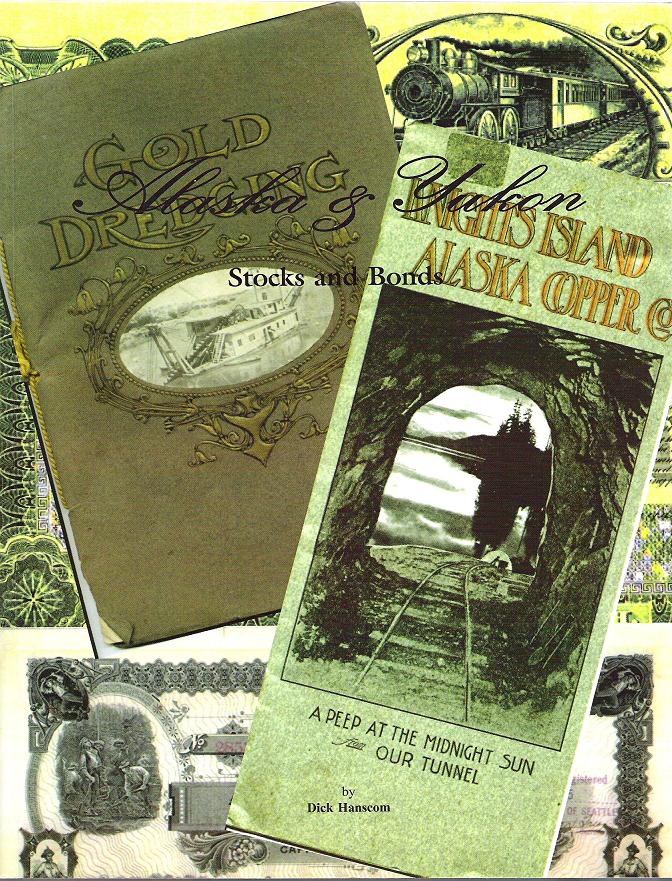
ID : no ISBN number; published 2002 by Alaska Rare Coins
Languages : English
Number of pages : 344
Images : over 500 black and white images
Index : 1. on company names, 2. on subject (other relevant words appearing in the names on the certificates)
This reference catalogue lists up over 700 stocks and bonds from companies operating in Alaska or Yukon whatever the nature of their activities : platinum and gold mining, copper, tin and coal mining, petroleum, aviation, railroads, transport and trading, fisheries, livestock, fur trading, banks, state and city bonds, telephone and telegraph and more.
The author has ordered the entries by company name. Certificates are described with the following data fields : name of the company, place of incorporation, date of incorporation and issue, color, capital and shares, size, coupons, printer and other information.
Yes, you've read it correctly : over 500 images. Most of which I have never seen before.
Recommended for anyone attracked to scripophily from Alaska or Yukon !
New online scripophily articles and references, March 2013
Vintage Railroad Stocks and Bonds
Early February, Pete Angelos launched Vintage Railroad Stocks and Bonds, a new scripophily blog for US railroad enthousiasts. I'll quote the author : Hopefully this blog will get comments from veteran collectors and may spark some future collectors to take up this great hobby.
My radio is tuned, Pete !
The Manual of Statistics Stock Exchange Hand-book
At the end of the 19th century, Charles M. Goodsell and Henry E. Wallace wrote a series of stock exchange year books. Each one of these volumes contained thousands of entries to company profiles and their securities, government securities, economical and stock exchange statistics, and maps of railway systems. Topics covered : railroads, street railways, miscellaneous and industrial companies, grain and produce, cotton, petroleum, mining, banks, trust and insurance companies. Sales price of a book : five dollars in 1915.
Nine of these year books have been digitized by Google from the library of the University of Michigan and uploaded to the Internet Archive. You can find the links to these volumes here :
On each one of the pages mentioned above, on the left, you'll find a link 'Read Online' to the online version. The 'All Files: HTTPS' link, brings you to a web directory that includes a link to a downloadable PDF file. But be prepared : some of these files are almost 100 MB large.
Scripophily Magazine
In addition to the online sources above, the latest Dec 2012 No.90 issue of Scripophily magazine, published by the International Bond and Share Society , contains the following stories :
Save them! Save them! Stock certificates under assault worldwide
Avant Garde 1930s decorator trend discovered (stock certificates as wall paper)
Cox's Corner #15 : Loving the hobby
Specophily celebrates five year anniversary (about speculation in old paper)
My fair ladies : help wanted! (Are ladies portraited in stock engravings famous personalities?)
History of Congo railways
Scripophily in the Netherlands
other periodical topics : News, Bourse Reviews, Book Reviews, Auction Reviews, Events calendar, Member Classifieds
The common use of the term 'scrollwork' in scripophily
In auction catalogues that are written in English, you probably have noticed lot descriptions containing a phrase like 'scrollwork at left'. Such an expression will refer to a whole of ornamental design elements at the left side of a share or bond certificate. The term is an English term and you will often find such design elements on English shares and bonds. An example of scrollwork is printed at the left on the share shown below, hence the expression 'scrollwork at left'. Is there also something like 'scrollwork at right'? Ofcourse, scrollwork can be seen on all possible positions on a certificate.
The Para Electric Railways and Lighting Company, Limited
Certificate for 5% first debenture stock, 1968
Printed by W.H. Rickinson & Son
left image: detail of the 'scrollwork at left' double-click to enlarge images
Origins of the term 'scrollwork'
Scrollwork is an ornamental design element resembling a spiral. The name is derived from the word scroll which is a roll of paper, parchment or papyrus. The edge view of a scroll forms a spiral.
The term scrollwork is derived from the word scroll, which is a roll of paper. The edge view of the paper forms a spiral. detail from the certificate below
Nouvelle Compagnie de la Ligne Internationale d'Italie par le Simplon (Chemins de Fer et Navigation) Bond for 525 Francs, 1868 double-click to enlarge image
New online scripophily articles and references, October 2012
HPax - Hankes market index for German scripophily
Ulrich W. Hanke is no stranger to German collectors of stocks and bonds. In his German blog, Hankes Historische, Hanke follows the news on the German scripophily scene including auction and eBay results but also highlights the more modern securities. You may also want to read about him in this online interview.
As far as I know he is the first one to publish a market index for the German high end scripophily market. The HPax, Historische wertPApiere-indeX (English: historical securities index), is calculated twice a year and is based on the ten most expensive items sold by auction by the HWPH and FHW auction houses. See the chart here.
It is a matter of time when others may conceive similar indexes for other regions, e.g. Asia, or market segments, such as American gold mining certificates. A great idea! Banking history of Northern England
In 1894 E. Wilson & Company publishes the book A History of Banks, Bankers and Banking in Northumberland, Durham, and North Yorkshire. It is written by Maberly Phillips. As the subtitle indicates, this worthy volume illustrates the commercial development of the north of England from 1755 to 1894 with numerous portraits, facsimiles of notes, signatures, documents, et cetera.
Chapters:
Banking in London
Banking in Scotland
Incidents prior to Provincial Banking
Provincial Banking (8 chapters spanning the period 1755 - 1894 )
Coining and clipping, tontines and lotteries.
Bank Reviews
Index
Interesting for us: in 300 pages hundreds of banks are reviewed. Furthermore, the book is illustrated with close to a hundred images of early coins, clipped coins, forged assignates, banknotes, document signatures, portraits, engravings .. When did we stop making books like that? A must read for anyone interested in English banking history and early and counterfeit money. Yes, there is an online version. You can see it here , the PDF-link is at the left.
Scripophily Magazine
In addition to the articles above, the brand new August 2012 No.89 issue of Scripophily magazine, published by the International Bond and Share Society, contains the following stories :
The Oldest Mining Scripophily
Speculations Roll On (Mexico, Westphalia, Brazil)
The Nineteenth Century UK Bicycle/Infant Motor Industry Investment 'Bubbles'
Strasburg Retrospective
Joseph R De La Mar - The "American Monte Cristo" (US mining & gold mining)
The Texas Pacific Land Trust and the Saga of Certificate No.390 (railways, land property, oil)
The Central of Georgia (US railroad and shipping)
Self-Referential Scripophily: Mary Ann Gold and Silver Mining Co., Nevada Territory
other periodical topics : News, Bourse Reviews, Book Reviews, Auction Reviews, Events calendar, Member Classifieds, Update Membership Directory Supplement, Club Auction
Tip 1 : This issue has been put online as free download, see here. If you are still not a member, time to check out the magazine by yourself !
Tip 2 : Also this issue includes a 2-For-1 admission coupon for the Checks and Balances exhibition, see here, at the Museum of American Finance, open through November 2012.
You probably recognize the following dramatic experience that used to happen to me in the past more often than desired. The scenario is as follows :
In a good mood I visit a collectors fair. After strolling a while from one dealer table to another, I spot a certificate that looks quite interesting, for example this bond of the Valencia y Aragon railway company. Very soon the seller and me agree on the price.
Compañia de los Ferro Carriles de Valencia y Aragón
Compagnie des Chemins de Fer de Valence et Aragon
This Spanish railway company constructed a line between Valencia and Liria.
Incorporated in 1888 with a capital of 3 million Pesetas.
Became part of RENFE in 1941, the Spanish state-owned railway company.
This bond in particular interested me because of the unusual and large revenue stamp at the top border of the paper. My good mood became even better and happy with the result I went back home still unaware of the nightmare yet to come. At home I inspected the condition of the paper again. There was a little pencil marking in the upper right corner indicating the selling price. I took my eraser and started removing the marking. Fate hit me hard. Upon the first eraser move the corner was gone. I was startled, I couldn't believe that I simply rubbed the corner from the paper in one single stroke. I just killed an antique bond. I became angry with myself and cursed my clumsiness.
A missing corner, a damaged certificate is the result.
Use the right tool for the job
You need a soft artists eraser (rubber), preferably a white or pale eraser. Some stationery shops sell soft erasers fitted in pencil shaped holders. As you can see in the videos below, this is very handy to work with. This type of eraser feels very tight in the grip: the eraser has no chance to slip out of your fingers during this delicate operation. Furthermore, this type leaves a few centimeters between the rubbing point and your hand which gives you more overview on the operation. The eraser that I am using is made by Staedtler and bears the name Mars plastic (Art.Nr.528 50) .
The wrong way to erase pencil markings
On many occassions in the past, I had no trouble at all to detach the corner of an old share certificate. Here are some tips that will definitely help you to achieve the same (my nightmare scenario) :
use a hard eraser
do this in a hurry
rub from the certificate towards the border and back again, repeat this very quickly
don't lift the eraser from the paper, not even a single time
rub in all possible directions, do this randomly
It was not easy, but I managed to demonstrate this in a short video. For the sake of sensitive viewers I used a plain sheet of A4 printer paper which is much stronger than old scripophily material.
Wrong way to erase pencil markings
The correct way to erase pencil markings
All joking aside now. Try the following approach instead:
Make sure you a have a soft eraser.
Slow down and take your time to gently position the certificate in place. You can align your index finger and your middle finger in a V-shape around the markings. This will help you maintain your rubbing direction and will also prevent the certificate's border from curling up in the act.
Start rubbing slowly and as gently as possible : rub always in one direction from the pencil markings towards the edge of the paper. Use only as much pressure as needed. Be careful around any text as an eraser can "bleach" it. When reaching the edge lift the eraser and reposition it before starting the next rubbing move. This will help you to avoid extra creasing and folding.
Repeat the previous two steps but use alternate directions, again always rub from the pencil markings towards the edge.
When finished brush off the eraser residue gently, don't blow.
Are there indentations made by the writing ? Then, you might want to read the tip provided by Adam Tripp at the bottom of the article.
Correct way to erase pencil markings
Caveats 1. dirt and grease
Some stock certificates have become dirty and greasy over time. When erasing pencil markings on such certificates the eraser will easily take away the dirt and grease from the paper's surface : often the result will be a spot that is brighter than the surrounding paper.
You can avoid this by erasing extremely gently or by simply deciding not to erase the markings at all. In the situation where you ended up with a brighter spot, then you can start rubbing dirt and grease from the surrounding area using less pressure than used for the actual markings.
2. old expensive documents
Rubbing out pencil markings on very old documents should be done with gloves. Brush away the eraser residue with a brush. 3. flimsy paper
Some early American railway certificates from the 19th century, and some British certificates as well, for instance the 1860s shares of the The Ottoman Company, are printed on extremely flimsy paper. Well, extreme situations call for extreme measures. Erase slow and extremely gently. Brush away any eraser residue only with a brush.
Is it necessary to remove all pencil markings ?
I've never seen a painting for sale in an art gallery with the price being marked actually on the canvas. Still, many dealers mark their prices in pencil on their scripophily merchandise : a shame. These are the markings that can be removed.
Yet old pencil markings, like the ones we see on printer proofs and specimens, should not be erased. Indeed these markings belong to the natural history of the document.
The certificate shown in the videos above.
on the left : pencil markings indicating the sales price
on the right : certificate after the eraser operation
-
Trust Franco-Belge des Petroles S.A.
a French-Belgian oil company in Russia
Share of 500 Francs, 1920 Antwerp
Printed by Lith. Jules de Winter
Try before you die
If you want to do this yourself, then get some exercise. Buy some cigarette rolling paper. Write something silly on it with a pencil, e.g. the sales price of your mother-in-law. Now try to erase your writing without making a fold and without tearing the paper. Now that is what I call a challenge.
F.L.
Do you have any eraser tips? I will be happy to find out about them in the comments section below. Also, those who have experienced a similar trauma in the past, now have the chance to come up with it.
Update 1 June 2016 :
Here is an additional tip from Adam Tripp, a collector friend from the UK.
Rubbing the reverse side helps to flatten the indentations made by the mark/writing, therefore improving removal. Regards, Adam Tripp
Did you like this post and want to stay up to date ?Here's how