Showing posts with label Austro-Hungarian Empire. Show all posts

Tuesday, February 14, 2023

FHW auctions the Gottfried Schultz collection of worldwide automobile securities

Freunde Historischer Wertpapiere (FHW) has scheduled its 123rd sale for March 4, 2023. This time the auctioneer selected nearly 2000 lots of historic bonds and share certificates. 

FHW reserved major sections for scripophily from the Austro-Hungarian Empire, Germany, the German DM era, and the USA. Over 400 lots from previous auctions are grouped in a "50% from previous callout" section. On top of that about 900 lots of automobile related securities will attract the attention of collectors worldwide. 


In 1928 Harry J. Wolfington signed this stock certificate from Alex. Wolfington's Son, Inc., as President. At the age of 14 he joined the carriage body business founded in 1876 by his father Alexander. Seeing business opportunities with the rise of the automobile, he turned to the production of bodies for luxurious buses and carbodies for Stutz, Pierce-Arrow and Duesenberg. The latter's convertible 1929 Phaeton Royale is legendary. L(ot) 725 starts at €750 and is part of the Schultz automobile collection. 


The bulky Automobile section includes nearly 900 lots of antique securities from lesser known companies but also resounding names appear on the block such as : L923 Duesenberg Automobile and Motors, L1059 Hansa-Lloyd Werke, L1116 Hispano Suiza, L1329 Rolls-Royce and L1491 Automobiles Delahaye.  Food for specialists!


No doubt two top pieces in FHW's Automobile section are a 1908 share from the Établissements De Dion-Bouton, L957, signed by Georges Bouton, as well as a 1919 bond from the same company with facsimile signature of Albert De Dion, L958. In 1900 De Dion-Bouton was the largest automobile manufacturer in the world. Its cars and engines were all being made by hand; the assembly line had not yet been introduced. 


A major part of the offerings consists of antique bonds and shares from Germany with pre- and post-DM eras each in a dedicated section. Some examples:
  • L1621, a specimen share from the Credit-Bank Nürnberg eGmbH, 1924, large underprint of building, originating from a sample book printed by the Universitätsdruckerei H. Stürtz, Würzburg
  • A 1837 interim share in the Rhein-Weser-Eisenbahn-Gesellschaft depicts a train entering a tunnel. Daring for the time! Early and only certificate known. L1682
  • L1722, Basalt-Actien-Gesellschaft aka Basalt-AG extracts basalt, limestone, sandstone, granite and other rock from quarries in Germany and Europe. A large vignette on its DM100 share, 1973, depicts a worker handling basalt chunks.


The world's first passenger airline, Deutsche Luftschiffahrts-Aktiengesellschaft (DELAG), was organized in 1909 as a subsidiary of the Zeppelin airship construction company. DELAG's airships made air travel possible first between Germany's cities, later to the Mediterranean and then across the Atlantic with destinations in the US and South America. Its LZ 127 Graf Zeppelin measured over 230 meters long and cruised at 117km/h with a 15,000 kg payload. In 1929 it made a round-the-world flight (including stops) in 21 days, the fastest circumnavigation of the globe at the time. This share was printed by Osterrieth in 1910. L1626 


There is a lot to discover in the sale. Here are the details :


FHW's 123rd auction includes a Austro-Hungarian Empire section, L18 through L209. However, this 1895 share in the Magyar Folyam- és Tengerhajózási Részvény Társasag (Hungarian River and Sea Shipping Joint Stock Company) can be found in the "50% from previous callout" section.  


F.L.


PS : Did you like this post ? Thank you for sharing it on you favorite social media channel !

Wednesday, February 9, 2022

FHW presents unique stocks and bonds from the Austro-Hungarian Empire

FHW's upcoming auction takes place on February 26, 2022 in Wolfenbüttel, Germany. The town is home to both the world-famous Jägermeister distillery and the headquarters of the Freunde Historischer Wertpapiere.  

The sale includes 1910 lots of scripophily: antique share certificates and bonds from all continents will go under the hammer. Large sections include the Austro-Hungarian Empire, USA, Germany pre 1945, Germany DM era, Russia and the Baltic States, and China.


The Zillertal Railway is one of the most popular attractions in Tyrol. Its line opened in 1902 and runs along the Ziller river between Jenbach and Mayrhofen. Tourists and railway enthusiasts from all over the world enjoy a ride with the company's steam operated trains. This founder share, issued in 1903, designed in lovely Art Nouveau style, features vignettes from Jenbach, Zell am Ziller and Fügen. L(ot) 497 in the auction, Zillerthalbahn AG, starts at €1,500


The k. u. k. Doppelmonarchie, aka the Austro-Hungarian Empire, existed between 1867 and 1918. The "kaiserlich und königlich" refers to "imperial (Austria)" and "royal (Hungary)".  The state comprised Austria, Hungary and parts of todays Italy, Serbia, Croatia, Romania, Slovakia, Czech Republic, Poland and Ukrain. As such it was the second-largest country in Europe after the Russian Empire at over 620,000 km2. 

The sale features 350 k.u.k. lots including a lovely Zillerthalbahn share, image shown above. Some more examples from other Austro-Hungarian certificates are:

  • Actiengesellschaft der Liesinger Bräuerei, share from 1872, wide vignette of the brewery buildings, L153. 
  • Several hotel companies are included in the the k.u.k. section such as 
    • L164, Actien-Gesellschaft Hotel Goldenes Lamm, 1872, lodgings vignette in the underprint 
    • US President Theodore Roosevelt once stayed in the Hotel Krantz, L272 and L273
    • The luxury Grandhotel Pupp is located in Karlovy Vary (Karlsbad), Czech Republic, and can be admired in the movies Last Holiday, starring Queen Latifah, and Casino Royale, with James Bond. L274 
  • Railway collectors will appreciate the tens of railway companies that are included in this section. Some examples are: 
    • Grazer Tramway-Gesellschaft, L264, 
    • Innsbrucker Mittelgebirgsbahn, L279, and, 
    • one of the highlights in the auction, L310, K. K. Priv. Prager Eisenbahngesellschaft, Prague, share from 1828, one of the oldest railway companies in continental Europe.


Included in the Austro-Hungarian section is this Spar- und Kredit-Verein des Janus share. This bank was formed by the Janus wechselseitige Lebensversicherung-Anstalt, a mutual life insurance business, to provide financial services to its members. The amazing vignette shows a portrait of Janus with the two faces. This Roman god controlled the beginning and ending of conflicts. The certificate, issued in 1914, was produced by M. Salzer, one of the oldest printing companies of Austria. Matthäus Salzer (1799-1878) expanded the printing works of the Salzer family into a factory. He bought in 1866 the Carl Ueberreuter printing house. L430 in the auction starts at €200 


The auction includes two German scripophily sections presented by more than 400 lots : 
  1. Germany before 1945, lot range 1142 through 1429, and 
  2. Germany after 1945 'DM era', range 1430 - 1620. 
  3. On top of that you can add the "50% vom letzten Ausruf" section, range 695 - 1141, which contains many German items unsold in previous auctions but now listed at 50% of the original start price.

The printed (PDF) catalog contains indexes on themes and German regions. The online sites provide key word search functions. I tried the word Magdeburg and found more than twenty lots such as L943, a rare 200 Thaler share from 1872 in the Magdeburger Brückebau-Anstalt in Buckau bei Magdeburg with corner vignettes of bridges.


Vignettes on antique securities often display smoking chimneys alluding to productivity and profitability. Being a child of its time, this specimen share from the MEMBRAN Aktiengesellschaft für Finanzinformationssysteme delivers the same message by means of a then expensive desktop computer system with two diskette disk drives. Issued in 1987, Berlin, L1558 is part of the 200 lots counting DM era section.

In its auctions FHW features top American items, especially scripophily from railroad companies. This time the USA section includes about 300 lots.  Some examples are : 

  • a rare Colorado Northern Railway Company share, L1698, with vignette of a train exiting a tunnel, starts at €500
  • Civil War Major General Grenville Mellen Dodge who later became the Union Pacific's chief engineer signed the Denver, Texas and Forth Worth Railroad bond, rare, L1711
  • L1769, Chicago and Oak Park Elevated Railroad Company, stock certificate from 1908, great vignette of steam train on elevated track


From the USA section, this share in The Defender Gold Mining Company not only looks spectacular but tells a surprising story as well. Incorporated in Colorado the company prospected in the Cripple Creek gold district. It was founded in 1895 when the American sloop Defender defeated its British challenger, the Valkyrie III, in the America's Cup race. The share shows the winner, the "Auld Mug" trophy, shipping ropes and the company name, all of them in gold-print. L1706 in the sale 


There is a lot to discover in the auction, so here are the details :


F.L.


PS : Did you like this post ? I do appreciate it if you can share it on you favorite social media channel !

Friday, December 24, 2021

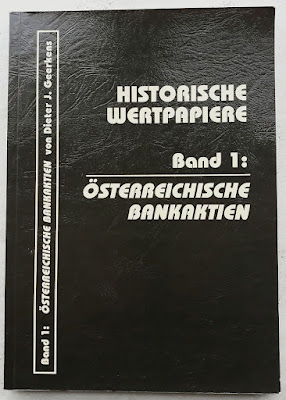
Reference book: Österreichische Bankaktien by Dieter J. Geerkens

Historische Wertpapiere Band 1: Österreichische Bankaktien is a reference catalog on antique bonds and shares from banking companies formed within the territory of Austria, including those banks set up during the Austro-Hungarian Empire. The book, a large format publication, was put together by author Dieter J. Geerkens. 


  • Title: Österreichische Bankaktien
  • Author : Dieter J. Geerkens
  • ID : no ID, published 1998 by Dieter J. Geerkens
  • Languages : German
  • Number of pages : 255
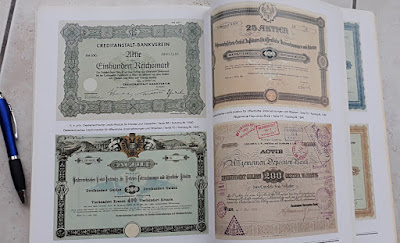
  • Images : more than 120 black and white and 150 page wide color images
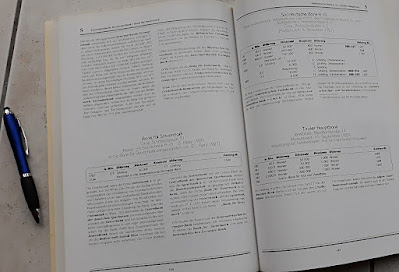
  • Index : on company names; index located on page 51 


The  catalog entries are divided over two sections. 

A first small section, "Zwischenkatalog", describes the companies that lasted only a few months, and of which no securities are known (at least at the time when this book was published). This part includes about 40 companies that were founded just before or after the Vienna Stock Exchange Crash of 1873. Some examples are : Grazer Bankverein, Pfandlei-Anstalt Steyr, etc. 

The second section, "Hauptkatalog", features about 140 banks with background information and a listing of their known securities. Each certificate has a catalog number referring to its entry in the price catalog chapter, and color photographs in the last part of the book. Some of the companies included are : British-Oesterreichische Bank- und Handels-Aktiengesellschaft, OrientBank (Palästinabank), Tiroler Hauptbank, etc.


Chapters
  • Vorwort und Erklärungen (Preface and explanations)
  • Kapitel 1 : Die Wiener Börse (Chapter 1 : The Vienna Stock Exchange) 
  • Kapitel 2: Die Banknoten (Chapter 2 : The banknotes)
    • Das Papiergeld
    • Verpfändung
    • Steueränderungen
    • Kriegsfinanzierung durch Steuern
    • Inflation
    • Bankozettel 1800
    • Wiener Stadt Banco Zettel Papiergeld anno 1800
    • Zollerhöhungen
    • Vorratsversteuerung
    • Der Friede von Austerlitz
    • Einlösungsscheine
    • Einlösungsdeputation
    • Keine neuen Steuern - Pferde vom Kaiserhaus
    • Staatsschulden-Tilgungsfonds
  • Kapitel 3: Die ersten Aktienbanken (Chapter 3: The first joint-stock banks)
    • Die Hofhaltung war kostspielig
    • Die privilegierte Oesterreichische Nationalbank
    • Die ersten Aktienbanken | Erneuerung des Notenbankprivilegiums 1841
  • Kapitel 4: Die Oesterreichisch-Ungarische Bank
    • Viertelaktie der Oesterreichischen Nationalbank
    • Aktie der Oesterreichischen Nationalbank
    • Interimsschein der Oesterreichischen Nationalbank
  • Kapitel 5: Die Bankgeschichte 1855 bis 1938 (Chapter 5: Banking history 1855 to 1938)
    • Der Wiener Börsenkrach 1873
    • 1873 bis 1914
    • Die Friedenszeiten von 1866 bis 1914
    • Erinnerungen an 1873
  • Kapitel 6: Historische Wertpapiere: Aktienbanken (Chapter 6: Historical securities: joint-stock banks)
    • Inhaltsverzeichnis der Aktienbanken
    • Zwischenkatalog
    • Hauptkatalog
  • Kapitel 7: Preiskatalog
  • Literaturverzeichnis (Literature list)
  • Anhang: Farbteil (Appendix: Color section)


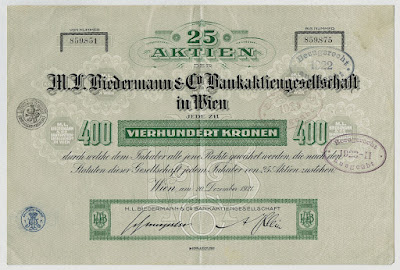
The M. L. Biedermann & Co. Bankaktiengesellschaft was originally founded in 1792 by Michael Lazar Biedermann, imperial Austrian court jeweler and co-founder of the Jewish community in Vienna. This  certificate for 25 shares of 400 Krone was issued in Vienna, 1921 and printed by H. Engel & Sohn. Other types of this share are illustrated in the catalog as number 1153, 1154 and 1157. 


The book was published almost 25 years ago, so the price indications (mentioned in Austrian Shilling) are not relevant anymore. Yet, this is a top work for anyone interested in the history of Austrian banking described and well illustrated in the first 50 pages of this volume. The color photographs are really well made! 


F.L.


Previous posts

Wednesday, February 10, 2021

F.H.W. auctions 1900 lots of historic securities in online event. Scripophily from Germany and Austro-Hungarian Empire substantial.

Freunde Historischer Wertpapiere (FHW) has scheduled its 119th sale for February 20, 2021. This time auctioneer Jörg Benecke and his team selected nearly 1900 lots of historic bonds and share certificates. Major sections have been reserved for scripophily from the USA, the Austro-Hungarian Empire, and of course Germany.

The auction starts with the American scripophily section, over 240 lots, the bigger part being railway securities. 


L(ot) 41 is an uncancelled! stock certificate from The Cincinnati, Portsmouth & Virginia Railroad Company. Henry Fink signed in 1903 this share as President. He was born in Germany and was called the "Dean of Railroad Men", a title he earned for his continuous service in the railroad field. Fink started his career in 1851 as a rodman on the Western Maryland Railroad. Within several railroad companies he climbed up from construction engineer and master of transportation all the way to vice president, general manager, and receiver. Henry Fink wrote several works on transportation subjects.


Here are some other interesting US railway lots : 
  • L44, The Cincinnati, Washington & Baltimore Railroad, 5% First Income Mortgage Bond, $1000, 1883, rare 
  • The Tyrone and Clearfield Railway Company share from 1867, L221, displays a lovely railway vignette and is signed by John Edgar Thomson best know for his leadership of the Pennsylvania Railroad. Thomson, an entrepreneur but also a reknown civil engineer co-designed what became known as "Horseshoe Curve".
  • L29, The Central Pacific Railway Company, $500 4% First Refunding Mortgage Gold Bond, 1899, color print by ABN with portrait of Collis Potter Huntington, rare 

One of the main roles in FHW's event is played by k.u.k. and its successor states (Nachfolgestaaten). The Austro-Hungarian Empire (1867-1918) comprised Austria, Hungary and parts of todays Italy, Serbia, Croatia, Romania, Slovakia, Czech Republic, Poland and Ukrain. It was the second-largest country in Europe after the Russian Empire at over 620,000 km2. The "kaiserlich und königlich" refers to "imperial (Austria)" and "royal (Hungary)".  The sale features over 300 k.u.k. lots including this lovely fire engine share.


L507 is a 100 Forint share from the Tarnóczy Tűzoltószer- És Gépgyár Részvenytársasag, in English: Tarnóczy Fire engine and Machine Company. Issued in Budapest, 1891, it shows the company's factory, hand-operated fire engines, lathes, a blacksmith and a firefighter with firehose. 


The lion's share of new offerings can be found in two major sections of the auction: Germany before, and, after 1945. The former counts 272 lots, the latter - the "DM" part - features 495 lots. As good as all regions and economic themes are represented. I checked out the catalog reference index on 'breweries and malthouses' and found tens of entries ! 


The economy of West Germany developed rapidly after World War II. This "Wirtschaftswunder" created a heavy demand for steel. German post-WWII securities are often artistically designed. Modern German steel scripophily counts perhaps the most stunning examples. Check FHW's catalog for L1816 Stahlwerke Peine-Salzgitter, L1542 Dortmund-Hörder Hüttenunion and L1641 Hüttenwerke Phoenix. This 1000 DM specimen share in the Rheinisch-Westfälische Eisen- und Stahlwerke AG dates from 1953, L1764 in the sale. Click image to enlarge


Top German item in the sale is L1223, a founders share from 1838 in the Gesellschaft für Spinnerei & Weberei in Ettlingen, the first public limited company in the German cotton industry. The share shows the detailed floor plan of the factory and its usage of hydropower from the Alb, a tributary of the Upper Rhine. The company is known today as ETTLIN AG and still manufactures fabric and technical textiles. 

You want to inspect the "50%" lot range 688-1126. Here, unsold lots from previous sales are offered again at 50% of the original start price. Included are also bonds and shares from the Dr. Werner P. Schmidt Automobile and China Collection.  


From the Dr. Werner P. Schmidt Automobile Collection, L881 consists of two Volvo shares from the 1930s. Volvo was founded in 1927 as a subsidiary of the ball bearing manufacturer SKF. The share shown here bears the facsimile signature of SKF founder Sven Wingqvist. 


There is a lot to discover in the sale, so here are the details :


F.L.


PS : Did you like this post ? Thank you for sharing it on you favorite social media channel !


Monday, September 21, 2020

FHW sells Chinese scripophily collection

Freunde Historischer Wertpapiere has scheduled its 118th auction for October 3rd 2020. This time more than 1,500 lots of antique securities will go under the hammer including the China collection of former Volkswagen CFO Dr. Werner P. Schmidt.

This scripophily event starts off with more than 300 American lots with the emphasis on US railway stocks and bonds.


A stunning print, this share from the Alaska Central Railway Company was issued in 1903. Engraved by the Seattle Engraving Company and printed by Yerkes Printing Company, it shows a full map of Alaska with the proposed route of the railroad and where timber, coal, gold, copper and quartz were to be found. Click the image to enlarge and note the area on top of the map designated as 'UNEXPLORED'. Lot 3 in the auction 


China collectors and investors will be interested in the collection of Dr. Werner P. Schmidt, recently deceased, and former CFO of Volkswagen AG. The series starts with lot 325, a share from the Aka-Dine Wood Production Company, and features several more shares from Taiwan. 

The Schmidt collection also counts several external loans from China. A £1000 bond from The Chinese Central Government Loan aka Arnold Karberg Loan III, only 300 issued, very rare, is one of the highlights and is expected to realize €5000. Lot 334 in the sale.


Chinese Government 23rd Year (1934) 6% Sterling Indemnity Loan for £1,500,000 
The Republic of China (ROC) was based in mainland China between 1912 and 1949, before the relocation of its government to the island of Taiwan. This £1000 bond shows the portrait of Sun Yat-Sen, Provisional President of the ROC. It was issued to finance the completion of the Canton-Hankow Railway. Part of the Dr. Werner P. Schmidt Collection and lot 338 in the auction.


Detail from lot 411, a share from the Kuangtun Canton-Hankow Railway Company (Kwong-Tung Yueh-Han), from the Dr. Werner P. Schmidt Collection. 


Germany gets the "lion's share" of the auction. Nearly 900 lots are divided over two sections, Deutschland (pre Deutsche Mark) and DM (from 1945 onwards). Note that both contain a subsection with 20 highlight picks from the auctioneer.


Offered as lot 1005 this 25 Reichsthaler Gold share in the Aper Canal-Gesellschaft was issued in 1849, Westerstede. The vignette is drawn by the artist A. Gordes. 


The catalog's table of contents reveals that scripophily from other countries is there as well. Nearly 100 lots represent the Austro-Hungarian Empire. Indexes on collecting themes, such as Art Nouveau, and German regions, may help you find what you are looking for.


Szeged is now one of the largest cities in Hungary. This share in the Szeged-Alsótanyai Népbank , or People's Bank of Szeged-Alsótanyai, was issued in 1906 when Szeged was still part of the Austro-Hungarian Empire. A great example of Szecesszió, the Hungarian Art Nouveau variant. Lot 569 


There is a lot to discover in the sale, so here are the details :
  • Location : The event takes place at Wolfenbüttel, however, at the time of writing, due to the covid-19 situation personal presence is likely not possible. Check out whether a visit is possible with the auction house. 
  • Date : 3 October, 2020
  • Further info, see here; PDF catalog see there; live bidding is possible through https://connect.invaluable.com/dwa/ 


"You will find happiness and joie de vivre while sleeping in a Steiner Paradies bed"
Now that's what we call maintaining a successful house-style. The Vienna subsidiary of the Paradiesbettenfabrik Steiner reused the photovignette from an earlier advertising campaign on its 1924 share. The Paradies brand still exists today. Lot 557 in the sale. 


F.L.

PS : Did you like this post ? Thank you for sharing it on you favorite social media channel !


Sunday, March 1, 2020

Societăți pe acțiuni românești în Austro-Ungaria - Hârtii de Valoare Istorice - Colecția Alois Weil


Societăți pe acțiuni românești în Austro-Ungaria is a brand new volume on antique securities from Romanian companies formed in the Austro-Hungarian Empire (1867-1918), more specifically in Transylvania.

The book, a large format, multicolor, hardcover publication was put together by authors Alois Weil, Gabriel Căsap and Ion Chirescu. It is illustrated with share certificates, mainly from financial companies, from the Weil collection.


Transylvania is a region in central Romania. The term is also used to refer to a larger area that includes parts of Crișana and Maramureș, and the Romanian part of Banat. Up through the 19th century Transylvania was an agricultural society. The Austro-Hungarian Compromise of 1867 (Ausgleich) made Transylvania a part of the Kingdom of Hungary. At the end of World War I Transylvania was united with Romania.


Here's a picture from the book's table of contents (in Romanian), click image to enlarge. Notice the bound bookmark produced with the colors of the flag of Romania.


The authors presented their book on February 10, 2020, in the presence of hundreds of Phd students and invited guests, in the „Lucian Blaga” Central University Library, Cluj-Napoca. The event also featured an exhibition of shares of banking companies from Transylvania.


share from the Allgemeine Versicherungsbank Transsylvania

The Allgemeine Versicherungsbank Transsylvania AG is one of the companies that is discussed in the book. This share was issued on Jun 21, 1918, only a few months before Transylvania became a part of Romania Dec 1, 1918. Illustrated are the coats of arms of the seven provinces of Transylvania. 
image courtesy : BooneShares, auction Oct 2018 


Some more details about the book :

  • Title :  Societăți pe Acțiuni Românești în Austro-Ungaria - Hârtii de Valoare Istorice - Colecția Alois Weil, in English: Romanian Joint-Stock Companies in Austria-Hungary - Historical Shares and Bonds - Alois Weil Collection
  • Authors : Alois Weil, Gabriel Căsap and Ion Chirescu
  • ID : ISBN 978-606-93235-9-5, publised by Art Group-România, under the aegis of Museum of Romanian Records, 2019
  • Languages : Romanian, with a summary chapter in English and German
  • Number of pages : 349
  • Images
    • nearly 200 large color images of share certificates 
    • about the same number of detail images and vignettes from these securities 
    • over 200 enlarged images of signatures seen on the securities
    • many postcards of company premises, pictures of significant business people, and the like
  • Index : no index, but one of the chapters contains a table with the details of 185 banking institutions organized as joint-stock companies


The stunning certificate illustrated on the left is from Plugarul, s.p.a. în Cacova, a credit company that serviced the agricultural sector. 'Plugarul' is Romanian for plowman. The share is signed by Ioan Opreanu, president of the Cacova parish committee (see signature in detail).
Click image to enlarge


Company entries in the book are grouped by historical period. Each company is discussed in its historical context. Most shares are illustrated together with enlarged images of the signatures of the company officers who signed them, each one briefly identified and described.

This is a top work for anyone interested in Romania, Austria-Hungary, banking, and of course, artistic designs in scripophily !


F.L. 

Related link


PS : Did you like this post ? Thank you for sharing it on you favorite social media channel !

Wednesday, February 28, 2018

Did the Republic of Austria start as a communist state ?

The Russian Revolution in 1917 led to the rise of the Soviet Union. The First Austrian Republic was created in 1919. Was Austria a communist state ? A daring statement. Let us have a look at Austria's coat of arms illustrated on the following bond.

4% Austrian lottery bond of  200 Kronen, 1920  with detail of Austrian coat of arms
4% Austrian lottery bond of  200 Krone, 1920 

Now check the emblem of the Soviet Union. It is depicted on the following  government loan. Do you see the similarities ?

USSR internal loan of the second five-year plan, 25 Rouble, 1935 with soviet emblem
USSR internal loan of the second five-year plan, 25 Rouble, 1935
This rare bond was auctioned by HWPH on 15 Oct 2016
together with a similar looking certificate, for €4,000
courtesy HWPH 

That's right, the Austrian eagle holds in its claws a hammer and a sickle, the main attributes of the soviet shield. Austria introduced its new shield in 1919 when it became a republic. Before that, Austria's coat of arms looked different as you can see here.

200 Krone bond from the 8th Austrian War Loan, 1918 design by Alfred Offner in Vienna Secession style
200 Krone bond from the 8th Austrian War Loan, 1918
design by Alfred Offner in Vienna Secession style 

Till the end of World War I, Austria was part of the Austro-Hungarian Empire, the Dual Monarchy. That's why we see a double-headed eagle on the previous bond.

After WWI Austria decided to change the looks of its eagle. Its sword and scepter was replaced with a sickle, its orb with a hammer. Up to the present, the Republic of Austria has been using that shield  on government bonds but also on banknotes and coins. 

Austrian Shilling banknote and coin with hammer and sickle eagle
above : 20 Shilling banknote, 1986, shield in upper left corner
below : 10 Shilling coin, 1974, by Awmcphee (Own work) [CC0], via Wikimedia Commons


The key question remains why Austria started using a hammer and a sickle in its shield ? Was it about communism ? I found the answer in a newsletter from CoinsWeekly/MünzenWoche which referred to THIS INTRIGUING VIDEO (5 min.) from the MoneyMuseum. Enjoy watching!

F.L.

Related links

Wednesday, October 5, 2016

HWPH - Auction 43 and 44


HWPH's upcoming double auction offers more than 1800 lots of scripophily. Included is an impressive set of 70 bonds and shares from brewery companies. One of these is an 1871 share in the Mauth Brewery Company from Bohemia.

1871 share certificate in the Aktienbierbrauerei Mauth from Mýto
lot 68 in the auction
Akcionářský pivovar v Mýtě
Aktienbierbrauerei Mauth
Share of 100 Österreichische Gulden, 1871
-
The brewery was founded in 1871. At that time the Czech town Mýto, Mauth in German, was part of the Austrian monarchy hence the Austrian currency. The brewery activity ceased in 1897. The maltery continued to export its products till the end of the 20th century, especially to Switzerland. The share's vignettes show brewery scenes, the factory and a king enjoying his beer. The design also includes the coat of arms of Bohemia (upper left)  and Mýto (upper right).
double-click image to enlarge


HWPH Public Auction Nr 43
cover: lot 72
Association Phonique des Grands Artistes
100 Francs share, 1906, Paris


HWPH Online Auction Nr 44
cover: lot 1039
Sociedad Anonima Astilleros de Tarragona
registered share of 1000 Pesetas, 1918, Barcelona


  • Dates : 15 October 2016 - public Auction 43 ; 17 October - Auction 44, internet only
  • Place : Auction 43, Wiesbaden, GERMANY
  • Further info , see here 
  • Some more about the auction's US railway section, see there 

F.L.

Sunday, October 20, 2013

HWPH - Auction 31 and 32

HWPH Auction 31 - Part 1
image: Brau-Gesellschaft des Marktfleckens Stankau
Share of 200 Gulden Ö.W.
1874, Markt Stankau, now part of Czech Republic
double-click image to enlarge


HWPH catalogue showing share certificate of the steam navigation company on the Thuner and Brienzer lake
HWPH Auction 31 - Part 2 - 50 Highlights
image: Vereinigte Dampfschiffahrtsgesellschaft
 für den Thuner- und Brienzersee
nominative share for 500 Swiss Francs
1843, Thun, Switzerland


HWPH catalogue depicting Holsten brewery share certificate
HWPH Online Auction 32
image: Holsten Brauerei
Share of 1000 Mark - later overstamped into 400 Reichsmark
1909, Hamburg Altona, Germany


  • Date: 26 October 2013  - Auction 31 ;  28 October 2013 - Auction 32
  • Place: Auction 31, Wiesbaden, GERMANY 
  • Further info, see here


F.L.