Showing posts with label Austria. Show all posts

Wednesday, February 9, 2022

FHW presents unique stocks and bonds from the Austro-Hungarian Empire

FHW's upcoming auction takes place on February 26, 2022 in Wolfenbüttel, Germany. The town is home to both the world-famous Jägermeister distillery and the headquarters of the Freunde Historischer Wertpapiere.  

The sale includes 1910 lots of scripophily: antique share certificates and bonds from all continents will go under the hammer. Large sections include the Austro-Hungarian Empire, USA, Germany pre 1945, Germany DM era, Russia and the Baltic States, and China.


The Zillertal Railway is one of the most popular attractions in Tyrol. Its line opened in 1902 and runs along the Ziller river between Jenbach and Mayrhofen. Tourists and railway enthusiasts from all over the world enjoy a ride with the company's steam operated trains. This founder share, issued in 1903, designed in lovely Art Nouveau style, features vignettes from Jenbach, Zell am Ziller and Fügen. L(ot) 497 in the auction, Zillerthalbahn AG, starts at €1,500


The k. u. k. Doppelmonarchie, aka the Austro-Hungarian Empire, existed between 1867 and 1918. The "kaiserlich und königlich" refers to "imperial (Austria)" and "royal (Hungary)".  The state comprised Austria, Hungary and parts of todays Italy, Serbia, Croatia, Romania, Slovakia, Czech Republic, Poland and Ukrain. As such it was the second-largest country in Europe after the Russian Empire at over 620,000 km2. 

The sale features 350 k.u.k. lots including a lovely Zillerthalbahn share, image shown above. Some more examples from other Austro-Hungarian certificates are:

  • Actiengesellschaft der Liesinger Bräuerei, share from 1872, wide vignette of the brewery buildings, L153. 
  • Several hotel companies are included in the the k.u.k. section such as 
    • L164, Actien-Gesellschaft Hotel Goldenes Lamm, 1872, lodgings vignette in the underprint 
    • US President Theodore Roosevelt once stayed in the Hotel Krantz, L272 and L273
    • The luxury Grandhotel Pupp is located in Karlovy Vary (Karlsbad), Czech Republic, and can be admired in the movies Last Holiday, starring Queen Latifah, and Casino Royale, with James Bond. L274 
  • Railway collectors will appreciate the tens of railway companies that are included in this section. Some examples are: 
    • Grazer Tramway-Gesellschaft, L264, 
    • Innsbrucker Mittelgebirgsbahn, L279, and, 
    • one of the highlights in the auction, L310, K. K. Priv. Prager Eisenbahngesellschaft, Prague, share from 1828, one of the oldest railway companies in continental Europe.


Included in the Austro-Hungarian section is this Spar- und Kredit-Verein des Janus share. This bank was formed by the Janus wechselseitige Lebensversicherung-Anstalt, a mutual life insurance business, to provide financial services to its members. The amazing vignette shows a portrait of Janus with the two faces. This Roman god controlled the beginning and ending of conflicts. The certificate, issued in 1914, was produced by M. Salzer, one of the oldest printing companies of Austria. Matthäus Salzer (1799-1878) expanded the printing works of the Salzer family into a factory. He bought in 1866 the Carl Ueberreuter printing house. L430 in the auction starts at €200 


The auction includes two German scripophily sections presented by more than 400 lots : 
  1. Germany before 1945, lot range 1142 through 1429, and 
  2. Germany after 1945 'DM era', range 1430 - 1620. 
  3. On top of that you can add the "50% vom letzten Ausruf" section, range 695 - 1141, which contains many German items unsold in previous auctions but now listed at 50% of the original start price.

The printed (PDF) catalog contains indexes on themes and German regions. The online sites provide key word search functions. I tried the word Magdeburg and found more than twenty lots such as L943, a rare 200 Thaler share from 1872 in the Magdeburger Brückebau-Anstalt in Buckau bei Magdeburg with corner vignettes of bridges.


Vignettes on antique securities often display smoking chimneys alluding to productivity and profitability. Being a child of its time, this specimen share from the MEMBRAN Aktiengesellschaft für Finanzinformationssysteme delivers the same message by means of a then expensive desktop computer system with two diskette disk drives. Issued in 1987, Berlin, L1558 is part of the 200 lots counting DM era section.

In its auctions FHW features top American items, especially scripophily from railroad companies. This time the USA section includes about 300 lots.  Some examples are : 

  • a rare Colorado Northern Railway Company share, L1698, with vignette of a train exiting a tunnel, starts at €500
  • Civil War Major General Grenville Mellen Dodge who later became the Union Pacific's chief engineer signed the Denver, Texas and Forth Worth Railroad bond, rare, L1711
  • L1769, Chicago and Oak Park Elevated Railroad Company, stock certificate from 1908, great vignette of steam train on elevated track


From the USA section, this share in The Defender Gold Mining Company not only looks spectacular but tells a surprising story as well. Incorporated in Colorado the company prospected in the Cripple Creek gold district. It was founded in 1895 when the American sloop Defender defeated its British challenger, the Valkyrie III, in the America's Cup race. The share shows the winner, the "Auld Mug" trophy, shipping ropes and the company name, all of them in gold-print. L1706 in the sale 


There is a lot to discover in the auction, so here are the details :


F.L.


PS : Did you like this post ? I do appreciate it if you can share it on you favorite social media channel !

Friday, December 24, 2021

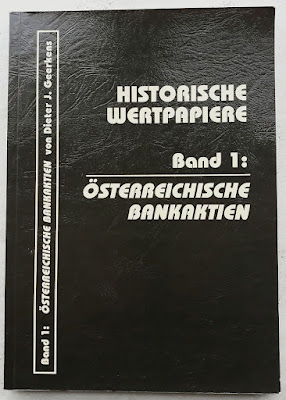
Reference book: Österreichische Bankaktien by Dieter J. Geerkens

Historische Wertpapiere Band 1: Österreichische Bankaktien is a reference catalog on antique bonds and shares from banking companies formed within the territory of Austria, including those banks set up during the Austro-Hungarian Empire. The book, a large format publication, was put together by author Dieter J. Geerkens. 


  • Title: Österreichische Bankaktien
  • Author : Dieter J. Geerkens
  • ID : no ID, published 1998 by Dieter J. Geerkens
  • Languages : German
  • Number of pages : 255
  • Images : more than 120 black and white and 150 page wide color images
  • Index : on company names; index located on page 51 


The  catalog entries are divided over two sections. 

A first small section, "Zwischenkatalog", describes the companies that lasted only a few months, and of which no securities are known (at least at the time when this book was published). This part includes about 40 companies that were founded just before or after the Vienna Stock Exchange Crash of 1873. Some examples are : Grazer Bankverein, Pfandlei-Anstalt Steyr, etc. 

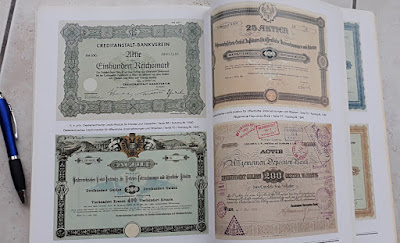
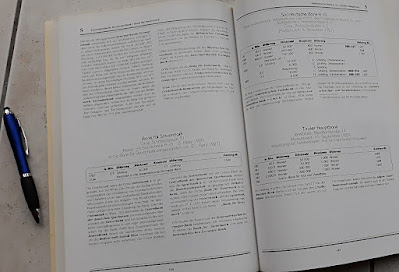
The second section, "Hauptkatalog", features about 140 banks with background information and a listing of their known securities. Each certificate has a catalog number referring to its entry in the price catalog chapter, and color photographs in the last part of the book. Some of the companies included are : British-Oesterreichische Bank- und Handels-Aktiengesellschaft, OrientBank (Palästinabank), Tiroler Hauptbank, etc.


Chapters
  • Vorwort und Erklärungen (Preface and explanations)
  • Kapitel 1 : Die Wiener Börse (Chapter 1 : The Vienna Stock Exchange) 
  • Kapitel 2: Die Banknoten (Chapter 2 : The banknotes)
    • Das Papiergeld
    • Verpfändung
    • Steueränderungen
    • Kriegsfinanzierung durch Steuern
    • Inflation
    • Bankozettel 1800
    • Wiener Stadt Banco Zettel Papiergeld anno 1800
    • Zollerhöhungen
    • Vorratsversteuerung
    • Der Friede von Austerlitz
    • Einlösungsscheine
    • Einlösungsdeputation
    • Keine neuen Steuern - Pferde vom Kaiserhaus
    • Staatsschulden-Tilgungsfonds
  • Kapitel 3: Die ersten Aktienbanken (Chapter 3: The first joint-stock banks)
    • Die Hofhaltung war kostspielig
    • Die privilegierte Oesterreichische Nationalbank
    • Die ersten Aktienbanken | Erneuerung des Notenbankprivilegiums 1841
  • Kapitel 4: Die Oesterreichisch-Ungarische Bank
    • Viertelaktie der Oesterreichischen Nationalbank
    • Aktie der Oesterreichischen Nationalbank
    • Interimsschein der Oesterreichischen Nationalbank
  • Kapitel 5: Die Bankgeschichte 1855 bis 1938 (Chapter 5: Banking history 1855 to 1938)
    • Der Wiener Börsenkrach 1873
    • 1873 bis 1914
    • Die Friedenszeiten von 1866 bis 1914
    • Erinnerungen an 1873
  • Kapitel 6: Historische Wertpapiere: Aktienbanken (Chapter 6: Historical securities: joint-stock banks)
    • Inhaltsverzeichnis der Aktienbanken
    • Zwischenkatalog
    • Hauptkatalog
  • Kapitel 7: Preiskatalog
  • Literaturverzeichnis (Literature list)
  • Anhang: Farbteil (Appendix: Color section)


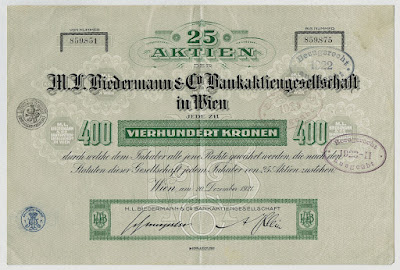
The M. L. Biedermann & Co. Bankaktiengesellschaft was originally founded in 1792 by Michael Lazar Biedermann, imperial Austrian court jeweler and co-founder of the Jewish community in Vienna. This  certificate for 25 shares of 400 Krone was issued in Vienna, 1921 and printed by H. Engel & Sohn. Other types of this share are illustrated in the catalog as number 1153, 1154 and 1157. 


The book was published almost 25 years ago, so the price indications (mentioned in Austrian Shilling) are not relevant anymore. Yet, this is a top work for anyone interested in the history of Austrian banking described and well illustrated in the first 50 pages of this volume. The color photographs are really well made! 


F.L.


Previous posts

Sunday, May 9, 2021

Feuerwerk at HSK's May auction! Over 1400 antique stocks and bonds from Germany, USA and other states, go on the block

Hanseatisches Sammlerkontor für Historische Wertpapiere, HSK, has scheduled its next auction for 29 May 2021. Michael Weingarten and his team goes online with more than 1400 lots of historic bonds and share certificates. The sale features scripophily from Germany, USA, Russia and more. One of the highlights is a stunning and rare share in the Rochlitz coal mining association.


The Gründerzeit starts halfway the 19th century. During this period Germany's rail and transport network took off, and in its wake, the other industrial activities. However, government rules allowed only very few companies to be organized.  
The short-lived Steinkohlenbau-Verein zu Rochlitz was formed in 1855. Its interim share, a wonderful lithograph, shows at the top the city of Rochlitz and mining scenes on the left and the right. At the bottom we see gnomes at work and an explosion in their mine. Seldom seen in early prints you detect mined rock with imprints of fossilized plants. L(ot) 1168 in the auction is expected to realize at least €12,000 


Starting with this auction, HSK's 40th, the auctioneer decided to change its schedule. HSK auctions will now take place in the early summer period of the year. Also, participants have now the opportunity to follow the auctions live on the Internet via the Invaluable online platform. 


The Alaska Gold Syndicate Company was formed in 1896 under the laws of the Territory of Arizona. Its office was located in "the end of the road " Homer,  Kachemak Bay, Alaska. This 1898 stock certificate, with large hydraulic mining vignette, was printed by the Hamilton Bank Note Engraving & Printing Co. L15 in the auction.

The first major section in the event includes 330 lots of American scripophily. Noteworthy are several certificates from Alaska, as well as stocks from several shipping companies, such as L313, Union Navigation Company, L314, The United States and Azorean Steam Packet Company, and L318, The United States Mail Steamship Company. And there is a lot to go through for US railroad collectors as well, a few examples :
  • L67 Chester and Eddystone Street Railway, elk vignette
  • L199 The Natchitoches and Red River Valley Railway, rare
  • L329 The Wilmington, Charlotte and Rutherford Railroad Company, three vignettes, rare


Merchants from Bremen formed in 1856 Norddeutscher Lloyd, a precursor of the multinational TUI Group. This rare 100 Reichsmark share from 1929 illustrates the printing mastership of Giesecke & Devrient. Note how Norddeutscher Lloyd's logo, a crossed anchor and key with an oak leaf wreath, is included in both the left corner guilloches. The anchor represents the sea and the wreath stands for a united Germany. The key is the key of the Freie Hansestadt Bremen. L603 starts from €300 


HSK specializes in scripophily from North Germany. The sale counts about 200 lots from Bremen and Niedersachsen, over 100 lots related to Hamburg and more than 40 lots from Schleswig-Holstein and Mecklenburg-Vorpommern. The Norddeutscher Lloyd share shown here is one example. Some others are :
  • L461 Aper Canal-Gesellschaft, 1849, what a shipping vignette! 
  • L478 Bremerhavener Strassenbahn, rare
  • L638 Uelzener Bierbrauerei-Gesellschaft, bond printed by Hofbuchdruckerei der Gebrüder Jänecke from Hannover 
  • Due to the spartan equipment of its ships and the notoriously poor catering, the Deutsch-Australische Dampfschiffs-Gesellschaft earned the nickname "the German-Austerity-Line". Its rare share from 1888 is one of the highlights in the auction, L671 


After World War I the Nürnberg area counted several competing brands of motorcycles such as Ardie, Mars and Zündapp.  Apparatebau AG Kracker & Co. produced in the early 1920s several lightweight motorcycles under the Abako brand. This specimen share, with hundreds of gears in the design, was produced in a striking Art Deco style by Graphische Kunstanstalt Zerreiss & Co. L828


The European section, lot range 365 through 452, includes historic items like a 1918 share in the Det-Østasiatiske Kompagni, L365, and, L409, Kaiser Ferdinands Nordbahn, 1856. And here is a representative of modern scripophily, Austrian Airlines.


In 1988 Austrian Airlines underwent an IPO upon the Vienna Stock Exchange. Yet the majority of shares in the company stayed with the Austrian government. L375, Austrian Airlines Österreichische Luftverkehrs-AG, Wien, 1000 Schilling share, 1988, starts at €100 


There is a lot more to discover in the sale, so here are the details :


F.L.


PS : Did you like this post ? Thank you for sharing it on you favorite social media channel !

Wednesday, February 10, 2021

F.H.W. auctions 1900 lots of historic securities in online event. Scripophily from Germany and Austro-Hungarian Empire substantial.

Freunde Historischer Wertpapiere (FHW) has scheduled its 119th sale for February 20, 2021. This time auctioneer Jörg Benecke and his team selected nearly 1900 lots of historic bonds and share certificates. Major sections have been reserved for scripophily from the USA, the Austro-Hungarian Empire, and of course Germany.

The auction starts with the American scripophily section, over 240 lots, the bigger part being railway securities. 


L(ot) 41 is an uncancelled! stock certificate from The Cincinnati, Portsmouth & Virginia Railroad Company. Henry Fink signed in 1903 this share as President. He was born in Germany and was called the "Dean of Railroad Men", a title he earned for his continuous service in the railroad field. Fink started his career in 1851 as a rodman on the Western Maryland Railroad. Within several railroad companies he climbed up from construction engineer and master of transportation all the way to vice president, general manager, and receiver. Henry Fink wrote several works on transportation subjects.


Here are some other interesting US railway lots : 
  • L44, The Cincinnati, Washington & Baltimore Railroad, 5% First Income Mortgage Bond, $1000, 1883, rare 
  • The Tyrone and Clearfield Railway Company share from 1867, L221, displays a lovely railway vignette and is signed by John Edgar Thomson best know for his leadership of the Pennsylvania Railroad. Thomson, an entrepreneur but also a reknown civil engineer co-designed what became known as "Horseshoe Curve".
  • L29, The Central Pacific Railway Company, $500 4% First Refunding Mortgage Gold Bond, 1899, color print by ABN with portrait of Collis Potter Huntington, rare 

One of the main roles in FHW's event is played by k.u.k. and its successor states (Nachfolgestaaten). The Austro-Hungarian Empire (1867-1918) comprised Austria, Hungary and parts of todays Italy, Serbia, Croatia, Romania, Slovakia, Czech Republic, Poland and Ukrain. It was the second-largest country in Europe after the Russian Empire at over 620,000 km2. The "kaiserlich und königlich" refers to "imperial (Austria)" and "royal (Hungary)".  The sale features over 300 k.u.k. lots including this lovely fire engine share.


L507 is a 100 Forint share from the Tarnóczy Tűzoltószer- És Gépgyár Részvenytársasag, in English: Tarnóczy Fire engine and Machine Company. Issued in Budapest, 1891, it shows the company's factory, hand-operated fire engines, lathes, a blacksmith and a firefighter with firehose. 


The lion's share of new offerings can be found in two major sections of the auction: Germany before, and, after 1945. The former counts 272 lots, the latter - the "DM" part - features 495 lots. As good as all regions and economic themes are represented. I checked out the catalog reference index on 'breweries and malthouses' and found tens of entries ! 


The economy of West Germany developed rapidly after World War II. This "Wirtschaftswunder" created a heavy demand for steel. German post-WWII securities are often artistically designed. Modern German steel scripophily counts perhaps the most stunning examples. Check FHW's catalog for L1816 Stahlwerke Peine-Salzgitter, L1542 Dortmund-Hörder Hüttenunion and L1641 Hüttenwerke Phoenix. This 1000 DM specimen share in the Rheinisch-Westfälische Eisen- und Stahlwerke AG dates from 1953, L1764 in the sale. Click image to enlarge


Top German item in the sale is L1223, a founders share from 1838 in the Gesellschaft für Spinnerei & Weberei in Ettlingen, the first public limited company in the German cotton industry. The share shows the detailed floor plan of the factory and its usage of hydropower from the Alb, a tributary of the Upper Rhine. The company is known today as ETTLIN AG and still manufactures fabric and technical textiles. 

You want to inspect the "50%" lot range 688-1126. Here, unsold lots from previous sales are offered again at 50% of the original start price. Included are also bonds and shares from the Dr. Werner P. Schmidt Automobile and China Collection.  


From the Dr. Werner P. Schmidt Automobile Collection, L881 consists of two Volvo shares from the 1930s. Volvo was founded in 1927 as a subsidiary of the ball bearing manufacturer SKF. The share shown here bears the facsimile signature of SKF founder Sven Wingqvist. 


There is a lot to discover in the sale, so here are the details :


F.L.


PS : Did you like this post ? Thank you for sharing it on you favorite social media channel !


Monday, September 21, 2020

FHW sells Chinese scripophily collection

Freunde Historischer Wertpapiere has scheduled its 118th auction for October 3rd 2020. This time more than 1,500 lots of antique securities will go under the hammer including the China collection of former Volkswagen CFO Dr. Werner P. Schmidt.

This scripophily event starts off with more than 300 American lots with the emphasis on US railway stocks and bonds.


A stunning print, this share from the Alaska Central Railway Company was issued in 1903. Engraved by the Seattle Engraving Company and printed by Yerkes Printing Company, it shows a full map of Alaska with the proposed route of the railroad and where timber, coal, gold, copper and quartz were to be found. Click the image to enlarge and note the area on top of the map designated as 'UNEXPLORED'. Lot 3 in the auction 


China collectors and investors will be interested in the collection of Dr. Werner P. Schmidt, recently deceased, and former CFO of Volkswagen AG. The series starts with lot 325, a share from the Aka-Dine Wood Production Company, and features several more shares from Taiwan. 

The Schmidt collection also counts several external loans from China. A £1000 bond from The Chinese Central Government Loan aka Arnold Karberg Loan III, only 300 issued, very rare, is one of the highlights and is expected to realize €5000. Lot 334 in the sale.


Chinese Government 23rd Year (1934) 6% Sterling Indemnity Loan for £1,500,000 
The Republic of China (ROC) was based in mainland China between 1912 and 1949, before the relocation of its government to the island of Taiwan. This £1000 bond shows the portrait of Sun Yat-Sen, Provisional President of the ROC. It was issued to finance the completion of the Canton-Hankow Railway. Part of the Dr. Werner P. Schmidt Collection and lot 338 in the auction.


Detail from lot 411, a share from the Kuangtun Canton-Hankow Railway Company (Kwong-Tung Yueh-Han), from the Dr. Werner P. Schmidt Collection. 


Germany gets the "lion's share" of the auction. Nearly 900 lots are divided over two sections, Deutschland (pre Deutsche Mark) and DM (from 1945 onwards). Note that both contain a subsection with 20 highlight picks from the auctioneer.


Offered as lot 1005 this 25 Reichsthaler Gold share in the Aper Canal-Gesellschaft was issued in 1849, Westerstede. The vignette is drawn by the artist A. Gordes. 


The catalog's table of contents reveals that scripophily from other countries is there as well. Nearly 100 lots represent the Austro-Hungarian Empire. Indexes on collecting themes, such as Art Nouveau, and German regions, may help you find what you are looking for.


Szeged is now one of the largest cities in Hungary. This share in the Szeged-Alsótanyai Népbank , or People's Bank of Szeged-Alsótanyai, was issued in 1906 when Szeged was still part of the Austro-Hungarian Empire. A great example of Szecesszió, the Hungarian Art Nouveau variant. Lot 569 


There is a lot to discover in the sale, so here are the details :
  • Location : The event takes place at Wolfenbüttel, however, at the time of writing, due to the covid-19 situation personal presence is likely not possible. Check out whether a visit is possible with the auction house. 
  • Date : 3 October, 2020
  • Further info, see here; PDF catalog see there; live bidding is possible through https://connect.invaluable.com/dwa/ 


"You will find happiness and joie de vivre while sleeping in a Steiner Paradies bed"
Now that's what we call maintaining a successful house-style. The Vienna subsidiary of the Paradiesbettenfabrik Steiner reused the photovignette from an earlier advertising campaign on its 1924 share. The Paradies brand still exists today. Lot 557 in the sale. 


F.L.

PS : Did you like this post ? Thank you for sharing it on you favorite social media channel !


Friday, March 27, 2020

Connoisseurs of British railway securities will be thrilled at Boone's next scripophily auction

The 64th auction of Mario Boone takes place online with an exceptional range of high quality collectibles. Nearly 1,700 antique stocks and bonds spanning 4 centuries of financial history represent about 100 countries.

Boone's next auction is set for 4 April 2020. Included are many genuine founder shares from famous companies. This is one from the Assicurazioni Generali Austro-Italiche. 


The very first share from the world famous Generali insurance company

Following the Napoleonic Wars, Trieste became the main trading port and shipbuilding centre of the Austrian Empire. There insurance expert Joseph Lazarus Morpurgo founded the Assicurazioni Generali Austro-Italiche in 1831. His company provided insurances against risks of marine and land transport, flood, fire, and much more, hence the name GENERALI.  One of its notable employees was writer Franz Kafka who worked for Generali in Prague in 1907 and 1908. This is Generali's share number 1, issued in Trieste, 1832, and signed by Morpurgo. Lot 943 in the auction is a top item for any scripophily collector of insurance companies or Italian/Austrian finance history. 


Connoisseurs of British railway securities will be thrilled. More than 120 lots come from an old collection that illustrates the rich and pioneering history of British railways. Even if you are not into railway scripophily, this is an exceptional opportunity to check out this series (lot range 789 through 914). Let me mention here a few of these gems :
  • L793 Blaydon, Gateshead & Hebburn Railway, stunning vignette; 
  • from Ireland, L804 River Line, Cork Blackrock and Passage Railway
  • L803 Clarence Railway, 1828!; 
  • L809 Durham and Sunderland Railway, rare, wax seal;
  • Another stunning vignette can be seen on a Liverpool and Manchester Railway certificate, 1826!, L845. 
  • L877 comprises a share from as early as 1804 - eighteen hundred and four !!! - issued by the horse-operated Oystermouth Rail-Way or Tram-Road. This company commenced to carry passengers in 1807. 


Monmouthshire Railway and Canal Company share transfer certificate with large vignette of train and barge approaching bridge

The Monmouthshire Railway and Canal Company operated a canal and a network of railways in south-east Wales. It started as the Monmouthshire Canal Navigation and opened canals from Newport to Pontypool and to Crumlin from 1796. The unusual large vignette on this 1854 share transfer certificate shows a train and a horse-drawn barge nearing a canal bridge. Click to enlarge image, L869 in the auction. 


Auctioneer Boone provides an extensive catalog for this sale with every lot described in detail (download link see below). Among the nearly 1,700 antique securities you'll find hundreds of little masterpieces. Their designs reflects the art style in vogue and often include vignettes from illustrators. Some examples :
  • L422 Comptoir de la Bourse de Bruxelles, illustrated by Charles Posch
  • Constand Montald's work can be seen on L443, Grands Magasins à l'Innovation, Bruxelles 
  • Oriental elements are abundant on L384 Société Foncière de Syrie
  • L691 Gewerkschaft "Deutsche Nickel-Gesellschaft" displays a super mining vignette
  • My favorite Art Deco share is the 100 Gulden share from the Nederlandsche Bakkerij-Centrale, Amsterdam, 1917, a work by Johan Rudolf Bonnet created before he went to live in Bali, L972


multicolor printed share in the Anatolian Rug Manufactoring Company from Greece

A little masterpiece is this 25 shares certificate from The Anatolian Rug Manufacturing Co. Ltd., Athens, dated 1924. Printed in multicolor by Aspiotis Brothers, banknote printers from Corfu, the share is adorned with oriental elements and shows carpet knotters at work. Despite their obvious activities, the scene is filled with silence. Click the image to enlarge, one of them noticed your attention. L924 in the sale


The catalog's comprehensive country index lists nearly 100 countries. In particular large sections (each containing between 40 and 250 lots) are Belgium, France, Germany, UK, Romania, Russia, Sweden, Australia, Netherlands Indies and the USA. Scripophily from less obvious, often exotic places, like British North Borneo, Iraq, Djibouti and Suriname is present as well.


Chile's Government Junta proclaimed Chile as an autonomous republic within the Spanish monarchy in 1810. Eight years later Chile declared its independency in 1818 which would only be recognized in 1844. The Anglo Chilian Mining Association, formed in London, 1825, is one of the earliest companies formed in the new state. L1519 in the auction.


It is impossible to mention all items in this sale, but there is a way to find out more about them. Here are the auction details :
  • Location : Internet only
  • Date : 4 April 2020
  • Further info : 

F.L.

PS This auction also includes the first part of a unique collection of Indonesian scripophily (ca. 250 lots! ). Find out more about this here .


Boone's 64th auction catalog includes also an index of collecting themes (besides countries). The sports entry refers to more than 20 shares, including this French 1911 share in the Olympic Tennis Club de Wimereux, Boulogne-sur-Mer. Lot 610 

Wednesday, February 28, 2018

Did the Republic of Austria start as a communist state ?

The Russian Revolution in 1917 led to the rise of the Soviet Union. The First Austrian Republic was created in 1919. Was Austria a communist state ? A daring statement. Let us have a look at Austria's coat of arms illustrated on the following bond.

4% Austrian lottery bond of  200 Kronen, 1920  with detail of Austrian coat of arms
4% Austrian lottery bond of  200 Krone, 1920 

Now check the emblem of the Soviet Union. It is depicted on the following  government loan. Do you see the similarities ?

USSR internal loan of the second five-year plan, 25 Rouble, 1935 with soviet emblem
USSR internal loan of the second five-year plan, 25 Rouble, 1935
This rare bond was auctioned by HWPH on 15 Oct 2016
together with a similar looking certificate, for €4,000
courtesy HWPH 

That's right, the Austrian eagle holds in its claws a hammer and a sickle, the main attributes of the soviet shield. Austria introduced its new shield in 1919 when it became a republic. Before that, Austria's coat of arms looked different as you can see here.

200 Krone bond from the 8th Austrian War Loan, 1918 design by Alfred Offner in Vienna Secession style
200 Krone bond from the 8th Austrian War Loan, 1918
design by Alfred Offner in Vienna Secession style 

Till the end of World War I, Austria was part of the Austro-Hungarian Empire, the Dual Monarchy. That's why we see a double-headed eagle on the previous bond.

After WWI Austria decided to change the looks of its eagle. Its sword and scepter was replaced with a sickle, its orb with a hammer. Up to the present, the Republic of Austria has been using that shield  on government bonds but also on banknotes and coins. 

Austrian Shilling banknote and coin with hammer and sickle eagle
above : 20 Shilling banknote, 1986, shield in upper left corner
below : 10 Shilling coin, 1974, by Awmcphee (Own work) [CC0], via Wikimedia Commons


The key question remains why Austria started using a hammer and a sickle in its shield ? Was it about communism ? I found the answer in a newsletter from CoinsWeekly/MünzenWoche which referred to THIS INTRIGUING VIDEO (5 min.) from the MoneyMuseum. Enjoy watching!

F.L.

Related links

Saturday, January 4, 2014

10 Years Wertpapierwelt

The town of Olten is only an hour's drive away from Zürich, Bern and Basel. Last summer it's Wertpapierwelt museum celebrated its tenth anniversary and surprised us with a threefold exhibition:
  • The first section, Shares & Co - How financial instruments work, displays the multifaceted nature of financial instruments and their workings.
  • The Story of capitalism – How shares changed the world is devoted to the origin and spread of the joint stock company throughout the last 400 years.
  • The special exhibition, The networked business world – Globalization and shares, provides an impression of just how globally interconnected the economy is with the most varied areas of our lives.

Dagmar Schönig is the curator at the Wertpapierwelt museum since the very beginning. Here is an interview with her.

Images by courtesy of Wertpapierwelt


Sociedad Mineralogica de la Ciudad de Arequipa engraved by Joseph Vazquez
Detail from the certificate, see below, of the 
Sociedad Mineralogica de la Ciudad de Arequipa company
Engraved by Joseph Vazquez
Vazquez, an engraver from the 18th and 19th century,
was also known for his map engravings as you can see
here

Me:
Dagmar, you are the curator of the Wertpapierwelt museum. This sounds like a dream job to some of us. 
Dagmar: 
I can imagine that the job as a curator in a museum of historical bonds and shares sounds like a dream job for any collector. However, you would run pretty quickly into a conflict of interests. That’s why the “code of ethics” of the International Council of Museums (ICOM) – which our museum is a member of – does not allow that employees of a museum are private collectors or professional dealers of objects that form the museum collection they have to work with.
Me:
Can you tell us something more about your work as a museum curator ?
Dagmar:
As the museum Wertpapierwelt is not “heavily staffed”, my job description covers a lot of different tasks:
1. I am in charge of  all aspects regarding the collection, i.e. inventory and all conservatory aspects (in case of old paper in exhibitions, mainly the light is a problem), I research historical backgrounds, make acquisitions according to the collection policy (within a given budget), and everything in between…
2. I plan exhibitions, develop the according concept, write all the texts, decide on the scenography with external exhibition builders, supervise the buildup and the production of the accompanying publications, control the costs, etc.
3. I have to run the day to day business of the museum, including providing guided tours for visitors, running marketing activities, making surveys and statistics, reporting to public authorities and  the board of the museum, etc. You see, it doesn’t get boring! 

share certificate of the Sociedad Mineralogica de la Ciudad de Arequipa
Sociedad Mineralogica de la Ciudad de Arequipa
Share certificate, Peru 1792
part of the The Story of Capitalism exhibition section

double-click image to enlarge

Me:
Does your earlier education somehow help you in being a scripophily curator ? 
Dagmar: 
In my “previous life” I have worked for several international banks. This professional background in the banking industry certainly helps me when it comes to explain the complexity of the finance business to the broad public. You have to understand that Wertpapierwelt does not just show historical securities and says “Look! What a nice old share”, but puts them into a wider context. We have a lot of school classes and visitors who have only a very vague idea about the differences between a share and bond for example. 
Originally I studied languages and economics – but that is a very long time ago. When I got the chance to take over the project of transforming an extensive collection of historical bonds and shares into a museum, I was thrilled! History, especially economic (and technical) history, had always interested me. And the beauty of most of the papers certainly helped my inspiration. Of course, I had to learn a lot in terms of “museum work” ! But we wanted from the beginning that Wertpapierwelt was run in a professional manner, therefore I started my further education and acquired my knowledge through professional training in classes provided by the Swiss Association of Museums and others. Now, I am additionally studying for a master degree in “Applied History” at the University of Zurich.
Me:
In your opinion, what key values are essential to a curator ?
Dagmar: 
As a curator of a museum you obviously have to have a profound knowledge of your objects”! You need to be curious about every aspect of their background and be a persistent researcher. Wikipedia is not enough!
In case of acquisitions, you must also have a good judgment of what fits your collection strategy and – often more difficult – what does not. It can be hard to let a certain piece go if you personally like it, but it just doesn’t fit.
You also have to really care for your objects and do everything for their good preservation, even if it means that you cannot show them as often or in a certain way, as you actually would like to do. Especially paper is very sensitive.
For setting up exhibitions you need a certain amount of creativity, the ability to tell an interesting story (which also means that you have fun researching it first and then putting your results into easily readable writing!), and – of course – you need project management skills (which means: stay cool!). 
Chen Feng Spinning and Weaving Company share certificate
Chen Feng Spinning and Weaving Company
pre-communist era

part of the "special" exhibition
double-click image to enlarge


Friday, November 1, 2013

The Copper Handbook - a manual of the copper mining industry of the world


The Copper Handbook, by Horace Stevens
image by Boone Shares
Following is a list of the elements with which copper is found chemically united in nature. This list includes 29 of the 77 elements known to science at this writing. Following the name of each element is its chemical symbol and atomic weight, as now figured by the best authorities : 


Aluminium Al 27.1
Antimony Sb 120
Arsenic As 75
Bismuth Bi 208.3
Calcium Ca 40.1
Carbon C 12
Chlorine Cl 35.45
Cobalt Co 59
Copper Cu 63.6
Hydrogen H 1.01
Iron Fe 56
Lead Pl 206.9
Manganese Mn 55
Nickel Ni 58.7
Niobium Nb 93.7
Nitrogen N 14.04
Oxigen O 16
Phosphorus P 31
Platinum Pt 195
Selenium Se 79.2
Silicon Si 28.4
Silver Ag 107.93
Sulphur S 32.06
Tellurium Te 127.5
Tin Sn 119
Tungsten W 184
Uranium U 240
Vanadium V 51.4
Zinc Zn 65.4


Excerpt from The Copper Handbook 1903, Vol. III for the year 1902, page 27


More than 2000 copper mines in all parts of the world
Scripophily auctioneers and a few blessed collectors use the book for researching companies. The 1903 issue contains 2207 company profiles. Most of the mines included are located in the USA, others are active in the following countries: Argentina, Austria, Australia, Algeria, Bolivia, Canada, Chili, Cuba, France, India, Italy, Ireland, Japan, Mexico, Norway, Peru, Portugal, Rhodesia, Russia, South Africa, Spain, Sweden, Turkey, UK and much more, even Sudan and New Caledonia. Many company descriptions span tens of lines, sometimes several pages. As an example, I included the profile of the Parrot Silver and Copper Company:


share certificate of the Parrot Silver and Copper Company
Parrot Silver and Copper Company
shares of 10 Dollars, issued in 1904, Butte, Montana
printed by Western Banknote Company, Chicago
In the Copper Handbook Vol. III the company
was ranked 25th in the list of largest copper producers.
double-click image to enlarge

PARROT SILVER & COPPER CO. - MONTANA
Mine office: Butte, Silver Bow Co., Montana. Harry A. Galway, superintendent. Has a stock issue of 230,000 shares, bulk of which is held by the Amalgamated Copper Co. This company is mixed up to some extent in the litigation that is so unpleasant a feature of mining operations in Butte. Principal mines are the Little Minah and Parrot, opened circa 1884. Company holds 19 claims in all, mostly well located. A barren zone occurs at a depth of about 1,000' , but good ore bodies are found below. Production is at the rate of about 12,000,000 pounds yearly. The ores carry fair values in silver and gold, as well as copper. Mine employs 300 to 400 men, when working full force. The Little Minah mine has a 1,000' two-compartment shaft connected underground with the Nipper. The Parrot mine is about 1,700' deep, main shaft having 3 compartments to 400' level and 4 compartments below, connected underground with Colusa-Parrot, Never Sweat, Nipper and Original mines.

detail from share certificate depicting parrot and ingot
detail from the Parrot Silver and Copper Company's stock certificate
vignette of a brainy parrot claiming his ingot (I want a parrot like that)


This book is encyclopedic
Do you know the meaning of following terms or expressions? Watch out! I can not pronounce some of these words I. Don't hurt yourself in the act.
  • pertenencia: one mineral claim in Mexico; area, one hectare or 2,471 acres
  • cutting down: when a shaft is enlarged, work begins at the top, and the work of enlargement is called cutting down
  • dognacskaite: a sulphide of bismuth and copper; carrying about 12% copper; from Hungary
  • pinching out: the narrowing of a vein to extinction

When was the first copper shipment from the Australian continent ? Answer: 1843
What was the world's largest mine in the early 1900s ? Answer: The Anaconda Copper Mining Company, Butte, Montana, producing more than 100,000,000 Pounds in 1901.

Tuesday, November 1, 2011

Uncharted - Belgian artist Posch


Many Belgian shares and bonds issued at the end of the 19th century are beautifully designed by the artist Charles Posch. I believe there is no other artist in the world that has been as productive in the field of securities.  His artwork is often signed with C. Posch or Ch. Posch.

Nevertheless Posch remains a mystery because I simply can not find any information about him or his work. Regrettable !

Who can provide some information about Charles Posch ?
F.L.


View on the city of Vienna  (seen from the Belvedere? )
Signature of C. Posch in the lower right corner.
Double-click to enlarge.

Compagnie des Eaux de Vienne
4.5% Obligation de 500 Francs, 1895
Design by Posch
Printed by Lithographie de la Cote Libre, Bruxelles
Double-click to enlarge