Showing posts with label Peru. Show all posts

Saturday, April 29, 2023

Auctioneer Boone celebrates 40th anniversary in Antwerp: oldest stock exchange building houses international scripophily auction and bourse

Mario Boone's 70th scripophily event spans 4 days! On Saturday May 6, a live auction with nearly 800 lots of historic and splendid antique shares and bonds takes place at the "Handelsbeurs" in Antwerp, the oldest stock exchange building in the world.

An international scripophily bourse with free entrance for any visitor is organized at the same location on Sunday May 7. A great opportunity to see antique securities in the center of Antwerp.

On Monday 8 and Tuesday 9 May, roughly 1500 more interesting lots will be sold through the Invaluable platform (live internet auctioning) or via the usual absentee bidding options.


This 1884 share in the Fabrica de Faianças das Caldas da Rainha, a porcelain factory from Portugal, is superbly designed and printed. Against a background of tiles the drawing combines a still life with more than 10 animals. Can you find them? L(ot) 463 starts at €1000. 


Saturday morning kicks off with a section of some 200 lots from Belgium Congo, Ruanda-Urundi and Belgium, including a 1899 Banque Coloniale de Belgique share certificate showing African scenes, L(ot) 6, and L34, a brewery share in the Brasserie de Stanleyville from 1949, both starting at €50. 

Noteworthy in the Belgian chapter are:  L82, Exposition Internationale Coloniale et d'Art Flamand Anvers 1930, a share subscription for the colonial exhibition in 1930, start price €50, and L84, a $500 gold bond from the City of Antwerp. Not to be missed is L97, Compagnie Internationale des Telephones, the oldest Belgian telephone share, 1881, with a large underprint of an early telephone. 


The Société de Zoologie in Antwerp, one of the oldest zoos in Europe, was founded in 1843. Its shareholders could enter the zoo for free on showing their share, hence the folds. Printed in 1843 by Joseph-Ernest Buschmann and designed by his brother and painter Gustave Buschmann. L299, €300 


More Belgian's, and this applies to other countries too, can be found in a mammoth World Highlights section, lot range 193-775. Some examples :
  • The Société Anonyme d'Horticulture et de Botanique de Gand was founded by botanists who started holding botanic exhibitions known as "Gentse Floraliën". Its share from 1835, decorated with flowers, is extremely rare, L294.
  • A top object in any art collection is the 1897 share from the Compagnie Fermière des Eaux Minerales de Genval. It is designed by Art Nouveau architect, painter and designer Paul Cauchie, known for his sgraffito technique. Only three certificates were found in the 1990s, and this is the last one available. L310 starts at €10,000 and can be seen in detail on the auctioneer's brand new website here.
  • The world famous Lotus Bakeries is listed on Euronext Brussels and run by Jan Boone, the grandson of founder Jan Boone sr. This specimen founder share of the Banket- en Peperkoekbakkerij "LOTUS" voorheen "Boone Gebroeders" dates from 1934 and is the only one known to the auctioneer, L318.


Then part of of the French colonies, the Mekong delta with its shallow waters was the perfect place to use "de Lambert hydroglisseurs", aka airboats. This 1920 share from the Société Anonyme des Hydroglisseurs "de Lambert", L228, starts at €200. 


In the Australasia, Asia and Africa sections I spotted these items:
  • Bank of Australia, Sydney, 1833, early share printed on vellum, L193
  • L205 is a nominative share from the Société Provinciale Privilégiee du Fokien - Hoa-Hu, China, 1902, company set up by diplomat Paul Claudel, Chinese landscape.
  • Opium shares are rarely seen. L226 is a nominative share from the Société Fermière de l'Opium au Tonkin, issued in Hanoi, 1887.
Lot range 271 through 279 comes from a diamond collection and includes scarce items such as a 1889 share from The Borneo Diamond Exploration Syndicate. 


This 100 soles share in the Compañia Explotadora de Perlas de Sechura, Lima, 1902, is part of a collection of 214 bonds and shares from Peru, L676. 


The European chapter is the largest one with over 300 lots, L280-L595. This blog format doesn't lend itself for enumerating all lots. Here are some of many astonishing historic securities:
  • L375 and L376 are two Eiffel companies: Société de Constructions de Levallois-Perret and the Société de la Tour Eiffel both showing the Eiffel tower.
  • Christiana Bye og dens Oplands Korn-Selskab, freely translated as Christiania Town and its Upland Grain Company: extremely early Norwegian share, dated 1810, from the time when Denmark ruled Christiania, today Oslo, L451
  • A Swiss watch collection, L563 through L574, includes names like LeCoultre, Tissot and Longines.


L338, Compagnie Générale Maritime, 1856, signed by politician and financier Emile Pereire, gorgious design by painter and engraver Melchior Péronard, €3000 


Over 50 lots of securities and related documents are featured in the 16th-18th century section, including:
  • A 1679! bond from the city of Enghien, Haunaut province, in need for financial resources under French occupation, 4 wax seals, L596
  • On Aug 27, 1701, Philip V, King of Spain and Louis XIV signed a treaty granting France the exclusive privilege to supply the Spanish colonies in the Americas with African slaves. This right was called the "Asiento". Issued in 1703 for 3000 Livres this share in the Compagnie Royale de l'Assiente, is an important evidence of imperialistic slave-trading practises in the 18th century and extremely rare, L607.


Rio de Janeiro Tramway Light and Power Company Limited, 1 share, text in English, French and German, 1909, facsimile signature of electrical engineer and entrepreneur Frederik Stark Pearson, L664, €200


The Latin America chapter, lots 657 through 677, include several remarkable collection lots. Each of these will be offered as a single group, and only when no bids are made, each collection will split and offered into single item lots in the online sessions on the following Monday & Tuesday:
  • L658 collection of Brasilian government bonds
  • L659 collection of Brasilian state bonds
  • L660 collection of Brasilian railroad certificates
  • L661 collection of Brasilian port/shipping certificates
  • L662 collection of Brasilian Industrial securities
  • L670 collection of Mexican scripophily
  • L676 collection of bonds and shares from Peru 
More Latin Americ scripophily, as is the case for other themes, will be auctioned on the two online sessions on 8 & 9 May 2023.


L682, New Jersey Southern Rail Road Company, $1000 bond, 1873 signed by railway tycoon Jay Gould, extremely rare, €12000


The American section of the Saturday highlights is divided in three chapters : Jay Gould , railroads, and various themes. To name a few:
  • The 50 cents bond, 1841, from the Ocmulgee and Flint River Rail Road Company is not only small in size and value, but rare as well. L689
  • L763 is stock certificate from The Kansas City Distilling Company, a whisky maker, view of the distillery, 1889
  • The World's Columbian Exposition was held in Chicago in 1893. It's share shows a lovely vignette of an allegorical woman and an underprint of the exposition site. L765
A tip for American railway collectors, you should check out Coxrail on this auction, see here


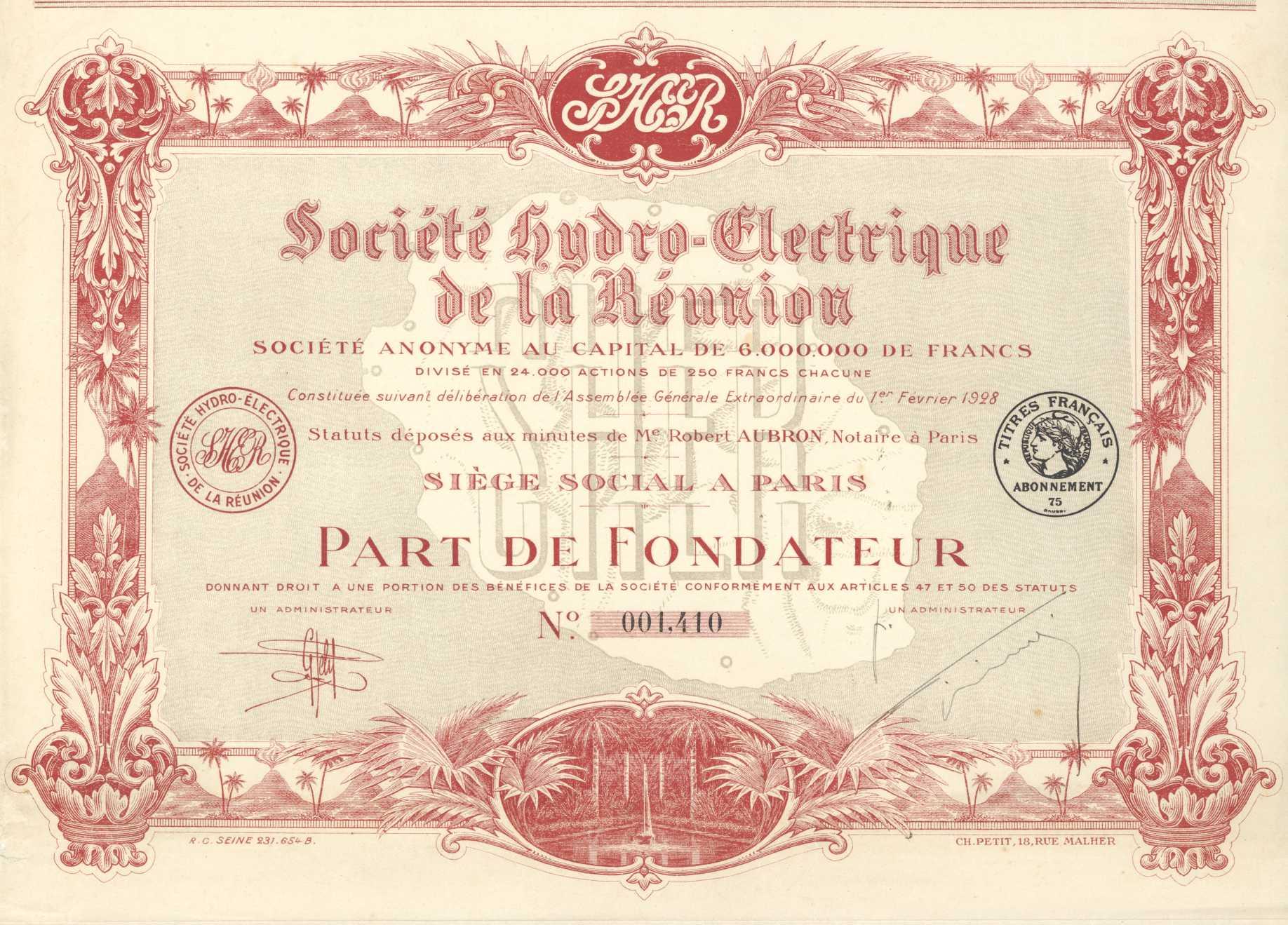
Société Hydro-Electrique de la Réunion, founder's share, 1928, map of Réunion in underprint and border with a pattern of volcanos, likely the Piton de la Fournaise, L927, €50 


The online sessions of this event are scheduled the days after the bourse on Sunday. These offer another 1500 lots of scripophily (or a bit less when the Latin American collections are hammered on the preceding Saturday - see above). Use the catalog's indexes or the search functions on the auctioneer's new website to find what you need.

The weekend of 6 & 7 May is a chance to see some great antique securities. The venue is the Handelsbeurs Antwerpen. 

Here are the auction details :
F.L.


PS : Did you like this post ? Thank you for sharing it on you favorite social media channel !


Monday, April 17, 2017

HWPH auctions scripophily from Albert Pick

Das Historisches Wertpapierhaus (HWPH) offers over 2,400 lots of historic securities in two upcoming auctions. The sale includes a section of bond and share certificates, promissory notes and checks which were collected by numismatic pioneer Albert Pick (lots 896 through 927).

From the Albert Pick collection :
6% 100 soles government bond, 1875, Lima Peru
The sol was introduced in 1863 when Peru completed its decimalization.
It replaced the real at a rate of 1 sol = 10 reales.
 

Albert Pick (1922-2015) is the most famous numismatist in the field of banknotes. He started collecting banknotes as a child. In 1964 Pick had assembled 180,000 banknotes, a collection he gave to the Bayerische Hypotheken- und Wechselbank. In exchange for that, the bank appointed him curator of the collection. Since then, and having lots of material at his disposal, Pick started to write books and paper money catalogs. The first edition of his Standard Catalog of World Paper Money was published in 1975 and is used all over the world. It assigns every banknote issued the well-known 'Pick number'.


Auction details

  • Dates & location
    • HWPH Auction 45 (lots 1-927): 29 April 2017, Würzburg
    • HWPH Auction 46 (lots 928-2425): 1 May 2017, Internet only
  • More info 

F.L.


Monday, October 5, 2015

HWPH - Auction 39 and 40


HWPH Auction 39
cover: Preussische Boden Credit Actienbank
Share of 200 Thaler, Berlin, 1873
printed by Preußische Staatsdruckerei


Lot 105 in HWPH Auction 39
Potosi, La Paz & Peruvian Mining Association
Consolidated Share of £ 15, London, 1827
design with early lathe work printing by John Ellis
--
One of the first Bolivian mining companies as 
Bolivia's independence was proclaimed on July 10, 1825. 
double-click images to enlarge

early vignette of Potosi silver mountain
The coat of arms of Bolivia depicts
the Potosi silver mountain with a sun rsing above it.


HWPH Online Auction 40
cover: Ushitschko Akzionarsko Druschtwo "Zlatibor"
5 Shares of 200 Dinar
Uzice, Yugoslavia, 1921


  • Date: 17 October 2015  - Auction 39 ;  19 October 2015 - Auction 40
  • Place: Auction 39, Wiesbaden, GERMANY
  • Further info, see here


F.L.

Saturday, January 4, 2014

10 Years Wertpapierwelt

The town of Olten is only an hour's drive away from Zürich, Bern and Basel. Last summer it's Wertpapierwelt museum celebrated its tenth anniversary and surprised us with a threefold exhibition:
  • The first section, Shares & Co - How financial instruments work, displays the multifaceted nature of financial instruments and their workings.
  • The Story of capitalism – How shares changed the world is devoted to the origin and spread of the joint stock company throughout the last 400 years.
  • The special exhibition, The networked business world – Globalization and shares, provides an impression of just how globally interconnected the economy is with the most varied areas of our lives.

Dagmar Schönig is the curator at the Wertpapierwelt museum since the very beginning. Here is an interview with her.

Images by courtesy of Wertpapierwelt


Sociedad Mineralogica de la Ciudad de Arequipa engraved by Joseph Vazquez
Detail from the certificate, see below, of the 
Sociedad Mineralogica de la Ciudad de Arequipa company
Engraved by Joseph Vazquez
Vazquez, an engraver from the 18th and 19th century,
was also known for his map engravings as you can see
here

Me:
Dagmar, you are the curator of the Wertpapierwelt museum. This sounds like a dream job to some of us. 
Dagmar: 
I can imagine that the job as a curator in a museum of historical bonds and shares sounds like a dream job for any collector. However, you would run pretty quickly into a conflict of interests. That’s why the “code of ethics” of the International Council of Museums (ICOM) – which our museum is a member of – does not allow that employees of a museum are private collectors or professional dealers of objects that form the museum collection they have to work with.
Me:
Can you tell us something more about your work as a museum curator ?
Dagmar:
As the museum Wertpapierwelt is not “heavily staffed”, my job description covers a lot of different tasks:
1. I am in charge of  all aspects regarding the collection, i.e. inventory and all conservatory aspects (in case of old paper in exhibitions, mainly the light is a problem), I research historical backgrounds, make acquisitions according to the collection policy (within a given budget), and everything in between…
2. I plan exhibitions, develop the according concept, write all the texts, decide on the scenography with external exhibition builders, supervise the buildup and the production of the accompanying publications, control the costs, etc.
3. I have to run the day to day business of the museum, including providing guided tours for visitors, running marketing activities, making surveys and statistics, reporting to public authorities and  the board of the museum, etc. You see, it doesn’t get boring! 

share certificate of the Sociedad Mineralogica de la Ciudad de Arequipa
Sociedad Mineralogica de la Ciudad de Arequipa
Share certificate, Peru 1792
part of the The Story of Capitalism exhibition section

double-click image to enlarge

Me:
Does your earlier education somehow help you in being a scripophily curator ? 
Dagmar: 
In my “previous life” I have worked for several international banks. This professional background in the banking industry certainly helps me when it comes to explain the complexity of the finance business to the broad public. You have to understand that Wertpapierwelt does not just show historical securities and says “Look! What a nice old share”, but puts them into a wider context. We have a lot of school classes and visitors who have only a very vague idea about the differences between a share and bond for example. 
Originally I studied languages and economics – but that is a very long time ago. When I got the chance to take over the project of transforming an extensive collection of historical bonds and shares into a museum, I was thrilled! History, especially economic (and technical) history, had always interested me. And the beauty of most of the papers certainly helped my inspiration. Of course, I had to learn a lot in terms of “museum work” ! But we wanted from the beginning that Wertpapierwelt was run in a professional manner, therefore I started my further education and acquired my knowledge through professional training in classes provided by the Swiss Association of Museums and others. Now, I am additionally studying for a master degree in “Applied History” at the University of Zurich.
Me:
In your opinion, what key values are essential to a curator ?
Dagmar: 
As a curator of a museum you obviously have to have a profound knowledge of your objects”! You need to be curious about every aspect of their background and be a persistent researcher. Wikipedia is not enough!
In case of acquisitions, you must also have a good judgment of what fits your collection strategy and – often more difficult – what does not. It can be hard to let a certain piece go if you personally like it, but it just doesn’t fit.
You also have to really care for your objects and do everything for their good preservation, even if it means that you cannot show them as often or in a certain way, as you actually would like to do. Especially paper is very sensitive.
For setting up exhibitions you need a certain amount of creativity, the ability to tell an interesting story (which also means that you have fun researching it first and then putting your results into easily readable writing!), and – of course – you need project management skills (which means: stay cool!). 
Chen Feng Spinning and Weaving Company share certificate
Chen Feng Spinning and Weaving Company
pre-communist era

part of the "special" exhibition
double-click image to enlarge


Friday, November 1, 2013

The Copper Handbook - a manual of the copper mining industry of the world


The Copper Handbook, by Horace Stevens
image by Boone Shares
Following is a list of the elements with which copper is found chemically united in nature. This list includes 29 of the 77 elements known to science at this writing. Following the name of each element is its chemical symbol and atomic weight, as now figured by the best authorities : 


Aluminium Al 27.1
Antimony Sb 120
Arsenic As 75
Bismuth Bi 208.3
Calcium Ca 40.1
Carbon C 12
Chlorine Cl 35.45
Cobalt Co 59
Copper Cu 63.6
Hydrogen H 1.01
Iron Fe 56
Lead Pl 206.9
Manganese Mn 55
Nickel Ni 58.7
Niobium Nb 93.7
Nitrogen N 14.04
Oxigen O 16
Phosphorus P 31
Platinum Pt 195
Selenium Se 79.2
Silicon Si 28.4
Silver Ag 107.93
Sulphur S 32.06
Tellurium Te 127.5
Tin Sn 119
Tungsten W 184
Uranium U 240
Vanadium V 51.4
Zinc Zn 65.4


Excerpt from The Copper Handbook 1903, Vol. III for the year 1902, page 27


More than 2000 copper mines in all parts of the world
Scripophily auctioneers and a few blessed collectors use the book for researching companies. The 1903 issue contains 2207 company profiles. Most of the mines included are located in the USA, others are active in the following countries: Argentina, Austria, Australia, Algeria, Bolivia, Canada, Chili, Cuba, France, India, Italy, Ireland, Japan, Mexico, Norway, Peru, Portugal, Rhodesia, Russia, South Africa, Spain, Sweden, Turkey, UK and much more, even Sudan and New Caledonia. Many company descriptions span tens of lines, sometimes several pages. As an example, I included the profile of the Parrot Silver and Copper Company:


share certificate of the Parrot Silver and Copper Company
Parrot Silver and Copper Company
shares of 10 Dollars, issued in 1904, Butte, Montana
printed by Western Banknote Company, Chicago
In the Copper Handbook Vol. III the company
was ranked 25th in the list of largest copper producers.
double-click image to enlarge

PARROT SILVER & COPPER CO. - MONTANA
Mine office: Butte, Silver Bow Co., Montana. Harry A. Galway, superintendent. Has a stock issue of 230,000 shares, bulk of which is held by the Amalgamated Copper Co. This company is mixed up to some extent in the litigation that is so unpleasant a feature of mining operations in Butte. Principal mines are the Little Minah and Parrot, opened circa 1884. Company holds 19 claims in all, mostly well located. A barren zone occurs at a depth of about 1,000' , but good ore bodies are found below. Production is at the rate of about 12,000,000 pounds yearly. The ores carry fair values in silver and gold, as well as copper. Mine employs 300 to 400 men, when working full force. The Little Minah mine has a 1,000' two-compartment shaft connected underground with the Nipper. The Parrot mine is about 1,700' deep, main shaft having 3 compartments to 400' level and 4 compartments below, connected underground with Colusa-Parrot, Never Sweat, Nipper and Original mines.

detail from share certificate depicting parrot and ingot
detail from the Parrot Silver and Copper Company's stock certificate
vignette of a brainy parrot claiming his ingot (I want a parrot like that)


This book is encyclopedic
Do you know the meaning of following terms or expressions? Watch out! I can not pronounce some of these words I. Don't hurt yourself in the act.
  • pertenencia: one mineral claim in Mexico; area, one hectare or 2,471 acres
  • cutting down: when a shaft is enlarged, work begins at the top, and the work of enlargement is called cutting down
  • dognacskaite: a sulphide of bismuth and copper; carrying about 12% copper; from Hungary
  • pinching out: the narrowing of a vein to extinction

When was the first copper shipment from the Australian continent ? Answer: 1843
What was the world's largest mine in the early 1900s ? Answer: The Anaconda Copper Mining Company, Butte, Montana, producing more than 100,000,000 Pounds in 1901.