Showing posts with label Ukraine. Show all posts

Sunday, May 22, 2022

Collecting antique stock certificates ? Go to the next level with Scripophily magazine !

Scripophily magazine is the world’s most comprehensive and insightful publication for passionate collectors and researchers of antique securities. Its 2022 April issue brings over 50 pages of scripophily news, in depth articles, book reviews, pictures of collector friends, auction reports and quality images of stunning, historic and rare stocks and bonds.


Scripophily magazine is illustrated with tons of gorgious stock certificates. This one from The Cincinnati Edison Electric Company is featured in the Deutsche Bank trilogy (© HIWEPA). The company was incorporated in the state of Ohio. Its $1 million capital was represented by 10,000 shares of $100. This certificate, issued in 1892 to the Deutsche Bank of Berlin, for 3,333 1/3 shares, represents a third of the capital. Image by Horst Klophaus 


Compelling tales, business plot twists and memorable personalities keep you spellbound. Scripophily magazine uncovers the stories of historic and artistic securities. In addition, reports from the auction markets help you to stay up-to-date. This periodical is the flagship of The International Bond and Share Society (IBSS) and appears three times a year.

Here is a summary on the topics brought in the latest issue :
  • Piers and Seaside Entertainment, interview with a collector 
  • Book review : Stamp Taxes in Nevada I. Silver Fever! Nevada Territory Stock Certificates, 1863-4, author Michael Mahler 
  • Book review : Michigan Copper Mining Stocks and Bonds, Part II, author Lee Degood
  • El Partido Revolucionario Cubano, a rare but fake bond emerged 
  • The Insanity Spreads, NFT technology flirts with Scripophily 
  • Dispatches from the Front, Bits and Pieces, market concerns with the Russo-Ukrainian War 
  • The Greenawalt Donation : Interview with David Mihaly of the Huntington Library 
  • Charles V Bond with phenomenal Face Value emerges (Spain)
  • Standing on the Shoulders of Giants, Terry Cox reflects on his US railway project coxrail.com 
  • The Howe Sound Co, copper mining in British Columbia 
  • Selling the Security, member contributions with share certificates promoting the business 
  • Studebaker, the family, stocks and bonds, and legacy
  • Deutsche Bank Part I : The History of "Deutsche Bank AG"
  • Boomtimes in the German Sugar Industry : 1850-1885 

On top of that the issue brings results and analysis on more than 20 auctions that took place during the preceding period in Germany, USA, China, Switzerland, UK, and other countries. You'll find out which auctions took place, what collecting themes are currently in demand and what price results are achieved for top pieces.


Subscribing to Scripophily magazine brings you valuable free extras: 
  1. The IBSS Directory brings you in contact with fellow collectors. Many of those are experts in their field, often share common interests with you, and possibly live nearby. The Directory contains members from more than 40 countries. 
  2. Upcoming events : Learn which auctions, collector bourses and society meetings will take place.
  3. Locate dealers and auctioneers : The Membership Directory also contains a list of dealers and auctioneers with further contact details. Most  auctioneers and dealers publish their catalogues either online or on paper.
  4. Access to the Experts : Being part of the International Bond and Share Society (IBSS) has provided me access to a network of experts in a variety of specialties related to the collection of Stocks and Bonds, always willing to led a hand and point me in the right direction.
  5. Access to all content on the IBSS website, including digital versions of previous issues of Scripophily magazine, the online forum, special theme galleries, and the like. 
  6. Newsflashes on the website focus on hot topics that can't wait for the next issue of the magazine. 
  7. Get extra credibility : being listed as a member is a good reference in any deals made remotely with parties previously unknown. 
A 1-year subscription only costs £25 or $35 or €28. The magazine is published by IBSS. More info : https://scripophily.org/membership/join/ 


F.L.

Related links


Monday, April 4, 2022

An Albatros from Ukraine

Alexander Kamenka was born in 1888 in Odessa, Ukraine. Because of the Russian Revolution and the Russian Civil War he fled with film producer Joseph Ermolieff to France. In Montreuil near Paris, they established in 1920 a film production company. 

In 1922 Ermolieff leaves Paris to continue his film work in Germany. Kamenka stays and founds a new company, the Société Anonyme des Films Albatros. Co-founders are Maurice Hache and Noë Bloch, the latter also being a refugee from Russia. 


Société Anonyme des Films "Albatros" 
Ordinary share of 100 Francs, 1924, printed by Imp. Richard 


Several of Albatros' first films were directed by Victor Tourjansky : 1922 Nuit de carnaval, 1923 Calvaire d'amour, 1924 La Dame masquée. Tourjansky came from an artistic family in Kyiv. He had fled to Yalta, Crimea, during the Russian revolution. And after Lenin nationalized in 1919 the Soviet film industry he came to France with Ermolieff and his group of actors, cinematographers and directors.

The Albatros films were "silent" films. Films with recorded sound and dialogues were technically not possible to produce till the end of the 1920s. Silent-film actors emphasized body language and facial expression. Onscreen titles were used for explaining dialogues and actions. The title writer fulfilled a key function in addition to the scenario writer who created the story. 


Alexander Kamenka  (1888, Odessa - 1969, Paris) was the son of Boris Abramovich Kamenka (1855, Kiev - 1942). His father was an entrepreneur and banker in the Russian Empire. Boris Kamenka joined the board of several companies including the Azov-Don Bank and the Taganrog Metallurgical Company.  
image : Cinémagazine 31 Dec 1926 


Other Albatros movies from that period are La Maison du mystère, 1923, shot by, inter alia, cinematographer Fédote Bourgasoff (b. 1890, Lokhvitsia, Ukraine) and Kean, 1924, starring Ivan Mosjoukine and his wife Nathalie Lissenko. Born in Nikolayev, Ukraine, 1884, Lissenko left Russia in 1920 with her husband.

Other important film makers of the era working with Alexander Kamenka's Albatros Films included Jean Epstein, Jacques Feyder, Marcel L'Herbier and René Clair. 


Alexander Kamenka produced in 1924 Le Lion des Mogols. The film directed by Jean Epstein and co-written by Ivan Mosjoukine was a success. Mosjoukine, the star of the Albatros studios, played the main role together with his wife Nathalie Lissenko. The actors fancy costumes and this movie poster were designed by Boris Bilinsky. He won a gold medal for that at the 1925 Paris International Exhibition of Decorative Arts. Bilinsky, a Russian Civil War refugee, was born in Bender, Moldova.
image : Multilingual Inventory of Cultural Heritage in Europe, films from the "Albatros" catalogue 


At the end of the 1920s sound film made its entrance. Only well into the 1930s the Paris studios became fully sound-equipped. Many French sound movies were shot in Germany where film studios were faster to adopt the new technology. 

It was a difficult time for Kamenka's Albatros company. Cagliostro, coproduced in 1929 with Wengeroff-Film and starring the German actor Hans Stüwe was still a silent movie. An interesting trivia is that Universal Pictures planned a remake of it with Boris Karloff in the title role, but the script was rewritten into The Mummy.


Facsimile signature of Alexander Kamenka, Managing and Artistic Director of Films "Albatros" 


In 1930 Albatros produces Le procureur Hallers, a sound film. It was made in the same year in the same Berlin studio by director Robert Wiene as a French language version of Wiene's Der Andere. La porteuse de pain from 1934 stars actor Fernandel.  Le Messager, a sound film from 1937 directed by Raymond Rouleau, was one of Albatros' last movie productions and featured French top actors Jean Gabin and Bernard Blier. 

With the outbreak of World War II, Kamenka winds up the company. For the second time in his life, his home country, now France, goes through a war.


After WWII Alexander Kamenka organizes a new film production company, the Société des Films Alkam. He produces Les Frères Bouquinquant, 1948, Le mystère Barton, 1949, Coupable?, 1951, and several more movies. His son, Sacha Kamenka, born in 1910, will also become a movie producer.

The origin of the company name Films "Albatros" is not clear. Some sources refer to the the name of a boat which brought some of the fugitives from Russia. Besides adopting the image of the albatros as its symbol, the company took the motto "Debout dans la tempête" : Upright in the storm.

F.L.

Related links 


Previous posts


Wednesday, December 5, 2018

Scripophily magazine uncovers the stories of historic and artistic securities

Scripophily magazine brings you into the world of antique stocks and bonds. Buckle up! Compelling stories, business plot twists and memorable personalities won't let you go during your reading journey. You'll find out about today's discoveries. Reports from the auction markets will keep you up-to-date. So, if you are serious about this matter, then this is the magazine you are looking for.


vignette of sailing ship, taken from stock certificate


Scripophily was first published in 1982 under the name The Bond & Share Society Journal. On the occasion of the magazine's 100th edition, editor Max Hensley testified :
"The magazine appears on high quality paper, articles are longer and brought with more images in full color. Every issue was produced .. without paying a penny for content".
That's right, all content is created voluntarily by enthousiastic people from the hobby, three times a year.

Scripophily magazine cover


Issue 108 brings over 50 pages of scripophily news, in depth articles, pictures of collector friends, auction reports and more than 100 high quality images of stunning, historic or rare stocks and bonds. Here is a summary on the topics brought in the latest issue :
  • Swiss railway scripophily on Youtube 
  • Newsletter about Belgian scripophily 
  • Herzog Collection on the IBSS website 
  • Mexican scripophily sources 
  • New book on US railways by Terry Cox 
  • New book on the Wogau Empire (Russia) by Erik Meyer 
  • Playwright Neil Simon 
  • The shipyard from Gdansk 
  • Saved at the last minute, a story on share adventures
  • Donating collections, do's and don'ts 
  • "A L'Innoviation" inferno (Belgium) 
  • Borki train disaster (Ukraine) 
  • Cattle ranching in the US 
  • Barcelona Traction, Light and Power Co 
  • Survival rates on US Mining scripophily 


vignette with allegorical woman and locomotive, taken from share certificate


Is this a free magazine? No. Good stuff is never for free. But a 1-year subscription full of excitement only costs £20 or $32 or €25. The magazine is published by the International Bond and Share Society, the leading international organization for collectors, dealers and auctioneers in this field. More info : https://scripophily.org/membership/join/ 


F.L.

Related links


Thank you for sharing this post so we can reach more people ...

Monday, April 4, 2016

HWPH - Auction 41 and 42


HWPH Auction 41
cover: lot 71
Compagnie Universelle du Canal Maritime de Suez
1/5th founder share, 1930


Canal Maritime Russe des Deux Mers (de Riga à Kherson) printer proof Imprimerie Richard
Lot 782 from the live auction 
Société d'Études du Canal Maritime Russe des Deux Mers (de Riga à Kherson) 
promissory note for a profit share
printer proof from Imprimerie G. Richard ca. 1891
The final certificate would have incorporated, on the right side,
the Russian version of the French text printed on the left.
-
After Germany, Austria-Hungary and Italy formed the Triple Alliance (1882), France and Russia 
found themselves sharing a common foreign policy with mutual strategic military interests.  
Financial ties between the two countries developed and this French company can be seen 
as an example of that growing flow of French capital into Russia. The company was formed 
to assess the practicality of developing and operating a waterway 
between Riga (Baltic Sea) and Kherson (Black Sea). The Dvina river connects Riga with Vitebsk. 
And the Dnieper river connects Orsha with Kherson. A 90km canal between Vitebsk and Orsha 
could make the connection complete. By 1894 both countries had formalized their Franco-Russian alliance, but due to World War I and the subsequent Russian Revolution, the project was never realised.

Société d'Études du Canal Maritime Russe des Deux Mers (de Riga à Kherson)
detail from the certificate above
double-click image to enlarge 


HWPH Auction 42
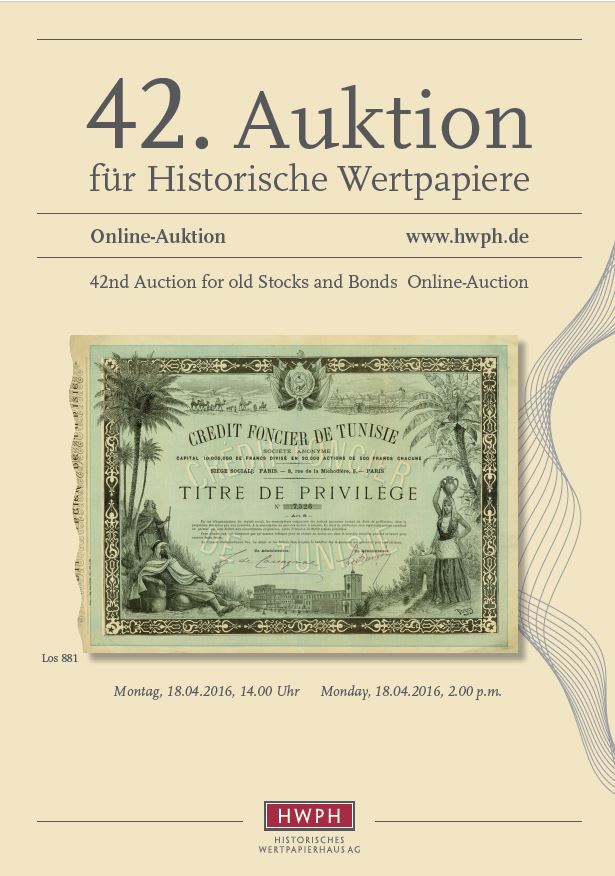
cover: lot 881 
Credit Foncier de Tunisie
privileged share, ca. 1891


  • Dates : 16 April 2016 - Auction 41 ; 18 April - Auction 42, internet only
  • Place : Auction 41, Würzburg, GERMANY
  • Further info , see here 

F.L.