Showing posts with label signatures. Show all posts

Saturday, December 23, 2023

Dhotis not allowed at the Willingdon Sports Club

A victim of its own success, membership to the Royal Willingdon Sports Club is closed. Only children of current members, wealthy ones, can become members, and even that on a selective basis depending on the applicant’s family background and profession.

The private club was founded by Lord Willingdon in 1918. Willingdon (1866-1941) ruled as Governor of the Bombay Presidency from 17 Feb 1913 through 16 Dec 1918. This administrative subdivision of British India, more or less the size of today’s Germany, counted then nearly 30 million people.


A highlight in the Willingdon Sports Club’s existence is the visit in 1921 of Edward VIII, then Prince of Wales. The Prince played four chukkers at polo on the club’s ground. This non-interest bearing irredeemable debenture, issued by the club in 24th Nov 1916, is issued to the Maharaja of Gondal and signed by Sir Stanley Reed as Secretary. 


From the beginning Willingdon maintained good relations with the Indian Princes and India’s important business men. The crème de la crème of British India often met on official events. 

However, on one occasion he invited some friends, Maharajas, to the Royal Bombay Yacht Club. The Governor and his Indian guests were denied access. The club only accepted European members. Willingdon did not agree with the situation and discussed the incident with his friend Stanley Reed.

Sir Herbert Stanley Reed (1872-1969) joined the Bombay based journal The Times of India as correspondent in 1897. When George V, then Prince of Wales, and Princess Victoria Mary of Teck, made their royal tour of India in 1905 and 1906, Reed traveled along as special correspondent of the Times of India.

Stanley Reed became the newspaper’s longest serving editor from 1907 until 1924. He maintained close ties with the British political elite. Mahatma Gandhi corresponded with Reed and occasionally paid him a visit at the newspaper office to discuss the questions of the hour. 

Reed was one of the first persons to whom Gandhi revealed his Swadeshi pledge. The Swadeshi movement strived for India to be self-sustainable and self-reliant. Gandhi's swadeshi pledge in 1919 was a pledge to boycott foreign goods.


Stanley Reed improved the coverage of The Times of India and made it ‘the leading paper in Asia’. He is credited with extending the deadline for carrying news from 5 PM to midnight. Earlier, news that came after 5 PM would be kept over for printing the next day. During his tenure the cover price of the paper was reduced from four annas to one, which gave a phenomenal boost to its circulation. 


At the end of World War I, Reed exposed the grievous sufferings of the Indian troops in a newspaper article in which a change in the High Command was argued. Lord Willingdon supported him in that. The latter took responsibility for treating the thousands of wounded that returned from the Mesopotamian campaign by ship to Bombay in appalling circumstances.

Reed and Willingdon discussed the latter’s experiences in the Royal Bombay Yacht Club. It was decided to start a private club that would bring together the best elements of Indian and European society on an equal basis. Lord Willingdon was its President and Stanley Reed became its Honorary Secretary. 

Willingdon found a piece of land in what is now south Mumbai where he established his club. To finance his project, he had to attract funds. 

Stanley Reed writes in his book The India I Knew 1897-1947: “British residents subscribed handsomely, but it was the generosity of the Indian Princes which made realization possible. They contributed not less than £25,000 in non-interest-bearing irredeemable debentures, and asked no more than life membership.” Note that 'irredeemable debentures' are debentures that cannot be redeemed during the lifetime of the company. Investors can only redeem if the company is winding up. 


Freeman Freeman-Thomas & Maria Adelaide Brassey, also known as Lord and Lady Willingdon, 1916. Attribution: Parasnis, Dattatraya Balwant, Rao bahadur, public domain, via Wikimedia Commons 


Lord Willingdon formally opened the club on December 8, 1917. The princes came be-jewelled and robed, the Maharaja of Idar standing out in his gold earrings. Lady Willingdon wore a mauve dress, the colour of the Club’s crest, its curtains and, until 1975, the hue of the waiter’s waistcoats and neckties. In the temporary parking place stood Rolls-Royces, Duesenbergs, Alfa Romeos and other fabulous cars.

Sport amenities were constructed for playing polo, golf, cricket, tennis, badminton, swimming, billiards, poker, and a rifle range as well. The club was not meant to be a sports-only club but also promoted intercultural activities by means of music performances, lectures, ballroom dances, banquets and dinners, etc. Its first name was the Willingdon Club, but Lord Willingdon didn’t like the club’s shortened name. Hence, the Willingdon Sports Club.


The exclusive club attracted maharajas, high government officials, upper rank army officers and India’s top business men. To name a few: the Maharaja of Mysore, the Raja of Ratlam, Sir Dorab Tata, Sir Sassoon David, the Aga Khan, Ibrahim Rahimtoola and then later JRD Tata. Top financier FE Dinshaw was a club’s recurring bridge player.

Lady Willingdon was equally thrilled with the founding club and was the driving force for opening it up for the members’ wives as well. It was said that she got the ruling princes to contribute towards the establishment of the club. One story about her was that she would admire the diamond rings and necklaces that the maharajas used to wear (some even wore them while playing tennis). The recipients of the compliment had no alternative but to present her with the valuables. It is said that soon the maharajas made sure not to wear anything expensive at the club. 


His Highness Maharaja Thakore Shri Sir Bhagwant Singhji Sagramji Sahib Bahadur, Maharaja of Gondal, 1911. Attribution: Photographs from the Lafayette Studio Archive of the V&A, London, Public domain, via Wikimedia Commons 


Several Indian princes invested in the Willingdon Sports Club. This certificate shown here was issued for two debentures of 500 Rupees on 24th November 1916 to Bhagvatsinghji, His Highness the Thakore Saheb of Gondal, the ruling Maharaja of the princely state of Gondal (1865-1944). Back then, the Indian princely states were sovereign entities within the British Indian Empire, not directly governed by the British, but by an Indian ruler.

Bhagvatsinghji reformed the administration of his state, provided free and compulsory education for men and women, and made Gondal a tax-free state. The Thakore Saheb was one of the first maharajas to welcome at his residence Gandhi and his wife after their return from South Africa in 1915. The maharaja would meet with Gandhi several times more. On some of these occasions Gandhi deemed it necessary to appeal to the maharaja’s conscience to be a good ruler for the people of Gondal. On the 50th anniversary of his accession to the throne the maharaja gave his weight in gold to charity.

Lord Willingdon also met Gandhi on several occasions. In 1931 he became Viceroy of India for five years. During his reign Gandhi and the Indian National Congress party organized a mass Civil Disobedience Movement. Of course, all of this was covered in Stanley Reed’s Times of India. Eventually Willingdon would imprison Gandhi, the INC members and tens of thousands of Indian activists.


A bouquet for the author, picture taken from Stanley Reed’s book “The India I Knew 1897-1947”.  An expert on Indian current affairs, Reed wrote and compiled several year books such as The Times of India Directory, and The Indian Year Book Including Who's Who. 


I wonder whether Stanley Reed got along with Gandhi. In his more than 260 pages counting memoires The India I Knew 1897-1947, he mainly describes his experiences with British India’s politicians. Though Gandhi made the headlines all those years, Reed dedicated merely five pages to the Mahatma.

I’ll end this article on the Willingdon Sports Club, with an interesting note. In 1954 a post-awards banquet was held at the club to celebrate the first Filmfare awards ceremony. The event was attended by actor Gregory Peck. One of the award winners, influential director Bimal Roy, was denied entry into the club because he was dressed in a dhoti, a type of sarong, fastened in between the legs in a manner that it outwardly resembles trousers. The most photographed person in the world wearing a dhoti must be Gandhi. He was never invited to the Willingdon Sport Club. 


F.L. 


References
  • A commemorative Volume to mark the sixtieth year of the Willingdon Sports Club Bombay 1917-1977, by Behram Contractor, Naval J. Ardeshir 
  • His Royal Highness The Prince of Wales Tour In India (1921-1922), by O’mealey M
  • The India I knew 1897-1947, by Stanley Reed 
  • The TOI Story, by Sangita P. Menon Malhan [ed.: about The Times Of India] 
  • The Royal Tour in India - A Record of the Tour of T.R.H. The Prince and Princess of Wales in India and Burma, from November 1905 to March 1906, by Stanley Reed. The book has been digitized by Google and is available to the public here 


Previous posts

Saturday, April 29, 2023

Auctioneer Boone celebrates 40th anniversary in Antwerp: oldest stock exchange building houses international scripophily auction and bourse

Mario Boone's 70th scripophily event spans 4 days! On Saturday May 6, a live auction with nearly 800 lots of historic and splendid antique shares and bonds takes place at the "Handelsbeurs" in Antwerp, the oldest stock exchange building in the world.

An international scripophily bourse with free entrance for any visitor is organized at the same location on Sunday May 7. A great opportunity to see antique securities in the center of Antwerp.

On Monday 8 and Tuesday 9 May, roughly 1500 more interesting lots will be sold through the Invaluable platform (live internet auctioning) or via the usual absentee bidding options.


This 1884 share in the Fabrica de Faianças das Caldas da Rainha, a porcelain factory from Portugal, is superbly designed and printed. Against a background of tiles the drawing combines a still life with more than 10 animals. Can you find them? L(ot) 463 starts at €1000. 


Saturday morning kicks off with a section of some 200 lots from Belgium Congo, Ruanda-Urundi and Belgium, including a 1899 Banque Coloniale de Belgique share certificate showing African scenes, L(ot) 6, and L34, a brewery share in the Brasserie de Stanleyville from 1949, both starting at €50. 

Noteworthy in the Belgian chapter are:  L82, Exposition Internationale Coloniale et d'Art Flamand Anvers 1930, a share subscription for the colonial exhibition in 1930, start price €50, and L84, a $500 gold bond from the City of Antwerp. Not to be missed is L97, Compagnie Internationale des Telephones, the oldest Belgian telephone share, 1881, with a large underprint of an early telephone. 


The Société de Zoologie in Antwerp, one of the oldest zoos in Europe, was founded in 1843. Its shareholders could enter the zoo for free on showing their share, hence the folds. Printed in 1843 by Joseph-Ernest Buschmann and designed by his brother and painter Gustave Buschmann. L299, €300 


More Belgian's, and this applies to other countries too, can be found in a mammoth World Highlights section, lot range 193-775. Some examples :
  • The Société Anonyme d'Horticulture et de Botanique de Gand was founded by botanists who started holding botanic exhibitions known as "Gentse Floraliën". Its share from 1835, decorated with flowers, is extremely rare, L294.
  • A top object in any art collection is the 1897 share from the Compagnie Fermière des Eaux Minerales de Genval. It is designed by Art Nouveau architect, painter and designer Paul Cauchie, known for his sgraffito technique. Only three certificates were found in the 1990s, and this is the last one available. L310 starts at €10,000 and can be seen in detail on the auctioneer's brand new website here.
  • The world famous Lotus Bakeries is listed on Euronext Brussels and run by Jan Boone, the grandson of founder Jan Boone sr. This specimen founder share of the Banket- en Peperkoekbakkerij "LOTUS" voorheen "Boone Gebroeders" dates from 1934 and is the only one known to the auctioneer, L318.


Then part of of the French colonies, the Mekong delta with its shallow waters was the perfect place to use "de Lambert hydroglisseurs", aka airboats. This 1920 share from the Société Anonyme des Hydroglisseurs "de Lambert", L228, starts at €200. 


In the Australasia, Asia and Africa sections I spotted these items:
  • Bank of Australia, Sydney, 1833, early share printed on vellum, L193
  • L205 is a nominative share from the Société Provinciale Privilégiee du Fokien - Hoa-Hu, China, 1902, company set up by diplomat Paul Claudel, Chinese landscape.
  • Opium shares are rarely seen. L226 is a nominative share from the Société Fermière de l'Opium au Tonkin, issued in Hanoi, 1887.
Lot range 271 through 279 comes from a diamond collection and includes scarce items such as a 1889 share from The Borneo Diamond Exploration Syndicate. 


This 100 soles share in the Compañia Explotadora de Perlas de Sechura, Lima, 1902, is part of a collection of 214 bonds and shares from Peru, L676. 


The European chapter is the largest one with over 300 lots, L280-L595. This blog format doesn't lend itself for enumerating all lots. Here are some of many astonishing historic securities:
  • L375 and L376 are two Eiffel companies: Société de Constructions de Levallois-Perret and the Société de la Tour Eiffel both showing the Eiffel tower.
  • Christiana Bye og dens Oplands Korn-Selskab, freely translated as Christiania Town and its Upland Grain Company: extremely early Norwegian share, dated 1810, from the time when Denmark ruled Christiania, today Oslo, L451
  • A Swiss watch collection, L563 through L574, includes names like LeCoultre, Tissot and Longines.


L338, Compagnie Générale Maritime, 1856, signed by politician and financier Emile Pereire, gorgious design by painter and engraver Melchior Péronard, €3000 


Over 50 lots of securities and related documents are featured in the 16th-18th century section, including:
  • A 1679! bond from the city of Enghien, Haunaut province, in need for financial resources under French occupation, 4 wax seals, L596
  • On Aug 27, 1701, Philip V, King of Spain and Louis XIV signed a treaty granting France the exclusive privilege to supply the Spanish colonies in the Americas with African slaves. This right was called the "Asiento". Issued in 1703 for 3000 Livres this share in the Compagnie Royale de l'Assiente, is an important evidence of imperialistic slave-trading practises in the 18th century and extremely rare, L607.


Rio de Janeiro Tramway Light and Power Company Limited, 1 share, text in English, French and German, 1909, facsimile signature of electrical engineer and entrepreneur Frederik Stark Pearson, L664, €200


The Latin America chapter, lots 657 through 677, include several remarkable collection lots. Each of these will be offered as a single group, and only when no bids are made, each collection will split and offered into single item lots in the online sessions on the following Monday & Tuesday:
  • L658 collection of Brasilian government bonds
  • L659 collection of Brasilian state bonds
  • L660 collection of Brasilian railroad certificates
  • L661 collection of Brasilian port/shipping certificates
  • L662 collection of Brasilian Industrial securities
  • L670 collection of Mexican scripophily
  • L676 collection of bonds and shares from Peru 
More Latin Americ scripophily, as is the case for other themes, will be auctioned on the two online sessions on 8 & 9 May 2023.


L682, New Jersey Southern Rail Road Company, $1000 bond, 1873 signed by railway tycoon Jay Gould, extremely rare, €12000


The American section of the Saturday highlights is divided in three chapters : Jay Gould , railroads, and various themes. To name a few:
  • The 50 cents bond, 1841, from the Ocmulgee and Flint River Rail Road Company is not only small in size and value, but rare as well. L689
  • L763 is stock certificate from The Kansas City Distilling Company, a whisky maker, view of the distillery, 1889
  • The World's Columbian Exposition was held in Chicago in 1893. It's share shows a lovely vignette of an allegorical woman and an underprint of the exposition site. L765
A tip for American railway collectors, you should check out Coxrail on this auction, see here


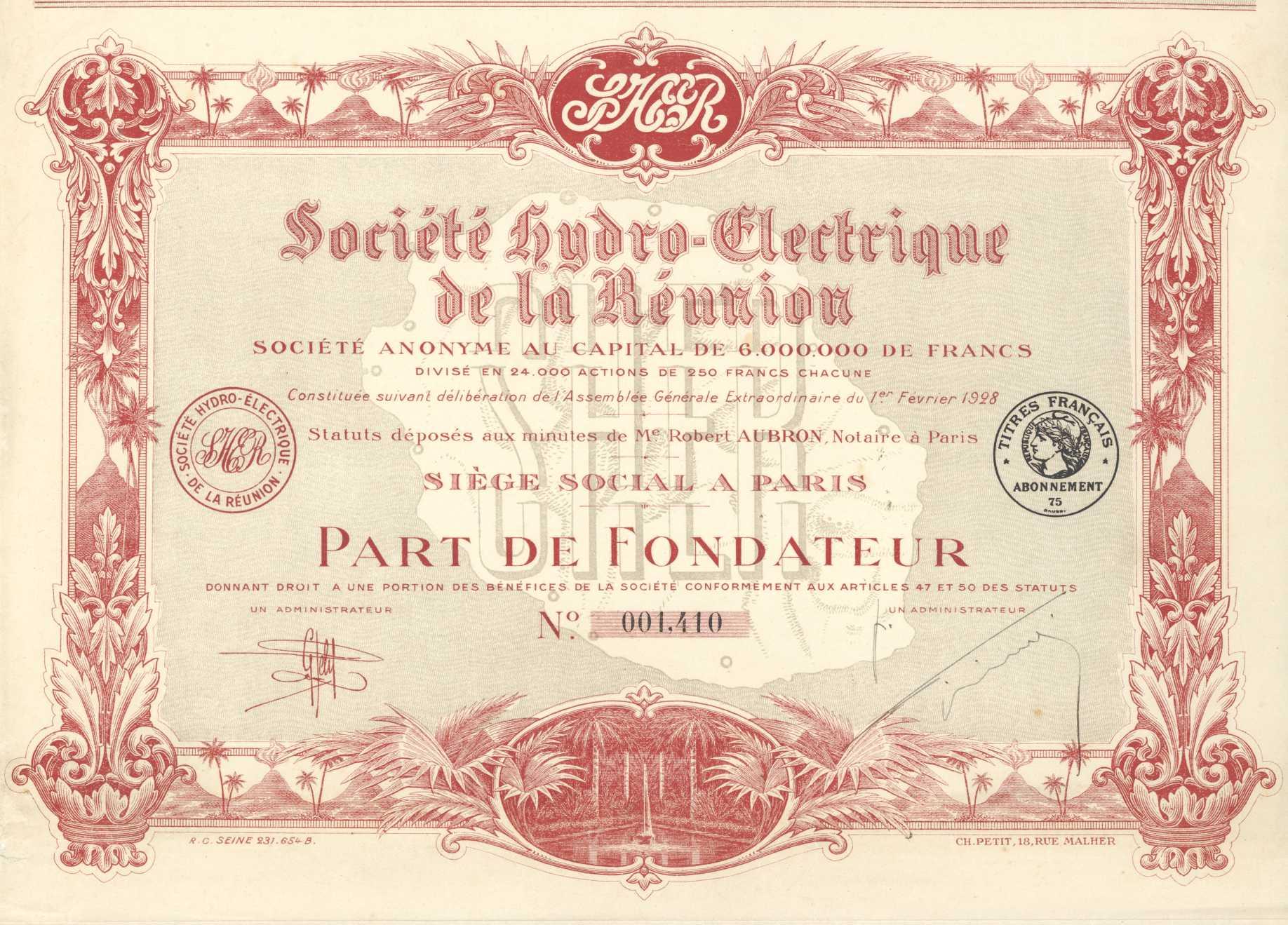
Société Hydro-Electrique de la Réunion, founder's share, 1928, map of Réunion in underprint and border with a pattern of volcanos, likely the Piton de la Fournaise, L927, €50 


The online sessions of this event are scheduled the days after the bourse on Sunday. These offer another 1500 lots of scripophily (or a bit less when the Latin American collections are hammered on the preceding Saturday - see above). Use the catalog's indexes or the search functions on the auctioneer's new website to find what you need.

The weekend of 6 & 7 May is a chance to see some great antique securities. The venue is the Handelsbeurs Antwerpen. 

Here are the auction details :
F.L.


PS : Did you like this post ? Thank you for sharing it on you favorite social media channel !


Thursday, March 2, 2023

Scripophily Puzzle No. 7 - solution

What have The Washington Post, Berkshire Hathaway and 20th Century Fox in common? 

Answer: Scripophily Puzzle No. 7 ? 
Hm, yes ... but no, we are looking for the solution of that puzzle.

To help you solve the puzzle, see here, I provided three visual cues. These were images from three different stock and bond certificates. Each one relates to our mystery person.

And the correct answer for the puzzle was ... (drumm roll in the background) ... Katharine Graham.

The first cue showed a 100 shares certificate from The Washington Post Company, issued in 1971. At that time Katharine Meyer Graham was the President of her family's newspaper business. 


Her father, financier Eugene Meyer was Chairman of the Federal Reserve Board from 1930 to 1933. After leaving the Federal Reserve he bought the Washington Post newspaper at a bankruptcy auction in 1933 and became its "publisher". In the US a newspaper publisher is the owner of small newspaper company, or the chief executive of a major newspaper. Eugene Meyer was both. 
 
When president Harry Truman named Meyer to be the first president of the World Bank in 1946, Meyer transferred control of the Post to his daughter and her husband Phil Graham, the new publisher. After his father-in-law passed away in 1959 Phil Graham became the company's new president and chairman of the board.

So much for some background info about the newspaper. Enters our starring role, Katharine Meyer Graham.


Katharine Graham, publisher of The Washington Post, guest at a meeting of the Dutch Newspaper Press (NDP) in 1975
attribution: Unknown / Anefo, CC0, via Wikimedia Commons, URL see here  


In 1938, after graduation, Katharine Meyer covered labor news and a wide range of other topics at the San Francisco News. One year later she returned to Washington to work for her father's newspaper. Katharine married Philip Graham in 1940. After serving the army during World War II he took over the position of The Washington Post's publisher from her father.

When her husband died in 1963, she took control of the newspaper as its new president and publisher. Back then, a woman was not supposed to be able to run a tough business like a newspaper company, but she persisted.


Katharine Graham was the first woman to head a Fortune 500 company. She was the first to serve as a director of the Associated Press, the news service owned by member newspapers, and of the American Newspaper Publishers Association. Her facsimile signature appears on stock certificates from The Washington Post.  


Mrs Graham made historic decisions about the publication of the Pentagon Papers in 1971, a top secret government account of the war in Vietnam, and the Watergate scandal, which led to Richard Nixon's resignation from the presidency in 1974 under the threat of impeachment. 

In both cases, she hold out against massive pressure from the White House and other government agencies not to publish, at the risk of criminal charges for violating espionage laws and opposition to licenses for the company's broadcasting properties.

Together with Benjamin C. Bradlee, The Post's editor, Katharine Graham took the company to the top in American journalism. During her leadership, the company's revenue grew about twentyfold. The Washington Post got listed on the New York Stock Exchange in 1971 and became a diversified media corporation.


What did The Washington Post disclose about the Vietnam War? The Pentagon Papers revealed that the U.S. had secretly enlarged its military operations in the Vietnam War, without informing the mainstream media. 


The first visual cue of this puzzle - a Washington Post share with Katharine Graham's signature - already contained sufficient information to take a good guess.  

However, I wanted to make you doubt yourself by providing two more visual cues, diversions, including one with a detail of another famous signature. 


The facsimile signature shown in the second image provided is the one from famous investor Warren Buffett, chairman and CEO of Berkshire Hathaway Inc., a multinational conglomerate holding company. 

Warren Buffett started buying large portions of Washington Post stocks in the 1970s. He became a close friend and financial advisor to Katharine Graham. For 37 years Buffett was a member of the board of the newspaper till 2011. At that time Berkshire Hathaway owned 21% of the common stock in The Post.


The last visual cue for this puzzle is a $5,000 bond certificate from Twentieth Century-Fox Film Corporation. 20th Century Fox released in 2017 The Post, a political thriller about The Washington Post and the publication of the Pentagon Papers. It stars Meryl Streep as Katharine Graham. 

Trivia: Katharine Meyer Graham and Meryl Streep both attended Vassar College, Poughkeepsie, New York, though at different times.

The movie, directed by Steven Spielberg, also shows a similar looking stock certificate from The Washington Post. Check out The Post's trailer at imdb.com see here. Scroll forward there to 1m 32sec to see Meryl Streep presenting the Washington Post's new stock certificate. 


The Washington Post's company seal, shown at the bottom of the share, mentions 1947 as its date of (re)incorporation. Near the upper left and right corner of the image, and outside the seal, you can distinguish two small round marks. You can find these dots elsewhere on the certificate too and also on many other American stock certificates. Called "planchettes" they are mixed into the paper pulp during the manufacturing process of the security paper and glow under ultraviolet light. 


Is The Washington Post still owned by the Graham family? In Oct 2013, the Graham family sold the newspaper to Nash Holdings, owned by Jeff Bezos, for $250 million.

Tuesday, February 14, 2023

FHW auctions the Gottfried Schultz collection of worldwide automobile securities

Freunde Historischer Wertpapiere (FHW) has scheduled its 123rd sale for March 4, 2023. This time the auctioneer selected nearly 2000 lots of historic bonds and share certificates. 

FHW reserved major sections for scripophily from the Austro-Hungarian Empire, Germany, the German DM era, and the USA. Over 400 lots from previous auctions are grouped in a "50% from previous callout" section. On top of that about 900 lots of automobile related securities will attract the attention of collectors worldwide. 


In 1928 Harry J. Wolfington signed this stock certificate from Alex. Wolfington's Son, Inc., as President. At the age of 14 he joined the carriage body business founded in 1876 by his father Alexander. Seeing business opportunities with the rise of the automobile, he turned to the production of bodies for luxurious buses and carbodies for Stutz, Pierce-Arrow and Duesenberg. The latter's convertible 1929 Phaeton Royale is legendary. L(ot) 725 starts at €750 and is part of the Schultz automobile collection. 


The bulky Automobile section includes nearly 900 lots of antique securities from lesser known companies but also resounding names appear on the block such as : L923 Duesenberg Automobile and Motors, L1059 Hansa-Lloyd Werke, L1116 Hispano Suiza, L1329 Rolls-Royce and L1491 Automobiles Delahaye.  Food for specialists!


No doubt two top pieces in FHW's Automobile section are a 1908 share from the Établissements De Dion-Bouton, L957, signed by Georges Bouton, as well as a 1919 bond from the same company with facsimile signature of Albert De Dion, L958. In 1900 De Dion-Bouton was the largest automobile manufacturer in the world. Its cars and engines were all being made by hand; the assembly line had not yet been introduced. 


A major part of the offerings consists of antique bonds and shares from Germany with pre- and post-DM eras each in a dedicated section. Some examples:
  • L1621, a specimen share from the Credit-Bank Nürnberg eGmbH, 1924, large underprint of building, originating from a sample book printed by the Universitätsdruckerei H. Stürtz, Würzburg
  • A 1837 interim share in the Rhein-Weser-Eisenbahn-Gesellschaft depicts a train entering a tunnel. Daring for the time! Early and only certificate known. L1682
  • L1722, Basalt-Actien-Gesellschaft aka Basalt-AG extracts basalt, limestone, sandstone, granite and other rock from quarries in Germany and Europe. A large vignette on its DM100 share, 1973, depicts a worker handling basalt chunks.


The world's first passenger airline, Deutsche Luftschiffahrts-Aktiengesellschaft (DELAG), was organized in 1909 as a subsidiary of the Zeppelin airship construction company. DELAG's airships made air travel possible first between Germany's cities, later to the Mediterranean and then across the Atlantic with destinations in the US and South America. Its LZ 127 Graf Zeppelin measured over 230 meters long and cruised at 117km/h with a 15,000 kg payload. In 1929 it made a round-the-world flight (including stops) in 21 days, the fastest circumnavigation of the globe at the time. This share was printed by Osterrieth in 1910. L1626 


There is a lot to discover in the sale. Here are the details :


FHW's 123rd auction includes a Austro-Hungarian Empire section, L18 through L209. However, this 1895 share in the Magyar Folyam- és Tengerhajózási Részvény Társasag (Hungarian River and Sea Shipping Joint Stock Company) can be found in the "50% from previous callout" section.  


F.L.


PS : Did you like this post ? Thank you for sharing it on you favorite social media channel !

Friday, January 13, 2023

"Auction Explosion!" says Scripophily magazine

Scripophily is the world’s most comprehensive and insightful publication for passionate collectors and active researchers of antique securities. 

The magazine uncovers the stories and features of historic and artistic securities. It brings tales of famous and forgotten business plot twists and memorable personalities. In addition, reports from the auction markets help you to stay up-to-date.


Scripophily, a three-yearly periodical, printed on high quality paper, is the flagship of The International Bond and Share Society (IBSS). 


Here is an overview on the topics brought in the latest issue :
  • Events Calendar 
  • Michigan Copper Mining Stock Discovered
  • Boone To Celebrate 40 years with International Scripophily Event in Antwerp
  • Earliest known German Stock Hammered Down at 72,000 Euros
  • Bang-Up Scripophily at Bonhams New York
  • National Show Back on Track! (27 & 28 Jan 2023, Crown Plaza-Dulles Airport)
  • Banks in Transition: From Counters to Apps (Swiss Finance Museum new exhibition) 
  • Address on Stock Leads to Present Day 
  • eBay Seller Name Fraudulently Used to Pitch Scam
  • Letter to the Editor 
  • Lingenfelter Collection Donated to the University of California at San Diego 
  • EDHAM wins Wikipedia Award and awards Professor Wanner Prize 
  • $2.4 Million for one Bond (Marchel Duchamp at Christie's)
  • The Winpennys of Manyunk
  • Specialization in Our Hobby
  • Deutsche Bank Part III: Shares in Deutsche Bank as a Mirror of German Currency History
  • W. Y. O. D. and Other Strange Mining Company Names
  • Modernizing Certificates 
  • Agua Suja Mining Co., Ltd - Diamonds in Brazil 
  • Charles Yerkes and the West Chicago Street Railroad


Until 2010 LLoyd Aéreo Boliviano was the principal airline of Bolivia. Founded in 1925, LAB is one of the earliest airlines in the world. This share, issued in 1926 La Paz, sold in HWPH's Sep 2022 auction for €160. 


In its current issue Scripophily reports on exceptional auction activity from recent months. Five-digit amounts are hammered for top historic items, such as:
  • John D. Rockefeller Standard Oil Company founders' stock certificate (Bonhams, $28,000)
  • the oldest known German share certificate from the Embden Asiatic Company which traded with China (FHW, €72,000)
  • Oost-Indische Compagnie aka V.O.C. bond (HWPH, €40,000)
  • the oldest loan of the City of Antwerp from 1558 (Booneshares, €36,000) 
  • Nikola Tesla owned share in the Nikola Tesla Company (Bonhams, $28,000) 
  • and a share owned by Frederick-William III of Prussia (HWPH, €25,000) 
More details and images on these recent scripophily highlights, and many other discoveries, can be found in the 48 pages counting December issue.

Subscribing to IBSS's magazine costs you only £28, $35 or €32. What are you waiting for ?
All the info can be found here .

F.L.


Previous posts

Thursday, October 27, 2022

Boone's 69th auction spans now 2 days. Among the stars are Ferdinand de Lesseps Suez Canal certificates and a 16th century loan from Antwerp.

Mario Boone scheduled its next sale of antique stocks and bonds for 5 and 6 November 2022. That's right, the auctioneer applies a new event format which starts in Antwerp with an international bourse on Saturday morning. The live auction kicks off at 2 PM in the same venue. On Sunday, the second part comprises of a internet/mailbid auction. 


Altogether more than 1700 lots will be hammered in Boone's upcoming auction.  This is an opportunity to see many stunning certificates like this one. Noted security printer Charles Crabbé produced this 1902 share from the Paris-based Crédit National Assurances. L(ot) 353 starts at €100.

Latin America is excellently represented. More than 300 lots fill several chapters : Latin America lot range 534-556 , The Carribbean Collection L729-861, Venezuala Collection L862-965. All of these are scheduled on Saturday, and then there is another Latin America chapter, L1518-1580, on Sunday.  

Some of the interesting items are :
  • The Cuban Central Railways Ltd £100 debenture from 1899 shows two small vignettes and is rare, L544.
  • Lots 806 through 828 includes several Panama Canal certificates.
  • L887 shows a frontal view of a steamship on a Orinoco Steamship Company bond printed in 1902 by the International Bank Note Co. from New York.
  • The Société de Recherches de Temascaltepec (Mexique) was organized to mine for silver in Temascaltepec. L1569


L548 in the auction is a share in the Syndicat des Placers Guyanais. The company was formed in 1913 to dig for alluvial gold and diamonds. An overseas department of France in South America, French Guiana's currency is the euro. Gold mining, often done illegally, is still one of its main industries today. Bidding starts at €200.


Included in the sale are several certificates signed by or issued to historic figures, such as:
  • members from the Rothschild banking family, L402 through 415, 
  • Paul Kruger, President of the South African Republic, L296
  • L499 shows the signature of Robert Surcouf, the French slave trader and privateer who raided British ships
  • A Nederlandsche Handel-Maatschappij share issued to the Dutch King Willem III, L441.
The auction catalog's Autographs index refers to many more personalities, including Ferdinand de Lesseps !


On March 23, 2021, container ship Ever Given gets stuck in the Suez Canal and disrupted global trade for six days. The consequences were incalculable: industries were impacted with shortages, e.g. of semiconductors. The non delivering of food resulted in price rises and livestock shipments were suspended.
The Suez Canal connects the Mediterranean Sea to the Red Sea. It was constructed by Ferdinand de Lesseps' Suez Canal company between 1859 and 1869.  
Boone offers a set of printer proof bonds from the company's 1879/80 loan, all different and unique. One of these is corrected by Ferdinand de Lesseps himself, and personally signed by him. His handwritten signature in scripophily is of the highest rarity. The set of certificates deserves a place in any top collection highlighting France, Egypt, Canals & Transport, and even World History. Start price €10,000 .


The 16-18th century chapter counts more than 50 lots of shares, bonds and related financial documents. Among these "prehistorics" are 
  • bonds from the Flemish cities Antwerp, Aalst and Oudenaarde (L480, L482, L484)
  • a 1759 share in the Compagnie Royale Prussienne de Bengale , L511
  • whaling and canal companies, L486 & L514
  • 18th & early 19th century French privateer companies, L489 through L499, and an American one, L533
  • a collection of 108 French lotteries issued between 1699 and 1828, L501
  • a put option certificate of the Bank of England as early as 1730, L516


An amazing discovery is L480, an Antwerp city bond for 100 Carolus Guilders from 1558. Issued on vellum, it has a large Antwerp city seal in red wax showing 'Het Steen', the still existing 13th century castle. The bond was part of a loan granted in 1555 by Charles V, Holy Roman Emperor and King of Spain.

At the start of the 16th century Antwerp belonged to the Habsburg Netherlands, then part of the Holy Roman Empire. The city was a major shipping base for Spanish and Portuguese merchants importing sugar and raw produce from overseas. Antwerp became the main business centre around the Atlantic. Its wealthy bankers lended money to governments in Europe.

Between 1555 and 1556, Charles V split his empire into an Austro-German and a Spanish branch. As a result of Charles's abdications, the Habsburg Netherlands were left to his son Philip II of Spain. Thus became Antwerp part of the Spanish Netherlands. 

During these decades war with France was never far away. Also the Catholic Church in the Spanish realm had to be defended against the upcoming Protestant Reformation. The loan was raised to finance the construction and maintenance of the fortifications of Antwerp, the so-called 'Spaanse omwalling' (Spanish ramparts). These were built on order of Charles V from 1542 onwards.
€5000 is the start price for this top item that has witnessed a florishing but turbulent Flemish and Spanish 16th century.


As usual the sale includes a large chapter of USA scripophily, presented in both the Saturday and Sunday sessions of the auction. 
  • There is an opportunity to buy a Southern State Bonds Collection as a single lot (L649-L728). When there is no buyer then the collection will be regrouped by state, each one then offered as one group lot. In turn, these, when not sold, will be split into single item lots. 
  • US railways are plenty. You can find an interesting review on this chapter on Coxrail News and Announcements, see here     


The National Glass Company from Pittsburgh, Pa., was a short-lived glass trust. It owned several factories in places like Dunkirk, Ind., Cumberland, Md. and Marietta, Oh. They specialized in colored table glassware and decorated lamps. This $1000 bond from 1901, a Western Bank Note print, starts at €50. L1708


It is impossible to address all items in this sale, but there is a way to find out more about them. Here are the auction details :
  • Dates
    • 5 November 2022, Antwerp Crowne Plaza Hotel
      • International Bourse 8h30-12h 
      • Live auction 14h-18h30
    • 6 November 2022, mailbid and online auction
  • Further info : 
    • online catalog & bidding, see here 
    • or via the Invaluable platform (large images), see there 
    • and the PDF version of the catalog can be found here 

Even if you are not a collector 5 November 2022 is an opportunity to see some great antique securities. The venue is the Antwerp Crown Plaza. The public bus stops right outside the place and takes you in 10 minutes to Antwerp Central Station. 

F.L.


PS : Did you like this post ? Thank you for sharing it on you favorite social media channel !

Saturday, July 2, 2022

Gigantic : Moody's Industrial Manual

"Moody's Industrial Manual for 1963 is the most comprehensive source of information on industrial corporations and enterprises available to the banker, investor, analyst and business executive."
Introduction, Moody's Industrial Manual 1963


The Moody's manuals are a treasure for scripophily researchers. They contain tons of information about the companies from which we collect antique stocks and bonds.


The American John Moody (1868 – 1958) was a financial analyst and investor. In 1900 he published his first manual providing details and ratings of company and government bonds. In 1909 he founded Moody's Investors Service to produce yearly manuals like the one illustrated here. 

Featured in the Industrial Manuals are thousands of profiles of industrial companies, mainly from the USA but also from Canada, Great Britain and other countries. For instance, Siemens & Halske, Honda Motor Co., Heijn (Albert), Ontario Steel Products Co., SIMCA Industries, Rolls-Royce and Montecatini are a few of the many non-American entries in the illustrated 1963 edition.


Here's an excerpt from a profile from the Stanley Aviation Corp, an aircraft equipment manufacturer. This is one of the smallest entries in the book. Medium-sized and large companies are listed with much bigger profiles, up to several pages. For instance, R. H. Macy & Co., Inc., is described in four pages; E. I. Du Pont de Nemours & Co. fills six pages.

The entries consists of : a company history, its capital structure, background, mergers and acquisitions, company name changes, subsidiairies, plants and properties, employee statistics, officers and directors, business activities and products, operating statistics, balance sheets, and much more. 


These books are gigantic. Issue 1963 measures about 21,5x28,5 cm, or 8.5x11.2 inch, and counts 3028 pages. It's thickness is 10,5 cm or 4.1 inch. It weighs 5 kg or 11 lbs. Don't put any of these on your flatbed scanner ! Some year editions are even bigger and consist of two volumes : monstrous. 

Illustrated below is an extract from the Alphabetical Index in the 1963 edition. The index section counts 114 pages with each page referring to about 130 company names ! 


I use manuals like this for looking up company details and identifying hard to read signatures. Let's try this with a 1960s specimen share from The Bendix Corporation

The manual has three pages on this company: 

"Incorporated in 1929 as the Bendix Aviation Corp., the company adopted its present name in 1960. Bendix and its subsidiaries produce a wide line of aviation, automotive, missile, electronic, marine, space and automation products, .."


What about the signature of Bendix' chairman ? Note that this is a facsimile signature, which is a reproduction by engraving, printing (like this example) or stamping of the manual signature.

The manual lists for Bendix over twenty officers and directors. One of them, our match, is listed both as Exec. Vice-President and Director : A. P. Fontaine. This information in turn allows me to find out more about the person :

Athanas P. Fontaine (1905-1989) was a pioneering airplane designer. After graduating in aeronautical engineering, he helped designing the Aeronca C-1, the first lightweight passenger plane in the US. An aircraft designer and project engineer he worked for several aircraft companies such as Fairchild Aircraft Corp and Republic Aircraft Corp. 
A. P. Fontaine headed Bendix' aircraft division in 1944 but left in 1946 and returned in 1952 to become director of engineering. He was chairman and chief executive of Bendix from 1965 to 1972. source: The New York Times, May 17, 1989


These books are valuable research tools. Unfortunately very few have been digitized. On this Moody's Manual Wikipedia page you'll find several links to editions from the 1910s and 1920s. A few of them actually lead to a fully browsable digitized version.

F.L. 


Previous posts


Friday, April 15, 2022

International auction & bourse weekend in Antwerp shows amazing historic securities and scripophily collections

A major player in the field of antique stock certificates, auctioneer Mario Boone scheduled his 68th scripophily auction and bourse on 30 April and 1 May 2022. On the agenda are about 1400 scripophily lots ready to go on the block. Boone managed to assemble exceptional rare and beautiful stocks and bonds from all continents. 

Part of the offerings are several thematic collections containing exceptional items. One of them is the Portuguese Railways collection consisting of 126 lots of Portuguese and Portuguese colonial railway certificates. The collection formed the basis of the 1990 published Boone-Shakespeare catalog on Spanish and Portuguese railway scripophily and it was further enlarged with new discoveries. Bidders will first have the opportunity to bid on the entire collection as a whole. Start price is set at €18,000. In case no bid is achieved, the auctioneer presents the lots one by one.


Founded in 1908 the Companhia Carris de Ferro do Porto operated the Porto tramways. This 5 shares of Rs10$00 certificate from 1909, only one known, shows a perspective of the Dom Luís I Bridge taken from Vila Nova de Gaia. Part of the Portuguese railway collection, Lot 617 (L618-L744). 


The Boone sale includes many highlights from the turbulent 18th century! That century saw the great powers waging several wars and expanding slave trading across the Atlantic but also the founding of Los Angeles, the discovery of the Rosetta Stone, the premiere of Mozart's Don Giovanni, and the invention of the steamboat and the power loom. Some of the historical items from this period are : 
  • L409 is a 2500 livres share from the Compagnie des Indes from 1770
  • From 1797, L285, a share from the Natur-Torfgräber Unternehmung zu Moosbrunn, a peat digging company in Lower Austria, is probably the oldest Austro-Hungarian share known.
  • The most mind-blowing lot in the sale, L516, is a 1777 founder share from the Iron Bridge company. Boone expects it to hammer at €18,000. 


This share in the Company for Building a Bridge across the River Severn, Ironbridge, Shropshire, England, dates from 1777. Opened in 1781, it was the first major bridge in the world to be made of cast iron. The share is signed by Abraham Darby III and John Wilkinson

Darby took over the iron-making business of his family. He became manager of the Coalbrookdale ironworks. The Darbys and other ironmasters like John Wilkinson perfected the technique of smelting iron with coke, instead of coal. This allowed them to produce cheaper and more cast iron. They started casting iron rails and wheels for railway wagons. 

John "Iron-Mad" Wilkinson invented a precision boring machine that could bore cast iron cylinders such as cannon barrels and piston cylinders used in steam engines. In 1787 he launched on the Severn an iron ship. In 1775 Wilkinson and local businessmen commissioned Abraham Darby III to build the Iron Bridge. 

Thanks to the bridge, its builders and their achievements, the area around Ironbridge is described by UNESCO as the "Birthplace of the Industrial Revolution". The monument gave its name to the town that grew around it. The Ironbridge Gorge Museum Trust runs 10 museums throughout the IronBridge Gorge World Heritage Site; they tell the story of the Industrial Revolution. 


Signatures of Abraham Darby III and John Wilkinson. 
Few people have had such a lasting impact on modern society. L516 


Another remarkable collection offered in the auction are 78 Panorama certificates. Before the advent of cinema audiences could visit a panorama or diorama attraction. Often implemented as large winding 360-degree paintings, and sometimes constructed as mobile attractions or in specialized theatres, these immersed the viewer in large topographic landscape views and historical events. The collection as a whole can be purchased, L9, starting at €8,000. In case no bid is achieved, the auctioneer presents the lots one by one, L10-87.


The Panorama collection includes attractions from Belgium, the Netherlands, Austria, France, the USA and more. This share in the French Royal London Panorama company dates from 1881. The company built its panorama in the former Saville House, Leicester Square, London, where it showed the battle of Waterloo. L65 


The printed catalog contains several indexes to help you find what you are looking for. The online versions can be searched by keywords. The largest country represented this time is the USA and, including a Confederate Bonds collection, counts over 300 lots. Many non-typical scripophily countries are represented as well such as Fiji, Pakistan, Kenya, San Marino and Uruguay.


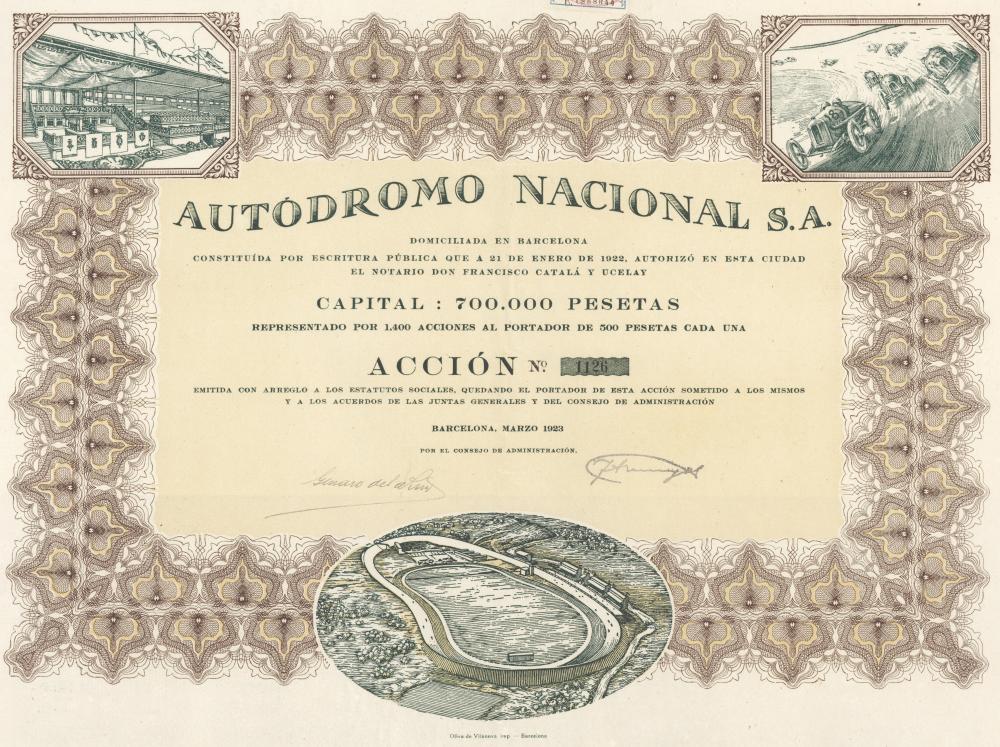
One of the lots mentioned under the "Sports" index, L927, is a 1923 share in the Autodrómo Nacional SA. Founded in 1922 the company built and operated the Terramar Autodrome, a racing circuit in Sant Pere de Ribes, Catalonia, Spain. In 1923 Alberto Divo won the first race with his Sunbeam at an average of 142 kilometers per hour. 


Even if you are not a collector the weekend of 30 April & 1 May is an opportunity to see some great antique securities. The venue is the Antwerp Crown Plaza. An airport shuttle from Brussels Airport to Antwerp (about 30 minutes) stops in front of the hotel. The public bus stops right outside the place and takes you in 10 minutes to Antwerp Central Station. 

Here are the auction details :
  • Location : Antwerp, Belgium
  • Dates
    • 30 April 2022, Boone's 68th live and internet auction
    • 1 May 2022, bourse of historic bonds and shares
  • Further info : 
    • online catalog & bidding, see here 
    • or via the Invaluable platform (large images), see there 
    • and the PDF version of the catalog can be found here 
F.L.


PS : Did you like this post ? Thank you for sharing it on you favorite social media channel !