Showing posts with label sugar. Show all posts

Sunday, May 22, 2022

Collecting antique stock certificates ? Go to the next level with Scripophily magazine !

Scripophily magazine is the world’s most comprehensive and insightful publication for passionate collectors and researchers of antique securities. Its 2022 April issue brings over 50 pages of scripophily news, in depth articles, book reviews, pictures of collector friends, auction reports and quality images of stunning, historic and rare stocks and bonds.


Scripophily magazine is illustrated with tons of gorgious stock certificates. This one from The Cincinnati Edison Electric Company is featured in the Deutsche Bank trilogy (© HIWEPA). The company was incorporated in the state of Ohio. Its $1 million capital was represented by 10,000 shares of $100. This certificate, issued in 1892 to the Deutsche Bank of Berlin, for 3,333 1/3 shares, represents a third of the capital. Image by Horst Klophaus 


Compelling tales, business plot twists and memorable personalities keep you spellbound. Scripophily magazine uncovers the stories of historic and artistic securities. In addition, reports from the auction markets help you to stay up-to-date. This periodical is the flagship of The International Bond and Share Society (IBSS) and appears three times a year.

Here is a summary on the topics brought in the latest issue :
  • Piers and Seaside Entertainment, interview with a collector 
  • Book review : Stamp Taxes in Nevada I. Silver Fever! Nevada Territory Stock Certificates, 1863-4, author Michael Mahler 
  • Book review : Michigan Copper Mining Stocks and Bonds, Part II, author Lee Degood
  • El Partido Revolucionario Cubano, a rare but fake bond emerged 
  • The Insanity Spreads, NFT technology flirts with Scripophily 
  • Dispatches from the Front, Bits and Pieces, market concerns with the Russo-Ukrainian War 
  • The Greenawalt Donation : Interview with David Mihaly of the Huntington Library 
  • Charles V Bond with phenomenal Face Value emerges (Spain)
  • Standing on the Shoulders of Giants, Terry Cox reflects on his US railway project coxrail.com 
  • The Howe Sound Co, copper mining in British Columbia 
  • Selling the Security, member contributions with share certificates promoting the business 
  • Studebaker, the family, stocks and bonds, and legacy
  • Deutsche Bank Part I : The History of "Deutsche Bank AG"
  • Boomtimes in the German Sugar Industry : 1850-1885 

On top of that the issue brings results and analysis on more than 20 auctions that took place during the preceding period in Germany, USA, China, Switzerland, UK, and other countries. You'll find out which auctions took place, what collecting themes are currently in demand and what price results are achieved for top pieces.


Subscribing to Scripophily magazine brings you valuable free extras: 
  1. The IBSS Directory brings you in contact with fellow collectors. Many of those are experts in their field, often share common interests with you, and possibly live nearby. The Directory contains members from more than 40 countries. 
  2. Upcoming events : Learn which auctions, collector bourses and society meetings will take place.
  3. Locate dealers and auctioneers : The Membership Directory also contains a list of dealers and auctioneers with further contact details. Most  auctioneers and dealers publish their catalogues either online or on paper.
  4. Access to the Experts : Being part of the International Bond and Share Society (IBSS) has provided me access to a network of experts in a variety of specialties related to the collection of Stocks and Bonds, always willing to led a hand and point me in the right direction.
  5. Access to all content on the IBSS website, including digital versions of previous issues of Scripophily magazine, the online forum, special theme galleries, and the like. 
  6. Newsflashes on the website focus on hot topics that can't wait for the next issue of the magazine. 
  7. Get extra credibility : being listed as a member is a good reference in any deals made remotely with parties previously unknown. 
A 1-year subscription only costs £25 or $35 or €28. The magazine is published by IBSS. More info : https://scripophily.org/membership/join/ 


F.L.

Related links


Saturday, August 14, 2021

Watermarks in Scripophily - part 2 Paper manufacturers

In Watermarks in Scripophily – part 1 I introduced you into the world of watermarks specifically on bonds and shares. This time we’ll talk about watermarks created by the paper makers themselves, perhaps the most obvious category of watermarks in scripophily. 

The first watermarks appeared in Italy during the 13th century. They were used to identify the papermaker or the trade guild that manufactured the paper. An interesting question is whether watermarks were invented, or just a side effect in the production process?


images 1a and 1b: When viewed against a light source, this Nira Valley Sugar Co share reveals a watermark pattern of bold vertical and faint horizontal lines. This is an example of laid paper. A detail of the pattern is shown here below. Click images to enlarge. The actual company and its share was described and illustrated in part 1 of this series, see here


European paper was initially made by dipping a wooden-framed screen, a lattice of metal wires, into a tub of warm water and cellulose fibers, scooping up this pulp, and then letting the water drain out. The cellulose came from cotton linters or recycled cloth (rag), and only much later wood fibers were used too. 

The cellulose fibers subsequently matted into a thin layer against the screen. For hundreds of years these screens had a rectangular design with widely-spaced vertical “chain” wires and closely-spaced horizontal “laid” wires tied on top of the chain wires.

In the process the wires in the screen compress the pulp fibres and reduce their thickness. The resulting patterned portion of the paper is thinner and lets more light through than the surrounding paper. 

The laid wires yield faint lines in the watermark. Chain wires have a greater impact and are responsible for the bolder lines. This type of paper is known as laid paper. A nice example can be seen above in images 1a and 1b.


images 2a and 2b: The Swedish immigrant Willgodt T. Odhner invented the Arithmometer, a pinwheel calculator. Following the Russian revolution, his company moved from St. Petersburg to Göteborg, Sweden. This 1918 share’s watermark reveals a coat of arms of the paper manufacturer Lessebo, a crowned beehive with the date 1719. The words ‘Handgjord Post’ translate as ‘handmade post’. Image courtesy Wilhelm Leiter 


Paper makers found out that they could add special designs to the watermark by sewing wire designs to the screen frame. A paper maker could now incorporate its coat of arms, a logo, or its name into the watermark. The product could now be identified and became difficult to counterfeit. An interesting example is the Original-Odhner share, see images 2a and 2b.

Often paper makers have a remarkable history. The Original-Odhner’s share’s paper manufacturer is Lessebo Paper. The paper mill was originally an iron mill established in the 17th century. In the 1690s the mill started making heavy paper for paper cartridges used for containing a bullet and gunpowder. In 1719 the mill gained permission to manufacture paper, a date that you see in the company’s coat of arms (image 2a). Lessebo Paper still manufactures hand-made paper today.

Over time, the production of watermarks became mechanized. During manufacture paper pulp is passed through rolls with a raised design. The designs applied on the rolls cause density variations in the produced paper. In turn, these density variations make an image or a pattern appear in the paper in the form of various shades of lightness and darkness. We speak of multi-tonal watermarks.

A relevant example can be seen in part 1, see there, namely the Indian Post Office 5-Year Cash Certificate. That paper shows light, dark and even multi-tonal watermarks giving the viewer an impression of depth. Another fine example can be seen on a Olivetti bond, see images 3a and 3b.


Images 3a and 3b: Ing. C. Olivetti & C. was founded in 1908 as a typewriter manufacturer and evolved into computers and smartphones. This certificate, issued 1948, has a watermark pattern, a repeating design that is applied all over the surface of the paper. Watermark patterns can be seen on many Russian railway bonds. In most cases it is not possible to detect whether patterns like these were designed by the paper manufacturer, or by commission of the certificate’s printer or issuer. The pattern on this Olivetti bond consists of diagonally placed geometrical figures. The multi-tonal shade gives you an impression of depth and the pattern appears as a structure of ‘buttons’, looking like bubble wrap plastic, something I usually cannot resist popping! 


In the 1700s James Whatman started a paper making business in Maidstone, Kent. He experimented with the wire screen used in the process. Whatman replaced the lattice of laid and chain wires with a screen of a much finer woven mesh of wires. As a result, the paper was formed on a much more uniform surface and showed no watermark pattern of lines, unless a wire design had been sewn to the screen. This type of handmade paper is called wove paper, and its invention led to what we know as modern paper today.

Whatman was probably the first paper company that added a year to its watermark, see image 4b. You may discover on your certificates watermarks by other paper makers incorporating a year as well. The shares in the United Commercial Bank, Calcutta, issued in the 1960s, show the T H Saunders (or parts of it) name with the year 1946. That company was founded by Thomas Harry Saunders. Famous for its diversity in watermark designs used on stamps, bills of exchange, securities, and the like, Saunders won medals at international exhibitions for his light and shade watermarks that were used to prevent frauds.


Images. 4a and 4b: Established in the 1840s as the Auckland Hotel, Kolkata’s Great Eastern Hotel, today known as the LaLiT Great Eastern, hosted many notable persons like Nikita Khrushchev, Elizabeth II, Dave Brubeck and M K Gandhi. This 1937 share was printed on wove paper. Its watermark shows the WHATMAN name, ‘HAND MADE’ and the year ‘1916’. 


You cannot interpret a year in a watermark as the year of paper production or as a print date. It should be seen as “paper produced not earlier than” because mills did not always update their watermarks.

Besides their name and coat of arms, paper mills sometimes added to the watermark an indication of the paper brand and the paper quality. That made it easy for stationery businesses and printers to look up the right type of paper in their inventory. As an example, I show here an American paper, see images 5a and 5b.


Images 5a and 5b: The Q1 Corporation was a pioneering microcomputer company. In 1972 they delivered the world’s first personal computer based on an 8-bit general purpose microprocessor, the Intel 8008. The share bears the watermark of the Strathmore Paper Co, founded in 1892, West Springfield, Massachusetts. The watermark shows the brand ‘Strathmore Script’ and its quality ‘100% Cotton Fibre’. Cotton fibres are strong yet soft and create a uniform paper surface that is strong and flexible. 100% cotton paper is often used for banknotes. 


In some cases, paper makers add to their watermark the location where the paper was made. Some examples from Indian shares: The Rajnagar Spg. Wvg. & Manufacturing Co Ltd, preference share, 1945, was ‘MADE IN ENGLAND’ and a 100 Rupees share in The Birla Mills Ltd, 1920, reveals ‘MADE IN CANADA’.

More of a surprise is a 100 Rs share from The Gold Mohur Mills Ltd, 1926, Bombay, telling us ‘MADE IN AUSTRIA’. Another example that illustrates the export of quality paper products is shown in images 6a and 6b.


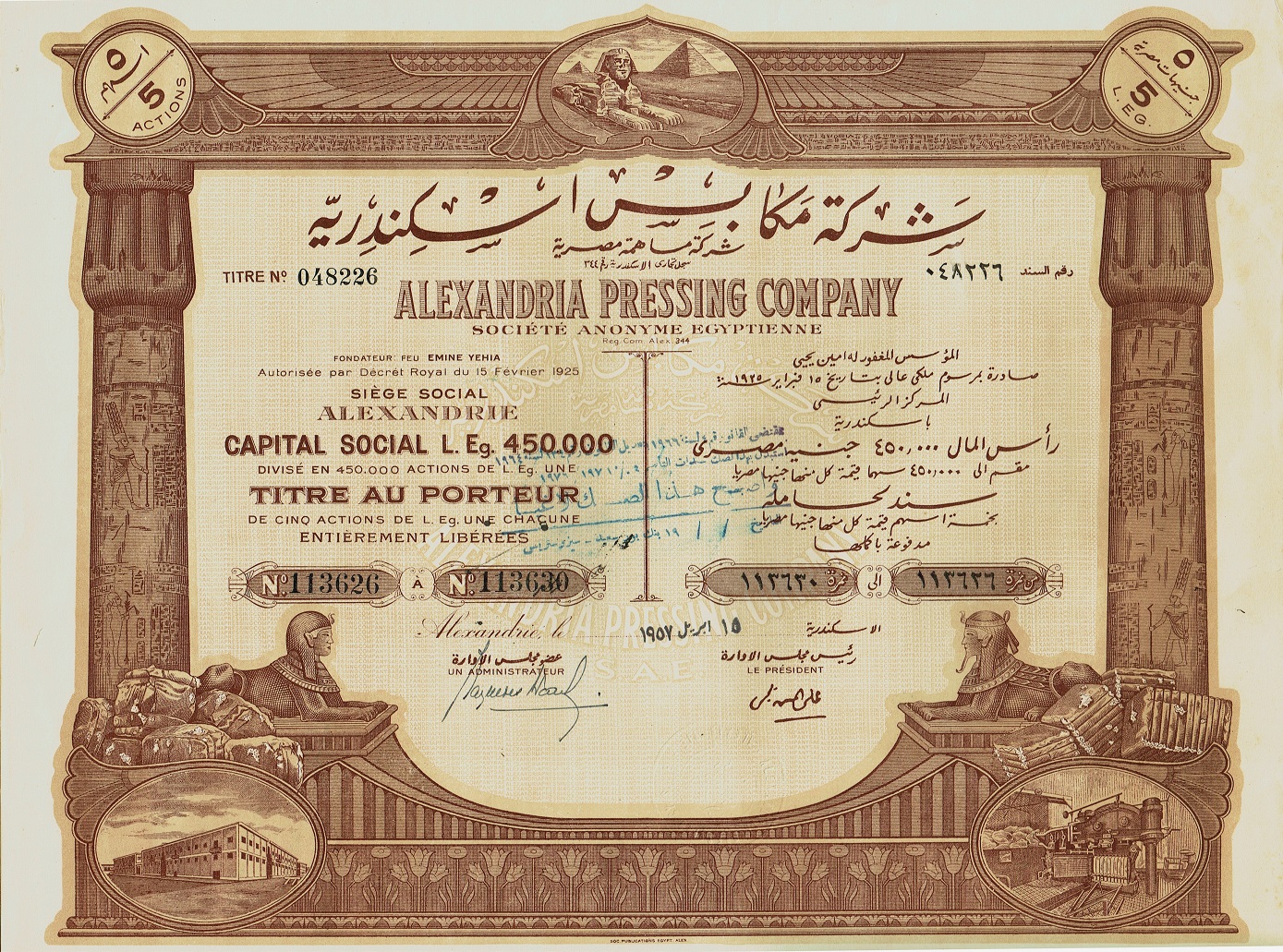
Images 6a and 6b: From Egypt, the shares from the Alexandria Pressing Company that were issued in the 1950s have a watermark showing the name of the Norwegian company ‘BORREGAARD’, the paper type ‘TUB SIZED LEDGER’ and the location of the paper mill ‘MADE IN NORWAY’.


I conclude this part in the series with one of my favorites: a share in The Dahramsi Morarji Chemical Co Ltd, Bombay (DMCC). Its watermark shows the line LUCKY PARCHMENT, a design of a jockey racing a horse, and the words RAG CONTAINING underneath. See images 7a and 7b below.

Parchment paper is not to be confused with “parchment”. The latter is a writing material made from animal skin. The former is a type of cellulose-based paper (made from wood pulp and cotton fibers) which has been treated chemically to make the paper stronger, more heat resistant and above all non-sticky.

You’ll find the words PARCHMENT also in the watermarks of shares from McLeod and Co, Ltd (1940s) and many other scripophily examples. In my example, LUCKY PARCHMENT is a parchment paper brand from the Indian paper company Ballarpur Paper and Straw Board Mills, Ltd.

RAG CONTAINING is another line of text in the DMCC watermark. Rag paper or cotton paper is primarily made of cotton linters or from used cloth (rags). Cotton paper may last many decades without any sign of deterioration, see also images 5a and 5b before.


Images 7a and 7b: This share in The Dahramsi Morarji Chemical Co Ltd was issued in 1968. The company's headquarters were located at Dr Dababhoy Naoroji Road in Mumbai. The certificate shows the coat of arms of the company, including a tiny map of India, and has a watermark of a racing jockey. 


The DMCC’s remarkable jockey watermark seems unrelated but it is not. I learned from scripophily expert Sayeed Cassim (see also here) that the Ballarpur paper company was founded by Karam Chand Thapar, who headed the Thapar Group of companies. The Thapar family was involved in race horse ownership, hence the jockey.

Time for a quick review. The first watermarks were formed, likely unexpectedly, in the production process of what we now call laid paper. Paper makers then added a logo, their coat of arms, or their name to the watermark design. Some of them further added a year, a paper type or brand, and also a location where the paper was made. If you haven’t done so already, you might start viewing your certificates against a window.

In part 3, I’ll show that paper manufacturers start adding watermark elements on behalf of one of their important customer segments: security printers.


F.L. 

This article was initially published in Scripophily magazine No. 114, December 2020. 
You might be interested to read : Watermarks in Scripophily - part 1 Introduction 


Wednesday, November 25, 2020

Watermarks in Scripophily – part 1 Introduction

This article is an introduction into a lesser known aspect of securities : watermarks. If you don’t know what a watermark is then hold a banknote toward a light source. Against the light a design appears, at least this is the case on many banknotes. 

Watermarks can be seen on official documents, banknotes, stamps, cheques and also bonds and shares. When you investigate a new entry for your collection, you want to look for a watermark. 

However, most certificates don’t show watermarks; no wonder that many collectors overlook this feature. Yet, now and then you will be surprised by what emerges from the dark side. 


image 1a. The shortlived Nira Valley Sugar Co had a factory at Malegaon in Maharashtra, India. It operated a narrow gauge railway at its sugar cane mill. This share was issued to Maharaja Ganshyamsinhji Ajitsinhji of Dhrangadhra, Bombay, 1920.  
image 1b. Viewed against a window on a sunny day, the share reveals in the lower border a watermark of the paper manufacturer "STANLEY". The four black dots in the corners of the ‘watermark’ image are the silhouettes of little magnets used to hold the certificate in place on a semi-transparant screen when photographed. Click image to enlarge


Watermarks were first developed as the paper manufacturer’s hallmark. Early Italian paper manufacturers from the 13th century started experimenting with this idea. Watermarks that were created by the paper makers themselves are a first category of watermarks in scripophily. See image 1a en 1b as an example. 

How are these things created ? Watermarks are drawings created in paper during the paper manufacturing process. They are produced by having a design raised on the rolls through which the paper pulp is passed during manufacture. 

The designs applied on the rolls cause density variations in the produced paper. In turn, these density variations make an image or a pattern appear in the paper in the form of various shades of lightness and darkness.


image 2a. The Tambracherry Estates & Wynaad Gold Mining Co Ltd had mining operations in the Indian state of Kerala but eventually purchased estates for the cultivation of coffee, tea, and the like. £1 shares, London, 1882.  

image 2b. Written upwards along the right border, a watermark shows “WATERLOW & SONS”, the printer of this certificate. The watermark image was taken on a cloudy day, hence the darker appearance.


Printers of banknotes realized that watermarks in notes could be used as an extra anticounterfeiting device. Halfway through 17th century Stockholms Banco was the first bank that applied a watermark in a banknote; it revealed the word ‘BANCO’. 

Later, security printers adopted the technique and occasionally applied tailor-made watermarks that identified the printing house. This type of watermarks forms a second category. See the Waterlow & Sons example, images 2a & 2b.

In addition to watermarks from paper manufacturers and printers, governments and companies have issued certificates that were produced with customized watermarks. In most cases these comprise the name of the issuer, or the latter’s coat of arms or logo. This is a third category of watermarks in scripophily. As an example, see images 3a en 3b. 


image 3a. Some issuers of securities ordered their own watermark. Here is a Reserve Bank of India certificate for Rs100 issued in 1935. 

image 3b. The entire watermark design almost forms a share on its own including the name ‘RESERVE BANK OF INDIA’ in front of large sun with rays, and a triple line border, all around the certificate. Click image to enlarge


There is little scripophily literature that addresses these features. I know of two books : World War II Remembered, by C Frederick Schwan & Joseph E Boling, and Alexander Kipfer’s Historische Wertpapiere der Spanischen Königlichen und privaten Handelsgesellschaften des 18. Jahrhunderts. 

The comprehensive Schwan/Boling volume describes numismatics, in the broadest sense, including bonds, issued by the WW II powers, and where applicable watermarks are described or illustrated. You can find more details on this work here.

Kipfer’s book describes the securities of the 18th century Spanish trading companies. Also here a handfull of these have been identified as bearing watermarks. 


images 4a and 4b. The Real Compañia de Filipinas took over the Real Compañia de Comercio Establecida en Barcelona in 1785. As a result the company obtained a trade monopoly with the Philippines. Depending on the paper that was used, some of its 250 pesos shares from 1785 display a watermark, others don’t. Alexander Kipfer spotted the stylishly elaborated letters 'AF' on some shares from this company. 
The Schweizer Finanz Museum provided the left image. The other one  was taken from the Alexander Kipfer's book with permission of the publisher Haag & Herchen GmbH.


I'm planning some follow-up articles for later to illustratie the variety that exists in these watermarks on bonds and shares : 
  • Watermarks by paper manufacturers
  • Watermarks by printers
  • Watermarks by companies & governments
  • Watermarks that really stand out


image 5a. and 5b. Examples from the third category, custom watermarks used by companies or governments, can be astonishing. 
This Indian Post Office 5-Year Cash Certificate for 20 Rupees, 1935, shows off its watermarks created in several shades of dark and light. You can detect a repeating pattern made up of the words GOVT of INDIA and the Star of India emblem. Joe Boling, co-author of WW II Remembered, identified the dark letters as the British royal cipher, GRI, which stands for Georgius Rex Imperator, or George, King (of Britain) and Emperor (of India). Click image to enlarge


If you have a certificate with a remarkable watermark, then you can email me an image. But be carefull while handling the certificate. You don't want to end up with a torn corner or a heavy fold.

F.L.

This article was published in Scripophily magazine No. 113, August 2020.
You might be interested to read : Watermarks in Scripophily - part 2 Paper manufacturers 


Previous posts

Friday, March 20, 2020

Selamat pagi ! Boone auctions Indonesian scripophily

Mario Boone's 64th auction takes place on 4 April. The sale offers about 1,700 lots of antique stocks and bonds from all corners of the world. I'll come back to these in a follow up post but now I want to discuss a unique scripophily collection that is part of the sale. 


aandeel uit 1895 van de Kediri-Stoomtrammaatschappij, Kediri Steam Tramway Company share from 1895

Boone's upcoming sale features the first part of a unique collection of Indonesian scripophily. This is a 1895 share from the Kediri-Stoomtrammaatschappij. The company, founded in the same year, ran a steam operated tramway service connecting Kediri with Pare and Jombang, East Java. Tens of sugar factories from the surrounding area used the line to deliver their produce in Kedira, a sugar trading hub. Lot 245 in the auction


Boone's upcoming sale includes the first part of an extraordinary collection of bonds and shares related to Indonesia's colonial history. This time almost 250 lots will be auctioned from many economic themes like mining, oil extraction, tobacco, agriculture, coffee, tea, sugar, rubber, forestry, construction & building, banking, insurance, shipping, railroads & tramways, transport, trading, shops, electric-water-lighting utilities, and more.


The Maatschappij tot Exploitatie van de Suikeronderneming Koning Willem II was founded in 1891 with a capital of 492,000 Gulden divided into 984 shares. Its sugar factory was located in Sidoardjo. L117 


Indonesia is a quite impressive country. Its name origins from the Greek words Indos (Ἰνδός) and nesos (νῆσος), meaning "Indian" and "islands". More than 17,000 islands are home to about 270 million people (2018), more or less 1/3rd of the population in Europe. Indonesians use about 540,000 kilometers of roads. The country occupies an area of 1.9 million km2, that is roughly 1/5th of Europe. Unlike Europe, the islands count 400 volcanoes, around 130 are active. Their eruptions in the distant past produced fertile lands, ideally suited for farming and coffee and tea estates. 


Lot 292 consists of a 1949 share and this preference share, 1937, both specimens, from Heineken's Nederlandsch-Indische Bierbrouwerij Maatschappij, Surabaya. The brewery company makes one of Indonesia's most popular beers, Bintang.


The collection covers dozens of locations from different islands, e.g. Java: Jogjakarta, Magelang, Besuki, Japara, Sidoarjo, Surabaya, Madoera, Probolinggo; Borneo: Benkajang, Balangan; Sulawesi: Pagoeat, Belang; and Sumatra: Tjenako, Langkat, Medan, Tamiang. Many more places and districts can be found in the catalog's lot descriptions.


NV "Prauwenveer Kalimas" from Surabaya operated a ferry service with Indonesian proas, L263


Auction details

  • Location : Internet only
  • Date : 4 April 2020
  • Further info : 
    • online catalog & bidding here, or via the Invaluable platform
    • PDF version of the catalog there 


From the Indonesia collection : a 1912, Art Nouveau style, share from Les Huileries de Sumatra, a palm oil producer. Lot 212 in the sale.


F.L.
NB : The latter image is for a short period available as an online jigsaw puzzle, check that out here.

Monday, July 11, 2016

Guadeloupe on the map

Guadeloupe is a small group of islands forming one French overseas department in the Caribbean. Very few Guadeloupean bond and share certificates are known. G Cifré's La France d'Outre-Mer only lists seven certificates. From a statistical point, the chance of finding scripophily with a map of Guadeloupe would be one in a million.

Société Anonyme des Usines de Beauport
5000 Francs share, undated

In 1908 the sugar factory Société Anonyme des Sucreries de Port-Louis (SASPL) was taken over by three Bordeaux families, who operated it as the Société Anonyme des Usines de Beauport (SAUB). The company was founded in 1863 and made use of its own railway system to transport sugar cane from the surrounding estates. After World War I more and more bananas were grown on the islands. Sugar, once a highly profitable trade, lost gradually its importance and suffered from several poor harvests. SAUB went bankrupt in 1981.


The map on the certificate shows Guadeloupe's two main islands.
It is not visible on the rather roughly drawn map, but both islands,
Basse-Terre and Grande-Terre, are separated by a narrow sea channel
called Rivière Salée (Salt River).
Double-click image to enlarge.

Guadeloupe was colonized from 1635 onward by the Compagnie des Îles de l'Amérique, a French chartered company. Over the next two centuries the British seized the island group several times from the French. Just before French control of Guadeloupe was internationally accepted after the 1815 Treaty of Vienna, Sweden owned Guadeloupe for about 15 months as a result of the Anglo-Swedish Alliance in 1813. Have you seen any early Swedish Guadeloupe scripophily ? Me neither, but scripophily often reveals big surprises, sooner or later.

F.L.

Reference links

Sunday, December 7, 2014

Digest of scripophily readings XV

New online scripophily articles and references, December 2014

Biografía de las Riquezas de Puerto Rico
Jorge David Capiello-Ortiz tells us a fascinating story about the history of coffee plantations and sugar mills of Puerto Rico.  His Spanish website, Biografía de las Riquezas de Puerto Rico,  (Riches of Puerto Rico) is illustrated splendidly with photographs, coins, bank notes, tokens, post cards, letters and receipts, stereoviews, checks, and ofcourse stocks and bonds from :
  • sugar mills, see here 
  • railways, see there, and
  • banks, see here
As you see, numismatics in the widest sense. Thank you for sharing Jorge !

stock certificate of the Central Aguirre Associates, later renamed into Central Aguirre Sugar Company
Central Aguirre Associates
later renamed into Central Aguirre Sugar Company
100 Common shares, specimen, 1928
double-click image to enlarge
source : Jorge David Capiello-Ortiz
Biografía de las Riquezas de Puerto Rico

The Californian Gold Rush
The first individual gold prospectors tried to build subterranean shafts by manually digging holes into overlying earth, as into a hillside. The shafts seldom reached deeper than one or two meters. This technique was called ‘coyoting’ after the coyote that tunneled his way into the ground in a similar manner. No stocks or bonds, but coins and pictures illustrate this three-part series of articles about the Gold Rush in California written by Ursula Kampmann from CoinsWeekly | MünzenWoche  :
  • part I : the first gold finds, news reaches the east, the voyage, the local situation, grassroots democracy and lynch law (in German, see here ) 
  • part II : the work, success and failure, spending a life in deficiency, xenophobia amongst the gold prospectors (in German, see here )
  • part III  : coins for California, the end of the gold rush (in German, see here) 

Compagnie Française & Américaine de San-Fransisco
5 Shares of 5 Francs, 1850
Source : HWPH, Auction 36, 2014

Texas and German Emigration Company
The Bullock Texas State History Museum, named after former Texas Lieutenant Governor  "God bless Texas" Bob Bullock, certainly knows how to combine artefacts with interactive multimedia and special effects. I will not go into further details, but check out this Interactive Texas Map .

Eurotunnel forerunner
If, before the Great War, a tunnel would have existed between France and England, it could have shortened the War by two years. Read more about the Chemin de Fer Sous-Marin entre la France et l'Angleterre on Hans-Georg Glasemann's NONVALEURS blog.


Scripophily magazine issue August 2014 No. 95

Scripophily magazine
In addition to the online sources above, the last August 2014 No.95 issue of Scripophily magazine contains the following stories :
  • Scripophily of the 1893 World's Columbian Exposition
  • The Long Distance Telephone Company and AT&T
  • Rare Chinese scripophily at Spink's Jan 2014 Hong Kong auction
  • Flights of Fancy, about early spectacular airplanes
  • Cox's Corner : Scanning certificates
  • Jewish Colonial Trust
  • An interview with retiring society auctioneer Bruce Castlo
  • Sexy vignettes
  • other periodical topics : society matters, news, bourse reviews, auction reviews, events calendar, member classifieds, book reviews, interviews and lots of pictures of collector friends and scripophily.

F.L.


Saturday, October 4, 2014

Exhibition & book : Patrimonium et oeconomia

Patrimonium et oeconomia is the name of the current exhibition at the City Museum "Sztygarka" of Dąbrowa Górnicza, Poland. The exhibition features securities from the collection of Christopher Stachowicz.

Share of Société Française et Italienne des Houillères de Dombrowa (Pologne Russe)
Société Française et Italienne des Houillères de Dombrowa (Pologne Russe)
Founder's share, Paris 1909
Source: City Museum "Sztygarka"
double-click image to enlarge
On display are shares and bonds in companies and organizations active in the Polish Basin and Silesia area and beyond. Among the exhibits are, securities and documents, from the nineteenth and twentieth centuries, related to the steel industry, railways, coal mining, banking, utilities, textile, breweries and distilleries, chocolate and sugar, and more. Less known to scripophily collectors in general, some of the displayed certificates are designed by important artists like Zofia Stryjenska and Felix Wygrzywalski. 


Source: City Museum "Sztygarka"

Practical info :

  • Location : City Museum "Sztygarka", Muzeum ul. Legionów Polskich 69 41-300 Dąbrowa Górnicza, POLAND
  • Duration : 11 September 2014 – 12 October 2014
  • Opening hours : Mon closed, Tues & Wed 9:00-15:00, Thu 10:00-19:00, Fri 9:00-15:00, Sat 8:45-15:00, Sun 12:00-16:00
  • Entrance fee : 5.00 PLN ( about 1.2 EUR ) 
  • Tip : You can also combine the exhibit with a mine visit at the museum


There is also the book Patrimonium et oeconomia. Papiery wartościowe ze zbiorów Krzysztofa Stachowicza, written by Krzysztof Stachowicz and Kamil Świderski. See here (in Polish) but the Google Translate service renders a good enough version, see there

Related links


F.L.

P.S. Thanks to the members of EDHAC for reporting this special event.

Friday, May 30, 2014

Reference book : Dictionnaire des Patrons en Belgique


  • Title : Dictionnaire des Patrons en Belgique, in English: Dictionary of Belgian Business Leaders
  • Author : Kurgan-van Hentenryk Ginette, Jaumain Serge, Montens Valérie
  • ID : ISBN 2-8041-1581-X; published 1996 by De Boeck Université
  • Languages : French
  • Number of pages : 729
  • Images : about 150 black and white images and 15 color images
  • Index : 1. alphabetical index on companies and persons

This comprehensive reference book describes more than 500 Belgian entrepreneurs and financers active between 1830 and 1980 regarding their family background, social status, education, business career, political functions, cultural activities, business networks and interests. Included are descriptions of notable business families. An example is the Solvay family, described in 6 pages including biographical entries of Ernest, Alfred and Armand Solvay.

In many cases these Belgian captains of industry founded companies all over the world. That makes this work a "not only for Belgians" book. The book concludes with a +40 page long mixed index on company and person name. The reverse lookup of a company name can be interesting as it yields one or more entries in the dictionary. Also here an example : the Tramways de Szegedin, which operated in Hungary, is mentioned with the entries of two bankers, namely Léon Cassel and David Van Buuren. 

The book contains many images, mostly portraits, but also ads, photographs and a handful of letterheads and share certifates as well.

A great book for the advanced researcher. 

F.L.

Monday, June 17, 2013

Reference catalogue : Sicily


Image by Boone Shares

  • Title : Sicilia, Carte Valori d'Epoca Collana Regionale, freely translated in English : Sicily, Old Securities Regional Series
  • Author : Alex Witula, Giuseppe Giambalvo
  • ID : ISBN 88-900-170-6-6 (original), ISBN 978-88-900170-6-3 (since Jan 2007); published by Portafoglio Storico
  • Languages : Italian
  • Number of pages : 144
  • Images : one or two  color images on almost every page
  • Index : certificates ordered by province, then by name


This colorful small format catalog presents scripophily from Sicily. Included are 
  • bonds and shares from Sicilian companies 
  • bonds and shares from Italian and non-Italian companies but operating mainly in Sicily
  • government and city bonds from Sicily

The companies listed were active in the field of : banking, mining, football, railways, real estate, transport, agriculture, sugar, explosives, shipping, public construction, shipyards, insurances, state loans, electricity, film, metal works, shops, hotels and wine.

Chapters group items per province. Each chapter contains also a list of known securities of which there is no good image available :
  • Agrigento
  • Caltanissetta
  • Catania
  • Enna
  • Messina
  • Palermo
  • Ragusa
  • Siracusa
  • Trapani

The book contains a separate leaflet containing the index on the certificates with corresponding price valuations. 

Scripophily from Sicily is not often seen. This collecting theme is much richer than I originally thought not only in terms of numbers of certificates but also in its decorative qualities. Where possible, the author has mentioned the artists that designed some of these historical papers. Bèn fatto!

F.L.

Signed the Guest book yet ?

Saturday, June 30, 2012

How Claude Lorrain influenced scripophily !

Claude Lorrain 1605-1682: French artist of the Baroque era
I start off this article with a little task for you. Below, two old shares are listed. I want you to double-click the images and take a good look at their enlarged versions. For the moment don't spent any time checking out the other images from this post which are discussed later. So, take a deep breath, forget what is happening around you and focus on these first two certificates. Try to identify what these two shares have in common. I am not talking about any similarities in geographical, historical or economical terms, but in terms of visual experience. 

share of the Sugar Company of Annam (French Indochina)
Société Sucrière d'Annam, in English : Sugar Company of Annam
 Share of 100 Francs, Saigon, French  Indochina, 1929
Printed by the French printer Imp. B. Arnaud
double-click to enlarge

a 10 share certificate of the Helouan (Egypt) Development Company
Helouan (Egypt) Development Company
10 Ordinary Shares of 1 Pound Sterling, 1907
Note the art deco elements in the border design : early for the date.
double-click to enlarge

What do these shares have in common ?
When looking at the Sucrière d'Annam share, my eyes immediately perceive the printed borders, the company's name and  the 100 Francs denomination. But then, something else happens, unknowingly. After that first glance, my eyes are guided right into the underprint design. I'm not focusing anymore on the flat surface of the share. No, I'm peering .. deeper into the design. It sounds silly, but my eyes come at rest on a point a few meters further into the open space between the sugar canes. The same happens when looking at the share of the Heloun (Egypt) Development Company. When you see it, you'll first notice the title, its denomination and the border. But also here, the next blink of your eyes sets your focus on a spot maybe a 100 meters further into the design, behind the palm trees but before the sphinx. Magic ?

Wednesday, April 25, 2012

Exhibition : Sugar Factories

‘The beet-root, when being boiled, yields a juice similar to syrup of sugar,
which is beautiful to look at on account of its vermilion color.'
Olivier de Serres (1539 – 1619), French soil scientist

In their Ausstellung "Zuckerfabriken", the Heimatmuseum Wolfskehlen exhibits documents, images, bonds and shares of sugar factories from the Michael Fraikin collection. Included are certificates from Germany and around the world.

Opening times :
  • Sunday 29 April 2012 14:00 - 17:00
  • Sunday 6 May 2012 10:00 - 12:00
  • Sunday 13 May 2012 10:00 - 17:00 (car-free day)

Free entrance.
More practical info, see here and there.
And here is an article, in German, on Echo Online.

F.L.

Compagnie Sucrière de Bulgarie
Share of 500 Francs, 1912 Bruxelles
design by the Belgian artist Gustave Fraipont
printed by Imprimerie Chaix, Paris
double-click to enlarge