Showing posts with label precision mechanics. Show all posts

Thursday, June 23, 2022

Spink's summer scripophily sale brings us to New Zealand, Mexico and beyond

Precisely 496 lots of scripophily will go on Spink's E-block. At stake are antique stocks and bonds from all continents. Large sections are reserved for scripophily from Australia, New Zealand, Great Britain, Latin America and the USA. This online sale already took off at 17:00 June 16. The bidding window closes on Jul 5 at 11:00. 


This is L(ot) 182 from the European section. The Société Française de Phonographes "La Fauvette" was incorporated in 1900 in Paris. The company's major product was "La Sirène", an early cylinder gramophone player that could play "Ideal" (large format) cylinders with a duration of up to 12 minutes.  La Sirène is depicted on this 1902 share, together with a fauvette (warbler bird). 


Spink's upcoming sale features many bonds and shares from Australia, New Zealand, and even one from the British Solomon Islands. A few examples : 
  • L5 is 5 shares certificate in The Railway Construction and General Development Company (Tasmania) from 1901. 
  • The Butcher's Reef North Gold Mining Company, Bear Hill, New South Wales, shares, 1889, bold red, purple and gold printing, L11
  • The share from the South Australian Oil Wells Co shows a large vignette of an oil field. The company operated in Gippsland, Victoria, and reported test drills in the 1940s at a depth of over 4,000 feet. L29


New Zealand is represented by more than 40 lots, several from gold mining companies. L76, a share from The Maoriland Gold Mines Ltd, was issued in 1896. 


The British chapter consists of several sections: railways, canals and shipping, government, banking and insurance, bridges, commercial, industrial, mining, automobiles and cycling, newspaper and publishing. Let's mention some entries:
  • Railway enthusiasts will love the 1875 issued share in The Gorsedda Junction and Portmadoc Railways Company, Wales. Rare, L228 depicts a double-ended steam locomotive, a "double Fairlie".  
  • L290 contains lots of history: a share in The London Clinic and Nursing Home Ltd from 1929. The London Clinic is one of the UK's best private hospitals and has treated many famous names such as Charlie Chaplin. It was here that Chilean dictator General Augusto Pinochet was arrested in 1998. 
  • L264 consists of a group of three shares in the Associated Newspapers Ltd. Today known as DMG Media. This media holding publishes the Daily Mail, Metro, New Scientist, the Irish Daily Mail and many more. 


The Normal Powder and Ammunition Company Ltd, ordinary shares, 1898, company logo with rifles and canon repeated in the embossed seal, L292, click image to enlarge 


The USA chapter is split into 5 sections: automobiles and aviation, commercial and industrial, government, mining and railways. Here are some of the interesting lots noted :
  • The Duquesne Incline Plane Co., Pittsburgh, PA, incorporated in 1876 with a capital of $40,000 consisting of 800 shares of $50. This certificate, from 1877, was issued for 20 shares. The company built a funicular on Mount Washington that ran at a grade of up to 30.5 degrees. L480 
  • Several $1000 6% Territory of Florida bonds from 1838, several vignettes, are offered. L360 through L368.
  • L440 is a $5 Class B stock certificate in The North Carolina Gold Mining and Reduction Company, Philadelphia 1882, uncommon vignet of miners at work and railway bridge.


A section of 60 lots includes scripophily from Argentina, Brazil, Columbia, Cuba, Honduras and many more Latin American countries. Several Mexican railway certificates will pass in review, including this Ferrocarriles de Toluca á Tenango y San Juan, 1907. It is part of a trio, each one printed with a distinct denomination and in different colours, but all with the same great locomotive vignette. L331 


There is lots more to discover in this sale, so here are the details :
  • Location : this is an Internet only sale
  • Date : Jun 16 17:00 - Jul 5 11:00, 2022
  • Further info : see here 

F.L.


PS : Did you like this post ? Thank you for sharing it on your favorite social media channel !


Saturday, August 14, 2021

Watermarks in Scripophily - part 2 Paper manufacturers

In Watermarks in Scripophily – part 1 I introduced you into the world of watermarks specifically on bonds and shares. This time we’ll talk about watermarks created by the paper makers themselves, perhaps the most obvious category of watermarks in scripophily. 

The first watermarks appeared in Italy during the 13th century. They were used to identify the papermaker or the trade guild that manufactured the paper. An interesting question is whether watermarks were invented, or just a side effect in the production process?


images 1a and 1b: When viewed against a light source, this Nira Valley Sugar Co share reveals a watermark pattern of bold vertical and faint horizontal lines. This is an example of laid paper. A detail of the pattern is shown here below. Click images to enlarge. The actual company and its share was described and illustrated in part 1 of this series, see here


European paper was initially made by dipping a wooden-framed screen, a lattice of metal wires, into a tub of warm water and cellulose fibers, scooping up this pulp, and then letting the water drain out. The cellulose came from cotton linters or recycled cloth (rag), and only much later wood fibers were used too. 

The cellulose fibers subsequently matted into a thin layer against the screen. For hundreds of years these screens had a rectangular design with widely-spaced vertical “chain” wires and closely-spaced horizontal “laid” wires tied on top of the chain wires.

In the process the wires in the screen compress the pulp fibres and reduce their thickness. The resulting patterned portion of the paper is thinner and lets more light through than the surrounding paper. 

The laid wires yield faint lines in the watermark. Chain wires have a greater impact and are responsible for the bolder lines. This type of paper is known as laid paper. A nice example can be seen above in images 1a and 1b.


images 2a and 2b: The Swedish immigrant Willgodt T. Odhner invented the Arithmometer, a pinwheel calculator. Following the Russian revolution, his company moved from St. Petersburg to Göteborg, Sweden. This 1918 share’s watermark reveals a coat of arms of the paper manufacturer Lessebo, a crowned beehive with the date 1719. The words ‘Handgjord Post’ translate as ‘handmade post’. Image courtesy Wilhelm Leiter 


Paper makers found out that they could add special designs to the watermark by sewing wire designs to the screen frame. A paper maker could now incorporate its coat of arms, a logo, or its name into the watermark. The product could now be identified and became difficult to counterfeit. An interesting example is the Original-Odhner share, see images 2a and 2b.

Often paper makers have a remarkable history. The Original-Odhner’s share’s paper manufacturer is Lessebo Paper. The paper mill was originally an iron mill established in the 17th century. In the 1690s the mill started making heavy paper for paper cartridges used for containing a bullet and gunpowder. In 1719 the mill gained permission to manufacture paper, a date that you see in the company’s coat of arms (image 2a). Lessebo Paper still manufactures hand-made paper today.

Over time, the production of watermarks became mechanized. During manufacture paper pulp is passed through rolls with a raised design. The designs applied on the rolls cause density variations in the produced paper. In turn, these density variations make an image or a pattern appear in the paper in the form of various shades of lightness and darkness. We speak of multi-tonal watermarks.

A relevant example can be seen in part 1, see there, namely the Indian Post Office 5-Year Cash Certificate. That paper shows light, dark and even multi-tonal watermarks giving the viewer an impression of depth. Another fine example can be seen on a Olivetti bond, see images 3a and 3b.


Images 3a and 3b: Ing. C. Olivetti & C. was founded in 1908 as a typewriter manufacturer and evolved into computers and smartphones. This certificate, issued 1948, has a watermark pattern, a repeating design that is applied all over the surface of the paper. Watermark patterns can be seen on many Russian railway bonds. In most cases it is not possible to detect whether patterns like these were designed by the paper manufacturer, or by commission of the certificate’s printer or issuer. The pattern on this Olivetti bond consists of diagonally placed geometrical figures. The multi-tonal shade gives you an impression of depth and the pattern appears as a structure of ‘buttons’, looking like bubble wrap plastic, something I usually cannot resist popping! 


In the 1700s James Whatman started a paper making business in Maidstone, Kent. He experimented with the wire screen used in the process. Whatman replaced the lattice of laid and chain wires with a screen of a much finer woven mesh of wires. As a result, the paper was formed on a much more uniform surface and showed no watermark pattern of lines, unless a wire design had been sewn to the screen. This type of handmade paper is called wove paper, and its invention led to what we know as modern paper today.

Whatman was probably the first paper company that added a year to its watermark, see image 4b. You may discover on your certificates watermarks by other paper makers incorporating a year as well. The shares in the United Commercial Bank, Calcutta, issued in the 1960s, show the T H Saunders (or parts of it) name with the year 1946. That company was founded by Thomas Harry Saunders. Famous for its diversity in watermark designs used on stamps, bills of exchange, securities, and the like, Saunders won medals at international exhibitions for his light and shade watermarks that were used to prevent frauds.


Images. 4a and 4b: Established in the 1840s as the Auckland Hotel, Kolkata’s Great Eastern Hotel, today known as the LaLiT Great Eastern, hosted many notable persons like Nikita Khrushchev, Elizabeth II, Dave Brubeck and M K Gandhi. This 1937 share was printed on wove paper. Its watermark shows the WHATMAN name, ‘HAND MADE’ and the year ‘1916’. 


You cannot interpret a year in a watermark as the year of paper production or as a print date. It should be seen as “paper produced not earlier than” because mills did not always update their watermarks.

Besides their name and coat of arms, paper mills sometimes added to the watermark an indication of the paper brand and the paper quality. That made it easy for stationery businesses and printers to look up the right type of paper in their inventory. As an example, I show here an American paper, see images 5a and 5b.


Images 5a and 5b: The Q1 Corporation was a pioneering microcomputer company. In 1972 they delivered the world’s first personal computer based on an 8-bit general purpose microprocessor, the Intel 8008. The share bears the watermark of the Strathmore Paper Co, founded in 1892, West Springfield, Massachusetts. The watermark shows the brand ‘Strathmore Script’ and its quality ‘100% Cotton Fibre’. Cotton fibres are strong yet soft and create a uniform paper surface that is strong and flexible. 100% cotton paper is often used for banknotes. 


In some cases, paper makers add to their watermark the location where the paper was made. Some examples from Indian shares: The Rajnagar Spg. Wvg. & Manufacturing Co Ltd, preference share, 1945, was ‘MADE IN ENGLAND’ and a 100 Rupees share in The Birla Mills Ltd, 1920, reveals ‘MADE IN CANADA’.

More of a surprise is a 100 Rs share from The Gold Mohur Mills Ltd, 1926, Bombay, telling us ‘MADE IN AUSTRIA’. Another example that illustrates the export of quality paper products is shown in images 6a and 6b.


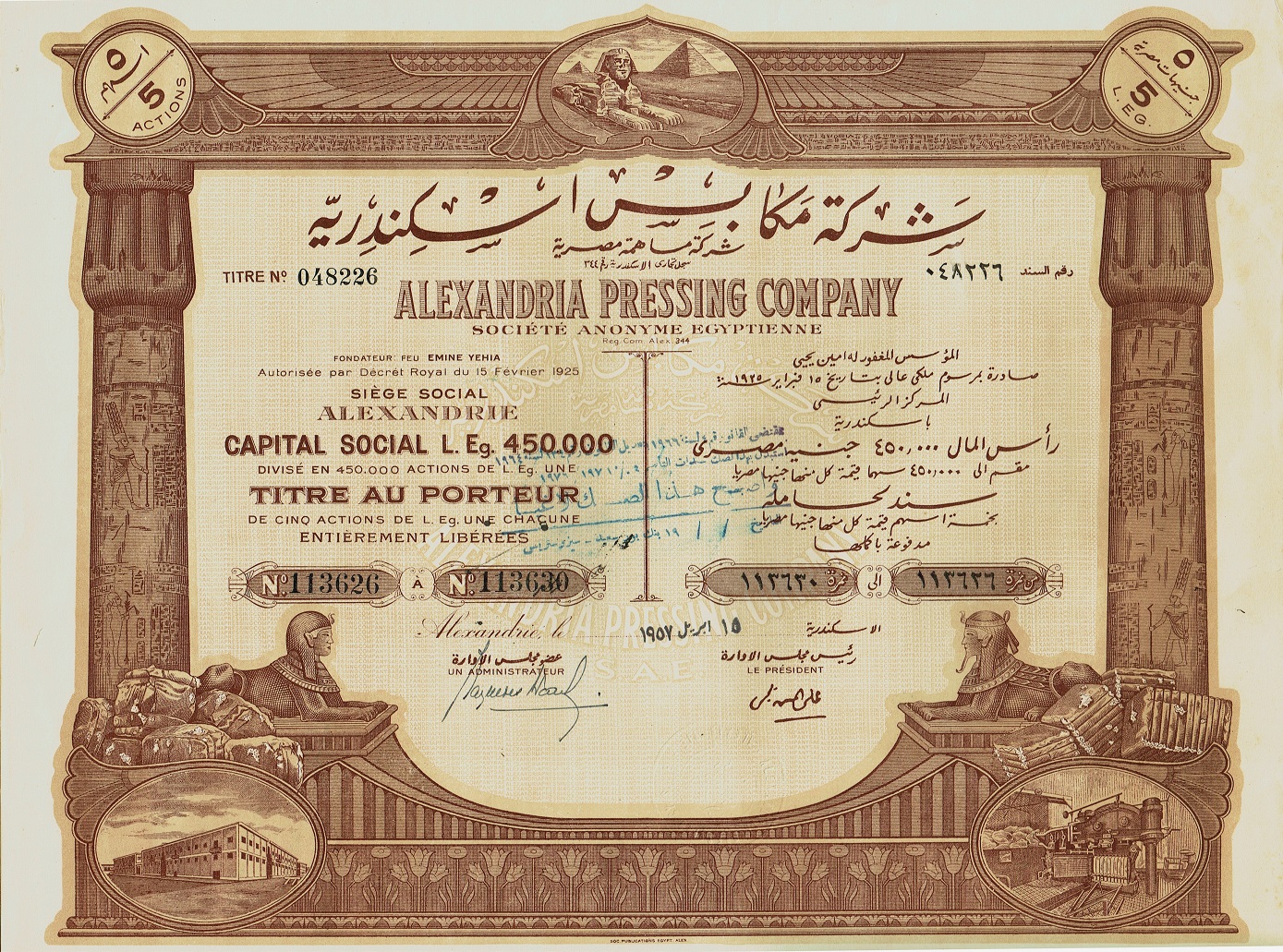
Images 6a and 6b: From Egypt, the shares from the Alexandria Pressing Company that were issued in the 1950s have a watermark showing the name of the Norwegian company ‘BORREGAARD’, the paper type ‘TUB SIZED LEDGER’ and the location of the paper mill ‘MADE IN NORWAY’.


I conclude this part in the series with one of my favorites: a share in The Dahramsi Morarji Chemical Co Ltd, Bombay (DMCC). Its watermark shows the line LUCKY PARCHMENT, a design of a jockey racing a horse, and the words RAG CONTAINING underneath. See images 7a and 7b below.

Parchment paper is not to be confused with “parchment”. The latter is a writing material made from animal skin. The former is a type of cellulose-based paper (made from wood pulp and cotton fibers) which has been treated chemically to make the paper stronger, more heat resistant and above all non-sticky.

You’ll find the words PARCHMENT also in the watermarks of shares from McLeod and Co, Ltd (1940s) and many other scripophily examples. In my example, LUCKY PARCHMENT is a parchment paper brand from the Indian paper company Ballarpur Paper and Straw Board Mills, Ltd.

RAG CONTAINING is another line of text in the DMCC watermark. Rag paper or cotton paper is primarily made of cotton linters or from used cloth (rags). Cotton paper may last many decades without any sign of deterioration, see also images 5a and 5b before.


Images 7a and 7b: This share in The Dahramsi Morarji Chemical Co Ltd was issued in 1968. The company's headquarters were located at Dr Dababhoy Naoroji Road in Mumbai. The certificate shows the coat of arms of the company, including a tiny map of India, and has a watermark of a racing jockey. 


The DMCC’s remarkable jockey watermark seems unrelated but it is not. I learned from scripophily expert Sayeed Cassim (see also here) that the Ballarpur paper company was founded by Karam Chand Thapar, who headed the Thapar Group of companies. The Thapar family was involved in race horse ownership, hence the jockey.

Time for a quick review. The first watermarks were formed, likely unexpectedly, in the production process of what we now call laid paper. Paper makers then added a logo, their coat of arms, or their name to the watermark design. Some of them further added a year, a paper type or brand, and also a location where the paper was made. If you haven’t done so already, you might start viewing your certificates against a window.

In part 3, I’ll show that paper manufacturers start adding watermark elements on behalf of one of their important customer segments: security printers.


F.L. 

This article was initially published in Scripophily magazine No. 114, December 2020. 
You might be interested to read : Watermarks in Scripophily - part 1 Introduction 


Thursday, July 29, 2021

Wurlitzer Good Will Bond


Dreamer
You're nothing but a dreamer
Well can you put your hands in your head ? Oh No
I said, "Dreamer ...


These are the opening words from Dreamer, one of Supertramp's world hits. Formed in London in 1970, Supertramp blended progressive rock and pop styles. Take a few moments to listen here to the song recorded at a live concert in Germany in the 1980s. I bet that you'll recognize the Wurlitzer piano play that was essential to their unique sound.


Specimen stock certificate from The Wurlitzer Company, 1960s. 
Image courtesy scripophily.com 


The Wurlitzer Company started as the Rudolph Wurlitzer Company in Cincinnati in 1853. They produced pianos and organs, and later electric pianos and also electronic organs. The company's magnificently designed jukeboxes were popular from the 1930s through the 1960s. In some places "Wurlitzer" became a generic name for any jukebox. 

Starting in 1950 the American stock market started a long rise. On Dec 29, 1954, the Dow Jones Industrial Average reached the 400 points milestone. On Jan 28, 1965, the DJIA stood at 900 points. Trading volume rose from 16 million shares a day at the end of the 1950s, to 32 million in 1965.


$200 Good Will Bond from The Wurlitzer Company, 1964
But is this a debt certificate in the true sense ? 


In the 1950s Wurlitzer got competition from the Seeburg Corporation. The latter's jukeboxes were technologically more advanced and were the first that could play the then-new 45 rpm records. Other competitors where AMI and Rock-Ola. Around 1960 about 750,000 jukeboxes operated in the USA alone.

Wurlitzer was known for its strong marketing efforts. As the stock market was peaking it should not be a surprise that the company introduced these so-called Good Will Bonds for their salesforce, in this case the sellers of Wurlitzer pianos and organs. 


The certificates looked like the real thing, printed by security printer GOES, and promised a $200 bonus. Not bad when the average yearly income in 1965 was around $6,900. Well, there were strings attached.


The text on the certificate explains it very clearly : 
This Bond represents a total value of Two Hundred Dollars
under the following conditions : otherwise this bond is valueless

Each coupon represents one-tenth of the total value of the bond.
The holder of the bond lists on each coupon the name and address of a prospective purchaser of a new or used piano or organ, and deposits it with the issuing company. 
If the person whose name is listed, purchases a new or used Wurlitzer Piano or Wurlitzer Organ from the issuing company the coupon becomes payable at the face value of Twenty Dollars ($20) in cash upon delivery of the piano or organ.
If the name of a prospective purchaser has been previously presented by another bondholder, or is already contacted by the company, the priority will supersede. Another coupon will be furnished.
This bond and offer is valid for a period of 6 months from date shown above. Each coupon is good for 6 months after the date of listing.


I found a 1955 advertisement for one of Wurlitzer's entry-level electric pianos mentioning a price tag of $300. Selling these instruments must not have been easy. Our bondholder never cashed in.


F.L.


Previous posts


Monday, November 4, 2019

Swedish Society of Historical Securities celebrates in Stockholm !

The members of the Svenska Föreningen för Historiska Värdepapper proudly announced the 40th Anniversary of their favorite society. A pioneer when it comes to scripophily, SFHV, founded in 1979, celebrates with an exciting weekend in Stockholm at the end of this month.


Östra Centralbanans Jernvägsaktiebolag
This 100 kronor share from the Eastern Central Line Railway Co., Linköping was issued in 1900. The design includes a map showing the line from Linköping to Vimmerby.


The two-day festivities are inaugurated on Friday evening, November 29, 2019, with an exhibition of Swedish certificates. Guest speakers will talk on the subject of collecting old bonds and shares. On Saturday, 20 November, the society will organize an anniversary auction, concluded with a dinner. Place to be : Jernkontoret, Kungsträdgårdsgatan 10, Stockholm. 


Aktiebolaget Svenska Kullagerfabriken was founded in 1907 by Sven Gustaf Wingqvist, a Swedish engineer and inventor of the famous SKF ball bearing and roller bearing. This 5 shares SKF certificate from 1918 has Wingqvist's facsimile signature in its lower right corner.


For this occasion, SFHV will publish a catalog of Swedish shares (about 8,000 of them) and, around the end of the year, also a 400-page Anniversary book with all articles published in its quarterly magazine during these 40 years, totalling some 125 articles.

More information available on : http://www.historiskavardepapper.com/
Jubilee Auction catalog, see here .

F.L. 

Friday, August 16, 2019

Before computers ruled the Earth

After World War II, policy makers and scientists thought that the world would only need a handful of computers. We know better now. Today, devices like wristwatches and washing machines, and even tootbrushes, are equipped with computers sized less than 10 mm². These 'embedded’ computers have become a commodity. 


vignette from a stock certificate in the GM Hughes Electronics Corporation


The definition of a computer has changed with time 

During the Middle Ages the word ‘computer’ was used for a person employed to perform computations. Following advances in mathematics and technology, people tried to develop calculating devices to save time and prevent human errors. In 1623, the German Wilhelm Schickard designed the first calculating machine capable of doing simple additions and subtractions. 

These ingenious devices calculated outcomes in mechanical ways and are not comparable to what we know as modern computers. To understand this jump in technological evolution, we need to look at the definition for ‘a modern computer’. 

Simply said, a computer is a machine that ‘performs work’ or ‘output’. In order to perform that work the machine requires some ‘input’, like information and energy. This seems obvious today but imagine that you are a cotton dealer, let's say, somewhere in the 1790s. 

You - the cotton dealer - visit the watchmaker in your town, then the finest engineer in precision mechanics. You tell him that you need a machine that can perform some work. You explain your watchmaker also that you want to provide instructions to the machine so it can perform different kinds of work. Furthermore, the machine should be able to ‘store’ these instructions and ‘carry them out at some time’. Your watchmaker would be perplexed, maybe even terrified.


Jacquard’s loom, the first use of punched cards holding instructions to control machine function 
image: G. Bruno - Le Tour de la France par deux enfants, Engineering and Technology History Wiki 


Babbage, conceiver of the programmable computer

Our watchmaker in our story just now, actually received an order for our computer: a programmable machine, one that can be fed with instructions to be executed at some time. The merchant in the story was the English mathematician and engineer Charles Babbage (1791-1871). He was the first person to conceive the idea of a programmable computer. 

In 1822 Babbage designed prototypes of his ‘Difference Engine’ which could calculate polynomial functions and print the results automatically. His ‘Analytical Engine’, described in 1837, had a far more elaborate design. It would have been capable of storing 1,000 large numbers in a mechanical way and it would be programmed using punched cards that just needed to be put into the machine and let it run. 

Using punched cards for controlling a machine’s output was an idea coming from loom technology that Babbage applied in another context. Joseph-Marie Jacquard earlier had improved the weaving process by using punched cards. The holes punched in the cards corresponded to the woven rows of the textile pattern. 

Babbage could never complete his machines due to lack of political support and budget problems. He left us only partial prototypes and his paper designs, and the idea of a general purpose computer.


1881 share certificate in the Connecticut Telephone Co, the first telephone switching office (New Haven) 


The Industrial Revolution leads to development of computer elements 

In the 19th century, increases in industrial activity and international trading were accompanied by comparable increases in the amount of data to be processed by companies.

Faster and more reliable communication over longer distances became crucial. Different forms of transmitting information appeared and several technological advances quickly succeeded each other. All of them contributed to the making of the modern computer :

  • 1829 William Austin Burt patents the first typewriting machine in the USA. 
  • 1830 The American Joseph Henry demonstrated the first electric telegraph 
  • 1843 Per Georg Scheutz (Sweden) and his son Edvard finished their version of Babbage’s Difference Engine. It was the first machine that could print mechanically calculated tables. 
  • 1846 Alexander Bain uses perforated ‘ticker’ tape to transmit telegrams. 
  • 1852 Charles Xavier Thomas de Colmar starts the commercialisation of his Arithmometer, the first mass-produced mechanical calculator in the world. 
  • 1861 The Italian Giovanni Caselli invents the first practical telefax machine. 
  • 1865 Rasmus Malling-Hansen of Denmark invented the Writing Ball, the first commercially sold typewriter. 
  • 1867 Christopher Latham Sholes starts designing the first successful typewriter with a keyboard as we know it today. Remington will manufacture the model in 1873 with the QWERTY layout. 
  • 1870 William Stanley Jevons, a British logician, constructs the first practical logical machine by means of which a conclusion could be derived mechanically from a set of premises. 
  • 1870 Thomas Alva Edison invents the Universal Stock Ticker, a forerunner to the electric typewriter. It printed telegraphed information remotely on a typewriter. 
  • 1876 Alexander Graham Bell patents the first practical telephone, but it will take almost another 100 years before computers start using telephone lines for communication.


Société Bénéficiaire de la ‘Remington-Sholes Visible’, 1000 Francs share, 1910 
This Paris based company obtained the rights to distribute the Remington-Sholes Visible typewriter in France. 


The office computing revolution 

In 1880 the US Census took place. It took seven years to process the data manually. With a lot of new immigrants in the 1880s, the Census Bureau realised that it would be impossible to process the 1890 census data before the next census in 1900. 

Herman Hollerith devised an electric tabulating system to accomplish the task of quickly counting and sorting data. He used punched cards like Jacquard, but this time, instead of machine instructions, the actual data was punched on the cards. Information categories like age, sex, etc. were represented by specific holes on the card. It was a success. The 1890 census was processed in a few months. 

In 1896 Hollerith formed the Tabulating Machine Co. His tabulators were quickly introduced in Europe for other censuses, and in accounting, banking and industry. Tabulators, and peripheral machines for managing punched cards (records), would be the most important data processing machines for more than fifty years. 


International Business Machines Corporation, unissued stock certificate on punch card 
Around 1970 several attempts were made to deal with the huge amount of paper work involved with stock market  transactions. One of these trials involved the introduction of punch card stock certificates combined with optical character recognition technology. 


Hollerith’s company eventually merged with three other companies to form the Computing-Tabulating-Recording Corporation. Thomas John Watson renamed it into the International Business Machines Company (IBM) in 1924. 

IBM had a fierce competitor that was offering cheaper machines. That was the Powers Tabulating Machine Company, later known as Powers Accounting Machine Company. Formed in 1911. Powers merged in 1927 together with Remington Typewriter Company and Rand Kardex Company to form the Remington Rand Company. 

In the UK, Hollerith formed the Tabulator Ltd in 1902. The company obtained the rights to sell Hollerith’s machines. Renamed in 1909 as the British Tabulating Machine Company, it would eventually become ICL. Here, in the UK, the Powers-Samas Company was competing with Hollerith’s BTM.

In Germany Hollerith founded the Deutsche Hollerith Machinen-Gesellschaft (DEHOMAG) in 1910.


The vignette on the National Cash Register share shows the company's Class 2000 electric accounting machine. Introduced in 1921 it featured 30 totalizers. NCR will build during WW II electronic code-breaking machines. Not much later they become a well-know computer manufacturer. 


 The National Cash Register Company, 100 shares, issued 1955 


In this pre-electronics period, typewriters, calculators, cash registers and tabulating machines went into mass production by American companies like National Cash Register Company, Burroughs Company, Powers Company and Felt & Tarrant Company.

The Bull, Elliot Fisher and Odhner companies serviced European offices. A Japanese electric tabulating machine was developed at the Ministry of Communications and Transportation in 1905.

The machines became reliable, smaller and simpler in use and manufacturers started to electrify parts of their products. However, their devices were still single purpose machines. And they could not ‘store’ instructions. Babbage seemed to have been forgotten.


The pre-World War II period sets the stage 

The Englishman Alan Turing conceived his Universal Turing Machine in the 1930s. This ‘UTM’ would read symbols, such as letters and numbers, from a tape device, process them by using transition rules, and output new symbols as a result. Turing realized the transition rules, which were just symbols, could be put on tape as well and be read by his machine, instead of building them into the ‘hardware’. 


Brown, Boveri & Cie, Mannheim, 1000 DM specimen bond, 1956 
German engineer Konrad Zuse built his Z1 electro-mechanical computer in the late 1930s. The machine used a binary system: it used only 0s and 1s. His company, Zuse KG, was purchased in 1964 by the German subsidiary of Brown, Boveri & Cie, who in turn sold most of its Zuse interests to Siemens three years later. BBC would introduce in 1969 its first industrial process computer, the DP-100. 


At that time the German engineer Konrad Zuse used what is called a ‘binary system’ in his Z1 machine. A binary system, also known as a digital system, uses only 0s and 1s. The basic element Zuse used for his machine was a mechanical switch, which could represent a 0 and 1 (off/on state).

Zuse’s Z3 machine, operational in 1941, used relays (electromechanical switches). It was the first programmable digital computer but it could not store its program because it was read from punched film tape. The German High Command refused any further funding for a much faster machine using vacuum tubes. 


American Telephone & Telegraph Company, stock certificate for 2 shares, 1942 
The signature at the bottom right is from Walter Sherman Gifford, then the company's President. In 1927 Gifford had a video telephone conversation with Herbert Hoover via AT&T's telephone network. Talking about innovation ! 


In 1939 the Bell Telephone Laboratories subsidiary of the American Telephone and Telegraph Company built the first computing machine to work remotely over telephone lines with teletypes. 

The same year, Harvard University, under the lead of Howard Aiken, started building the Harvard Mark I at IBM. This electromechanical giant was finished in 1944. It was driven by a five-horsepower electric motor and used 500 miles of wire.

In Japan Fuji Electric Works worked in 1940 on a relay-based computing machine.


World War II created demand for more sophisticated computing machines 

WW II forced the Allies to develop general purpose computers. The English BTM company devised ‘The Bombe’, an electromechanical machine to break the coded messages generated by the Enigma machines of the German Navy.

In response to the more sophisticated Lorenz machine, used by the German High Command, an entirely electronic machine, the Colossus, was completed in 1943 at the Government Code and Cyphering School in Bletchley Park. This digital machine stored the deciphering key in its internal vacuum tube memory. Yet this machine still was not a general purpose computer. 

The US military faced another pressing problem: the mass generation of artillery firing tables. The Electronic Numerical Integrator Analyzer and Computer (ENIAC) was built by John Mauchly and John Adam Presper Eckert at Pennsylvania University. This 30 tons weighing electronic machine was finished several months after the war. It could perform 5,000 additions per second and was 1,000 times faster than relay-based machines.

The ENIAC proved electronic systems were viable. However, it was hard to reprogram the machine as it needed to be rewired for each new task. The ENIAC solved problems in minutes but took days to reprogram.


International Business Machines Corporation, stock certificate from 1946 
In 1944 IBM starts building the Selective Sequence Electronic Calculator. The "SSEC" was a hybrid of vacuum tubes and electromechanical relays. Instructions were read from paper tape. 


In parallel with the ENIAC development, Eckert and Mauchly started to build the Electronic Discrete Variable Computer (EDVAC), a stored-program computer. The internal architecture became known as the ‘von Neumann’ machine.

John Von Neumann conceived the idea of a special ‘control transfer’ instruction which permitted interrupting and restarting program execution at any point. Since this point almost all computers have contained five major architectural components: input, output, memory unit, control unit and an arithmetic unit.

Also at the other side of the Atlantic Ocean research teams joined the race for the first general- purpose electronic computer.

At Manchester University, Freddy Williams used a cathode ray tube surface for storing program instructions. CRT's were used as radar and television screens. It was Williams' team that finished in 1949 the first electronic digital general-purpose stored-program computer. The program had to be written in binary code, a laborious and error-prone process.


J. Lyons & Company, Ltd, 8% cumulative preference stock, 1951
This company was a British restaurant and tea-shop chain, food manufacturing business and hotel conglomerate. In 1947 J. Lyons provided additional funds for the pioneering EDSAC project at the University of Cambridge. After its completion the company decided to build a digital general purpose computer on its own, the LEO I (Lyons Electronic Office).


Maurice Wilkes, from Cambridge University, used an idea from Eckert to store the program instructions not in a million vacuum tubes but to use sound waves circulating in mercury delay lines. His Electronic Delay Storage Automatic Calculator (EDSAC) project received crucial support from J. Lyons & Company, Ltd.

The EDSAC was the first practical general-purpose stored-program computer because it was much easier to use than its predecessors. Wilkes used an alphabetic shorthand for programming, which was faster and more intuitive for the programmers. The computer then translated the shorthand into binary instructions. The age of computing could now really kick off. 


F.L. 

PS
  1. This article is based on an article previously written for Scripophily magazine, Dec 2010, No.84, published by International Bond and Share Society 
  2. More about computer history and scripophily ? See here  


Did you like this article ? Thank you for sharing it !

Monday, November 26, 2018

Archives International Auctions reaches exciting milestone

Archives International Auctions (AIA) has something to celebrate! To mark their 50th auction anniversary, Bob Schwartz, President of AIA, and his dedicated team is holding a two-day sale of rare and captivating banknotes, scripophily, autographs and historic ephemera.

The event happens on 3 Dec at the Collectors Club, 22 East 35th Street, New York City, and 4 Dec at the company offices, Fort Lee, New Jersey. Scripophily collectors and enthusiasts will see over five hundred lots of antique bonds and shares going on the block. Several of these originate from the John E. Herzog Collection.


Wells Fargo Mining Co. stock certificate from 1876, designed by Grafton Tyler Brown (1841-1918). 
Lithographer Brown was the first African American artist depicting the Far West. His work has been displayed in several exhibitions at the Oakland Museum, Walters Art Museum Baltimore, the Smithsonian American Art Museum and the Metropolitan Museum of Art, New York. Bids on this authentic financial artwork from California are welcomed from US$650. Lot 56 in the auction. 


American scripophily is more than substantially present in this auction. Some of the highlights :
  • L(ot)1, a 1795 Philadelphia and Lancaster Turnpike share signed by William Bingham is the opener of the sale. 
  • Geyser "Old Faithul" can be admired on a Yellowstone Park Association share from 1887, L59. 
  • L62 comprises of a spectacular specimen share and bond, 1865, from The Norfolk and St. Nazaire Steam Navigation Company. Included is a mockup and the orginal artwork of the vignettes, a steamship between globes. Bids invited from $325. 
  • Historic, L108, a $20 bond from 1898 issued to finance the Spanish American War including the purchase of the Philippine Islands from Spain, is expected to realize at least $8,000.  
  • Aviation history can be found in L792, share number 1 in the Aviation Corporation of America, a Pan Am predecessor. 


A game changer in technology, Thomas Edison signed this Edison Phonographs stock certificate from the Roaring Twenties. This rarity, L114 in the auction, can possibly be purchased from $500 onwards. 


AIA's anniversary sale includes exceptional items from the John E. Herzog Collection. Mr. Herzog started collecting in the late 1950s. After being active in the stockbroking business, he became Chairman of the R. M. Smythe & Co. numismatic auction company. John Herzog is also the founder of the Museum of American Finance. Here are some of the many Herzog items featured in the sale :
  • An early and scarce Havana Railroads Company bond from 1850, L23, will interest collectors of Cuban scripophily. 
  • L7, and L775 through L778 are early Amercan stock options (rights to buy or sell at a specified price), e.g. L776, a 1880 option for selling 100 Pacific Mail Steamship shares, signed by financier and railroad executive Russel Sage.
  • Suffragist and abolitionist Lucy Stone (1818-1893) signed the Providence and Worcester Railroad Co share, see L780. 


From the Herzog Collection : Dominion of Canada "Fourth War Loan" of 1917, specimen bond, printed by the American  Bank Note Co., Ottawa, vignettes of King George V and Queen Mary of Teck,  L16 


Museum-caliber scripophily from the 18th century makes this an outstanding AIA sale. These 'Pirates of the Caribbean'-era certificates are rare, historic and often produced as copper engravings on vellum with paper seals. Several lots in this auction segment also originate from the Herzog Collection :
  • The Danish West Indies was a Danish colony in the Caribbean, consisting of the islands of Saint Thomas, Saint John and Saint Croix. From 1778, a bond from the Royal Danish West Indian Company with large vignette of Neptune, Mercury and the Royal Standard of Denmark, is estimated between $400-800. L25 in the auction.
  • L27, a share in the Compagnie des Fosses a Charbon de Monsieur Le Marquies de Traisnel, one of the earliest French coal mining companies, dates from 1781 and bears the coat of arms of the Marquess.
  • The Svenska Ostindiska Companiet, the Swedish East-India Company, traded Swedish steel and timber for tea and porcelain from the Far East. With the American Revolutionay War, when France, the Dutch Republic and Spain joined forces against Britain and blocked trading from China, the company briefly became one of the only suppliers of tea in Europe. A bond from 1782, L47, starts at $425.


Bidding on this spectacular share from the Real Compañia de San Fernando de Sevilla, ca 1748, L43 in the auction, starts from $1,500. This Spanish company controlled the trade, especially in precious metals, with various parts from South America. The share has an engraved view of the city of Seville, but there is much more to discover: click the image to enlarge. 


Besides the fact that scripophily from many countries is represented, auctioneer Bob Schwartz also points out the rich assortment from Mexico :
This is one of the largest offerings of specimen and issued scripophily bonds and shares from Mexico that we have offered ever in auction. It includes items from a serious Western collector as well as specimens never offered previously from the ABN Archives.
Aquí algunos ejemplos
  • At the end of the 19th century, the Compañia Limitada de Ferrocarriles del Distrito operated a large part of the Mexico City street railway network. L906, a 100 Pesos specimen stock from the 1880s, large vignette of horse-powered street railway in front of the Metropolitan Cathedral, accepts bidding from $150.
  • L893 Banco de Nuevo Leon, Monterrey, extremeley rare specimen share from 1900
  • L931 República Mexicana, Bono Hipotecario del Ferrocarril Nacional de Tehuantepec, £200 Sterling=4080 German Reichsmark, 1890 specimen bond, $280 start price


The Banco Internacional é Hipotecario de Mexico was founded in 1882. This 6% specimen bond for 100 Mexican Dollars, 1905, scarce, starts at $325. L899 in the auction. 


Another theme from the sale that deserves attention is Mandatory Palestine. You can find most of these certificates in lot range 943-969, e.g. L968, a Solelboneh (Jewish Workers Cooperative Association) share issued in 1925 with a strong Art Deco design.


"Palestine Foundation Fund, Keren Hayesod Sacrifice Bond, for the upbuilding of Palestine as a homeland for the Jewish People ...To the investor, it (the investment) will yield no return in money .." 
Established in 1920 Keren Hayesod is the official fundraising organization for Israel. With donations raised throughout the world, it brought tens of thousands of Jews fleeing Europe to Eretz Yisrael. This 1922 specimen bond shows a vignette of Theodore Herzl, who promoted Jewish immigration to Palestine to form a Jewish state. Historic and very rare, L32, starts at $800. 


AIA has always been a strong auctioneer in US Railway stocks and bonds, many of these originating from the American Bank Notes Archives. This sale continues tradition, just get a look online on these pearls :

  • A great setting of steamboats, ferries and sailboats sailing under the Brooklyn Bridge is shown on a Union Elevated Railroad Company of Brooklyn specimen bond from 1887. L67 is estimated around $700-1,200, bidding can start at $575. No sales recorded for over 10 years on Coxrail.
  • Issued in 1844 is L73, a very rare stock certificate from the Danville & Pottsville Railroad Company with vignettes of Benjamin Franklin and Stephen Girard, probably the only one known.
  • Starting at $120, a $1000 specimen bond from The Saint Paul Minneapolis and Manitoba Railway Company, Montana Extension, will certainly interest Montana collectors. L1093.


Texas and Pacific Railway Company $1000 specimen bond, 1888, with stunning graphics. 
Click image to enlarge. L64 in the sale starts at $425. 


Of course, there is much more to tell about this auction, but the most interesting way is to see for yourself. So here are the auction details :

  • Dates & locations
    • December 3, 2018, Collectors Club, 22 East 35th Street, New York City 
    • December 4, 2018, Archives International Auctions, Fort Lee, New Jersey 
  • Further info : see here , live and absentee bidding here and a downloadable PDF catalogue there 


F.L.

Sunday, September 9, 2018

Worldwide scripophily touch down in Würzburg

HWPH Historisches Wertpapierhaus AG has something to celebrate ! The company conducts its 50th auction anniversary on Saturday 15 September, a week from today.  Over 900 lots of bonds and shares will then go on the block at public auction. And more than 1,200 lots are offered in the accompanying online auction ending 2 PM Monday 17 September. Here is a quick tour.


The Asia and the Middle-East section starts the ball rolling in both sales. Here are a few observations. Issued in Shanghai, 1939, a share from the Russian-Chinese Credit Society,  L(ot) 685, extremely rare, starts at €2,500. The Holy Land is well represented with certificates like The Palestine Corporation Limited, 1949, L973. A share from The Palestine Land Development Company dates from as early as 1909, L974. The Japanese Meigo Steel Corporation and Naigai Steel Corporation may be acquired from €1. From Turkey, there is the Drumm Collection, historic in Scripophily, but more about that see there.


The Premier Automobiles Ltd., India 
Lot 977 in the auction, the share is signed by the industrialist, philanthropist and cricketer Lalchand Hirachand as Director, and starts at €120. 


Almost 300 lots represent The Americas. An early Puerto-Rican share, L23, Compañia del Vapor de Catañio starts at €130. From New Orleans, a 1840 Mexican Gulf Rail-Way Company bond, L37,  invites bidding from €450. Nearly 50 Confederate States of America are offered in both auctions. The advanced CSA expert will recognize the CSA 8% Montgomery, 1861, $500 and $1000 bonds, L24 & L25, vignettes of J. C. Calhoun and J. Davis, respectively. Lot range 48-52 is all about Thomas Alva Edison scripophily, including signatures.


William Steinway, who made the Steinway & Sons piano company world famous, developed his own company town Steinway Village in Astoria, New York. This is the serial number 1 share from the Astoria Electrical Manufacturing Company, issued to its Director William Steinway, 1891. The company manufactured electrical motors. Lot 18 in the auction, €150 start price. 


HWPH, known for its Russian offerings, included this time nearly 250 lots from Russia and the former USSR. Formed in London, the New Central Siberia Ltd, L703, was active in gold mining around Yeniseysk. From Saratov, a rare 1000 Roubel bond from 1898, L782, is set at €1,600. Vignettes of a tramcar, a map of the region and a dynamo illustrate an extremely rare share from the Donbass Electric Company, L691.


A great example of Soviet artistic design, click the image to enlarge. This lottery bond was part of an internal loan issued for Stalin's second five-year plan, 1933. Lot 888, in the auction, may be bought from €100. 


Excluding Russian and German material, HWPH included over 500 European lots, representing nearly every country. Here are some interesting items. You'll find their chocolate in almost any airport, from Switzerland, €70 can buy you a Chocolat Tobler share, L1020. Art Nouveau and Art Deco artists created wonderful angels on these beauties : Banco Regional de Cataluña, L69, La  Protectrice, L99 and Exposition Religieuse Internationale de 1900, L120.  The sales 50 Highlights section includes a spectacular share from The Baltic Salvage Association. What words can not describe, a high quality image reveals in detail. So here is a link.

Zoo collectors will love seeing these : Thiergarten-Gesellschaft in Wien, L155, Actien-Verein des zoologischen Gartens zu Berlin, L333 , Neue Zoologische Gesellschaft, Frankfurt, L457, Société Royale de Zoologie d'Anvers, L1333 and my personal favorite, Koninklijk Zoologisch Genootschap Natura Artis Magistra, Amsterdam, L669.


Koninklijk Zoologisch Genootschap Natura Artis Magistra
500 Gulden share, unissued, 1853, Amsterdam 
Natura Artis Magistra, or "Nature is the teacher of the arts", is one the oldest zoos built on mainland Europe. The zoo had three gates with the words 'Natura', 'Artis' and 'Magistra'. The Artis gate was the main one, and that's how the zoo is usually called. Only a handful of certificates like this one,  L669, are known. Bids are invited from €2,000. 


Over 900 German lots are spread over several sections in both auctions :
  • 16th - 18th century
  • Germany pre 1948
  • German currency history
  • Deutsch Mark (DM) certificates
  • Southern Germany 
  • 50 Highlights
From the pre 1948 section, I noted Stadt Magdeburg 8% 100,000 Mark bond, 1923, text in German and, unusual, also in English, with striking colors and great harbour vignette, L1667.
Some German bonds and shares have survived several currency periods. During their circulation these certificates have received several currency conversion stamps, and therefore form an interesting collecting theme 'German currency history'.  The William Janssen AG share, L1722, lived through four currency periods : issued in Mark, stamped consecutively in Gold Mark and Reichsmark and was still negotiable in the early DM period.  
The DM section contains several early computer manufacturers : Anker-Werke, L1731, Nixdorf Computer, L602, Walther Electronic, L1856, and Siemens, L304.
The auctioneer produced a dedicated catalogue for The 50 Highlights section with extra large images and background information. Among the German lots, you'll find a collection of 192 Hamburg city related loans, some of them from the 18th and even the 17th century, L653. Historic is a J. W. von Goethe share from 1793, see the following image. 


Johann Wolfgang von Goethe signed this Ilmenauer Kupfer- und Silber Bergwerk share, issued in 1793. Goethe, mainly known as a poet, novelist, playwright (Faust), philosopher, diplomat and politician, was also a mineralogist. The mineral goethite (iron oxide) is named after him. One of highlights in Matthias Schmitt's 50th auction, lot 650, it is expected to realize €20,000. 


Of course, there is much more to tell, but the best way is to see for yourself. Here are the auction details :

  • dates & locations
    • HWPH Auction 50 (lots 1-912): 15 September 2018, Würzburg, including Award Journalistenpreis Historische Wertpapiere und Finanzgeschichte around 3 PM as part of the auction event
    • Ersten Deutschen Historic-Actien-Club e.V (EDHAC) members meeting:  16 September, same location of the public auction, Würzburg
    • HWPH Auction 51 (lots 913-2180): 17 September, Internet only
  • More info


F.L.