Showing posts with label chemicals. Show all posts

Friday, February 9, 2024

FHW's 125th auction is online with exceptional antique stocks and bonds

Jörg Benecke has scheduled FHW's 125th sale for 2 March 2024. With his team he brought together 2000 lots of scripophily and related documents. The event, a live auction held at FHW's home base Wolfenbüttel, offers historic and beautiful antique stocks and bonds from all continents. 


A highlight in FHW's auction is L(ot)962, a 1858 share in the Eisenhütten-AG Blücher, an early steel company from Dortmund. Germany's Ruhr area counted almost 300 coal mines by the 1850s. Coal was exported or processed in coking ovens into coke, used in blast furnaces, producing iron and steel. This 200 Thaler share depicts Generalfeldmarschall Gebhard Leberecht von Blücher who won several battles against Napoleon’s troops. He joined Wellington at the Battle of Waterloo, his army playing a decisive role in the final victory. The vignette shows von Blücher wearing the Star of the Grand Cross of the Iron Cross awarded only twice in history. This rare and spectacular lithoprint by H. Kaufmann from Münster starts at €2,800. 


The Eisenhütten-AG Blücher certificate is part of the Deutschland bis 1945 chapter that includes about 650 lots. Some of the other historic items here are:
  • Deutsche Bank, Berlin, 200 Thaler share, 1881, extremely rare and a top object in any international finance collection 
  • Junkers Flugzeug- und Motorenwerke AG, 1000 shares certificate, from the Reichsbank archives
  • LLoyd-Werft Aktiengesellschaft, builder of boats, 10000 Mark share 1923, underprint of a sailboat and a hand emerging from the water rescuing a canoe.
  • Münchener Trambahn-Actien-Gesellschaft, 400 Mark share, 1882, rare founder's share 


Part of the 200 lots in the Deutschland ab 1945 chapter, is this BASF specimen 1000 shares certificate. BASF as we know it today was reorganized in 1952 and became the largest producer of chemicals in the world. In the 1960s and 1970s BASF succesfully sold computer tape and other storage devices. At the end of the 1970s the company marketed Hitachi's mainframe computers and soon thereafter launched their own line of business microcomputers like the BASF 7120 model. The certificate dates from 1967 and shows the Ludwigshafen production site.  L1457 starts at €500. 


A surprise is the sale of a complete collection of stocks and bonds related to Israel. About 130 certificates, spanning two centuries, are initially offered as one lot at €20,000, L24. In case of no bids, buyers have the opportunity to bid on the individual lots. 


This certificate from The Arab Cigarettes and Tombac Company Ltd is part of the Israel collection. The company was founded in Nazareth, which is the largest Arab city in Israel today. The company traded in cigarettes and tombac, a unwashed natural tobacco leaf used with the waterpipe. This unissued share of 1 Palestine pound with text in English and Arabic might be available from €240. 


Over 350 lots are comprised in the USA chapter. Among the many interesting items are: 
  • L1743 Florida Land Rock Phosphate Company, Western Bank Note engraving, 1894, unique vignette of phosphate miners in forest 
  • L1835 New Orleans, Opelousas and Great Westeren Rail Road Company, stock certificate, 1855, large train vignette, signed by Benjamin Franklin Flanders, Governor of Louisiana and mayor of New Orleans, who formed the 'Friends of Universal Suffrage' 
  • L1680 Central New England Railway Company, preferred stock, 1906, large Poughkeepsie Bridge vignette 
  • L1652 Apperson Bros. Automobile Company 


Steel engraving is the trademark of the American Bank Note Company. With no sales recorded during the past ten years in the coxrail.com database, this stock from the Tennesee based Morristown and Cumberland Gap Railroad can find a new home from €500 onwards. L1824 


The auction catalog counts over 200 pages. You'll find several more chapters in it, including two with items offered at half of their previous start price. So, lots to discover there. Here are the details :
  • Location : The event takes place at the company headquarters in Wolfenbüttel.
  • Date : 2 March, 2024
  • Further info, see here; PDF catalog see there; live bidding is possible through https://connect.invaluable.com/dwa/  


L277: Sociedad del Teatro Chapi de Villena, 25 pesetas share from 1915, vignette of the Spanish composer Ruperto Chapi, lovely Art Nouveau design, €150 


F.L.

PS : Did you like this post ? Thank you for sharing it on you favorite social media channel !

Friday, October 1, 2021

The Compagnie des Indes Orientales : Boone reveals the oldest share ever auctioned in upcoming international collectors event

Mario Boone is a major player in the field of antique share certificates and financial documents. The auctioneer scheduled his 67th scripophily auction and bourse on 16 and 17 October 2021. On the agenda are about 1400 scripophily lots that will go on the block in Antwerp.

Boone succeeded in compiling exceptional rare and beautiful stocks and bonds from all continents, such as the oldest share to be auctioned, the oldest French railway share, a share purchased by Nobel prize laureate Max Planck, and many more amazing historic securities like this one.


Prior to the late 1890s color photography was the domain of a small number of researchers that build their own equipment. This share from 1897 is signed by the Belgian color photography pioneer Louis Ernest Dugardin who invented one of the first commercially available color cameras in the world. He founded in 1897 the Paris based Société Nationale de la Photographie des Couleurs et de Reproductions Artistiques Procédés L. Dugardin. This share was designed by the French Belle Epoque artist Lucien Métivet and printed by Imprimerie G. Richard. An amazing document, L(ot) 557 in the sale starts at €2000.


I'll point of out some more highlights of the sale in a moment, but first I'll say something about the bulky auction catalog that counts over 200 pages of data and images. Auction lots are grouped first by region, then by country. The main index lists over 90 countries. Large sections include Belgium, France, Russia, Germany, USA, Spain, Egypt, China, Great Britain and Italy. Collectors of scripophily from seldom-seen places like Papua New Guinea, Pakistan, Ghana, Monaco, Martinique, etc, will be surprised by what's going under the hamer.


The Monte Toro Fábrica de Quesos operated on the island of Menorca. This share shows scenes from the town of Es Mercadal at the foot of the Monto Toro, the highest point on the island, a woman making cheese, and grazing cows. The certificate was printed in 1901 in Barcelona by Imp. Luis Tasso. L1075 in the auction, bids accepted from €100 onwards. 


So, what about the top item of the sale ? Well, it's a share from the Compagnie des Indes Orientales issued more than 350 years ago in 1665. That was an eventful year :  the Second Anglo-Dutch War begins, King Charles II of England leaves London fleeing the Great Plague, the Qing invasion of Taiwan fails due to a typhoon, and the Compagnie des Indes Orientales sends twenty settlers to start the colonisation of Réunion.


The Compagnie des Indes Orientales was founded by Jean-Baptiste Colbert on 1 September 1664 to compete with the English and Dutch colonial trading companies. The company was granted a 50-year monopoly of French trade in the Indian and Pacific Oceans, from the Cape of Good Hope to the Straits of Magellan, with a concession in perpetuity for Madagascar and ‘all other islands and lands it could conquer’ (*).  The company also had to build churches and train priests in its territories. Several ‘comptoirs’ were established in various parts of India such as Puducherry and Chandannagar. 
This share of 6000 French Livres, 2000 Livres been paid, unique and of great historic importance, is the earliest share ever auctioned. Bids for L467 start at €44,000 
(*) The Compagnie des Indes, by Howard Shakespeare, Journal of the IBSS, Feb 1997 


At the end of the printed catalog, you'll find a list with over 100 indexes on themes, Belgian provinces, famous signatures, artists and printing companies. On top of that you can search through the online version with keywords.

There is nothing as fascinating as antique securities produced in gold print. A search through the digital catalog on keywords like "gold print", "printed in gold" and "gold, black" (co-occuring colors), yield some great results. You should see these. I've listed them by start price in ascending order : 
  • €30, L440 Basilique de Sainte Thérèse de l'Enfant-Jésus à Lisieux, 1933, Lisieux, Calvados
  • €40, L1173 The Port Rowan and Lake Shore Railway Company, 1880s, Port Dover, Ontario
  • €80, L702 Cooperative des Médecins et Pharmaciens de Grèce, 1924, Athens (see image below)
  • €200, L230 Szegedi Kereskedelmi es Iparbank, 1909, Szegeden, Hungary
  • €200, L524 Compagnie L'Union Service par Bateaux à Vapeur et Autres, 1840, Rouen, France
  • €1000, L459 Casino et Concerts Paganini, 1837, Paris
  • €1200, L1274 The Gold Mining Company, 1888, registered in West Virginia, mines at Mojave County, Arizona
  • €2000, L758 Barkschip: Grootmeester Nationaal, 1857, Dordrecht
  • €2000, L1169 Great Cariboo Gold Company, 1905, New York, but operations in British Columbia, Canada


L702 is a wonderful 5 shares certificate in the Cooperative des Médecins et Pharmaciens de Grèce. Issued in 1924, Athens, and produced in gold print. 


Boone auctions always include scripophily related to that little country somewhere near the center of Europe, Belgium (about 220 lots). Here are some interesting lots from that chapter in the sale :
  • L234 Algemeene Nederlandsche Maatschappij ter Begunstiging van de Volksvlijt, a Dutch share from 1825 to finance a new canal between Pommeroeul and Antoing (Hainaut province) 
  • L241 the oldest certificate seen, a bond, from A.C.E.C., and highly decorative too
  • L245 Société Européenne d'Automobiles, 1898, far ahead of its time targeting the European market, rare and prehistoric automobile manufacturer 


I didn't know that Belgium once tried to colonize Guatemala, did you ? Here's a share, L292, in the Compagnie Belge de Colonisation, Communauté de l'Union, issued in 1844. The company was founded with the help of King Leopold I of Belgium to administer Santo-Thomas de Guatemala, today known as Santo Tomàs de Castilla, Puerto Barrios. Leopold's goal was not only to exploit rich natural resources, but also to reduce crime in Belgium by sending the unemployed, the underprivileged and adventurers to the "promised land of Verapaz".  Many colonists died in the harsh conditions and the project was given up after 20 years. A rare object of Belgian international history, bidding starts at €200.


There is a lot more to discover in the auction. I almost forgot, if you are into Russian scripophily, then don't forget to check out that chapter as well. It includes interesting railway certificates but also a large section of Russian banking and credit securities. 

Before giving you further details and links for the event, I'll end this post with an incredibly beautifully produced work. Extremely rare and of historic economic importance, L451 is a share in the Chemin de Fer de Paris à St. Cloud et Versailles - Rive Droite de la Seine, the oldest French steam-powered railway. The share dates from 1837 and is signed by politician and financier Emile Pereire.


The auction catalog fully describes the history of this French railway company, the Chemin de Fer de Paris à St. Cloud et Versailles. Click the image above and below to see more details of this wonderful print. In the detail below, you see two angels below a column. They present the coat of arms of Paris. Above and at the left of the figures you can detect two light grey rosettes. All those details are produced in such a way that it gives the viewer a feeling of depth just like the raised relief on a medal. But that is only an optical illusion. In fact, the only color used for this print is black. The certificate's design was created by the best engraver of its time, Jacques-Jean Barre, who designed and engraved the first postage stamps of France. He was master engraver at the Monnaie de Paris producing designs for coins and medals. Absolutely stunning. Start price of L451 is €12,000.


Even if you are not a collector the weekend of 16 and/or 17 October is an opportunity to see some great antique securities. As for me, I am looking forward to meet again collector friends that I haven't seen for a long time. Here are the details :
  • Location : Antwerp, Belgium
  • Dates
    • 16 October 2021, Boone's 67th live and internet auction
    • 17 October 2021, bourse of historic bonds and shares
  • Further info : 
    • online catalog & bidding, see here 
    • or via the Invaluable platform (large images), see there 
    • and the PDF version of the catalog can be found here 


F.L.

PS : Did you like this post ? I'd love to see you sharing it on your favorite social media channel !


Saturday, August 14, 2021

Watermarks in Scripophily - part 2 Paper manufacturers

In Watermarks in Scripophily – part 1 I introduced you into the world of watermarks specifically on bonds and shares. This time we’ll talk about watermarks created by the paper makers themselves, perhaps the most obvious category of watermarks in scripophily. 

The first watermarks appeared in Italy during the 13th century. They were used to identify the papermaker or the trade guild that manufactured the paper. An interesting question is whether watermarks were invented, or just a side effect in the production process?


images 1a and 1b: When viewed against a light source, this Nira Valley Sugar Co share reveals a watermark pattern of bold vertical and faint horizontal lines. This is an example of laid paper. A detail of the pattern is shown here below. Click images to enlarge. The actual company and its share was described and illustrated in part 1 of this series, see here. 


European paper was initially made by dipping a wooden-framed screen, a lattice of metal wires, into a tub of warm water and cellulose fibers, scooping up this pulp, and then letting the water drain out. The cellulose came from cotton linters or recycled cloth (rag), and only much later wood fibers were used too. 

The cellulose fibers subsequently matted into a thin layer against the screen. For hundreds of years these screens had a rectangular design with widely-spaced vertical “chain” wires and closely-spaced horizontal “laid” wires tied on top of the chain wires.

In the process the wires in the screen compress the pulp fibres and reduce their thickness. The resulting patterned portion of the paper is thinner and lets more light through than the surrounding paper. 

The laid wires yield faint lines in the watermark. Chain wires have a greater impact and are responsible for the bolder lines. This type of paper is known as laid paper. A nice example can be seen above in images 1a and 1b.


images 2a and 2b: The Swedish immigrant Willgodt T. Odhner invented the Arithmometer, a pinwheel calculator. Following the Russian revolution, his company moved from St. Petersburg to Göteborg, Sweden. This 1918 share’s watermark reveals a coat of arms of the paper manufacturer Lessebo, a crowned beehive with the date 1719. The words ‘Handgjord Post’ translate as ‘handmade post’. Image courtesy Wilhelm Leiter 


Paper makers found out that they could add special designs to the watermark by sewing wire designs to the screen frame. A paper maker could now incorporate its coat of arms, a logo, or its name into the watermark. The product could now be identified and became difficult to counterfeit. An interesting example is the Original-Odhner share, see images 2a and 2b.

Often paper makers have a remarkable history. The Original-Odhner’s share’s paper manufacturer is Lessebo Paper. The paper mill was originally an iron mill established in the 17th century. In the 1690s the mill started making heavy paper for paper cartridges used for containing a bullet and gunpowder. In 1719 the mill gained permission to manufacture paper, a date that you see in the company’s coat of arms (image 2a). Lessebo Paper still manufactures hand-made paper today.

Over time, the production of watermarks became mechanized. During manufacture paper pulp is passed through rolls with a raised design. The designs applied on the rolls cause density variations in the produced paper. In turn, these density variations make an image or a pattern appear in the paper in the form of various shades of lightness and darkness. We speak of multi-tonal watermarks.

A relevant example can be seen in part 1, see there, namely the Indian Post Office 5-Year Cash Certificate. That paper shows light, dark and even multi-tonal watermarks giving the viewer an impression of depth. Another fine example can be seen on a Olivetti bond, see images 3a and 3b.


Images 3a and 3b: Ing. C. Olivetti & C. was founded in 1908 as a typewriter manufacturer and evolved into computers and smartphones. This certificate, issued 1948, has a watermark pattern, a repeating design that is applied all over the surface of the paper. Watermark patterns can be seen on many Russian railway bonds. In most cases it is not possible to detect whether patterns like these were designed by the paper manufacturer, or by commission of the certificate’s printer or issuer. The pattern on this Olivetti bond consists of diagonally placed geometrical figures. The multi-tonal shade gives you an impression of depth and the pattern appears as a structure of ‘buttons’, looking like bubble wrap plastic, something I usually cannot resist popping! 


In the 1700s James Whatman started a paper making business in Maidstone, Kent. He experimented with the wire screen used in the process. Whatman replaced the lattice of laid and chain wires with a screen of a much finer woven mesh of wires. As a result, the paper was formed on a much more uniform surface and showed no watermark pattern of lines, unless a wire design had been sewn to the screen. This type of handmade paper is called wove paper, and its invention led to what we know as modern paper today.

Whatman was probably the first paper company that added a year to its watermark, see image 4b. You may discover on your certificates watermarks by other paper makers incorporating a year as well. The shares in the United Commercial Bank, Calcutta, issued in the 1960s, show the T H Saunders (or parts of it) name with the year 1946. That company was founded by Thomas Harry Saunders. Famous for its diversity in watermark designs used on stamps, bills of exchange, securities, and the like, Saunders won medals at international exhibitions for his light and shade watermarks that were used to prevent frauds.


Images. 4a and 4b: Established in the 1840s as the Auckland Hotel, Kolkata’s Great Eastern Hotel, today known as the LaLiT Great Eastern, hosted many notable persons like Nikita Khrushchev, Elizabeth II, Dave Brubeck and M K Gandhi. This 1937 share was printed on wove paper. Its watermark shows the WHATMAN name, ‘HAND MADE’ and the year ‘1916’. 


You cannot interpret a year in a watermark as the year of paper production or as a print date. It should be seen as “paper produced not earlier than” because mills did not always update their watermarks.

Besides their name and coat of arms, paper mills sometimes added to the watermark an indication of the paper brand and the paper quality. That made it easy for stationery businesses and printers to look up the right type of paper in their inventory. As an example, I show here an American paper, see images 5a and 5b.


Images 5a and 5b: The Q1 Corporation was a pioneering microcomputer company. In 1972 they delivered the world’s first personal computer based on an 8-bit general purpose microprocessor, the Intel 8008. The share bears the watermark of the Strathmore Paper Co, founded in 1892, West Springfield, Massachusetts. The watermark shows the brand ‘Strathmore Script’ and its quality ‘100% Cotton Fibre’. Cotton fibres are strong yet soft and create a uniform paper surface that is strong and flexible. 100% cotton paper is often used for banknotes. 


In some cases, paper makers add to their watermark the location where the paper was made. Some examples from Indian shares: The Rajnagar Spg. Wvg. & Manufacturing Co Ltd, preference share, 1945, was ‘MADE IN ENGLAND’ and a 100 Rupees share in The Birla Mills Ltd, 1920, reveals ‘MADE IN CANADA’.

More of a surprise is a 100 Rs share from The Gold Mohur Mills Ltd, 1926, Bombay, telling us ‘MADE IN AUSTRIA’. Another example that illustrates the export of quality paper products is shown in images 6a and 6b.


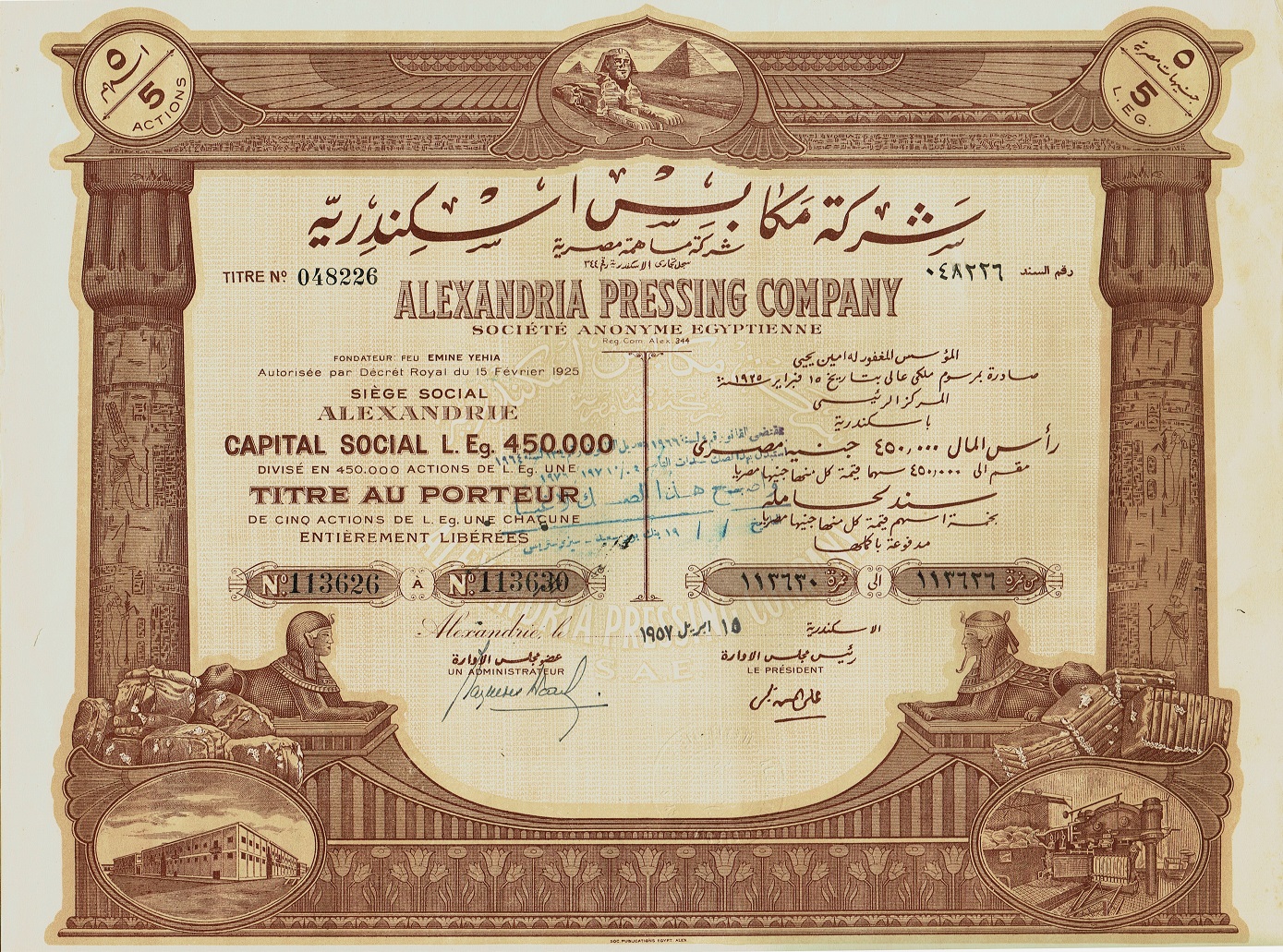
Images 6a and 6b: From Egypt, the shares from the Alexandria Pressing Company that were issued in the 1950s have a watermark showing the name of the Norwegian company ‘BORREGAARD’, the paper type ‘TUB SIZED LEDGER’ and the location of the paper mill ‘MADE IN NORWAY’.


I conclude this part in the series with one of my favorites: a share in The Dahramsi Morarji Chemical Co Ltd, Bombay (DMCC). Its watermark shows the line LUCKY PARCHMENT, a design of a jockey racing a horse, and the words RAG CONTAINING underneath. See images 7a and 7b below.

Parchment paper is not to be confused with “parchment”. The latter is a writing material made from animal skin. The former is a type of cellulose-based paper (made from wood pulp and cotton fibers) which has been treated chemically to make the paper stronger, more heat resistant and above all non-sticky.

You’ll find the words PARCHMENT also in the watermarks of shares from McLeod and Co, Ltd (1940s) and many other scripophily examples. In my example, LUCKY PARCHMENT is a parchment paper brand from the Indian paper company Ballarpur Paper and Straw Board Mills, Ltd.

RAG CONTAINING is another line of text in the DMCC watermark. Rag paper or cotton paper is primarily made of cotton linters or from used cloth (rags). Cotton paper may last many decades without any sign of deterioration, see also images 5a and 5b before.


Images 7a and 7b: This share in The Dahramsi Morarji Chemical Co Ltd was issued in 1968. The company's headquarters were located at Dr Dababhoy Naoroji Road in Mumbai. The certificate shows the coat of arms of the company, including a tiny map of India, and has a watermark of a racing jockey. 


The DMCC’s remarkable jockey watermark seems unrelated but it is not. I learned from scripophily expert Sayeed Cassim (see also here) that the Ballarpur paper company was founded by Karam Chand Thapar, who headed the Thapar Group of companies. The Thapar family was involved in race horse ownership, hence the jockey.

Time for a quick review. The first watermarks were formed, likely unexpectedly, in the production process of what we now call laid paper. Paper makers then added a logo, their coat of arms, or their name to the watermark design. Some of them further added a year, a paper type or brand, and also a location where the paper was made. If you haven’t done so already, you might start viewing your certificates against a window.

In part 3, I’ll show that paper manufacturers start adding watermark elements on behalf of one of their important customer segments: security printers.


F.L. 

This article was initially published in Scripophily magazine No. 114, December 2020. 
You might be interested to read : Watermarks in Scripophily - part 1 Introduction 


Friday, March 13, 2020

Belgian Association for Scripophily exists 40 years

The Belgian Association for Scripophily, in French: Association Belge de Scriptophilie (ABS), in Dutch : Belgische Vereniging van Scriptophilie (BVS), is a non-profit society that was founded 40 years ago in 1980. Ever since, the society's members gather once a month, to share news and discuss findings in our field of collection.

Two years ago member Denis Sagaert took the initiative to publish a free scripophily newsletter. More than reason enough to have a talk with him ! For the occassion, Denis choose the images for this post.


Alfred Van Neste (1874-1969) created the design for the founders share in the Société Anversoise de Cartonnages & Biseautages. The company, founded in 1899, was a book producer and publishing company from Antwerp. Van Neste, a landscape painter, illustrator and engraver, became one of Antwerp's most known poster designers. Click the image to enlarge and discover several illustrations from stages in early book production. The drawings are so prominent that the Art Nouveau elements in the border nearly escape our attention. Just below the rooster in the upper left corner you'll find 'SACB', the company's cypher (an interlacing or placing together of letters).


FL Denis, welcome to our virtual studio. How did you become a collector of antique securities ?
Denis I bought my first old shares in 2004 at a flea market in Brussels. As an  asset manager I was already very familiar with bonds and shares, but I had no clue about 'scripophily'. Two years later, I read a newspaper article written by the chairman of the Belgian society. I then became a member.

FL Do you collect certain themes ? 
Denis Yes, my main themes are Belgian-Russian shares, Belgian tramways and Belgian mining companies.


The Solvay company is a global player in the chemical and pharmaceutical business. The brothers Ernest Solvay and Alfred Solvay founded the company in 1863 to produce sodium carbonate by the Solvay proces. The vignette on the left is derived from the company's 50th anniverary medal made in 1913 by Belgian sculptor and medalist Victor Rousseau. In 1938 a similar, much larger bronze plaque made by Rousseau, was delivered for the Solvay memorial monument in Rebecq, the birthplace of the brothers. This bearer share dates from 1967, the year of Solvay's first public offering of shares to the public.


FL Denis, can you tell something about ABS/BVS ?
Denis Our association was founded in 1980 when scripophily was still a young hobby. ABS/BVS is a non-profit organization. Once a month we gather in Jezus-Eik, close to Brussels, and hold an auction for members. Occasionally, non-members are allowed to take part in a special auction either on-site or through submission of email bids. Also, people who still own some old cancelled bonds and shares, can contact our chairman for value estimations. They can also consign their 'non-valeurs' for sale at the club auction.

FL How many members does the society has ? 
Denis We have about 25 members.

FL I've seen that the newsletter is mainly written in French. Do most members speak French ?
Denis There are a little more French speakers. We have a small group of members from France! But there is no big difference with the number of Dutch speakers.


Banker André Langrand-Dumonceau founded in 1863 the Banque de Crédit Foncier et Industriel. From the 1850s through the 1860s Langrand-Dumonceau tried to build a major Catholic financial group in Europe to counterbalance the so-perceived Jewish dominance in the financial sector. He became manager of tens of financial companies. He founded Royale Belge, one of the largest Belgian insurance companies. Pope Pius IX, King Leopold of Belgium, Napoleon III of France, and other European notables supported Langrand-Dumonceau's activities. However, by 1870, his financial empire collapsed and he fled to the USA. Langrand-Dumonceau signed this 1863 certificate for 20 shares of 500 Francs. 


FL Denis, the society has an interesting website. What does it offer ?
Denis The site hosts a very extensive online database of antique securities (*). Of course, you can find information about our club and our hobby. In case of a 'special auction', we put the auction catalog online as well.
(*) Editor's note: you can search among more than 40,000 bonds and shares

FL You decided to publish a newsletter. What is it about ?
Denis We have a lots of resources on Belgian business histories, like the Moniteur and Recueil Financier year books. We bring topics on Belgian scripophily. In cases where a foreign company has a Belgian connection, eg. through its shareholders, then we might bring topics on foreign corporations too. In all cases, the content should be a combination of financial history and known bonds and shares.

FL Denis, was there a particular reason to start the newsletter ?
Denis Well, in the first place, we hope our members find it interesting, but publishing a newsletter is also a great way to give visibility to our association. The number of collectors in Belgium is diminishing. Hopefully, we can attract new members with this project.


L'Ikelemba was an agricultural and trading company, especially in rubber. The company's assets were located in the Ikelemba river bassin, in today's Democratic Republic of the Congo. The Lithographie du "Messager de Bruxelles" produced this share from 1898, a great example of a chromolithograph. Instead of using techniques like intaglio printing (e.g. engraving) or raised relief (wood-cut), this printing process was based on a flat surface printing method. The drawing was made on a special stone. By means of chemicals, ink was attracted by the drawing and repelled from the surrounding areas. In the case of multiple colors, separate stones were used for each color. A single print went through the press separately for each 'color' stone. The big challenge was to keep the resulting color prints aligned to form a unified image.  


FL I can't resist asking the next question, I'm a bad person, but what is your favorite certificate ? 
Denis Hm ... one of my favorites is a L'Ikelemba, action de dividende, from 1898 and extremely decorative.

FL Denis, I want to thank you for this interview and wish you success with the newsletter. 


Related links


F.L.


Tuesday, March 19, 2019

The Wogau saga that includes a bonus

In the early 1760s, Catherine II the Great wanted to modernize agriculture and industry in the Russian Empire. Compared with Western Europe the country was lagging behind on economic development. She published declarations in which she invited Europeans to immigrate and become Russian citizens, farmers, entrepreneurs and traders. Many new settlers came from Germany. Catherine was a German princess herself.

Wogau & Co. brings the remarkable story of the Wogau family and its businesses in the Russian Empire. The book's author is Erik Meyer, an expert in Russian scripophily who has written articles in magazines and auction catalogs in this field. 


Wogau & Co., by Erik Meyer 
Portrait of Philipp Maximilian von Wogau (27 May 1807 - 20 Jan 1880) 


In 2017, after many years of research on the German Wogau family, Erik Meyer published the book Wogau & Co.  He sketches out the growth of the Wogau business:
"In 1827, Maximilian von Wogau leaves Frankfurt and sets off for Moscow to seek his fortune. He will rise from office boy to multi-millionaire. His enterprise will become the largest and wealthiest German trading firm and industrial group in Russia.  
Wogau engaged in consumer goods tea and sugar as well as in commodities and semi-finished products such as iron, copper, cement, paper, soda and other  chemical and pharmaceutical products. 
Despite holding shares in a dozen factories, the company’s own capital was strictly kept within the family. Wogau never went public. The shares in capital and profits of individual family members were only kept in a simple notebook, the so-called  “Journal of the Secret Book.“ 


The book's chapters discuss the many aspects of the Wogau saga. An overview :
  • Am Anfang stand der Tee (Tea in the beginning)
  • Die Dynastie der Associés (Dynasty of associates)
    • Friedrich (Fjodor Maximowitsch) von Wogau
    • Wilhelm (Wassilij Dmitriewitsch) Luther
    • Karl Heinrich (Karl Maximowitsch) von Wogau
    • Moritz (Mawrikij Filippowitsch) Marc
    • Conrad (Konrad Karlowitsch) Bansa
    • Albert Erwin (Erwin Augustowitsch) Schumacher
    • Otto (Otto Maximowitsch) von Wogau
    • Maximilian Hugo (Hugo Maximowitsch) von Wogau
    • Maximilian (Max Karlowitsch) von Wogau
    • Georg Konrad (Georgij Dmitriewitsch) Rüchardt
    • Rudolf (Rudolf Wassiliewitsch) Hermann
    • Hugo (Hugo Mawrikiewitsch) Marc
    • Walter Waldemar Schumarcher (Ffennell)
  • Der Handel mit "Commodities" (Trading in commodities) 
  • Wogau als Privatbankier und Bankengründer (Wogau as a private banker and bank founder) 
  • Die industriellen Beteiligungen (The industrial holdings)  
    • Wogau in der Eisenhüttenindustrie (Iron and steel) 
    • Wogau in der Kupferindustrie (Copper) 
    • Wogau in der Baustoffindustrie (Building materials) 
    • Wogau in der chemischen Industrie (Chemical) 
    • Wogau in der Zuckerindustrie (Sugar) 
    • Weitere Industriebeteiligungen (Other industrial participations) 
  • Die Geschäftsordnung des Handelshauses (Rules of Order of the trading house) 
  • Das Geheimbuch (The Secret Book) 
  • Warwarka, die Zentrale des Hauses Wogau & Co. (The headquarters of the Wogau business) 
  • Familie und Gesellschaft (Family and company) 
  • Weltkrieg, Revolution und Flucht (World war, revolution and flight) 
  • BRAMARCO - Wogau im Exil (Successor BRAMARCO - Wogau in exile) 
  • Das Schiksal der in Russland Gebliebenen (The fate of those who remained in Russia)  


Société pour la Production de Soude en Russie sous la Firme "Lubimoff, Solvay et Cie" 
1000 Roubles share, 1888, Moscow 
This joint venture between the Russian soda producer Ivan Lubimoff and the Belgian company Solvay came about in 1887 through the initiative and equity participation of Wogau & Co. Already more than 130 years ago, the founding of the company was the result of a joint pan-European project involving the Russian Ivan Lubimoff, the Belgian Armand Solvay, the German Maximilian von Wogau, the Frenchman Auguste Loutreuil and the British citizen and St. Petersburg textile manufacturer William Thornton as the founders. 
courtesy of Erik Meyer 


But things would change for the Wogau family business. Erik Meyer continues :
"Over the years, Wogau managed to grow the company’s capital to nearly unbelievable proportions. By adopting prudent bylaws for the trading firm, Wogau succeeded in keeping together the growing family and its capital for nearly 80 years. The firm’s “Secret Book“, for a long time supposed to have been lost, survived and is presented in this volume for the very first time!  
The Russian Revolution of 1917 put a stop to the remarkable rise of the trading firm of Wogau & Co. The family had to flee the Bolsheviks. Their hard-earned wealth of over 50 million gold rubles was lost in one fell swoop."

Erik Meyer has written an intriguing work about a German immigrant family in Tsarist Russia. The book includes black and white photographs from the 19th and early 20th century, and of course several rare Russian bond and share cerificates in full color. 

Further details
  • Title: Wogau & Co. - Das grösste deutsche Handelshaus im russischen Zarenreich, in English : Wogau & Co. - The largest German trading house in the Russian Empire
  • Author : Erik Meyer
  • ID : hardcover 978-3-86460-618-2, softcover 978-3-86460-619-9, published 2017 by Pro BUSINESS GmbH
  • Languages : German
  • Number of pages : 210
  • Images : 70 images, including about 20 bonds and shares 

The book, which fits in your laptop case, is available on Amazon here. Google provides an online preview, there.

Oh, and at the end of the book, there is a Buchbonus, a QR code, that gives you access to more online resources including huge family trees, some more scripophily and the like.
Top !


F.L.

Wednesday, May 16, 2012

Digest of scripophily readings III

New online scripophily articles and references, 16 May 2012

Flickr Photostream of Museum of American Finance
Images of objects and documents in the collection of the Museum of American Finance, NYC, can be found here . Several rare stocks and bonds are listed.

Commercial overprints of Great Britain
I'd like to refer to a wonderful blog, namely the blog of the COSGB, or Commercial Overprint Society of Great Britain. Commercial overprints are postage or revenue stamps that have been commercially printed with the name of the user prior to being used. " In Great Britain, Ireland, and New Zealand, these stamps were used to pay an excise tax and were applied to receipts of various sorts."  Besides the lovely images of these stamps, each blog post is dedicated to one company. Just to pick one out : here is the link to Imperial Chemical Industries (ICI). You really should have a quick look.

WWII Danzig bonds
A small article - in German - was written by Rollo Steffens on Gdansk scripophily (German: Danzig), see here .

German football league bonds
Are fan bonds a good investment? Find out for yourself in this (German) article , written by Henning Eberhardt for Spiegel Online.


Front cover of scripophily magazine Der AktienSammler April 2012
double-click to enlarge

der aktienSammler 
In addition to the articles above, the latest April 2012 No.2/12 issue of der aktiensammler magazine, contains the following stories (in German) :
  • Vereinigte Dampfschiffahrts-Gesellschaft des Thuner- & Brienzersees , or in English: United Steamship Company of Lake Thun and Brienz (shipping in Switzerland)
  • Die Firmengruppe "Rostock" Elmshorn, or in English: the "Rostock" Elmshorn corporate group  (food trade and processing in Germany)
  • John Law, two contributions on related scripophily
  • Kreditfinanzierung auf English und das erste Papiergeld in Europa, English : Credit Financing in England and the first paper money in Europe  (part 8 in a series on the evolution of money)
  • Florida Panthers Holding: Der "Rat-Trick"  (ice hockey)
  • Die Erste Russische Lokalbahngesellschaft: Kennerblick gefragt, in English : the First Russian Local Railway Company: an expert eye needed
  • Der Spekulation ist nichts zu schwör, or freely translated: No limits to speculation (about the current wave of speculation in Mexican bonds and shares)
  • other periodical topics : Auction Reviews, Collector's Portrait, Events Calendar, Classifieds

F.L.