Showing posts with label watermarks. Show all posts

Saturday, August 14, 2021

Watermarks in Scripophily - part 2 Paper manufacturers

In Watermarks in Scripophily – part 1 I introduced you into the world of watermarks specifically on bonds and shares. This time we’ll talk about watermarks created by the paper makers themselves, perhaps the most obvious category of watermarks in scripophily. 

The first watermarks appeared in Italy during the 13th century. They were used to identify the papermaker or the trade guild that manufactured the paper. An interesting question is whether watermarks were invented, or just a side effect in the production process?


images 1a and 1b: When viewed against a light source, this Nira Valley Sugar Co share reveals a watermark pattern of bold vertical and faint horizontal lines. This is an example of laid paper. A detail of the pattern is shown here below. Click images to enlarge. The actual company and its share was described and illustrated in part 1 of this series, see here


European paper was initially made by dipping a wooden-framed screen, a lattice of metal wires, into a tub of warm water and cellulose fibers, scooping up this pulp, and then letting the water drain out. The cellulose came from cotton linters or recycled cloth (rag), and only much later wood fibers were used too. 

The cellulose fibers subsequently matted into a thin layer against the screen. For hundreds of years these screens had a rectangular design with widely-spaced vertical “chain” wires and closely-spaced horizontal “laid” wires tied on top of the chain wires.

In the process the wires in the screen compress the pulp fibres and reduce their thickness. The resulting patterned portion of the paper is thinner and lets more light through than the surrounding paper. 

The laid wires yield faint lines in the watermark. Chain wires have a greater impact and are responsible for the bolder lines. This type of paper is known as laid paper. A nice example can be seen above in images 1a and 1b.


images 2a and 2b: The Swedish immigrant Willgodt T. Odhner invented the Arithmometer, a pinwheel calculator. Following the Russian revolution, his company moved from St. Petersburg to Göteborg, Sweden. This 1918 share’s watermark reveals a coat of arms of the paper manufacturer Lessebo, a crowned beehive with the date 1719. The words ‘Handgjord Post’ translate as ‘handmade post’. Image courtesy Wilhelm Leiter 


Paper makers found out that they could add special designs to the watermark by sewing wire designs to the screen frame. A paper maker could now incorporate its coat of arms, a logo, or its name into the watermark. The product could now be identified and became difficult to counterfeit. An interesting example is the Original-Odhner share, see images 2a and 2b.

Often paper makers have a remarkable history. The Original-Odhner’s share’s paper manufacturer is Lessebo Paper. The paper mill was originally an iron mill established in the 17th century. In the 1690s the mill started making heavy paper for paper cartridges used for containing a bullet and gunpowder. In 1719 the mill gained permission to manufacture paper, a date that you see in the company’s coat of arms (image 2a). Lessebo Paper still manufactures hand-made paper today.

Over time, the production of watermarks became mechanized. During manufacture paper pulp is passed through rolls with a raised design. The designs applied on the rolls cause density variations in the produced paper. In turn, these density variations make an image or a pattern appear in the paper in the form of various shades of lightness and darkness. We speak of multi-tonal watermarks.

A relevant example can be seen in part 1, see there, namely the Indian Post Office 5-Year Cash Certificate. That paper shows light, dark and even multi-tonal watermarks giving the viewer an impression of depth. Another fine example can be seen on a Olivetti bond, see images 3a and 3b.


Images 3a and 3b: Ing. C. Olivetti & C. was founded in 1908 as a typewriter manufacturer and evolved into computers and smartphones. This certificate, issued 1948, has a watermark pattern, a repeating design that is applied all over the surface of the paper. Watermark patterns can be seen on many Russian railway bonds. In most cases it is not possible to detect whether patterns like these were designed by the paper manufacturer, or by commission of the certificate’s printer or issuer. The pattern on this Olivetti bond consists of diagonally placed geometrical figures. The multi-tonal shade gives you an impression of depth and the pattern appears as a structure of ‘buttons’, looking like bubble wrap plastic, something I usually cannot resist popping! 


In the 1700s James Whatman started a paper making business in Maidstone, Kent. He experimented with the wire screen used in the process. Whatman replaced the lattice of laid and chain wires with a screen of a much finer woven mesh of wires. As a result, the paper was formed on a much more uniform surface and showed no watermark pattern of lines, unless a wire design had been sewn to the screen. This type of handmade paper is called wove paper, and its invention led to what we know as modern paper today.

Whatman was probably the first paper company that added a year to its watermark, see image 4b. You may discover on your certificates watermarks by other paper makers incorporating a year as well. The shares in the United Commercial Bank, Calcutta, issued in the 1960s, show the T H Saunders (or parts of it) name with the year 1946. That company was founded by Thomas Harry Saunders. Famous for its diversity in watermark designs used on stamps, bills of exchange, securities, and the like, Saunders won medals at international exhibitions for his light and shade watermarks that were used to prevent frauds.


Images. 4a and 4b: Established in the 1840s as the Auckland Hotel, Kolkata’s Great Eastern Hotel, today known as the LaLiT Great Eastern, hosted many notable persons like Nikita Khrushchev, Elizabeth II, Dave Brubeck and M K Gandhi. This 1937 share was printed on wove paper. Its watermark shows the WHATMAN name, ‘HAND MADE’ and the year ‘1916’. 


You cannot interpret a year in a watermark as the year of paper production or as a print date. It should be seen as “paper produced not earlier than” because mills did not always update their watermarks.

Besides their name and coat of arms, paper mills sometimes added to the watermark an indication of the paper brand and the paper quality. That made it easy for stationery businesses and printers to look up the right type of paper in their inventory. As an example, I show here an American paper, see images 5a and 5b.


Images 5a and 5b: The Q1 Corporation was a pioneering microcomputer company. In 1972 they delivered the world’s first personal computer based on an 8-bit general purpose microprocessor, the Intel 8008. The share bears the watermark of the Strathmore Paper Co, founded in 1892, West Springfield, Massachusetts. The watermark shows the brand ‘Strathmore Script’ and its quality ‘100% Cotton Fibre’. Cotton fibres are strong yet soft and create a uniform paper surface that is strong and flexible. 100% cotton paper is often used for banknotes. 


In some cases, paper makers add to their watermark the location where the paper was made. Some examples from Indian shares: The Rajnagar Spg. Wvg. & Manufacturing Co Ltd, preference share, 1945, was ‘MADE IN ENGLAND’ and a 100 Rupees share in The Birla Mills Ltd, 1920, reveals ‘MADE IN CANADA’.

More of a surprise is a 100 Rs share from The Gold Mohur Mills Ltd, 1926, Bombay, telling us ‘MADE IN AUSTRIA’. Another example that illustrates the export of quality paper products is shown in images 6a and 6b.
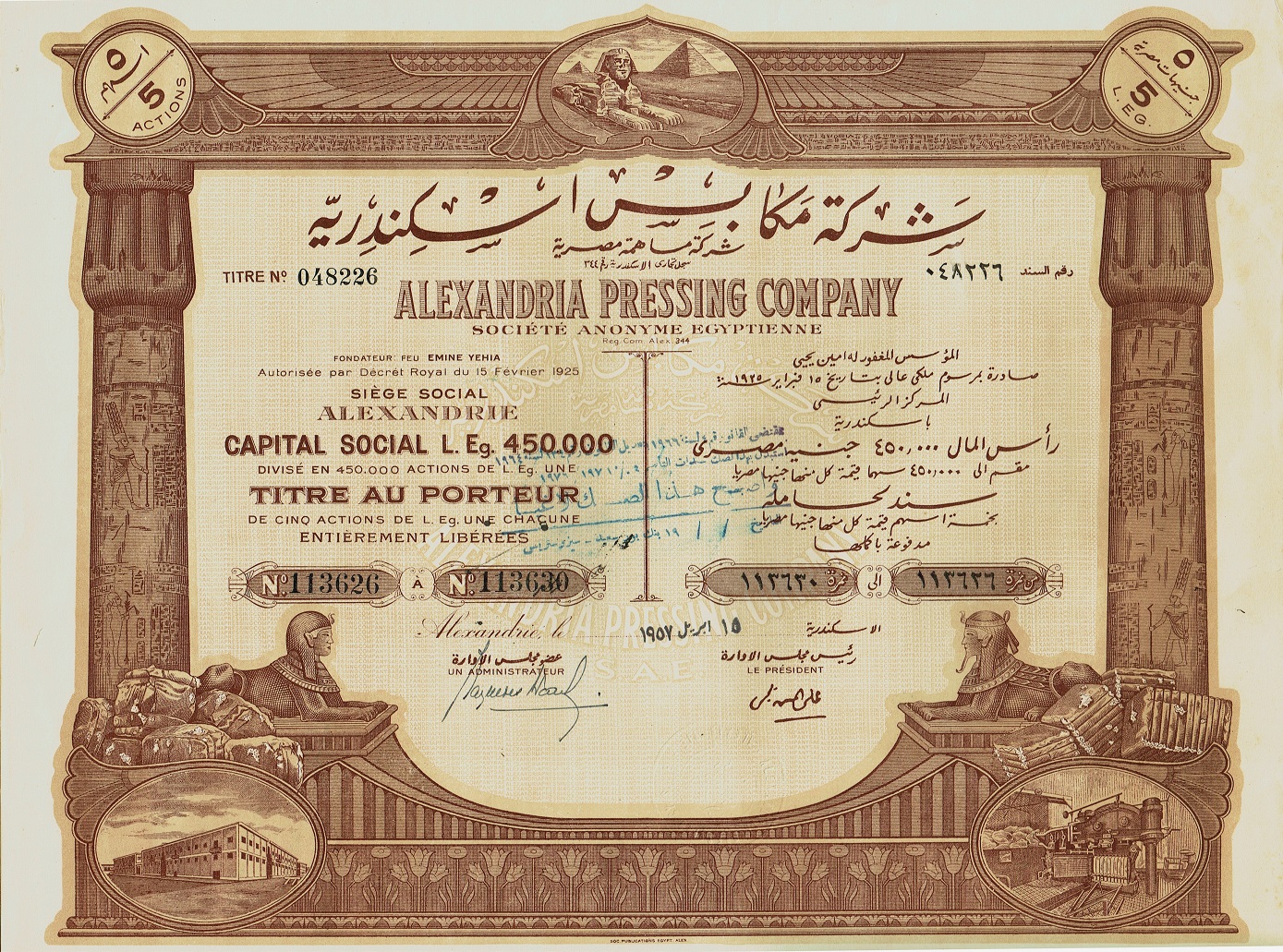


Images 6a and 6b: From Egypt, the shares from the Alexandria Pressing Company that were issued in the 1950s have a watermark showing the name of the Norwegian company ‘BORREGAARD’, the paper type ‘TUB SIZED LEDGER’ and the location of the paper mill ‘MADE IN NORWAY’.


I conclude this part in the series with one of my favorites: a share in The Dahramsi Morarji Chemical Co Ltd, Bombay (DMCC). Its watermark shows the line LUCKY PARCHMENT, a design of a jockey racing a horse, and the words RAG CONTAINING underneath. See images 7a and 7b below.

Parchment paper is not to be confused with “parchment”. The latter is a writing material made from animal skin. The former is a type of cellulose-based paper (made from wood pulp and cotton fibers) which has been treated chemically to make the paper stronger, more heat resistant and above all non-sticky.

You’ll find the words PARCHMENT also in the watermarks of shares from McLeod and Co, Ltd (1940s) and many other scripophily examples. In my example, LUCKY PARCHMENT is a parchment paper brand from the Indian paper company Ballarpur Paper and Straw Board Mills, Ltd.

RAG CONTAINING is another line of text in the DMCC watermark. Rag paper or cotton paper is primarily made of cotton linters or from used cloth (rags). Cotton paper may last many decades without any sign of deterioration, see also images 5a and 5b before.


Images 7a and 7b: This share in The Dahramsi Morarji Chemical Co Ltd was issued in 1968. The company's headquarters were located at Dr Dababhoy Naoroji Road in Mumbai. The certificate shows the coat of arms of the company, including a tiny map of India, and has a watermark of a racing jockey. 


The DMCC’s remarkable jockey watermark seems unrelated but it is not. I learned from scripophily expert Sayeed Cassim (see also here) that the Ballarpur paper company was founded by Karam Chand Thapar, who headed the Thapar Group of companies. The Thapar family was involved in race horse ownership, hence the jockey.

Time for a quick review. The first watermarks were formed, likely unexpectedly, in the production process of what we now call laid paper. Paper makers then added a logo, their coat of arms, or their name to the watermark design. Some of them further added a year, a paper type or brand, and also a location where the paper was made. If you haven’t done so already, you might start viewing your certificates against a window.

In part 3, I’ll show that paper manufacturers start adding watermark elements on behalf of one of their important customer segments: security printers.


F.L. 

This article was initially published in Scripophily magazine No. 114, December 2020. 
You might be interested to read : Watermarks in Scripophily - part 1 Introduction 


Wednesday, November 25, 2020

Watermarks in Scripophily – part 1 Introduction

This article is an introduction into a lesser known aspect of securities : watermarks. If you don’t know what a watermark is then hold a banknote toward a light source. Against the light a design appears, at least this is the case on many banknotes. 

Watermarks can be seen on official documents, banknotes, stamps, cheques and also bonds and shares. When you investigate a new entry for your collection, you want to look for a watermark. 

However, most certificates don’t show watermarks; no wonder that many collectors overlook this feature. Yet, now and then you will be surprised by what emerges from the dark side. 


image 1a. The shortlived Nira Valley Sugar Co had a factory at Malegaon in Maharashtra, India. It operated a narrow gauge railway at its sugar cane mill. This share was issued to Maharaja Ganshyamsinhji Ajitsinhji of Dhrangadhra, Bombay, 1920.  
image 1b. Viewed against a window on a sunny day, the share reveals in the lower border a watermark of the paper manufacturer "STANLEY". The four black dots in the corners of the ‘watermark’ image are the silhouettes of little magnets used to hold the certificate in place on a semi-transparant screen when photographed. Click image to enlarge


Watermarks were first developed as the paper manufacturer’s hallmark. Early Italian paper manufacturers from the 13th century started experimenting with this idea. Watermarks that were created by the paper makers themselves are a first category of watermarks in scripophily. See image 1a en 1b as an example. 

How are these things created ? Watermarks are drawings created in paper during the paper manufacturing process. They are produced by having a design raised on the rolls through which the paper pulp is passed during manufacture. 

The designs applied on the rolls cause density variations in the produced paper. In turn, these density variations make an image or a pattern appear in the paper in the form of various shades of lightness and darkness.


image 2a. The Tambracherry Estates & Wynaad Gold Mining Co Ltd had mining operations in the Indian state of Kerala but eventually purchased estates for the cultivation of coffee, tea, and the like. £1 shares, London, 1882.  

image 2b. Written upwards along the right border, a watermark shows “WATERLOW & SONS”, the printer of this certificate. The watermark image was taken on a cloudy day, hence the darker appearance.


Printers of banknotes realized that watermarks in notes could be used as an extra anticounterfeiting device. Halfway through 17th century Stockholms Banco was the first bank that applied a watermark in a banknote; it revealed the word ‘BANCO’. 

Later, security printers adopted the technique and occasionally applied tailor-made watermarks that identified the printing house. This type of watermarks forms a second category. See the Waterlow & Sons example, images 2a & 2b.

In addition to watermarks from paper manufacturers and printers, governments and companies have issued certificates that were produced with customized watermarks. In most cases these comprise the name of the issuer, or the latter’s coat of arms or logo. This is a third category of watermarks in scripophily. As an example, see images 3a en 3b. 


image 3a. Some issuers of securities ordered their own watermark. Here is a Reserve Bank of India certificate for Rs100 issued in 1935. 

image 3b. The entire watermark design almost forms a share on its own including the name ‘RESERVE BANK OF INDIA’ in front of large sun with rays, and a triple line border, all around the certificate. Click image to enlarge


There is little scripophily literature that addresses these features. I know of two books : World War II Remembered, by C Frederick Schwan & Joseph E Boling, and Alexander Kipfer’s Historische Wertpapiere der Spanischen Königlichen und privaten Handelsgesellschaften des 18. Jahrhunderts. 

The comprehensive Schwan/Boling volume describes numismatics, in the broadest sense, including bonds, issued by the WW II powers, and where applicable watermarks are described or illustrated. You can find more details on this work here.

Kipfer’s book describes the securities of the 18th century Spanish trading companies. Also here a handfull of these have been identified as bearing watermarks. 


images 4a and 4b. The Real Compañia de Filipinas took over the Real Compañia de Comercio Establecida en Barcelona in 1785. As a result the company obtained a trade monopoly with the Philippines. Depending on the paper that was used, some of its 250 pesos shares from 1785 display a watermark, others don’t. Alexander Kipfer spotted the stylishly elaborated letters 'AF' on some shares from this company. 
The Schweizer Finanz Museum provided the left image. The other one  was taken from the Alexander Kipfer's book with permission of the publisher Haag & Herchen GmbH.


I'm planning some follow-up articles for later to illustratie the variety that exists in these watermarks on bonds and shares : 
  • Watermarks by paper manufacturers
  • Watermarks by printers
  • Watermarks by companies & governments
  • Watermarks that really stand out


image 5a. and 5b. Examples from the third category, custom watermarks used by companies or governments, can be astonishing. 
This Indian Post Office 5-Year Cash Certificate for 20 Rupees, 1935, shows off its watermarks created in several shades of dark and light. You can detect a repeating pattern made up of the words GOVT of INDIA and the Star of India emblem. Joe Boling, co-author of WW II Remembered, identified the dark letters as the British royal cipher, GRI, which stands for Georgius Rex Imperator, or George, King (of Britain) and Emperor (of India). Click image to enlarge


If you have a certificate with a remarkable watermark, then you can email me an image. But be carefull while handling the certificate. You don't want to end up with a torn corner or a heavy fold.

F.L.

This article was published in Scripophily magazine No. 113, August 2020.
You might be interested to read : Watermarks in Scripophily - part 2 Paper manufacturers 


Previous posts

Monday, April 20, 2020

Star of India

When you inspect an antique share certificate then there is a good chance that you discover a seal on the document. Here's an example of a dry seal, also known as an embossed seal, hardly noticeable but surprising at a closer look.

Seals are security features used to enhance protection against counterfeiting. There are many ways by which seals can be produced, e.g. as a dry seal like the one in the example, as a stamp imprent with ink, or as an impressed relief in wax. Even holograms are used on modern certificates. 


embossed seal with the Star of India

Dry seal with in the circumference the text THE SCINDIA STEAM NAVIGATION CO. LD. - BOMBAY 


Dry seals are created on the document by means of an embossing press. An embossing press consists of two plates, one bearing the image in relief and the other one bearing the mirror image. By pressing the document between the plates, the seal image is produced forming a raised image in the paper. 

Seals on certificates can show the name of the issuer, an emblem or a coat of arms, an incorporation date, or a picture of the kind of activity that was involved.

Our seal was embossed on a share from The Scindia Steam Navigation Company, Limited. It shows a star surrounded first by some lettering and then by sun rays. Not all letters are readable but you can recognize ..EAVEN'S LIGHT OUR G..


share certificate from The Scindia Steam Navigation Company

The Scindia Steam Navigation Company, Limited was founded in 1919 by Walchand Hirachand, Narottam Morarjee, Kilachand Devchand and Lallubhai Samaldas. Back then the sea routes in the British Empire were controlled by British companies. In April of 1919, the company's ship SS Loyalty sailed to the United Kingdom. Much against the will of the British, it was the first Indian ship to do so. The vignette on this share from 1920 depicts the company's flag ship, the SS Loyalty. 


All-wise Google tells me that the star and the lettering in the dry seal matches the emblem of the Order of the Star of India. It was Queen Victoria who created in 1861 this order of knighthood to honour (loyal) Indian Princes and Chiefs, as well as British officers and administrators who served in India.

The order's motto was HEAVEN'S LIGHT OUR GUIDE and can now be recognized on the seal above. With HEAVEN referring to the stars, this neutral motto had to appeal to people of different faiths. The star did not have Christian connotations, and was so accepted by the Indian Princes.


Maharaja Madho Rao Scindia of Gwalior with the Star of India

In  1886 Maharaja Madho Rao Scindia of Gwalior succeeded his father Jivaji Rao Scindia and ruled until his death in 1925.  Note the Star of India on the chest. image (clipped) : Internet Archive Book Images / No restrictions via Wikimedia Commons


At first it was unclear to me why we see the Star of India in the seal from the Scindia Steam Navigation Company. However my friend David had an interesting theory. What he came up with can also explain why the name of the company, despite being founded in Bombay by Gujarati businessmen, includes the word Scindia, the name of a dynasty that ruled the State of Gwalior

David pointed out that the company's first ship, the SS Loyalty, was purchased from Maharaja Madho Rao Scindia of Gwalior. Madho Rao became Commander in the Order of the Star of India in 1895. The Maharaja in turn had bought the ship, then known as the RMS Empress of India, from the Canadian Pacific Line in 1914. According to The New York Times of Dec 20, 1914, he was the richest Prince of the Indian Empire.


Royal Bombay Yacht Club debenture with company seal

Royal Bombay Yacht Club, 6% Rs.100 debenture, 1898 
Note the Star of India in the emblem's lower right quarter, click image to enlarge 
image: Barry Collection, via scripoworld.com 


Are there more scripophily items illustrated with a Star of India ? Almost none, but there is a bond from the Royal Bombay Yacht Club, see imageThis exclusive membership club, founded in 1846, was awarded its blue flag with a Star of India surmounted by the Imperial Crown of India.

A regular customer of the RBYC was politician Freeman-Thomas, aka Lord Willingdon (1866-1941). As Governor of Bombay he ruled from 17 Feb 1913 through 16 Dec 1918 over the Bombay Presidency. This administrative subdivision of British India, more or less the size of today's Germany, counted then nearly 30 million people.

While in office Willingdon maintained good relations with the Indian Princes and important business men. He met Narottam Morarjee, one of the founders of the Scindia Steam Navigation Company, to discuss the shipping business. Another founder of that company was Lalubhai Samaldas who had served as an Executive Councillor to the Governor.


statue of Lord Willingdon in Delhi

Lord Willingdon's statue in Coronation Park, Delhi, India. Note the Star of India 
image (clipped) : Nvvchar / CC BY-SA (https://creativecommons.org/licenses/by-sa/3.0) via Wikimedia Commons 


On the 3rd of June, 1918, Lord Willingdon was appointed by King George V as a Knight Grand Commander of the Order of the Star of India.  He often visited the Royal Bombay Yacht Club with important British officials and officers.

One one occasion in 1918 Willingdon invited some Maharaja's, possibly including the Maharaja of Gwalior, to the club. The Governor and his Indian guests were denied access. The RBYC only accepted European members. Willingdon then founded his own Willingdon Sports Club with membership open to both Indians and British.


coat of arms of the British Empire

detail from the Post Office Cash certificate, see below, showing the coat-of-arms of the British Empire


There was one celebrity that Willingdon did not get along with. That person was Mohandas Karamchand Gandhi. When Gandhi returned in Jan 1915 to India from South Africa, both met at Gandhi's welcome reception in Bombay. They would later meet each other again under different circumstances.

In 1917 a famine broke out in the Kheda region of the Bombay Presidency ruining the local economy. Peasants were not able to pay their taxes anymore. Under Gandhi's influence the people sent a petition to Willingdon, asking that he cancel the taxes for that year. Property confiscation and arrests was the government's answer.

Gandhi with the help of his followers organized the people to start a non-violent resistance, with success. Taxes were cancelled, property was returned and prisoners released.

Here's another "Star of India" certificate, a [India] Post Office 5-Year Cash Certificate, issued in 1935 while Lord Willingdon was India's Viceroy. However, the star is not immediately visible.


Indian Post Office 5-Year Cash certificate issued 1935

During the British rule of India several acts were approved to expand and regulate the Indian Posts and Telegraphs service. After the Government Savings Bank Act 1873 was ratified in 1881, Post Office Savings Banks opened throughout India. The reverse of this certificate explains that the holder, after his initial investment of 18 Rupees and 13 annas, would cash in 20 Rs after five years. The average per capita income in 1931-32 was Rs 65 (Towards Freedom 1945, Bimal Prasad)


On 18 Apr 1931 Lord Willingdon became Viceroy of India for five years. During his reign Gandhi and the Indian National Congress party organized a mass Civil Disobedience Movement. Willingdon imprisoned Gandhi, the INC members and tens of thousands of Indian activists.

As Viceroy, Willingdon was also supreme commander of the British Indian Army. The Government of India Act 1919 gave him also direct control over foreign affairs and communications, including the post service in India.

The viceroy served also as the grand master of the two principal order of chivalry of British India: the Order of the Star of India and the Order of the Indian Empire.


watermarks showing the Star of India

When viewed against a light source, the Post Office Cash certificate shows off its watermarks including several Star of India emblems. The four black dots (three of them in the corners) are the silhouettes of little magnets used to hold the certificate in place when photographed. Click image to enlarge 


The Post Office 5-Year Cash certificate is revealing when it comes to watermarks. Besides the initials of the paper maker, you can see a repeating pattern of the words GOVT of INDIA and the Star of India.

Gandhi must have been the Indian Postal Services' top customer. At some point he received hundreds of letters on a daily basis. These were answered by several close friends acting as his secretaries. Tens of thousands of letters written by Gandhi survived, 31,000 of them were compiled in the Collected Works of Gandhi.


microprinting in the underprint

Microprinting is rarely seen in Indian scripophily but this Post Office Cash certificate has it in the underprint:  'POST OFFICE FIVE YEAR CASH CERTIFICATE'. Image scanned at a resolution of 1200 dpi 


Was Gandhi ever awarded a Star of India ? Well, he was close to the founders of the Scindia Steam Navigation Company who publicly supported him, morally and financially. Did Gandhi encounter the Maharaja of Gwalior ? Yes, on one of these occasions Gandhi addressed Madho Rao Scindia in public and asked him for contributing to the funds of the new Benares Hindu University.  However Gandhi did not receive a Star of India, that was about the last of his concerns.

F.L.


PS You've seen other shares with a Star of India ? Send me a picture, I'd be happy to include it here, or post it on Facebook's Ancient indian stocks & bonds - scripophily group.

Reference

More on Seals

= = = = =

Here is an addition from 30th April, 2020. Thank you for the tip Sanjay ! 


The Eastern Electric Light & Power Company Limited, £5 shares certificate, 1882
vignette of Star of India, repeated in the embossed seal 
source: Spink Auction 9014, May 2019


Sunday, May 28, 2017

Kawasaki in the year 2889

We are in the year 2889. By then, all objects in museums are virtualized. People can download a perfect but scaled copy of any thinkable museum object and have it rendered in their living room as a tangible three-dimensional image. The objects that are speaking volumes are the ones the general public like the most. And you? Well, you are an archaeologist specialized in 20th century financial artefacts.

That day you are excavating a chamber at an ancient site which seems to be an office building from the 1960s. Yes, that is funny, back then people used to assemble all day long in a dedicated building to do office work. Anyway, the chamber you are working on, contains a safe weighing about 100 pounds. Your hand-scanner tells you there are documents inside the safe. With your tools, you manage to open it in no time. Wow, the parcel inside contains a set of old stock certificates. In the 20th century, people printed shares on paper for representing ownership in companies. Most of these certificates perished. One of the shares stands out from the others. It is speaking volumes.


With a PhD in Ancient Oriental Languages and Cultures, you translate the long line of characters on top. It is ancient Japanese, and you need to read it in the old way : from right to left. 


'Kabushiki Kaisya', 株式會社 are the first words and mean stock/limited company. A common term on Japanese certificates. You mouth the following word much slower : 'Kawa', , and 'saki', 崎, 'together Kawasaki', 川崎. Aha, that's interesting, halfway now. 
Already from the start you identified the last two symbols, 'Kabuken',  株券, 'share certificate'. Then you speak loudly, 'Zōsen', 造船, 'shipbuilding .. Tokoro, place', 所. 'Wait a minute, together they form Zōsensho, shipyard !',  造船所. You have figured it out : 'Kabushiki Kaisya Kawasaki Zōsensho Kabuken! I found a share in the Kawasaki Shipyard Co. Ltd '. With your hand-scanner you look up the flag printed on the share. Yep, that is the one.


Six months later, a new exhibition of the objects unearthed by you is launched at the Central Museum. The Kawasaki share is one of the highlights. As one of the museum's educators, you are leading a school group around the show. Of course, you spend time on the Kawasaki and explain all about the way business initiatives and innovations were financed 900 years ago. Some of the kids are babbling on anything but the tour, others look a bit bored. One of the kids raises its arm. 'Yes ?'. The group now turns quiet and looks at you first, then at the kid who says, 'If this piece of paper was meant to finance a business, what type of business would that have been?' The other kids are speechless and are now all staring at you.


Happy with the question and all the attention you have, you clarify 'Well, that could be anything you can think of, but in this case, you can see from the vignettes, the little pictures on the certificate, what this company was all about.' Now, for the first time, all the kids turn to the display case and inspect the Kawasaki share. 'They made ships !', shouts one of them and they all look at you again. 'That is correct ! The Kawasaki Shipyard Company was founded in 1896 and already one year later the company completed the Ivomaru, its first ship. If you look carefully, you can see a drawing of the shipyard behind the lettering. At Kawasaki they were very inventive. In 1906 they completed their first submarine. They even made battlecruisers like the Haruna, which was a warship of the Imperial Japanese Navy during World War I and II !'.

After reducing contrast, the underprint of the Kawasaki share reveals 
an image of a dockyard with ships under construction.
click to enlarge image

'And they also made cars .. and airplanes .. and locomotives !', they tell each other and leave their finger prints all over the display case. The kid that posed the first question, raises its arm again. 'Yes?', you wonder amused, 'What's your name ?'. The whole group answers instead, 'Sidney!'. 'Yes, Sidney, what is it ?'  Again, the group turns quiet and Sidney continues, 'These large vertical signs, they look like a cartouche. Is this from a Pharaoh ?' To everyone's reassurance you can not suppress a smile. 'Sidney, that's is actually a good question. A cartouche, an oval with a horizontal line at one end, encloses a royal name and was used in Ancient Egypt.' The boys and girls look disappointed but turn their heads to the share certificate again when you proceed, 'But, as is the case with this Kawasaki share, a signature of a high official or very important person was often printed in such a vertical way.'

printed signature of Matsukata Kōjirō, president of Kawasaki Shipyard company
'Do you see these five large vertically written characters over here?', and with your light pen you point out the position on the share. 'The first two stand for Matsukata.' , 松方. Some children try to mumble the word. 'The last three are Kōjirō.', 幸次郎 . 'So from top to bottom you read Matsukata Kōjirō.', 松方幸次郎. 'Now repeat all together !' They all chant Matsukato Kōjirō in unison. 

'Matsukata Kōjirō was born in 1865, that's more than a 1,000 years ago, and he was the son of the Prime Minister of Japan. Kōjirō became president of the Kawasaki Shipyard Company in 1896.' 

'Was he rich ?', someone asks. 'Oh yes, his business was very successful for some time. Kōjirō also wanted to give something in return to the people in his country. With the fortune he accumulated, he bought lots of Western European and Japanese art and wanted to build an art museum. Unfortunately he died in 1950 before he could realize his dream. But soon large parts of his collection found a home in Japan's National Museum of Western Art in Ueno and the Tokyo National Museum.'

'I have another question', adds Sidney, 'My dad rides a Kawasaki motorbike, why don't we see a motorbike on the share ?'  Some kids nod, they obviously know Sidney's father. 'Great question Sidney.' The group is proud to have Sidney on board. 'You see, this share was issued in 1921', and you point out the date 大正拾年 on the Kawasaki share. 'In Japan, years were then expressed as the number of years in the reign of the emperor starting with 1. 大正 represents Emperor Taishō, 拾 stands for 10 and 年 is the word for year. Taishō's first year of reign is 1912. So the date we see here is 1912 + 10 -1 which results in 1921. Now, that was easy, isn't it ?'. Everyone in the group tries to convince one another that it was easy. So you continue, 'Kawasaki started producing motorcycles more than 30 years later; therefore we see no motorbike on the share. The first motorbikes were produced by Kawasaki's Aircraft Division. That's why the emblem's on their fuel tanks looked like the Kawasaki flag within a wing.'

Later at home, Sidney tells mom and dad about the museum visit. The child activates the home visualizer and downloads a virtual replica of the Kawasaki share. It rotates slowly in the air when Sidney walks around it. 'Omigosh!'  The floor lamp shines through the image and a large watermark becomes visible.


Reading from right to left the watermark of the Kawasaki share says 
壹拾  株券 : 1x10  share certificates
株式 會社 : Kabushiki Kaisya  = Co., Ltd.
川崎 造船所 Kawasaki Shipyard
In 1969 the Kawasaki Shipyard company merges with its earlier spin-offs, 
Kawasaki Rolling Stock Manufacturing and Kawasaki Aircraft, 
into Kawasaki Heavy Industries.


F.L.

Related links


The Tokyo Motor Show 2013 featured the Kawasaki J Concept motorbike.
Image by Morio [CC BY-SA 3.0], via Wikimedia Commons


Saturday, June 27, 2015

Printers : Kelly Print


The share certificate below is printed by Kelly Print from Denver, Colorado. Except for the Colorado state seal, the print looks rather plain. 

Amity Canal, Reservoir and Improvement Company, share certificate from 1891
The Amity Canal, Reservoir and Improvement Co. 
(name as indicated on the embossed seal in the bottom left corner)
Incorporated under the laws of Colorado.
Capital stock $400,000 in shares of $50; issued in 1891.
double-click image to enlarge 


As so often is the case with plain looking certificates, the little hidden details are cheating you. Only when you take your time to have a closer look, you'll be surprised. 

The left and right borders contain two tiny bird vignettes, a dove and a rooster. Both measure only 7 mm each (0.28 inch).

tiny dove vignette measures 7 mm


The paper contains also a nice watermark. By means of some image edits, I was able to make the watermark visible. Double-click the image below, and you can recognize a large turkey. 


watermark of turkey
Watermark shows 'Turkey Linen' and a turkey.

Kelly Print is not often seen in scripophily. A Colorado certificate of the Rossiter Mining & Milling Company, auctioned as lot 1463 by Holabird's Western American auction #9, was also printed by Kelly Print. Any more information about Kelly Print or certificates printed by this printer is welcome.

F.L.


Wednesday, September 21, 2011

The double-headed eagle of the Third Rome

The internet technology company Google has one of the most famous and recognizable logos. In scripophily, this title is taken by the double-headed eagle of the Russian Tsar. During the 19th century, until the Russian Revolution in 1917, millions of securities have been issued to finance the Russian state, its railways, Russian companies and Russian cities. They were distributed all over Europe and the rest of the world. But have you paid any attention yet to the imperial eagle that has been printed on so many certificates? Have you noticed how many shields that eagle bears ?  Ever heard of the Third Rome ?

collage of old Russian bonds
Collage of bonds from the Russian Empire.
Image sources provided by Mr. and Mrs. A. Kamyshin

Nine coats of arms represent 500 years of history
When looking carefully, you can distinguish 9 coats of arms on the eagle. However, in most cases, these shields are printed so tiny that few details can be revealed.

Russian Kopek coin 1917
click to enlarge and distinguish the 9 shields

The center shield on the eagle's chest is the one with the arms of Moscow. Then, in clockwise order starting from the heads, we see the arms of Astrakhan, Siberia, Georgia, Finland, Kiev-Vladimir-Novgorod, Taurica, Poland and Kazan. As you will read further, you'll see that this double-headed eagle represents about 500 years of Russian imperial history. To be honest, I was unaware of the rich past of Russia and while reading about it I found myself consuming one story after another. I can only recommend you to do the same.

1866 bond of the Russian empire with detail on the Russian double-headed imperial eagle
2e Russ. 5% Inner. Anleihe mit praemien-verloos.
1866, Bond for 100 Roubles
Double-click for details
At the end of the post, I'll highlight some more remarkable appearances of the Russian eagle, but to start with, here is a brief overview the shields and the history that is represented by them, given again in their clockwise order.