Showing posts with label telephone. Show all posts

Thursday, February 4, 2021

Pioneering communication technology and lots more ready for take off at Spink

SPINK's latest timed scripophily auction went live earlier this week and ends at 11 AM GMT on Feb 16, 2021. This online sale presents about 600 lots of antique bonds and shares from all continents.


SPINK's e-Auction includes a large American section. The Utah Lithographing Co. S. L. C produced this stunning print for the Fairview Southend Mining Co. We've seen other lovely scripophily works by this printer, such as those made for the Salt Lake and Ogden Railway Co., depicting a tramcar and a mountain and lake landscape, and for the Dromedary Hump Mines Company illustrated with a dromedary. This 1906 issued share certificate shows a native American at nightfall watching the first star that appears behind the mountain tops. L(ot)534


For this sale SPINK specialist Mike Veissid selected a remarkable number of antique bonds ands shares from companies pioneering in the field of communication technology. Marconi needs no introduction, L292 is a share from Marconi's Wireless Telegraph Company Ltd. Edison is represented with a £100 share in The Edison Telephone Company of Glasgow, 1880, L281. 
Here are some other fascinating items :
  • Most of us still remember the fax machine. L290 Kamm's Zerograph Syndicate (1905), Limited, issued in 1906, is signed by Leo Kamm who invented a filmless movie projector but also a telegraph transmitting text that was printed at the receiving end. 
  • Two 1911 shares in The National Telewriter Company, Limited comprise lot 296.
  • Military commander and aviation pioneer Baden Baden-Powell signed L286, The Helsby Wireless Telegraph Company, 1910. 
  • A share in The Kilduchevsky Mega Telephone Syndicate, Limited, L291, is signed by another aviation pioneer, Paul de Kilduchevsky.


The German Josef H. Reineke invented this wireless telephone system for use in mining environments. A demonstration of Reineke's system was given in 1913 at the Annandale Pit, Kilmarnock, belonging to the Carrington and Auchlochan Coal Co. It was stated that with a portable apparatus in case of an accident, when ordinary telephone wires would be broken, it would be possible to converse with entombed miners. Officials of Dinnington Main Colliery, Yorkshire, where the system was tested for six months, often spoke from the pit-head or the pit-bottom to an operator in the cage while in motion. They also communicated with success through a mile of solid coal. L299 in the auction.
source: The Electrical Review, Vol. 73 No. 1869, Sep 19, 1913.


Also prominent in the sale is a series of securities related to arms, explosives and weapons : 
  • Probably the most splendid scripophily in this theme is a share in The Colt Gun and Carriage Company, Limited. Issued in 1906 it is embellished with vignettes of soldiers and machine guns, L306. 
  • L312 is a share in John Rigby & Co. (Gunmakers), Limited. Rigby, one of the oldest gunmaking companies in the world became famous in the 18th century for its dueling pistols. 
  • Hiram Percy Maxim is credited with inventing the firearm silencer. L311 is a Maxim Silencer Company, Limited share from 1909 with embossed seal depicting guns.


The Rexer Arms Company acquired the rights to manufacture the Danish Madsen machine gun in the British Empire. After a legal battle on patents Rexer changed its focus on producing the Rexer Steam Car, without success. L323, £1 shares certificate, 1906, vignette of aiming soldier 


There is a lot more to discover. Collectors of scripophily from South Africa, Rhodesia and Egypt will be delighted, as well as those looking for new automobiles, motorcycles and tobacco material !
Here are the sale's details : 


Into African and Belgian Congo scripophily? Then this top signature of Henry Morton Stanley will definitely interest you. As an agent of King Leopold II of Belgium, Stanley searched for the source of the Nile and explored central Africa. Detail from L303, W. T. Henley's Telegraph Works Company Limited


F.L.


PS : Did you like this post ? Thank you for sharing it on you favorite social media channel !

Monday, October 12, 2020

Taxonomy of a certificate : Iowa Union Telephone and Telegraph Company


Taxonomy : the practice of describing, identifying, naming, and classifying things on the basis of characteristics

Suppose you collect LP records. You could describe each one of these with characteristics such as the name of the album, name of the performer, release date, etc. Using a predefined list of characteristics makes it easy to register your collectibles in a document, a spreadsheet, or any other database application. 

As far as antique securities are concerned, you can define as many characteristics as you need. I usually consider two groups of characteristics : 
  • those that you derive from the certificate's appearance: physical characteristics
  • and those that you get after more research: researched characteristics.
As an example I use a stock certificate from the Iowa Union Telephone and Telegraph Company


Iowa Union Telephone and Telegraph Company 
share certificate, 1883 


Physical characteristics
  • Issuer : Iowa Union Telephone and Telegraph Company
  • Type :  share 
  • Denomination : $100 shares 
  • Capital/Principal : not mentioned 
  • Issue date : 20th July, 1883
  • Place of issue : Davenport, Iowa
  • Registered or bearer : registered 
  • Lifecycle status : issued and uncancelled
  • Printer : Egbert, Fidlar & Chambers 
  • Colors : black, gold 
  • Design & vignettes : gold underprint of wall-mounted telephone, border with flowers in corners, horseshoe under title
  • Engraver : none mentioned
  • Artist : none mentioned
  • Language : English
  • Security features 
    • seal : embossed seal with company name (lower left  corner)
    • watermark : none
  • Notable person (signed by, issued to, transferred to) : none
  • Format : horizontal
  • Medium carrier : paper
  • Special remarks :  inscription in telephone vignette mentioning Ezra Gilliland

Researched characteristics  
  • Country of issuance  : USA 
  • Place of operations : Davenport, Iowa
  • Country of operations : USA
  • Type of operations : telephone business, telegraph business
  • Era : Gilded Age


Once you have specified a certificate's characteristics, you can use that information to find out more about the certificate, its issuer or the notable persons involved. Here's what I found.

A pioneering telephone company 
The first commercial telephone exchange started operating in the late 1870s at New Haven. This share was issued by another one of the early telephone companies:  the Iowa Union Telephone and Telegraph Company (IUTTC). The company was established in 1883. 

In 1885 IUTTC, connecting nearly 2000 miles of poles with over 2600 miles of wire, operated 45 exchanges and 247 toll stations - what we would call "pay phones" today. 

The Bell Telephone Company owned $1,000,000, one third, of the company's capital stock in 1886. IUTTC merged with the Iowa and Minnesota Telephone Company into the Iowa Union Telephone Company on 31 January, 1887. 

This successor company was consolidated in 1896 together with the Central Union Telephone Company of Chicago, into a new company, the Iowa Telephone Company. In 1920 it became the Northwestern Bell Telephone Company


Inventor and entrepreneur Ezra Torrence Gilliland (1845-1903)
It is a good idea to check out vignettes on historic stock certificates in detail. In this case the share tells us also the story of Ezra T. Gilliland. The telephone, printed in gold underprint, bears a plate. I scanned that part of the image at 1200 DPI. The plate says: 

Gillilands Patent
Western Electric Co.
Indianapolis, Ind.

Ezra Gilliland started his career first as a telegraph operator and became interested in telephone equipment. He invented an improved telephone switchboard and the magneto bell. In 1879 he organized his Indianapolis Telephone Company

Western Electric obtained a majority control in Gilliland's company in 1881, the same year when Bell acquired Western Electric. WE supplied Bell of telephones and telephone equipment. Gilliland's switchboards were used in several European countries too. WE's plant in Indianapolis would become the largest telephone maker in the world in the 1960s. 

After working for Bell, Gilliland became a business partner of his close friend Thomas Edison. 

F.L.

Related links


Wednesday, September 16, 2020

Referenskatalog Svenska Aktiebrev

On the occasion of their 40th Anniversary the Swedish scripophily society, SFHV, published its third edition of the Referenskatalog Svenska Aktiebrev. This reference work in the Swedish language lists over 8000 Swedish stocks and bonds.


front cover of the Referenskatalog Svenska Aktiebrev


Members of the Svenska Föreningen för Historiska Värdepapper (SFHV) produced a third up-to-date catalog. In 1998 SFHV published a first reference catalogue on Swedish shares (5651 entries). A second, updated catalogue from 2010 added 2000 “new” shares. In this new book editors Marita Strandberg, Bo Niklasson and John Örtengren included 8500 certificates.

Several small chapters enclose the main catalog section: 

  • Förord/Preface
  • Att samla på gamla aktiebrev är också att göra utflykter i ekonomisk historia (Collecting old share certificates is also making excursions into economic history) 
  • När började aktiebrev anvaändas i Sverige ? (When were share certificates used in Sweden?) 
  • Starten på SFHV (The start of SFHV) 
  • Det internationella aktiebrevsamlandet började för hundra år sedan (International stockbroking [in Sweden] - began a hundred years ago) 
  • Internationale föreningar (International [scripophily] associations) 
  • Värdering av gamla aktiebrev är en sammanvägning av olika faktorer (Valuation of old share certificates is the result of various factors) 
  • Hur man hittar i katalogen (How to use the catalog) 
  • Förkortningar i textkatalogen (Abbreviations in the text catalog) 
  • Main catalog section 
  • Stadgar Svenska Föreningen för Historiska Värdepapper (Statutes SFHV) 
  • Litteraturförteckning ([interesting] Bibliography [on Swedish scripophily]) 


share certificate from the Rosenbad AB from Stockholm

This AB Rosenbad share illustrates the Rosenbad building that was designed by Art Nouveau architect Gustaf Ferdinand Boberg. The share is adorned all around with roses. Completed in 1902 on the site where there used to be a rose spa, the building features several rose ornaments on its facades. When you walk all the way through Stockholm’s Drottninggatan shopping street towards Gamla stan, the old town district, you’ll find the Rosenbad building on the right corner before you cross the bridge that leads to the Parliament House. It now houses the Swedish government chancellery. Catalog entry 5578, 5 shares of 1000 Kronor, 1900 


The catalog section counts over 8000 entries of Swedish stocks and bonds which are classified by company name. Each entry is characterized by

  • name of the company or organization
  • type of activity
  • county
  • municipality
  • denomination
  • year
  • remarks

NOTE : Apart from the basic twenty-six letters, A–Z, the Swedish alphabet includes Å, Ä, and Ö. These are distinct letters, and are sorted after Z. So you'll find the entry for a share in the Östra Centralbanans Jernvägs AB, see image here, at the end of the catalog.


share in Telefonaktiebolaget L. M. Ericsson

Lars Magnus Ericsson started in 1876 his telegraph repair shop which became Telefonaktiebolaget L. M. Ericsson in 1925. After WWII the company specialized in computerized telephone exchanges. In the late 1960s Ericsson developed a military computer and got involved in personal computers in the 1980s. Bluetooth technology was invented at the company's Lund office in 1989. Catalog entry 7149 : 1 "A" share of 35 Kronor, 1951 


More information about the book
  • Title: Referenskatalog Svenska Aktiebrev
  • Editors : Marita Strandberg, Bo Niklasson, John Örtengren
  • ID : 978-91-89330-69-6, published 2019 by Svenska Föreningen För Historiska Värdepapper
  • Languages : Swedish
  • Number of pages : 215
  • Images : more than 750 small color images (ca 3cm x 3.5cm)
  • Index : no index, certificates are classified by company name in the main catalog section

Are you into Swedish scripophily ? Then, no doubt, this would be a nice Christmas present. You can order the catalog from the Swedish Association for Historical Securities, or you can check your favorite scripophily dealer.


F.L.

Related link


Previous posts

Friday, August 16, 2019

Before computers ruled the Earth

After World War II, policy makers and scientists thought that the world would only need a handful of computers. We know better now. Today, devices like wristwatches and washing machines, and even tootbrushes, are equipped with computers sized less than 10 mm². These 'embedded’ computers have become a commodity. 


vignette from a stock certificate in the GM Hughes Electronics Corporation


The definition of a computer has changed with time 

During the Middle Ages the word ‘computer’ was used for a person employed to perform computations. Following advances in mathematics and technology, people tried to develop calculating devices to save time and prevent human errors. In 1623, the German Wilhelm Schickard designed the first calculating machine capable of doing simple additions and subtractions. 

These ingenious devices calculated outcomes in mechanical ways and are not comparable to what we know as modern computers. To understand this jump in technological evolution, we need to look at the definition for ‘a modern computer’. 

Simply said, a computer is a machine that ‘performs work’ or ‘output’. In order to perform that work the machine requires some ‘input’, like information and energy. This seems obvious today but imagine that you are a cotton dealer, let's say, somewhere in the 1790s. 

You - the cotton dealer - visit the watchmaker in your town, then the finest engineer in precision mechanics. You tell him that you need a machine that can perform some work. You explain your watchmaker also that you want to provide instructions to the machine so it can perform different kinds of work. Furthermore, the machine should be able to ‘store’ these instructions and ‘carry them out at some time’. Your watchmaker would be perplexed, maybe even terrified.


Jacquard’s loom, the first use of punched cards holding instructions to control machine function 
image: G. Bruno - Le Tour de la France par deux enfants, Engineering and Technology History Wiki 


Babbage, conceiver of the programmable computer

Our watchmaker in our story just now, actually received an order for our computer: a programmable machine, one that can be fed with instructions to be executed at some time. The merchant in the story was the English mathematician and engineer Charles Babbage (1791-1871). He was the first person to conceive the idea of a programmable computer. 

In 1822 Babbage designed prototypes of his ‘Difference Engine’ which could calculate polynomial functions and print the results automatically. His ‘Analytical Engine’, described in 1837, had a far more elaborate design. It would have been capable of storing 1,000 large numbers in a mechanical way and it would be programmed using punched cards that just needed to be put into the machine and let it run. 

Using punched cards for controlling a machine’s output was an idea coming from loom technology that Babbage applied in another context. Joseph-Marie Jacquard earlier had improved the weaving process by using punched cards. The holes punched in the cards corresponded to the woven rows of the textile pattern. 

Babbage could never complete his machines due to lack of political support and budget problems. He left us only partial prototypes and his paper designs, and the idea of a general purpose computer.


1881 share certificate in the Connecticut Telephone Co, the first telephone switching office (New Haven) 


The Industrial Revolution leads to development of computer elements 

In the 19th century, increases in industrial activity and international trading were accompanied by comparable increases in the amount of data to be processed by companies.

Faster and more reliable communication over longer distances became crucial. Different forms of transmitting information appeared and several technological advances quickly succeeded each other. All of them contributed to the making of the modern computer :

  • 1829 William Austin Burt patents the first typewriting machine in the USA. 
  • 1830 The American Joseph Henry demonstrated the first electric telegraph 
  • 1843 Per Georg Scheutz (Sweden) and his son Edvard finished their version of Babbage’s Difference Engine. It was the first machine that could print mechanically calculated tables. 
  • 1846 Alexander Bain uses perforated ‘ticker’ tape to transmit telegrams. 
  • 1852 Charles Xavier Thomas de Colmar starts the commercialisation of his Arithmometer, the first mass-produced mechanical calculator in the world. 
  • 1861 The Italian Giovanni Caselli invents the first practical telefax machine. 
  • 1865 Rasmus Malling-Hansen of Denmark invented the Writing Ball, the first commercially sold typewriter. 
  • 1867 Christopher Latham Sholes starts designing the first successful typewriter with a keyboard as we know it today. Remington will manufacture the model in 1873 with the QWERTY layout. 
  • 1870 William Stanley Jevons, a British logician, constructs the first practical logical machine by means of which a conclusion could be derived mechanically from a set of premises. 
  • 1870 Thomas Alva Edison invents the Universal Stock Ticker, a forerunner to the electric typewriter. It printed telegraphed information remotely on a typewriter. 
  • 1876 Alexander Graham Bell patents the first practical telephone, but it will take almost another 100 years before computers start using telephone lines for communication.


Société Bénéficiaire de la ‘Remington-Sholes Visible’, 1000 Francs share, 1910 
This Paris based company obtained the rights to distribute the Remington-Sholes Visible typewriter in France. 


The office computing revolution 

In 1880 the US Census took place. It took seven years to process the data manually. With a lot of new immigrants in the 1880s, the Census Bureau realised that it would be impossible to process the 1890 census data before the next census in 1900. 

Herman Hollerith devised an electric tabulating system to accomplish the task of quickly counting and sorting data. He used punched cards like Jacquard, but this time, instead of machine instructions, the actual data was punched on the cards. Information categories like age, sex, etc. were represented by specific holes on the card. It was a success. The 1890 census was processed in a few months. 

In 1896 Hollerith formed the Tabulating Machine Co. His tabulators were quickly introduced in Europe for other censuses, and in accounting, banking and industry. Tabulators, and peripheral machines for managing punched cards (records), would be the most important data processing machines for more than fifty years. 


International Business Machines Corporation, unissued stock certificate on punch card 
Around 1970 several attempts were made to deal with the huge amount of paper work involved with stock market  transactions. One of these trials involved the introduction of punch card stock certificates combined with optical character recognition technology. 


Hollerith’s company eventually merged with three other companies to form the Computing-Tabulating-Recording Corporation. Thomas John Watson renamed it into the International Business Machines Company (IBM) in 1924. 

IBM had a fierce competitor that was offering cheaper machines. That was the Powers Tabulating Machine Company, later known as Powers Accounting Machine Company. Formed in 1911. Powers merged in 1927 together with Remington Typewriter Company and Rand Kardex Company to form the Remington Rand Company. 

In the UK, Hollerith formed the Tabulator Ltd in 1902. The company obtained the rights to sell Hollerith’s machines. Renamed in 1909 as the British Tabulating Machine Company, it would eventually become ICL. Here, in the UK, the Powers-Samas Company was competing with Hollerith’s BTM.

In Germany Hollerith founded the Deutsche Hollerith Machinen-Gesellschaft (DEHOMAG) in 1910.


The vignette on the National Cash Register share shows the company's Class 2000 electric accounting machine. Introduced in 1921 it featured 30 totalizers. NCR will build during WW II electronic code-breaking machines. Not much later they become a well-know computer manufacturer. 


 The National Cash Register Company, 100 shares, issued 1955 


In this pre-electronics period, typewriters, calculators, cash registers and tabulating machines went into mass production by American companies like National Cash Register Company, Burroughs Company, Powers Company and Felt & Tarrant Company.

The Bull, Elliot Fisher and Odhner companies serviced European offices. A Japanese electric tabulating machine was developed at the Ministry of Communications and Transportation in 1905.

The machines became reliable, smaller and simpler in use and manufacturers started to electrify parts of their products. However, their devices were still single purpose machines. And they could not ‘store’ instructions. Babbage seemed to have been forgotten.


The pre-World War II period sets the stage 

The Englishman Alan Turing conceived his Universal Turing Machine in the 1930s. This ‘UTM’ would read symbols, such as letters and numbers, from a tape device, process them by using transition rules, and output new symbols as a result. Turing realized the transition rules, which were just symbols, could be put on tape as well and be read by his machine, instead of building them into the ‘hardware’. 


Brown, Boveri & Cie, Mannheim, 1000 DM specimen bond, 1956 
German engineer Konrad Zuse built his Z1 electro-mechanical computer in the late 1930s. The machine used a binary system: it used only 0s and 1s. His company, Zuse KG, was purchased in 1964 by the German subsidiary of Brown, Boveri & Cie, who in turn sold most of its Zuse interests to Siemens three years later. BBC would introduce in 1969 its first industrial process computer, the DP-100. 


At that time the German engineer Konrad Zuse used what is called a ‘binary system’ in his Z1 machine. A binary system, also known as a digital system, uses only 0s and 1s. The basic element Zuse used for his machine was a mechanical switch, which could represent a 0 and 1 (off/on state).

Zuse’s Z3 machine, operational in 1941, used relays (electromechanical switches). It was the first programmable digital computer but it could not store its program because it was read from punched film tape. The German High Command refused any further funding for a much faster machine using vacuum tubes. 


American Telephone & Telegraph Company, stock certificate for 2 shares, 1942 
The signature at the bottom right is from Walter Sherman Gifford, then the company's President. In 1927 Gifford had a video telephone conversation with Herbert Hoover via AT&T's telephone network. Talking about innovation ! 


In 1939 the Bell Telephone Laboratories subsidiary of the American Telephone and Telegraph Company built the first computing machine to work remotely over telephone lines with teletypes. 

The same year, Harvard University, under the lead of Howard Aiken, started building the Harvard Mark I at IBM. This electromechanical giant was finished in 1944. It was driven by a five-horsepower electric motor and used 500 miles of wire.

In Japan Fuji Electric Works worked in 1940 on a relay-based computing machine.


World War II created demand for more sophisticated computing machines 

WW II forced the Allies to develop general purpose computers. The English BTM company devised ‘The Bombe’, an electromechanical machine to break the coded messages generated by the Enigma machines of the German Navy.

In response to the more sophisticated Lorenz machine, used by the German High Command, an entirely electronic machine, the Colossus, was completed in 1943 at the Government Code and Cyphering School in Bletchley Park. This digital machine stored the deciphering key in its internal vacuum tube memory. Yet this machine still was not a general purpose computer. 

The US military faced another pressing problem: the mass generation of artillery firing tables. The Electronic Numerical Integrator Analyzer and Computer (ENIAC) was built by John Mauchly and John Adam Presper Eckert at Pennsylvania University. This 30 tons weighing electronic machine was finished several months after the war. It could perform 5,000 additions per second and was 1,000 times faster than relay-based machines.

The ENIAC proved electronic systems were viable. However, it was hard to reprogram the machine as it needed to be rewired for each new task. The ENIAC solved problems in minutes but took days to reprogram.


International Business Machines Corporation, stock certificate from 1946 
In 1944 IBM starts building the Selective Sequence Electronic Calculator. The "SSEC" was a hybrid of vacuum tubes and electromechanical relays. Instructions were read from paper tape. 


In parallel with the ENIAC development, Eckert and Mauchly started to build the Electronic Discrete Variable Computer (EDVAC), a stored-program computer. The internal architecture became known as the ‘von Neumann’ machine.

John Von Neumann conceived the idea of a special ‘control transfer’ instruction which permitted interrupting and restarting program execution at any point. Since this point almost all computers have contained five major architectural components: input, output, memory unit, control unit and an arithmetic unit.

Also at the other side of the Atlantic Ocean research teams joined the race for the first general- purpose electronic computer.

At Manchester University, Freddy Williams used a cathode ray tube surface for storing program instructions. CRT's were used as radar and television screens. It was Williams' team that finished in 1949 the first electronic digital general-purpose stored-program computer. The program had to be written in binary code, a laborious and error-prone process.


J. Lyons & Company, Ltd, 8% cumulative preference stock, 1951
This company was a British restaurant and tea-shop chain, food manufacturing business and hotel conglomerate. In 1947 J. Lyons provided additional funds for the pioneering EDSAC project at the University of Cambridge. After its completion the company decided to build a digital general purpose computer on its own, the LEO I (Lyons Electronic Office).


Maurice Wilkes, from Cambridge University, used an idea from Eckert to store the program instructions not in a million vacuum tubes but to use sound waves circulating in mercury delay lines. His Electronic Delay Storage Automatic Calculator (EDSAC) project received crucial support from J. Lyons & Company, Ltd.

The EDSAC was the first practical general-purpose stored-program computer because it was much easier to use than its predecessors. Wilkes used an alphabetic shorthand for programming, which was faster and more intuitive for the programmers. The computer then translated the shorthand into binary instructions. The age of computing could now really kick off. 


F.L. 

PS
  1. This article is based on an article previously written for Scripophily magazine, Dec 2010, No.84, published by International Bond and Share Society 
  2. More about computer history and scripophily ? See here  


Did you like this article ? Thank you for sharing it !

Wednesday, March 13, 2019

Archives International Auctions presents antique securities in upcoming March auction

Over the last 12 years Archives International Auctions has been offering banknotes, coins, scripophily, autographs and security printing ephemera in more than 50 auctions. Their next sale takes place on Tuesday, March 19th 2019 at their new offices in River Edge, New Jersey. The event marks also the launch of Archives International Middle East Auctions, AIA's new division which will specialize in banknotes and coins from Islamic countries.


Scripophily is substantial in this auction sale which includes 300 lots of antique stocks and bonds from the USA, Mexico, China and much more. Here are some stunning items from the American section.


Lot 892 : New York Telephone Company, 1909 $500 specimen bond 
Now part of Verizon, this company was organized in 1896 by the Bell Telephone Company to take over the operations of the Metropolitan Telephone and Telegraph and the Westchester Telephone companies. In 2001 the September 11 attacks on the World Trade Center damaged the company's largest exchange building, now called the Verizon Building. 


Lot 583 : Arkansas State Telegraph Company, $50 shares, 1861 
Right from the start of the American Civil War, private telegraph companies played an important role in this conflict. Telegrams were used to transmit information from reconnaissance missions, reports on army units in contact with the enemy, or simply for asking a fellow officer to charter steam boats for troop transport. The Arkansas State Telegraph Company was one of the most important private telegraph companies of the Confederates. This share was issued on 1st of July 1861, only two months after Arkansas left the Union. Historic and extremely rare


Lot 767 : Wired Ventures, Inc., specimen stock, ca. 1993 
"IN THE FUTURE WE TRUST" is the motto printed vertically over the entire width on this Wired stock certificate. Founded in 1993 the magazine focuses on how new technologies affects culture, the economy, and politics. The term "Crowdsourcing" was coined in the magazine's June 2006 issue. More recently Wired discussed the 2018 Atlanta cyberattack in several much talked-about articles about cyberwarfare.  


There is much more to tell about this auction, but the most interesting way is to see for yourself. So here are the auction details :
  • New Location : 1060 Main Street Suit 202, River Edge, New Jersey
  • Date : 19 March 2019
  • Further info : see here , live and absentee bidding here and a downloadable PDF catalogue there 


F.L.

Thursday, April 23, 2015

Digest of scripophily readings XVI


New online scripophily articles and references, April 2015

Recueil des Sociétés Coloniales et Maritimes 1902
This online "Manual of Colonial and Shipping Companies 1902" consists of the following parts 
  1. Colonial companies from Belgium, France, Germany, United Kingdom, Portugal and the Netherlands operating in Africa, Asia, America and Oceania
  2. Shipping companies from Belgium, France, Germany, United Kingdom, Italy and the Netherlands
  3. List of directors
detail share certificate from Compagnie Anglo-Belge de la Côte D'Or (Gold Coast colony)
Compagnie Anglo-Belge de la Côte D'Or
Detail from the certificate below.
Notice the hatching work on the well-muscled man in the front.
Hatching is a technique often used in drawings to suggest volume.
double-click image to enlarge

The book was originally publised in 1902 by the Société d'Études Coloniales de Belgique, now digitized by Google on the Internet Archive. You can browse it online here . The page contains also a link to a 20 MB PDF file, but the online version has better search functionalities.

Founder's share of the Compagnie Anglo-Belge de la Côte D'Or 1899
Compagnie Anglo-Belge de la Côte D'Or
English: Anglo-Belgian Company of Gold Coast (Ghana)
Founder's share, 1899
Printed by Lith. Laporte & Cie., Antwerp

Men of the Pacific Coast
Here is a helpful online reference for the researchers of American Far West history. The full title of the book is : Men of the Pacific Coast containing Portraits and Biographies of the Professional, Financial and Business Men of California, Oregon and Washingthon 1902-1903. It was published by the Pacific Art Company, San Fransisco, Cal. in 1903, and has been digitized by the Internet Archive with funding from Microsoft Corporation. 
Included are portraits and brief biographies of men involved in commerce, manufacture, art, science, literature, finance and religion from the Pacific Coast. You can view it online here. On the same page, there is a link available for downloading the almost 90 MB sized PDF file. In contrary to the above publication, this PDF version offers better results for searching on place names and terms like "railway, gold, diamond, ..".

Pictures of Wyle C. Morris, Eastern Oregon Railway Company and Amos O. Benjamin, Alaska Company, Inc.
Men of the Pacific Coast
Left : Wyle C. Morris, Eastern Oregon Railway Company
Right : Amos O. Benjamin, Alaska Company, Inc.
double-click image to enlarge


Scripophily magazine
In addition to the online sources above, the last December 2014 No.96 issue of Scripophily magazine contains the following stories :
  • Amazing Western Union Telegraph Co Certificates Found in New York Stock Exchange Archives
  • Inter-City Umbrella Renting Company
  • Flagler - a Household Name in Florida, about Henry M. Flagler's oil and railway activities
  • Scripophily of the 1893 World's Columbian Exposition - Part 2
  • In Memoriam The 4%s, about the British 4% Consols
  • The Early History of Palm-oil Production in Indonesia and Malaysia - The Story of Adrien Hallet
  • Cox's Corner : Assessable Shares
  • other periodical topics : society matters, news, bourse reviews, auction reviews, events calendar, member classifieds, book reviews, interviews and lots of pictures of collector friends and scripophily


Scripophily magazine is a publication from the International Bond & Share Society.

F.L.
Signed the Guest book, yet ?


P.S. This post marks 5 years of Franky's Scripophily BlogSpot. 
Thank you all for the visits, remarks and questions. 
I hope to see you again sooner or later.

Cheers !
Franky

Friday, March 20, 2015

Booklet : 1984 Exhibition of Antique Bonds and Share Certificates at the Sydney Stock Exchange

In 1984, more than 30 years ago, the Sydney Stock Exchange was home to what was probably one of the first scripophily exhibitions on the Australian continent.

Automatic Telephones (Australasia) Limited stock certificate
Automatic Telephones (Australasia) Limited
Deferred shares of 1/- each , 191x
black and white photocopy from the booklet
double-click image to enlarge

Author Estella C. Robinson introduces us into the fascinating world of the 

scrip collector and researcher .. who .. thrives on debacles, failures, 
conspiracies, frauds - the more spectacular the better.
The certificate is the tangible surviving link which breathes life into history. 


Estella Robinson passed away in 1985 and was a pioneer when introducing the hobby of scripophily through numerous columns in Australian Coin Review magazine.
 
exhibition booklet by The Sydney Stock Exchange Limited

  • Title : Exhibition of Antique Bonds and Share Certificates, January 16 to 27, 1984
  • Authors : Estella Camhi Robinson
  • ID : no ISBN number, printed by The Sydney Stock Exchange Limited, 1984
  • Languages : English
  • Number of pages : 26
  • Images : 13 large black and white images 
  • Indexes : no index

The booklet is a low-cost photocopy publication, hence the lower quality of the images. Thirteen Australian certificates are depicted and described with a brief historic company profile.

Other numismatic publications by the author :
  • Seven Seas guide to Australian coins and tokens, Dubbo : Seven Seas Stamps, 1981 
  • A guide to Australian coins, Sydney Readers Digest Services, 1978 

F.L.

Related link :


Sunday, December 7, 2014

Digest of scripophily readings XV

New online scripophily articles and references, December 2014

Biografía de las Riquezas de Puerto Rico
Jorge David Capiello-Ortiz tells us a fascinating story about the history of coffee plantations and sugar mills of Puerto Rico.  His Spanish website, Biografía de las Riquezas de Puerto Rico,  (Riches of Puerto Rico) is illustrated splendidly with photographs, coins, bank notes, tokens, post cards, letters and receipts, stereoviews, checks, and ofcourse stocks and bonds from :
  • sugar mills, see here 
  • railways, see there, and
  • banks, see here
As you see, numismatics in the widest sense. Thank you for sharing Jorge !

stock certificate of the Central Aguirre Associates, later renamed into Central Aguirre Sugar Company
Central Aguirre Associates
later renamed into Central Aguirre Sugar Company
100 Common shares, specimen, 1928
double-click image to enlarge
source : Jorge David Capiello-Ortiz
Biografía de las Riquezas de Puerto Rico

The Californian Gold Rush
The first individual gold prospectors tried to build subterranean shafts by manually digging holes into overlying earth, as into a hillside. The shafts seldom reached deeper than one or two meters. This technique was called ‘coyoting’ after the coyote that tunneled his way into the ground in a similar manner. No stocks or bonds, but coins and pictures illustrate this three-part series of articles about the Gold Rush in California written by Ursula Kampmann from CoinsWeekly | MünzenWoche  :
  • part I : the first gold finds, news reaches the east, the voyage, the local situation, grassroots democracy and lynch law (in German, see here ) 
  • part II : the work, success and failure, spending a life in deficiency, xenophobia amongst the gold prospectors (in German, see here )
  • part III  : coins for California, the end of the gold rush (in German, see here) 

Compagnie Française & Américaine de San-Fransisco
5 Shares of 5 Francs, 1850
Source : HWPH, Auction 36, 2014

Texas and German Emigration Company
The Bullock Texas State History Museum, named after former Texas Lieutenant Governor  "God bless Texas" Bob Bullock, certainly knows how to combine artefacts with interactive multimedia and special effects. I will not go into further details, but check out this Interactive Texas Map .

Eurotunnel forerunner
If, before the Great War, a tunnel would have existed between France and England, it could have shortened the War by two years. Read more about the Chemin de Fer Sous-Marin entre la France et l'Angleterre on Hans-Georg Glasemann's NONVALEURS blog.


Scripophily magazine issue August 2014 No. 95

Scripophily magazine
In addition to the online sources above, the last August 2014 No.95 issue of Scripophily magazine contains the following stories :
  • Scripophily of the 1893 World's Columbian Exposition
  • The Long Distance Telephone Company and AT&T
  • Rare Chinese scripophily at Spink's Jan 2014 Hong Kong auction
  • Flights of Fancy, about early spectacular airplanes
  • Cox's Corner : Scanning certificates
  • Jewish Colonial Trust
  • An interview with retiring society auctioneer Bruce Castlo
  • Sexy vignettes
  • other periodical topics : society matters, news, bourse reviews, auction reviews, events calendar, member classifieds, book reviews, interviews and lots of pictures of collector friends and scripophily.

F.L.


Thursday, September 4, 2014

Archives International Auctions - Hong Kong Fall Auction 2014


Auction catalogue Archives International Auctions Hong Kong Chinese and Asian Banknotes, Scripophily & Coins
Archives International Auctions
Hong Kong 3, September 2014
Chinese and Asian Banknotes, Scripophily & Coins

Bond certificate from Shanghai Telephone Company with  IT&T System logo expressed in Silver Dollars
Shanghai Telephone Company
company logo mentions " IT&T System"
double-click image to enlarge
Shanghai, 1933 specimen
$1000 6% 1st Mortgage Silver Dollar Debenture, Series B

The Silver Dollar was introduced 
in 1914
 
as the national currency of the Republic of China.

This auction contains 15 lots of China related scripophily.

  • Date : 27 September, 2014
  • Place : Hong Kong
  • Further info : see here


F.L.


Sunday, July 7, 2013

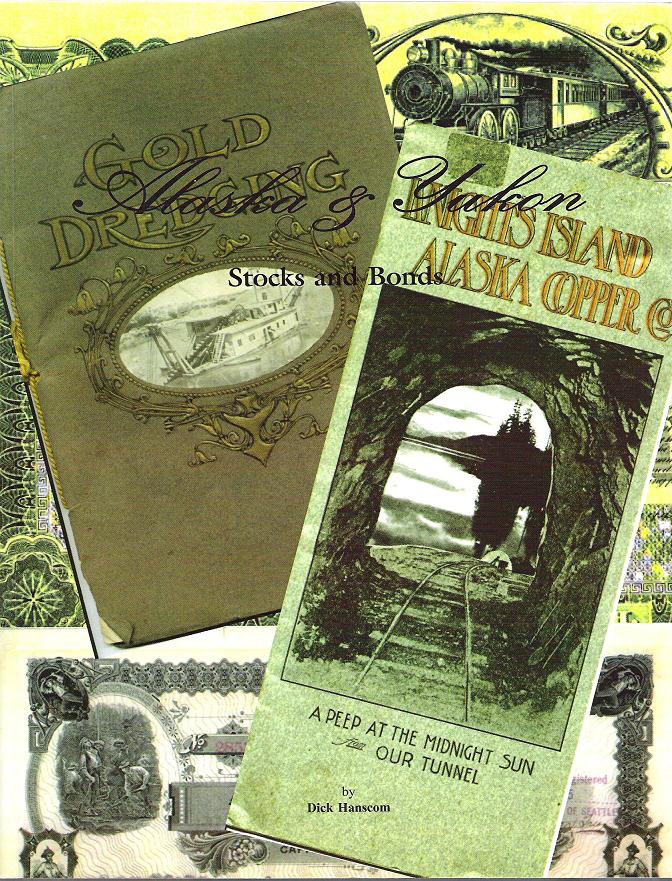
Stocks and bonds from Alaska and Yukon


Image by Boone Shares
double-click to enlarge

  • Title : Alaska & Yukon - Stocks and Bonds
  • Author : Dick Hanscom
  • ID : no ISBN number; published 2002 by Alaska Rare Coins
  • Languages : English
  • Number of pages : 344
  • Images : over 500 black and white images
  • Index : 1. on company names, 2. on subject (other relevant words appearing in the names on the certificates)


This reference catalogue lists up over 700 stocks and bonds from companies operating in Alaska or Yukon whatever the nature of their activities : platinum and gold mining, copper, tin and coal mining, petroleum, aviation, railroads, transport and trading, fisheries, livestock, fur trading, banks, state and city bonds, telephone and telegraph and more.

The author has ordered the entries by company name. Certificates are described with the following data fields : name of the company, place of incorporation, date of incorporation and issue, color, capital and shares, size, coupons, printer and other information. 

Yes, you've read it correctly : over 500 images. Most of which I have never seen before.
Recommended for anyone attracked to scripophily from Alaska or Yukon !

F.L.

Tuesday, September 11, 2012

Digest of scripophily readings VI

New online scripophily articles and references, September 2012


AHM brings our mining past back alive
Archivo Historico Minero is an online project, in Spanish. The site contains a large image database related to coal mining in Spain, but also gold and iron mines, marble quarries and lots of other mining sites and related events from all over the world. Numerous photographs are provided by many contributors. You can find here the main link to this project. Also, interesting for scripophily collectors, there is a section Acciones mineras with lots of images of mining stocks and bond certificates. You can find it there. A great initiative and anyone can help contributing images and related stories.

Telephone and telegraph histories from South America
In a series of books, published in the 1920s, Victor M. Berthold of the American Telephone and Telegraph Company, discusses South America's telephone and telegraphy history featuring several early telecom companies :
  • History of the telephone and telegraph in Brazil, 1851-1921
  • History of the telephone and telegraph in Chile, 1851-1922
  • History of the telephone and telegraph in Colombia, 1865-1921
  • History of the telephone and telegraph in the Argentine republic, 1857-1921
  • History of the telephone and telegraph in Uruguay, 1886-1925
And guess what.. at least two of these books are available online! You can find the Argentine part here and the Brazilian part there. On the left, you'll find a link for downloading a PDF version.
Does anybody know if the other parts have been put online as well ?

Why Wall Street, why Bulls and why Bears ?
CNBC has put online some short videos about the history of Wall Street. Find the answers on the following questions in these minute videos :


Front cover of the magazine der aktiensammler
double-click to enlarge


der aktiensammler
In addition to the articles above, the latest August 2012 No.4/12 issue of der aktiensammler magazine, contains the following stories (in German) :
  • McDonald's : Fast food at its best
  • Die älteste Siemens-Aktie: Ein US-Papier aus dem Jahr 1883, in English: The oldest Siemens share (The Siemens' Regenerative Gas Lamp Company)
  • Die Rentenmark - der Sanierer der Hyperinflation, English: The Rentenmark - remedy for hyperinflation (part 10 in a series on the evolution of money)
  • Dampflok-Tradition: Nordhausen-Wernigeroder Eisenbahn AG, or in English: the Nordhausen-Wernigeroder Railway Company
  • Zwischen Wupper und Ruhr: Bergische Kleinbahnen AG, freely translated: Between the Wupper and the Ruhr (river) runs the Berg Light Railway Company
  • Trabrennbahn Hamburg-Bahrenfeld: Getrabt wird bald woanders, about the Hamburg-Bahrenfeld harness racing track
  • Friedrich Eberts Zwangsanleihe: Verjährte Massenpapiere, English: Friedrich Ebert's Forced Loan - piles of expired bonds
  • Die Ebay-Spekulationswelle flacht deutlich ab, in English: Speculation wave on Ebay is clearly weakening
  • other periodical topics : Auction Reviews, Book Reviews, Collector's Portrait, Events Calendar, Classifieds


F.L.