Showing posts with label real estate. Show all posts

Sunday, May 8, 2022

HSK's upcoming auction in Hamburg features more than 1100 lots of historic securities

28 May is the day when HSK's 41st auction takes place in Hamburg. This time HSK brought together more than 1100 scripophily lots. Bonds and shares from Berlin real estate developers, the Wolfgang Tartz collection, are part of many top-quality items included in this sale.

The event starts with a talk by Claus Müller titled The beginnings of the Russian mining industry in Ukraine, financed with foreign capital. After the auction a collector's bourse precedes a joint dinner.


From the American auction section,  L(ot) 62 is a rare bond from The Colorado Bonanza and Union Tunnel and Mining Company issued in 1891. The company was founded that year to dig for Colorado gold in Gilpin County. The upper vignette shows its mining operations near Bates Hill and Maryland Mountain. Remarkable, a cross-section of that same view tells us about the Bonanza and Union tunnels that were to be excavated. 


Scripophily from all continents is represented in the auction. Major sections are dedicated to America and Germany with in particular Bremen & Niedersachsen, Hamburg, Schleswig-Holstein & Mecklenburg-Vorpommern.

Some noteworthy items from the European section :
  • L256 is a 1886 share in the Compagnie Générale des Bateaux Parisiens with riverboat vignette. The company operated commuter riverboat services around Paris. 
  • Illustrated with a Roman! pyramid, L298 is a lovely share certificate from the Public-Auto SA per il Servizio delle Automobili da Piazza in Roma e Altrove, a public transport company in Rome.
  • The Manchester Race Course Association share from 1848 features a detailed vignette of the company's grandstand, L287. 


The Eidgenössische Bank AG, aka Banque Fédérale SA, Zürich, was one of the most important Swiss commercial banks. It became part of the Schweizerische Bankgesellschaft (SBG) in 1945 (later UBS). The sale features two of the company's sought-after share certificates. L260, dates from 1893, see image, and  L261, from 1917. 


Before I discuss the Berlin real estate developers collection, let me point out some interesting German certificates :
  • L881, a "Stamm" (Kux, mining share) in one of the earliest mercury mining companies from Germany is a top item in HSK's auction. The share in the Quecksilberwerke am Lemberg, issued in 1846, shows excavation activities, the smelting of mercury ore, and is adorned with leaf scrollwork in beautiful blue printing. Check the word 'STAMM' in detail : each letter is designed as a trunk (another meaning of the word STAMM). A very rare, small work of art.
  • Carosseriewerke Schebera Aktiengesellschaft from Berlin dealt in automobiles and produced car bodies. The 1922 specimen share, L692, illustrated with a horse carriage and two of the company's automobiles, bears the facsimile signature of Jacob Schapiro, car dealer, taxi entrepreneur and stock market speculator, who became a large shareholder of Daimler-Benz.
  • Art Deco enthousiasts will love L941, a 1923 issued share from the Textil-Kunst Aktiengesellschaft from Dresden.
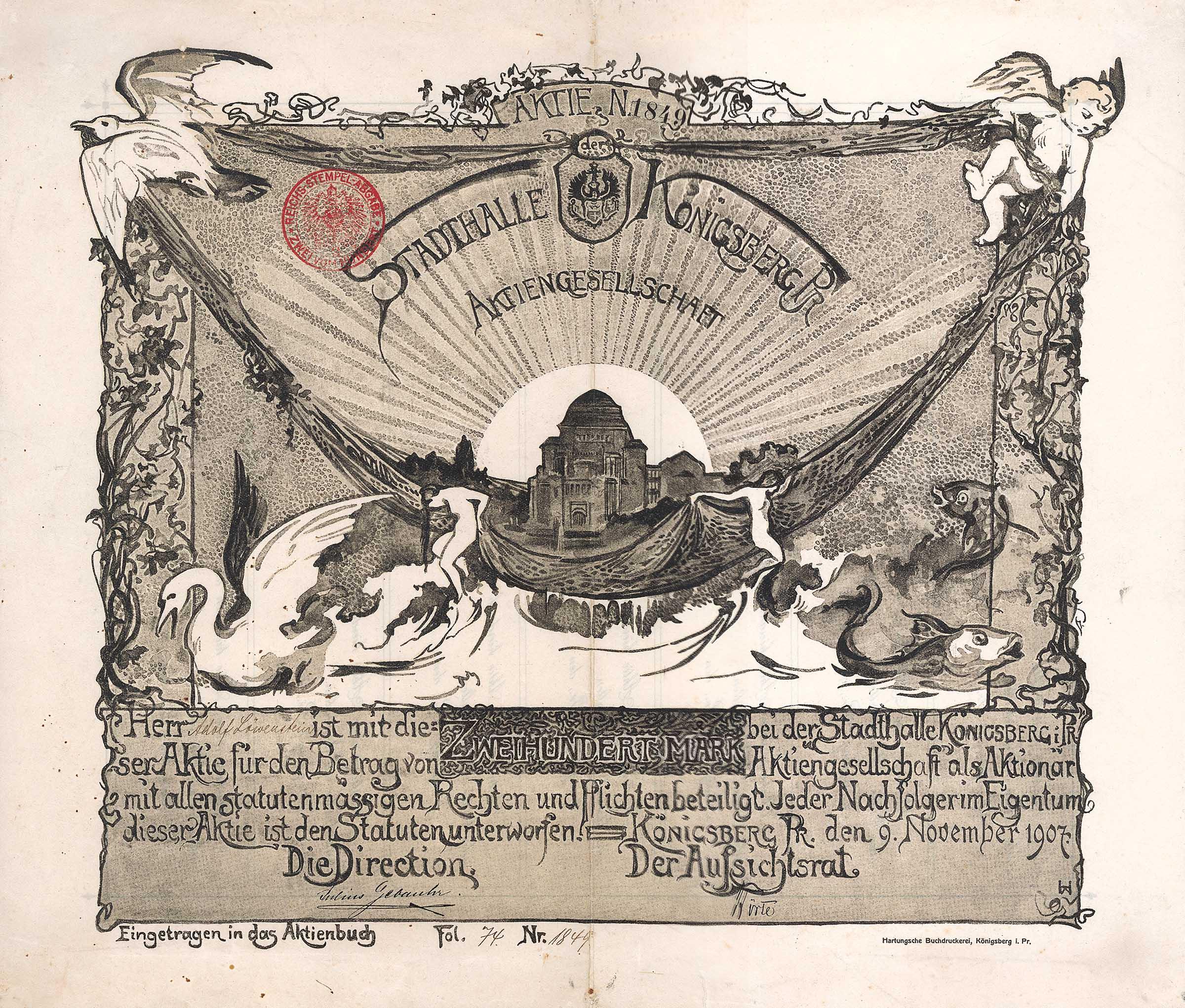


Architect Ludwig Richard Seel designed the city hall for Königsberg, known today as the Russian city of Kaliningrad. Seel is known for building the Parliament and Ministry of Justice in Tokyo. Königsberg's city hall, completed in 1912 and illustrated on this Stadthalle Königsberg share from 1907, included concert halls, a restaurant and a cafe. During the Nazy era, many artists lived in Königsberg to work independently of state control. The building was destroyed in World War II. Restored in the 1980s, it is now home to the Kaliningrad Regional Museum of History and Arts. L930 


The Wolfgang Tartz Collection counts over fifty bonds and shares from Berlin real estate development and property companies.  The collection was assembled over a period of many decades. Lot range 570 through 624.
Between 1750 and 1850 Berlin's population tripled to over 400,000 people. In 1871 Otto von Bismarck unified Germany. Berlin, the capital of the new German Empire, became the center of politics on the European continent. Von Bismarck created a favorable investment climate for the city's development. A large numbers of industrial workers and their labour unions, bankers, entrepreneurs, scientists and artists made Berlin a thriving but fast growing city. By 1910 the number of Berliners amounted to 2,000,000. 


The public square and transport hub of Alexanderplatz is recognizable from afar thanks to Berlin's nearby 368m heigh Fernsehturm. With hundreds of thousands of passers-by and visitors  Alexanderplatz is the most visited area of Berlin. 
Founded in 1912, the Aktiengesellschaft Alexanderplatz managed a number of houses at Alexanderplatz and nearby, including Hotel "Alexanderplatz". This 1000 Reichsmark share from the same year is part of the Wolfgang Tartz collection. L572 


There is a lot more to discover in the sale, so here are the details :


Though called a share certificate (Anteil-Schein) this is an interest-free lottery bond from the still existing Ski-Klub Oberstaufen. It was issued in 1920 for "the purpose of building a first class ski jump". Since the 1960s several international slalom competitions were held in Oberstaufen won by champions like Vreni Schneider and Ingemar Stenmark.  Note the logo with skis. L902 in the auction. 


F.L.


PS : Did you like this post ? Thank you for sharing it on you favorite social media channel !

Wednesday, September 16, 2020

Referenskatalog Svenska Aktiebrev

On the occasion of their 40th Anniversary the Swedish scripophily society, SFHV, published its third edition of the Referenskatalog Svenska Aktiebrev. This reference work in the Swedish language lists over 8000 Swedish stocks and bonds.


front cover of the Referenskatalog Svenska Aktiebrev


Members of the Svenska Föreningen för Historiska Värdepapper (SFHV) produced a third up-to-date catalog. In 1998 SFHV published a first reference catalogue on Swedish shares (5651 entries). A second, updated catalogue from 2010 added 2000 “new” shares. In this new book editors Marita Strandberg, Bo Niklasson and John Örtengren included 8500 certificates.

Several small chapters enclose the main catalog section: 

  • Förord/Preface
  • Att samla på gamla aktiebrev är också att göra utflykter i ekonomisk historia (Collecting old share certificates is also making excursions into economic history) 
  • När började aktiebrev anvaändas i Sverige ? (When were share certificates used in Sweden?) 
  • Starten på SFHV (The start of SFHV) 
  • Det internationella aktiebrevsamlandet började för hundra år sedan (International stockbroking [in Sweden] - began a hundred years ago) 
  • Internationale föreningar (International [scripophily] associations) 
  • Värdering av gamla aktiebrev är en sammanvägning av olika faktorer (Valuation of old share certificates is the result of various factors) 
  • Hur man hittar i katalogen (How to use the catalog) 
  • Förkortningar i textkatalogen (Abbreviations in the text catalog) 
  • Main catalog section 
  • Stadgar Svenska Föreningen för Historiska Värdepapper (Statutes SFHV) 
  • Litteraturförteckning ([interesting] Bibliography [on Swedish scripophily]) 


share certificate from the Rosenbad AB from Stockholm

This AB Rosenbad share illustrates the Rosenbad building that was designed by Art Nouveau architect Gustaf Ferdinand Boberg. The share is adorned all around with roses. Completed in 1902 on the site where there used to be a rose spa, the building features several rose ornaments on its facades. When you walk all the way through Stockholm’s Drottninggatan shopping street towards Gamla stan, the old town district, you’ll find the Rosenbad building on the right corner before you cross the bridge that leads to the Parliament House. It now houses the Swedish government chancellery. Catalog entry 5578, 5 shares of 1000 Kronor, 1900 


The catalog section counts over 8000 entries of Swedish stocks and bonds which are classified by company name. Each entry is characterized by

  • name of the company or organization
  • type of activity
  • county
  • municipality
  • denomination
  • year
  • remarks

NOTE : Apart from the basic twenty-six letters, A–Z, the Swedish alphabet includes Å, Ä, and Ö. These are distinct letters, and are sorted after Z. So you'll find the entry for a share in the Östra Centralbanans Jernvägs AB, see image here, at the end of the catalog.


share in Telefonaktiebolaget L. M. Ericsson

Lars Magnus Ericsson started in 1876 his telegraph repair shop which became Telefonaktiebolaget L. M. Ericsson in 1925. After WWII the company specialized in computerized telephone exchanges. In the late 1960s Ericsson developed a military computer and got involved in personal computers in the 1980s. Bluetooth technology was invented at the company's Lund office in 1989. Catalog entry 7149 : 1 "A" share of 35 Kronor, 1951 


More information about the book
  • Title: Referenskatalog Svenska Aktiebrev
  • Editors : Marita Strandberg, Bo Niklasson, John Örtengren
  • ID : 978-91-89330-69-6, published 2019 by Svenska Föreningen För Historiska Värdepapper
  • Languages : Swedish
  • Number of pages : 215
  • Images : more than 750 small color images (ca 3cm x 3.5cm)
  • Index : no index, certificates are classified by company name in the main catalog section

Are you into Swedish scripophily ? Then, no doubt, this would be a nice Christmas present. You can order the catalog from the Swedish Association for Historical Securities, or you can check your favorite scripophily dealer.


F.L.

Related link


Previous posts

Tuesday, October 8, 2019

Exhibition "Bayerische Werte"

From tomorrow on you can visit "Bayerische Werte", a unique exhibition on scripophily from Bayern. The event takes place at the IHK-Stammhaus für Munich und Oberbayern and presents stocks and bonds from the immense Uto Baader Collection.

Bayerische Werte, "securities from Bavaria", is jointly organized by the Bayerisches Wirtschaftsarchiv (BWA) and its founders, the Bavarian Chambers of Commerce and Industrie (IHK's). In the twenty-five years of its existence, the BWA has collected original documents from more than 2,500 companies. Archives of more than 170 companies have been taken over. 


"Haus für Handel und Gewerbe" in München, 1000 Mk. bond, 1899
The building illustrated on this bond was built by Munich's Chambre of Commerce and the Münchner Börse between 1899 and 1901. It still exists and is located at Maximiliansplatz 8, Munich, just around the corner of the current headquarters of the IHK für München und Oberbayern.
image courtesy : Bayerisches Wirtschaftsarchiv, Uto Baader Collection


On the occasion of BWA's 25th anniversary, Uto Baader, founder of the Baader Bank and Chairman of the Bayerische Börse, entrusted the BWA his tremendous collection of historic Bavarian securities (about 4,500 certificates).

With her team, Dr. Eva Moser, manager of the BWA, carefully made a selection from that collection. These gems, spanning more than two centuries, both illustrate the economic history of Bavaria and the artistry of Bavarian security design. Fifty-six of these have been printed and enlarged in high resolution with accompanying explanation notes on display panels. 


Actienbrauerei zum Löwenbräu in München, 100 Thaler founder's share, 1873
The history of the brewery traces back to the Late Middle Ages. Löwenbräu has been served at every Oktoberfest in Munich since 1810.
image courtesy : Bayerisches Wirtschaftsarchiv, Uto Baader Collection


Practical info "Bayerische Werte"

  • Duration : 9 October to 5 November 2019
  • Location : Atrium of the IHK für München und Oberbayern,  Max-Joseph-Straße 2, München
  • Opening hours : Monday to Thursday, 9:00 a.m. to 6:00 p.m.; Friday 9:00 a.m. to 4:00 p.m.
  • Entrance fee: free
  • further information : Ausstellung "Bayerische Werte" 

Related link

F.L.

Wednesday, October 10, 2018

SPINK to sell New Zealand stock at online auction

SPINK's next scripophily auction is set for October 17, 2018. This online sale counts about 500 lots of antique bonds and shares from the UK, Russia, China, Mexico, Egypt, USA and many more states. The auction starts with an important range of New Zealand scripophily.


share from the Land and Loan Company of New Zealand, 1884

The Land & Loan Company of New Zealand Limited provided credit for farmers and traders in wool and frozen sheep meat. Meat and dairy exports to Britain would form the basis for economic growth in New Zealand. Bids for this rare 1884 share, lot 15 in the auction, can start at £60. 


detail from a share in the Land & Loan Company of New Zealand comparing vignettte and embossed company seal

Detail from the Land & Loan Company of New Zealand certificate above. 
The vignette illustrates the company seal showing a ship and sheep. The vignette's design is skillfully repeated in the company's embossed seal. 
Click image to enlarge. 


Bonds and shares from New Zealand are hardly seen at auctions. SPINK included this time more than sixty lots. Among the highlights you can find a share from the Dunedin Stock Exchange, L(ot) 13. The New Zealand Times Company share, L18 in the auction, issued in Wellington, 1900, may be purchased from £120. Some certificates show a Māori vignette, such as L39 and L40, two different types from The London & New Zealand Exploration Company, but also on a Taitapu Gold Estates certificate from 1899, L54.


early share in the Timaru Landing and Shipping Company, 1868

From Timaru, located on New Zealand's South Island, this £10 share in the Timaru Landing and Shipping (Limited), L57, was issued in 1868. Equally rare and early, it is estimated at £120-150. 


The Far East section contains mainly lots from China. An uncancelled Shanghai Power Company share, L139, printed by American Bank Note Co, with text in Chinese and English, starts from £180. L141 is a 200 silver dollar share in the Tai Seng Opium Firm from Macau, dated 1918. £400 may buy you this extraordinary topic in scripophily. The section counts many Chinese government loans offered either in group lots or as a single item such as a 1912 5% Gold 'Crisp' Loan, bond for £1000, L99.


share certificate from The Shanghai Land Investment Company with Chinese drawing

L137, two shares from the Shanghai Land Investment Company, incorporated in Hong Kong, show a Chinese workman painting a house at the top of a ladder. Both certificates, signed by philantropist Sir Horace Kadoorie, can be acquired from £80. 


Some twenty lots of African company securities are next, often richly decorated, e.g. L170 Compagnie Impériale des Chemins de Fer Éthiopiens,  L172 Compagnie Générale de l'Afrique Française, French Congo, L174 Charterland Goldfields Limited, Rhodesia.


share from The Ottoman Company Limited with vignette of Ottoman merchant and dromedary

The Ottoman Company Limited, formed in 1865 to finance the Bank of Turkey, failed the following year as a result of the Panic of 1866. Its £20 share, 1865, printed by Bradbury, Wilkinson & Co, has one of the finest engravings in scripophily. L159, in the auction, estimated at £50-60.


Great Britain contains over 50 lots including several pre-Irish independence ones. L253, The Derby Canal Company share, printed on vellum, with waxed paper seal and rare, was issued in 1793.  L269, a trio, contains a share in The Atlantic Royal Mail Steam Navigation Co Ltd, 1860, wonderful vignette of a paddle steamer and issued to "The Most Honorable The Marquis of Clanricarde of Portumna Castle County Galway" (sic). Another share, from The Boy Messengers and Electric Call Company, L273, is signed by Patrick Bowes-Lyon, uncle of Elizabeth the Queen Mother, who won the mens doubles Wimbledon championship in 1887. Modestly estimated at £40-50.


share from The Navan & Kingscourt Railway Company

The Navan and Kingscourt Railway Company opened the section that connected the Irish towns of Kingscourt and Navan in 1875, at that time still part of Great Britain. This £10 share, issued 1871, Dublin, is part of a trio, L297 in the auction. 


The sale covers many other European countries. E.g. collectors of 18th century securities will be impressed by the caligraphy and the fine printing of the company seal on a Canal de Richelieu share from 1753, L206, bids welcomed from £200 onwards. Lots of Art Nouveau, Jugendstil and Belle Époque material ready for the block, such as a Théatre-Concert du Moulin-Rouge share from 1904, with the famous windmill logo's inclusive, £80, L220.


vignette of sailing ship on Confederate States of America Treasury Note

The SPINK auction features scripophily from the Confederate States of America as well. This $100,000 5% treasury note, was issued in the last months of the American Civil War on February 1, 1864, Richmond. Click the image and see the enlarged sailing ship vignette. L381, estimated £120 to £150. 


Matching time zones, scripophily from The Americas tops off the sale with over 150 lots. Bidding can start at £140 for an extremely early Peruvian Treasury Loan issued during the Peru's fight for independence from Spain, L368. A specimen share from the Canadian Western Lumber Company, with felled timber in the vignette, was printed circa 1910 by Waterlow & Sons, L358. Catalogued on Coxrail.com as LAC-360-B-30, the only one known, L422, a $1000 bond in the Lackawanna and Bloomsburg Rail-Road Company, 1855, can possibly be snapped up for £80.


Banco de Buenos Aires share with large underprint scene

Banco de Buenos Aires, share of 10 Pesos, 1911, with a nowadays controversial but mega underprint scene of natives listening to a conquistador with priest. L346 in the auction. 


You can find more of these fascinating stocks and bonds in the SPINK online catalogue. Here are the auction details :

  • date : 17 October 2018, 11:00 AM
  • location : online auction
  • online catalogue and further info, see here  


F.L.

Thursday, August 23, 2018

Hieroglyphs in scripophily deciphered !

Antique securities from companies that operated in Egypt were typically illustrated with pharaonic themes and hieroglyphs. Standing on their own as true pieces of artwork, their mysterious designs made possible investors dream of promising outcomes. People bought these share certificates in the 19th and 20th century when the stock exchanges of Alexandria and Cairo flourished. But are the hieroglyphs on these certificates actually legible? 


Crédit Agricole d'Egypte 
1 Share of 4 Egyptian Pounds, 1951 
Are the hieroglyphs in the lower border genuine? 
Click image to enlarge 


In August 2016, the Belgian radio program #weetikveel (English: I Don't Know) featured an Egyptologist in a broadcast about the pharaohs of Egypt. I had been puzzled for quite a while by the hieroglyphs that were printed on Egyptian shares. I introduced myself by email to the guest speaker, researcher Marleen De Meyer, and she was amused by the pictures of these antique securities I had sent her. She agreed to have a look at them to see whether the texts were actually legible. 

Gibberish!, she said when I showed her this stunning share in the Crédit Agricole d'Egypte. De Meyer works as a Postdoctoral Researcher at the Department of Archaeology with a specialty in Egyptology at KU Leuven University. She is an experienced Egyptologist and can read and understand ancient Egyptian texts. 

The earliest hieroglyphic inscriptions are over 5000 years old. The knowledge of reading them was completely lost some 1500 years ago. The world had to wait until the time of Napoleon to regain that expertise. Under the pretext of protecting the French interests in Egypt, he sent his Armée d'Orient on expedition to Egypt in 1798. Pierre-François Bouchard, one of Napoleon's officers, found in 1799 near Rosetta, a city in the Nile Delta, a stone slab bearing inscriptions in three different scripts. The stone would lead to a breakthrough in deciphering hieroglyphics.


Fayoum Light Railways Company Société Anonyme 
4% £20 Sterling Bearer Bond, Cairo, 1899, printed by Charles Skipper & East
The symbols printed in the bond's upper and lower border look like hieroglyphs.


Also the hieroglyphs on the Fayoum Light Railways bond are total nonsense. But a share from the Electric Light and Power Supply Company was more interesting. Marleen De Meyer explains :
  • The inscriptions on the pylon, the temple gateway, are (also) nonsense. 
  • The inscriptions below both sphinxes are legible hieroghlyphs. They are derived from the titulature of Ramses II, though not without faults.
I am pleased. Finally, we're getting somewhere !


Electric Light and Power Supply Co. Société Anonyme
dividend share, Cairo, issued 1933
The inscriptions below both sphinxes are legible hieroghlyphs
but those on the pylon, the temple gateway, are not.


When Pierre-François Bouchard found the Rosetta Stone there was nobody who could translate the stone's inscriptions. The same text was written in three languages : Greek, Demotic, and Ancient Egyptian (hieroglyphs). At this time, no one had been able to decipher the latter two scripts, but Greek was of course known. Bouchard told his superiors and his commanding officer Nicolas-Jacques Conté, that he had found something of importance. Before they joined Napoleon's army in Egypt, Bouchard and Conté were already friends. Both had lost an eye during one of Conté's experiments with hydrogen gas.

The Rosetta Stone, measuring 112cm high, 75cm wide, 28cm thick, and weighing about 760 kilograms, was brought to Cairo. Napoleon's expedition in Egypt included many scientists who described and drew ancient monuments and antiquities. Eager to inform their colleagues in France, they tried to copy the Rosetta Stone’s texts by hand.

That proved to be an error-prone process. Nicolas-Jacques Conté suggested to use the Rosetta Stone itself as a printing block to reproduce the inscription. They applied ink to the surface, including the incisions, and then cleaned off the ink from the raised surface. The resulting print, in reverse text, could be read from the back side, or in a mirror. Copies of the stone's texts reached Paris in 1801.


Compagnie Universelle du Canal Maritime de Suez 
specimen dividend share, 1924
The Suez Canal connects the Mediterranean Sea to the Red Sea. It was constructed by Ferdinand de Lesseps' Suez Canal company between 1859 and 1869. The drawing of the share is made by James Pouchet, an engineer working for de Lesseps. Pouchet designed several buildings along the Suez Canal, including the Viceroy Palace at Ismailia. (L'Illustration: Journal Universel, 16 Oct 1869)
image courtesy : Mario Boone 


For many years now, Marleen De Meyer has been researching the field of funerary culture from Egypt's Old and Middle Kingdom. Since 2002 she is a permanent team member of the Dayr al-Barsha Project directed by the Egyptology research group at KU Leuven. Dayr al-Barsha is located in Middle Egypt, where in 2014, De Meyer discovered in the area of the Old Kingdom rock tombs (2300-2200 BC), an extraordinary and well preserved plaster funerary mask.

A five hour drive from Dayr al-Barsha takes you to Suez, which brings us to the next item to discuss. Marleen could easily identify the meaning of the symbols on the Suez Canal share because these are genuine hieroglyphs. James Pouchet, a Suez Canal engineer who made the drawing for the Suez Canal share, had accurately copied the writings. Marleen clarifies :
  • The one on the left says : "Lord of The Two Lands, Cleopatra", dating to the Ptolemaic Period 
  • The column on the right reads : "King of Upper and Lower Egypt, Lord of The Two Lands, Necho II", 26th Dynasty (610-595 BCE)


Details from the Suez Canal share, see above. 
The inscriptions have been identified by Egyptologist De Meyer. 
The hieroglyphs refer to Cleopatra and Necho II.


Earlier I told you that paper copies of the Rosetta stone's inscriptions arrived in Paris in 1801. All this time, the French army was frequently under attack from British and Ottoman troops. In August 1801, the French general Menou had to surrender. Together with Arabian manuscripts, ancient statues and other antiquities collected by the French, the Stone of Rosetta came into British possession. It was transported to London where it became a top attraction in the British Museum ever since.


Société Belge-Egyptienne de l'Ezbékieh  
500 Francs bond, Brussels, 1905 
Founded in 1899 with Belgian capital, the company was a real estate developer in and around Cairo. 
Hieroglyphs can be found on this certificate along all borders of the design.
Click image to enlarge 


A bond from 1905 issued by the Société Belge-Egyptiènne de l'Ezbékieh counts no less than 14 hieroglyphic inscriptions. This was "le plat principal" for Marleen De Meyer. In clockwise order and starting at the top, she identifies the names of several Egyptian rulers written in cartouches:

 1. Arsinoe II (Ptolemaic Period)
 2. Amenirdis I or II (25th Dyn.)
 3. Snefru (4th Dyn.) with an error
 4. not a legible name
 5. The designer was likely inspired by the titulature of Seti I  (19th Dyn.), but the writing shows several errors.
 6. Ramses II (19th Dyn.)
 7. Merneptah (19th Dyn.)
 8. Ramses II (19th Dyn.)
 9. Ptolemaios II Philadelphos (Ptolemaic Period)
10. Horemheb (18th Dyn.)
11. [mAa-xrw] “true of voice", the name of a pharaoh is missing
12. Amenemhat (12th Dyn.), with an error
13. Probably based on the titulature of Takelot (22nd Dyn.), but the writing has several errors.
14. Seti I (19th Dyn.)

To locate the hieroglyphs more easily on the certificate, I prepared a somewhat compressed version of the certificate's border.


Société Belge-Egyptiènne de l'Ezbékieh 
layout of the fourteen hieroglyphic inscriptions 


By the beard of the pharaoh, what an amazing find! Unfortunately, I have no idea which illustrator has so thoroughly copied these royal names into this work, as there is no author mentioned on the certificate. If you want more information, you can check the standard work of Jürgen von Beckerath: Handbuch der Ägyptischen Königsnamen, 1999. 

So far in my story of the Rosetta Stone, you learned that France lost the Rosetta Stone in Egypt to the British in 1801. However another race was on : who would be the first to decipher hieroglyphs? The British brought the stone to England aboard the captured French frigate HMS Egyptienne. The ship arrived in Portsmouth in February 1802. But the French had already sent from Egypt several printed copies of the stone's inscriptions to scholars in France the year before.

The deciphering of hieroglyphs did not came as a single achievement from one person. Several scientists have made their contribution. The two most important ones are Thomas Young (1773–1829) from Great Britain and the Frenchman Jean-François Champollion (1790–1832) and, like the political climate between their countries, both were each other's rival.

It was Champollion who was the first to understand that hieroglyphs were a combination of phonograms (such as letters in alphabet), logograms (similar to Chinese characters) and ideograms (symbols representing a concept). He also realized that the hieroglyphic text on the Rosetta Stone was translated from Greek, not the other way around. In 1822 Champollion presented the way in which he had cracked the code.


The Rosetta Stone in the British Museum 
The three fragments of writing on it say the same thing in three different languages : 
Demotic, Ancient Greek  and Ancient Egyptian (hieroglyphs).
The text is a royal decree from the Hellenistic Period about the taxes of temple priests.
image : Olaf Herrmann [Copyrighted free use], from Wikimedia Commons


During the last two hundred years, illustrators of bond and share certificates successfully used design elements like pyramids, sfinxes, and both pseudo-hieroglyphs and genuine hieroglyphs to attract potential investors.

There is still one question that remains unsolved in Egyptian scripophily. Has anyone of you seen a share certificate bearing a vignette of the Rosetta Stone ? The stone's discovery triggered a tremendous amount of interest all over the world for many decades. I have no doubt that a share certificate like that exists, and it is just waiting to be discovered by collectors like you.


F.L.

I want to express my gratitude to Marleen De Meyer, KU Leuven, for helping me voluntarily to solve these Egyptian puzzles in scripophily. What a great job !

Related links


Did you enjoy this article ? Please share it.


Monday, September 7, 2015

Syria


view of the city of Damascus and the Umayyad Mosque


Millions of Syrian families have left their destroyed country in search for better human conditions. So far, a few hundred thousand parents and children made a dangerous journey to Europe in order to find a better life. There are many more to come. Few of Europe's national leaders recognize the current scale of this tragedy and realize how the refugee problematics will evolve. These capable politicians are prepared to take fully fledged measures. Bravo Germany, "a strong country will manage", indeed.

Other European politicians do not dare to take the right decisions. They forgot that, long ago, our great-grandparents were also, in times of war, on the run with children and elderly. And our great-grandparents sought and found protection in European countries too.

Yes, this is not the usual scripophily post, but I feel upset about how slow some of our national leaders are addressing the situation. They should be aware that the decision whether or not to provide shelter, relief and care, is not a political but a humane one.

F.L.

Société Foncière de Syrie
Share of 500 Francs, Paris, 1923
design by Lucien Leclerc
Source: Wertpapierwelt
double-click image to enlarge


Société Ottomane du Chemin de Fèr de Damas-Hamah et Prolongements
Share of 500 Francs, Constantinople, 1901
Printed by Chaix, Paris
Source: Wertpapierwelt

Société Anonyme de la Fabrication Ciments et de Produits Constructives
Nominative share, 1950, Aleppo
Source : Boone Auction Sep 2006

Syrian Ottoman Railway Company Limited
One preference share, 1893, London
Source: Wertpapierwelt

Tramways et Électricité de Damas Société Anonyme
share of 500 Francs, Brussels, 1928
printed by J. Verschueren
Source: Wertpapierwelt

Fabrication de la Bière, Société Anonyme Syrienne
Share of 200 Syrian Pounds, 1959, Aleppo
Source : Boone Auction Sep 2006

Friday, September 26, 2014

HWPH - Auction 35 and 36


HWPH Auction 35
cover image: Bergbau-Aktien-Gesellschaft Medio-Rhein
in English : Medio-Rhein Mining Company
Share of 100 Thaler Prussian courant, 1858
design by Theodor Mintrop


early share certificate from  the Real Compañia de San Fernando de Sevilla
Real Compañia de San Fernando de Sevilla
Share of 250 Pesos, 1748
double-click image to enlarge


HWPH Online Auction 36
cover image: Société Foncière de Syrie
in English: Land Company of Syria
share of 3000 Francs


  • Date: 18 October 2014  - Auction 35 ;  20 October 2014 - Auction 36
  • Place: Auction 35, Wiesbaden, GERMANY 
  • Further info, see here 


F.L.

Thursday, April 11, 2013

Book : Edouard Empain

Edouard Empain, Belgian captain of industry, is known for building the Paris Métro and the district of Heliopolis in Cairo. In this book, author Jacques Simar brings us the story of Baron Empain and an overview of the industrial empire that Empain built up all over the world.

cover of the book Edouard Empain - de l'empire industriel .. aux titres de collection

double-click to enlarge image

from left to right:

Ateliers de Constructions Electriques de Charleroi
The Cairo Electric Railways and Heliopolis Oases Company
Chemins de Fer du Congo Supérieur aux Grands Lacs Africains
Compagnie de Chemin de Fer Métropolitain de Paris

background:

Edouard Empain ( 1852 - 1929 )

  • Title : Edouard Empain, Esprit Fécond, Entrepreneur Conquérant, English : Edouard Empain, a first rank entrepreneur from Belgium
  • Author : Jacques Simar
  • ID : no ISBN number, published by The Scripophily Center, 2013, see here
  • Languages : French, but a good summary in English and Dutch is provided
  • Number of pages : 107
  • Images : about 100 color images

Chapters
  1. Premières années et premiers défis 1852 - 1881  (English: first years and first challenges)
  2. Développement de l' empire 1879 - 1929 (development of the business empire)
  3. Le système Empain ( the Empain system )
  4. La collection des titres Empain ( the collection of Empain scripophily )
  5. Summary in Dutch
  6. Summary in English
  7. Remerciements (Thanks)
  8. Annexes : sociétés du groupe Empain ( Appendices : companies of the Empain group )
  9. Source des illustrations ( source of illustrations )
  10. Notes
Chapter 2, being the largest one, gives us an overview of the activities and realizations of Empain's  companies in the Ottoman Empire, Chili, Syria, Netherlands, Russia, Spain, China, Belgian Congo and, of course, Belgium, France and Egypt.

The book is richly illustrated with images of shares and bonds of companies active in railways, banking, metal works, electric power, gas distribution, chemical industry, tourism and hotels, canals, real estate, shipping and mining. Several of the certificates depicted are very rare.

What else is there in the book ? Well, the work includes also : 
  • an overview diagram of the Empain family dynasty
  • several maps : routes of the Tramways du Caire, the concession of the Cairo Electric Railways and Heliopolis Oasis company, the railway network of Belgian Congo, routes of the Lung-Hai railway in northern China
  • long term stock charts of companies
  • classifications of the companies in the Empain group by country and in chronological order

A reference catalogue as well
Chapter 4 contains a reference catalogue section. Included are the stocks and bonds of the Empain companies surfaced in scripophily so far.  More than 500 securities from about 110 companies are represented  and ordered by country. Interesting, each entry contains a value indication between 1 and 5.

A book that fits in your laptop bag. Top !
Still available from the publisher, see here, at 30 Euro.

F.L.

NB : 
What is your favorite share depicted in the book ?
Mine is the 500 Francs bond from 1895 issued by the Tramways de Kischinew.

Sunday, October 14, 2012

Digest of scripophily readings VII

New online scripophily articles and references, October 2012

HPax - Hankes market index for German scripophily
Ulrich W. Hanke is no stranger to German collectors of stocks and bonds. In his German blog, Hankes Historische, Hanke follows the news on the German scripophily scene including auction and eBay results but also highlights the more modern securities. You may also want to read about him in this online interview.
As far as I know he is the first one to publish a market index for the German high end scripophily market. The HPax, Historische wertPApiere-indeX (English: historical securities index), is calculated twice a year and is based on the ten most expensive items sold by auction by the HWPH and FHW auction houses. See the chart here.
It is a matter of time when others may conceive similar indexes for other regions, e.g. Asia, or market segments, such as American gold mining certificates. A great idea!

Banking history of Northern England
In 1894 E. Wilson & Company publishes the book A History of Banks, Bankers and Banking in Northumberland, Durham, and North Yorkshire. It is written by Maberly Phillips. As the subtitle indicates, this worthy volume illustrates the commercial development of the north of England from 1755 to 1894 with numerous portraits, facsimiles of notes, signatures, documents, et cetera.

Chapters:
  • Banking in London
  • Banking in Scotland
  • Incidents prior to Provincial Banking
  • Provincial Banking (8 chapters spanning the period 1755 - 1894 )
  • Coining and clipping, tontines and lotteries.
  • Bank Reviews
  • Index
Interesting for us: in 300 pages hundreds of banks are reviewed.  Furthermore, the book is illustrated with close to a hundred images of early coins, clipped coins, forged assignates, banknotes, document signatures, portraits, engravings ..  When did we stop making books like that? A must read for anyone interested in English banking history and early and counterfeit money. Yes, there is an online version. You can see it here , the PDF-link is at the left.


Front cover of Scripophily magazine, issue 89 August 2012, IBSS

Scripophily Magazine
In addition to the articles above, the brand new August 2012 No.89 issue of Scripophily magazine, published by the International Bond and Share Society, contains the following stories :


  • The Oldest Mining Scripophily
  • Speculations Roll On (Mexico, Westphalia, Brazil)
  • The Nineteenth Century UK Bicycle/Infant Motor Industry Investment 'Bubbles'
  • Strasburg Retrospective
  • Joseph R De La Mar - The "American Monte Cristo" (US mining & gold mining)
  • The Texas Pacific Land Trust and the Saga of Certificate No.390 (railways, land property, oil)
  • The Central of Georgia (US railroad and shipping)
  • Self-Referential Scripophily: Mary Ann Gold and Silver Mining Co., Nevada Territory
  • other periodical topics : News, Bourse Reviews, Book Reviews, Auction Reviews, Events calendar, Member Classifieds, Update Membership Directory Supplement, Club Auction  


Tip 1 : This issue has been put online as free download, see here. If you are still not a member, time to check out the magazine by yourself !

Tip 2 : Also this issue includes a 2-For-1 admission coupon for the Checks and Balances exhibition, see here,  at the Museum of American Finance, open through November 2012.

F.L.

Signed the Guest book yet ?

Saturday, June 30, 2012

How Claude Lorrain influenced scripophily !

Claude Lorrain 1605-1682: French artist of the Baroque era
I start off this article with a little task for you. Below, two old shares are listed. I want you to double-click the images and take a good look at their enlarged versions. For the moment don't spent any time checking out the other images from this post which are discussed later. So, take a deep breath, forget what is happening around you and focus on these first two certificates. Try to identify what these two shares have in common. I am not talking about any similarities in geographical, historical or economical terms, but in terms of visual experience. 

share of the Sugar Company of Annam (French Indochina)
Société Sucrière d'Annam, in English : Sugar Company of Annam
 Share of 100 Francs, Saigon, French  Indochina, 1929
Printed by the French printer Imp. B. Arnaud
double-click to enlarge

a 10 share certificate of the Helouan (Egypt) Development Company
Helouan (Egypt) Development Company
10 Ordinary Shares of 1 Pound Sterling, 1907
Note the art deco elements in the border design : early for the date.
double-click to enlarge

What do these shares have in common ?
When looking at the Sucrière d'Annam share, my eyes immediately perceive the printed borders, the company's name and  the 100 Francs denomination. But then, something else happens, unknowingly. After that first glance, my eyes are guided right into the underprint design. I'm not focusing anymore on the flat surface of the share. No, I'm peering .. deeper into the design. It sounds silly, but my eyes come at rest on a point a few meters further into the open space between the sugar canes. The same happens when looking at the share of the Heloun (Egypt) Development Company. When you see it, you'll first notice the title, its denomination and the border. But also here, the next blink of your eyes sets your focus on a spot maybe a 100 meters further into the design, behind the palm trees but before the sphinx. Magic ?