Showing posts with label electric power. Show all posts

Monday, November 20, 2023

Booneshares offers rare US railroad and South American certificates in December scripophily auction

Mario Boone is a major player in the field of antique share certificates and financial documents. The auctioneer scheduled his 71st scripophily auction on 2 December 2023. This auction will take place live on the internet via the Invaluable platform. On the agenda are more than 1000 lots of bonds and shares.


The auction features stunning shares from all parts of the world. This founders share from the Banque de Cochinchine was issued in 1907 and printed by the well-known security printer Crabbé. The share is signed by Noël Pardon, who previously was acting governor of Cochinchina and New Caledonia, and then governor of Guadeloupe and Martinique. L(ot) 46 starts at €400.


For this occasion, auctioneer Mario Boone has compiled a strong section of US railroad certificates. To give an example: L777, starting at €300, comprises a 1877 bond from The Cheraw and Chester Railroad Company, South Carolina. Only two examples known and coxrail.com reports no sales recorded within the last ten years. 

The US railroad section counts over 200 lots. A few more examples:
  • 5% First Mortgage Gold Bond $1000 from The Canon City and Cripple Creek Electric Railway Company, mountain vignette, 1897, L762
  • L949, The Western Virginia and Kentucky Rail Road and Coal Company, $1000 bond, 1857, several vignettes, amazing scrollwork and very rare
  • L769, The Central Union Depot and Railway Company, $100 shares, 1885, vignette of Cincinnati building and street scene 
  • A rare print from the American Bank Note Company is L876, Nevada Southern Railway Company, First Mortgage 5% 30 Year Gold Bond of $1000, 1893 


The auction catalog includes stock certificates from companies involved in all types of activities. Such as this CELTA share. This cooperative was founded in 1931 to compete with Sudam, a private company providing electricity to the city of Tres Arroyos in Argentina. The still existing cooperative expanded its activities over the years also including telephone, funeral, health and dental services. This share, issued in 1939, presents a bold Art Deco scene conceived by the artist T. Menna. 

Often these old securities have been designed by the artists of the day. The auction catalog lists a special index of the artists and engravers featured in the offerings. The certificate illustrated below depicts a Congolese woman with basket, an elephant tusk, a village, a map of the Basankusu region and the Star of Congo in the underprint. 


The early 20th century share shown here is from the notorious ABIR. The company harvested rubber in the Congo Free State, then private property of King Leopold II of Belgium. ABIR forced the local population to pay taxes and to harvest rubber under inhumane conditions. Those who failed where beated, mutilated, killed or their relatives were kidnapped or raped. This share from 1904 is a testament to Belgium's awful low point in history. 

It was Frans Hens who made the design of the certificate. He was the first Belgian artist to travel in the 1880s through the Congo and paint its nature, villages and people. He became known as a painter of the Belgian coast and the Schelde river. L82 is listed with a start price of €50. 


Another major topic in the sale is South America. The auction includes several single-item lots but also group lots from most South American countries. Collectors have the opportunity to acquire several certificates in these lots at reduced average item prices. However, in case no group bids are received most of these groups will be split into single-item lots during the auction.  

Illustrated above is L1002 a 1909 Banco de Guatemala share. Printed by Waterlow & Sons it shows several vignettes and many guilloches. Very lovely printed is the Resplendent Quetzal - featured in the coat of arms of Guatemala: the country's national bird representing freedom and independence.  L1002 is part of the Guatemala group lot, L992.


There is lots more to discover in the auction. Here are the auction details :

F.L.


PS : Did you like this post ? Thank you for sharing it on you favorite social media channel !

Saturday, April 29, 2023

Auctioneer Boone celebrates 40th anniversary in Antwerp: oldest stock exchange building houses international scripophily auction and bourse

Mario Boone's 70th scripophily event spans 4 days! On Saturday May 6, a live auction with nearly 800 lots of historic and splendid antique shares and bonds takes place at the "Handelsbeurs" in Antwerp, the oldest stock exchange building in the world.

An international scripophily bourse with free entrance for any visitor is organized at the same location on Sunday May 7. A great opportunity to see antique securities in the center of Antwerp.

On Monday 8 and Tuesday 9 May, roughly 1500 more interesting lots will be sold through the Invaluable platform (live internet auctioning) or via the usual absentee bidding options.


This 1884 share in the Fabrica de Faianças das Caldas da Rainha, a porcelain factory from Portugal, is superbly designed and printed. Against a background of tiles the drawing combines a still life with more than 10 animals. Can you find them? L(ot) 463 starts at €1000. 


Saturday morning kicks off with a section of some 200 lots from Belgium Congo, Ruanda-Urundi and Belgium, including a 1899 Banque Coloniale de Belgique share certificate showing African scenes, L(ot) 6, and L34, a brewery share in the Brasserie de Stanleyville from 1949, both starting at €50. 

Noteworthy in the Belgian chapter are:  L82, Exposition Internationale Coloniale et d'Art Flamand Anvers 1930, a share subscription for the colonial exhibition in 1930, start price €50, and L84, a $500 gold bond from the City of Antwerp. Not to be missed is L97, Compagnie Internationale des Telephones, the oldest Belgian telephone share, 1881, with a large underprint of an early telephone. 


The Société de Zoologie in Antwerp, one of the oldest zoos in Europe, was founded in 1843. Its shareholders could enter the zoo for free on showing their share, hence the folds. Printed in 1843 by Joseph-Ernest Buschmann and designed by his brother and painter Gustave Buschmann. L299, €300 


More Belgian's, and this applies to other countries too, can be found in a mammoth World Highlights section, lot range 193-775. Some examples :
  • The Société Anonyme d'Horticulture et de Botanique de Gand was founded by botanists who started holding botanic exhibitions known as "Gentse Floraliën". Its share from 1835, decorated with flowers, is extremely rare, L294.
  • A top object in any art collection is the 1897 share from the Compagnie Fermière des Eaux Minerales de Genval. It is designed by Art Nouveau architect, painter and designer Paul Cauchie, known for his sgraffito technique. Only three certificates were found in the 1990s, and this is the last one available. L310 starts at €10,000 and can be seen in detail on the auctioneer's brand new website here.
  • The world famous Lotus Bakeries is listed on Euronext Brussels and run by Jan Boone, the grandson of founder Jan Boone sr. This specimen founder share of the Banket- en Peperkoekbakkerij "LOTUS" voorheen "Boone Gebroeders" dates from 1934 and is the only one known to the auctioneer, L318.


Then part of of the French colonies, the Mekong delta with its shallow waters was the perfect place to use "de Lambert hydroglisseurs", aka airboats. This 1920 share from the Société Anonyme des Hydroglisseurs "de Lambert", L228, starts at €200. 


In the Australasia, Asia and Africa sections I spotted these items:
  • Bank of Australia, Sydney, 1833, early share printed on vellum, L193
  • L205 is a nominative share from the Société Provinciale Privilégiee du Fokien - Hoa-Hu, China, 1902, company set up by diplomat Paul Claudel, Chinese landscape.
  • Opium shares are rarely seen. L226 is a nominative share from the Société Fermière de l'Opium au Tonkin, issued in Hanoi, 1887.
Lot range 271 through 279 comes from a diamond collection and includes scarce items such as a 1889 share from The Borneo Diamond Exploration Syndicate. 


This 100 soles share in the Compañia Explotadora de Perlas de Sechura, Lima, 1902, is part of a collection of 214 bonds and shares from Peru, L676. 


The European chapter is the largest one with over 300 lots, L280-L595. This blog format doesn't lend itself for enumerating all lots. Here are some of many astonishing historic securities:
  • L375 and L376 are two Eiffel companies: Société de Constructions de Levallois-Perret and the Société de la Tour Eiffel both showing the Eiffel tower.
  • Christiana Bye og dens Oplands Korn-Selskab, freely translated as Christiania Town and its Upland Grain Company: extremely early Norwegian share, dated 1810, from the time when Denmark ruled Christiania, today Oslo, L451
  • A Swiss watch collection, L563 through L574, includes names like LeCoultre, Tissot and Longines.


L338, Compagnie Générale Maritime, 1856, signed by politician and financier Emile Pereire, gorgious design by painter and engraver Melchior Péronard, €3000 


Over 50 lots of securities and related documents are featured in the 16th-18th century section, including:
  • A 1679! bond from the city of Enghien, Haunaut province, in need for financial resources under French occupation, 4 wax seals, L596
  • On Aug 27, 1701, Philip V, King of Spain and Louis XIV signed a treaty granting France the exclusive privilege to supply the Spanish colonies in the Americas with African slaves. This right was called the "Asiento". Issued in 1703 for 3000 Livres this share in the Compagnie Royale de l'Assiente, is an important evidence of imperialistic slave-trading practises in the 18th century and extremely rare, L607.


Rio de Janeiro Tramway Light and Power Company Limited, 1 share, text in English, French and German, 1909, facsimile signature of electrical engineer and entrepreneur Frederik Stark Pearson, L664, €200


The Latin America chapter, lots 657 through 677, include several remarkable collection lots. Each of these will be offered as a single group, and only when no bids are made, each collection will split and offered into single item lots in the online sessions on the following Monday & Tuesday:
  • L658 collection of Brasilian government bonds
  • L659 collection of Brasilian state bonds
  • L660 collection of Brasilian railroad certificates
  • L661 collection of Brasilian port/shipping certificates
  • L662 collection of Brasilian Industrial securities
  • L670 collection of Mexican scripophily
  • L676 collection of bonds and shares from Peru 
More Latin Americ scripophily, as is the case for other themes, will be auctioned on the two online sessions on 8 & 9 May 2023.


L682, New Jersey Southern Rail Road Company, $1000 bond, 1873 signed by railway tycoon Jay Gould, extremely rare, €12000


The American section of the Saturday highlights is divided in three chapters : Jay Gould , railroads, and various themes. To name a few:
  • The 50 cents bond, 1841, from the Ocmulgee and Flint River Rail Road Company is not only small in size and value, but rare as well. L689
  • L763 is stock certificate from The Kansas City Distilling Company, a whisky maker, view of the distillery, 1889
  • The World's Columbian Exposition was held in Chicago in 1893. It's share shows a lovely vignette of an allegorical woman and an underprint of the exposition site. L765
A tip for American railway collectors, you should check out Coxrail on this auction, see here. 


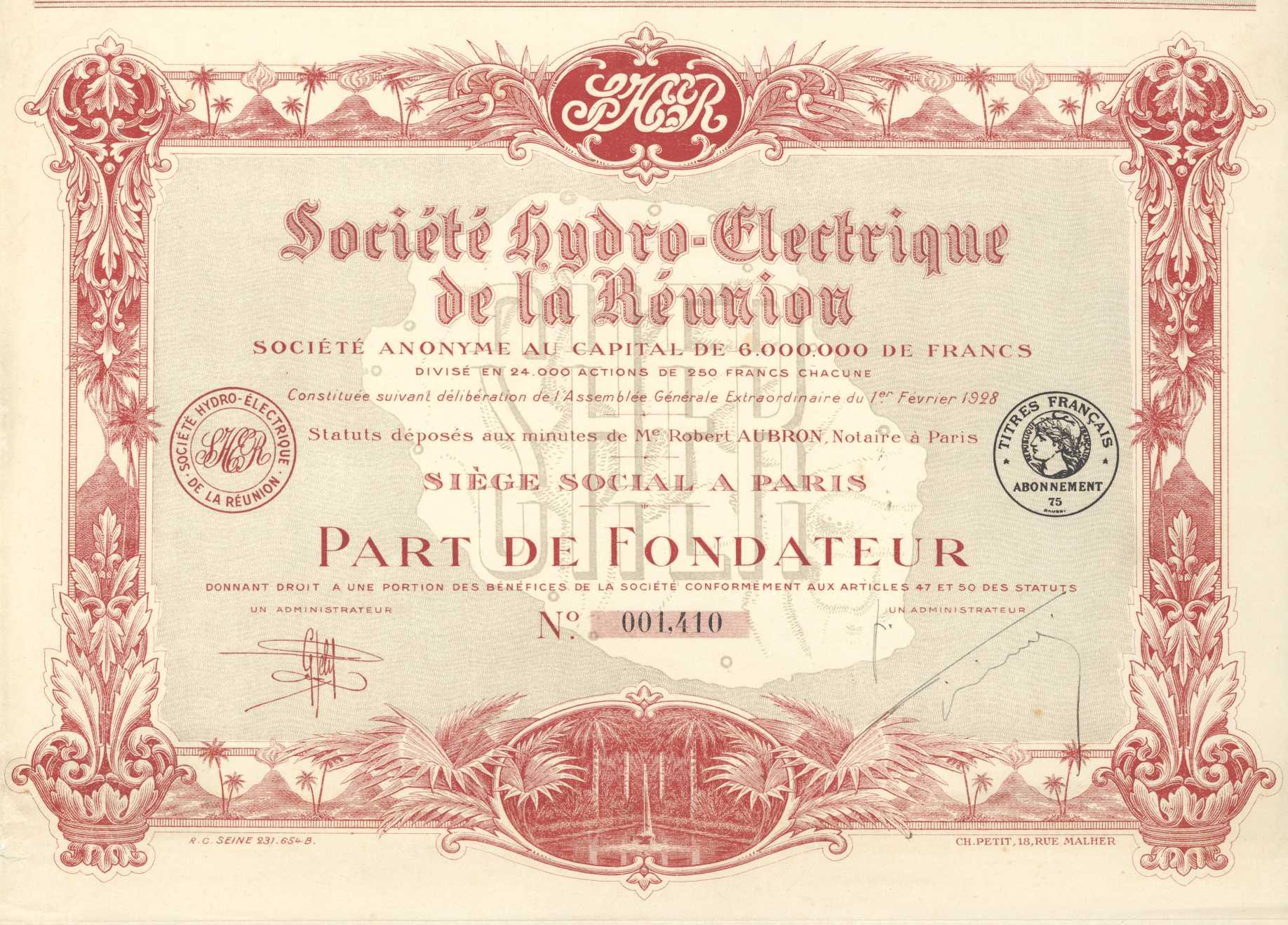
Société Hydro-Electrique de la Réunion, founder's share, 1928, map of Réunion in underprint and border with a pattern of volcanos, likely the Piton de la Fournaise, L927, €50 


The online sessions of this event are scheduled the days after the bourse on Sunday. These offer another 1500 lots of scripophily (or a bit less when the Latin American collections are hammered on the preceding Saturday - see above). Use the catalog's indexes or the search functions on the auctioneer's new website to find what you need.

The weekend of 6 & 7 May is a chance to see some great antique securities. The venue is the Handelsbeurs Antwerpen. 

Here are the auction details :
F.L.


PS : Did you like this post ? Thank you for sharing it on you favorite social media channel !


Sunday, May 22, 2022

Collecting antique stock certificates ? Go to the next level with Scripophily magazine !

Scripophily magazine is the world’s most comprehensive and insightful publication for passionate collectors and researchers of antique securities. Its 2022 April issue brings over 50 pages of scripophily news, in depth articles, book reviews, pictures of collector friends, auction reports and quality images of stunning, historic and rare stocks and bonds.


Scripophily magazine is illustrated with tons of gorgious stock certificates. This one from The Cincinnati Edison Electric Company is featured in the Deutsche Bank trilogy (© HIWEPA). The company was incorporated in the state of Ohio. Its $1 million capital was represented by 10,000 shares of $100. This certificate, issued in 1892 to the Deutsche Bank of Berlin, for 3,333 1/3 shares, represents a third of the capital. Image by Horst Klophaus 


Compelling tales, business plot twists and memorable personalities keep you spellbound. Scripophily magazine uncovers the stories of historic and artistic securities. In addition, reports from the auction markets help you to stay up-to-date. This periodical is the flagship of The International Bond and Share Society (IBSS) and appears three times a year.

Here is a summary on the topics brought in the latest issue :
  • Piers and Seaside Entertainment, interview with a collector 
  • Book review : Stamp Taxes in Nevada I. Silver Fever! Nevada Territory Stock Certificates, 1863-4, author Michael Mahler 
  • Book review : Michigan Copper Mining Stocks and Bonds, Part II, author Lee Degood
  • El Partido Revolucionario Cubano, a rare but fake bond emerged 
  • The Insanity Spreads, NFT technology flirts with Scripophily 
  • Dispatches from the Front, Bits and Pieces, market concerns with the Russo-Ukrainian War 
  • The Greenawalt Donation : Interview with David Mihaly of the Huntington Library 
  • Charles V Bond with phenomenal Face Value emerges (Spain)
  • Standing on the Shoulders of Giants, Terry Cox reflects on his US railway project coxrail.com 
  • The Howe Sound Co, copper mining in British Columbia 
  • Selling the Security, member contributions with share certificates promoting the business 
  • Studebaker, the family, stocks and bonds, and legacy
  • Deutsche Bank Part I : The History of "Deutsche Bank AG"
  • Boomtimes in the German Sugar Industry : 1850-1885 

On top of that the issue brings results and analysis on more than 20 auctions that took place during the preceding period in Germany, USA, China, Switzerland, UK, and other countries. You'll find out which auctions took place, what collecting themes are currently in demand and what price results are achieved for top pieces.


Subscribing to Scripophily magazine brings you valuable free extras: 
  1. The IBSS Directory brings you in contact with fellow collectors. Many of those are experts in their field, often share common interests with you, and possibly live nearby. The Directory contains members from more than 40 countries. 
  2. Upcoming events : Learn which auctions, collector bourses and society meetings will take place.
  3. Locate dealers and auctioneers : The Membership Directory also contains a list of dealers and auctioneers with further contact details. Most  auctioneers and dealers publish their catalogues either online or on paper.
  4. Access to the Experts : Being part of the International Bond and Share Society (IBSS) has provided me access to a network of experts in a variety of specialties related to the collection of Stocks and Bonds, always willing to led a hand and point me in the right direction.
  5. Access to all content on the IBSS website, including digital versions of previous issues of Scripophily magazine, the online forum, special theme galleries, and the like. 
  6. Newsflashes on the website focus on hot topics that can't wait for the next issue of the magazine. 
  7. Get extra credibility : being listed as a member is a good reference in any deals made remotely with parties previously unknown. 
A 1-year subscription only costs £25 or $35 or €28. The magazine is published by IBSS. More info : https://scripophily.org/membership/join/ 


F.L.

Related links


Tuesday, March 23, 2021

Google Translate and tiny printer names

Recently I compiled a list of the printing houses identified on the bonds and shares illustrated in the blog. Some of these printers have produced bonds and shares over many decades and in different styles. It shouldn't be a surprise that people start a collection of certificates made by their favorite printer, such as Waterlow & Sons, Richard or Cote Libre. But the quest is not always straightforward.

There is always a possibility that one can't detect a printer name on a certificate. The reason why may be simple. Sometimes the design did not include a printer name. Or, speaking for myself in this case, the name can not be identified because you don't know how to read the language.


This ¥25 million stock certificate for 500,000 Hitachi shares of ¥50 is an undated specimen (見 本) from the 1970s. Its vignettes show the company's logo, a power transformer and an electric locomotive.

As a kid I was mesmerized by the sparkling Hitachi modular Hi-Fi systems on display in a local shop. Hitachi, Ltd., a Japanese multinational conglomerate company, has been active in many fields of technology such as electric and nuclear power installations, electric engines and locomotives, military vehicles, supercomputers and communication technology. Today, Hitachi has about 300,000 employees.


The illustrated Hitachi share shows the name of its printer at the bottom. It's in Japanese. That's out of my depth but there is a work-around.

I once wrote about What you can do with Google Translate on your smartphone. In that article, I showed you how to deal with scripophily catalogs in an unknown language. I tried that same approach, this time on the printer name of the Hitachi share. It did not work.


The name of printer was too small, less than 2cm, about two grains of rice long. The characters, less than 1.5 mm wide, were too small for my camera to be recognized. If I could only provide a larger image. Now, that thought turned out to be a step in the right direction. 


high resolution scan of printer name, taken at 600 dpi

I put the certificate on the image scanner. I set the scanning properties to a high resolution of 600 dots per inch to get a large and clear image of that line of text. I narrowed the scan area to a rectangle surrounding the text. The resulting image, see above, was saved.


Next, I opened the saved image file on the PC screen, and started the Google Translate app on the smartphone. Language parameters were set : 
  • Text to translate from : Japanese
  • Text to translate into : English
I pointed the camera to the image on the PC screen and pressed the camera icon in the app.


The Google Translate software tried to recognize the words that were captured by the camera. It was necessary to find the right distance between the camera and the computer screen by holding the phone closer to and further from the screen. Then the answer appeared on the phone : Dai Nippon Printing Co., Ltd. Got it !

The text on the share actually shows two words 大日本印刷株式会社 and 印刷. The first part says  Dai Nippon Printing Co., Ltd., the second part - which occurs also in the first part - means 'printing'. I guess the entire line means '(a) printing of the Dai Nippon Printing Co., Ltd.'.

Here is another example of a Dai Nippon Printing certificate. Note that the name of the printer here is written from right to left.


Matsushita Electric Industrial Co., Ltd. 
100 Shares of 50 Yen, specimen stock certificate, 1968 


The Dai Nippon Printing Co., Ltd., (Dai Nippon Insatsu) was organized in 1935 as a merger between the Shueisha printing house and the Nisshin Printing Co., Ltd. After WWII the company began printing new banknotes for Japan. In 1949 its Enokicho plant started producing share certificates.

What I like about Dai Nippon Printing certificates are the fine patterns and guilloches produced in subtle color tints in the underprint. You can check this blog's printer page to find another Dai Nippon Printing share.


F.L.

Sunday, January 17, 2021

HWPH kicks off '21 with large scripophily auction

Auctioneer Matthias Schmitt has compiled pretty much as 2000 lots of mainly antique bonds and shares for his 58th sale. The online event runs till 30 January, 10 AM. 

Collectors seek these genuine securities for their historic values or artistic features. I'll show you an Italian example from the auction of the first type later, but to start with, here is one of the latter type.


The SA Italiana per l'Impianto e l'Esercizio del Giardino Zoologico in Roma was founded in 1909. Today it is known as Bioparco di Roma. Its shares feature a gorgious vignette of wild animals, and sixteen others interacting with exuberant scrollwork and foliage. Click the image to enlarge. Creator of this Stile Liberty work was Giambattista Conti, aka Giovanni Battista Conti (1878-1970). He was known for his religious works and as an illustrator of children books. He became Director of the Vatican Restoration Institute. This rare certificate for 10 founders' share , lot 773 in the auction, starts at €1,000. 


HWPH is known for its Russian offerings and starts the feast with more than 250 lots from Russia and the former USSR. Two examples : 
  • L(ot)116 A 5-shares certificate, 1898, from the Rigaer Commerz-Bank, unusual large underprint  the imperial double-headed eagle holding the arms of the city of Riga, then still part of the Russian Empire.
  • A specimen bond from the Soviet Union's 1925 Internal Loan for the Reconstruction of the Economy, multicoloured Art Nouveau design, three vignettess, L151.


One of the Russian highlights is L154, a specimen bond from the 9% railway loan of 1927. The loan was issued to finance railway extensions connecting Uzbekistan and Kazakhstan with the Trans-Siberian Railway. The bond has a denomination of 25 Chervonets, a currency, fully convertible and backed by the gold standard, that was introduced by the Soviet Union to stabilize the hyperinflation. 


A major part of the sale consists of scripophily items related to Germany. Actually there are 700 of them. These can easily be queried online by means of key words like 'Freiburg', yielding 3 results, or 'Leipzig', 16 results. 


Allgemeine Elektricitäts-Gesellschaft, AEG, originated in 1882 when Emil Rathenau acquired licenses to use some of Thomas Edison's lamp patents in Germany. This extremely rare share from 1890, L917, bears Rathenau's facsimile signature. L918, a share in another Berlin company, has Rathenau's original signature. Rathenau died in 1915 when AEG pioneered in the development of aircraft and soon thereafter in film projectors as well. 


Nearly 300 lots represent scripophily from the USA, some picks :
  • L1714 shows a share number 1 in The Magirus Corporation of America, issued in 1926, and with vignette of a fire engine. Conrad Dietrich Magirus, born in Ulm, Germany, was the inventor of the mobile fire ladder. Today, the Magirus M68L is the fire engine with the highest turntable ladder in the world with a range of 68 meters.
  • The Los Angeles, San Diego and Yuma Railway Company, 1890 stock certificate, L1711, rare
  • The tracks of the Virginia and Tennessee Rail Road, a company that played a strategic role for the Confederacy, were destroyed during the American Civil War and later rebuilt. Its $1000 bond from 1853, shows off some of the finest vignettes on US railway securities. L1801, interesting start price at €40.
  • A section of 27 Confederate States of America bonds with start prices at €20 to €40, L1618 through 1644


The auction counts no less than eight 'piano' lots : 563, 1023, 1139, 1213, 1567, 1578, 1773 and 1886. This share in the Schomacker Piano Forte Manufacturing Company was issued in 1894. Pianists and high society figures like President Ulysses S. Grant preferred these fine and award-winning instruments. Schomacker pianos were called the “Gold String” pianos. H. W. Gray, who signed this share as President, patented a technique wherein the piano strings were gold plated through a process called electro-plating. The other signature we see here is the one of Henry C. Schomacker, son of Johan Heinrich Schomacker, founder of the business. L1773 


The offerings present bonds and shares from many more countries. Let me further mention some more noteworthy collectibles :
  • UK : One of the oldest Cunard Steam-Ship Company shares seen, 1888, with ship vignette, L532
  • Italy : Gucci Group NV, Dutch Gulden specimen stock certificate , vignettes of the Cattedrale di Santa Maria del Fiore, Florence, and Gucci craftsman inspecting a Gucci handbag, L598
  • Czechoslovakia : L727, Prvni Pražský Měštanský Pivovor, freely translated : The First Prague Civic Brewery, 1930, multicolor print with brewing vignetttes and of course, a drinking King
  • The sale includes a nice selection of Egyptian scripophily.


The Monte di Pietà, a church-run lending institution founded in Italy's 15th century, became a model for many charity institutions. Called “Monte’s” these organizations obtained their funds by means of bonds called “Luoghi di Monte” and evolved into banks and lending institutions. The bonds were registered, and guaranteed the investor a type of life annuity. This Monte non vacabile del Sale della Città di Firenze was issued as early as 1699! The loan was guaranteed by income from taxes on salt (Sale) and bears the arms of the House of Medici. L895 


Of course, there is much more to tell, but the best way is to see for yourself. Here are the auction details:
  • Date : 30 Januari 2021, online auction
  • Further info and catalogs, see here on HWPH. 
  • Live bidding is possible through Invaluable.com, see here, where you can find high quality images of the lots.

F.L.


PS : Did you like this post ? Thank you for sharing it on you favorite social media channel !

Thursday, January 17, 2019

Spink UK sells Branston Railway Museum gems

SPINK's Bonds and Shares Department has put its first sale of 2019 online with a new look and functionality. The auctioneer offers over 500 antique securities including a large collection of scarce bonds and shares belonging to the Branston Railway Museum. The online auction ends at 11 AM GMT on Jan 25, 2019.


1885 bond from the Cie Universelle du Canal Maritime de Suez

Three 500 Francs bonds from the Compagnie Universelle du Canal Maritime de Suez make their entrance at the sale, lots 7-9. The famous Suez Canal Company was founded in 1858 by Ferdinand de Lesseps (1805-94). These bonds from 1885 have the printed signature of the wealthy Prince Auguste Louis Albéric d'Arenberg (1837-1924), then President of the company. Prince d'Arenberg's son Ernest, Lieutenant in France's 32nd Infantry Regiment, was killed on the battle fields of WWI on March 21, 1915. 


The SPINK sale presents over 500 lots of historic and beautiful stocks and bond certificates from all continents representing more than 50 countries. Some examples :
  • L(ot) 87 Hiroshima Spinning and Weaving Co, Meiji 15 (1882), rare Japanese scripophily
  • L81 Mongolia State Loan, group lot of 7 Mongolian state bonds from the 1950s
  • L130 Portuguese Loan 5% £100 Sterling 1823, early state loan from Portugal
  • L146 Trans-Alaska-Siberian Railway Company, 1906, the company was authorized by Czar Nicholas II of Russia to build a tunnel from Alaska to Russia


This Atlantic and Lake Superior Railway Company bond includes a beaver vignette

Collectors of Canadian scripophily will be surprised to find a 50 lots counting section, including this £100 bond from 1895 in The Atlantic and Lake Superior Railway Company (with beaver vignette), L421.


The British chapter consists of several sections such as canals, government, railways, etc. One of the early certificates is an amazing River Nene Navigation Join Stock from 1762 with nine wax seals and one lead seal, L312. Other interesting earlies : Itchen Bridge and Roads, 1835, arms of Southampton, wax seal, L354, and Durham County Coal Company from 1838, shield of Durham, L352.


The North of Scotland & Orkney & Shetland Steam Navigation Company was pioneering in Norwegian cruising.

This share in the North of Scotland and Orkney and Shetland Steam Navigation Company (NSOS) represents a milestone in shipping and tourism history. The certificate was issued in 1882 to Alexander Hall Wilson, director of Aberdeen shipbuilder Hall, Russell & Company, Limited. The NSOS introduced Norwegian cruising in 1886. It was a profitable operation from the start. To meet further demand the company ordered a new ship, the St. Sunniva. No surprise, it was built by Hall Russell. The St. Sunniva was the world's first purpose-built cruise ship and was a great success. 
L331 in the auction.


Several rare British government bonds are part of the offerings. L307 is a specimen 5% National War Bond 1918-1928, unseen in issued form. A great vignette of the Houses of Parliament with Big Ben adorns a specimen £50 Treasury Bond from 1925, L311.


Blackpool and Lytham Railway share certificate with embossed seal depicting lighthouse

This Blackpool and Lytham Railway Company share from 1861 is extremely rare. Embossed company seal with lighthouse in the lower left corner. From the Branston Railway Museum Collection, L173 in the auction.


The auction features the scripophily collection of railways, tramways and canals, assembled by the Branston Railway Museum, L164 to L300. The private museum is being closed and its collections disposed of during the year. Some of the many noteworthy lots in this collection are : L165 Oakham Canal, L170 Belfast and Northern Counties Railway Company and L200 Fleetwood, Preston & West Riding Junction Railway Company.


Isle of Man Tramways and Electric Power Co share certificate with triskelion coat of arms

This Isle of Man Tramways and Electric Power Company share, issued 1900, with the island's triskelion coat of arms, is part of a group lot of four certificates, estimated at £70-£90.


You can find more of these fascinating stocks and bonds in the SPINK online catalogue. Here are the auction details :
  • date : 25 Jan 2019, 11:00 AM
  • location : online auction
  • online catalogue and further info, see here  


F.L.


What is Scripophily ?, a quick introduction   

Wednesday, December 5, 2018

Scripophily magazine uncovers the stories of historic and artistic securities

Scripophily magazine brings you into the world of antique stocks and bonds. Buckle up! Compelling stories, business plot twists and memorable personalities won't let you go during your reading journey. You'll find out about today's discoveries. Reports from the auction markets will keep you up-to-date. So, if you are serious about this matter, then this is the magazine you are looking for.


vignette of sailing ship, taken from stock certificate


Scripophily was first published in 1982 under the name The Bond & Share Society Journal. On the occasion of the magazine's 100th edition, editor Max Hensley testified :
"The magazine appears on high quality paper, articles are longer and brought with more images in full color. Every issue was produced .. without paying a penny for content".
That's right, all content is created voluntarily by enthousiastic people from the hobby, three times a year.

Scripophily magazine cover


Issue 108 brings over 50 pages of scripophily news, in depth articles, pictures of collector friends, auction reports and more than 100 high quality images of stunning, historic or rare stocks and bonds. Here is a summary on the topics brought in the latest issue :
  • Swiss railway scripophily on Youtube 
  • Newsletter about Belgian scripophily 
  • Herzog Collection on the IBSS website 
  • Mexican scripophily sources 
  • New book on US railways by Terry Cox 
  • New book on the Wogau Empire (Russia) by Erik Meyer 
  • Playwright Neil Simon 
  • The shipyard from Gdansk 
  • Saved at the last minute, a story on share adventures
  • Donating collections, do's and don'ts 
  • "A L'Innoviation" inferno (Belgium) 
  • Borki train disaster (Ukraine) 
  • Cattle ranching in the US 
  • Barcelona Traction, Light and Power Co 
  • Survival rates on US Mining scripophily 


vignette with allegorical woman and locomotive, taken from share certificate


Is this a free magazine? No. Good stuff is never for free. But a 1-year subscription full of excitement only costs £20 or $32 or €25. The magazine is published by the International Bond and Share Society, the leading international organization for collectors, dealers and auctioneers in this field. More info : https://scripophily.org/membership/join/ 


F.L.

Related links


Thank you for sharing this post so we can reach more people ...

Sunday, September 9, 2018

Worldwide scripophily touch down in Würzburg

HWPH Historisches Wertpapierhaus AG has something to celebrate ! The company conducts its 50th auction anniversary on Saturday 15 September, a week from today.  Over 900 lots of bonds and shares will then go on the block at public auction. And more than 1,200 lots are offered in the accompanying online auction ending 2 PM Monday 17 September. Here is a quick tour.


The Asia and the Middle-East section starts the ball rolling in both sales. Here are a few observations. Issued in Shanghai, 1939, a share from the Russian-Chinese Credit Society,  L(ot) 685, extremely rare, starts at €2,500. The Holy Land is well represented with certificates like The Palestine Corporation Limited, 1949, L973. A share from The Palestine Land Development Company dates from as early as 1909, L974. The Japanese Meigo Steel Corporation and Naigai Steel Corporation may be acquired from €1. From Turkey, there is the Drumm Collection, historic in Scripophily, but more about that see there.


The Premier Automobiles Ltd., India 
Lot 977 in the auction, the share is signed by the industrialist, philanthropist and cricketer Lalchand Hirachand as Director, and starts at €120. 


Almost 300 lots represent The Americas. An early Puerto-Rican share, L23, Compañia del Vapor de Catañio starts at €130. From New Orleans, a 1840 Mexican Gulf Rail-Way Company bond, L37,  invites bidding from €450. Nearly 50 Confederate States of America are offered in both auctions. The advanced CSA expert will recognize the CSA 8% Montgomery, 1861, $500 and $1000 bonds, L24 & L25, vignettes of J. C. Calhoun and J. Davis, respectively. Lot range 48-52 is all about Thomas Alva Edison scripophily, including signatures.


William Steinway, who made the Steinway & Sons piano company world famous, developed his own company town Steinway Village in Astoria, New York. This is the serial number 1 share from the Astoria Electrical Manufacturing Company, issued to its Director William Steinway, 1891. The company manufactured electrical motors. Lot 18 in the auction, €150 start price. 


HWPH, known for its Russian offerings, included this time nearly 250 lots from Russia and the former USSR. Formed in London, the New Central Siberia Ltd, L703, was active in gold mining around Yeniseysk. From Saratov, a rare 1000 Roubel bond from 1898, L782, is set at €1,600. Vignettes of a tramcar, a map of the region and a dynamo illustrate an extremely rare share from the Donbass Electric Company, L691.


A great example of Soviet artistic design, click the image to enlarge. This lottery bond was part of an internal loan issued for Stalin's second five-year plan, 1933. Lot 888, in the auction, may be bought from €100. 


Excluding Russian and German material, HWPH included over 500 European lots, representing nearly every country. Here are some interesting items. You'll find their chocolate in almost any airport, from Switzerland, €70 can buy you a Chocolat Tobler share, L1020. Art Nouveau and Art Deco artists created wonderful angels on these beauties : Banco Regional de Cataluña, L69, La  Protectrice, L99 and Exposition Religieuse Internationale de 1900, L120.  The sales 50 Highlights section includes a spectacular share from The Baltic Salvage Association. What words can not describe, a high quality image reveals in detail. So here is a link.

Zoo collectors will love seeing these : Thiergarten-Gesellschaft in Wien, L155, Actien-Verein des zoologischen Gartens zu Berlin, L333 , Neue Zoologische Gesellschaft, Frankfurt, L457, Société Royale de Zoologie d'Anvers, L1333 and my personal favorite, Koninklijk Zoologisch Genootschap Natura Artis Magistra, Amsterdam, L669.


Koninklijk Zoologisch Genootschap Natura Artis Magistra, 
500 Gulden share, unissued, 1853, Amsterdam 
Natura Artis Magistra, or "Nature is the teacher of the arts", is one the oldest zoos built on mainland Europe. The zoo had three gates with the words 'Natura', 'Artis' and 'Magistra'. The Artis gate was the main one, and that's how the zoo is usually called. Only a handful of certificates like this one,  L669, are known. Bids are invited from €2,000. 


Over 900 German lots are spread over several sections in both auctions :
  • 16th - 18th century
  • Germany pre 1948
  • German currency history
  • Deutsch Mark (DM) certificates
  • Southern Germany 
  • 50 Highlights
From the pre 1948 section, I noted Stadt Magdeburg 8% 100,000 Mark bond, 1923, text in German and, unusual, also in English, with striking colors and great harbour vignette, L1667.
Some German bonds and shares have survived several currency periods. During their circulation these certificates have received several currency conversion stamps, and therefore form an interesting collecting theme 'German currency history'.  The William Janssen AG share, L1722, lived through four currency periods : issued in Mark, stamped consecutively in Gold Mark and Reichsmark and was still negotiable in the early DM period.  
The DM section contains several early computer manufacturers : Anker-Werke, L1731, Nixdorf Computer, L602, Walther Electronic, L1856, and Siemens, L304.
The auctioneer produced a dedicated catalogue for The 50 Highlights section with extra large images and background information. Among the German lots, you'll find a collection of 192 Hamburg city related loans, some of them from the 18th and even the 17th century, L653. Historic is a J. W. von Goethe share from 1793, see the following image. 


Johann Wolfgang von Goethe signed this Ilmenauer Kupfer- und Silber Bergwerk share, issued in 1793. Goethe, mainly known as a poet, novelist, playwright (Faust), philosopher, diplomat and politician, was also a mineralogist. The mineral goethite (iron oxide) is named after him. One of highlights in Matthias Schmitt's 50th auction, lot 650, it is expected to realize €20,000. 


Of course, there is much more to tell, but the best way is to see for yourself. Here are the auction details :

  • dates & locations
    • HWPH Auction 50 (lots 1-912): 15 September 2018, Würzburg, including Award Journalistenpreis Historische Wertpapiere und Finanzgeschichte around 3 PM as part of the auction event
    • Ersten Deutschen Historic-Actien-Club e.V (EDHAC) members meeting:  16 September, same location of the public auction, Würzburg
    • HWPH Auction 51 (lots 913-2180): 17 September, Internet only
  • More info


F.L.

Thursday, August 23, 2018

Hieroglyphs in scripophily deciphered !

Antique securities from companies that operated in Egypt were typically illustrated with pharaonic themes and hieroglyphs. Standing on their own as true pieces of artwork, their mysterious designs made possible investors dream of promising outcomes. People bought these share certificates in the 19th and 20th century when the stock exchanges of Alexandria and Cairo flourished. But are the hieroglyphs on these certificates actually legible? 


Crédit Agricole d'Egypte 
1 Share of 4 Egyptian Pounds, 1951 
Are the hieroglyphs in the lower border genuine? 
Click image to enlarge 


In August 2016, the Belgian radio program #weetikveel (English: I Don't Know) featured an Egyptologist in a broadcast about the pharaohs of Egypt. I had been puzzled for quite a while by the hieroglyphs that were printed on Egyptian shares. I introduced myself by email to the guest speaker, researcher Marleen De Meyer, and she was amused by the pictures of these antique securities I had sent her. She agreed to have a look at them to see whether the texts were actually legible. 

Gibberish!, she said when I showed her this stunning share in the Crédit Agricole d'Egypte. De Meyer works as a Postdoctoral Researcher at the Department of Archaeology with a specialty in Egyptology at KU Leuven University. She is an experienced Egyptologist and can read and understand ancient Egyptian texts. 

The earliest hieroglyphic inscriptions are over 5000 years old. The knowledge of reading them was completely lost some 1500 years ago. The world had to wait until the time of Napoleon to regain that expertise. Under the pretext of protecting the French interests in Egypt, he sent his Armée d'Orient on expedition to Egypt in 1798. Pierre-François Bouchard, one of Napoleon's officers, found in 1799 near Rosetta, a city in the Nile Delta, a stone slab bearing inscriptions in three different scripts. The stone would lead to a breakthrough in deciphering hieroglyphics.


Fayoum Light Railways Company Société Anonyme 
4% £20 Sterling Bearer Bond, Cairo, 1899, printed by Charles Skipper & East
The symbols printed in the bond's upper and lower border look like hieroglyphs.


Also the hieroglyphs on the Fayoum Light Railways bond are total nonsense. But a share from the Electric Light and Power Supply Company was more interesting. Marleen De Meyer explains :
  • The inscriptions on the pylon, the temple gateway, are (also) nonsense. 
  • The inscriptions below both sphinxes are legible hieroghlyphs. They are derived from the titulature of Ramses II, though not without faults.
I am pleased. Finally, we're getting somewhere !


Electric Light and Power Supply Co. Société Anonyme
dividend share, Cairo, issued 1933
The inscriptions below both sphinxes are legible hieroghlyphs
but those on the pylon, the temple gateway, are not.


When Pierre-François Bouchard found the Rosetta Stone there was nobody who could translate the stone's inscriptions. The same text was written in three languages : Greek, Demotic, and Ancient Egyptian (hieroglyphs). At this time, no one had been able to decipher the latter two scripts, but Greek was of course known. Bouchard told his superiors and his commanding officer Nicolas-Jacques Conté, that he had found something of importance. Before they joined Napoleon's army in Egypt, Bouchard and Conté were already friends. Both had lost an eye during one of Conté's experiments with hydrogen gas.

The Rosetta Stone, measuring 112cm high, 75cm wide, 28cm thick, and weighing about 760 kilograms, was brought to Cairo. Napoleon's expedition in Egypt included many scientists who described and drew ancient monuments and antiquities. Eager to inform their colleagues in France, they tried to copy the Rosetta Stone’s texts by hand.

That proved to be an error-prone process. Nicolas-Jacques Conté suggested to use the Rosetta Stone itself as a printing block to reproduce the inscription. They applied ink to the surface, including the incisions, and then cleaned off the ink from the raised surface. The resulting print, in reverse text, could be read from the back side, or in a mirror. Copies of the stone's texts reached Paris in 1801.


Compagnie Universelle du Canal Maritime de Suez 
specimen dividend share, 1924
The Suez Canal connects the Mediterranean Sea to the Red Sea. It was constructed by Ferdinand de Lesseps' Suez Canal company between 1859 and 1869. The drawing of the share is made by James Pouchet, an engineer working for de Lesseps. Pouchet designed several buildings along the Suez Canal, including the Viceroy Palace at Ismailia. (L'Illustration: Journal Universel, 16 Oct 1869)
image courtesy : Mario Boone 


For many years now, Marleen De Meyer has been researching the field of funerary culture from Egypt's Old and Middle Kingdom. Since 2002 she is a permanent team member of the Dayr al-Barsha Project directed by the Egyptology research group at KU Leuven. Dayr al-Barsha is located in Middle Egypt, where in 2014, De Meyer discovered in the area of the Old Kingdom rock tombs (2300-2200 BC), an extraordinary and well preserved plaster funerary mask.

A five hour drive from Dayr al-Barsha takes you to Suez, which brings us to the next item to discuss. Marleen could easily identify the meaning of the symbols on the Suez Canal share because these are genuine hieroglyphs. James Pouchet, a Suez Canal engineer who made the drawing for the Suez Canal share, had accurately copied the writings. Marleen clarifies :
  • The one on the left says : "Lord of The Two Lands, Cleopatra", dating to the Ptolemaic Period 
  • The column on the right reads : "King of Upper and Lower Egypt, Lord of The Two Lands, Necho II", 26th Dynasty (610-595 BCE)


Details from the Suez Canal share, see above. 
The inscriptions have been identified by Egyptologist De Meyer. 
The hieroglyphs refer to Cleopatra and Necho II.


Earlier I told you that paper copies of the Rosetta stone's inscriptions arrived in Paris in 1801. All this time, the French army was frequently under attack from British and Ottoman troops. In August 1801, the French general Menou had to surrender. Together with Arabian manuscripts, ancient statues and other antiquities collected by the French, the Stone of Rosetta came into British possession. It was transported to London where it became a top attraction in the British Museum ever since.


Société Belge-Egyptienne de l'Ezbékieh  
500 Francs bond, Brussels, 1905 
Founded in 1899 with Belgian capital, the company was a real estate developer in and around Cairo. 
Hieroglyphs can be found on this certificate along all borders of the design.
Click image to enlarge 


A bond from 1905 issued by the Société Belge-Egyptiènne de l'Ezbékieh counts no less than 14 hieroglyphic inscriptions. This was "le plat principal" for Marleen De Meyer. In clockwise order and starting at the top, she identifies the names of several Egyptian rulers written in cartouches:

 1. Arsinoe II (Ptolemaic Period)
 2. Amenirdis I or II (25th Dyn.)
 3. Snefru (4th Dyn.) with an error
 4. not a legible name
 5. The designer was likely inspired by the titulature of Seti I  (19th Dyn.), but the writing shows several errors.
 6. Ramses II (19th Dyn.)
 7. Merneptah (19th Dyn.)
 8. Ramses II (19th Dyn.)
 9. Ptolemaios II Philadelphos (Ptolemaic Period)
10. Horemheb (18th Dyn.)
11. [mAa-xrw] “true of voice", the name of a pharaoh is missing
12. Amenemhat (12th Dyn.), with an error
13. Probably based on the titulature of Takelot (22nd Dyn.), but the writing has several errors.
14. Seti I (19th Dyn.)

To locate the hieroglyphs more easily on the certificate, I prepared a somewhat compressed version of the certificate's border.


Société Belge-Egyptiènne de l'Ezbékieh 
layout of the fourteen hieroglyphic inscriptions 


By the beard of the pharaoh, what an amazing find! Unfortunately, I have no idea which illustrator has so thoroughly copied these royal names into this work, as there is no author mentioned on the certificate. If you want more information, you can check the standard work of Jürgen von Beckerath: Handbuch der Ägyptischen Königsnamen, 1999. 

So far in my story of the Rosetta Stone, you learned that France lost the Rosetta Stone in Egypt to the British in 1801. However another race was on : who would be the first to decipher hieroglyphs? The British brought the stone to England aboard the captured French frigate HMS Egyptienne. The ship arrived in Portsmouth in February 1802. But the French had already sent from Egypt several printed copies of the stone's inscriptions to scholars in France the year before.

The deciphering of hieroglyphs did not came as a single achievement from one person. Several scientists have made their contribution. The two most important ones are Thomas Young (1773–1829) from Great Britain and the Frenchman Jean-François Champollion (1790–1832) and, like the political climate between their countries, both were each other's rival.

It was Champollion who was the first to understand that hieroglyphs were a combination of phonograms (such as letters in alphabet), logograms (similar to Chinese characters) and ideograms (symbols representing a concept). He also realized that the hieroglyphic text on the Rosetta Stone was translated from Greek, not the other way around. In 1822 Champollion presented the way in which he had cracked the code.


The Rosetta Stone in the British Museum 
The three fragments of writing on it say the same thing in three different languages : 
Demotic, Ancient Greek  and Ancient Egyptian (hieroglyphs).
The text is a royal decree from the Hellenistic Period about the taxes of temple priests.
image : Olaf Herrmann [Copyrighted free use], from Wikimedia Commons


During the last two hundred years, illustrators of bond and share certificates successfully used design elements like pyramids, sfinxes, and both pseudo-hieroglyphs and genuine hieroglyphs to attract potential investors.

There is still one question that remains unsolved in Egyptian scripophily. Has anyone of you seen a share certificate bearing a vignette of the Rosetta Stone ? The stone's discovery triggered a tremendous amount of interest all over the world for many decades. I have no doubt that a share certificate like that exists, and it is just waiting to be discovered by collectors like you.


F.L.

I want to express my gratitude to Marleen De Meyer, KU Leuven, for helping me voluntarily to solve these Egyptian puzzles in scripophily. What a great job !

Related links


Did you enjoy this article ? Please share it.