Showing posts with label banking. Show all posts

Wednesday, October 1, 2025

Showcasing your services: The Hindusthan Safe Deposit Company

Old stock certificates often illustrate the purpose or type of business a company was in. As such, they act as a window into the past, making them valuable as historical documents. 

Here's a nice example from The Hindusthan Safe Deposit Company. It features two vignettes each depicting a vault with a map of British India in the background.


The Hindusthan Safe Deposit Company Limited, Karachi 
stock certificate for 10 ordinary shares of 10 Rupees (5 Rupees paid) 


This Hindusthan Safe Deposit Company share was issued to Hormusjee Ardeshir Mistri on the 2nd of April 1937 in Karachi. Now the capital city of the Pakistani province of Sindh, Karachi was then part of British India. 

The company, incorporated in 1936, was managed by reputable businessmen like Homi Mehta, A. D. Shroff, and Messrs Doongursee & Sons. It provided safe deposit services and had its building on the McLeod Road in Karachi, today known as the I. I. Chundrigar Road.


The company's building and vault were designed by K. T. Divecha, an architect from Mumbai “on the most modern lines and provide up-to-date amenities. The vault is one of the strongest in India and was impregnable by the most skilled and persistent attacks of the scientific burglar. Particular care has been exercised to see that it does not become out-of-date when modern warfare breaks out. Local authorities have certified it as well designed to resist damages from bombs.”

The vault had a capacity of 5,000 lockers with a spacious and well-furnished waiting room provided for the clients. The basement was air-conditioned in order to give better protection to deposits against deterioration due to moisture. Apparently, the architect was forethoughtful about us scripophilists.


The certificate has a beautiful embossed seal showing a vault. 
(image taken from the reverse)  


The certificate has two vignettes, quite alike, depicting a robust vault door on a map of Hindhustan, commonly spelled as Hindustan or Hindostan. During the British Raj, which extended over almost all present-day India, Pakistan, Bangladesh and Myanmar, the term Hindusthan referred to the whole of the Indian subcontinent. 

Note that the company was organized in 1936. Though partly shown on the map illustrated in the vignettes, Burma (now Myanmar) became a separated colony of Britain on 1 April 1937, just the day before this certificate was issued.


F.L.

This post is based on my article for Scripophily magazine No 127-April 2025, a publication by IBSS. 

References: “The Colourful Personalities of Sind,”, M. U. Abbassi, 1944


Sunday, April 28, 2024

The Case of the Missing Farmers – Egyptologist traces back Crédit Agricole d’Égypte vignettes

The share of the Crédit Agricole d’Égypte is one of the most decorative securities from Egypt. It is adorned with oriental and pharaonic elements. In the underprint you recognize lotus flowers, a temple and the harbour of Alexandria. The lower border shows a pharaoh with two agricultural drawings showing what seems like ancient Egyptian texts. 

It turns out that the certificate’s design has a connection with a lost temple from ancient times and with Germany’s Berlin from the 1850s as well. 


Crédit Agricole d'Égypte
5 shares of 4 Egyptian pounds, issued in Cairo, 1934 
click image to enlarge  


The Crédit Agricole d'Égypte (CAE) was established in 1931 with registered office in Cairo. Half of the capital of 1 million Egyptian pounds was subscribed by the government. The bank applied low interest rates to small cultivators and agricultural cooperative societies. By 1940 the bank ran over 100 branches all over Egypt. CAE changed its name in 1948 to the Agricultural and Cooperative Credit Bank. The bilingual 5-shares bearer certificate shown here, was issued in 1934.

We know of several bonds and shares that are illustrated with hieroglyphic-like texts and pharaonic elements. Scripophily from Egypt is therefore one of my favorite themes.  


On top of the CAE certificate we see the goddess Nekhbet, depicted as a vulture. She protects the symbol of the Kingdom of Egypt (1922-1953): three stars and a crescent moon. 


Some certificates have genuine Ancient Egyptian words in their design. A Belgian Egyptologist helped me to translate these texts on a number of certificates. You can read more about that in my blog article Hieroglyphs in scripophily deciphered!, Aug, 2018, and as well as in Scripophily magazine, No.111, Dec 2019. 

However, the texts on the CAE share seemed incomplete and were drawn too crudely. They could not be translated correctly. And there ended the story for that certificate … at least I thought so. 


'5 shares' in Arabic 


Four years went by and then I got an email from Sandra Ottens in Sep, 2023. What a surprise when she wrote me that she had solved the puzzle of this CAE share. 

Ottens obtained a MA at University Leiden with a speciality in Egyptology.  She wrote that she had read in 2019 about ‘scripophily’ on the Facebook page of the Leuven-based ‘Pyramids & Progress’ project (1). The post referred my blog article from 2018. 
(1) The Pyramids & Progress project was a research project on Belgian expansionism and the making of Egyptology. See here  

Intrigued by the unidentified texts on the CAE share, Ottens started researching the images because these looked familiar to her. During her study of ancient tombs with the Leiden Mastaba Study Group she had seen a lot of similar texts and images. She consulted several sources but without any results and eventually put that puzzle aside for several years.


Last summer Ottens resumed her research on the CAE certificate. On her own blog Egyptoblogie, see here, you can read about the many steps she undertook. She found the solution in a book from Karl Richard Lepsius.

Lepsius was an Egyptologist from the 19th century. In 1842, he was commissioned by King Frederich Wilhelm IV of Prussia to lead an archeological expedition to Egypt and the Sudan. With his team he documented as much as possible the ancient places. After his return Lepsius became professor of Egyptology at Berlin University in 1846. 


Karl Richard Lepsius (1810-1884)
image: Ernst Milster, Public domain, via Wikimedia Commons 


Lepsius compiled his 12 volume compendium Denkmäler aus Aegypten und Aethiopien (Monuments from Egypt and Ethiopia) over a time span of 10 years. These works describe plates of ancient Egyptian inscriptions, monuments, maps, temple drawings, tomb walls and landscapes.

On her quest Sandra Ottens went through Lepsius’ volumes and then came to Volume IV, Section II, page 107. That page contained an image of a tomb relief that referred to ‘Grab 2 in Sauiet el Meitin’. The tomb was located in Zawyet Sultan in Middle Egypt. The tomb owner was identified as Khunes who probably lived during the reign of pharaoh Teti (early 6th dynasty, around 2300 BC). 


Karl Richard Lepsius’ Denkmäler aus Aegypten und Aethiopien, Volume IV, Section II, page 107, features the scenes from the CAE share certificate. 


On that page Ottens recognized the reaping scene from the lower left border of our certificate. On the original tomb relief it is part of the scene in which several men are harvesting grain with sickles (lowest line of inscriptions at right in the image above). 

She explains: “The much more clearly drawn hieroglyphs can be translated as ‘Harvesting of grain by the servants of the king’ (Azx it in Hmw nswt)”. 


The reaping scene 


And Ottens locates also the ploughing scene on the same relief drawing (upper line of inscriptions at right on the page from Lepsius' book).

She clarifies: “The ploughing scene shows two men driving an ox-drawn plough across a field. The text reads: ‘Revitalising (the land) with a plough’ (skA m hb) and ‘press your hand down’ (wAH a=k) (2). ” 
(2) Sandra Ottens: The ‘=’ is a grammatical addition in the transliteration to link the suffix ‘k’, represented by the small basket, meaning ‘your(s)’, with the ‘a’, meaning ‘hand or arm’, represented by the arm. The sentence is apparently an encouragement for the depicted farmer to press the plough firmly down to make furrows in the ground.


The ploughing scene 


And as if she can read my restless scripophily mind, she adds that the tomb with the scenes does not exist anymore. What a scripophily attraction wouldn't that have been? In 2020 the Zawyet Sultan mission confirmed that the tomb was largely destroyed by limestone quarrying several years after Lepsius visited the place.  

Puzzle solved! What a journey in history. If you think about it, it is amazing how much time jumps were made to tell this story:
  • ca 2300 BC: During Teti’s reign, in Zawyet Sultan (Middle Egypt), the tomb of an Egyptian official named Khunes is embellished with relief drawings and texts.
  • 1840s: Prussian Egyptologist Lepsius visits the tomb and documents the tomb reliefs.
  • 1850s: Lepsius publishes his Denkmäler aus Aegypten und Aethiopien.
  • ca 1930: A so far unknown artist designs the CAE share and gets inspiration most certainly from Lepsius’ Denkmäler aus Aegypten und Aethiopien
  • 2019: A blogpost featuring the CAE certificate with ancient Egyptian texts catches the attention of Dutch Egyptologist Sandra Ottens.
  • 2023: Ottens solves the puzzle in 2023 by researching the works of Lepsius.


Egyptologist Sandra Ottens 


My sincere thanks to Sandra Ottens for sharing her exciting piece of research. You can read her findings on her original blogpost here:  Sandra Ottens original blogpost The Case of the Missing Farmers .
 
F.L.

I wrote this article for Scripophily magazine No 123-January 2024, a publication by IBSS.

Tuesday, February 27, 2024

Swastikas for prosperity

Last year's Holabird Americana’s Big Bonanza Auction included a share in the Swastika Mining and Development Company. The item sold for $80. Scripophily magazine no.121 said: “The swastika was said to be a good luck symbol in western Native American culture and it appears on a few certificates”. That’s only a part of the truth.


Fig. 1 The Swastika Mining and Development Company owned claimes at Lakeview, Idaho, and a lime quarry at Lake Pend Oreille. This share was issued in 1910, and shows two swastikas in the masthead and one in the embossed seal. 


We usually recognize the Swastika symbol as the symbol of Nazis, which we can also find on Nazi era bonds. However it is a much older symbol. In North America, the Tlinglit and the Hopi applied the symbol to decorate objects like baskets up to the 20th century. The Ancient Greeks, the Romans, the Celts, Germanic and Baltic tribes, as well as the Vikings knew about the swastika. The swastika is one of the most common symbols on Mesopotamian coins.


Fig. 2 Detail of the tomb of Bishop William Edington (d. 1366) in Winchester Cathedral. Note the swastika on the vestments of the effigy of Bishop William Edington. Atrribution: Ealdgyth, CC BY-SA 3.0, via Wikimedia Commons 


The word swastika comes from Sanskrit, the lingua franca in ancient South Asia and generally means ‘beneficial for well-being and prosperity’. The Sanskrit philologist Pāṇini from Ancient India wrote down the word approximately around 500 BC, but the symbol predates even the pyramids of Egypt.


Fig.3 Details of swastikas on Indian shares. Top row, left to right: Kesoram Cotton Mills, Gourepore Co, Scindia Steam Navigation, Bottom row, left to right: Indore Malwa United Mills, Jodhpur Commercial Bank 

The swastika icon has a spiritual significance in Indian religions. Swastikas can be seen on many buildings, statues and in homes in Asia and especially in India. It is an auspicious symbol for Hindus and can be used when starting anything new. The swastika often decorates the opening pages of personal and ledger account books. What follows are some examples in Indian scripophily. I grouped the details in figure 3.


Fig.4 The Indore Malwa United Mills Ltd, Rs100 share, 1949 


Sir Sarupchand Hukumchand was an important opium trader and a pioneer in the cotton Industry of central India. He founded the Indore Malwa United Mills in 1909 at Indore. In the 1950s the company employed about 3,000 textile workers that worked more than 1,400 looms. The underprint of its share shows the Goddess Lakshmi giving lots of coins. A minuscule swastika was incorporated in the border design right below the hoard (Fig. 3 and 4).


Fig.5 The Scindia Steam Navigation Co Ltd, 1 share of Rs15, 1948 


The Scindia Steam Navigation Company was founded in 1919 by Walchand Hirachand, Narottam Morarjee, Kilachand Devchand and Lallubhai Samaldas. Back then the sea routes in the British Empire were controlled by British companies. The company's flag ship SS Loyalty was the first Indian owned ship to sail to the United Kingdom. The vignette on the share, Fig. 5, depicts the SS Loyalty. The ship was purchased from Maharaja Madho Rao Scindia of Gwalior. Note the tax duty stamp with swastika.


Fig. 6 The Gourepore Co, Ltd, ordinary shares of Rs100, 1929 


What appears to be a rather plain certificate, the share of the Gourepore Company comes with a surprise feature to the meticulous researcher. This jute mill was registered in 1893. Its factory at Naihati, now part of the Kolkata Metropolitan area, had its own train carrying coal to its power house. The underprint of the certificate, Fig. 6 and 3, consists of a pattern of 2.5 mm² sized swastikas covering most of the surface.


Fig.7 Kesoram Cotton Mills Ld, 100 ordinary shares of Rs10, 1955 


Registered in 1919, the Kesoram Cotton Mills from Calcutta was managed by the Birla brothers. On 16 August 1946, Direct Action Day was announced by the All-India Muslim League leading to large-scale lethal violence between Muslims and Hindus in Calcutta. More than 300 labourers of the Kesoram Cotton Mills were killed. The company’s share certificate from 1955 shows an embossed company seal with swastika (Fig. 7 & 3). The business evolved into today’s industrial group Kesoram Industries Ltd.


Fig.8 Jodhpur Commercial Bank Ltd, ordinary shares of Rs10 paid Rs5, 1946 


The Jodhpur Commercial Bank was established in 1944 in Jodhpur but soon opened branches in Kuchaman, Merta City and Pali, all three in Rajasthan, but also in Nagpur and Bombay. Jodhpur’s impressive Mehrangarth Fort is illustrated on the company’s share certificate, figure 8. Note the swastika in the 100 shares denomination. 

As a symbol of good luck the swastika had a major revival in Europe and North America in the 19th and early 20th century (that lasted till World War II). Scout groups used the icon on badges, even the US Army’s 45th infantry division used it as a sleeve insignia. Carlsberg has put it on its beer labels. Metal watch fobs in the form of a swastika with Coca-Cola logo are now selling at auctions for hundreds of dollars.


Fig.9 The Ericsson Shipping Co, Ltd, shares of £1, 1915, image courtesy aktien.gutowski.de 


I end this article with a share from the Ericsson Shipping Company. This company from Newcastle-on-Tyne experimented with ships built with a corrugated steel hull. This design increased the longitudinal strength of a ship without any corresponding increase of weight. Its certificate shows a sectional view of a ship’s hull on the left. 

The Ericsson shipping flag consists of a swastika for good luck. However, its SS Monitoria was sunk on 21 Oct 1915 by a U-boat. Their SS Willingtonia, built in 1918, was hit by a torpedo the very same year. So much for good luck.


FL


Previous posts

Monday, November 20, 2023

Booneshares offers rare US railroad and South American certificates in December scripophily auction

Mario Boone is a major player in the field of antique share certificates and financial documents. The auctioneer scheduled his 71st scripophily auction on 2 December 2023. This auction will take place live on the internet via the Invaluable platform. On the agenda are more than 1000 lots of bonds and shares.


The auction features stunning shares from all parts of the world. This founders share from the Banque de Cochinchine was issued in 1907 and printed by the well-known security printer Crabbé. The share is signed by Noël Pardon, who previously was acting governor of Cochinchina and New Caledonia, and then governor of Guadeloupe and Martinique. L(ot) 46 starts at €400.


For this occasion, auctioneer Mario Boone has compiled a strong section of US railroad certificates. To give an example: L777, starting at €300, comprises a 1877 bond from The Cheraw and Chester Railroad Company, South Carolina. Only two examples known and coxrail.com reports no sales recorded within the last ten years. 

The US railroad section counts over 200 lots. A few more examples:
  • 5% First Mortgage Gold Bond $1000 from The Canon City and Cripple Creek Electric Railway Company, mountain vignette, 1897, L762
  • L949, The Western Virginia and Kentucky Rail Road and Coal Company, $1000 bond, 1857, several vignettes, amazing scrollwork and very rare
  • L769, The Central Union Depot and Railway Company, $100 shares, 1885, vignette of Cincinnati building and street scene 
  • A rare print from the American Bank Note Company is L876, Nevada Southern Railway Company, First Mortgage 5% 30 Year Gold Bond of $1000, 1893 


The auction catalog includes stock certificates from companies involved in all types of activities. Such as this CELTA share. This cooperative was founded in 1931 to compete with Sudam, a private company providing electricity to the city of Tres Arroyos in Argentina. The still existing cooperative expanded its activities over the years also including telephone, funeral, health and dental services. This share, issued in 1939, presents a bold Art Deco scene conceived by the artist T. Menna. 

Often these old securities have been designed by the artists of the day. The auction catalog lists a special index of the artists and engravers featured in the offerings. The certificate illustrated below depicts a Congolese woman with basket, an elephant tusk, a village, a map of the Basankusu region and the Star of Congo in the underprint. 


The early 20th century share shown here is from the notorious ABIR. The company harvested rubber in the Congo Free State, then private property of King Leopold II of Belgium. ABIR forced the local population to pay taxes and to harvest rubber under inhumane conditions. Those who failed where beated, mutilated, killed or their relatives were kidnapped or raped. This share from 1904 is a testament to Belgium's awful low point in history. 

It was Frans Hens who made the design of the certificate. He was the first Belgian artist to travel in the 1880s through the Congo and paint its nature, villages and people. He became known as a painter of the Belgian coast and the Schelde river. L82 is listed with a start price of €50. 


Another major topic in the sale is South America. The auction includes several single-item lots but also group lots from most South American countries. Collectors have the opportunity to acquire several certificates in these lots at reduced average item prices. However, in case no group bids are received most of these groups will be split into single-item lots during the auction.  

Illustrated above is L1002 a 1909 Banco de Guatemala share. Printed by Waterlow & Sons it shows several vignettes and many guilloches. Very lovely printed is the Resplendent Quetzal - featured in the coat of arms of Guatemala: the country's national bird representing freedom and independence.  L1002 is part of the Guatemala group lot, L992.


There is lots more to discover in the auction. Here are the auction details :

F.L.


PS : Did you like this post ? Thank you for sharing it on you favorite social media channel !

Saturday, September 30, 2023

FHW auction features more than 1500 historic bonds and shares including several German collections

Freunde Historischer Wertpapiere (FHW) has scheduled its 124th sale for October 7, 2023. This time the auctioneer selected more than 1500 lots of historic bonds and share certificates. Major sections have been reserved for scripophily from the USA, Germany, the German DM era, and a series of more than 300 lots from other countries.


One of the auction's highlights is this gorgeous share from the Société des Fermes Réunies du Kurhaus et de la Banque de Nauheim Hesse Électorale. It was the Frenchman Jacques Roland Viali who founded the casino and the accompanying health resort. In addition to the roulette hall, there was also a reading room, a concert hall and a dance hall. Spa guests strolled in the adjoining parc around the large pond and boats were purchased to provided more entertainment. Within a year after its opening, 1 Jan 1854,  Nauheim received city rights, and soon new avenues were constructed. Few companies would change a town's history so quickly. This 1854 share, with Viali signature, is part of the Deutschland Top 20 chapter and starts at €2,600. L(ot) 626 in the auction


Traditionally FHW is know for its strong emphasis on German scripophily. On top of that, several collections are now going under the hammer. The Hans-Werner Schmidt collection of Oberfranken (Upper Franconia) features 338 certificates in 146 lots from all themes, including brewery shares, such as L162, a rare share from the Erste Bamberger Export-Bierbrauerei Frankenbrau. 


Collectors of DM securities will be pleased to find a large section in the catalog counting almost 400 lots of securities from the Deutsche Mark era. However, this SchmidtBank KGaA 1000 shares certificate, is part of the Hans-Werner Schmidt Oberfranken collection, L225. Bidding starts at €500. 

The USA forms the largest non-German chapter in the sale with about 200 lots such as:
  • L1350, Barkley-Grow Aircraft Corp, stock certificate, 1936, airplane vignette, €240 
  • L1419, Massachusetts Fish Co, specimen share, 1907, crowded harbour scene, €100 
  • L1461, Petaluma and Sebastopol Railroad, stock certificate, 1889, rare, €600 


The Sebago and Long-Pond Steam-Navigation Company built its Fawn steamboat in 1847. It had a shallow hull to navigate Maine's winding Songo River, with passengers asked to shift sides as ballast to keep both paddlewheels in the water around sharp curves. This 1848 share features three vignettes, two paddlewheel steamers and a church, and a green company seal. L1483, €400 


There is a lot more to discover in the sale, so here are the details :


F.L.

Wednesday, May 24, 2023

HSK presents American scripophily, bonds and shares from Northern Germany and the H-W Schmidt collection of German banking securities

Hanseatisches SammlerKontor für Historische Wertpapiere (HSK) plans its next auction of stocks and bonds on June 3, 2023 at its headquarters in Wolfenbüttel. Over 1200 lots are described in full in a 200 pages counting auction catalogue. All lots can be checked out online as well.


This 1000 mark share from the Landbank, Berlin, featuring a Jugendstil design, was printed in 1897 by the Reichsdruckerei. Only a handfull of these certificates are known. This one is part of the H-W Schmidt collection. L(ot) 762 in the auction starts at €800. 


The Hans-Werner Schmidt Collection of German banking securities forms a major section in this auction. This collection consists of lots 677 through 816 and has been assembled over several decades. A few examples:
  • Rarely seen is the bold industrial artwork of the 10000 mark share in the Ostbayerische Industrie- und Handelsbank AG, Furth i.W., 1923, L778.
  • L751, Herzogl. Sächs. Landrentenbank in Coburg, 100 mark bond, issued in 1911.
  • One of the most spectacular typographical designs in scripophily is the multicolor share certificate from the Preussische Boden Credit Actienbank, Berlin, 1873. L783


The 1873 founder share of the Stadttheater-Gesellschaft zu Hamburg is the top highlight in HSK's auction. The new stone building of the Hamburg State Opera was inaugurated in 1827. In 1873 the building was renovated in Gründerzeit style, as illustrated in the large underprint of the certificate. Gustav Mahler was the company's musical director from 1891 to 1897. In World War II Hamburg was an easy to find target and the opera house was destroyed by fire-bombing. Rebuilt in the early 1950s by Bauhaus architect Gerhard Weber, the Staatsoper reopened in 1955 with Mozart's Die Zauberflöte. L515 starts at €10,000. 


About 900 lots of German scripophily are presented in several sections:
  • L315-446 Bremen and Niedersachsen, for example L348 Deutsche Petroleum-Bohr-Gesellschaft, 1881, illustrated with an oil field vignette 
  • L447-519 Hamburg, e.g. L515 Stadttheater-Gesellschaft zu Hamburg, image see above 
  • Lot range 520 through 645 consists of a collection of Hamburg related zero numbered specimen certificates from the Deutsche Mark period. 
  • L646-676 Schleswig-Holstein and Mecklenburg-Vorpommern, such as L650, two shares in the Flensburg-Ekensunder Dampfschiffs-Gesellschaft, based in the very north of Germany.
  • L677-818 H-W Schmidt collection of German banking securities, see above
  • L817-1046 Germany before 1945, including L817 a 1852 share from the Aachen-Mastrichter Eisenbahn-Gesellschaft, bilingual in German and Dutch, two coat of arms 'Gott mit uns' and 'Je Maintiendrai', elaborate floral design.
  • L1047-1239 Germany from 1945 onwards, e.g. L1110 Deutsche Lufthansa Aktiengesellschaft, Köln, 1997, illustrated with a world map vignette


Polish Auschwitz survivor Jack Tramiel - who later formed Atari Corporation - founded in 1954 the Commodore Portable Typewriter Company. In 1955 the company was reincorporated in Canada as Commodore Business Machines, Inc., and went public on the NYSE under the name Commodore International Limited in 1962. Already in the early 1970s the company produced electronic programmable calculators. Reorganized in 1976, CIL moved its financiel headquarters to the Bahamas. Launched in 1977 the Commodore PET personal computer helped to bring personal computers to widespread use. L63 starts at €100. 


The American section counts 200 lots including several certificates signed by or issued to Thomas A. Edison, L79, L196, L197 and L78.  A Pan American Airways Corporation stock certificate from 1945, L155,  is issued to Sherman M. Fairchild who also signed it on reverse.  
Some other examples:
  • L106 is a bond from The Huntingdon and Broad Top Mountain Rail Road and Coal Company, large railway bridge vignettte, issued in 1862.
  • A lovely banking vault vignette adorns a Lowry Banking Company stock certificate, Georgia, 1894. L120
  • L26 The American Quick-Transit Steamship Company, 1882, Boston, Mass., depicts a large ocean steamer.


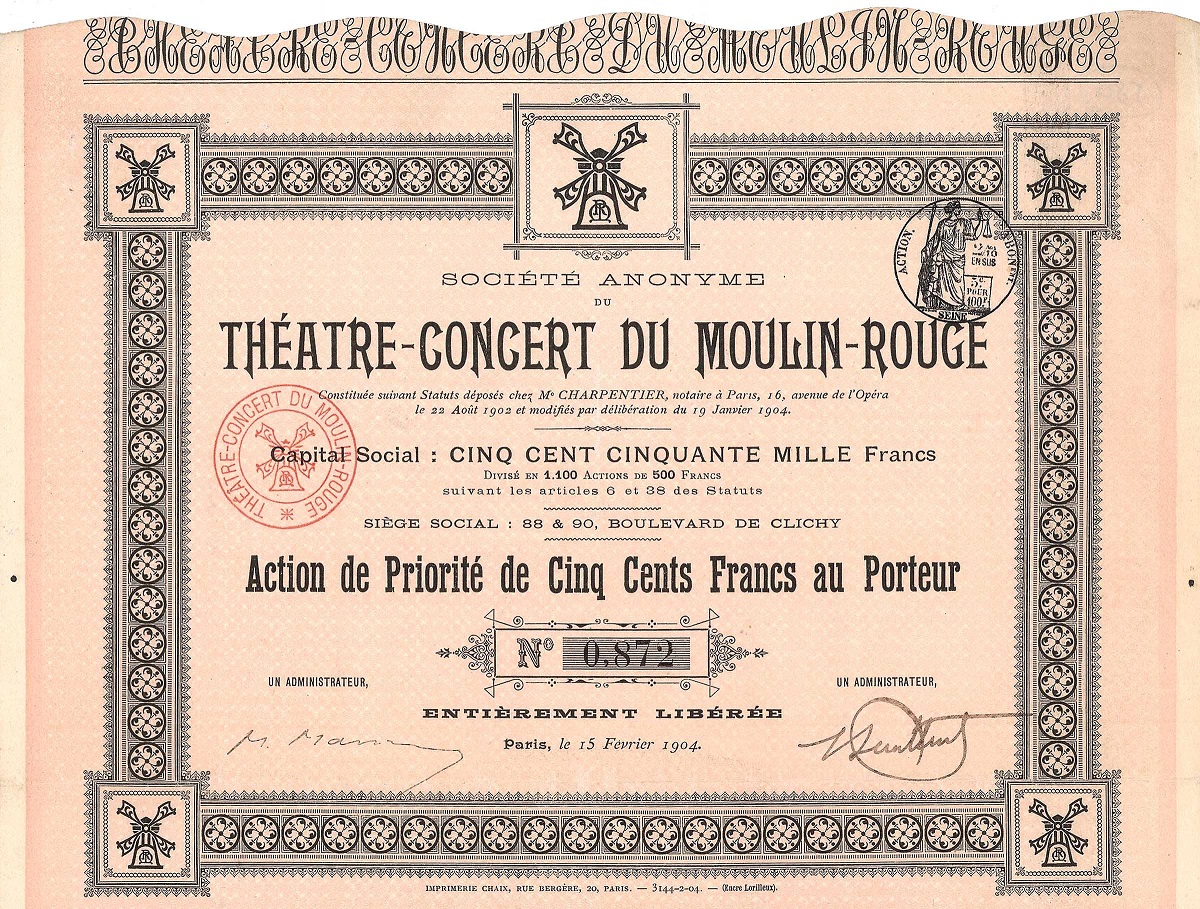
The European section in HSK's 42nd auction includes objects such as this 1904 share from the Société Anonyme du Théatre-Concert du Moulin-Rouge. Located in the Boulevard de Clichy, Paris, this cabaret became a world famous attraction with its can-can danse. Bids start at €200 for L292.


There is a lot more to discover in the catalog, so here are the details :

F.L.


PS : Did you like this post ? Thank you for sharing it on you favorite social media channel !

Friday, March 17, 2023

Something for everyone: HWPH puts 4486 lots on the auction block!

Historisches Wertpapierhaus AG has scheduled his next triple-session auction for 27, 28 and 29 March 2023. This time Matthias Schmitt and his team brought together over 4400 lots of scripophily and related documents from all continents. 

One thing is for sure, you need some time to go through all the offerings. So I suggest you use keywords in the online search functions. HWPH's site has a dedicated page to select Regions, Countries, Eras and Industries, see here. I tried out the country Japan and found over 40 related lots. 


This unissued Kyoto bond was part of the city's 1909 5% External Loan of 45,000,000 francs. It shows the facsimile signature of mayor Saigo Kikujiro (1861-1928). He was a member of the Satsuma army, a group of dissident samurai that revolted against the imperial government in the Seinan War of 1877. Then, he was shot in the right leg which was partially amputated. Later, as mayor of Kyoto, he organized large infrastructure projects such as the excavation of the Second Lake Biwa Canal, the development of the city's water supply resources, and the expansion of Kyoto's roads and tramway network. With the Mitsui Bank, Saigo Kikujiro procured this 45 million francs foreign loan to finance these projects.  L(ot) 1895  


On the same page you can select for certain industries such as Fine China (Porcelain): you'll be surprised how many hits you get on this theme.  

Oh yes, you can combine 'industries' with 'countries'. I tried USA + Railways, and there it is, over 200 lots in that combination, including the following rare bond printed by the National Bank Note Company. 


The Yumuri Rail and Tramway Company was incorporated in 1907 in the state of New York to construct a railway across the east end of Cuba connecting the northwest and southeast coasts. The Republic of Cuba was founded in 1902. The country's first decade was tumultuous and created a difficult climate for foreign investors. It is unclear what happened to the Cuban operations of this company. It went bankrupt in 1914. Click to enlarge image. L2996 


HWPH also brings its event to the online public through Invaluable.com. There, you'll find a separate section for each auction session. Click through to see the items. From there continue and select "Sort by: Price High to Low" to find the top items within each session. 


One of the top items from the first session is this 500 thaler Prussian Courant share in the Pommersche-Ritterschaftliche Privat-Bank from Stettin.  Today known as Szczecin, Poland, Stettin was then the capital of the Prussian Provence of Pomerania.  The fine print was produced by the Berlin-based lithographic workshop of H. Hindersin. Click the image below to see the rich details on the word "Actie" (share). L796 in the auction.


There is a lot more to discover in HWPH's auction catalogs. Here are the details of this online event:
  • Dates: 27, 28 and 29 March, each day starting at 11 AM German time 
  • Location: this is an online event
  • Further info and catalogs, see here on HWPH. Live bidding is possible through Invaluable.com, see there.

F.L.

Did you like this post ? Thank you for sharing it on you favorite social media channel !

Thursday, March 2, 2023

Scripophily Puzzle No. 7 - solution

What have The Washington Post, Berkshire Hathaway and 20th Century Fox in common? 

Answer: Scripophily Puzzle No. 7 ? 
Hm, yes ... but no, we are looking for the solution of that puzzle.

To help you solve the puzzle, see here, I provided three visual cues. These were images from three different stock and bond certificates. Each one relates to our mystery person.

And the correct answer for the puzzle was ... (drumm roll in the background) ... Katharine Graham.

The first cue showed a 100 shares certificate from The Washington Post Company, issued in 1971. At that time Katharine Meyer Graham was the President of her family's newspaper business. 


Her father, financier Eugene Meyer was Chairman of the Federal Reserve Board from 1930 to 1933. After leaving the Federal Reserve he bought the Washington Post newspaper at a bankruptcy auction in 1933 and became its "publisher". In the US a newspaper publisher is the owner of small newspaper company, or the chief executive of a major newspaper. Eugene Meyer was both. 
 
When president Harry Truman named Meyer to be the first president of the World Bank in 1946, Meyer transferred control of the Post to his daughter and her husband Phil Graham, the new publisher. After his father-in-law passed away in 1959 Phil Graham became the company's new president and chairman of the board.

So much for some background info about the newspaper. Enters our starring role, Katharine Meyer Graham.


Katharine Graham, publisher of The Washington Post, guest at a meeting of the Dutch Newspaper Press (NDP) in 1975
attribution: Unknown / Anefo, CC0, via Wikimedia Commons, URL see here  


In 1938, after graduation, Katharine Meyer covered labor news and a wide range of other topics at the San Francisco News. One year later she returned to Washington to work for her father's newspaper. Katharine married Philip Graham in 1940. After serving the army during World War II he took over the position of The Washington Post's publisher from her father.

When her husband died in 1963, she took control of the newspaper as its new president and publisher. Back then, a woman was not supposed to be able to run a tough business like a newspaper company, but she persisted.


Katharine Graham was the first woman to head a Fortune 500 company. She was the first to serve as a director of the Associated Press, the news service owned by member newspapers, and of the American Newspaper Publishers Association. Her facsimile signature appears on stock certificates from The Washington Post.  


Mrs Graham made historic decisions about the publication of the Pentagon Papers in 1971, a top secret government account of the war in Vietnam, and the Watergate scandal, which led to Richard Nixon's resignation from the presidency in 1974 under the threat of impeachment. 

In both cases, she hold out against massive pressure from the White House and other government agencies not to publish, at the risk of criminal charges for violating espionage laws and opposition to licenses for the company's broadcasting properties.

Together with Benjamin C. Bradlee, The Post's editor, Katharine Graham took the company to the top in American journalism. During her leadership, the company's revenue grew about twentyfold. The Washington Post got listed on the New York Stock Exchange in 1971 and became a diversified media corporation.


What did The Washington Post disclose about the Vietnam War? The Pentagon Papers revealed that the U.S. had secretly enlarged its military operations in the Vietnam War, without informing the mainstream media. 


The first visual cue of this puzzle - a Washington Post share with Katharine Graham's signature - already contained sufficient information to take a good guess.  

However, I wanted to make you doubt yourself by providing two more visual cues, diversions, including one with a detail of another famous signature. 


The facsimile signature shown in the second image provided is the one from famous investor Warren Buffett, chairman and CEO of Berkshire Hathaway Inc., a multinational conglomerate holding company. 

Warren Buffett started buying large portions of Washington Post stocks in the 1970s. He became a close friend and financial advisor to Katharine Graham. For 37 years Buffett was a member of the board of the newspaper till 2011. At that time Berkshire Hathaway owned 21% of the common stock in The Post.


The last visual cue for this puzzle is a $5,000 bond certificate from Twentieth Century-Fox Film Corporation. 20th Century Fox released in 2017 The Post, a political thriller about The Washington Post and the publication of the Pentagon Papers. It stars Meryl Streep as Katharine Graham. 

Trivia: Katharine Meyer Graham and Meryl Streep both attended Vassar College, Poughkeepsie, New York, though at different times.

The movie, directed by Steven Spielberg, also shows a similar looking stock certificate from The Washington Post. Check out The Post's trailer at imdb.com see here. Scroll forward there to 1m 32sec to see Meryl Streep presenting the Washington Post's new stock certificate. 


The Washington Post's company seal, shown at the bottom of the share, mentions 1947 as its date of (re)incorporation. Near the upper left and right corner of the image, and outside the seal, you can distinguish two small round marks. You can find these dots elsewhere on the certificate too and also on many other American stock certificates. Called "planchettes" they are mixed into the paper pulp during the manufacturing process of the security paper and glow under ultraviolet light. 


Is The Washington Post still owned by the Graham family? In Oct 2013, the Graham family sold the newspaper to Nash Holdings, owned by Jeff Bezos, for $250 million.

Friday, January 13, 2023

"Auction Explosion!" says Scripophily magazine

Scripophily is the world’s most comprehensive and insightful publication for passionate collectors and active researchers of antique securities. 

The magazine uncovers the stories and features of historic and artistic securities. It brings tales of famous and forgotten business plot twists and memorable personalities. In addition, reports from the auction markets help you to stay up-to-date.


Scripophily, a three-yearly periodical, printed on high quality paper, is the flagship of The International Bond and Share Society (IBSS). 


Here is an overview on the topics brought in the latest issue :
  • Events Calendar 
  • Michigan Copper Mining Stock Discovered
  • Boone To Celebrate 40 years with International Scripophily Event in Antwerp
  • Earliest known German Stock Hammered Down at 72,000 Euros
  • Bang-Up Scripophily at Bonhams New York
  • National Show Back on Track! (27 & 28 Jan 2023, Crown Plaza-Dulles Airport)
  • Banks in Transition: From Counters to Apps (Swiss Finance Museum new exhibition) 
  • Address on Stock Leads to Present Day 
  • eBay Seller Name Fraudulently Used to Pitch Scam
  • Letter to the Editor 
  • Lingenfelter Collection Donated to the University of California at San Diego 
  • EDHAM wins Wikipedia Award and awards Professor Wanner Prize 
  • $2.4 Million for one Bond (Marchel Duchamp at Christie's)
  • The Winpennys of Manyunk
  • Specialization in Our Hobby
  • Deutsche Bank Part III: Shares in Deutsche Bank as a Mirror of German Currency History
  • W. Y. O. D. and Other Strange Mining Company Names
  • Modernizing Certificates 
  • Agua Suja Mining Co., Ltd - Diamonds in Brazil 
  • Charles Yerkes and the West Chicago Street Railroad


Until 2010 LLoyd Aéreo Boliviano was the principal airline of Bolivia. Founded in 1925, LAB is one of the earliest airlines in the world. This share, issued in 1926 La Paz, sold in HWPH's Sep 2022 auction for €160. 


In its current issue Scripophily reports on exceptional auction activity from recent months. Five-digit amounts are hammered for top historic items, such as:
  • John D. Rockefeller Standard Oil Company founders' stock certificate (Bonhams, $28,000)
  • the oldest known German share certificate from the Embden Asiatic Company which traded with China (FHW, €72,000)
  • Oost-Indische Compagnie aka V.O.C. bond (HWPH, €40,000)
  • the oldest loan of the City of Antwerp from 1558 (Booneshares, €36,000) 
  • Nikola Tesla owned share in the Nikola Tesla Company (Bonhams, $28,000) 
  • and a share owned by Frederick-William III of Prussia (HWPH, €25,000) 
More details and images on these recent scripophily highlights, and many other discoveries, can be found in the 48 pages counting December issue.

Subscribing to IBSS's magazine costs you only £28, $35 or €32. What are you waiting for ?
All the info can be found here .

F.L.


Previous posts