Showing posts with label Switzerland. Show all posts

Saturday, August 17, 2024

HIWEPA on tour in August

HIWEPA will be on the road later this month. Based in Ittigen, Switzerland, this auctioneer and dealer in antique stocks and bonds regulary participates at events.

This month you'll see them at

  • Börsentag Zürich (Stock Exchange Day), Zurich, Saturday 24 August 2024
  • 10th Ansichtkarten-, Foto- und Papierbörse (bourse of vintage postcards, pictures and ephemera), Olten, Sunday 25 August 2024
  • Bourse Aux Monnaies (coin and banknote exchange), Neuchâtel, Sunday 25 August 2024

Further info: https://www.hiwepa.ch/en/blog/events-2024.html


Löwenbräu Burgdorf A-G, Burgdorf 
500 Francs share from 1903
lion logo in underprint 


F.L.

Monday, November 14, 2022

Banks in Transition : From Counters to Apps

Last summer the Swiss Finance Museum opened its new exhibition Banks in Transition : From Counters to Apps

This special production shows the evolution of Swiss banks and their relationship with private clients. A selection of authentic historical securities showcase Swiss banks, as well as global tech companies that are driving digitization in the financial sector.   


In several parts the exhibition present the roots of Swiss banking, the emergence of the Swiss financial centre, the Internet, and the advent of the smartphone and its huge impact on today's digital payment culture. The latter part features interactive tools and displays.

The exhibition shows several antique share certificates from companies like the Banque Générale Suisse de Crédit International Mobilier et Foncier, Banque Privée Edmond de Rothschild SA Genève, Apple Computer, etc.


 This eBay Inc. stock certificate is part of the new exhibit. A success story of the dot-com bubble in the 1990s, e-commerce and online auction site eBay offered online money transfers through its previously wholly owned subsidiary Paypal. 


The Swiss Finance Museum is located at the headquarters of SIX in Zurich. In its Permanent Exhibition the museum explains the origins of the economic system and the role of the stock market. This unique museum is home to a collection of 10,000 historic securities from more than 150 countries. 

Key historical pieces, combined with interactive videos and animations, historical film recordings and interviews, tell the story of the development of our modern financial economy. Since this summer, the permanent exhibition features a new highlight: a share in the French East India Company from 1665.


More info about the museum can be found here .

F.L.


Related links

Tuesday, June 14, 2022

Schweizer Finanzmuseum celebrates its 5th Anniversary

In its Permanent Exhibition the Swiss Finance Museum explains the origins of the economic system and the role of the stock market. This unique museum is home to a collection of 10,000 historic securities from more than 150 countries. 

Key historical pieces, combined with interactive videos and animations, historical film recordings and interviews, tell the story of the development of our modern financial economy. The museum, since 2017 located at the new headquarters of SIX in Zurich, celebrates its 5th Anniversary.


Schweizer Finanzmuseum
view on the Permanent Exhibition 
image courtesy Schweizer Finanzmuseum


The museum welcomes the public to its Open Day on July 2, 2022 from 11 am to 3 pm with a dedicated program : 
  • 11 am - 12 pm: Combined tour (permanent and special exhibition), in German
  • 12h30-1 pm: Guided tour through the special exhibition Sport & Geld, in German
  • 1 pm -1h30 pm: Guided tour through the special exhibition Sport & Geld, in English 
  • 2 pm - 3 pm: Combined tour (permanent and special exhibition), in German

Participants of the Open Day should register here


This stunning 500 Lire share from Pirelli, printed by the Milan-based security printer Brevetti Calcografia e Cartevalori was issued in 1947. It is one of several antique shares on display in the Sport & Geld special exhibition. Pirelli, one of the top tyre manufacturers in the world, sponsored sport competitions since the start of the 20th century. Its financial backing was/is important to e.g. the FIA Formula One World Championship, football club Inter Milan, the Chinese Super League (football), the Hungarian Grands Prix (motorsport) and the Alpine World Ski Championship. 
image courtesy Schweizer Finanzmuseum 


The current special exhibition Sport & Geld shows why money plays such an important role in sports. Using the sports of Formula 1, tennis, equestrian sports, soccer and skiing, the exhibition gives a glimpse of the financial aspect of physical exercise. Sport & Geld can be seen until July 15, 2022. On display here are a dozen historical shares. 

The museum then closes for the conversion up to and including August 25, 2022. Its new special exhibition Banks in Transition: from Counters to Apps will features securities as well.  The opening of this new exhibition is planned for the end of August.

More info can be found here (German), or there (English).

F.L.


Sunday, May 8, 2022

HSK's upcoming auction in Hamburg features more than 1100 lots of historic securities

28 May is the day when HSK's 41st auction takes place in Hamburg. This time HSK brought together more than 1100 scripophily lots. Bonds and shares from Berlin real estate developers, the Wolfgang Tartz collection, are part of many top-quality items included in this sale.

The event starts with a talk by Claus Müller titled The beginnings of the Russian mining industry in Ukraine, financed with foreign capital. After the auction a collector's bourse precedes a joint dinner.


From the American auction section,  L(ot) 62 is a rare bond from The Colorado Bonanza and Union Tunnel and Mining Company issued in 1891. The company was founded that year to dig for Colorado gold in Gilpin County. The upper vignette shows its mining operations near Bates Hill and Maryland Mountain. Remarkable, a cross-section of that same view tells us about the Bonanza and Union tunnels that were to be excavated. 


Scripophily from all continents is represented in the auction. Major sections are dedicated to America and Germany with in particular Bremen & Niedersachsen, Hamburg, Schleswig-Holstein & Mecklenburg-Vorpommern.

Some noteworthy items from the European section :
  • L256 is a 1886 share in the Compagnie Générale des Bateaux Parisiens with riverboat vignette. The company operated commuter riverboat services around Paris. 
  • Illustrated with a Roman! pyramid, L298 is a lovely share certificate from the Public-Auto SA per il Servizio delle Automobili da Piazza in Roma e Altrove, a public transport company in Rome.
  • The Manchester Race Course Association share from 1848 features a detailed vignette of the company's grandstand, L287. 


The Eidgenössische Bank AG, aka Banque Fédérale SA, Zürich, was one of the most important Swiss commercial banks. It became part of the Schweizerische Bankgesellschaft (SBG) in 1945 (later UBS). The sale features two of the company's sought-after share certificates. L260, dates from 1893, see image, and  L261, from 1917. 


Before I discuss the Berlin real estate developers collection, let me point out some interesting German certificates :
  • L881, a "Stamm" (Kux, mining share) in one of the earliest mercury mining companies from Germany is a top item in HSK's auction. The share in the Quecksilberwerke am Lemberg, issued in 1846, shows excavation activities, the smelting of mercury ore, and is adorned with leaf scrollwork in beautiful blue printing. Check the word 'STAMM' in detail : each letter is designed as a trunk (another meaning of the word STAMM). A very rare, small work of art.
  • Carosseriewerke Schebera Aktiengesellschaft from Berlin dealt in automobiles and produced car bodies. The 1922 specimen share, L692, illustrated with a horse carriage and two of the company's automobiles, bears the facsimile signature of Jacob Schapiro, car dealer, taxi entrepreneur and stock market speculator, who became a large shareholder of Daimler-Benz.
  • Art Deco enthousiasts will love L941, a 1923 issued share from the Textil-Kunst Aktiengesellschaft from Dresden.
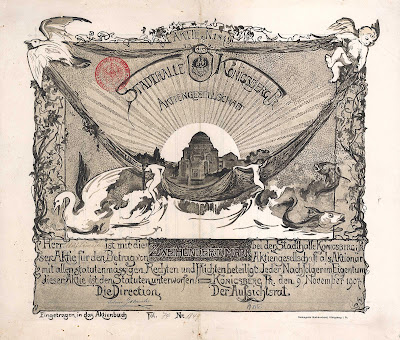


Architect Ludwig Richard Seel designed the city hall for Königsberg, known today as the Russian city of Kaliningrad. Seel is known for building the Parliament and Ministry of Justice in Tokyo. Königsberg's city hall, completed in 1912 and illustrated on this Stadthalle Königsberg share from 1907, included concert halls, a restaurant and a cafe. During the Nazy era, many artists lived in Königsberg to work independently of state control. The building was destroyed in World War II. Restored in the 1980s, it is now home to the Kaliningrad Regional Museum of History and Arts. L930 


The Wolfgang Tartz Collection counts over fifty bonds and shares from Berlin real estate development and property companies.  The collection was assembled over a period of many decades. Lot range 570 through 624.
Between 1750 and 1850 Berlin's population tripled to over 400,000 people. In 1871 Otto von Bismarck unified Germany. Berlin, the capital of the new German Empire, became the center of politics on the European continent. Von Bismarck created a favorable investment climate for the city's development. A large numbers of industrial workers and their labour unions, bankers, entrepreneurs, scientists and artists made Berlin a thriving but fast growing city. By 1910 the number of Berliners amounted to 2,000,000. 


The public square and transport hub of Alexanderplatz is recognizable from afar thanks to Berlin's nearby 368m heigh Fernsehturm. With hundreds of thousands of passers-by and visitors  Alexanderplatz is the most visited area of Berlin. 
Founded in 1912, the Aktiengesellschaft Alexanderplatz managed a number of houses at Alexanderplatz and nearby, including Hotel "Alexanderplatz". This 1000 Reichsmark share from the same year is part of the Wolfgang Tartz collection. L572 


There is a lot more to discover in the sale, so here are the details :


Though called a share certificate (Anteil-Schein) this is an interest-free lottery bond from the still existing Ski-Klub Oberstaufen. It was issued in 1920 for "the purpose of building a first class ski jump". Since the 1960s several international slalom competitions were held in Oberstaufen won by champions like Vreni Schneider and Ingemar Stenmark.  Note the logo with skis. L902 in the auction. 


F.L.


PS : Did you like this post ? Thank you for sharing it on you favorite social media channel !

Thursday, October 14, 2021

The Berner Alpenbahn Gesellschaft - Bern-Lötschberg-Simplon, new book from author Dr Peter Christen

In 1906 the Berner Alpenbahn-Gesellschaft Bern-Loetschberg-Simplon was founded with the purpose of building the second Swiss railway line through the Alps between the cantons Berne and Valais through the Loetschberg mountain. Today it runs under the name BLS and is the largest private railway in Switzerland.

This year, the scripophily public welcomed Dr. Peter Christen’s new book on the Bern–Lötschberg–Simplon Railway. More than reason enough to have a talk with the author! 


FL Welcome Peter in this virtual studio. We are honoured to have you here. Let’s start from the beginning. How did you become interested in scripophily? 

PC Thank you. My “scripophily career” started at Christmas 1980. I can remember very well. I then was a first-year student at the University of Geneva. At the train station on my way to Christmas visit home I bought a financial newspaper … and out fell a share of the “Builder Investment Group”. It was a special Christmas present from the newspaper to its readers. I immediately fell in love with old shares and bonds.Since that day I am into scripophily.

FL Peter, what is the greatest joy you get from collecting?

PC The most fascinating thing for me is the information gathering. First, I have a share or bond in front of me and I know very little about it. Then, when I start to investigate, I find all this interesting information about its history and all its connections it is leading to.


FL Can you tell us something about yourself regarding your “scripophily career”?

PC As a collector, I am definitely not a good role model: I do not specialize in one field. I collect items that are interesting and do have significant importance in economic history. This scope makes a collection really big. However, one of my main fields is collecting railways and more than 10 years ago I published a comprehensive catalogue for Swiss Railways and have published several articles about Swiss railway companies in different media. 


FL Oh yes, in 2014 you won the Journalistenpreis Historische Wertpapiere und Finanzgeschichte. If I am correct, you are the president of the Swiss Collectors Association SCRIPOPHILA HELVETICA, and you’re also a partner in the auction and trading house for historical securities HIWEPA AG. Now you have published a new book, “Die Berner Alpenbahn-Gesellschaft Bern-Lötschberg-Simplon BLS”. Why did you choose this subject?

PC I actually have hundreds of ideas of interesting things I could write about. There is just not enough time. But this year it is different. The idea for writing this book came up in February. “Thanks” to all these Covid restrictions I was forced to stay at home and could not go to my usual spring trekking holidays in Spain. So I decided spontaneously that I would write a book.

PC Finding a theme is definitely not a problem for me. A couple of years ago I wrote a short article (see here) about the “Finanzgeschichte der BLS Lötschbergbahn – Berner Alpenbahn” for my colleagues at HIWEPA. Together with the famous “Gotthardbahn” the BLS Lötschbergbahn – Berner Alpenbahn” was the second Swiss railway through the alps and has a very interesting history.

PC I took this article as a starting base and, for a couple of weeks, I investigated further into the story of the company, with – what at least I think – super interesting and new information about this railway and all its shares and bonds.


FL Well, you made me curious. Can you tell us briefly what makes this railway so interesting? What surprised you most?

PC The Berner Alpenbahn Bern-Lötschberg-Simplon, today BLS, was and is the second railway through the Swiss Alps and a very important link between Northern Europe and Italy. Its financial history is very interesting. Actually, at the beginning, nobody in Switzerland, except the people of the canton Berne, wanted to finance this project. Berne had to look elsewhere to raise the necessary funds and these were to come from an unexpected source.

PC I personally was surprised to find out that the Berner Alpenbahn and its shares and bonds even have some connections to an assassinated French president and even to the Compagnie Générale Aéropostale and its famous pilot and author Antoine de Saint-Exupéry. I think nobody knew about this connection until I found it. 

FL Wow, that’s sounds intriguing? Looking at the book cover we can detect a certificate in the background of the front cover. Why did you pick that particular certificate?

PC The background for the front cover is the bond of the Berner Alpenbahn-Gesellschaft issued for building the railway. Between 1906 and 1912, the company raised money with four issues of these decorative bonds.


FL The vignette invites us to have a closer look. Does it represent a real view in Switzerland?

PC Yes, the image in the vignette shows an aerial view of the main section of the railway in the Bernese Oberland. The bond also depicts the two shields of the main cantons along the line, Berne, in the left border, and Valais, on the right. On top of the certificate, you’ll see a winged railway wheel with Mercury and the electric bolts. It represents the BLS as the first electric railway through the Alps.

FL I’m sure our readers will be interested about the book format and content. What about that?

PC The book has 148 pages and many colour images especially with details of the old shares and bonds. The book has three chapters, first, the financial history of the company and, second, the detailed images, description and background of its shares and bonds and, third, the list and images of all issued shares and bonds of the company. You also can buy the book as e-Book. 


FL Where there any special sources that you used for your research? How long did it take you then to write it?

PC I especially researched all reports from the company itself, general history and other reports about the company. Further, I am always astonished how every year the information you can get through the Internet increases. As I already have written a shorter financial history about the company the information gathering did not take too much time. It took me three to four weeks the write the book then.

FL Now, it’s time for what I believe is one of the most difficult questions a collector may answer. If you could add any certificate in the world to your collection, what would it be, and why?

PC I would love to find a share or bond with the signature of James Watt. In the collector market, all important inventions, railways, canals, cars, airplanes, etc, do have shares or certificates but there is nothing on the extremely important invention of the steam engine. So, a share with the signature of James Watt would really be a sensational find. Maybe our collector friends from the UK will make this find ... but I doubt it.

FL Peter, I want to thank you for this interview and wish you a lot of success with the book.


Die Berner Alpenbahn-Gesellschaft Bern-Lötschberg-Simplon BLS Finanzgeschichte und Historische Wertpapiere, by Peter Christen, is published by Books on Demand :
  • ISBN: 978-3-753-40662-6
  • Price: CHF 29.80
The book can be ordered with hiwepa.ch, email info@hiwepa.ch, or at most bookshops and online bookstores. An e-Book version is available as well.

FL

This post was originally written for Scripophily magazine, published by IBSS.


Previous posts

Wednesday, December 5, 2018

Scripophily magazine uncovers the stories of historic and artistic securities

Scripophily magazine brings you into the world of antique stocks and bonds. Buckle up! Compelling stories, business plot twists and memorable personalities won't let you go during your reading journey. You'll find out about today's discoveries. Reports from the auction markets will keep you up-to-date. So, if you are serious about this matter, then this is the magazine you are looking for.


vignette of sailing ship, taken from stock certificate


Scripophily was first published in 1982 under the name The Bond & Share Society JournalOn the occasion of the magazine's 100th edition, editor Max Hensley testified :
"The magazine appears on high quality paper, articles are longer and brought with more images in full color. Every issue was produced .. without paying a penny for content".
That's right, all content is created voluntarily by enthousiastic people from the hobby, three times a year.

Scripophily magazine cover


Issue 108 brings over 50 pages of scripophily news, in depth articles, pictures of collector friends, auction reports and more than 100 high quality images of stunning, historic or rare stocks and bonds. Here is a summary on the topics brought in the latest issue :
  • Swiss railway scripophily on Youtube 
  • Newsletter about Belgian scripophily 
  • Herzog Collection on the IBSS website 
  • Mexican scripophily sources 
  • New book on US railways by Terry Cox 
  • New book on the Wogau Empire (Russia) by Erik Meyer 
  • Playwright Neil Simon 
  • The shipyard from Gdansk 
  • Saved at the last minute, a story on share adventures
  • Donating collections, do's and don'ts 
  • "A L'Innoviation" inferno (Belgium) 
  • Borki train disaster (Ukraine) 
  • Cattle ranching in the US 
  • Barcelona Traction, Light and Power Co 
  • Survival rates on US Mining scripophily 


vignette with allegorical woman and locomotive, taken from share certificate


Is this a free magazine? No. Good stuff is never for free. But a 1-year subscription full of excitement only costs £20 or $32 or €25. The magazine is published by the International Bond and Share Society, the leading international organization for collectors, dealers and auctioneers in this field. More info : https://scripophily.org/membership/join/ 


F.L.

Related links


Thank you for sharing this post so we can reach more people ...

Saturday, March 5, 2016

Mario Boone - Auction 56

Boone will auction about 1600 lots of antique bond and share certificates on 19 March 2016. One of the highlights is an exceptional early Antwerp city bond.

early coat of arms of the city of Antwerp on Breughel bond
Lot 418 detail from the 1664 Antwerp city bond below
Since the 15th century, the Antwerp arms show a hand on each side of a castle.
This bond depicts an earlier version of the arms with the hands placed on flags.


Bond from Antwerp issued in 1664 is handwritten on parchment
Lot 418 : Bond for 281 Carolus guilders and 5 Stuivers, issued by the City of Antwerp, 1664.
The obligation debt was payable to Clara Antheunissen Gasparsdochter, owed to her for land which
she had sold to Ambrosius Breughel. The bond is expressed in Carolus guilders which was
the official currency in the Habsburg Netherlands since Emperor Charles V, from 1521 to 1680.
Ambrosius Brueghel (1617-1675) , son of Jan Brueghel the elder and grandson of Pieter Brueghel the elder
was, just as his forefathers, a Flemish baroque painter who specialized in landscapes.
Clara Antheunissen Gasparsdochter is the daughter of Antheunis Gasparsz and
granddaughter of the art dealer Gaspar Antheunis. 

Bond from Antwerp issued in 1664 is signed by Philips Rubens
The bond above is signed by Philips Rubens as town clerk of Antwerp.
Philips Rubens (1611-1678) was the nephew and biographer of the painter Pieter Paul Rubens.
The combination of the Rubens and Brueghel families make this an exceptional historic certificate.


The certificate on Boone's catalog cover is a 1000 French francs share, 
unissued and printed in the 1840s for the Basel based
Dampfschiffahrts-Gesellschaft der Adler des Ober-Rheins
(freely translated: Eagle of the Upper-Rhine Steamship Company)


Practical info
  • Auction date: 19 March 2016 
  • Place: Antwerp, Belgium
  • Further info, see here 

Tip for 20 March : IBSS Breakfast meeting followed by Boone's International Scripophily Bourse, at the same place.

F.L.


Collecting stocks and bonds? Please participate in this anonymous poll.

Monday, March 31, 2014

Digest of scripophily readings XIII

New online scripophily articles and references, March 2014


POLSKIE OBLIGACJE PAŃSTWOWE 1918 - 1939 POLISH STATE BONDS
"Collecting is not only the accumulation of objects but also the gathering of information about these objects." , says Piotr Bykowski from Poland. In 2004 Piotr published a 100 page study about bonds issued during the Second Polish Republic. Mr. Bykowski's work, written in Polish, includes English chapter titles and contains images of most types of certificates. You can find the work online and download it here. A great reference work. The author, a fervent traveller and motorcyclist, is grateful for any opinions and feedback. You can contact him by email, pibykster@gmail.com or through his blog.

Poland 1920 treasury loan
5% Long term internal state loan of 1920
temporary certificate Poland treasury
handwritten denomination

The World's Airlines - Past, Present & Future
There is not a single image of an airline's stock certificate present, but still, The World's Airlines is a great reference place for any collector of aviation scripophily. The author has currently 17871 airlines listed in his database (latest release 30th March 2014). Amazing. As a test, I checked out Brazil and counted more than 250 airlines. You can follow the author on Twitter here.

HWPSAMMLER.TUMBLR.COM a bilingual blog
Dr. Roland Schmidt, alias HWPSammler, is the author of the scripophily blog titled Historische Wertpapiere. Blog posts are written alternately in German and English and cover a broad list of topics. Here is one of my favorite posts about a warbond from .. yes .. Switzerland. Thank you for sharing HWPSammlr, I am tuned ! 


Scripophily magazine from the International Bond and Share Society
Scripophily magazine No.93.

Scripophily Magazine
In addition to the online sources above, the latest December 2013 No.93 issue of Scripophily magazine, published by the International Bond and Share Society, contains the following stories :
  • The birth of the Bank of England
  • The story of two Rhodesian Mining Companies & Jake The Barber
  • Dr. Fred Pearson's Infrastructure Projects Part II 
  • The Malay Peninsula Exploration Syndicate, a story about constructing a canal across the Malaya Peninsula
  • La Nouvelle France or Voyage to the end of the world
  • 1925 - 8% Skoda Loan II, about Chinese government debt
  • Phillips Scripophily Auctions
  • Chinese speculations on Ebay
  • Cox's Corner : Pondering the big hoard
  • Top Thirty record auction prices recorded
  • other periodical topics : society matters, news, bourse reviews, auction reviews, events calendar, member classifieds, book reviews


F.L.
Signed the Guest book yet ?

Friday, February 14, 2014

Book : Shares & Co. - A journey through the world of securities and the history of capitalism

Both a reference book and an exhibition catalogue
published in an English, German and French edition

double-click image to enlarge


  • Title : 
    • English edition : Shares & Co. - A journey through the world of securities and the history of capitalism
    • German edition : Aktien & Co. - Ein Streifzug durch die Welt der Wertpapiere und die Geschichte des Kapitalismus
    • French edition : Actions & Cie. - A la découverte de l’univers des papiers-valeurs et de l’histoire du capitalisme
  • Authors : Dagmar Schönig, Thomas Fenner
  • ID : ISBN 978-3-033-04124-0 (only for the German edition), published by Wertpapierwelt
  • Languages : see different editions
  • Number of pages : 77 (English and French ed.), 152 (German ed.)
  • Images : about 110 color images
  • Available from Wertpapierwelt, see here 

This catalogue accompanies the main exhibition currently presented in Wertpapierwelt's scripophily museum. An easy read, written for the broad public, and still comprehensive, this work makes us understand about the how, what, when and why of securities and capitalism. Do you know the difference between a subscription right and an interim certificate ? Can you tell why the introduction of bearer stocks made sense at a specific moment in history ? You'll find answers on questions like these and many more in this handy publication.

German World War I loan design by Hanns Anker
8. Kriegsanleihe, Germany, 1918
design by Hanns Johannes Anker (1873-1950) 
one of many certificates featured in the book
image by courtesy of Wertpapierwelt

Chapters
  • Shares & Co. - How financial instruments work
    • Introduction : From bartering to stock exchanges, The corporate capital, From physical commercial paper to digital book-entries
    • Shares
    • Bonds
    • Derivatives
    • Historical financial instruments
    • Security features of securities certificates
  • The story of capitalism - How shares changed the world
    • 17th/18th centuries : The origins of the joint stock company
    • 19th century : Shares take off in the nineteenth century
    • 20th century : World wars, economic miracles and the world wide web


Tip
Both the English and French editions are printed as a booklet (Price: 15 CHF). Pages contain up to three smaller images. The German edition (Price: 20 CHF) is published as a book with a hard cover counting twice as many pages. The contents is the same but the images are larger (one per page). For the linguists among us, why not buy an English or French edition together with the German edition. Not only will you enjoy larger images, but you can immerse yourself in a German scripophily language course.

F.L.

Related links

Saturday, January 4, 2014

10 Years Wertpapierwelt

The town of Olten is only an hour's drive away from Zürich, Bern and Basel. Last summer it's Wertpapierwelt museum celebrated its tenth anniversary and surprised us with a threefold exhibition:
  • The first section, Shares & Co - How financial instruments work, displays the multifaceted nature of financial instruments and their workings.
  • The Story of capitalism – How shares changed the world is devoted to the origin and spread of the joint stock company throughout the last 400 years.
  • The special exhibition, The networked business world – Globalization and shares, provides an impression of just how globally interconnected the economy is with the most varied areas of our lives.

Dagmar Schönig is the curator at the Wertpapierwelt museum since the very beginning. Here is an interview with her.

Images by courtesy of Wertpapierwelt


Sociedad Mineralogica de la Ciudad de Arequipa engraved by Joseph Vazquez
Detail from the certificate, see below, of the 
Sociedad Mineralogica de la Ciudad de Arequipa company
Engraved by Joseph Vazquez
Vazquez, an engraver from the 18th and 19th century,
was also known for his map engravings as you can see
here

Me:
Dagmar, you are the curator of the Wertpapierwelt museum. This sounds like a dream job to some of us. 
Dagmar: 
I can imagine that the job as a curator in a museum of historical bonds and shares sounds like a dream job for any collector. However, you would run pretty quickly into a conflict of interests. That’s why the “code of ethics” of the International Council of Museums (ICOM) – which our museum is a member of – does not allow that employees of a museum are private collectors or professional dealers of objects that form the museum collection they have to work with.
Me:
Can you tell us something more about your work as a museum curator ?
Dagmar:
As the museum Wertpapierwelt is not “heavily staffed”, my job description covers a lot of different tasks:
1. I am in charge of  all aspects regarding the collection, i.e. inventory and all conservatory aspects (in case of old paper in exhibitions, mainly the light is a problem), I research historical backgrounds, make acquisitions according to the collection policy (within a given budget), and everything in between…
2. I plan exhibitions, develop the according concept, write all the texts, decide on the scenography with external exhibition builders, supervise the buildup and the production of the accompanying publications, control the costs, etc.
3. I have to run the day to day business of the museum, including providing guided tours for visitors, running marketing activities, making surveys and statistics, reporting to public authorities and  the board of the museum, etc. You see, it doesn’t get boring! 

share certificate of the Sociedad Mineralogica de la Ciudad de Arequipa
Sociedad Mineralogica de la Ciudad de Arequipa
Share certificate, Peru 1792
part of the The Story of Capitalism exhibition section

double-click image to enlarge

Me:
Does your earlier education somehow help you in being a scripophily curator ? 
Dagmar: 
In my “previous life” I have worked for several international banks. This professional background in the banking industry certainly helps me when it comes to explain the complexity of the finance business to the broad public. You have to understand that Wertpapierwelt does not just show historical securities and says “Look! What a nice old share”, but puts them into a wider context. We have a lot of school classes and visitors who have only a very vague idea about the differences between a share and bond for example. 
Originally I studied languages and economics – but that is a very long time ago. When I got the chance to take over the project of transforming an extensive collection of historical bonds and shares into a museum, I was thrilled! History, especially economic (and technical) history, had always interested me. And the beauty of most of the papers certainly helped my inspiration. Of course, I had to learn a lot in terms of “museum work” ! But we wanted from the beginning that Wertpapierwelt was run in a professional manner, therefore I started my further education and acquired my knowledge through professional training in classes provided by the Swiss Association of Museums and others. Now, I am additionally studying for a master degree in “Applied History” at the University of Zurich.
Me:
In your opinion, what key values are essential to a curator ?
Dagmar: 
As a curator of a museum you obviously have to have a profound knowledge of your objects”! You need to be curious about every aspect of their background and be a persistent researcher. Wikipedia is not enough!
In case of acquisitions, you must also have a good judgment of what fits your collection strategy and – often more difficult – what does not. It can be hard to let a certain piece go if you personally like it, but it just doesn’t fit.
You also have to really care for your objects and do everything for their good preservation, even if it means that you cannot show them as often or in a certain way, as you actually would like to do. Especially paper is very sensitive.
For setting up exhibitions you need a certain amount of creativity, the ability to tell an interesting story (which also means that you have fun researching it first and then putting your results into easily readable writing!), and – of course – you need project management skills (which means: stay cool!). 
Chen Feng Spinning and Weaving Company share certificate
Chen Feng Spinning and Weaving Company
pre-communist era

part of the "special" exhibition
double-click image to enlarge


Sunday, October 20, 2013

HWPH - Auction 31 and 32

HWPH Auction 31 - Part 1
image: Brau-Gesellschaft des Marktfleckens Stankau
Share of 200 Gulden Ö.W.
1874, Markt Stankau, now part of Czech Republic
double-click image to enlarge


HWPH catalogue showing share certificate of the steam navigation company on the Thuner and Brienzer lake
HWPH Auction 31 - Part 2 - 50 Highlights
image: Vereinigte Dampfschiffahrtsgesellschaft
 für den Thuner- und Brienzersee
nominative share for 500 Swiss Francs
1843, Thun, Switzerland


HWPH catalogue depicting Holsten brewery share certificate
HWPH Online Auction 32
image: Holsten Brauerei
Share of 1000 Mark - later overstamped into 400 Reichsmark
1909, Hamburg Altona, Germany


  • Date: 26 October 2013  - Auction 31 ;  28 October 2013 - Auction 32
  • Place: Auction 31, Wiesbaden, GERMANY 
  • Further info, see here


F.L.


Thursday, October 10, 2013

Spink Switzerland - Auction October 2013


Spink Switzerland - Bonds & Share Certificates of the World
image (double-click to enlarge) :
Berner Chocolade-Fabrik, Tobler & Co. A.G.
English: Bern Chocolate Factory Tobler & Co.
Share of 100 Francs, 1905
"Toblerone Jugendstil"


share certificate of the Basel Zoo
Actien-Gesellschaft des Zoologischen Gartens in Basel
English: Basel Zoological Garden Company
Duplicate nominative share of 250 Francs 1910, issued in 1975


  • Date: 19 October and 21 October 2013
  • Place: Lugano, Switzerland on 19 Oct (21 Oct is an online auction only)
  • More info: see here


F.L.


Thursday, November 15, 2012

Scrollwork at left

The common use of the term 'scrollwork' in scripophily
In auction catalogues that are written in English, you probably have noticed lot descriptions containing a phrase like 'scrollwork at left'. Such an expression will refer to a whole of ornamental design elements at the left side of a share or bond certificate. The term is an English term and you will often find such design elements on English shares and bonds. An example of scrollwork is printed at the left on the share shown below, hence the expression 'scrollwork at left'. Is there also something like 'scrollwork at right'? Ofcourse, scrollwork can be seen on all possible positions on a certificate. 

share certificate of the Para Electric Railways and Lighting Company

The Para Electric Railways and Lighting Company, Limited
Certificate for 5% first debenture stock, 1968
Printed by W.H. Rickinson & Son
left image: detail of the 'scrollwork at left' 
double-click to enlarge images

Origins of the term 'scrollwork'
Scrollwork is an ornamental design element resembling a spiral. The name is derived from the word scroll which is a roll of paper, parchment or papyrus. The edge view of a scroll forms a spiral. 

The term scrollwork is derived from the word scroll, which is a roll of paper. 
The edge view of the paper forms a spiral.
detail from the certificate below

share in the Ligne Internationale D'Italie par le Simplon
Nouvelle Compagnie de la Ligne Internationale d'Italie
par le Simplon (Chemins de Fer et Navigation)
Bond for 525 Francs, 1868
double-click to enlarge image


Wednesday, May 16, 2012

Digest of scripophily readings III

New online scripophily articles and references, 16 May 2012

Flickr Photostream of Museum of American Finance
Images of objects and documents in the collection of the Museum of American Finance, NYC, can be found here . Several rare stocks and bonds are listed.

Commercial overprints of Great Britain
I'd like to refer to a wonderful blog, namely the blog of the COSGB, or Commercial Overprint Society of Great Britain. Commercial overprints are postage or revenue stamps that have been commercially printed with the name of the user prior to being used. " In Great Britain, Ireland, and New Zealand, these stamps were used to pay an excise tax and were applied to receipts of various sorts."  Besides the lovely images of these stamps, each blog post is dedicated to one company. Just to pick one out : here is the link to Imperial Chemical Industries (ICI). You really should have a quick look.

WWII Danzig bonds
A small article - in German - was written by Rollo Steffens on Gdansk scripophily (German: Danzig), see here .

German football league bonds
Are fan bonds a good investment? Find out for yourself in this (German) article , written by Henning Eberhardt for Spiegel Online.


Front cover of scripophily magazine Der AktienSammler April 2012
double-click to enlarge

der aktienSammler 
In addition to the articles above, the latest April 2012 No.2/12 issue of der aktiensammler magazine, contains the following stories (in German) :
  • Vereinigte Dampfschiffahrts-Gesellschaft des Thuner- & Brienzersees , or in English: United Steamship Company of Lake Thun and Brienz (shipping in Switzerland)
  • Die Firmengruppe "Rostock" Elmshorn, or in English: the "Rostock" Elmshorn corporate group  (food trade and processing in Germany)
  • John Law, two contributions on related scripophily
  • Kreditfinanzierung auf English und das erste Papiergeld in Europa, English : Credit Financing in England and the first paper money in Europe  (part 8 in a series on the evolution of money)
  • Florida Panthers Holding: Der "Rat-Trick"  (ice hockey)
  • Die Erste Russische Lokalbahngesellschaft: Kennerblick gefragt, in English : the First Russian Local Railway Company: an expert eye needed
  • Der Spekulation ist nichts zu schwör, or freely translated: No limits to speculation (about the current wave of speculation in Mexican bonds and shares)
  • other periodical topics : Auction Reviews, Collector's Portrait, Events Calendar, Classifieds

F.L.