Friday, January 21, 2022

SPINK UK's first scripophily sale of 2022 presents Australian gold mines, British stone companies, American cattle businesses and lots more

SPINK UK launched its e-auction of world bonds & share certificates. 601 scripophily lots go on the block. The online sale started earlier this week, and its bidding window closes on Jan 31 at 12:00. The Down Under chapter in the sale consists of more than 50 lots. 


The Australasian Gold and Finance Corporation Ltd registered in 1896. The company dealt in mining properties in Western Australia, Victoria and Waihi, New Zealand. This share from 1897 has an exceptional vignette of a prospector with kangaroos and emus. L(ot) 39 in the auction starts at £50.


Here are some more Australian examples: 

  • L16 Melbourne and Suburban Railway Company, 1859, vignette of surveyor and navvy presenting train on bridge, riverboat and map, embossed seal with train 
  • The Central Australian Ruby Mining and Prospecting Co., Ltd, 1888, L45 
  • Along the Howqua River archaeological quarry sites from the Taungurong people were found. The river area would later be mined by the Chief of Howqua Gold Mining Company, L48 
  • Kelly's Freehold Gold Mining Company, Rutherglen, Victoria, 1898, wide vignette of mining operations, L65


The Canadian section features this £100 bond from the Toronto, Grey and Bruce Railway Company issued for 999 years in 1884. People bought these certificates which could be traded on the securities market. Though due in 2883, the Canadian Pacific Railway recently repaid the outstanding bonds. At £60, L385 is expected to attract buyers. 


A section of 30 Russian lots includes many Maikop oil certificates. 

About 150 lots of British bonds and shares, divided over several sections, represent themes such as canals, shipping, railways, mining, sports and entertainment. Some British examples :

  • Several slate, stone and granite companies are offered, such as the Hard Stone Firms Ltd, see image below.
  • The Grimwith Lead Mining Company, certificate for 2 ordinary shares, 1867, mines at Appletreewick, near Pateley Bridge, Yorkshire, embossed seal, fine vignette of mine entrance, L277
  • A high denomination share of £10,000 in the Wheal Stackhouse Mining Company, L302, was issued in 1836, Truro. The company operated tin and copper mines in St. Enoder, Cornwall.
  • The Crystal Palace housed the Great Exhibition of 1851 in Hyde Park, London. It became a symbol of progress, L317 and L318
  • Lot range 185 through 194 consists of 18th century South Sea annuities


The Hard Stone Firms, Limited was formed in 1897 with offices in Bath. The company owned granite quarries in Cornwall and Devon. Cornish granite was used for the Eddystone Lighthouse located on the dangerous Eddystone Rocks, roughly 15 miles south of Plymouth. The rocks submerge below the surface of the sea. The lighthouse appears both in the vignette and in the embossed seal. L278 in the auction.


The USA is the largest country represented in the auction. Several American sections cover themes like railways, mining, oil and turnpikes. This time there is also a nice series of livestock scripophily. Some examples with great vignettes: L570 Dale Land and Cattle Co. (Texas), L573 Lea Cattle Co. (New Mexico) and L576 North Moccasin Live Stock Co. (Montana).


L582 in the sale is this $1000 bond from the Union Cattle Company. Issued in 1886 it shows off its cow breed and the company's cow brand embossed in the gold seal. 


There is lots more to discover in this sale, so here are the details :
  • Location : this is an Internet only sale
  • Date : Jan 18 12:00 - Jan 31 12:00, 2022
  • Further info : see here 

F.L.


PS : Do you like these posts ? You can help me by sharing this post on your favorite social media channel !



Wednesday, December 29, 2021

The most valuable scripophily item hammered in 2020

One of the highest auction sales in 2020 was a subscription for shares in the South Sea Company. Issued in 1720 the document was signed by one of the most influential scientists of all time Isaac Newton. It sold in the University Archives May 2020 auction for US$85,000 without premium. This in itself is a fantastic result, but it was eclipsed by an even more spectacular sale: Marcel Duchamp's Monte Carlo bond.


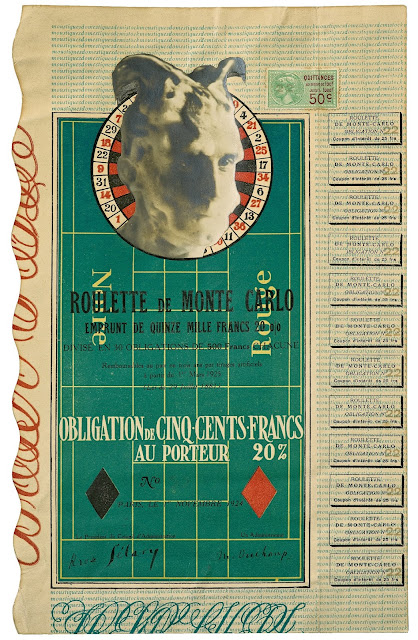
Sotheby's 4 February 2020 London sale featured this Roulette de Monte Carlo 500 Francs bond, number 22, dated 1924. The bond was issued and designed by Marcel Duchamp. It features a picture of himself made by American artist and close friend Man Ray.  Duchamp's head is covered with shaving lather. His hair is peaked into two devilish horns.
Photograph courtesy of Private collection c/o Sotheby’s


Marcel Duchamp (1887-1968) is one of the most revolutionary and influential artists of the 20th century. He was born in Blainville-Crevon, a farming village in Normandy, France. His brother Gaston aka Jacques Villon became a famous painter. His sister Suzanne was also a painter, and his brother Raymond a sculptor.

Duchamp pioneered in the field of plastic arts, conceptual art and kinetic art. He introduced readymades, ordinary manufactured objects that he modified to combine creativity with criticism. 

Fountain, one of his most discussed and controversial works, was a readymade of a porcelain urinal presented with an altered orientation. His Belle Haleine - Eau De Voilette, a readymade of a perfume bottle, created in 1921 with the help of Man Ray, sold at Christie's New York in Feb 2009 for  $11,406,900.


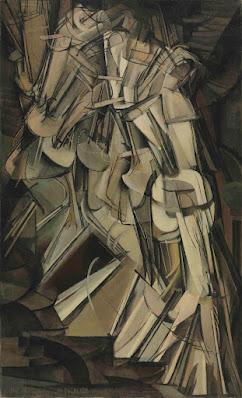
Marcel Duchamp finished his Nude Descending a Staircase, No. 2 in 1912. 
The painting is located at the Philadelphia Museum of Art.


Since childhood Duchamp's family introduced him to the game of chess. He became a good player and even wrote about chess. His fascination with the game distressed his first wife so much that at some point she glued his pieces to the chessboard. 

Possibly the logic and mathematical concepts behind the chess game sparked his interest for the roulette game. Duchamp worked out a system which he could apply to the roulette tables of Monte Carlo. To finance increased wagers, Duchamp created bonds of 500 francs, repayable over a three-year period at 20% interest rate. 

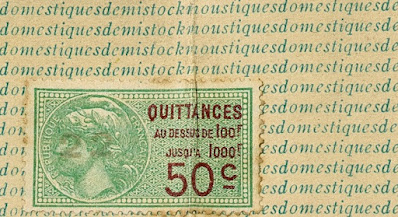
The artist planned to produce thirty of these bonds. Only eight, possibly less, bearing a legal stamp, were "issued" to some of his close friends as personal loans or as an early form of crowdlending certificates. 


Upon further investigation you'll find out that there is something special going on with these certificates. 

First of all, repeated in green ink in a continuous pattern in the underprint, you'll find a pun “moustiques domestiques demi-stock” (domestic mosquitoes half-stock).

Then, there is the interest rate of 20%. During the mid twenties, long term bond interest rates in France were about 6 to 8%. The one mentioned on the certificate must have been shocking.


Let's have a look at the signatures on the Monte Carlo bond. In its lower corners you'll find two signatures of company administrators, which is usually a legal requirement. The signature on the right is M[arcel] Duchamp's. The one on the left reads as Rrose Sélavy. Here we are dealing with the same person. 

Rrose Sélavy was a Duchamp pseudonym. The name sounds like the French phrase Eros, c'est la vie. Sélavy emerged in 1921 in a series of photographs by Man Ray showing Duchamp dressed as a woman.


Here is one last oddity. Normally, on French securities we see a standard formalution like "Statuts déposés chez ..., notaire a", which means 'Articles of association filed with [name of person], notary at [name of location]'.  Instead, we see the mentioning of a French law : Loi du 29 Juillet 1881.

The French Law of 29 July 1881, also known as the Law on the Freedom of the Press of 29 July 1881, defines the freedoms and responsibilities of the media and publishers in France. One of the most important reforms installed by the law was a major reduction in the extensive range of activities deemed slanderous.


As is the case with his other works, also here Duchamp challenges us and questions society, traditional art values and even his own productions.

In her 2004 essay Marcel Duchamp (1887–1968) Nan Rosenthal, art historian and back then curator at The Metropolitan Museum of Art, wrote : 
By World War I, he had rejected the work of many of his fellow artists as “retinal” art, intended only to please the eye. Instead, Duchamp wanted, he said, “to put art back in the service of the mind.” 

The Duchamp bond realized £495,000 including 20% buyer's premium.

F.L.


Reference 

Friday, December 24, 2021

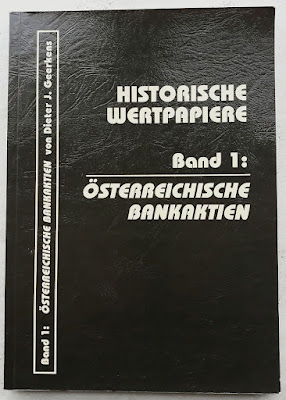
Reference book: Österreichische Bankaktien by Dieter J. Geerkens

Historische Wertpapiere Band 1: Österreichische Bankaktien is a reference catalog on antique bonds and shares from banking companies formed within the territory of Austria, including those banks set up during the Austro-Hungarian Empire. The book, a large format publication, was put together by author Dieter J. Geerkens. 


  • Title: Österreichische Bankaktien
  • Author : Dieter J. Geerkens
  • ID : no ID, published 1998 by Dieter J. Geerkens
  • Languages : German
  • Number of pages : 255
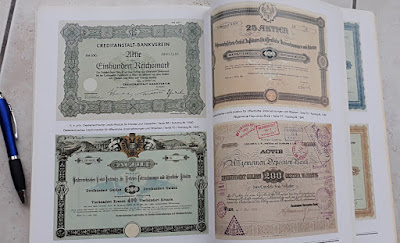
  • Images : more than 120 black and white and 150 page wide color images
  • Index : on company names; index located on page 51 


The  catalog entries are divided over two sections. 

A first small section, "Zwischenkatalog", describes the companies that lasted only a few months, and of which no securities are known (at least at the time when this book was published). This part includes about 40 companies that were founded just before or after the Vienna Stock Exchange Crash of 1873. Some examples are : Grazer Bankverein, Pfandlei-Anstalt Steyr, etc. 

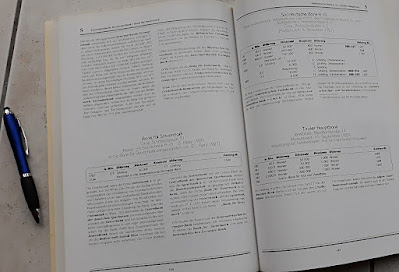
The second section, "Hauptkatalog", features about 140 banks with background information and a listing of their known securities. Each certificate has a catalog number referring to its entry in the price catalog chapter, and color photographs in the last part of the book. Some of the companies included are : British-Oesterreichische Bank- und Handels-Aktiengesellschaft, OrientBank (Palästinabank), Tiroler Hauptbank, etc.


Chapters
  • Vorwort und Erklärungen (Preface and explanations)
  • Kapitel 1 : Die Wiener Börse (Chapter 1 : The Vienna Stock Exchange) 
  • Kapitel 2: Die Banknoten (Chapter 2 : The banknotes)
    • Das Papiergeld
    • Verpfändung
    • Steueränderungen
    • Kriegsfinanzierung durch Steuern
    • Inflation
    • Bankozettel 1800
    • Wiener Stadt Banco Zettel Papiergeld anno 1800
    • Zollerhöhungen
    • Vorratsversteuerung
    • Der Friede von Austerlitz
    • Einlösungsscheine
    • Einlösungsdeputation
    • Keine neuen Steuern - Pferde vom Kaiserhaus
    • Staatsschulden-Tilgungsfonds
  • Kapitel 3: Die ersten Aktienbanken (Chapter 3: The first joint-stock banks)
    • Die Hofhaltung war kostspielig
    • Die privilegierte Oesterreichische Nationalbank
    • Die ersten Aktienbanken | Erneuerung des Notenbankprivilegiums 1841
  • Kapitel 4: Die Oesterreichisch-Ungarische Bank
    • Viertelaktie der Oesterreichischen Nationalbank
    • Aktie der Oesterreichischen Nationalbank
    • Interimsschein der Oesterreichischen Nationalbank
  • Kapitel 5: Die Bankgeschichte 1855 bis 1938 (Chapter 5: Banking history 1855 to 1938)
    • Der Wiener Börsenkrach 1873
    • 1873 bis 1914
    • Die Friedenszeiten von 1866 bis 1914
    • Erinnerungen an 1873
  • Kapitel 6: Historische Wertpapiere: Aktienbanken (Chapter 6: Historical securities: joint-stock banks)
    • Inhaltsverzeichnis der Aktienbanken
    • Zwischenkatalog
    • Hauptkatalog
  • Kapitel 7: Preiskatalog
  • Literaturverzeichnis (Literature list)
  • Anhang: Farbteil (Appendix: Color section)


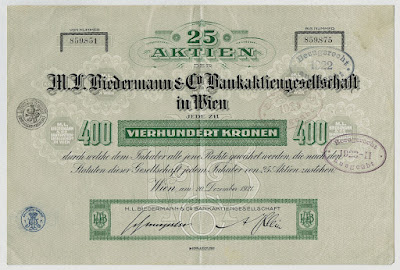
The M. L. Biedermann & Co. Bankaktiengesellschaft was originally founded in 1792 by Michael Lazar Biedermann, imperial Austrian court jeweler and co-founder of the Jewish community in Vienna. This  certificate for 25 shares of 400 Krone was issued in Vienna, 1921 and printed by H. Engel & Sohn. Other types of this share are illustrated in the catalog as number 1153, 1154 and 1157. 


The book was published almost 25 years ago, so the price indications (mentioned in Austrian Shilling) are not relevant anymore. Yet, this is a top work for anyone interested in the history of Austrian banking described and well illustrated in the first 50 pages of this volume. The color photographs are really well made! 


F.L.


Previous posts